Mystic Seaport Museum

IMG_5258

Last weekend my absolutely amazing girlfriend and I went to the Mystic Seaport Museum, which was awesome. It was her idea; her family used to go to Mystic on vacation when she was a kid and so had some nostalgia for the area, and she also knows I like boats. I have been to Mystic a few times, but never actually made it into the museum, despite the aforementioned deep love of boats. So on a particularly hot Saturday in July we packed up the DeLorean and head up to Mystic to check it out.

It was a great day to go to the seaport. We got there right when it opened at 10, and initially had some confusion about the ticket counter (well, I had some confusion), though after a security guard cleared it up for us we were right in. They were handing out a free book that day with admission, Through Hand and Eye by a guy named Ted Hood, who I had never heard of but is a sailor dude and apparently important (or self-important) enough to get an autobiography published of himself that normally costs $50. And more importantly, they were renting out sailboats FOR FREE!!!!
IMG_Whatever

I was very excited for this because I very rarely get to sail and I do love it so. I guess on a normal day you can pay money to rent one of their sailboats, but given that large chunks of the museum were closed due to coronavirus, they were letting people just take boats out as a bit of compensation I guess. Since it was free, and first come first serve, I was anxious about getting there in time to be able to take a boat out. So I speed walked us right over there and arrived before the boathouse even opened up. I loitered nervously and made sure to get even closer when another couple arrived, though I shouldn’t have worried because they wanted a rowboat.

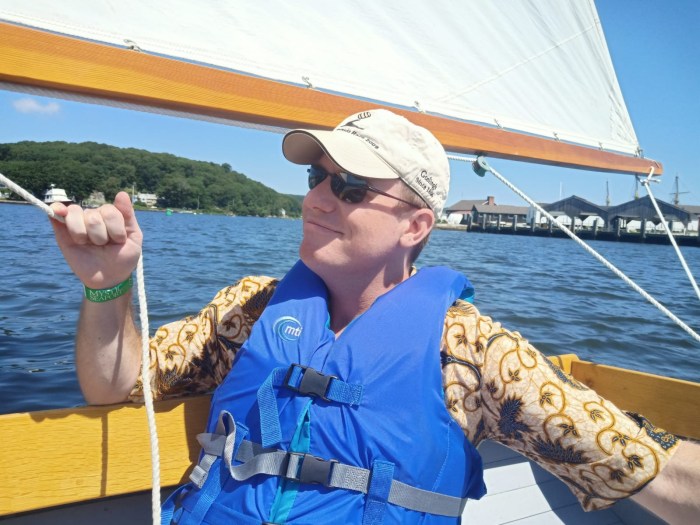
I was excited to take my girlfriend sailing because she had “maybe once, though I can’t remember for sure” gone sailing before. And I mean I talk endlessly about it. I even wrote an essay for a magazine about sailing mostly to impress her. So I was excited to take her sailing and show her both the literal ropes and the metaphorical ropes, and teach her all sorts of great vocabulary like “port” and “sheet.” To be able to take the sailboat out, you had to pass a rigorous knowledge test, which consisted of the person asking “do you have small boat sailing experience?” to which I cunningly answered “yes,” though I had specifically worn my 2009 Marion-Bermuda race hat to show off my sailing credentials.

So with a shove from the dockhand we were off! We were sailing in the river there and it was a lot of fun. The breeze was light but constant and there was plenty of room and not much traffic and we got to go around for like 40 minutes before I started to feel guilty and pulled us in with a slightly too aggressive docking maneuver (we made it anyways). I had her take the tiller for a bit and she did amazing, absolutely fantastic, because she is both absolutely amazing and absolutely fantastic. It was a great time.

IMG_5287

The YP (Yard Patrol) craft!

Then we were off to see the rest of the museum. One of the more exciting bits was discovering that the Joseph Conrad (pictured up top) was owned by Alan Villiers. I own a number of his books so it was really cool to walk around his boat. That era of ships is also pretty astounding to me, because of how it spans different eras. The Joseph Conrad is a square-rigged sailing ship, but has an iron hull, you know? Villiers was of an era where you could both work on sail-powered cargo ships and then later also see the moon landing.

As we walked over into the shipyard area, I was also absolutely delighted to discover they had a YP! I almost didn’t recognize it at first because I walked up to it at a weird angle, and it was painted a super weird blue instead of it’s usual inspiring grey. I guess this one is owned by the Merchant Marine Academy, and was at the seaport because they’re experienced with working on wooden hulls. But my long and lasting experience with YPs (which I think I’ll detail next week) meant she couldn’t hide from me for long.

IMG_5270

Walking around the rest of the museum was also very nice. It’s not a single building, but actually a small village-looking thing. Although like I mentioned, much of it was closed, there was still plenty to look at. There was a scale model of the river from 1870 or so, and an old US Life-Saving Service hut, and various buildings full of boats. In the above picture, I convinced my super amazing girlfriend to stand next to a triple-expansion steam engine, because I find steam engines very sexy. I am comfortable posting the above picture because she has a mask and that will provide her some deniability of my obsession with steam engines. Actually going through my camera roll I managed to take pictures of a whole host of engines that day:
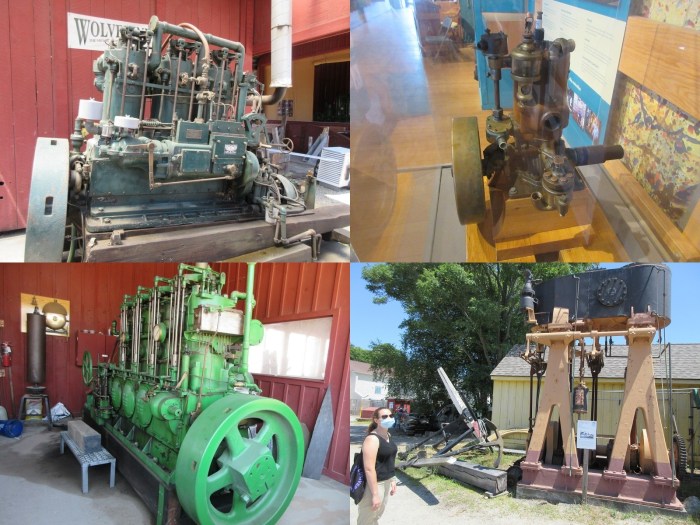
IMG_5277

So yeah. It was a great day at the Seaport Museum. We saw all sorts of ships and saw all sorts of nautical stuff and even got to go sailing!!! We managed to have lunch at a seafood shack not too far away, and after we were hot and tired from walking around and getting excited about nautical stuff we went to downtown Mystic and had some ice cream. After all that, the only other picture I wanted to post for you guys was the one below of the two little sailboats (one of these we had taken out earlier) because I thought they looked like they were racing. Maybe they were just going about the same direction at about the same time, but it my heart you can’t have two sailboats doing that and not believe they are racing:

IMG_5299

Battle of Lake Tanganyika

Lake Tanganyika.1

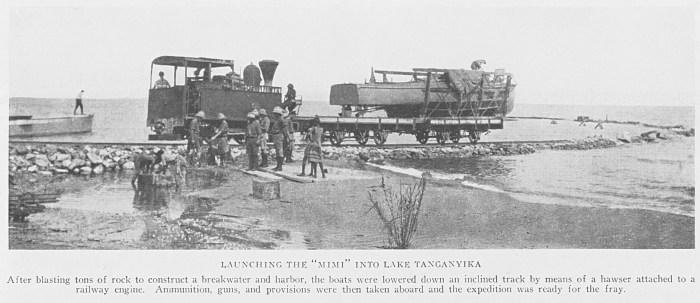
I’ve mentioned it before (briefly), but the Battle for Lake Tanganyika is probably one of the wildest naval expeditions to have ever happened.  During WWI, the Germans had set themselves up for naval dominance of Lake Tang, causing the British to launch an overland expedition to bring two tiny gun boats to the lake to try to even out the naval odds. It’s one of those tiny little episodes of history that are both nearly forgotten but also have a legend all their own (The African Queen is loosely based on it!). This post isn’t really about the battle, because I could hardly do it justice, there is so much crazy stuff that happened. For a long time I thought there wasn’t much to read about it, but I guess I finally googled it or something and came across Mimi and Toutou’s Big Adventure: The Bizarre Battle of Lake Tanganyika by Giles Foden. Despite the name, it’s a book for like, adults, and is a colorful if straight history of the whole expedition (for a fictionalized account, A Matter of Time by Alex Capus is good if not entirely accurate).
Digging into the book, I was excited to discover that he had cited an article published in the October 1922 issue of National Geographic, which contained a whole series of photographs by the expedition’s historian, Frank Magee. With the power of the internet, I was able to buy the nearly century-old issue (which contained the “Special Map Supplement” of Africa), and it arrived on my doorstep mere days later.

Lake Tanganyika.2

The point of this blog post was really to show you some of the pictures from the issue. There are like 30 of them. Unfortunately, the nature of my scanner is that I couldn’t really get good scans of the majority of pictures, though fortunately some were placed nearer to the margins and that is what you get to see here. These top two are nice because they actually show some of the ships involved in the battle, with the Mimi, one of the two gunboats, featured in the one up top. There are other, even wilder pics, including one of the gunboats being hauled up a hill by a whole team of oxen. If I can figure out a better way to get the pics scanned in, maybe I can give ’em a post.

Lake Tanganyika.3

The bottom pic is at Lake Bangweulu.

The one point I wanted to make though is that in telling the story of the battle, the people that get lost in the tellings is the thousands and thousands of native Africans that were affected by it. I’ve written about the effect of WWI on the people of Africa before, and the short story is that it doesn’t go well. Fortunately, the Lake Tanganyika expedition doesn’t appear to have resulted in thousands of tenga-tenga dying or anything like that, but certainly the expedition couldn’t have happened without their support, as the pictures above illustrate. Giles Foden’s book actually touches on the lives of the people affected by the battle, and he goes to some lengths to find oral history about the battle from the people still living at the lake.

But when Foden tells his story, he has to rely on the primary sources, such as Magee’s article, and in those sources the story of these people is lacking. I’m not actually that familiar with 1920s era literature on Africa, so I can’t judge Magee against the standards of the time. I would judge him in a lot of ways sympathetic to the people, like when he tells the story of how at one point the expedition relied on “native women from local villages” carrying water in gourds and jars from eight miles away in order to fill the water tanks of the steam-powered tractors they were using the haul the boats. He notes that since water carrying is “domestic work,” the men refused to help, and expresses some disgust.

But way more often than he ponders the gender balance of work, he is concerned about all the cannibals he believes himself to be surrounded by. Graves of German sailors killed in the battle are guarded against natives “addicted” to cannibalism. On noting one particularly decked out chief, he notes “the origin of the spats and pink sunshade puzzled me somewhat until I remembered we were in the land of reputed cannibals.” But most of all the native population just aren’t characters in the story; the only Africa native that is mentioned by name in the whole article is a pet chimpanzee the expedition dubbed Josephine.

Then again who am I to judge? If you go back and read my blog articles from my time in the Peace Corps you won’t find a whole lot of names. A chunk of that is privacy, but a lot of that is just that, like the people on the Lake Tanganyika expedition, the people I met were more or less the background to my own adventures. In the link above (here it is again) where I mention the Battle of Lake Tanganyika, I was myself travelling to the lake to find a ship (the remains of one anyways). The people in that story don’t have names (even the ones that helped me along the way), and in that telling I treated them more has a hindrance to one white guy trying to find the material legacy of other white guys on their turf. I still have some lessons to learn.

Lake Tanganyika.4

This photo is from the Nile river, not Lake Tanganyika, but I like dhows.

CelNav

IMGP0802

This story doesn’t really have a point, but I was asked in a conversation recently if I had ever learned to navigate by the stars, and I didn’t really get to answer, and there is a pandemic going on. The short answer is yes.

Back at the Naval Academy, I was on the sailing team and over the summer we would compete in various races with the team. That year I competed in the Marion-Bermuda Race, which runs in the years that the more famous Newport-Bermuda race doesn’t. The exciting part of this race, unlike its more famous cousin, is that it is a celestial navigation race. You got more points (or more accurately weren’t penalized) if you navigated the entire race using celestial navigation instead of GPS.

So that was pretty exciting! We got to learn how to use a sextant and stuff! I think I was officially the assistant navigator on this little journey, but firmly the celnav guy, and dove right into it. I was already firmly a Bowditch fan, so this was a lot of fun. I learned all about how celestial navigation worked, got pretty familiar with a variety of stars, and would plot sun lines by hand even though we wound up using a computer program to try to plot star shots. Before the Bermuda race we also did the Annapolis-Newport race, and although that was a GPS race we took the opportunity to practice our celnav skills and it was all pretty great! (that photo up top is of me doing navigation stuff on the sailboat)

Then came the actual race itself, which was overcast the whole time. It is pretty hard to do celestial navigation when the sky is covered in clouds. We got exactly one star shot during the trip, and we frankly weren’t sure whether to trust that more or our dead-reckoning position more. The most significant lesson I learned on that trip is you can dead-reckon your way across an ocean. The rule was that you could turn on your GPS within like, 30 miles of Bermuda, so when we thought we were within 30 miles we turned it on, discovered we were really like 50 or something out, turned it back off again, and repeated that process until we were in fact like 30 miles out. We got second in the race! Pretty good!

Anyways, flash forward about five years when I was a submarine officer and held the title of Assistant Operations Officer which, due to reasons, put me in nominal charge of navigation department. My most significant task in that role was approving the maintenance schedule, which is how I discovered that we had an annual maintenance item to check the ship’s sextant. This is how I discovered that we had a ship’s sextant. That was cool! A sextant onboard! Sextants are cool! I have no idea why we had one. I mean, presumably in was in case of emergencies, but I really cannot conceive of the scenario where a submarine would use a sextant. Like first the GPS system would have to go down, and then with all the backup and inertial navigation systems on board, and then the fact we would have to surface to use the sextant, there just isn’t any way we’d use it. I also had trouble figuring out how you would actually go about using it, even if you were on the surface. Not that anyone on board would know how. Except, you know, for me.

Since I knew how to use a sextant, navigation division decided to have a training on celestial navigation, which I would lead. I was looking forward to this, the division was looking forward to this, it was great! Until I was in the wardroom happily putting together my training PowerPoint. I didn’t usually hang out in the wardroom, almost entirely due to reasons like what happened. The squadron ops officer, who used to be our navigator, was on board for an exercise or something. He saw me putting together the Power Point, and asked what I was doing. I explained what I was doing, and then he asked why the hell I was doing that.

There’s actually a lot of use in learning celestial navigation, even if there is no conceivable reason a submarine would ever use a sextant. There’s a lot of really basic navigation concepts that you get to flex in interesting ways. And lemme tell ya I think submarine crews (maybe not navigation division itself but officers for sure) lack knowledge in basic navigation concepts. You have all these systems and computers that put a lot of it out of sight and out of mind, and so people just come to expect a magical box to give them their position and don’t think much about it, but things can go wrong and it is important to both understand what the magical box was doing and the thought behind it so you could actually rely on the magic box. Somethings the magic didn’t work right and when you run a $2 billion submarine aground people don’t really accept the excuse that “well I didn’t really question the magic box.” So there was a lot of use to it! Plus people were excited for it! No one is ever excited about training!

But the SQOPS apparently didn’t approve of celestial navigation training despite my reasoning. But that didn’t matter, he’s not in my chain of command. But then I guess he told the XO, who yelled at the current navigator, who was my boss, and who yelled at me. This was mildly annoying because the navigator APPROVED the training plan! That said I was going to be training on celestial navigation! And now he was yelling at me for trying to carry out the training plan he approved! It’s things like this that made me quit the Navy. But thankfully nav bought my “it’s really training on basic navigation concepts disguised as celestial navigation training” and so I got to do the training and play with a sextant and everyone loved it and it was a great Power Point to boot.

Corpus Christi

IMG_3271

South American Porcupine wants a smooch.

Reading this week:

  • War on Peace by Ronan Farrow

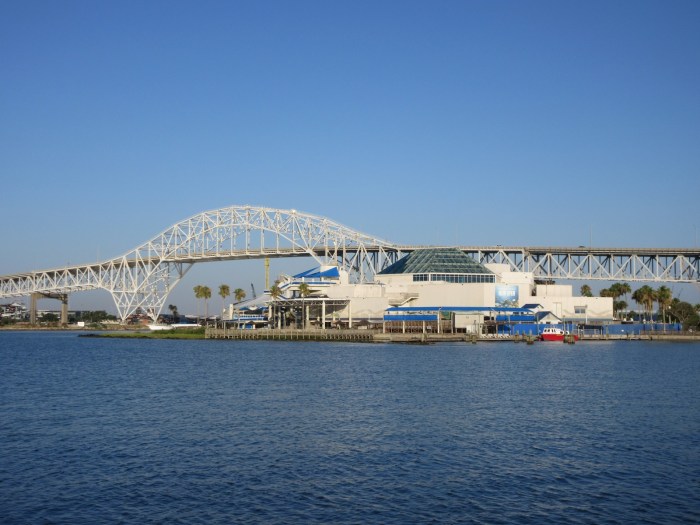
This past weekend my mom and I went to go visit my sister in Texas. My sister works at the Texas State Aquarium in Corpus Christi and performs in “Wild Flight,” which is the aquarium’s bird and animal show. Mom found some deal on Southwest to fly us down there so we bundled up and away we went.

IMG_3241

The aquarium.

The whole state of Texas quite frankly makes me uncomfortable. Back at the Academy there was a “movement order” you could participate in to go see a bowl game the Navy football team was in over in Houston. I went and got kicked out of a bar for being too drunk (I was, in fact, too drunk) and then left Texas the next day and I haven’t been back since. Also it seems to be a very flat place from what I saw of it. And full of Texans. But my sister has made for herself a rather comfortable living there and so yeah. We went.

IMG_3252

My sister rockin’ the show.

The first day we were there we accompanied my sister to work at the aquarium. We sort of had to because she only has her one car, but also of course she wanted to show off her work there and got us in for free. It is a pretty nice aquarium though if you know someone who works there I highly recommend it. She got us in to several animal encounters throughout the day and we got to meet a whole variety of animals, like the porcupine up top.

Pretty Kitty

Me and a cat you had to be very gentle around.

Besides the cat and the porcupine, we also got to meet a giant octopus (though they were a little shy) and a tiny baby alligator and a whole variety of birds. So pretty awesome! We spent the whole day at the aquarium (because, you know, my sister works full time) and then head home.

IMG_3244

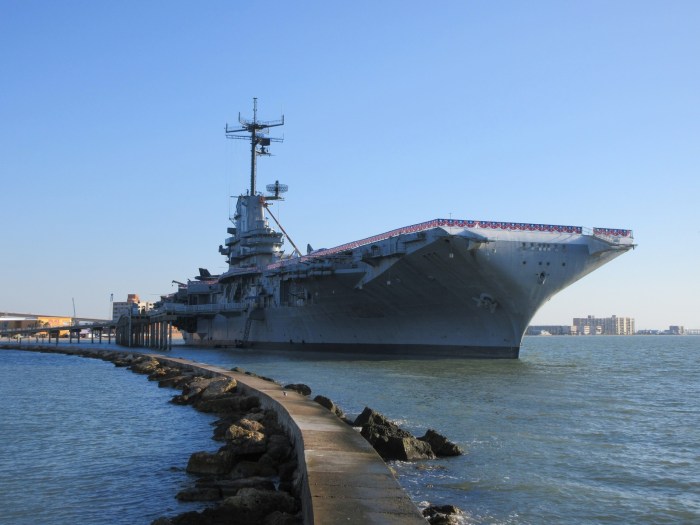
The next day we spent the whole day at the USS Lexington. The Lexington is right next door to the aquarium, and I didn’t think we’d wind up spending like a whole day there, but we did. It is, after all, a pretty big ship. It’s an aircraft carrier though, which like, lame, but hey these things have engineering spaces so they’re not a total wash. This ship is of course the second Lexington, the Lady Lex having been sunk and CV-16 here named in her honor. Her nickname was the “Blue Ghost” because she used to be blue and was reported has having been sunk a lot. But she never sunk!

On the ship they have a wide variety of planes from throughout her service career, and like, two different Blue Angels at least. That, uh, that’s really all the intelligent things I have to say about planes. This ship has an escalator to get the pilots to the flight deck, but if you didn’t want to climb 12 decks worth of ladders frankly you should have gone submarines. That’s why I went subs after all.

Besides the flight deck, the ship has extensive self-guided tours throughout most of the other operational portions of the ship. You can even go down into one of the enginerooms. They didn’t let you go into any of the boilerrooms, though I got to run around tracing the main steam piping from the bulkheads to the engines. This being an aircraft carrier they had both high pressure and low pressure turbines connected to the shaft via reduction gears, and I was rather stunned at how small the high-pressure turbines were, though I guess yeah of course. I don’t think they could have been much bigger than our turbines on the submarine. But they had a low-pressure turbine to go with it and those guys are in fact pretty big. So there ya go.

After that our third day in Texas was a trip to go look at the South Padre Island seashore (it was quite windy) and then to go antiquing. Before antiquing mom lectured me that the point of antiquing was to look at stuff and not to buy stuff (I wondered how mom thought she had never given me a similar lecture in my 30 years of life) but it was only her that wound up buying stuff. The next day my sister dropped us off at the airport on her way to work and back to Maryland we went!

IMG_3245

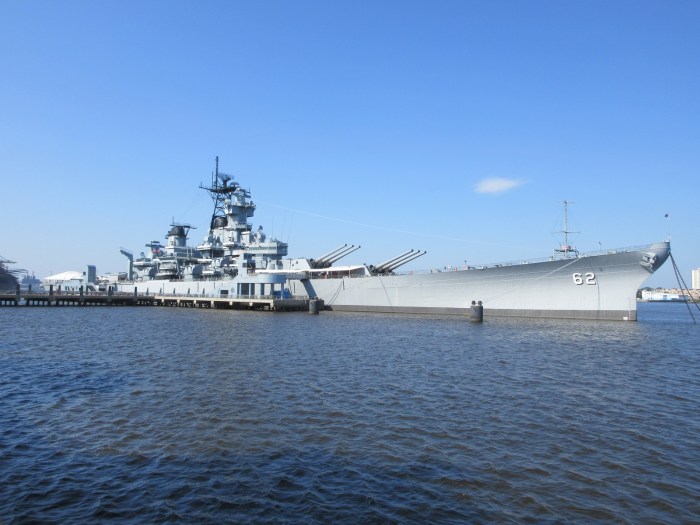
USS New Jersey

IMG_3209

“Firepower for Freedom,” the Big J herself.

After waxing poetic about the Iowa-class, I got to go on the USS New Jersey this past weekend. “This past weekend,” by the way, was in July because I am way ahead on these blog posts that no one reads. The New Jersey is parked across the river from Philadelphia in Camden, New Jersey, and I was in Philadelphia to see the Carly Rae Jepsen concert which was fantastic:

20190720_222439

She is very blurry and my phone camera sucks but look it is her!!!

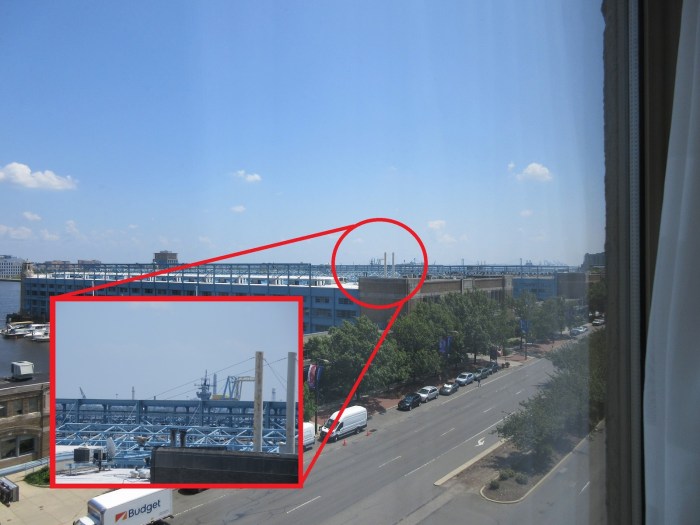
The weekend started off right because as soon as I got to the hotel room I checked to see if I had a view of the New Jersey and you can bet your sweet ass I did:

IMG_3207

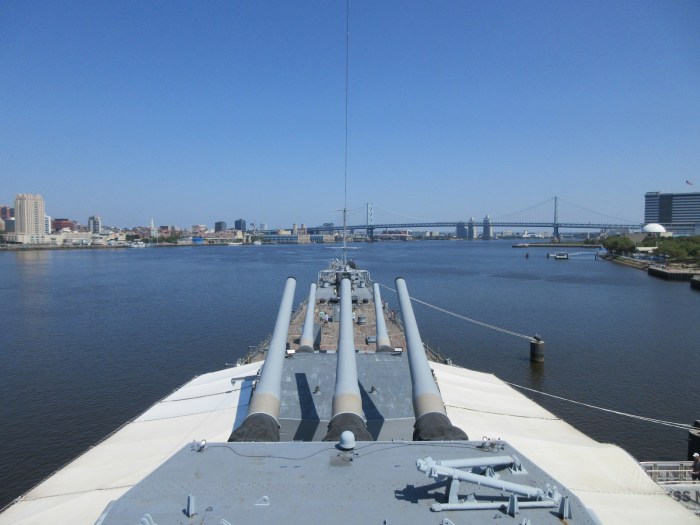
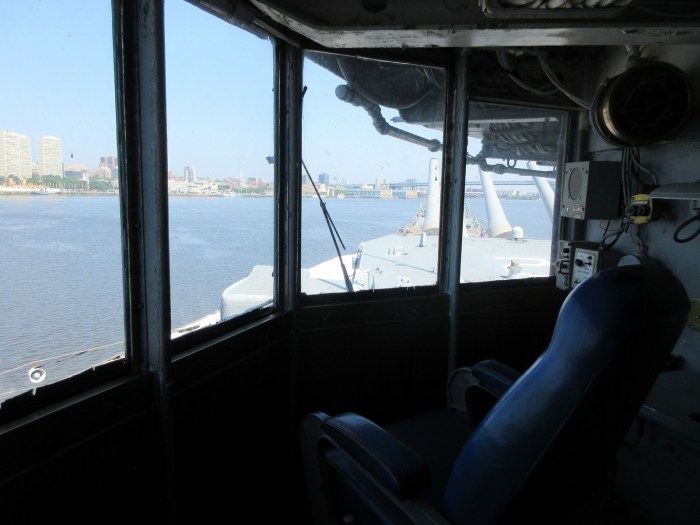
But anyways the ship herself. I went to go see her the day after the concert and it was hot as balls. It was hot as balls the day of the concert as well, but that’s irrelevant. I got to the ship right as she opened at 0930 and there were only a few other guys there besides myself, all Navy enthusiasts. I took the self-guided tour. The New Jersey is the third of the Iowa-class battleships I have been on, besides the Iowa and the Wisconsin. I have physically laid eyes on the Missouri several times before but never quite got around to touring her to complete the set. All that to say that I didn’t see anything radically new and different on this tour, but it’s always super awesome to see this view:

IMG_3235

That bridge is doomed.

Of the ships I have seen I thought the New Jersey’s crew had done a particularly good job of keeping her up and making her a really nice place to tour. I was most amused by some of the details they added to make it really realistic:

IMG_3222

The Naval Academy has a “sample Midshipman room” that tourists can see. It has the layout of one of the (nicer, two-man vice three-man) rooms and has some random crap in there to show the sort of things Mids have. But if you were a Midshipman you know it’s stocked with books no one ever reads and crap no one ever has, but the New Jersey took a different direction. I knew I was among people that cared about realism when there was a snuff tin in someone’s locker and a donut and coffee on the XO’s desk. Realism!

IMG_3228

One thing that also amuses me on a sort of fundamental level is when these ships still have danger tags hanging. The above picture has one and there were several others that are dated 1990, from the ship’s last decommissioning. I love it. I always wonder if the WAFs are still around? Is the tagout log? What if they ever need to operate that equipment? Who is authorized to clear that tag? Does anyone care? Can you still cause an incident report? The world will never know.

IMG_3231

The above picture is of two five-inch cannons. On the New Jersey (and other Iowa-class ships of course), these 5″ guns are the little secondary ones on the side that they use when it is too bothersome to crank over the 16″ cannons. But on a ship like an Arleigh Burke-class destroyer the main armament is a single little ole’ 5″ gun right on the front. The DDGs also have missiles (though the Iowas had some bolted on when they were re-commissioned) and those are neat I guess, and they probably have better targeting systems, but the Arleigh Burke’s pride and joy is just an afterthought on the New Jersey and besides the donuts and snuff and danger tags that also amuses me deeply.

IMG_3230

Those were the highlights of the tour. I got to see inside one of the turrets, and some of the engineering spaces too though not as much as I would have liked (I could only poke my head into the boiler and turbine rooms). I spent about 2.5 hours on the ship before heading out and making it to the bus station to head back home. A real must-see if you’re ever in the area.

Lord Jim

Lord Jim

Reading this week:

  • The Education of an Idealist by Samantha Power
  • Why Europe Intervenes in Africa by Catherine Gegout

So this post is about both Lord Jim and Star Wars: The Last Jedi. I read Lord Jim in the Peace Corps and only came across it because it was free for Kindle on Amazon. I found the novel to be very powerful and it resonated with me on a personal level. It follows Jim, in Joseph Conrad’s “dude telling a story is the story” style, who we meet as he is first mate on the Patna, a steamship carrying Muslims on the Hajj. After the ship strikes an underwater object and appears ready to sink, Jim abandons ship with the other crewmembers, leaving the passengers to their fate. Once they reach port, the other crewmembers run away, but Jim faces a trial for his and their actions. After this he spends a great deal of time running away from anyone who might even have heard of him, before finding some level of glory on a remote island.

What made this book stick with me was the nature of Jim’s failure. Most of the failure I think you’ll find written about or shown in movies is just not reaching a goal. The hero tries really really hard but just can’t make it. They run as fast as they can but don’t make the touchdown, or fight as hard as they can but just don’t beat the bad guy. This is a relatable and blameless sort of failure. Maybe you studied really hard and tried to write the best admission essay possible but you just didn’t get into that dream school. So you failed, but as long as you put in the best effort possible that failure isn’t really your fault.

But Jim’s failure in Lord Jim is of a whole different sort. Jim is a relatively experienced seaman serving as an officer onboard a ship carrying passengers who’s life he is responsible for. When the ship appears ready to sink, he wants to load the passengers onto lifeboats and do what he can to save them. If he can’t save them, he knows it is his duty to die trying. But meanwhile the rest of the crew is abandoning ship, and doing it as quietly as possible so the passengers don’t panic, rush the lifeboats, and keep the crew from saving themselves. Jim teeters on the edge of this decision, standing dumbstruck as he watches the rest of the crew put the lifeboat to sea. Finally, at the last possible second, Jim jumps into the lifeboat and saves himself, leaving the passengers (so he thinks) to die.

This is a radically different version of failure. Jim knew what the right answer was, knew what his duty was, and instead chose the wrong answer aware the whole time that it was the wrong answer. It’s not that Jim just didn’t try hard enough, it’s not that Jim made a sincere effort and just made a mistake, it’s not that Jim made what he thought was the right decision that later turned out to be wrong, it’s that Jim leapt into that lifeboat knowing the whole time he was abandoning his duty. And while Jim faces his failure with honor in the courtroom, he afterward runs from every port he lands in as soon as he hears his failures are catching up to him.

Which brings me to The Last Jedi. One of the big criticisms of the movie was the character arc of Luke Skywalker. People didn’t want to believe that the young man so full of hope that takes down the Empire in the first three movies could turn into a bitter old man by The Last Jedi. But man when I saw that movie I got it. This Esquire article tries to explain Luke’s exile as some sort of enlightened pacifism, but that’s not it. The only reason Luke could fall so far is because he used to be that young man full of hope and righteousness. In Luke’s flashbacks we learn that the moment of his fall was when he came into Ben Solo’s room with the intent to kill the future Kylo Ren because Luke feared what Ben could become. Luke suffered the same failure that Jim did. Luke’s failure wasn’t that he didn’t try hard enough when training Ben, or that he didn’t kill Ben when he had the chance, Luke’s story is that he chose the wrong answer despite knowing it was wrong. Luke knew that killing Ben was wrong and evil, but chose to do so anyways. He stopped himself before he committed the act, but it was too late and Ben had seen his mentor betray him. Luke knew he had failed and couldn’t look himself in the mirror let alone face anyone else.

I understood both these characters because I had been there. At the Naval Academy and throughout the Navy they teach you integrity is the most important thing. We do trainings on trainings on trainings. We talk about it all the time, discuss scenarios. I was so tired of integrity trainings that I joked that you can only become so integreful, and I should be exempt because I was at maximum integrity (you can’t tell the truth more than 100% of the time). But then one day I was standing as a duty officer and I lied. I thought I had a good reason (and I learned everyone always thinks they do), but I knew it was wrong. And when I got caught and had to face my failure I couldn’t. You have a whole image of yourself and what kind of person you are but when it is put to the test you find out what you’re really made of. When Luke failed he sent himself into exile on Ahch-To. Jim ran away from any port that had even heard of his actions. I spent two years in Zambia.

Jim is saved because he winds up in the remote village of Patusan. Alone and just forced to be the best man he can be, free of anyone who might have heard of his past failures, he finds success and courage. The next time he has to decide to run or to do the right thing, he chooses the correct path. Luke is saved because Rey shows up. When he tells her of his failures, she just doesn’t care. She knows the kind of man Luke is and can be, and that’s all she demands of him. So that’s what he winds up giving. If audiences don’t understand these characters, I think it is because they have never really had to face failure the way these characters have had to. Theirs isn’t a failure of effort but a failure between them and the very nature of their being. Finding yourself after a failure like that is a deeper arc then just running a bit faster or fighting a bit harder.

Battleship

Battleship Poster.jpg

The greatest movie ever made was the 2012 blockbuster Battleship. I love this movie un-ironically. It is amazing. It is fantastic. It exceeds everything else that has ever hit the silver screen, and quite possibly any other form of art or self-expression that has been hoisted into the human consciousness. I will be having a totally normal day, and I am not joking here, but suddenly this absolute cinematic masterpiece will pop into my head and I can’t think of anything else. This happened today and I spent a few hours clipping out some of my favorite scenes and creating the gifset below with the hopes that magnificent triumph of storytelling will reach a greater appreciation throughout the world.

Let’s start with the basics of this movie. I am not so blinded with love that I don’t notice the movie’s flaws. The movie spends the first ten or fifteen minutes attempting, for some reason, to set up a love story or something. If I was director I would have skipped this and gone straight to fighting aliens. It features Taylor Kitsh as an undisciplined bad boy, forced into the Navy by his older brother (played by Alexander Skarsgård!) after he steals a burrito. The love interest is Brooklyn Decker, who’s admiral father is played by Liam Neeson! The cast this movie puts together! An absolute powerhouse collection of movie stars assembled so that the real stars of the movie, the ships, don’t too far outshine these bit characters. Other significant players include Tadanobu Asano as the captain of a Japanese destroyer inserted to play the straight man, and Gregory D. Gadson as an Army double amputee inserted to provide a message of overcoming setbacks, or something, and also beat the shit out of some aliens. And I haven’t even mentioned that this movie includes freakin’ Rihanna, who is an absolute badass in the role of Petty Officer Cora Raikes.

After the movie sets up this love story/bad boy plot, aliens land. Frankly the Navy handled the first encounter kinda poorly but who gives a shit because now we’ve set up the thrust of the movie: aliens have landed and it is them versus the finest goddamned Navy the world has ever seen. Due to that first encounter our bad boy Taylor Kitsh is in charge of the small fighting force left to actually fight the aliens, with a ragtag crew at his side. The rest of the movie is them kicking some serious alien ass.

So let’s discuss Battleship as it compares to some other examples of the Navy movie genre. The most famous Navy movie of all time is Top GunTop Gun is okay. Launching planes to “Danger Zone” is a great thing to do, but because of that scene the movie peaks right at the start and it’s all downhill from there. Then the rest of the movie you get like what? One and a half dogfights? Psh lame. Plus as a general rule aircraft carriers are pretty uncool; they have Starbucks onboard. Movies like the recent Hunter Killer have a special place in my heart for being submarine movies, but even that action-packed thriller suffers for featuring a Virginia-class; fast attacks are supposed to be nuclear-powered sports cars and any boat with bilge keels is more like a minivan. But what does the movie Battleship offer you?

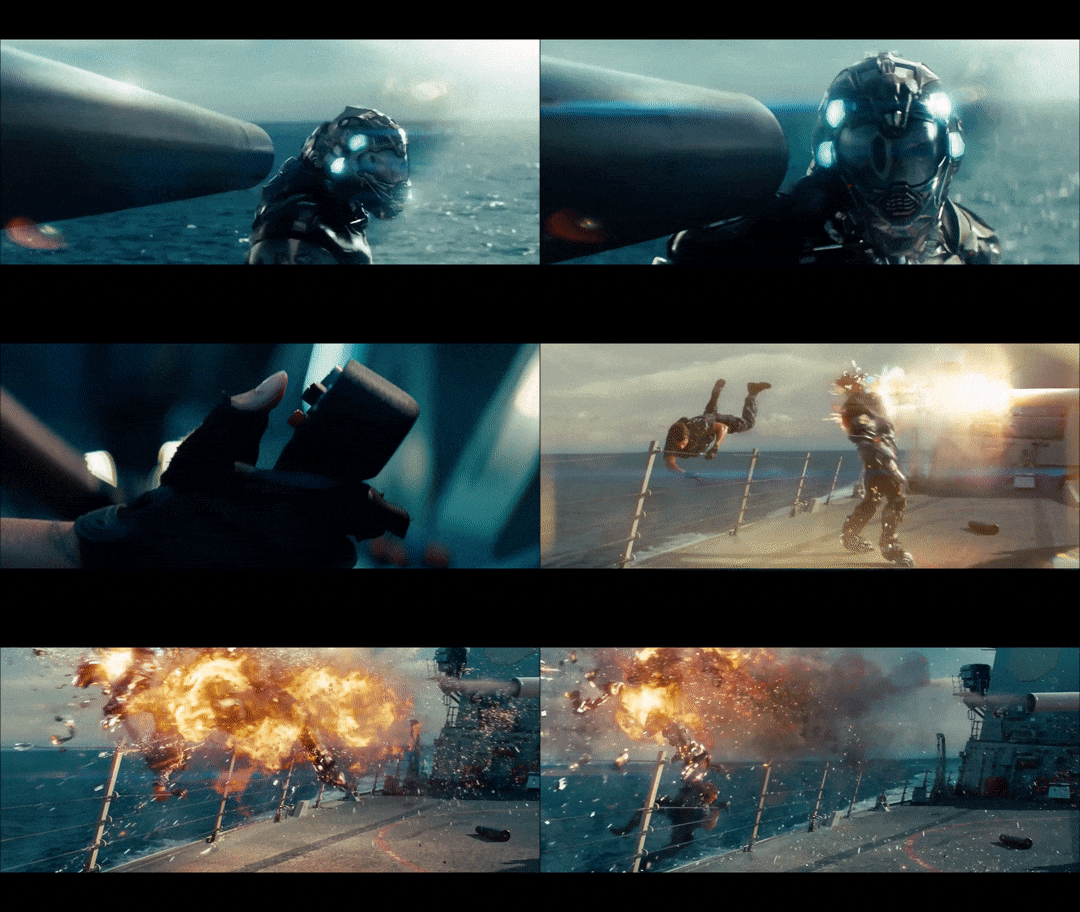
Mahalo Motherf

Battleship offers you RIHANNA SHOOTING AN ALIEN IN THE FACE WITH A FIVE INCH CANNON. Citizen Kane parades itself around as the greatest movie ever made, but at no point in Citizen Kane does an absolute fantastic piece of naval hardware get used to obliterate an alien at point blank range by one of the most versatile women of the modern era.

Fire Everything

The whole movie (except for the love story portions) is just badass nautical action after badass nautical action. It doesn’t hold back. In the above scene they think they’re down to a one-on-one battle, and they decide to throw literally everything their destroyer has at the alien ship. They launch every missile, they got all the dudes on machine guns, and our bad boy and his Japanese buddy are on the bow with 50 cal rifles for absolutely no good reason except for that it is fucking awesome.

Approach

But the real star of this movie, the real reason you came to see it, is the titular battleship, the USS Missouri, BB-63, the Mighty Mo’ herself. Here is another sincere, deeply held belief of mine: the Iowa-class battleships are the most beautiful thing mankind has ever created. The four sister ships are the largest and most powerful warships to ever float (that survived the war anyways) and represent the pinnacle of warship design in the final glorious age of that artform. Those babies got curves. Left without other options, our ragtag crew decide to try to bring her back to life and go head to head with the aliens once again.

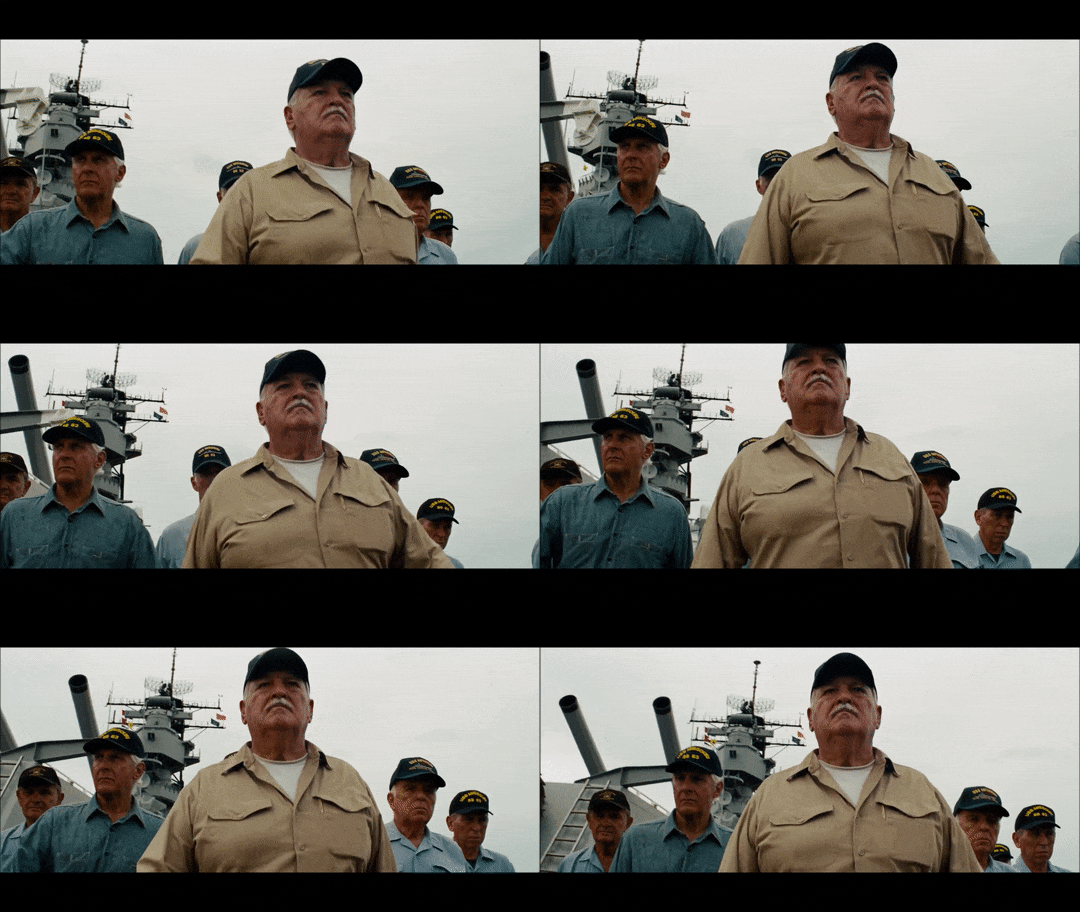
Old Guys

And thus kicks off the greatest 10 minutes of cinematic history to the tune of “Thunderstruck” by AC/DC, itself perhaps the finest accompaniment possible to the seagoing splendor of this film. The crew has a problem: they have no idea how to drive the Mighty Mo’. But no worries! Out of the woodwork come the original crew of the battleship. There is a whole scene where old, proud men with even older and prouder mustaches appear in mankind’s greatest moment of need to take the old but gallant girl out of retirement to face battle one more time.

Big Wave

I cannot stress enough that I am being 100% honest here, but the whole scene where they bring the ship back to life gives me tingles every time I watch it. It’s so magnificent. The enginerooms on steamships always get me hot and bothered anyways, but watching, even in CGI, an Iowa-class battleship get the fires in her heart lit once more very nearly brings tears to my eyes. And to watch the bow crash through the waves on her way to her sacred duty one last time would be a sight I would do anything to see for real if I could.

Alien Tackle

A brief interlude here to emphasize this movie has everything. I love the battleship most of all but there is a whole storyline that happens on land, and that storyline is badass. On the ship, they needed a five inch cannon to take out one of the aliens. Our double-amputee friend though, he just straight up tackles one of the dudes. He goes toe to toe with a huge armored alien and he doesn’t even have any toes. He’s an Army dude so that’s points against him but still man, respect.

Power Slide

But back to the battleship. I love the movie Casablanca. Play it Sam, play as “Time Goes By.” We’ll always have Paris. Here’s looking at you kid. Fantastic. But at no point in Casablanca do they powerslide a freakin’ Iowa-class warship and then fire a broadside at an alien spaceship. I mean holy shit. It’s Tokyo Drift but with 57000 long tons. Show me another movie that powerslides an Iowa-class battleship and I’ll show you another movie that has even half a chance at beating this one as the greatest of all time.

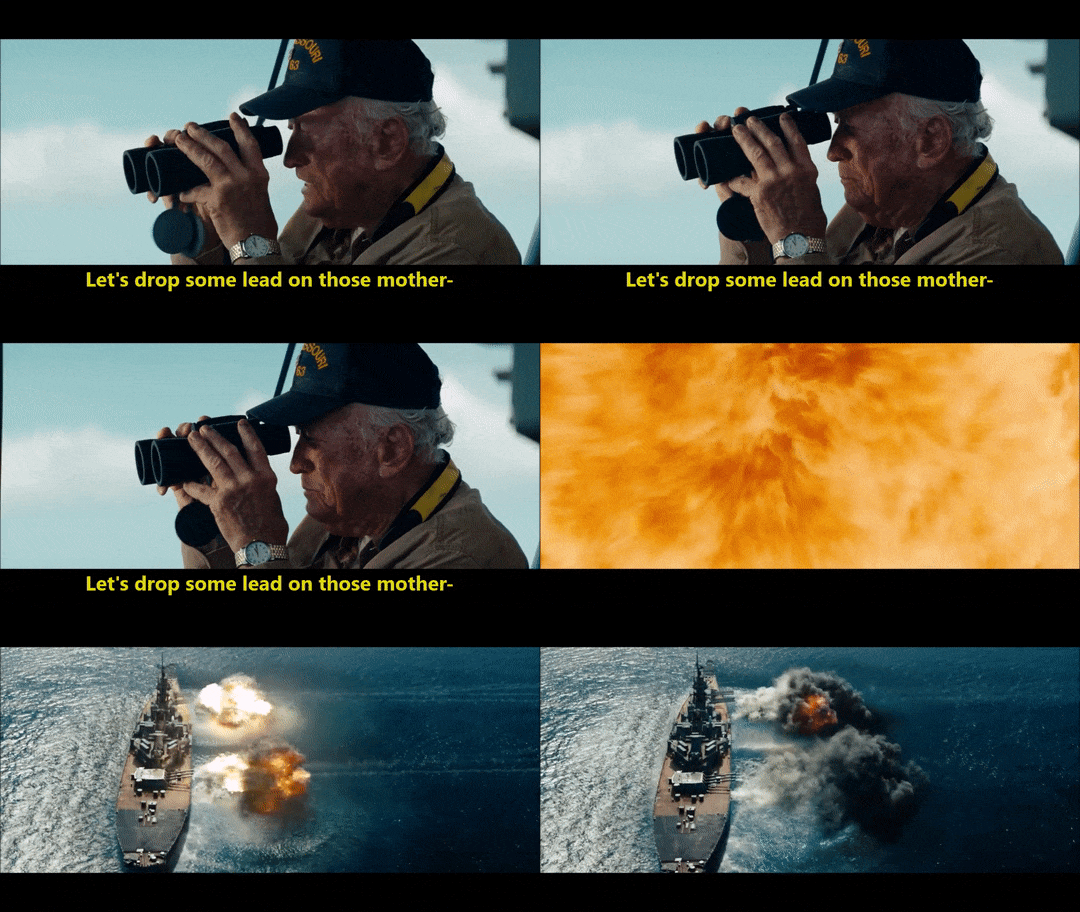
Drop Some Lead Small

And just look at that broadside in action. I’m only giving you seconds-long chunks of these scenes, and all silent. It goes on for ten minutes or more, just non-stop battleship action. I could run the thesaurus dry and not have the words to convey it to you. You have to watch it.

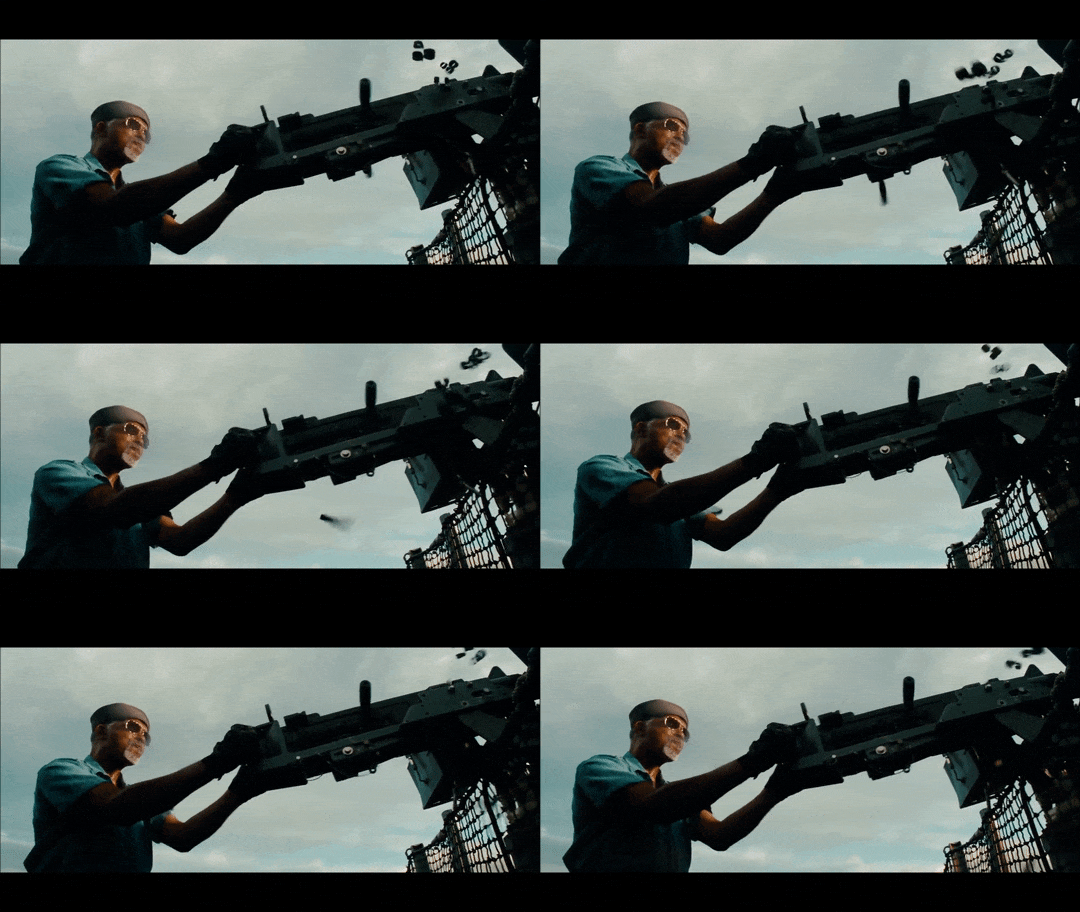
Old Dude Shooting

Even the old dudes get in on the action! In Marine Week, we were taught to hold a machine gun burst for the amount of time it takes you say “Die Motherfucker Die.” These old dudes 100% ignore that advice and fuckin’ get some when it comes to shooting aliens. The ship is already launching full broadsides of 16″ rounds at these aliens and they’re still firing 50 cal machine guns I think mostly for funsies. Amazing. Fantastic. World-class.

Stupid Jets

The only major mark against the movie though frankly is right at the end. After all this SWOtivating battle action, after our blackshoe friends do all the hard work and kill 90% of the aliens and knock down the force field that was keeping the rest of the Navy at bay, some freakin’ pilots swoop in and act like they actually contributed. Terrible. Pilots. Ugh.

So that’s the movie Battleship. It’s so fantastic. It’s everything you could possibly want in a movie. It’s got romance. It’s got intrigue. It’s got the Navy’s finest warships going head to head with an advanced alien race and kicking their fucking asses by virtue of being total badasses. I love this movie. Please spread my gospel.

Pirate Hunting

IMG_3161

The high seas.

Reading this week:

  • China’s Second Continent by Howard W. French

Back over the weekend before the 4th of July, we went pirate hunting. For the holiday my mom went off on a cruise with some of her sisters, and so my dad, my brother, and I went off to go look at pirate stuff enroute to my grandma’s house for the holiday. Specifically, we were looking at Blackbeard stuff. Eddy Teach there, during his illustrious two-year career had made the Outer Banks island of Ocracoke his favorite anchorage. So, three hundred years later, my brother decided that Ocracoke was the land of his swashbuckling dreams.

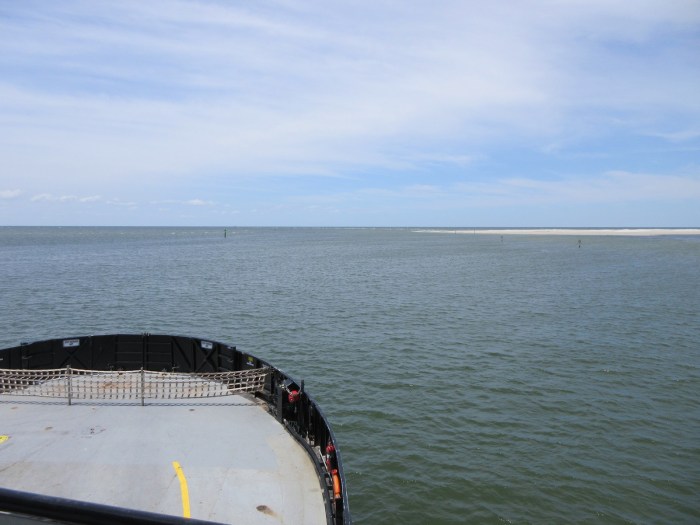
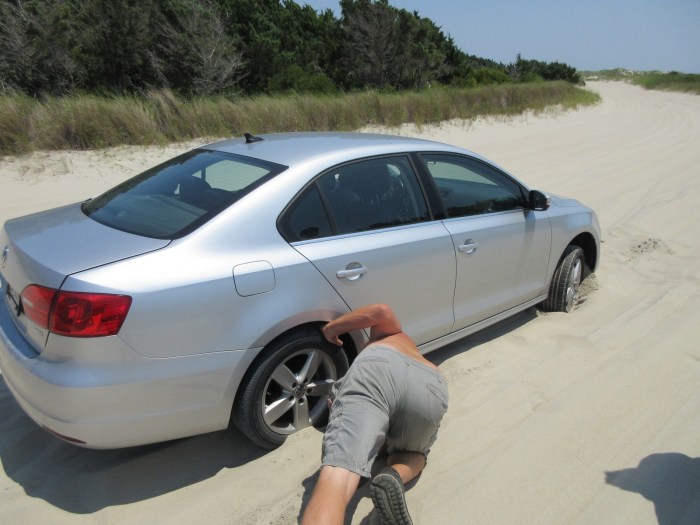
Ocracoke is a lovely little island much better known for its beaches and touristy vibe. People drive around in golf carts, lifted trucks, and jeeps. We had a two-wheel drive Jetta. To get there we took a ferry from Hatteras, and I am always a fan of any high-seas adventure. I wasn’t in charge of this trip, and was literally just along for the ride, so I hadn’t done any research into where crap actually was on this island. Neither, apparently, had anyone else on this trip. After a brief consultation of a decorative illustration based on a 300-year-old map and a comparison of said map to Google Maps, we set off down a dirt road that quickly turned to sand that quickly turned to us getting stuck.

IMG_3134

Luckily for us, the beach towing dude happened to be driving by and spotted us in our plight. I mean this is exactly where you’d get stuck if you were dumb enough to get stuck so I assume he just hangs out here all day. He was very nice though and gave us some directions. Personally, I had been pushing to visit the lighthouse first because Google Maps said it closed at 1700 and it was around 1500 by the time we got to the island and got some lunch. Our tow-line enabled friend told us in the midst of rescuing us that Teach’s Hole, which is where Blackbeard liked to anchor, was near the lighthouse and nowhere near our fateful sandtrap. So finally off to the lighthouse we went.

IMG_3135

The lighthouse is pretty nice! The worry about it closing at 1700 was silly because you can’t go into it (I guess you can go into the bottom sometimes), so all you can do is stand nearby and look at it. It proclaims itself at the second oldest still-operating lighthouse in America and well um. Sure. Besides the above picture I took another picture from somewhat closer and both depict a 75′ tall brick tower.

IMG_3140

But finally we set off down a trail in a little miniature state park and we came upon Teach’s Hole! There is of course nothing much to look at because by definition an anchorage is just a stretch of water and stretches of water look much like any other stretch of water. There were people swimming. We did not swim.

IMG_3144

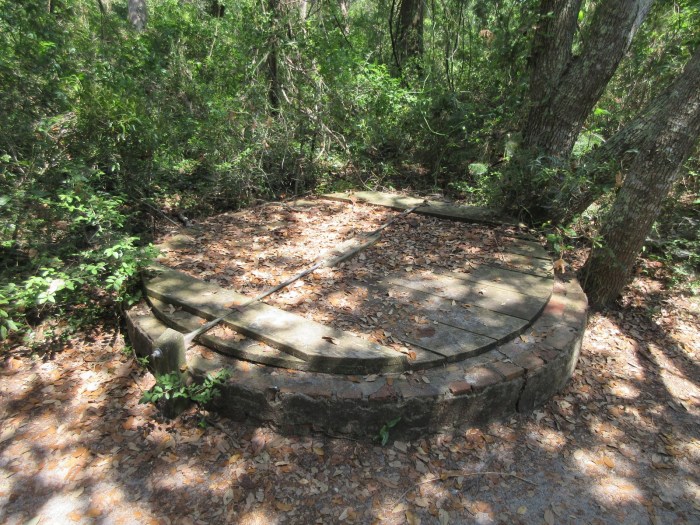
There is also on the site the above boarded-over well. This well was apparently used by Blackbeard. So that’s neat.

IMG_3157

IMG_3156

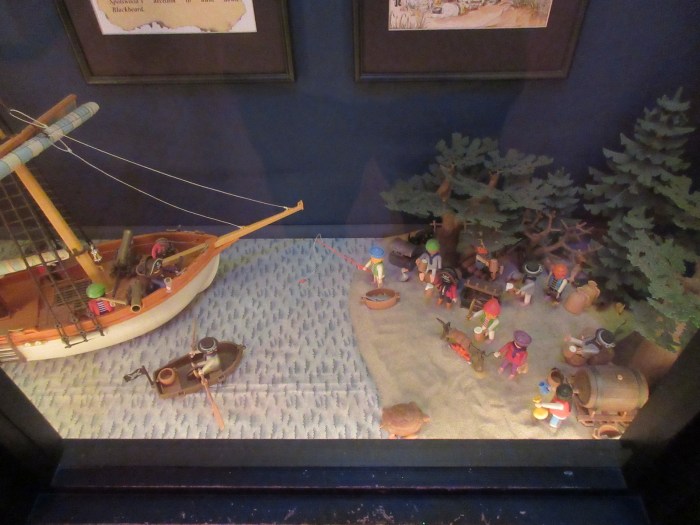
Ocracoke also takes advantage of its pirate history for some good ole-fashioned tourist stuff. One of these things is “Teach’s Hole,” which is mostly a pirate-themed gift shop with a small set of Blackbeard-themed displays. The entry fee for the displays is $4 (free with $15 purchase in the gift shop) and the displays were probably worth about $4. They’re very nicely done but my favorite was a diorama depicting “Blackbeard’s Beach Party” because they used Duplos to put it together. All the rest of the displays are well-done replicas and models and things but then out of nowhere they use kid’s toys to display a party so legendary we’re still talking about it three centuries later.

IMG_3174

After a night on the island we set off the next day on the ferry back to the mainland, landing on Ceder Island and driving on down to Beaufort, NC. Beaufort is home to the North Carolina Maritime Museum and that place is really nice! First off the admission is free and let me tell ya it is worth every penny. We got there only 45 minutes before it closed so we didn’t have a long time to look around, but we got the gist of it.

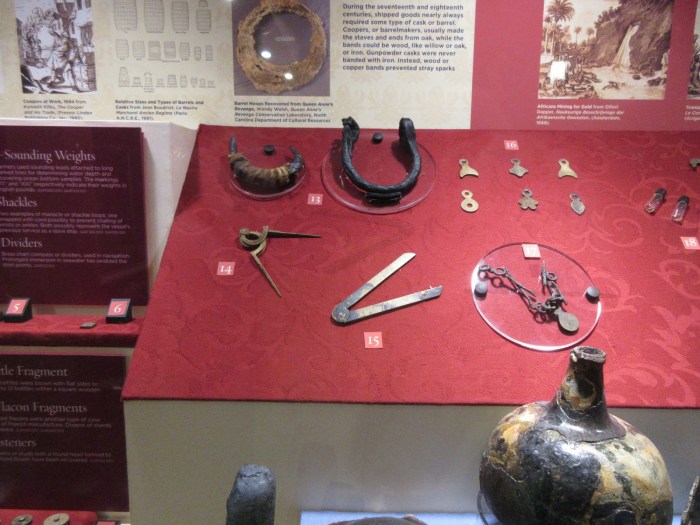
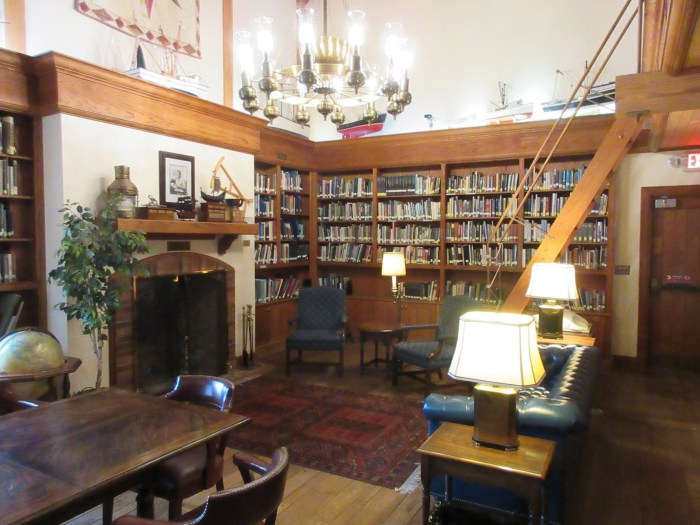
The museum is most famous for hosting artifacts from the Queen Anne’s Revenge. The QAR, as the museum referred to it, was of course Blackbeard’s ship. They found it a few years back and brought up a bunch of artifacts and stuck them in the Maritime Museum. The QAR section of the museum is the largest section, but they also have a lot of displays on other watercraft from the region, the local marine life, and maritime history. They also have a library that is decorated exactly how I would like a library in my own dream house decorated, so always nice to get some #DesignInspo along with my #nautical.

IMG_3176

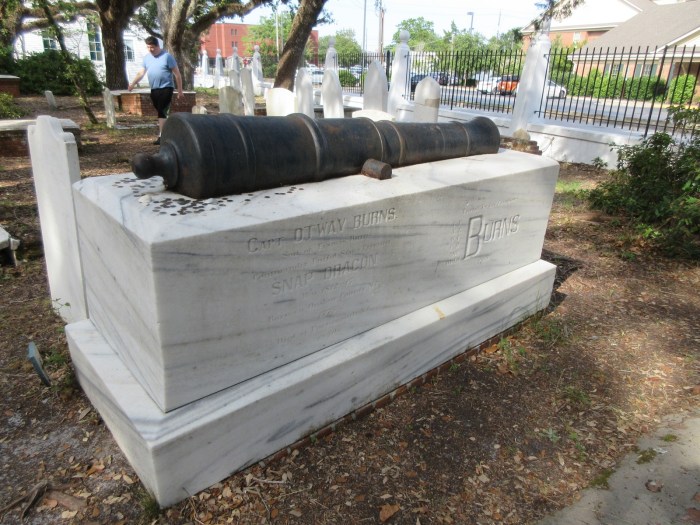
Our final pirate-related adventure was a block away to the Old Burying Ground which contained the grave of Captain Burns, an American privateer during the War of 1812. Mostly I wanted to go because it was on Atlas Obscura, but I got to find out his ship was called the “Snapdragon.” This is funny to me because on the submarine we had these exercises called Snapdragon and we hated them (maybe that was just me) so we called them “Snatchdragon” and this dude’s got a whole boat named that. Poor guy.

IMG_3191

And so with that we were off to grandma’s house. Far fewer pirates at grandma’s house.

Boats Part II

Sany crane.

Reading this week:

  • Fordlandia by Greg Grandin
  • Burmese Days by George Orwell
  • Out of the Mountains by David Kilcullen

Having achieved at least 50% of the boats I had set out to see, I was gonna catch a minibus back to Mpulungu, but I checked Facebook and lo and behold I had an answer to where the Dame des Isles was. So, exhausted but determined to double my boat batting average I set off for the spot. When I got there, the gate was closed and locked. Poo. But then it opened! And I managed to ask the guard (who was letting someone out the gate) about the boat. Unlike the other people I had asked, he knew exactly where it was. Where was it? The Mpulungu Harbor Authority (the italics are because, as you’ll recall, I had visited there and been turned away). So off I went to the Harbor Authority to Find My Boat.

Since it had been a few hours, I was hoping there would be different security staff at the gate. This was not to be. The same guy who didn’t seem to recognize my picture and told me to come back Monday was there. I asked him again about the boat and if he wasn’t sure it was there. Turns out, he knew exactly what I was talking about and had just meant that they didn’t give tours on weekends. Alas! I was so close to my goal, and yet so far! So I, um, not quite begged, but asked if it wouldn’t be possible to just look at it real quick, don’t I look trustworthy? At this point, being a security guy, he asked for my passport. I handed him my ARC (Alien Registration Card, which looks just like Zambian’s National Registration Card, except it says “Alien;” when these were first described to us new PCVs, with the Zambian accent it came out “Aryan Registration Card,” which seemed plausible if unfortunate and made us all really uncomfortable until a more experience PCV saw our faces and explained our mistake), and man, if you live in Zambia I recommend getting an ARC. Every time I show a Zambian their first, inevitable reaction is “You are Zambian!” and then they are about it.

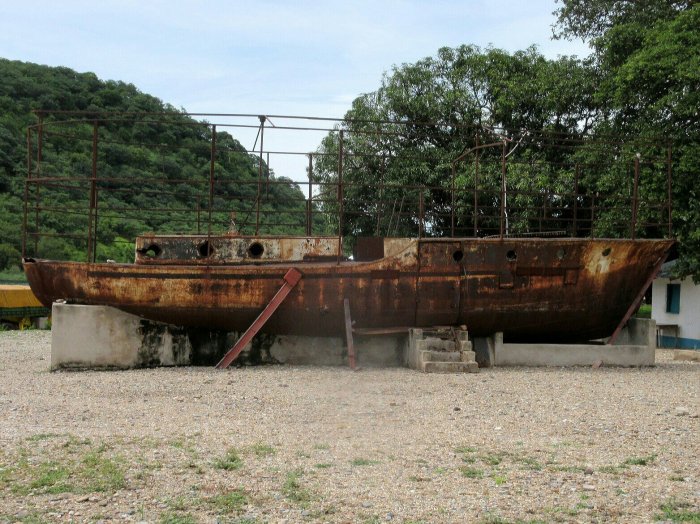
The Dame des Isles.

The Dame des Isles, from a slightly different perspective.

Since I went from an annoying tourist to fellow Zambian, my new friend Banda, Chief of Port Security, agreed to take me on a (short) tour. So we walked over to the Dame des Isles and I took some pictures. Another success! We were walking back to the gate, but then more exciting than even getting all both historic boats I wanted to see, Banda walked me over to the boats they were loading in the harbor. This was super cool!

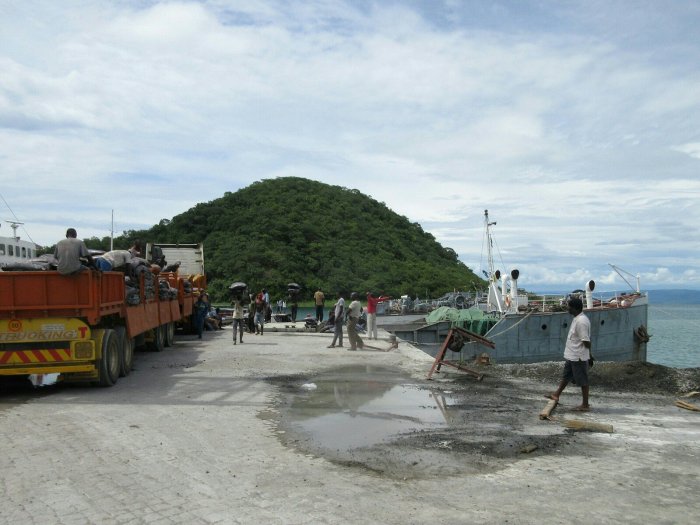
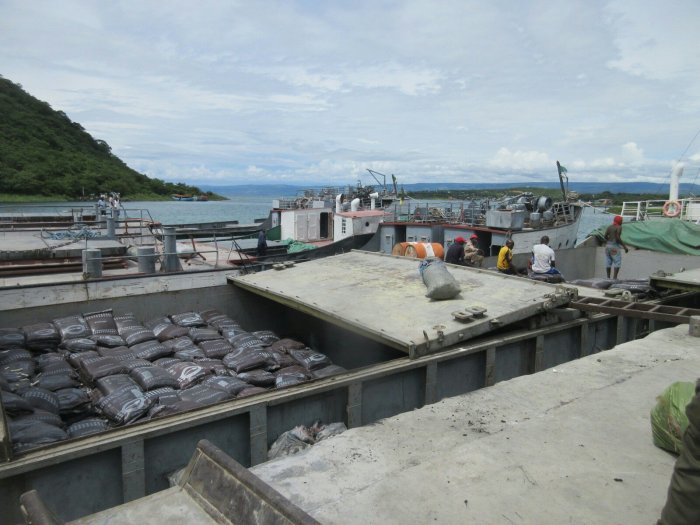
Men loading sugar.

My first reaction was “and they said breakbulk was dead.” There were cranes (made by Sany, which I liked the imagine was an off-brand Sony), but the boat they were loading was being loaded by hand by a bunch of shirtless longshoremen. They were loading it up with sugar. According to Banda, most of the port’s traffic are Burundian and Congolese boats shipping mostly sugar and concrete back to their respective countries. I was surprised to find out these were the port’s major exports, but I guess there ya go. The closest cement plant to Mpulungu, by the way, seems to be all the way in the Copperbelt, so that is some well-traveled concrete and I am amazed that for Burundi and the eastern part of the DRC that’s the best way to get it. Banda let me look all around and answered all the port ops questions he could, and then lead me back to the gate. Super neat! I love boats.

Sugar loaded by men.

From there, the rest was pretty straightforward. I caught a minibus where the drunk conductor tried to overcharge me, got back to Mbala super quick, did some shopping, and came home. Quite the adventure.

Boats Part I

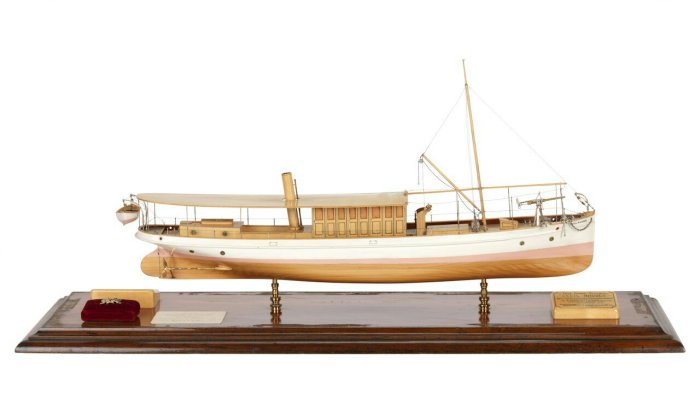
Model of the Cecil Rhodes.

Reading this week:

  • The Snow Leopard by Peter Matthiessen (I thought it would be like Journey to Lhasa but it is much different)
  • Guadalcanal Diary by Richard Tregaskis

This past weekend I went to go look at some boats, the SS Cecil Rhodes and the Dame des Isles. These boats were both in Mpulungu and so I decided to bike on down there to check them out.

First off, Mpulungu is always farther away than I think it is. In absolute terms, it is 40km from Mbala, and I usually describe it as “all downhill.” This is in fact a lie, as it is only mostly downhill, and man riding downhill 40km still is somehow exhausting. Plus you are losing a lot of altitude, and it is rainy season, so in the first part I was pretty cold but by the time I got to Mpulungu it was very, very hot. Good think I brought like 4L of water on this trek. I set off at about 0700 to try to beat the heat and get as much time in Mpulungu as possible, and made it there at a little before 1100.

First things first was lunch, which was lovely actually, thank you for asking, and then to find these boats. The Dames des Isles I found out about from my most frequented Facebook page, Mbala / Abercorn. The page didn’t list the location, and I didn’t think to ask before setting off. So I biked the waterfront, even stopping by the Mpulungu Harbor Authority where security told me to come back on Monday. I looked around at what I thought would be likely locations in Mpulungu before setting off for the SS Cecil Rhodes, the location of which I knew (mostly). I did take a second to ask the page, however, where exactly the Dame des Isles was.

The Cecil Rhodes is not nearly as intact as the Dame des Isles. This thread is where I got all of my information (I found it looking for SS Good News information). The Cecil Rhodes was another early steamer on the lake (I think the second, actually) but failed to find much fame or fortune after the death of its namesake. It rested in the bay west of Mpulungu until the opening days of WWI, when the Germans towed her out into the lake and sunk her. The Germans were trying to prevent her from being armed and entering the Battle for Lake Tang. The Cecil Rhodes by this point was laid up and had her engine out, and maybe wouldn’t have been a threat, but I guess Germans are thorough. Lucky for me though, her engine being, as discussed, out, has laid in the same spot for the past 100 years, ready to be found by your intreprid correspondant.

As you can see from the thread, a previous team had gone out and located the thing, pinpointing the location on a map. I had been meaning to go for a while but never got around to it. Since it was pinpointed, the only thing to do is to go out and look at it, but this is much easier said than done. Mpulungu is hot, and the road to the village, though not too far on the satellite map, is improbably steep and occurs, you know, about 52km into my bike riding. At a particular corner in the road, I tied up my bike and set off into the village.

Walking through strange villages is always fraught. As a white person, when I walk through a village I am usually The Most Exciting Thing To Have Ever Happened Ever. For the record, I humbly disagree with this assessment, but the kids don’t. You start walking through a village, and if you’re lucky people don’t notice. But before long the kids notice, and immediately scream MUZUNGU PELE! MUZUNGU PELE! as loud as they can. I don’t know why they do this. There is one kid in my village that screams my name at me every time I pass. Like, I know kid, calm down. But so now the heralds have sounded in this strange village. At first the kids just stare. This is usually alright, I am used to it. But before long, one kid becomes brave enough and starts to follow me. As soon as one kid does it, then the other kids aren’t scared any more, and the crowd grows. Children come out of the woodwork, out of the trees, out of the water, out of some strange pocket dimension and begin to amass. I always try to hurry lest we form a critical mass and collapse into a singularity, or something. At any rate, they’re really loud and get way too close.

Adults are also very friendly, but tend to want you to stop and talk. They’ll grab your arm in a friendly way and want to greet you. Cool, but these conversations are always them welcoming me to Zambia and being surprised I know how to speak a little Mambwe. I can never quite convince anyone I live here. And none of this helps find the Cecil Rhodes. The trick with adults is to immediately ask for directions. That distracts them and they point you on your way before they can think to ask where you are from. If you don’t employ this method, then before long adults are handing you their naked babies so they can take a picture of their naked baby with the white person, and then you’re just fending off naked babies left and right.

I can employ all these strategies for a bit, but at some point I was gonna have to ask someone about the boiler. Villages are twisty and turny and convoluted and the boiler was half-buried in the ground somewhere. Luckily, I had a picture I downloaded off of that thread, and so I could show people my phone and ask if they had seen it. The first kid I asked knew immediately what it was and pointed me down a path. I walked a bit down that path when I got stopped by a guy who wanted to know where I was going. I showed him a picture of the boiler, and then the only really twisty part of this narrative happened.

Upon seeing this picture of a boiler, he apparently immediately concluded I wanted to go to a lodge. When I showed him the picture he said he could show me and then started walking me down a path. People kept asking him about me (I’m right here, people) and eventually I actually listened and figured out that he was taking me to a lodge. And I was apparently going to pay him 100 kwatcha for this service. This sort of thing has happened to me before, and I always wonder what goes through people’s minds. I know random white guys don’t wander through the village every day, but given that I am, and I speak at least some Mambwe, why is the next conclusion that I want to go to a lodge? After showing you a picture of a hunk of metal in the ground? And the people I specifically ask to walk me somewhere never think I am going to pay them, it is only the people that just start doing it without asking that think they’ll get money out of me? Anyways.

So I figure out we’re going to a lodge, and so I say I don’t want to go to a lodge, and show him the picture again. I figure out he hasn’t spotted the boiler, and has only spotted the lake in the background (we are in sight of the lake this whole time), and at least one of us is very confused as to why I need directions to the lake (it’s very big and hard to miss). Realizing this, I point to the boiler in the picture, which he now notices. He asks what it is, but I had forgotten to look up the Mambwe for “it’s a 100 year old boiler from a ship the Germans sunk,” and when he suggests it is a water pipe, I say yes, because a boiler is kinda sorta a water pipe. So now he tries to take me to a water pipe. Then I try to explain it is a boat engine, but worry that won’t help because it doesn’t look anything like the outboard motor the canoes on the lake use. He is confused; I am confused. I try to show him my Google Maps with my pinpoint and how we have been walking away, but my limited Mambwe also doesn’t cover Google Maps. Eventually he takes me to his brother, who speaks English. I show the brother the picture, he immediately recognizes it, and takes me right to the spot, which was about 20 feet from where I met brother #1. For the record, brother #1 was trying very hard to help and I appreciate it and I really should have learned Mambwe better.

The boiler, hidden in its pumpkin patch.

The boiler, and many children’s feet.

But aha! Success! The boiler! It is currently in the midst of a maize and pumpkin patch. Some vines are cleared away, and I manage to take a few pictures of the boiler along with the feet of the small children who can never be scooted away effectively. Meanwhile the owner of the maize patch explains to me that it is a boat engine (his exact words, so I don’t know how to feel about calling it a boat engine myself and worrying that wouldn’t be clear) while trying to explain and sell to me the maize and pumpkin he is growing in this patch. Pictures taken, boiler touched, history interacted with, it was time to bolt, and I head out of the village and back to Mpulungu, sucking down a lot of water because have I mentioned it was hot?

Join me next week for the exciting conclusion, “Boats Part II!”