Paperwork enthusiast seeking new frontiers of paperwork. Former submariner, former Peace Corps Volunteer. Opinions, thoughts, and comments reflect no actual persons, living or in the Navy.
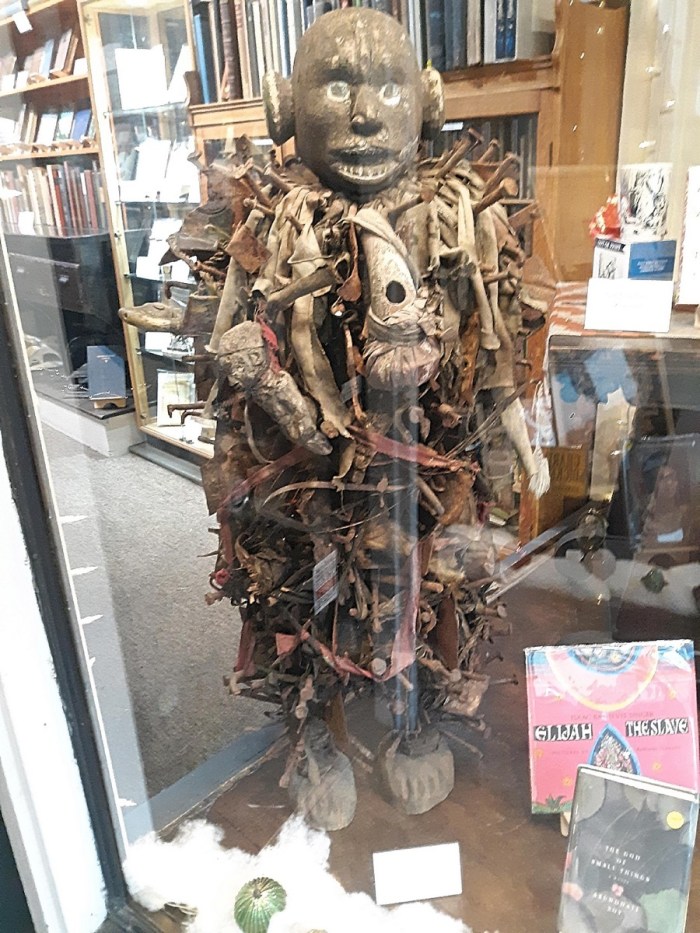
Before we talk about anything else, let’s note the top picture. It’s a Congolese nkondi, which, when I took the picture, could be found for sale in an otherwise very lovely bookstore in downtown Annapolis that I frequent whenever I’m in town. If you had something like $1500, it could be yours, presumably to display in the corner of your living room or something so you could go “look, it’s a Congolese nkondi. It’s witchcraft!” Whenever I see something like this, I have to wonder how it wound up in some Maryland storefront. What are the chances every person in the chain between here and the Congo thought they were getting the better end of the bargain? The store is about 500 feet from a memorial to Alex Haley and Kunte Kinte, who was delivered, enslaved, to the Annapolis docks. The cultural context of the nkondi has been reduced to whatever the storeowner could Google and stick on an index card next to a price. Maybe it was all on the up-and-up going all the way back to when the thing was hopefully made as an export piece for the tourist market, but does the person selling it and the person that is going to buy it have any clue?
Anyways, that’s not what this post is about. This post is about friends! With finals over, for the week before Christmas I went to go stay with my parents down in Maryland. Maryland is conveniently very close to DC, which is, conveniently, where a good chunk of my Peace Corps friends have moved to. So, since I am trying this hip new thing of actively maintaining friendships, I visited as many as I could while I could. It was great! It is extremely lovely to have friends, and they are all settling down to a variety of exciting things. They are working for the EPA and the Peace Corps and the FDA and all sorts of cool places! My major mission while visiting all of them was to get in with the DC happy hour scene I hear about so that I will then have friends who are in with the DC happy hour scene. This, I am told, is useful.
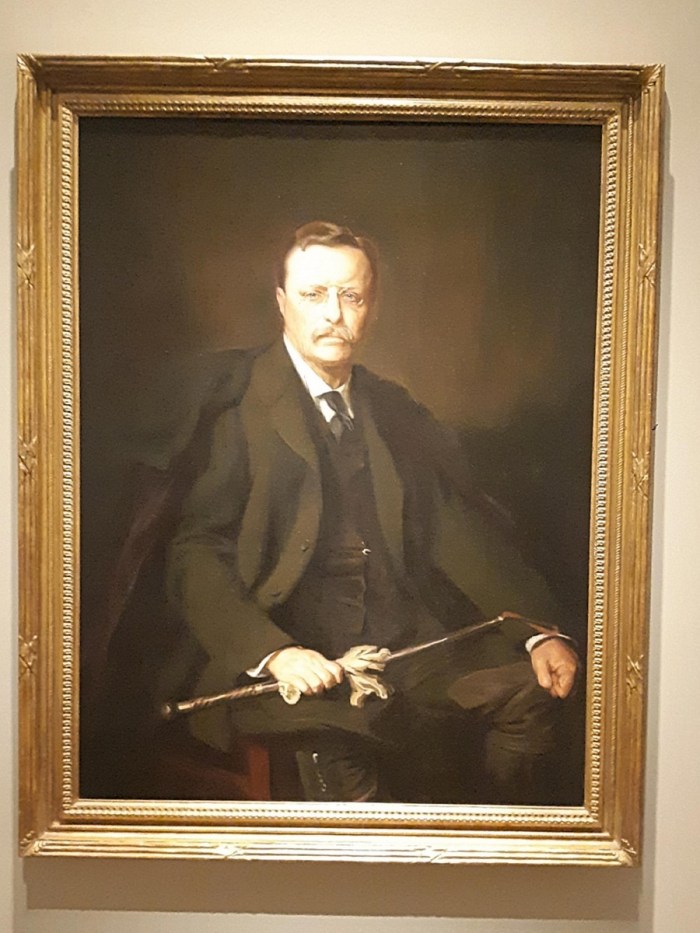
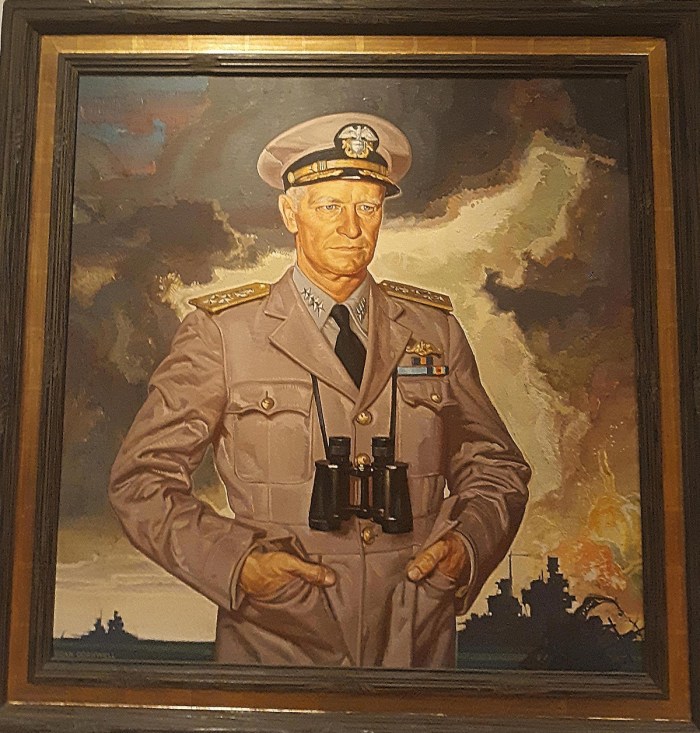
Importantly for the context of this post I also have a friend who is working at the Smithsonian American Art Museum (I write this blog partially just to stay in the habit of writing, but now I find when I write essays I write them like they’re blog posts, ie I will just mention something without any context, imagining that I will just add a hyperlink; this is probably not a great thing?), which is co-located with the National Portrait Gallery. The National Portrait Gallery is full of portraits, so when I was waiting around for her to get off work so we could get dinner I went to go look at some portraits. I was happy to see ole’ 2-6 Teddy Roosevelt, and while there you also have to of course check out Barack Obama. Then finally it was on to my absolute favorite admiral, the inestimable Chester Nimitz. Related, I am currently reading Invisible Women, and now that I am writing this blog post I feel terrible. Anyways.
What is he possibly looking at with those binoculars when he would also be wearing this outfit, with his hands in his pockets? Goddmanit I love you Chester Nimitz.
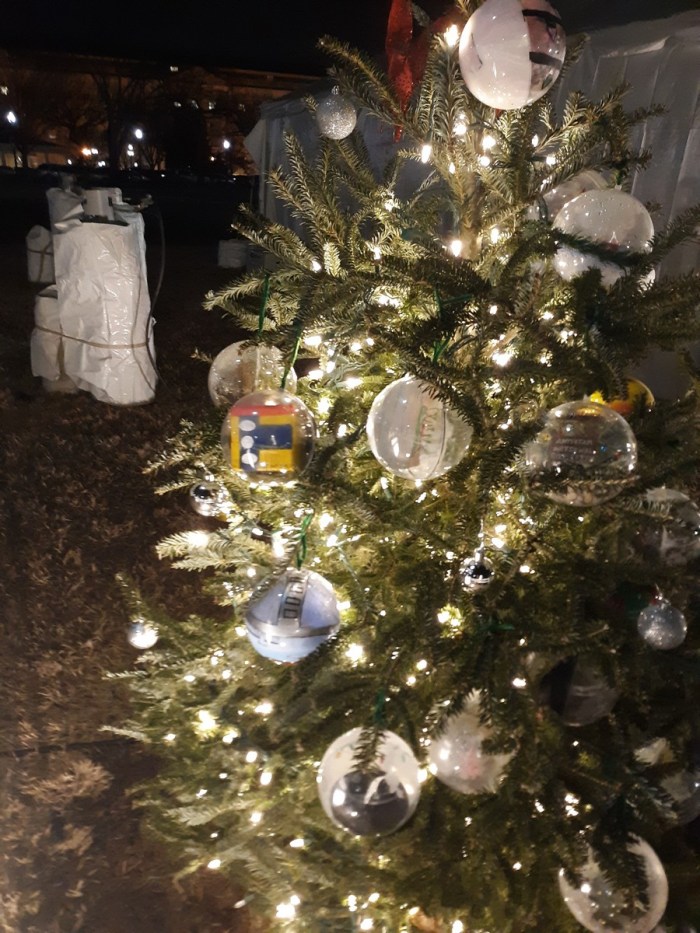
My other friend (man I have so many DC friends) also wanted to take a picture of the National Christmas Tree to send to her mom. So after dinner we wandered on down there to take a look. It was pretty neat! They don’t actually decorate the tree so much as design a whole different tree out of lights and then put the light-tree around the real-tree, but there ya go. They also had model trains running around, at which people from all over the world have apparently thrown coins (the around-the-world-ness evident from the variety of coins). And then they had around the big tree in the middle a whole set of smaller trees, arranged as though it was some sort of tree-cult ritual scene. The smaller trees were decorated from representatives from the 50 US states and then also, encouragingly, each of the US territories. 99% of the time, you’re totally forgotten, US Virgin Islands, but not at Christmas time! I was going to be resolutely unimpressed with the mini-trees, until we came across the Maryland one and it had an Old Bay ornament, so then it was worth it.
I had a Keurig I owned for many years that I loved very much that I had named Henry and had given a whole backstory to (he was in love with the printer, Maria, but Maria was in love with the computer, Isabelle) that I only relatively recently got rid of, and I am discovering I have zero pictures of it despite it being such a meaningful appliance. So I have created a very silly picture of a green Keurig to grace this otherwise serious post.
Until this week, at my program at Yale they provided us with disposable K-Cups to make coffee. A certain crowd agitated, and without warning they decided to stop providing disposable K-Cups. Instead they had roast coffee grounds, the reusable K-Cups, and pour-over coffee makers, with discussions ongoing about getting a regular coffee maker. I am perpetually grumpy and anti-authority, and was upset about this change. I’ve put my analysis below, but as far as I can tell disposable K-Cups are the most efficient method of producing coffee man has ever created. It’s stunning. They are so miserly with coffee, and coffee is such an energy-intensive crop (especially when you consider coffee being drunk in New England with the transportation energy included) that the extra roast coffee grounds required to make coffee for literally any other method (including, importantly, reusable K-Cups) more than offsets the carbon cost of the plastic in K-Cups.
This is an important point when it comes to environmentalism. You have to consider the whole picture. Single-use plastics are bad but they don’t exist in a vacuum; if they are replacing something else, what is the alternative? By switching from disposable K-Cups to another coffee brewing method, we’ve eliminated bright white plastic from sitting in our garbage can, but we’ve replaced it with an even greater amount of carbon dioxide we just release into the atmosphere. That carbon dioxide is easy to ignore though, because it is invisible and happens far away from us (or at least a bit down the road). People don’t have a good grasp on the fact that an electric kettle is a 3kW device that sucks down just gobs of power, and that’s because they don’t have a good grasp on how many of the systems we just take for granted in the Western world actually work.
To make a vaguely related point, this is why I get upset when people talk about nuclear waste. Nuclear waste is bad, I agree, but it is better than CO2. Dealing with nuclear waste is a relatively easy technical problem; you just bundle it up and stick it in a hole. It’s easy to transport and it just sits there. But people can see it, and have to do the actual transporting. It’s easier to be in favor a natural gas power plant in your backyard because the only waste that thing generates is invisible gasses that just float away.
The takeaway here is not that K-Cups are good for the environment. Turns out coffee is bad for the environment. But if you’re going to drink coffee (and participate in all the other terrible, environmentally unfriendly aspects of a modern Western lifestyle), then it seems that disposable K-Cups are literally the least bad way to do it.
My Analysis of the Carbon Footprint of K-Cups:
Disposable K-Cups: Each K-Cup is made of 4g plastic and 10g roast coffee (numbers range from 3-4g of plastic, and 5-11g of coffee).
Reusable K-Cup: Instructions call for using 2tbsp of coffee, which is 16g.
Carbon Footprint of Plastic: The “recyclable” K-cups (the latest ones) use polypropylene (PP). According to EPA estimates, each short ton of PP produced results in 3.02 metric tons of CO2 production, which is equivalent to 3.33g of CO2 production for 1g of PP produced.
Carbon Footprint of Coffee: Estimates here are hard to get. The most complete study was for coffee produced in Costa Rica and consumed in Europe. If you subtract consumption (brewing the cup, producing the filter), they estimate 2.83kg of CO2 for every 1kg of green coffee. For every 16oz of green coffee you generally produce 12oz of roast coffee, so you produce 3.77g of CO2 for 1g of roast coffee grounds. That is on the low end of estimates; other sources I found say 5.5g to 11g of CO2 for every 1g of roast coffee. Estimates for the carbon footprint of coffee are always going to be all over the place because it will depend on where they come from (our local roaster sources coffees from as close as Mexico and as far away as Sumatra) both due to transportation costs and production methods. The coffee plantation I lived next to had center-pivot irrigation and that had to consume tons of energy. The sources cited before also note the huge impact fertilizer use has on carbon footprint.
Carbon Footprint, Disposable vs. Reusable K-Cup: A Disposable K-Cup has a carbon footprint of 55.0g CO2 (13.3g from the plastic, 4g of plastic, 37.7g from coffee). The Reusable K-Cup has a carbon footprint of 60.3g CO2 (all from the coffee). So net, a Disposable K-Cup has a lower carbon footprint than a reusable K-cup. This is a low-end estimate; the difference gets much worse for Reusable K-Cups if we use the higher coffee carbon footprint from the other sources. Coffee is such an energy intensive crop and Disposable K-Cups are such an efficient coffee brewing system that the additional plastic in a disposable K-Cup is more than offset by the additional coffee in a reusable K-Cup. You even throw away less trash; the Disposable K-Cup weighs a total of 14g, but the Reusable K-Cup uses 16g of coffee, which also just gets thrown away (we don’t have a compost bin or anything). The major assumption in this is that the transport and packaging costs of K-Cups and roasted coffee is the same. I think this is a safe assumption because the K-Cup manufacturers have economies of scale, and when the K-Cups are delivered it is via very efficient delivery systems. The smaller scale of operations of the local roaster we get our coffee from likely means they are less efficient in their roasting and packaging operations and in their delivery systems. K-Cups are so efficient that Bloomberg credited the rise in K-Cup use over traditional coffee pots for a downturn in worldwide coffee demand. I also did not include the energy estimates for brewing the cup of coffee because I assume this is the same for disposable and reusable K-Cups, but this is significant for other brewing systems.
Waste in Other Brewing Methods: It takes a large amount of energy to heat water. At Yale, the electricity comes from the Central Power Plant (CPP), which uses natural gas and has a 20% thermal efficiency (20% of the thermal energy at the power plant is converted to electrical energy, which is per the tour I took at the beginning of the semester and is normal for turbine systems). 12oz of water weigh 0.78lbs, 1 BTU is the energy required to raise 1lbs of water by 1°F, and 53.07 kg CO2 is produced for every 1 million BTUs from natural gas. Thus, heating the water for one cup of coffee produces 29.4g CO2, which is equivalent to the plastic in just under two disposable K-Cups:
(212-70°F)*0.78lbs*(1BTU/°F-lbs)*(53.07kgCO2/1,000,000 BTU)*(1000g/1kg)/20% = 29.4g CO2
The takeaway from this analysis is that a major inefficiency in other types of brewing systems is wasted energy from heating extra water. If you make pour-over coffee using the kettle, every 2.4 extra teaspoons of water heated to boiling results in 1g of CO2 released into the atmosphere. If we get a coffee pot with a burner to keep the coffee warm, that would likely be the most significant energy loss in the whole system. If we get an airpot brewing system or even a traditional Mr. Coffee, then every cup of coffee left over at the end of the day or thrown away because it is cold or stale is two K-Cups worth of CO2 emissions wasted.
That also doesn’t count the roasted coffee used. Every other method calls for using more coffee than the K-Cup contains. Instructions for Century Series Air Pot Brewers call for 2.5oz of roasted coffee to produce 2.2L of coffee, which comes out to 11.43g per 12oz cup. If we produced coffee in accordance with the instructions, and drank every single cup, that is more efficient than a Disposable K-Cup. But between the coffee and the power, every wasted 12oz cup has a carbon footprint of 72.4 g CO2 (43g from coffee, 29.4g from heating water), or the equivalent to the plastic in 4.2 disposable K-Cups (that is also under ideal conditions; the calculation for heating water above doesn’t account for any losses). 11.43g of roasted coffee is also on the low end, as this source recommends 21.26g of roasted coffee per 12oz cup, which appears to align with a common suggestion of 20g per 12oz cup for other methods. One of the biggest efficiencies from K-Cups is that they result in no wasted cups of coffee at the end of the day; people don’t have to brew a whole pot of coffee to drink just one cup.
Conclusion: Coffee is energy-intensive no matter how you choose to go about making it. But because the Disposable K-Cup is such a resource-efficient method of brewing coffee, it is the least bad method. By eliminating Disposable K-Cups, we’ve eliminated that plastic from landfills but traded it for a larger mass of CO2 released into the atmosphere, where it is a much tougher problem to deal with. Plastic is unsightly but once you dump it in a landfill it tends to actually stay there. It is easier to pretend that the CO2 isn’t a problem, but that’s only because we can’t see it.
Appendix 1: Creamers
Dairy milk produces 1467g of CO2 per liter of milk. Almond milk produces 396g of CO2 per liter. A standard creamer packet contains 11mL of liquid. If you assume people put 22mL (two creamer packets) of milk into their coffee (for those that do), that is 32.3g of CO2 per cup of coffee for dairy milk and 8.7g of CO2 per cup of coffee for almond milk. Each creamer packet worth of dairy milk is just shy of 1 disposable K-Cup worth of plastic in terms of CO2 emissions.
Surprise! This past weekend I was in New York yet again! I have become one of those super hip types that travel down to “The City” every weekend to do culture and crap! And culture is exactly what I did this past weekend.
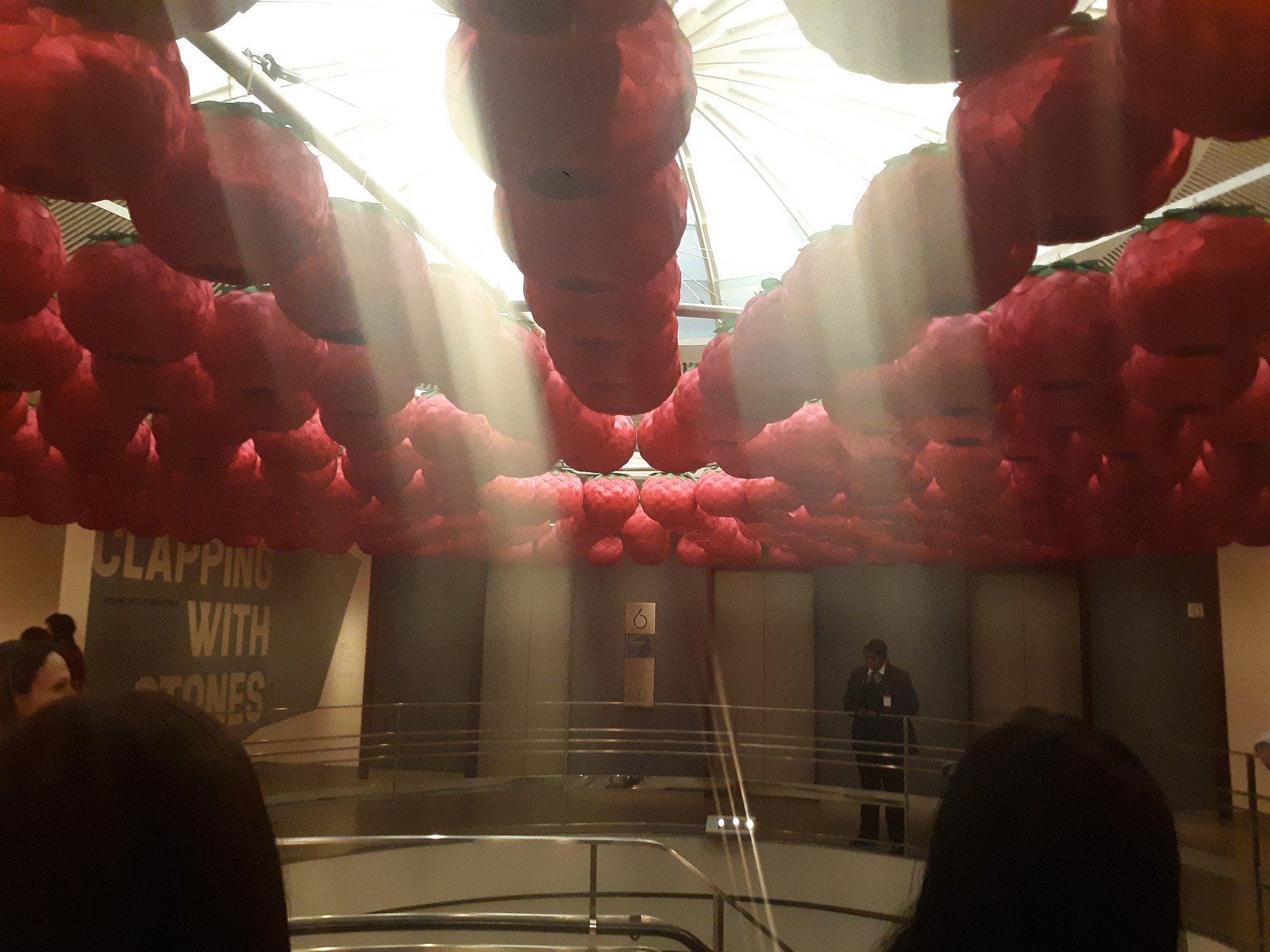
The Jackson Institute arranges these networking events for us to network. This was a “soft” networking event, in that it didn’t have “network” in the name of it, but they sent out a list of attendees beforehand along with their job titles and companies so we could see what people we would like to talk to. So that’s a whole thing. The nominal excuse was a trip to the Rubin Museum of Art to tour their current exhibition, “Clapping with Stones.” All the current Jackson students were stressing over finals, so very few of us showed up, so the whole event was pretty intimate and cozy and that is pretty nice I suppose. We rendezvous’d at the museum on Saturday afternoon and went to go see some art.
The art was good! At least I think it was. We had an actual tour guide which is nice to explain things (vice just wandering around ourselves) and context is helpful. The only picture I took is the top one (with my crappy phone camera, but I told myself the streaky light effect was artsy), and the museum website doesn’t have the name of it as far as I can tell. The tour took about an hour and then we adjourned to the museum’s rather large cafe. They gave us wine and appetizers (dumplings and kale salad) and we had a go at the whole networking thing. Turns out former Jackson people are just as cool as current Jackson people so we all had a great time.
The other purpose of this trip to New York was to see “The Book of Mormon.” My aunt and uncle are artsy New York theater types and turns out I’ve never seen a Broadway play, so for my birthday they wanted to change that. I had absolutely no opinions about which play to see, so they decided that The Book of Mormon would be a good place to start. I had told friends I was going to go see it and that was a whole mix of reviews. The initial impression from everyone is that it is great. But with such stellar reviews going around other people were worried I would set my expectations too high. So they warned me against that.
Having now seen it, yeah I dunno man. Some of the musical numbers are pretty good. But content-wise, I did some googling and this essay and this essay both more or less capture my feelings about it. I was downright queasy when they rolled out the “Africa” set. They managed to humanize the characters a bit more later on and frankly the “We Are Africa” piece felt about spot-on when it comes to White Savior complexes and all that jazz. So yeah. I don’t think I’m going to see it again.
After the play we took a stroll through Times Square to get to the subway. We passed on the way the “World’s Big Sleep Out” event (but didn’t manage to see Will Smith). This is another case of me having mixed feelings about protest-type events. Now that I have read the article, it seems to be a fantastic event and the guy that organizes them seems awesome and puts his money where is mouth is. I do like how many caveats the people in the NYT article put in (“‘I can’t ever relate to the helplessness and hopelessness of being truly homeless because I really do have those keys in my pocket, but at least for one night we are creating awareness to imagine what it’d be like sleeping outside,’ Mr. O’Shea, 54, said.”), and there are probably apt comparisons to be made between some of these people and the sincere and well-meaning Mormons who go to Africa and confront General Butt Fucking Naked. After we passed the Sleep Out we passed an actual homeless person. I sorta wonder if the Sleep Out people would have let him sleep with them?
For our Saturday in New York, we went to the Statue of Liberty and Ellis Island. This was neat! For several reason: 1) I had never been to either of these things, 2) I got to take THREE!!!! boat rides, between THREE!!!! different islands, and 3) Freedom n’ shit.
Walking around Liberty Island is pretty cool. I’ll spare you the phenomenal number of pictures of the Statue of Liberty I took because there are better ones elsewhere (except for the one up top, the one just above, and the one later on, but those all have excuses), but please admire the one right above because it features a hawk or eagle or something perched right on Lady Lib’s finger there. I assume that the hawk is looking for terrorists or just admiring America. We didn’t get tickets to go up in the statue or even up on the pedestal, so we had to be happy simply admiring Liberty from afar. But that is fine because the island is lovely with excellent views of New York City, and has a museum and a pretty good gift shop. In the museum you find out all sorts of things, including the bewildering array of steps it took to actually construct the statue. They must have used an absolutely insane amount of plaster.
After you’ve had your fill of Liberty Island, the ferry takes you on the like four minute ride over to Ellis Island. This was pretty enlightening. I have heard about Ellis Island of course and like apparently 100 million other ‘mericans have ancestors that passed through there, but I didn’t quite realize how large the facility is. It is pretty impressive! Nor did I quite realize that most immigrants only spent like 2-5 hours there. I suppose it is significant because they all went there, but 2-5 hours ain’t that much time. But the whole island is massive and is built on landfill but the facility at its structural peak didn’t get used for too long I think, because by the post-WWII era we had other ways of screening immigrants. So that’s neat. We had spent so much time on Liberty Island that we didn’t have a super long time to spend on Ellis Island, but that is fine because unless you get the “hard hat” tour (we didn’t) there is only so much you can explore there. But the biggest advantage of being there so late in the day was:
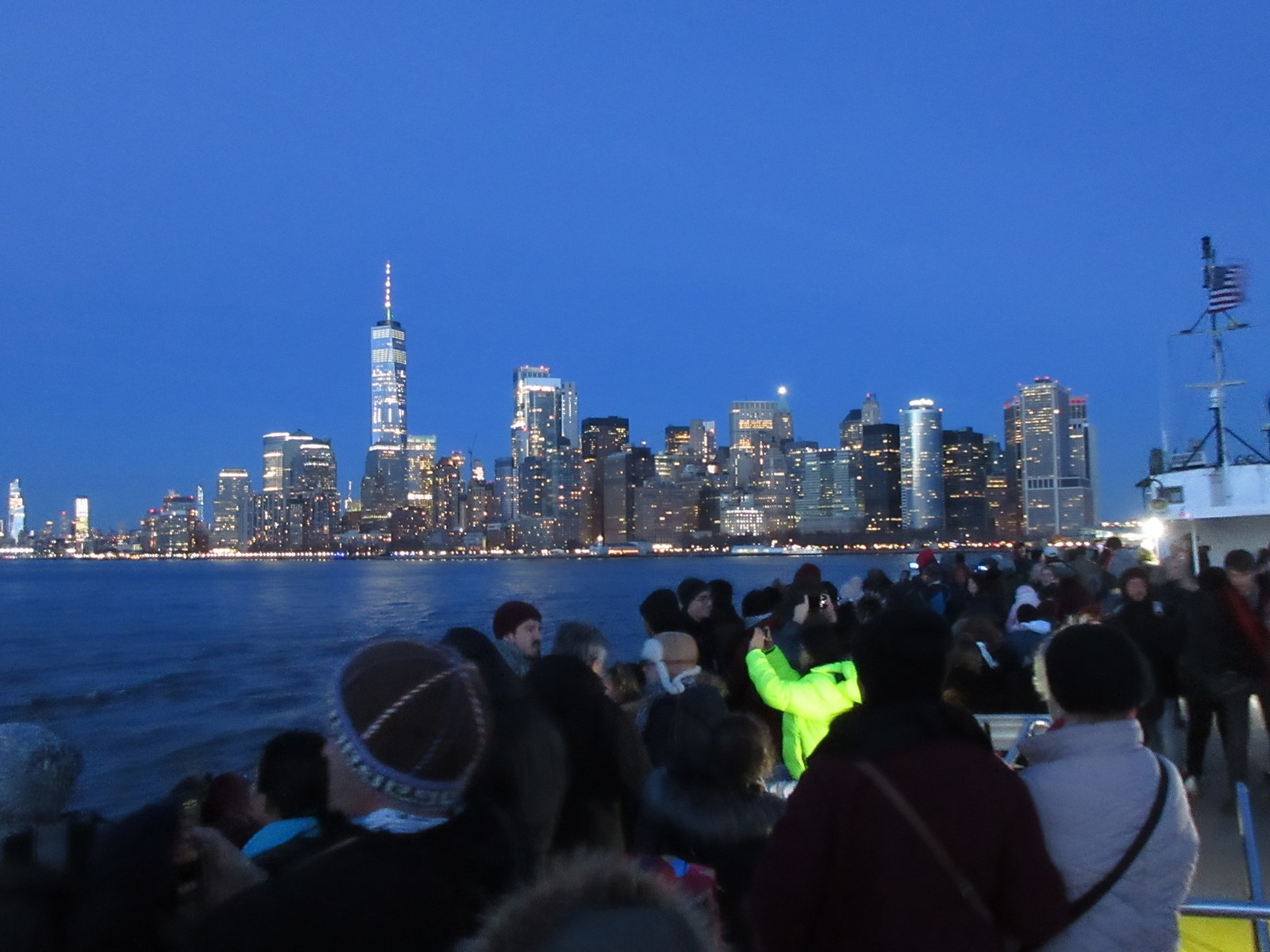
The fact that the ferry ride back to NYC was at night and the whole city was lit up and there were fantastic views of everything!
I had my own pictures that had exclusively the city lit up but I like this picture of all my fellow tourists flocking to take pictures because it has everyone just really appreciating how pretty everything looked. Given my druthers I think I’d rather be in the backcountry of Zambia or something but if you have to be in New England (I don’t actually think New York is New England but it’s all north of the Mason-Dixon line so who knows) this is a pretty place to be and the weather was pretty good if cold! Plus I got to contemplate America n’ shit for like the whole day which, you know, ‘Merica.
Right off the bat the title of this article is wrong. Pretty much none of what I write about will take part in Brooklyn. But for Thanksgiving I went down to visit my aunt and uncle who live in Brooklyn, and the rest of the family came up. Thanksgiving itself was pretty quiet and involved turkey and stuff, and then we stayed in New York for the weekend. On Friday and Saturday we went around and did tourist stuff. I’ve been in New York several times before, almost all those times to visit said aunt and uncle, but I think this is actually the longest amount of time I’ve ever spent in the city. I’m practically a native now.
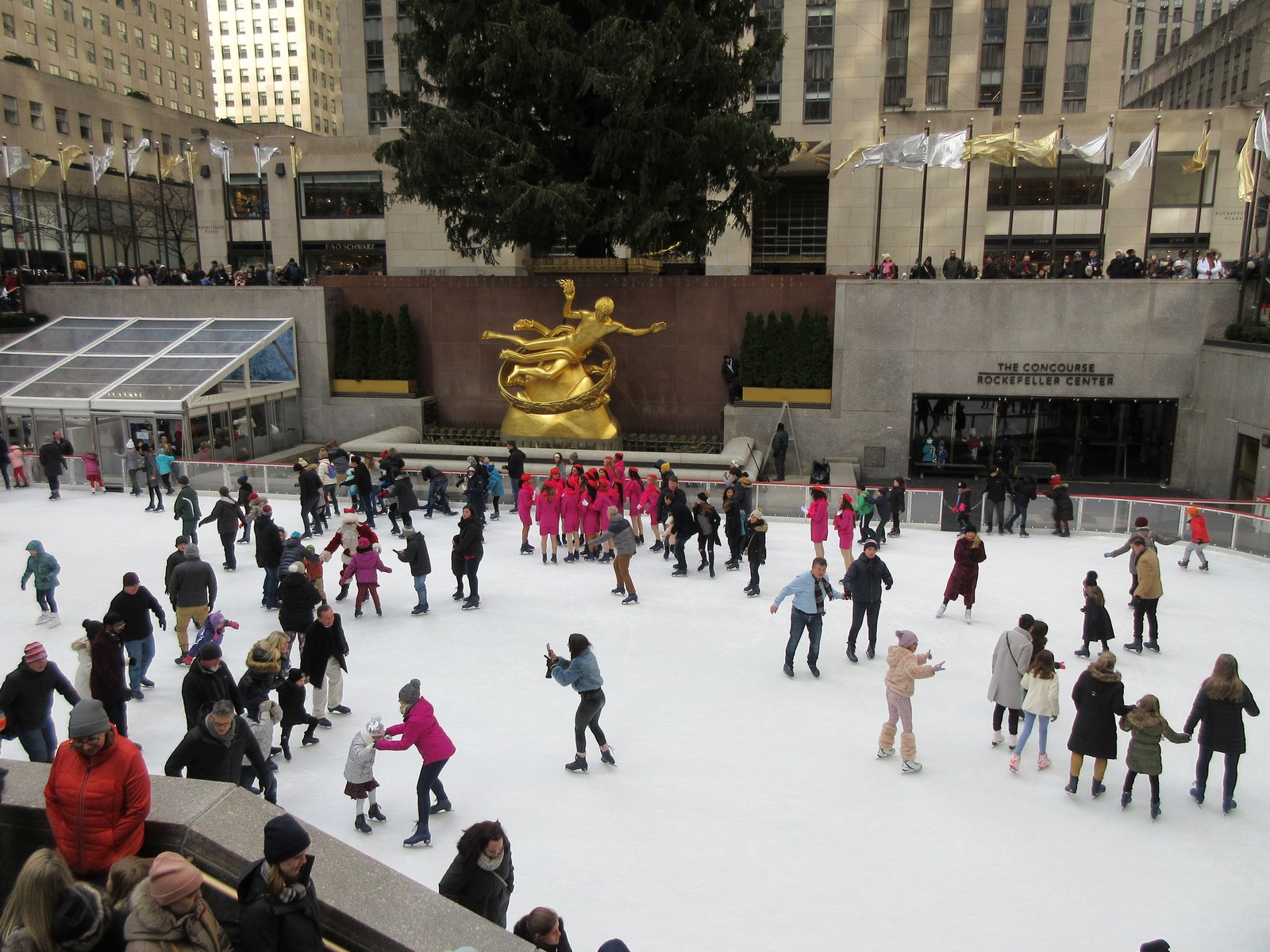
The first thing we did on Friday was to head off to Rockefeller Center. Dad seems to like the place. He wanted to watch the ice skaters and the windows over at Sak’s across the street. So we did that. I think I would have rather gone shopping; I could use some new shoes. But whatever we watched the skaters. Those are the top photos. They were pretty neat I guess! There are other skating rinks in Manhattan with better views but I guess this one is significant or something. Sorry for being such a downer?
The single most exciting part of the day for me was St. Patrick’s Cathedral. Not for the cathedral. I don’t really care about Christian religious structures period, and as far as cathedrals go St. Patrick’s is pretty whatever. I’ve seen better. But I learned about the St. Killian’s candle burning system! This thing amazed me that it existed. The boxes of candles spread throughout the place proudly proclaim that it is patented. Patented candle burning system! The audacity! The appeal of the system is that it is low maintenance. All those little candle holder thingies have a hole in the bottom, so when the candle burns low enough it just drops through and the candle holder is ready to accept another candle. A huge think of wax builds up below, and a) I don’t understand how that never catches on fire and b) someone has to clean it but it must be easier than cleaning out individual candle holders, but that is the only drawback. I even contemplated donating $2 so I could light a candle (no one was guarding them I could have just lit one but it didn’t mean that much to me and if I want to affect the church’s finances I’ll advocate for them to pay taxes) but I decided to just google them later instead. So that was exciting.
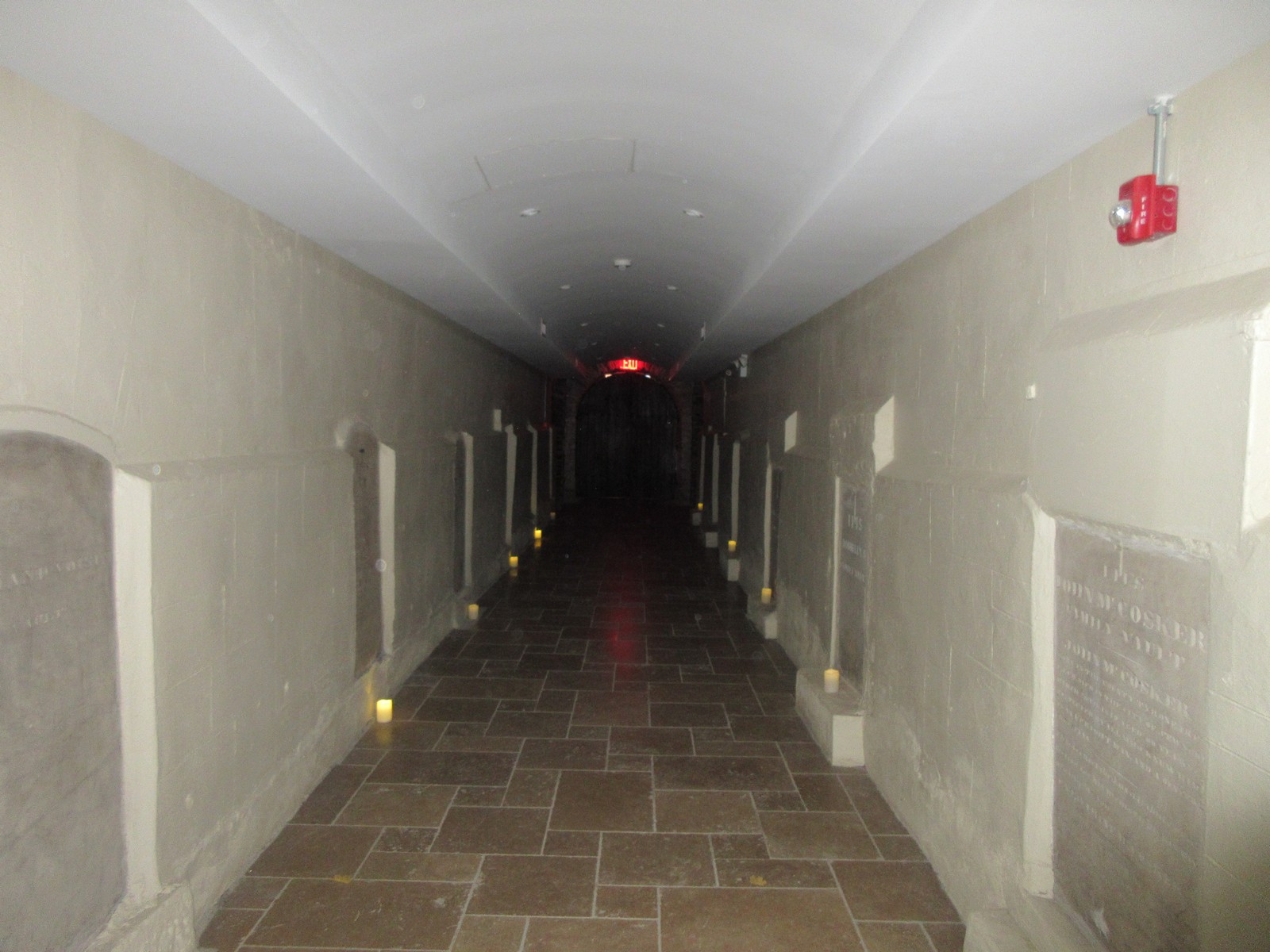
The second big adventure of the day was to go to St. Patrick’s cathedral. Wait didn’t I just say I was there?! I did indeed. I suppose the other St. Patrick’s isn’t a cathedral, it’s a basilica, but whatever. It is the original St. Patrick’s before the congregation decided they were cool enough to need a whole cathedral. The draw of this St. Patrick’s, besides being further downtown, is that it has catacombs that you can tour. The catacombs are mostly neat for being like, modern catacombs. The burials are not modern, but the place has been kept up and has modern ventilation and stuff (and lights, but the tour promises to be a “candlelit tour,” though the candles are electronic) and so represents what a catacombs would look like if you decided to build one anew. The tour was interesting but would have been better if it was one hour instead of two.
The final exciting thing was going up the One World Trade Center slash Freedom Tower. Plan A was to go up and watch the sunset from up there, but despite the elevator being blisteringly fast we didn’t get up there in time (plus our tickets were for too late) but still seeing Manhattan all lit up is pretty gorgeous. Eventually I figured out the “handheld night scene” mode on my camera but taking pictures through glass never helps. So we looked all around, admired a bunch of stuff, took some photos, bought a lapel pin (I got two lapel pins this day), went down, went home, and had burgers. Excellent times in New York.
Aid and Authoritarianism in Africa, edited by Tobias Hagmann and Filip Reyntjens
Yesterday was “The Game,” which is the rather pretentious moniker for the annual Harvard-Yale Football game. I don’t like football, I don’t even actually know the rules of football, but I went because it was billed as an “experience” and I had a lot more fun than I thought I was going to.
I saw very little of the football game. We had a pre-game thing at our institute’s building where the big draw was bagel sandwiches. The guy who organized it also brought bourbon, and that plus some Keurig coffee was a great way to start the day. We eventually head over to the bowl where we had a “tailgate,” which involved drinking some beers in the vicinity of Nick’s SUV, but I guess that is in fact the average tailgating experience so there you go.
We head into the stadium with about 20 seconds left in the second half, and so were quickly watching halftime. This is when the real action started: a climate protest! The protest was a coordinated effort between Yale and Harvard students to protest the investment in fossil fuels and the like by the endowments of each university. During the protest, I was not in favor of the protest, but I have since revised my assessment. First, the protesters had absolutely no trouble getting onto the field. I saw them line up behind some banners behind the endzone and then walk on over to the 50 yard line. Based on how easily they got down there, I figured Yale had known about it and allowed it to happen as a planned event, and so I was annoyed at Yale for acting all surprised that it was happening. Turns out they did not in fact have the blessing of Yale, and Yale just doesn’t try very hard to keep people off the field. So now I’m 100% in when it comes to execution of the thing.
The second thing was that I didn’t really get the point. I didn’t think there was anyone in the stadium that was particularly pro-climate change, so I didn’t know who they were trying to convince. My judgement here has been revised as well. Apparently the game (er, The Game) was being televised by ESPN so there was in fact a national audience they were trying to target. And they made both the New York Times (I’m technically in that header photo, way up in the stands) and the Washington Post, so maybe they’ll be able to exert enough pressure on the colleges to actually divest from the offending companies. While I was in the stands I was annoyed that Yale was allowing the protesters to delay the game (I was cold) so they could preach to the choir, but now I know none of that is true so I’m into what they were doing and I support it.
The game eventually restarted and I watched about 6 minutes of the second half. Then I ditched because like I said it was cold. But Yale won! That’s cool I guess!
Unrelated to all that, above is a card they were handing out with the Yale fight song. Let’s talk about this for a minute. I went to the Naval Academy for undergrad, and the big football rivalry there is with the Military Academy. The Army-Navy game is fantastic. As I also mentioned, I hate football, but I’ll get excited about Army-Navy. Give ’em the goat! It’s America’s game (I hold that’s less pretentious than “The Game,” also America is awesome and stuff), and the president tends to show up and stuff. More importantly, the Navy’s official fight song includes the line “Drink to the Foam,” which goes far to set the right tone (the best fight song is of course “The Goat is Old and Gnarly“). What does Yale’s fight song have? Some weird barking? Get your shit together Yale. You’re supposed to be the best and brightest.
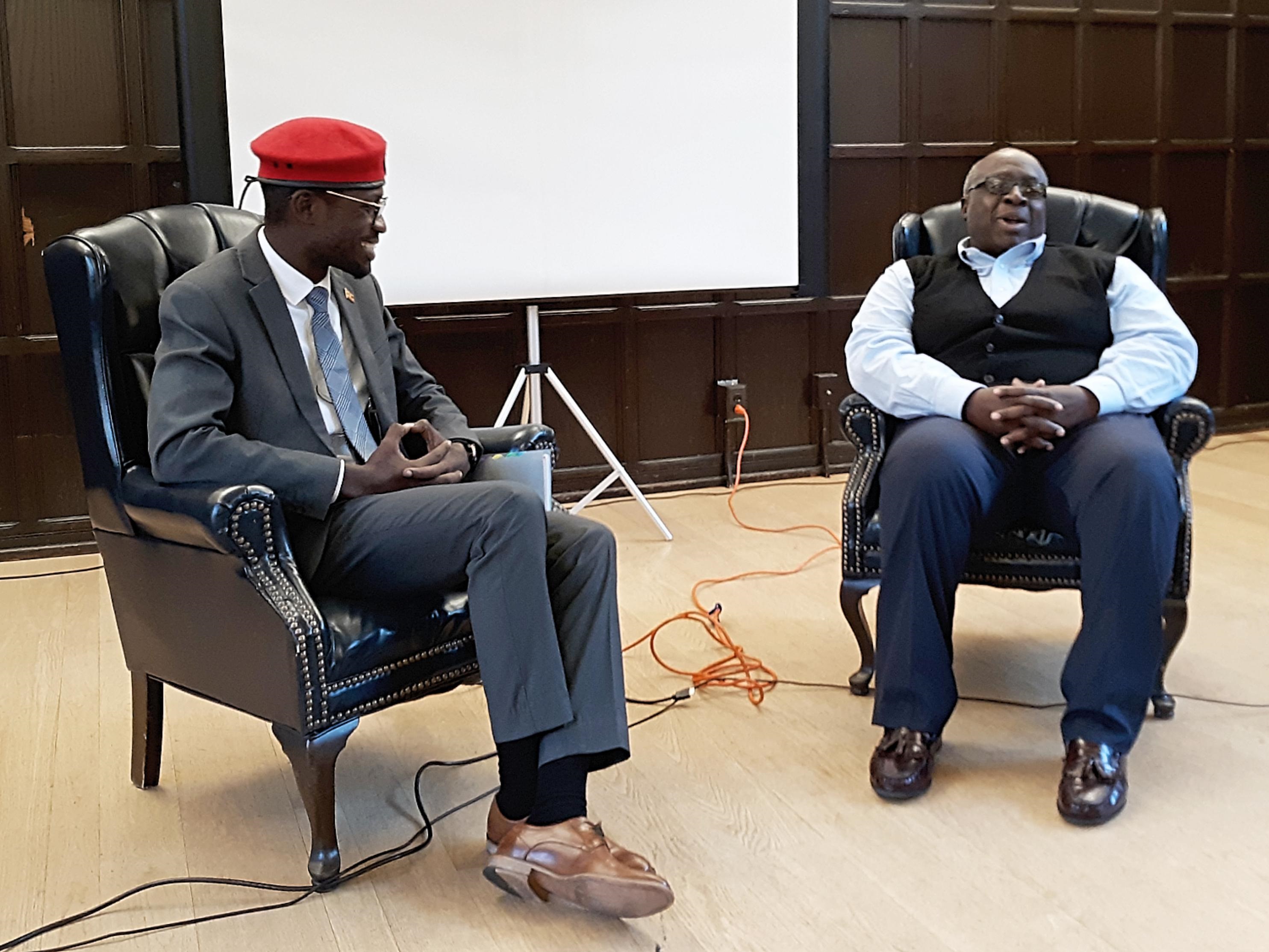
I saw Bobi Wine on Friday (you can watch videos of the talk here and here). This was an interesting experience because no one knew who he was. If you didn’t click on the link, Bobi Wine is the Ugandan opposition leader. That sort of position puts him in the midst of all the usual controversies in struggles over power and politics, which I won’t bother to comment on because I’m in no position to have a particularly educated opinion. But I at least knew who he was!
It was kinda tough to find out about the event. I suppose Wine there is only the opposition leader, but when Yale invited the presidents of Senegal and Sierra Leone to campus, these were known events and showed up in newsletters and the like. Bobi there was invited by the African American Studies group. I’m wondering if they kinda regretted it, because Bobi has in the past advocated for violence against the LGBT community, and has never really come around to full support of LGBT rights. During the talk, both the moderator and another friend of mine pressed Bobi on his stances around this issue, and frankly he gave a very politician-y answer. He talked about supporting the rights of all citizens but never quite said he supported the rights of Uganda’s LGBT citizens.
One answer I did particularly like of his was when one person asked him if he was going to commit to not becoming another Museveni and hold onto power for 35 years once he got it. Bobi said, in essence, that it wasn’t on him to promise not to hold onto power. Instead, preventing another Museveni was about empowering the people and empowering institutions. That’s an answer I thought made a lot of sense; you can’t put all your hopes in just the person itself, but in the position.
But that’s not really what I wanted to talk about. Except for the people at the talk, no one knew who Bobi Wine was. Before the event I asked people if they were going to see Bobi Wine speak. “Who?” “The Ugandan opposition leader.” “Oh.” They had never heard of him. I was no expert on Ugandan politics but I had at least heard of the man. I knew what red hats meant. I couldn’t believe that no one was even dimly aware of who Bobi Wine was. My friend and I showed up to the event 15 minutes early and we were the first ones. The turnout wound up being pretty good, because Yale people like to show up about two minutes late to everything, but still people weren’t exactly knocking down the doors to see a central figure in East African politics. I’ve started to recognize the people that show up to “Africa” things at Yale, and it’s always the same small crowd.
This is just another symptom of what everyone who cares about Africa knows: that the community of people who care about Africa outside of Africa is very tiny. This blows my mind. People give a whole lot of shits about China and the Middle East. But the interesting frontiers of China’s impact on the world aren’t happening inside China, they’re happening in places like Africa where China is having real effects on the ground. If you care about China you should care about Africa, and South America, and the rest of the Global South where China is working to increase its influence while at the same time the US and Europe are pulling away. Bobi Wine was on the Yale campus and every single person who cared about that fit into a not particularly large meeting room. That’s kinda crazy.
The Real Politics of the Horn of Africa by Alex de Waal
This past weekend I went to the final weekend of the 43rd season of the Maryland Renaissance Festival. It was frankly a little upsetting to discover that this was the 43rd season because I distinctly remember the 25th season and I thought that was slightly more recent.
The King arrives!
So clearly I have been going to the Maryland Renaissance Festival for years. As a guy who has actually been to a number of these things, the Maryland version is probably the best and that’s what keeps on bringing me back. Plus my dad is hugely into it. I was probably the one that got him into it, which is a trend for him when it comes to hobbies, because I was also the one that got him into German Longsword and blacksmithing. Dad is indeed a jack of all trades, except his name isn’t Jack and those trades are focused largely on not so useful skills in the modern era.
My dad and me! Dad is in his Outlander getup. It was my sister that got him into cosplay.
But anyways the actual festival! It was a fairly gorgeous day for it, except it was rather cold, which I was very aware of seeing that I was wearing my utilikilt all day long. Very liberating, a utilikilt, but much better in warm weather.
I started off the day by seeing Puke & Snot, which has for years been my major draw to the festival. Due to various circumstances, the show is on its third Snot but was none the less good for it. Frankly I enjoyed all the jokes centered on the fact that he is Snot #3. Those are the only new jokes; they’ve been doing the same act for years but somehow it’s still pretty funny. Perhaps I am merely old and set in my ways.
After that trip down memory lane, I went on several more trips down memory lane just wandering around the festival. When I was I guess 18 years younger I would spend most of the time in shops deciding what I would buy with my whole month’s paycheck from my paper route, which was usually about $100. This was a phenomenal amount of money when I was 12 or 13 and I just about spent it all every time. These days I buy less and see more shows but hey they still got cool stuff and it is still fun to go back to the same magic shops and ball maze games.
They do, of course, also continually incorporate new stuff. The above photo is from “The Danger Committee.” They are one of many many shows at the festival that have about three tricks and manage to stretch it into a 45 minute show largely by being funny. Though the main dude there did also manage to compose a rather great poem about an audience member right on the spot, so he’s probably actually got four tricks. I was just proud of the above picture, where you can see a silvery blur which is the knife thingy (it had more pointy bits than a regular knife) that he is throwing at his compatriots’ heads. Well, he’s throwing it to narrowly miss their heads but still.
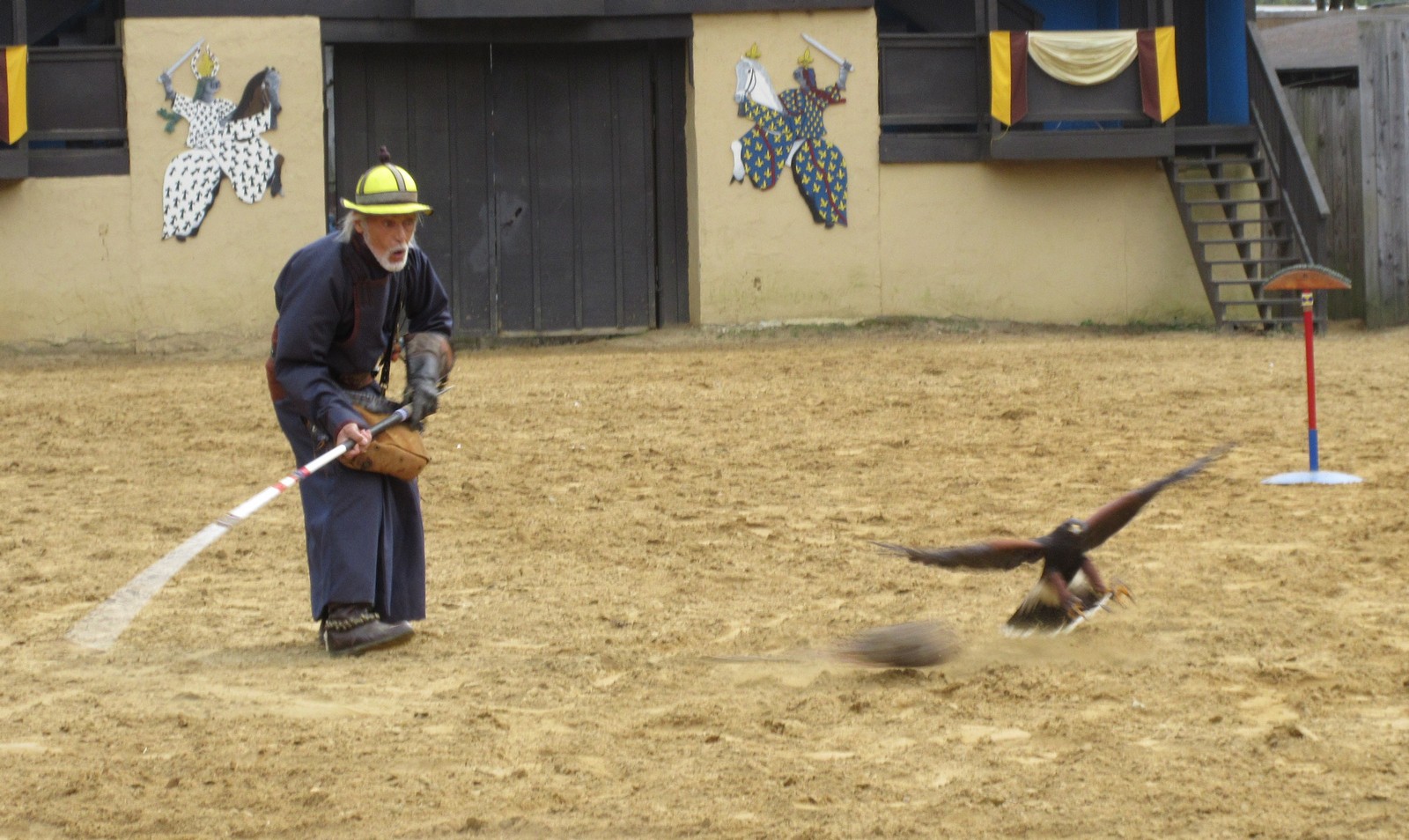
They also have this new (to me) falconry show where they have some falcons and the like and they show off their falconry skills. I am also very proud of the above picture, where you can see the falcon narrowly missing catching the target. What with the target being attached to a stick via a string, it was a lot like playing with cats, except the falcons are even more likely to wind up on top of a pole and not really want to come down. But all in all it was pretty neat.
Every time I go to the Renaissance Festival I am surprised at how quickly the day passes. You imagine you’re going to see every show and go into every shop, but just a few shows and a turkey leg later and you discover that the whole day has gone by and now you’re at the pub sing wondering how embarrassing it is that you are doing this weird dance thing they have you do but then a dude comes and plays a bagpipe really loudly right next to you and that is super awesome because bagpipes are awesome and you should really come to the festival more often but you keep doing this thing where you move to an entirely different continent. Anyways I recommend it. Until next year!
Terrorism and Counter-Terrorism in Africa by Hussein Solomon
I was warned that this would happen almost as soon as I arrived at Yale, but I have talked about Marx more in the past two months than I think in the entire other 30 years of my existence. I don’t know how unusual that is, given that I lived in prototypical suburban America growing up, and then went to the Naval Academy, and then of course was in the Navy for five years before briefly working for Amazon Web Services, none of which are particular hotbeds of pro-proletarian revolutionary thought. In the Peace Corps there was of course much more of a leftist lean, though I think that manifested itself more as something like radical feminism or anti-patriarchy sentiment without ever quite getting to the notion that we’ll have to break down the foundations of capitalist society, or whatever (two months have not made me a Marxist scholar, as you can tell).
I do remember reading while in the Peace Corps In Dubious Battle by John Steinbeck. In this book, as Wikipedia explains, “the central figure of the story is an activist attempting to organize abused laborers in order to gain fair wages and working conditions.” For me, besides of course rousing me to the fight for worker’s rights, the significant part of the book was that it is another example I think of how if you poke at the edges of some of the core authors of the American education system’s literary pantheon you find actual literal communist sympathies that we never quite get around to mentioning in high school. I’m going to lose the narrative thread here but yesterday one of the women in my program got Yale to sponsor an apple-picking trip for us to go on. So part of Yale’s endowment income (derived in a not-insignificant way from the fossil fuel industries) went towards providing a group of largely white and by definition privileged set of men and women the opportunity to pay to perform manual labor on an apple farm. What was the work the abused laborers were doing in the Steinbeck book? They were apple picking.
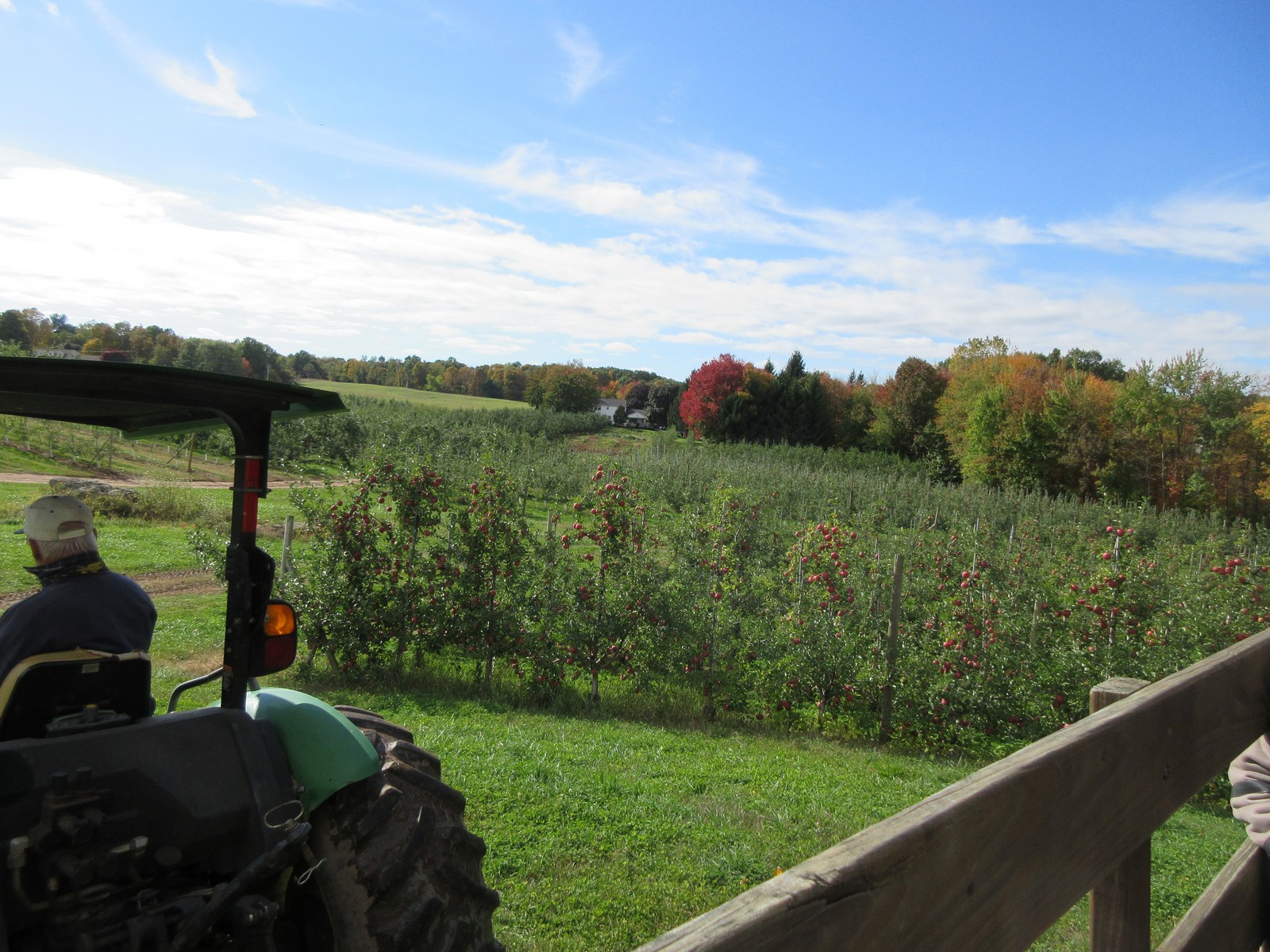
It was a lot of fun! We had hired a big yellow school bus to pick us up from New Haven to take us to the farm. The first activity was a “hay” ride. We in fact rode, but there was no hay, so the name is misleading, but it was pretty pleasant. The scheme here is that the tractor hauls its load of graduate students to the far end of the orchard (part of it anyways; I think they said they had something like 400 acres and we certainly didn’t see quite that many apples) and then you wander your way back picking apples and hanging out with people and apparently most importantly taking Instagram photos. I do not have an Instagram so I was at somewhat of a handicap.
They had a wide variety of apples and people had a whole lot of apple opinions but despite being perhaps the world’s #1 fan of apple pie I have never developed any strong feelings about apples. Some were better than others though. We sampled liberally as we moved along. The uh, cabaret apples I think were my favorite. Something like that. Some apples were clearly more popular than others, given the barren nature of the trees by the time our group got there, but that made it fun because you had to hunt down some exclusive apples. I had to climb a tree at one point. I was wearing my safari jacket though and ready for an expedition.
The day was pretty warm and the colors were fairly gorgeous. At one point I wandered off by myself to the crest of a hill (the trees were too young there to be bearing fruit) and looked out over the acres of trees. It was all pretty and peaceful and stuff. After we all managed to return from the fields the final part of the trip was apple cider and um, cider? donuts up at the barn/store thingy. That was yummy and we hung out some more before getting back on the school bus to head back home. Quite a fun afternoon. That evening I made apple cookies and I still had a lot of apples left so I will have to figure out what to do with them. Pie probably. I had imagined offering these baked goods to people but I think everyone else has the same idea so there will be too many apple-based baked goods. Very inefficient. I think we have discovered why we need collective action to make any real change.
Originally built in 1918! Still in use! Those brick towers are still exhaust towers!
Reading this week:
Foreign Intervention in Africa by Elizabeth Schmidt
So for two years in Zambia I had no one to talk about steam plants with. And lemme tell ya I love steam plants. Here at Yale I also have no one to talk to steam plants with, or so I thought until I got to take a tour of Yale’s Central Power Plant. It was amazing.
I figured out the Central Power Plant (CPP) existed when I walked by it one day on my way back from yoga and I spotted some piping and a load-testing resistor bank. Some googling later I was utterly surprised to discover that Yale in fact has two of its own full-sized power plants, and some other smaller installations. I spent like an hour or two trying to find an email address, and a bit later the manager of the plant had agreed to take me and some other people I convinced to go on a tour. It was by far the best way to spend a Thursday morning I could think of.
What I was most surprised to learn when I first started looking into the plant is that it is cheaper and greener for Yale to produce its own electricity than buy from the grid. The CPP’s main source of power are two large 7.9MW gas turbines which usually run off natural gas but can run off of fuel oil in a pinch. These suckers are cogen units, so the waste heat from the turbines are used to boil water for steam heating and other steam uses, bringing the total thermal efficiency of the system up to an astounding 80%. Plus they have a very clean emissions system and when those bad boys were installed in 2016 the CPP had the strictest air permit in the state. You could hardly go greener without going nuclear (which I would be totally in favor of for the record).
The tour started in the conference room where the three of us on the tour chatted with Troy, the plant manager, for half an hour, geeking out about load shedding and steam loads and all sorts of that good good talk. Then we got going on the tour, hardhats, eyepro, and earpro in place. We started in the control room, where one dude can pretty much control everything in the facility. That’s quite a lot, because the CPP provides electrical power, steam heating, and chill water to nearly the entirety of the Yale Campus, excluding West Campus and the Medical Center. They are capable of going into “Island Mode” and running the whole shebang for about three days straight with the fuel oil they keep on site before they need to refuel.
The two main cogen units (the turbines combined with the steam system) were massive units and still looked pretty much brand new. When we went by they were going full bore, producing about 15MW between them, but still the room was (fairly) quiet and you could barely tell there were two jet engines screaming on either side of us. I was particularly amused by the motto of Victory Energy, which was “Full Steam Ahead!” (as you can barely see in the photo above). The biggest reason I wanted to take other people on this tour is that people talk about energy policy and the like, but they don’t really know the actual infrastructure it takes to keep the lights on in even a small city.
Personally, I thought the funnest part of the tour was seeing all the steam equipment. In the winter, they have a very clear need for steam in order to heat all the buildings on Yale Campus. But in the summer, they still produce a whole lot of steam with the cogen units in order to keep up efficiency and help control the exhaust heat from the system. As a result of all this steam they produce, all over the plant they have a bunch of random steam-powered equipment. They had a bunch of steam-powered pumps (usually with an electrical backup for when they need the steam), but the thing I went giddy over was the steam-powered chillers. I didn’t even know such a thing existed! Imagine! Steam-powered air conditioning! Troy was trying to explain the whole thing but I was just going gaga and taking tons of pictures with my phone. It was amazing.
We went top to bottom on the whole plant, from the condensate tanks in the basement to the cooling towers on the roof (great views), learning all about the systems they put in place to keep the place efficient and running smoothly. The tour ended with a look at the switchboards, where they actually distribute the electricity to Yale’s campus. They’re not allowed to put power back into the grid, so they’re always drawing about half a MW and have the grid on-line of course to provide backup power to their plants. And like I said, in the event of a grid outage, they’ll automatically go into “island mode” to keep supplying power to critical Yale systems like science experiments or heating/cooling for the dorms. It was such a fantastic tour and Troy was a fantastic host and it was nice to be able to talk about how we actually go about keeping the lights on. I can tell you after Zambia that people take for granted the infrastructure that keeps us warm and fed until you don’t have it, and it’s a great learning experience to see what it actually takes to keep it going.


















 Pat in the World
You must be logged in to post a comment.