Shetland IX: Wrapping Up

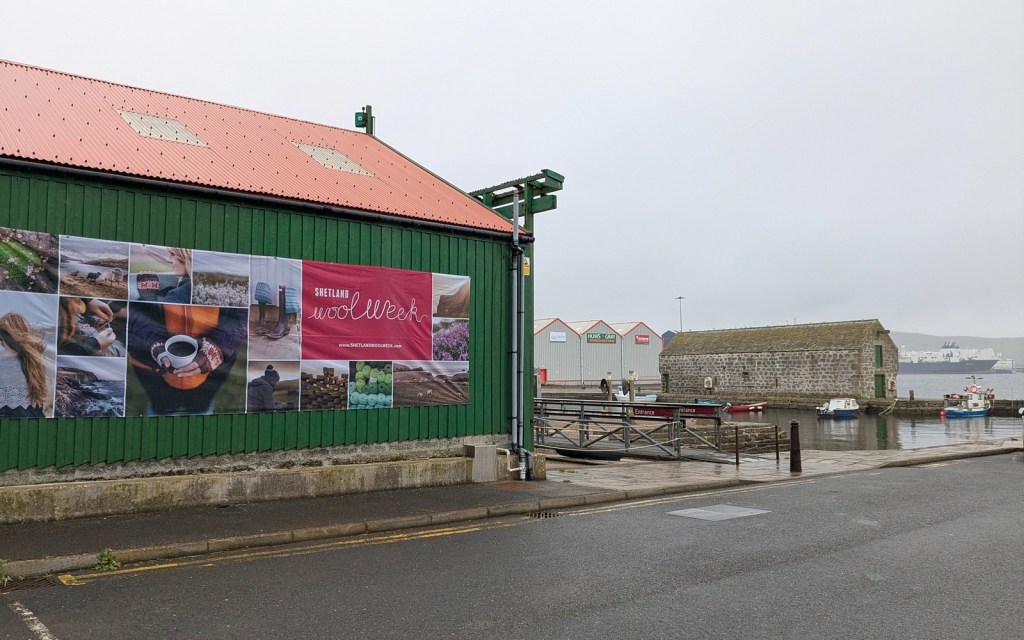
Loyal readers, we have finally come to our final full day in Shetland. Although we had not planned too intense of a day, we had a couple of Wool Week activities slated and were looking forward to those.

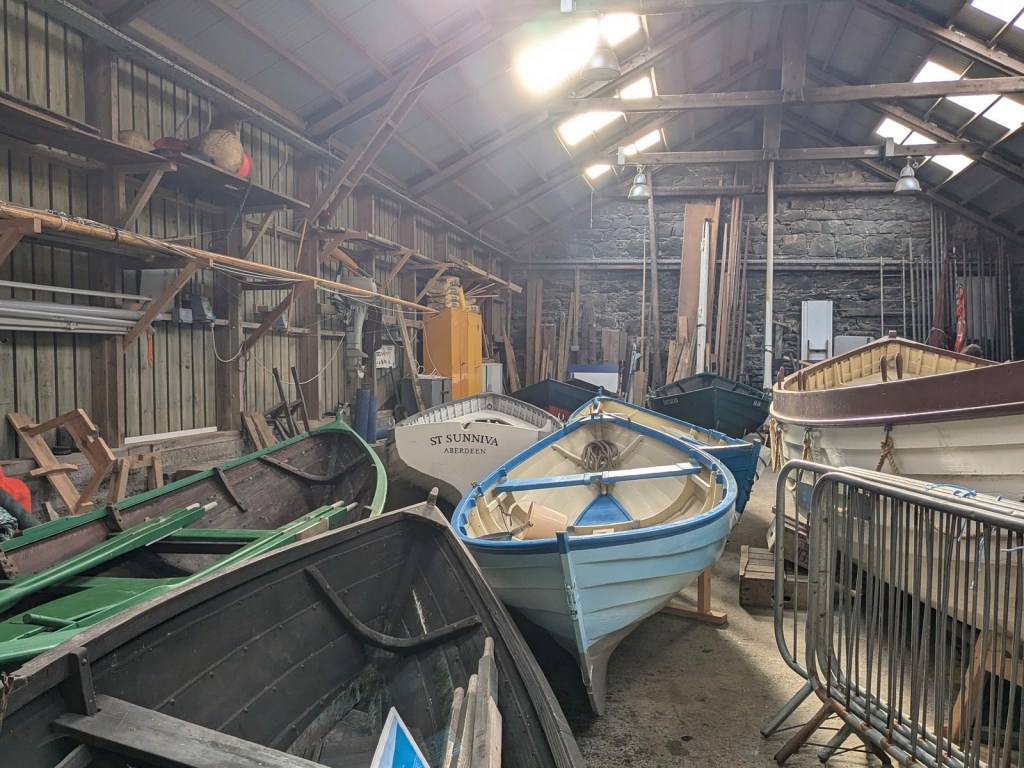
The first of these was a class on net mending. This was hosted by George, a former fisherman with the heaviest Shetland accent I had so far heard. During the net mending itself he also tended to talk with a knife held in his mouth, which added significantly to his charm if not clarity. The first half of this experience turns out was actually a tour through Shetland’s fishing history via the Shetland Museum’s collections. This was a particular and unexpected treat because we got to see the boats. What had been one of the museum’s most popular displays was its boat hall where various examples of historic Shetland boats were hung from the ceiling. But as George explained “health and safety” got to ‘em, and the boats had to be taken down and put in the shed, “where no one gets to see ‘em.”

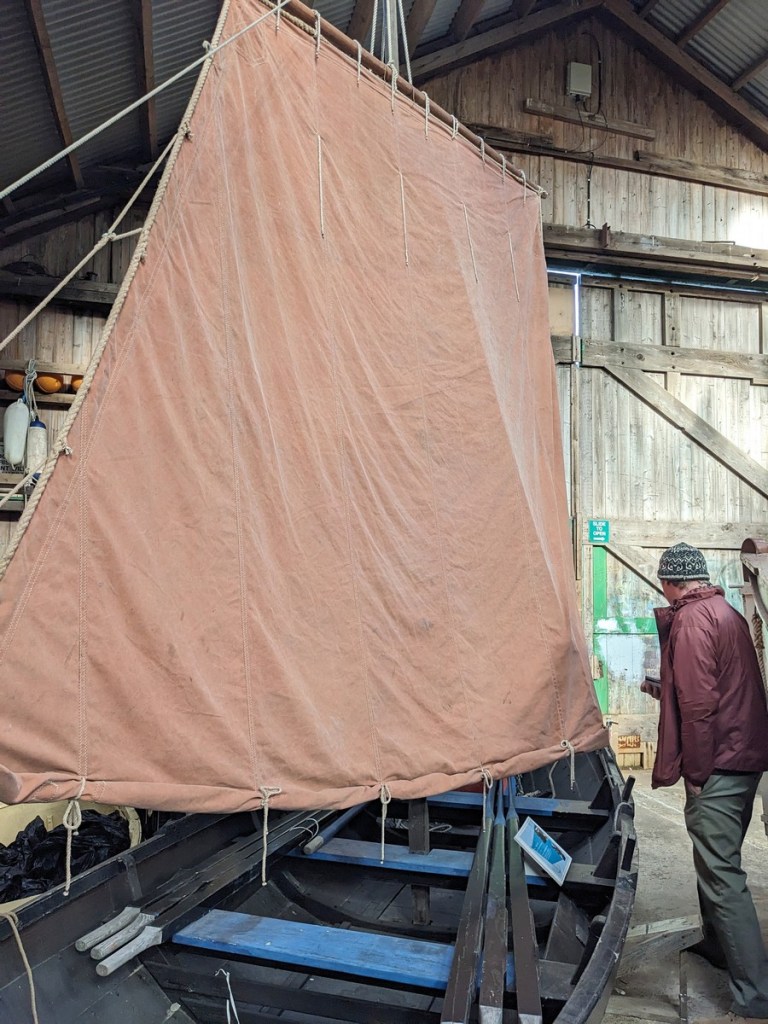
So that was a lot of fun to see the boats. Many of the designs are the descendants of traditional Viking designs and I had a blast poking around and looking at details. I tried to take photos of all the details so you know if I ever need to I can make a Viking-adjacent boat and homemade sails and ply the North Sea. After the boats themselves we went on through the museum exhibits, learning all about the Dutch and the Hanseatic League and all that. Then it was time for the net mending itself. George had a net set up with various holes in it and he showed us the proper technique for patching it back together before letting people give it a go. This was fun, but then towards the end people started to ask George more questions about fishing nets and man’s eyes really lit up. He got some paper and started diagramming different net configurations and constructions, and when people asked him about a whole net-making course he told us about trying to get it going but there were budget issues; apparently all the materials are quite expensive. It was very fun to learn from George and hear all about his long and storied fishing experience out of Shetland.
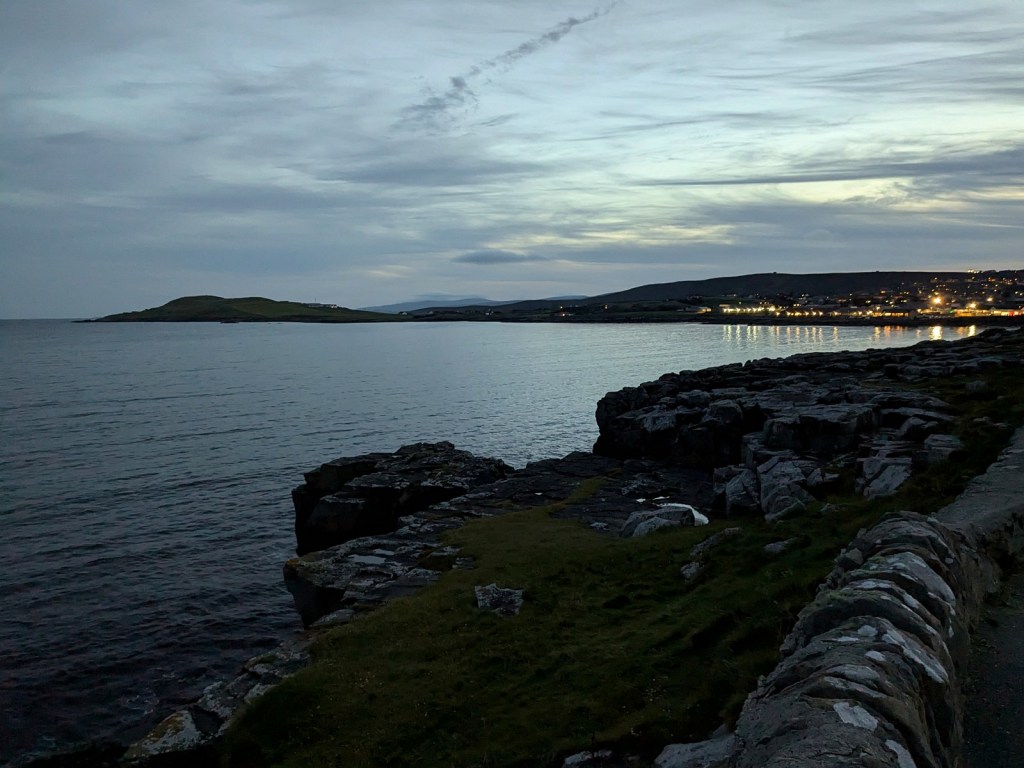
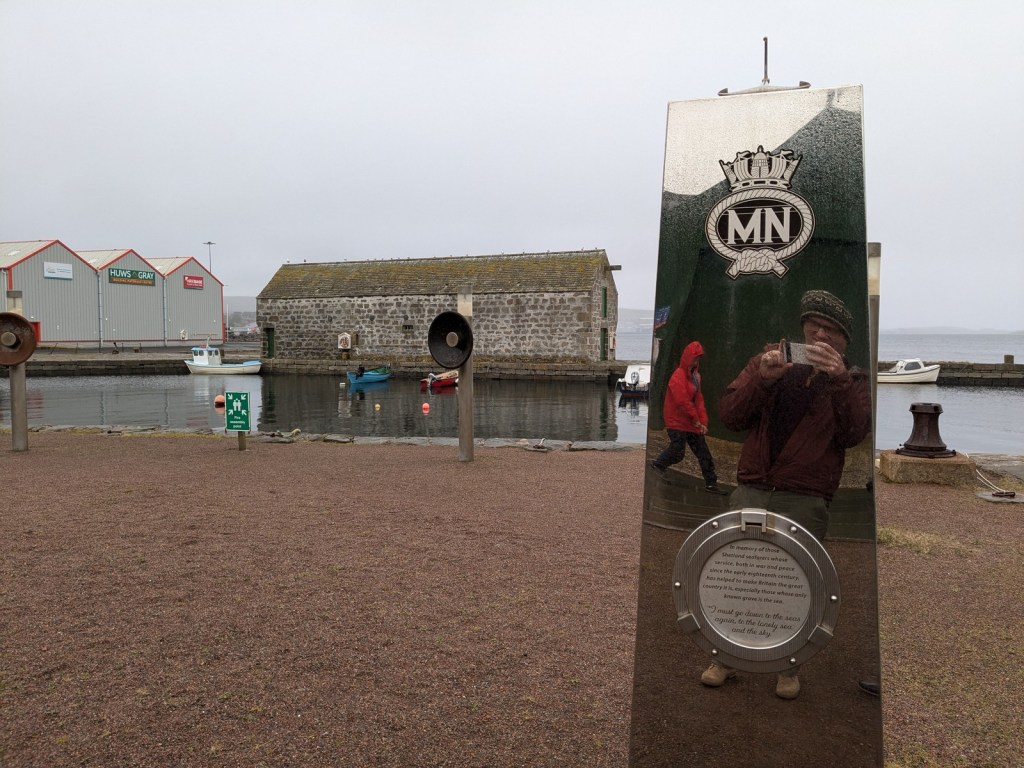
By da sletts (out of frame to the left).

Our next event wasn’t until the evening so we had the afternoon to spend in Lerwick. We first got lunch at the Fort Café & Takeaway, an absolutely lovely little chippy that was kind enough not to make us feel too out of sorts as the confused tourists trying to order some fish. It is the sort of place where if we didn’t speak the local language we would be bragging to our friends about the quaint cultural experience we had. Also we later saw it in Shetland and that was cool; we had sat at the same table as Jimmy Perez! Then there was some final shopping, including soaps from the utterly wonderful Shetland Soap Company and a Jamieson’s Fair Isle sweater jumper along with some yarn. For dinner we celebrated Wool Week by getting the lamb at No. 88. A walk along down to the da sletts rounded out our evening activities before the final talk.
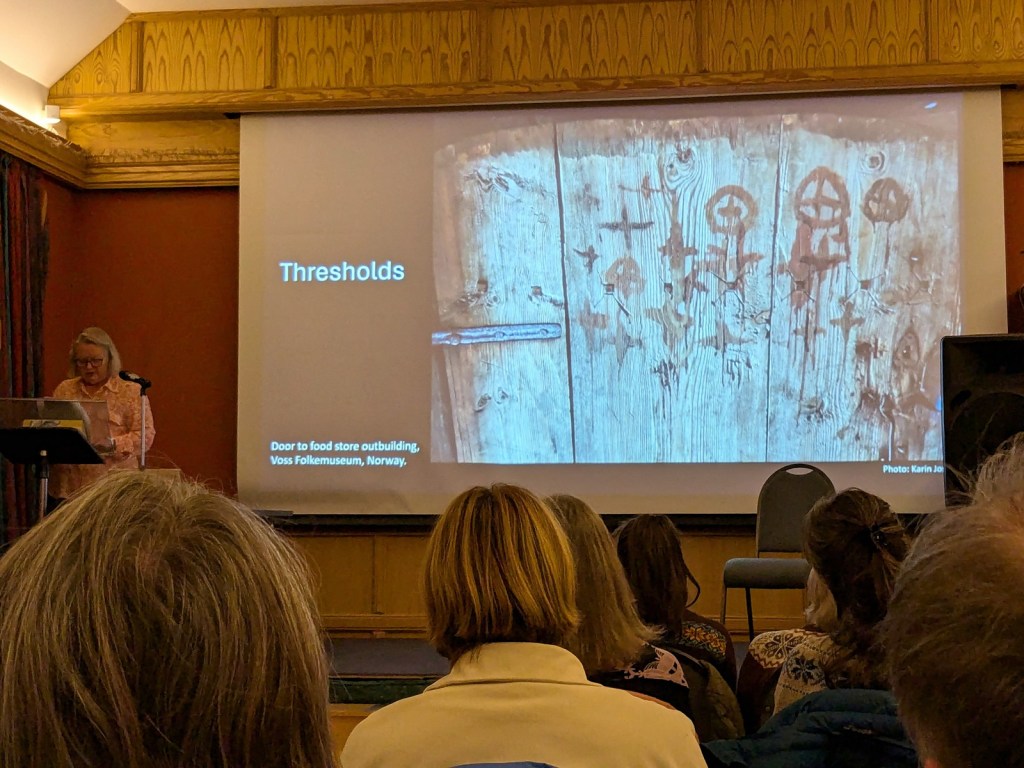
Slide from Dr. Christiansen’s talk.

And what a talk it was! It was all about the folk symbolism of taatit rugs. It was given by Dr. Carol Christiansen and was fascinating. Taatit rugs are in fact heavy pile bedspreads, important for blustery Shetland nights. She had gotten interested in the rugs as a window into Shetland folklore. The rugs often feature particular symbols and no one quite was sure what they meant. So she sat down to figure it out and turns out it is pretty deep. Most of the talk was a dive into Shetland mythology, much of which is linked to Norse stories but which have developed on their own on the isles. Especially important were the trows which inhabit Shetland. With sleep being such vulnerable times, the symbols on the taatit rugs acted to ward off the witches and trows that could come and prey on you at night. The rugs also had other stories associated with them, and would sometimes be made by a betrothed couples’ families as a wedding present. Since these were some rare textiles made purely by and for Shetlanders for their own private homes they were such an interesting window into the local culture.

And with that we were turned out into the night, with no symbols to protect us, and our Wool Week was done. We drove on back to the inn and did our final packing, nervous about the weight of all our souvenirs. In the wee hours of the morning we drove on down to the airport, got confused about where to leave the car (turns out, anywhere), and checked into our flight (I’m not sure they even weighed the bags in the end). Shetland was such an interesting and friendly and beautiful place and we are so very excited for when we get to go back.

Shetland VIII: Real Estate

Waves off Sumburgh.

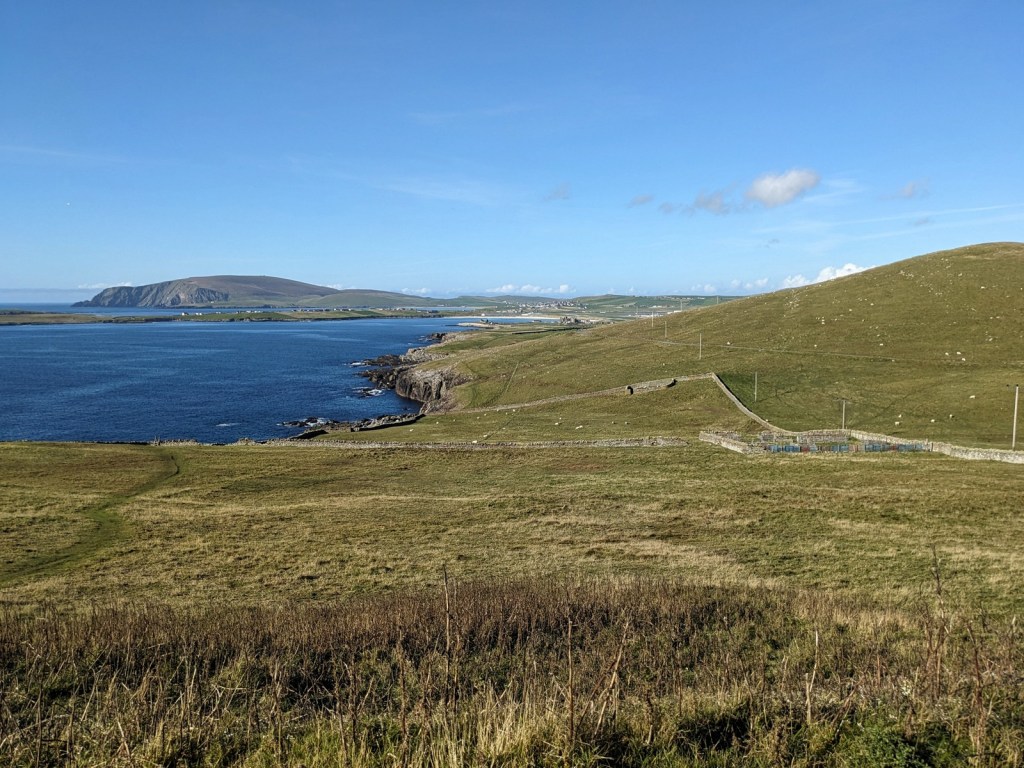
Having spent more time learning about crofting than we had anticipated, it was now time for lunch. And so we cruised on down to the Sumburgh Hotel. This felt like a particularly fancy option but they in fact had very low-priced lunches (later on as we were watching Shetland we were delighted to recognize the hotel featured as a retirement home). Plus the views off Sumburgh are gorgeous, though that is true of everywhere on Shetland.

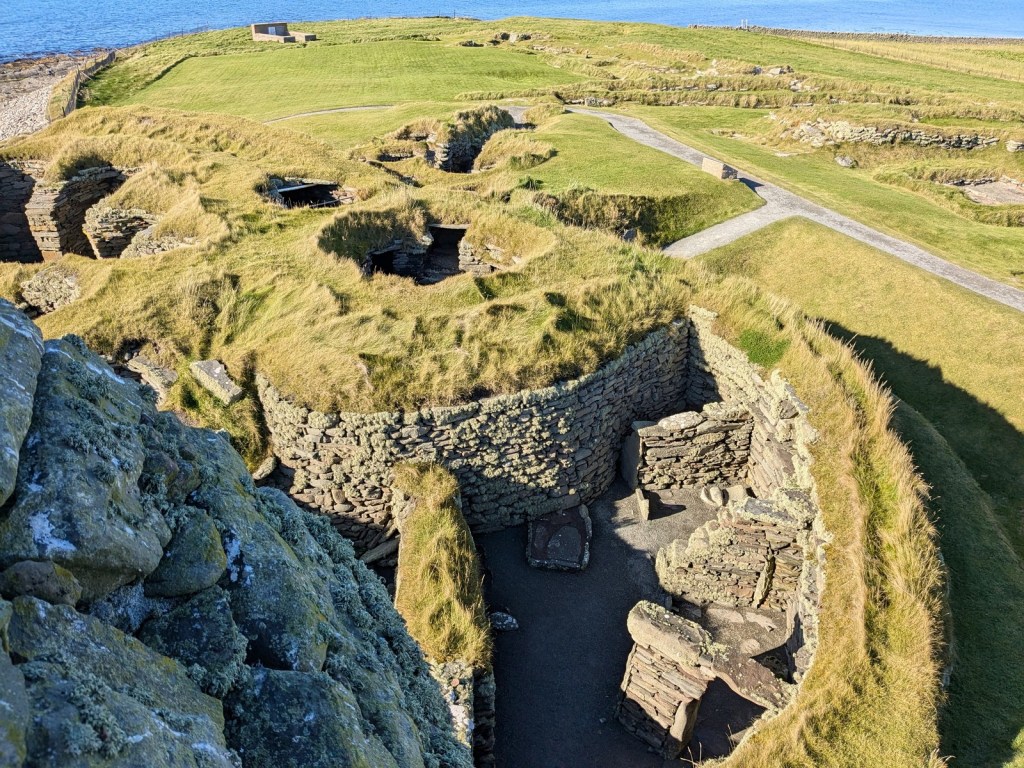
The hotel was however also extremely convenient for being right next to Jarlshof, an archeological site and our next destination. It is a very well-developed site, much to my surprise. It has an admission fee and an audio guide and everything. And it is very impressive and cool (also, it’s another Sir Walter Scott site; he coined the name “Jarlshof” in The Pirate). Some 4000 years of history is laid out, from a bronze-age settlement right up to a medieval farmhouse. All these different ruins are stacked atop each other and I always find it fantastic when people decide to just keep on living on the exact same spot for thousands and thousands of years. Though it is Shetland which I suppose means there is a bit of a dearth of options.

Bronze-age smithy. Like they left just yesterday.

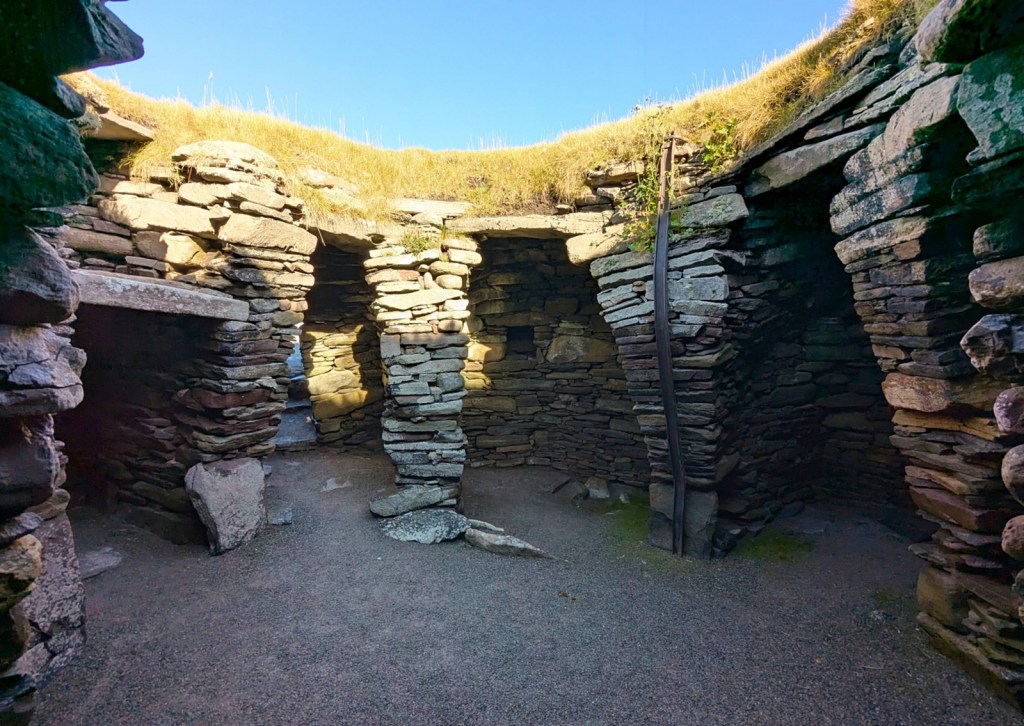
The audio tour and paths have you wind up through history in approximately chronological order. I am always entranced by old-fashioned blacksmithing and they have the remains of a bronze-age smithy. Then you wind up past a very well-preserved broch, and it would have been even better preserved if it weren’t for erosion cutting away at the site and dumping about half the broch into the sea. A highlight of Jarlshof is one of the best-preserved wheelhouses anywhere. It had a very tiny entrance that I could barely squeeze through without crawling, but I very much wanted to see the wheelhouse. Though when I got in there I discovered a much larger entrance and I could have just used that. I could see how it would have been a really very cozy place to live but man it must have taken a while to build one of those.

From there you stroll through the remains of several Viking longhouses before finally ascending up to the highest and latest part of the settlement, the laird’s house. This might actually be the least well-preserved part of the site, though you could tell it would have been quite the house in its heyday. Per usual it’s good to be rich. The best thing the remains of the house offers though is a spiral staircase up to a platform where you can get a beautiful view of the ocean and coastline and most importantly for our narrative the Sumburgh Head Lighthouse, our next destination.

Sumburgh Head Lighthouse from afar atop the Laird’s House.

Although by this time we had ticked over past tourist season which meant the visitor center for the lighthouse was closed, you could still go up and walk around the grounds. And man it is gorgeous. Public parking is near the bottom of the hill (there are higher drop-off points for those not so good at hill-climbing), but even this provided some fascination because there were sheep grazing all around and we of course like sheep. As you ascend the hill you just get more and more stunning views. My super amazing wife was hoping to see a whale, but without tourists to look at them the whales had since departed for other waters.

Sumburgh Head Lighthouse from right up close.

Since the lighthouse is surrounded by cliffs this is also an excellent spot to watch the birds. We didn’t know much about birds but we are 30-somethings so of course this has an appeal. They certainly seem to have some cozy spots there on the oceanside cliffs. Up at the top we got to admire the lighthouse itself which is of course very nice, but also of course this is certainly one of the most expansive seascapes you’re going to be able to see in all of Shetland. On a clear day, which this very much was, you’re supposed to be able to see all the way to Fair Isle. I did not spot it but eventually I concluded it was likely directly up-sun and therefore invisible to us.

Although we were taking a break from Wool Week activities on this day it had been too many hours since we had last seen wool so it was time to check out some knitwear places. Specifically Nielanell and the Shetland Woollen Co. Both had very cool stuff and cute little shops and are worth the trip to Hoswick to check out. Though the only thing I actually bought was a lapel pin from the Woollen Co because it features a cone of yarn that looks like a broch and that is a very witty. Since we were in Hoswick we went to their Visitor Center, even if we only had 15 minutes until closing. It is well worth a stop-in (and around the corner from the other two shops) and from their very cute little gift shop we picked up a knit blanket in a Fair Isle-pattern but with natural Shetland sheep wool colors along with a miniature basket of peat, both capable of keeping us warm back home. Although it never stopped us, by this time we were worried about hitting the rather low weight limit on the Loganair flight, but how can you pass up a knit blanket?

The broch of Mousa! I am told it is bigger up close.

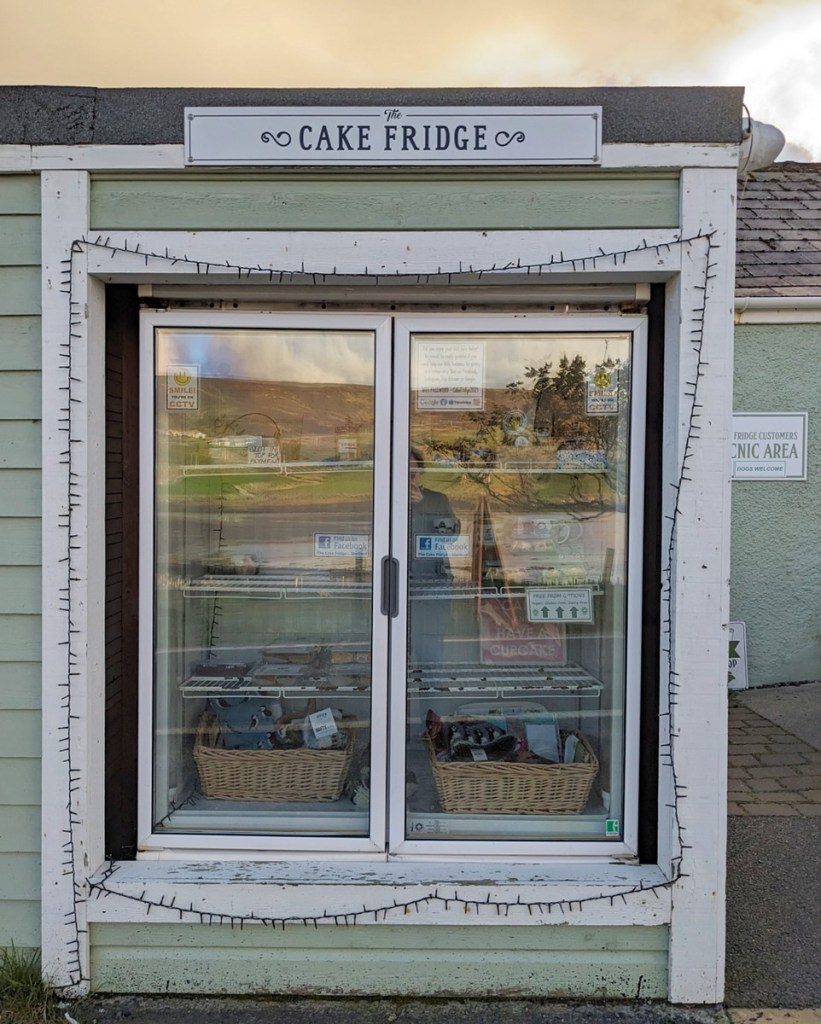
Just a couple final adventures and misadventures to round out the day. I had sorta kinda wanted to see the broch of Mousa while I was in Shetland. I knew we were too late in the year for the ferry but was hoping to catch a glimpse from afar. From Google Maps I tried to identify a likely lookout spot and then had us try to drive there, though gave up before we were like, barreling through some poor farmer’s field. So we departed but then as we were driving up some random hill BAM gorgeous viewpoint. I had been a very conscientious driver up until now on the one-lane roads but suddenly I was pulling weird u-turns to the consternation of the very patient woman behind me (in the other car to be clear, not my super amazing wife, who was also very patient with me). Then there was ANOTHER great view point and I pulled over again and got more views but luckily for the sanity of everyone involved that was the end of it. By this time we had experienced a very full day but cakes are irresistible so we did make one final stop at the world-famous original Shetland Cake Fridge to pick up some dessert for that evening. A wonderful end to what was a very fun-filled day with just too many beautiful views to count.

Shetland VII: Crofting

Reading this week:

  • Chief of Station, Congo by Larry Devlin

On the Wednesday of our Wool Week wanderings we had no planned activities. Well we did but we decided not to do it, the sunk cost fallacy obliterated by the fact that we had bought the tickets months before. We tried to give ‘em away but alas, no takers. This meant we spent the day driving around Shetland looking at various things in an even more touristy vein. At least things on the “mainland” anyway; we were too lazy to try to figure out the ferries.

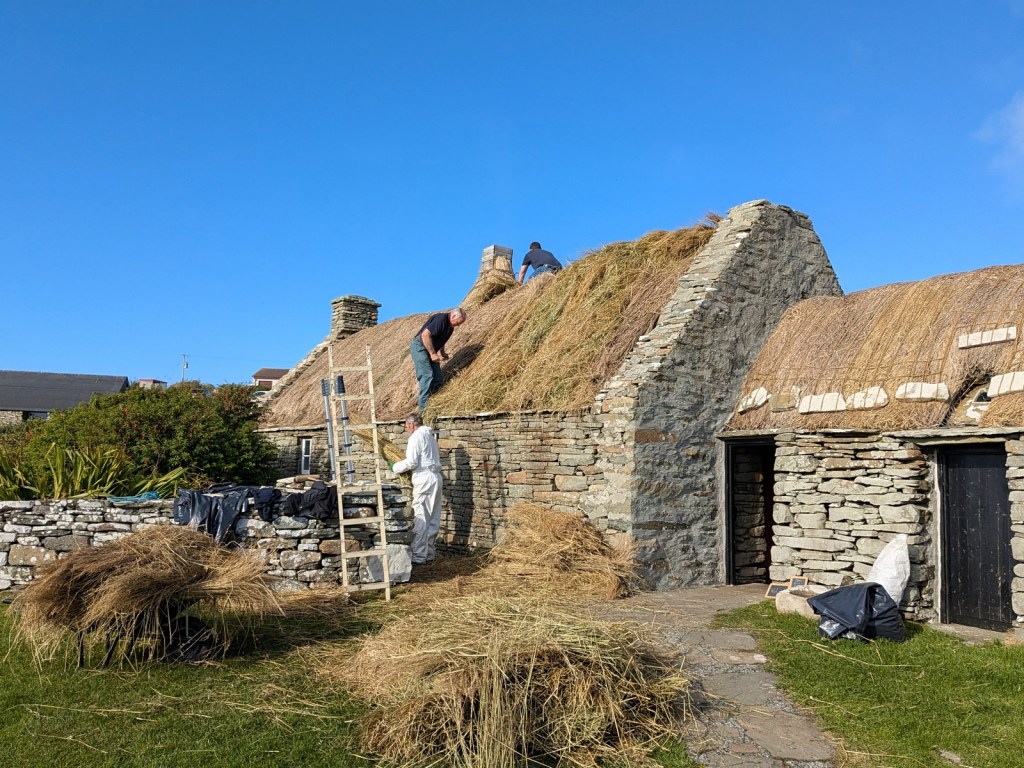
Our first destination was the Crofthouse Museum. This museum was all about the traditional way of farming life in Shetland, each farm being a croft and the house being the crofthouse. The museum is set up as though it was the 1870s but the house was in fact lived in up through the 1960s. What had happened you see is back then a group of Shetland diaspora were visiting the islands from New Zealand where many Shetlanders had emigrated. Disappointed that the old ways of living were being lost but not having to live there themselves, they put the money together the money to preserve a crofthouse, and the museum was born.

They were re-thatching that day; apparently hard to source the right straw these days.

The crofthouse is a traditional but and ben with an attached barn. Upon our arrival we went on in to the house and promptly went into the barn and were very surprised by the utter lack of living quarters in the place. Then we figured out you had to open the door to the actual but (kitchen/living room) and ben (bedroom) part of the house. Thereupon we discovered Linda, who was that day giving tours of the place.

Honestly it is a super great shed I wish I had one.

An aside. One of the most famous things about Shetland these days is Shetland, the TV series. This is a pretty great show and me and my super amazing wife are working our way through it to relive our glory days on the real-deal island. It’s a murder detective show and since it’s been going on for nine series now it has touched every part of the island. They have to; the fictional murder rate in the show would leave the real-life islands nearly depopulated. The upswing of this is that everyone we met seemed to have had some connection to the show, and everywhere we went had been a filming location at one time or another. The Westings Inn, where we were staying, had been the scene of a fictional murder. The star, Douglas Henshall, was known for biking around the island to the various filming locations. There is apparently a Facebook group where the show producers will put up posts about needing extras or various props to see if someone has something. Here at the crofthouse museum our guide Linda told us about her brush with fame, where the show needed an old-looking suitcase as a prop. She had one and sent in a photo and the production decided it was perfect. Linda volunteered to bring it on down, but instead they sent a car service for the suitcase, which marked it as a real celebrity. The show eventually returned her suitcase intact and significantly more famous.

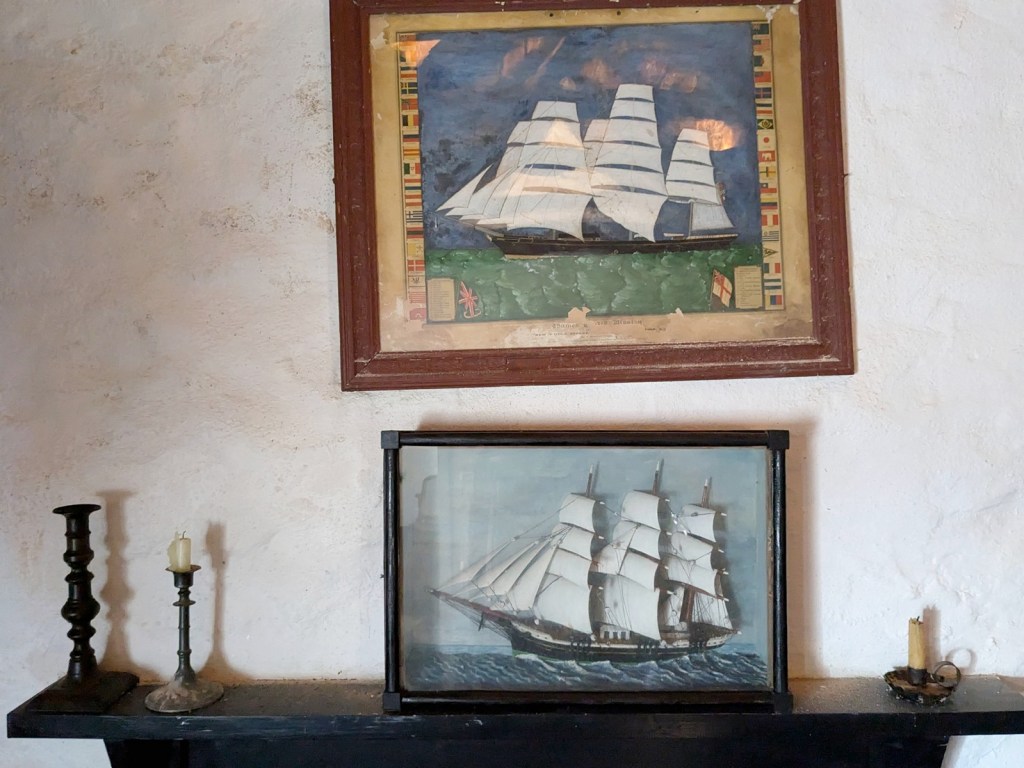
But back to the 1870s. The crofthouse was an all-in-one farm production facility, as referenced by us having gotten lost in the barn, which was under the same roof (having the cows next door provided warmth and was also convenient for doing chores without having to go outside). The but was where the cooking and knitting and other household activities would go on. They had there a big frame for doing lace and fish drying and the fireplace for cooking. While we were there Linda had a small peat fire going to keep the place warm (hence the closed door which confused us), and we learned that while Shetland has outlawed commercial peat harvesting since 2021, locals can still do it by hand for personal use (she showed us the tools and talked about having gone out to harvest peat as a youth). The crofthouse is really a very cozy home, though with a whole family I can see it feeling cramped. This example was a fairly well-decorated one, including a clock from Connecticut that was apparently all the rage in the 1840s. It said “E. Pluribus Unum” and like hells yeah man, ‘Merica. They also had some ship-themed art which is near and dear to my heart.

Sleep tight! Also check out those heart details.

Another fun fact is that while the but is the living room of the house favored guests would actually be brought into the ben, which was considered the nice room despite or because of being the bedroom (since it was the bedroom it wouldn’t be full of cooking and laundry and chores). The beds themselves were encased in a sort of wooden chamber or cabinet. As you crawled in at night this gave you some privacy and extra protection from any cold winds blowing through the roof.

A driving consideration for the architecture of the house is that wood is precious on Shetland. There are no forests so all the wood that comes ashore is driftwood, either from natural causes or perhaps shipwrecks. So parts of the house will be cobbled together from whatever wood you can get; I think the stalls for the cows were separated by bits of barrel and ship rudder. Outside there was a shed roofed by an old boat that was no longer seaworthy but was still roof-worthy, I guess. Waste not, want not. And then finally and unrelatedly I just personally thought it was very funny that the museum had installed modern toilet facilities in what I think was another barn, which would have been quite the juxtaposition if it was historical.

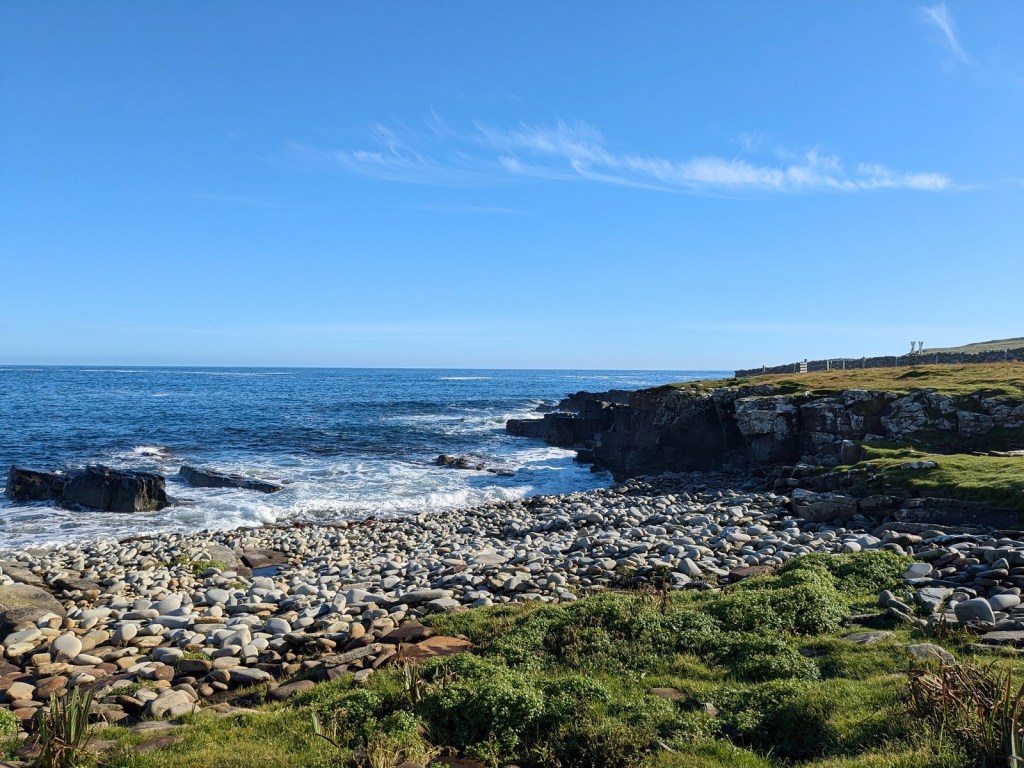
After seeing the crofthouse itself you can wander on down towards the seashore and check out the local mill. Inside the crofthouse there was a small hand-cranked mill for grinding grain, but also the neighborhood had gotten together and built a mill powered by a small local stream. I am kind of amazed it worked given how tiny the stream is. The building itself has signs outside warning you not to go in due to its dilapidated state, but looking underneath you can see the waterwheel and around there are the remnants of water control mechanisms. Then down on the seashore we just wandered around the rocks and admired the waves and enjoyed a very sunny and warm day. The crofting life could not have been easy, but there had to have been some real pleasant moments.

Shetland VI: Industry

Lerwick harbor from the Böd of Gremista.

In my last entry I fast forwarded from Uradale Farms to a talk given by Jamieson’s of Shetland, but we in fact did several other things in between those two events. The most significant one of which was visiting the Ninian Shetland studio!

We didn’t have a tour guide on this excursion, which meant when the bus driver (a different one from our buttonologist) dropped us off at the studio in Scalloway he just sorta told us to head on in and we were very confused (it’s not their storefront so it didn’t really have like an obvious door we were supposed to use). But eventually one of the ladies on the tour knocked on the door and Ninian founder and designer Joanna Hunter answered the door and had us come on in. This gave the whole thing an air of us having just popped in though of course Joanna was expecting us. She was apparently very excited to the Wool Week group as opposed to non-knitting specialists (which I suppose includes me actually) who just didn’t understand what she was all about.

Joanna seams up an arm warmer.

Joanna was very fun and very cool and gave a great talk. Her husband is English and her sister-in-law in French and she interacts with a lot of Americans and when talking about people would do their accent which made things very funny. The thrust of the talk was her design process, and to describe it she absolutely loaded up the table we were all sitting around with various knitwear examples. What she was most excited about was that she had apparently been cleaning out her parents’ attic to put insulation up there when she found a bunch of old family knitwear her forebears had knit so she had been diving into those for inspiration.

She clearly puts a whole lot of thought into textiles (I suppose this is her job). Ninian does machine knitting, and she opened the talk by telling the group that we would all be converts by the end. And you know what I do want to get one of those suckers. I don’t think it would be too bad to get a “domestic” knitting machine, as she called it. Prior to this I had been familiar with circular sock-knitting machines, but it had not occurred to me that you could also have a flat knitting machine. Ninian had recently acquired a gigantic Japanese computer-controlled machine and it was pretty impressive.

Pile o’ knitwear.

Just because a machine does the knitting though doesn’t mean there isn’t a lot of work involved. Joanna had a crew of 10 or 12 women putting together all these items. Although the machine produces the flat pieces of knitting you have to seam them up to make them into 3D garments. There is a machine for this but it still involves someone lining everything up by hand (later at the Jamieson’s talk they told us their limiting factor in how many sweaters they could produce were finding skilled operators of these seaming machines). And that’s still the end-stage of the process; Joanna talked about having to test different tensions for one design because the two layers had different weaves, so it was a lot of R&D to make it lay flat.

My biggest surprise during this whole talk was learning about how recently Shetland had a household-based piecework textile industry. That feels medieval, like in middle school when they are teaching you about the history of industrialization they are like “peasants used to have looms in their homes but then they invented sweatshops” and you bask in the glow of capitalism. But although Joanna had started her knitwear business 25 years ago she really got her start helping her granny out run pieces of sweaters off of their domestic knitting machine. Apparently everyone on Shetland had one (Joanna will still test designs on one in the corner of the studio instead of getting the big computerized Japanese one going), and she talked about her grandma getting deliveries of yarn from the wool companies, which she would knit up and send back. This was, by Joanna’s telling, the thing everyone in her neighborhood did. They taught knitting in schools even, for both boys and girls. This was wild to me but maybe we could learn a thing or two.

To wrap up the talk, Joanna ran off an arm warmer from the knitting machine. To finalize our conversion to machine knitting she wanted to show us how fast it was, and it was indeed pretty fast. The machine spit out the flat version and then Joanna took it over to the seam linker machine to finish it up. It was very cool to see the whole process in action. Later on we would get some pillow cases from Ninian’s which we like very much.

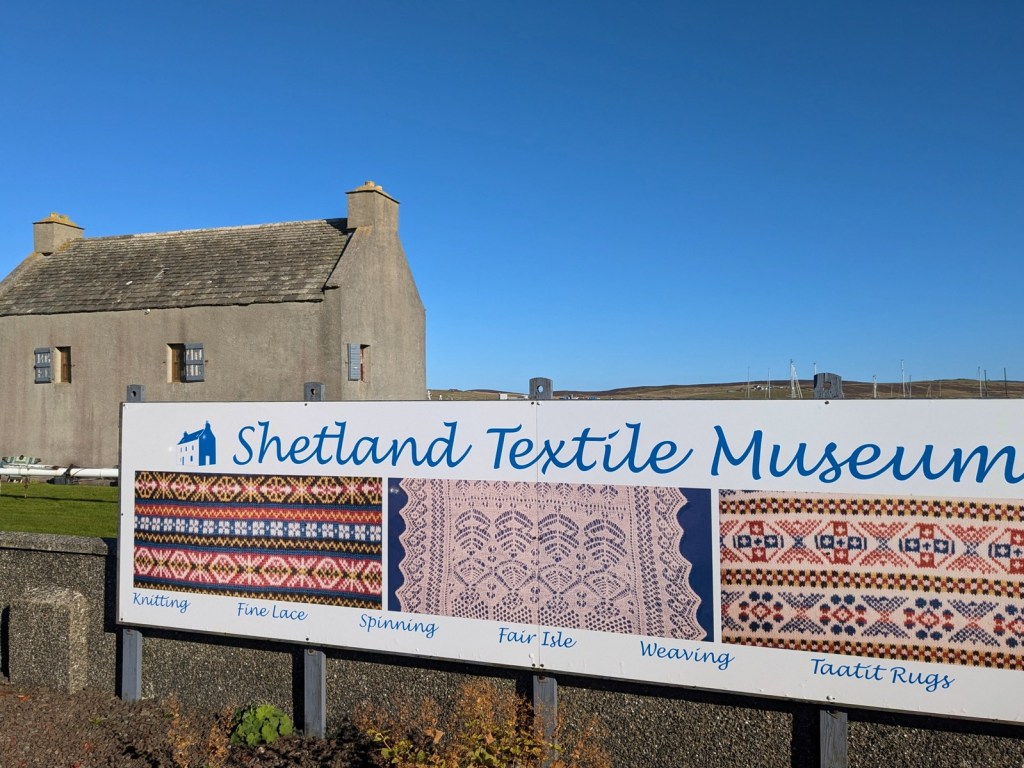
Back in town our next destination was the must-visit Shetland Textile Museum, housed in the dramatically named Böd of Gremista. A böd is a warehouse sorta thing for storing fishing equipment, and also for storing fishermen when they are away from their homes. This particular one was built by the manager of the Gremista fishing station, hence the name. Before the Textile Museum, the böd’s claim to fame was as the birthplace of Arthur Anderson, co-founder of the now-defunct Peninsular and Oriental Steam Navigation Company. But you knew that as I did from the Wikipedia.

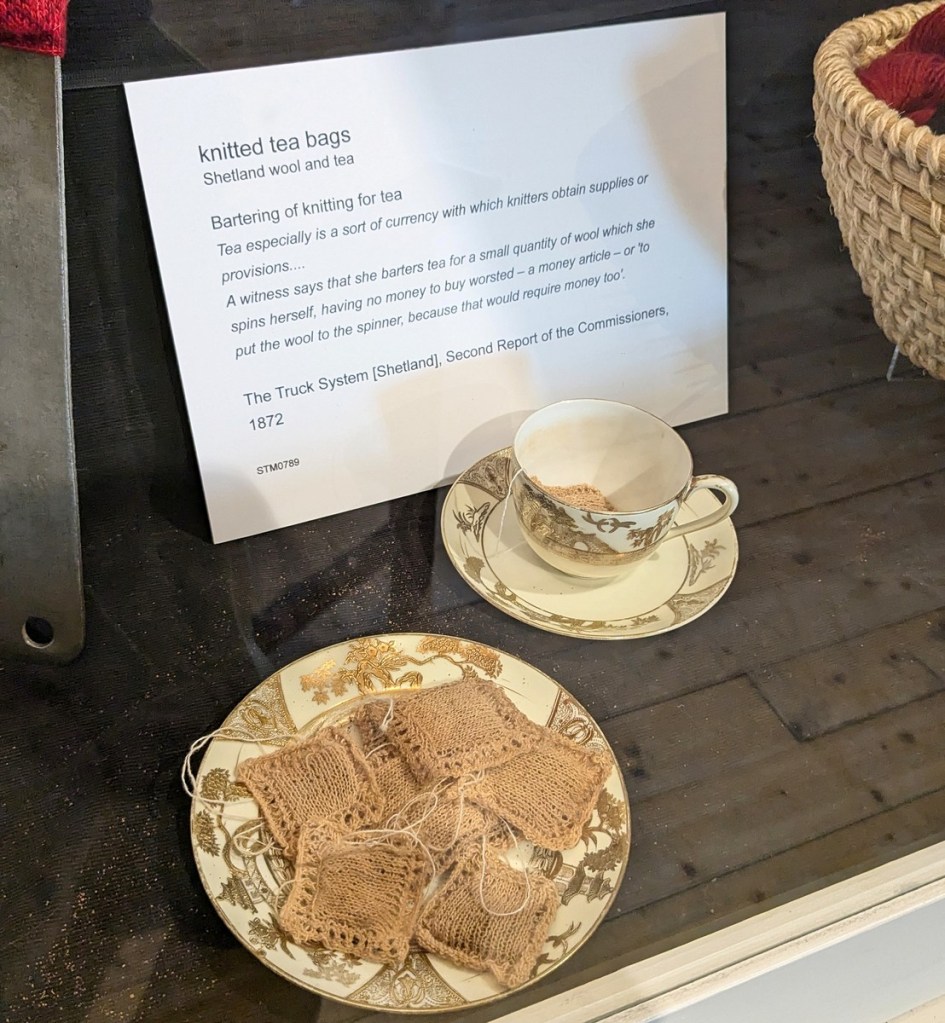
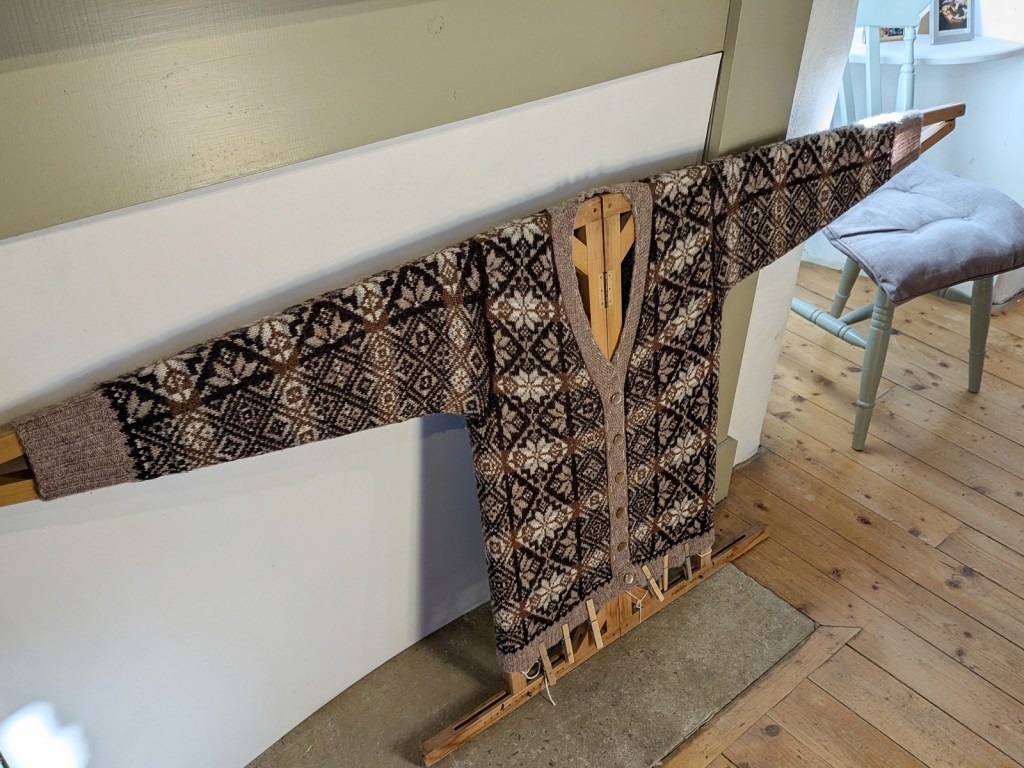
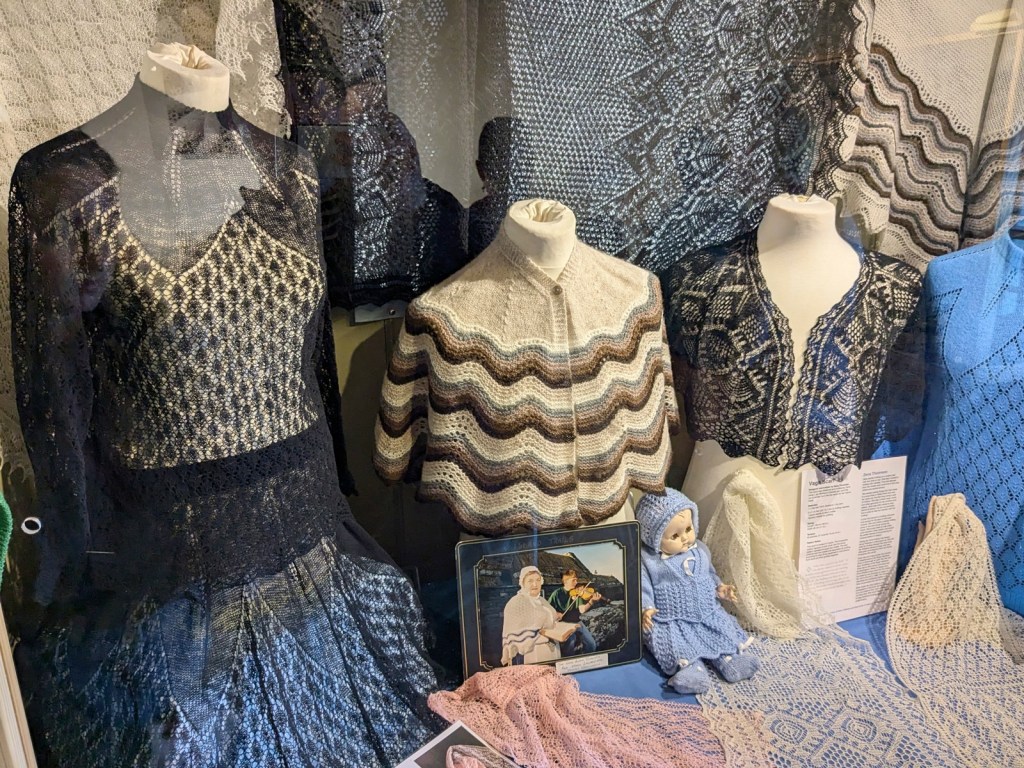
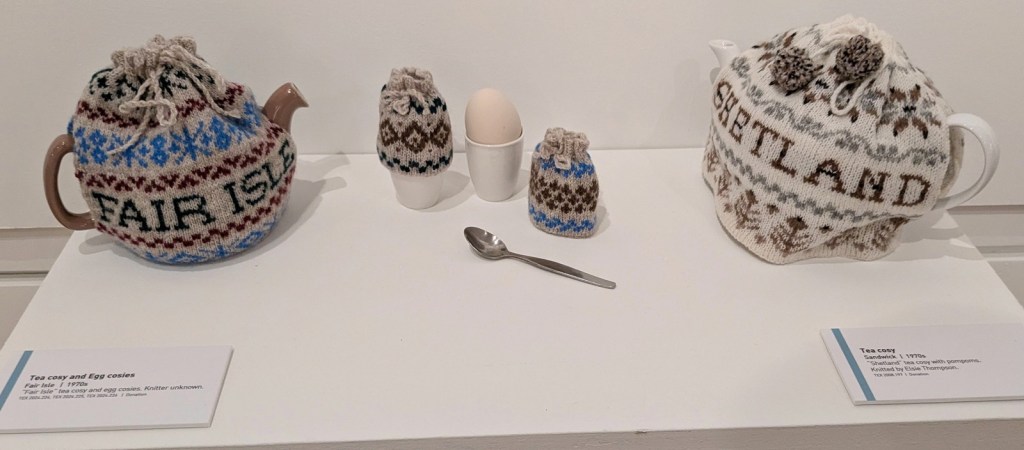
The museum is pretty small but very nice, and seemed to be overwhelmed when we visited with Wool Week visitors. They have a small room with a large loom (perhaps the last of its kind on Shetland), which was the traditional loom for weaving tweed. This room also housed a taatit rug, which at the talk we went to on our final night in Shetland the phenomenal presenter described as the only fully domestic textile on Shetland, what with the knitwear largely being for the export market. But then you go upstairs at the museum and it is stuffed with a whole bunch of displays of various donated traditional Shetland knitwear. Really a great source of inspiration and also history in the flesh (wool). An essential visit when you’re in Lerwick.

Me at Clickimin.

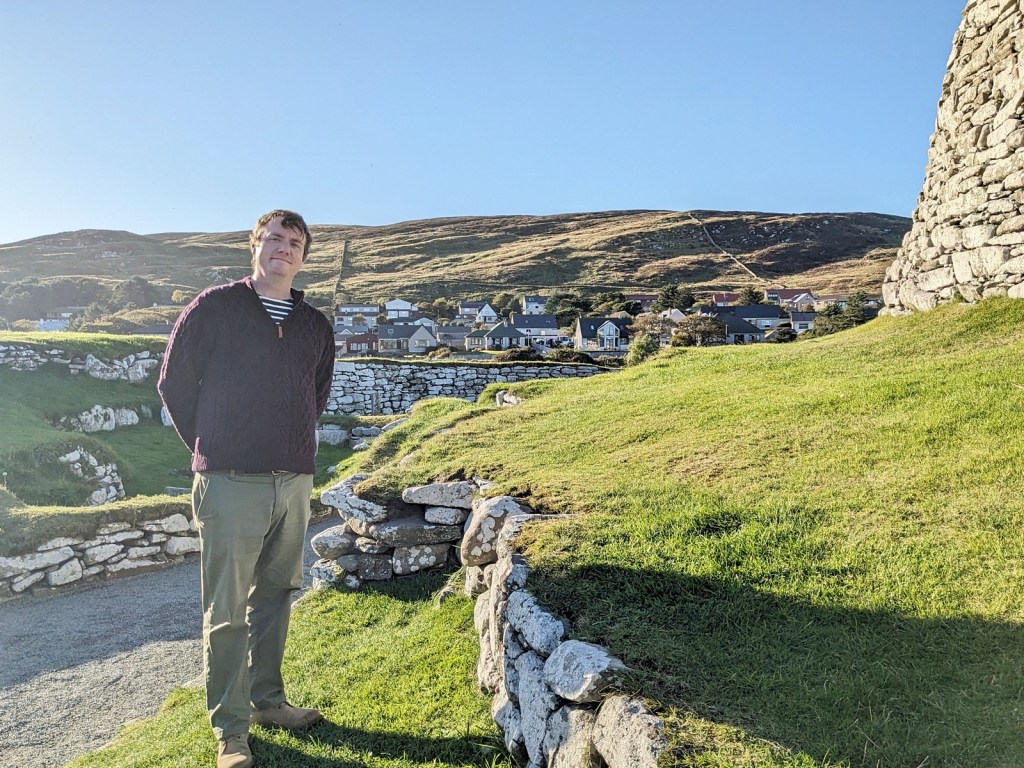
Since you’ve already heard about the very final part of our day, just going to mention here that we also managed to visit Clickimin Broch, which is a pretty well-preserved broch (minus the fact it is a bit shorter than it used to be) right in the heart of Lerwick, across from the Tesco. That was fun to stomp around, even if we were disturbing the teenagers hanging out on top of the wall. The horses in the field next door were pretty to look at as well. On to more adventures the next day!

Just another stunning Shetland sunset.

Shetland V: Sheep Doggin’

Pip!

The next day of our Shetland Wool Week experience dawned and our first stop was another farm tour. This involved another bus ride. This time we did not have a guide, so the bus driver took it upon himself to give us the tour. This was especially entertaining for me because we passed a lot of the same things and covered the same ground, but from a different perspective. I thought of this as the “buttonologist” tour and it was charming. Nothing too crazy here, did you know loch above Lerwick provides most of the water for Shetland? Or that Shetland produces most of Scotland’s mussels and half of its salmon?

Pip is in the back at the end of the gif.

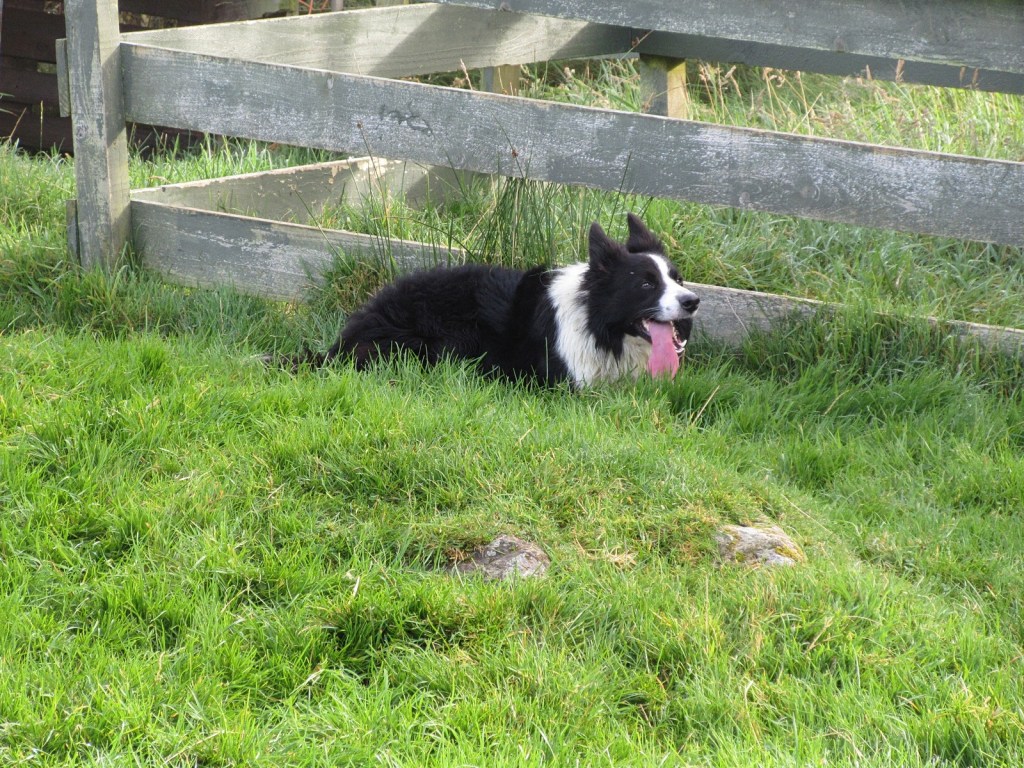
The drive eventually brought us to Uradale Farm. The sheep side of things were run by Ross, who was very nice. The most exciting part was Ross rounding up some of his sheep into the pen for us to admire, but of course it wasn’t Ross who round up the sheep but Pip the sheep dog. It is always amazing to see sheep dogs at work, just utterly locked in. A little trivia for ya is that they told us you always want your sheep dog to have a single-syllable name. This has to do with the commands you’re going to give the dogs apparently. Another piece of trivia is that Pip is very much a sweetie, who enjoyed getting some ear scratches as much as we loved giving them.

Ross’s story is that he found he couldn’t compete with the wool and meat producers when he first started off 30 years ago. You’re up against these giant industrial farms, and if you’re dedicated to Shetland sheep you are at a major disadvantage. Shetland sheep are much smaller than the mainland breeds, which means they produce less meat and less wool. And the wool they produce can be less desirable, what for being multi-colored. So Ross took the other path, raising his sheep organically and catering to much more bespoke places like fancy restaurants for the meat. I think he said he started off with 12 acres but now has 1200, but I wonder if that’s not actually such a great sign; with farming being less desirable the farms naturally wind up consolidating with the people that want to keep farming. I suppose that is the same for agriculture everywhere.

After our outside demonstrations we went on inside for lunch and more chatting abut yarn. One factor here I’ll highlight is that with Jamieson’s being such a force on the island, every other yarn-adjacent thing kinda makes digs at ‘em? The confusingly-named-for-familial-reasons-but-entirely-different-shop Jamieson & Smith has a sign out front of their place that says “Home of Real Shetland Wool.” Here at Uradale it was Ross saying about naming their yarns, “I don’t like names like 1234 something.” Instead they name their yarns after things from Shetland, like the deep layer of peat for the black yarn. Also interesting to note here that they use the same dyes on the different natural colors of the wool off the sheep which provides a whole wide range of different color ways.

This brought us to the stunning discovery that Ross’s wife Viveka aka Dr. Velupillai is a linguistics professor who came to Shetland to study the language. Ross is in fact bilingual, speaking both English and the Shetland dialect. So her whole project was studying and preserving and promoting the language and diving deep into Shetland’s culture. Which made her another Shetland import so yeah man people seem to show up to the island and fall in love and make it their whole life. Married to your work. One of Dr. Velupillai’s efforts is I Hear Dee, which has resources on the language. She gave us the low-down on the various languages that have come to Shetland and how they evolved into the local language and that is super cool. She also designs knitting patterns for her yarns. And then finally they also had a project on display where they recreated an authentic vararfelður, and you could tell it was authentic because of the smell. My super amazing wife walked away from Uradale with yarn for a shawl.

We also spotted some of Ross’s Shetland cows on a faraway hill.

To pad out this blog post and also because I talked about people taking digs at Jamieson’s two paragraphs ago, I will fast forward to the evening when we attended a talk from Jamieson’s. We had been disappointed that we couldn’t nab tickets for the mill tour so this was the next best thing. The talk was mostly about the spinning process, which wasn’t too surprising, though he talked a lot about what a hassle it is to do the dyeing. They’ve brought this upon themselves. One of the big things about Jamieson’s is that they have 220 different colors of yarn. They can’t reduce this number at all because sometimes their commercial customers will want them to recreate stuff and so they need the color. They apparently export the majority of their stuff to Japan. And by “stuff” I mean machine-knit Fair Isle sweaters, so now I know what to keep a lookout for if we ever get to Japan. Though Jamieson’s has started doing blended yarns to get some of their colorways instead of doing it purely with dye, which is simpler in some ways, and avoids some easy ways to make mistakes. A final fun fact is that while we were visiting they had done an exclusive limited-time color, i.e. they had messed up a batch when dyeing. Then the second half of the talk was from Gudrun Johnston, the Brand Director for Simply Shetland. A big part of the talk was how being the Brand Director had changed her perspectives on designing, which seemed to involve designing things with colors they had a lot of and avoiding the colors they didn’t have a lot of.

All in all a very interesting talk and the Jamieson’s folks seemed like good people. But the biggest thing we’ve learned so far is that if you want Shetland yarn, there is actually not shortage of options to choose from.

Just a beautiful Shetland view.

Shetland IV: Wool Sourcing

Reading this week:

  • An Outline of Shetland Archaeology by John Stewart

As my super amazing wife describes it there can be a divide between the wool-producing community and the wool-using community. She loves wool in all its forms and her parents also raise sheep, so she bridges the divide, but I am always a little amazed at knitters who don’t quite know how sheep work and farmers who don’t quite know how yarn works. One thing my super amazing wife therefore really appreciated is how much wool week worked to highlight the sheep producers to bring both sides of this industry together. And so our main activity for the day was a history-spanning tour of Old Scatness Broch and Laxdale Farm.

One anecdote before we really begin is that as my super amazing wife and I were milling around in the museum parking lot waiting for the tour bus, a lady spotted me and asked me if I could help put her car in reverse. Clearly rank sexism as I was the only man in the parking lot. But I did in fact know how to put her car in reverse because I drive a DeLorean and so I knew that sometimes you have to move the stick shift in the z direction. I felt like a hero. But before long we were off on the tour bus for the broch! We had a lovely tour guide, yet another import to Shetland herself, who gave us the rundown on everything we passed as we took the long drive down to the very southern tip of the mainland. She talked about how lovely she found Shetland, and how no one ever locked their doors. “How else would Amazon put the packages in your house,” she asked, while also noting she had never even gotten around to asking her landlord for the key to the backdoor of her house. We were also interested to learn that while there are elementary schools spread throughout the isles, for high school the government finds it cheaper to board students in Lerwick during the week and shuttle them back home every weekend than have a more decentralized system.

We arrived at Old Scatness having crossed the airport runway to get there. The site is right next to the runway so we would pause occasionally as a plane landed. The site would normally have been closed when we visited but Wool Week had put together a special tour, stunningly with the lead archeologist of the site herself. She had been working the site for 30 years. She describes being a young archeologist and her boss walking in one day and telling her “I bought you a broch” and she was like “why would you do that, no one studies those anymore.” But they have done some phenomenal archeology on the site, as it was utterly pristine before they figured out that natural hill wasn’t when they were putting in a road there. Significantly, the dating they did there proved that brochs originated in Shetland before moving down to Scotland, instead of the other way around as thought previously. They also found a cool Pictish carving of a bear.

It was indeed a really special tour. They are still working on stabilizing the site enough to let the general public sorta wander around unsupervised, so with our guide we got to scramble over some otherwise un-scrambleable spots. She didn’t have any solid answers on why all these brochs were built in the first place, but said it was best to think of them as castles which served several purposes. She also had a joke I didn’t quite have the archeological background to get that it was the Macedonians who built them because the timelines lined up. The wool connection is that they had found counterweight stones from looms still in situ. Apparently the looms took careful balance so once you were done weaving you could typically just cut the stones off so the order wouldn’t get mixed up and leave them there until the next time you took up weaving. Someone had cut these stones off and not picked the weaving back up, so they were still sitting there a millennia or so later.

Recreated stone age loom in the Old Scatness Broch visitor center.

From there we fast-forwarded only a couple of centuries to Laxdale Farm to see what this sheep thing was all about. Although we had seen some Shetland sheep the previous day this was our first up-close look at a more money-making farm system. It was a lot of fun. Upon our arrival we split into two groups, and our group first went off to look at the sheep. Our guide for this portion, the husband of the operation, showed us around the barn and told us lots about sheep breeding. I wrote that down in my journal but don’t recall much about how to breed sheep, having been too distracted by the sheep. We also learned about the grazing system, where each farm or croft would have associated rights to graze so many sheep up on the “hel,” or peatlands. And then finally he showed us how to skirt the wool once it was sheared and what he was looking for in a fleece. I found all these Shetlanders funny though hard to tell if they meant to be. One lady asked him how he felt about his wife going into the yarn business, and in response he gave us a look and said “well you support your wife.” Pretty funny, but doubly so when our group went inside and his wife told us the yarn was his idea in the first place. Triply funny when you consider that told us also that he doesn’t even know how the yarn was made, in a callback to my first paragraph there.

The next stop, as was typical in these tours, was inside for refreshments. They gave us coffee and some wonderful brownies, and then the wife Sheila told us all about her yarns. For anyone who wanted to walk away with some yarn (i.e. everyone on the tour), one of their rooms had been converted into a whole yarn shop. All the stuff produced and sold on the islands was indeed gorgeous, though interesting that there wasn’t really a place for small-batch processing on Shetland. You could sell your wool to Jamieson’s, who spins the wool and produces and dyes their own yarn, but if you’re an operation like Laxdale you have to ship the wool down to Scotland to have it spun and then it comes back up to Shetland.

And with that it was back on to Lerwick where we spent the afternoon wandering around. We had dinner reservations and a talk to go to. We checked out The Shetland Times Bookshop and wandered through Fort Charlotte. In the bookshop my super amazing wife bought some cookbooks, which is very on-brand. Eventually I realized I was feeling a bit queasy from only having eaten some brownies since breakfast and I got a sandwich as an appetizer for dinner, which was at The Dowry and great.

Then it was time for our talk, which was An Evening with the Doulls. The Doulls being of course that year’s Wool Week Patrons. When my super amazing wife talked about highlighting wool producers this is actually what she was talking about. The first part of the evening was a short documentary on the Doulls, which again I think was unintentionally very funny. Like there was a talking head moment in the documentary where the interviewee was saying “the Doulls have been raising Shetland sheep to the highest standard for generations” with an immediate smash cut to the Doull patriarch there with a pamphlet saying “here’s the standard” (referring to the standard book, which he helped write as an early member of the Shetland Sheep Society). As an insight into the wool trade, we also learned that all the Doulls need other jobs as well, despite owning something like four islands on which they graze sheep.

After the documentary they had a question-and-answer portion with the Doulls themselves. Seeing the stars of the show man, a Hollywood moment. It was a very charming portion of the evening because of how refreshing it was to see people with absolutely no media training. People were asking things like “how do you know it’s a good fleece” (the documentary talked extensively about how good the Doulls fleeces are, or at least the fleeces of their sheep anyway) and our patriarch there was like “well, uh… you know it when you see it.” Raw, uncut, beautiful. An inspiring part of this is that grandma, the matriarch, had a stroke a few years back and doesn’t have great use of her left arm anymore, but was still able to knit through the use of the traditional Shetland makkin’ belt. These were originally developed to let Shetland women knit while carrying giant baskets of peat, so as to maximize productivity, so very cool really they’re still useful. She was still very capable of making some of that gorgeous lace work (and fast!) we had seen in the museum. Though finally, with the Doulls worn out by their jampacked schedule of media appearances, and my super amazing wife and I worn out from a day full of wool production, it was time to turn in for the night.

Shetland III: The Museum

Reading this week:

  • Tomorrow, and Tomorrow, and Tomorrow by Gabrielle Zevin
  • The Africa House by Christina Lamb

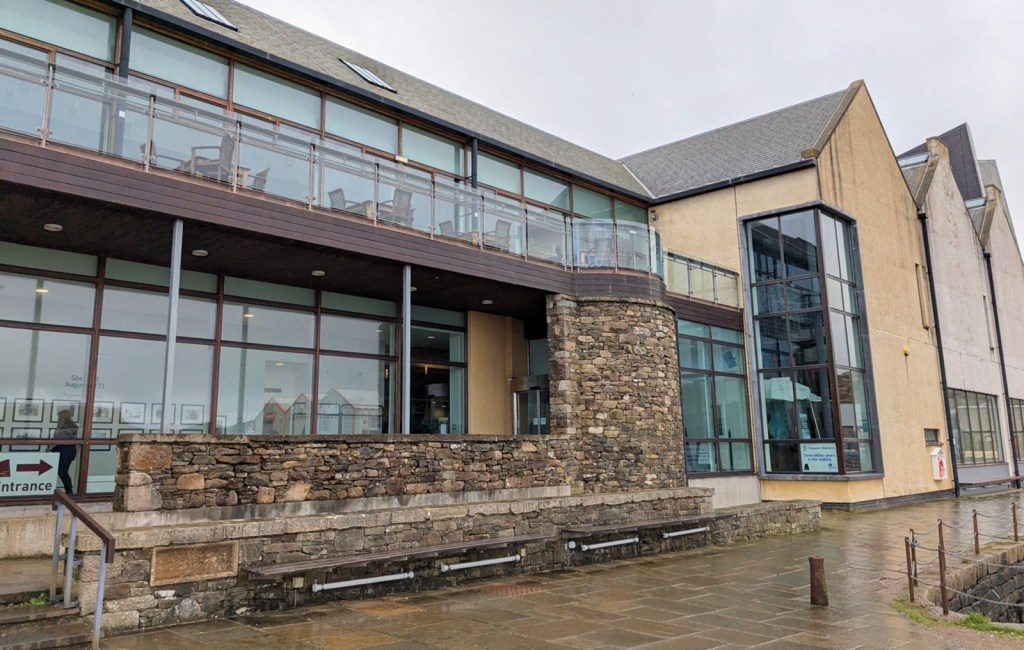
Our first taste of Wool Week under our belt, it was time to learn more about Shetland itself and this brought us to the Shetland Museum & Archives.

The museum entrance.

As mentioned last time, the museum was the home base for Wool Week, so there was a knitting room and if your event had a bus it picked you up there and the Wool Week swag store was there (they had very nice tote bags). It is also a very, very nice museum. Extremely well done and packed with artifacts from throughout Shetland’s history, from the geological underpinnings of the island to the modern-day economy. It’s also a very appropriate home base for Wool Week, because of its vast collection of knitting history.

For example while we were there the special exhibit they had was Chris Morphet, ALLOVER. Chris there, a man of fine taste, noticed all the Fair Isle knitwear in London back in the ‘70s and so started documenting it. The exhibition therefore was of all his pictures of Fair Isle knitwear and the way people wore it. It is fantastic stuff, and useful for a wide range of applications.

One thing I didn’t quite learn until the very tail end of the week, though it is covered some in the museum, the Shetland’s knitwear industry has always been export-driven. Like, okay, it is cold in Shetland and so people find sweaters very useful, but starting at least back in the 15th century fishermen associated with the Hanseatic League would use Lerwick harbor to salt all the fish they were catching. The Shetlanders would sell them stuff, including knitwear, and so there is a long history of Shetlanders spending all their spare time knitting so as to sell knitwear to visitors. The Fair Isle pattern evolved for the export market, and the designs don’t have any particular known meaning. Fashion baby.

But that’s towards the end of the museum. The beginning of the museum is all pre-history. Shetland has always been at a crossroads, seeing as it is equidistant-ish from a variety of places, and the gulf stream means that while it gets very blustery it never gets like way too cold (it’s way too cold for me most of the time but you know for the kind of people who live on Shetland it’s nice). The upswing of that is that Shetland has been settled for a very long time, and resettled several times, and so you can go to a place like Jarlshof (which we did) and see literally layers of history all stacked on top of each other.

An art installation in front of the museum.

One of the most vibrant layers you see day-to-day is the Norse and Scottish history. Shetland was originally settled probably by Pictish people (or the people that would become Picts), but then eventually the Vikings came and took over. Shetland has signs up all over the place telling you what the name of the place means in old Norse. The Vikings were apparently very uncreative; “Lerwick” means “muddy bay.” Most of the names are like that. But then Christian I, King of Norway, pledged Shetland against the dowry he was going to pay when he married his daughter Margaret off to James III of Scotland. Christian never paid the dowry so Shetland was the dowry and the islands were Scottish once more. This was 1470 and it is still a thing they talk about all the time. During the week we had a lovely dinner at The Dowry, for example. This is of course strange to our American sensibilities; I am from Maryland we fought a war with Pennsylvania that one time but you never hear us talk about it.

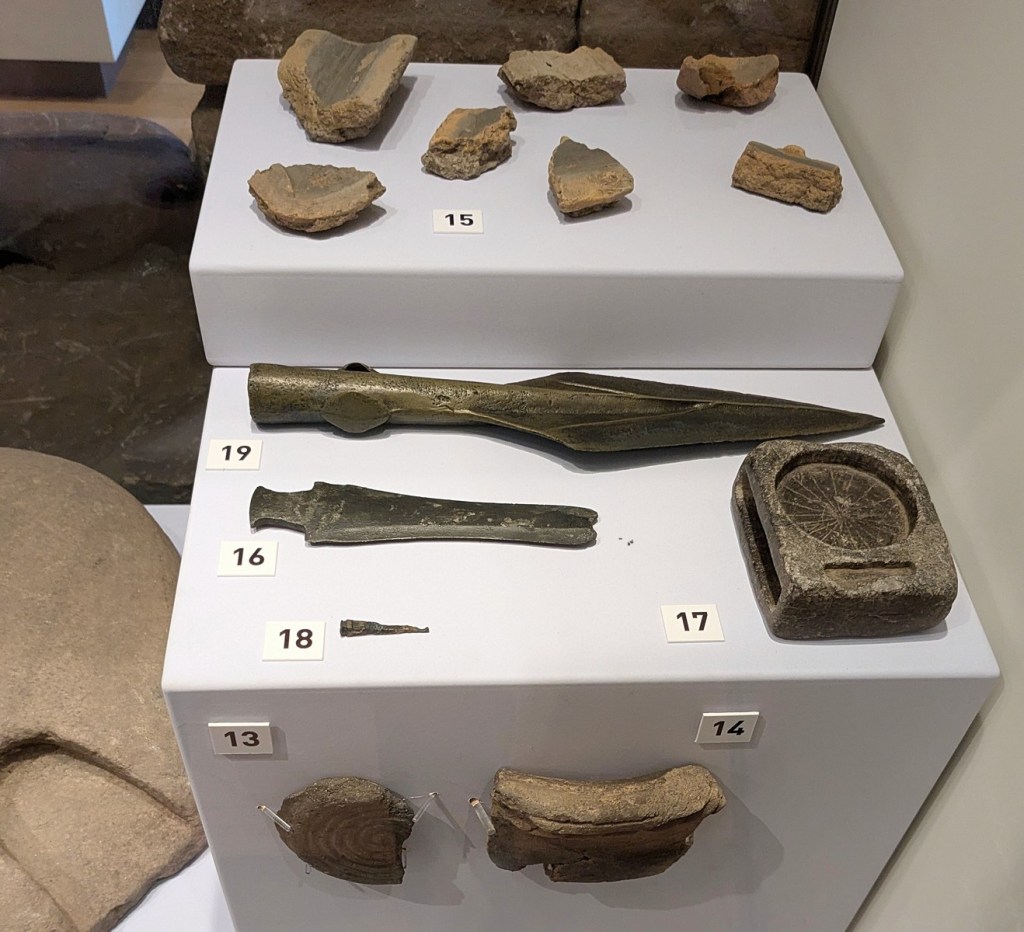
Anyways, I keep straying from the museum. Like I said it is great. They have bog butter (!), and again old food is one of my favorites types of museum artifacts and this was my first bog butter to boot. And they have all sorts of stone age and bronze age and iron age implements, and examples of houses, and boats! So many boats. They like boats in Shetland, being an island, and also descended from Vikings. The traditional Shetland boats are descended from Viking boats too.

Look at that lace!

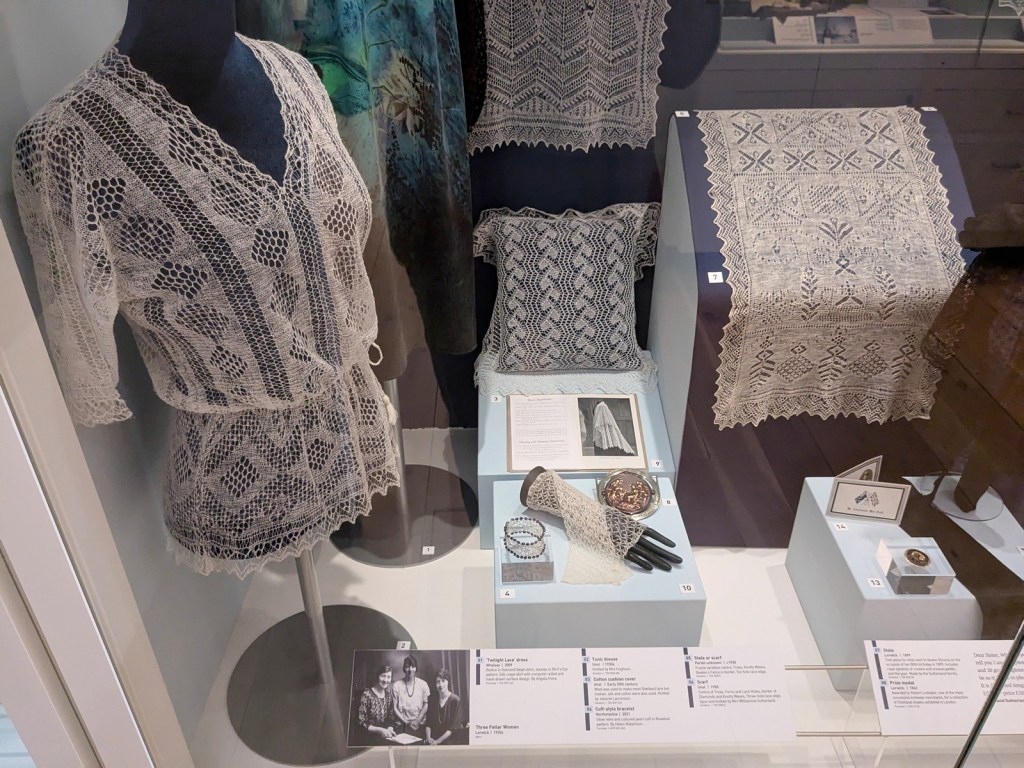
And then that brings us upstairs where they talk about all the industry of Shetland, which is a lot of fishing, and then more textiles! Besides regular ole’ knitting, the other most impressive textile export of Shetland is lace! Not true lace, as Wikipedia has just told me, but extremely fine knitted lacewear that is just so remarkably impressive. I saw some weaving of it and I just don’t know how they do it. That has got to take a lifetime of skill to master and the pieces they had on display are just so, so impressive. The height of fashion before I think even Fair Isle knitting was so man there you go.

The bay at Hillswick outside the Murmuration exhibit; sorry no photos of the inside.

And like, from there the day wasn’t even done! We hadn’t even checked into the inn yet! After the museum and some lunch we went over to the Wool Week craft fair where people had all sorts of stuff on display, and then drove back north again to go to Vidlin where there was another craft fair, and then the final exhibit we saw for the day was another tapestry! As part of Wool Week the absolutely gorgeous Murmuration Collaboration was on display. This was a series of tapestries, all made by different weavers around the world, coming together to display one long image of murmuration over a landscape. Like so many tapestries we had seen on this trip it was unbelievably stunning in person, with such intricate technique to depict the birds (and their murmuration) themselves. And this was I think the first time it came all together. Very much worth the drive.

And lo, with that, the day finally came to its end. We picked up some salads at Tesco for dinner and finally checked on into our inn.

Shetland II: Wool Week Begins

Reading this week:

  • Ancient Africa by Christopher Ehret

Now to the nitty-gritty of Wool Week. Shetland Wool Week as I understand it is a relatively young addition (only 16 years old) to the worldwide wool circuit. It is definitely popular and is probably at this point pushing the capacity of Shetland. We only lucked into a hotel room; the place we booked had just reopened so we managed to nab a room by sheer chance (it was an absolutely lovely place by the way, The Westings inn run by David, who gave us all sorts of tips and made sure we had breakfast every morning and got us croissants in between his half a dozen other jobs on the island). Other places I emailed told me they were booked two years out for Wool Week. And this isn’t even tourist season; Wool Week by design is scheduled in the off-peak times. It overlapped the end of September and beginning of October, and some places, like the Sumburgh Head Lighthouse’s visitor center or the ferry to Mousa Broch, in fact close down starting October 1. We also lucked into good weather, as the whole week was gorgeous but apparently the previous one was terrible (we had heard this everywhere in the UK).

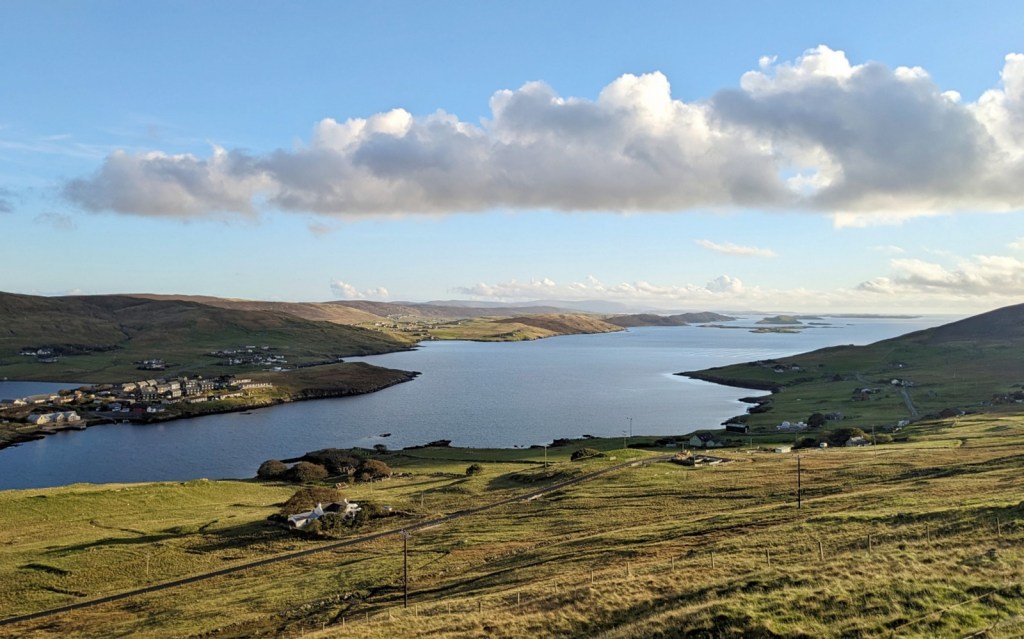
The view from The Westings, gorgeous at all times of day.

The Wool Week folks also go to great lengths to build a community. There are online events and a Facebook group and it behooves you to be in them. Although we rented a car for the week, many people are relying on public transportation or carpools to get around (many ticketed events have dedicated busses from Lerwick), and those are arranged in those groups beforehand. During Wool Week itself, they set up a crafting and rest space in the Shetland Museum & Archives, which serves as the home base for Wool Week. There you can also arrange those same car pools as well as swap tickets for the various Wool Week events. Since everything is so popular you have to get tickets for events and classes online beforehand, which all go on sale at the same time. This was the only frustrating part of the experience really, as the organization tries to update its tools to meet demand. We did not get the exact tickets we wanted due to a website glitch, which upset me deeply at the time, but the Wool Week people were very kind indeed.

So that’s the setup. Meanwhile we had just gotten into our rental car, weren’t set to check into the hotel until the afternoon (it was early enough in the morning that even the metropolis of Lerwick hadn’t really woken up yet), and my super amazing wife had not had breakfast. That meant we embarked on the most perilous of all possible activities right away: getting breakfast at the local café. Don’t worry, we managed to survive, getting a table, eating breakfast, and I think managing not to annoy the staff or locals too much. It was also very cheap to boot. The most entertaining part was overhearing another restaurant owner comment about how this year he was going to be prepared for all the vegetarians among the Wool Week crowds.

Walls harbor from the Regatta Club.

But now it was time to meet some of those Wool Weekers ourselves. They were easy to spot throughout the week; every year Wool Week comes out with a special hat pattern beforehand so my super amazing wife and knitted some up for us, and everyone else is wearing the same pattern in different colors. Our first day we didn’t have any ticketed events planned, but there were plenty of open workshops to go to. The very first one we went to was The Wooly Wyvern. They make really nice socks on a hand-cranked circular knitting machine. They have both socks made from Shetland wool meant mostly for indoor use (the Shetland wool is fine and soft but less durable than other breeds, apparently) along with sturdier versions. But the real fun is getting there, bounding over the Shetland roads to a town on the very tip of one of Shetland’s little peninsulas. We parked at the Walls Regatta Club and then had to open the gate to the Wyvern owner’s backyard to get to their workshop. This was a theme throughout Wool Week, because so much of the wool and knitting industry in Shetland happens in people’s homes and backyards. In this backyard we learned some about sock knitting and then picked up socks as gifts for our relatives in cooler climes.

Look at those cuties.

And then it was off to the next backyard! This was The Silly Sheep Fibre Company, which truly was an inspiration. Throughout our time in Shetland we were meeting a whole lot of people not from there who had moved there (though they were mostly married to Shetlanders to be fair). The Silly Sheepers here had set up what amounted to a retirement homestead with a bunch of sheep. Many of these they were given. The wife of the couple apparently has a big soft heart and so nearby farmers will give her baby lambs from their flocks when their mothers reject them (parenthood isn’t for everyone). You have to bottle-feed these lambs, and it isn’t worth it for most farmers. This was our first glimpse of Shetland sheep as well, and boy those guys are a treat. They are so small! This makes them hardy and able to survive the Shetland winters all on their own, and also makes them easy to handle because you can just like pick ‘em up (I mean they’re not like cat-sized but as far as sheep go they are small). This also means they produce less wool and meat but they are still very very cute, even for sheep. The husband explained this all to us while we admired his flock, and then we went into their little shop to check out the selection of home-grown wool products, which set us up already for the archetypal Wool Week experience. But don’t worry, there is a lot more to come.

One sheep against the world.

Shetland I: The Ferry

Our trusty steed.

We were finally approaching our final Scottish destination: Shetland! As alluded to several times over the course of this series, the primary reason we had gone to the UK was to go to Shetland Wool Week. We had also had some friends who had gone to Shetland, so were excited to see the rest of the place too. But first we had to get there. I left you, dear reader, as my super amazing wife and I were jumping the car and departing Inverness. We had about a two-hour drive ahead of us to Aberdeen, where we would catch the ferry to Shetland. We could have taken a flight to get to Shetland, but I pushed us towards the boat. I was looking forward to spending an overnight at sea and we sprung for the cabin instead of confining ourselves to chairs.

We almost didn’t make it. I should have looked more closely at a map and the locally available transportation options. We had a rental car we had to drop off at the airport and turns out the airport is not at all near the ferry terminal. I was stressed from driving down all the tiny little two-lane roads on the route the GPS took us between Inverness and Aberdeen, and my super amazing wife was stressed because we were looking at the clock and realizing this was going to be close no matter what. But we arrived at the car rental place and jumped on out, forgetting my super amazing wife’s sunglasses in the process (the rental place later emailed us to say we could pick up the sunglasses at our leisure, but we were, you know, in Shetland). We were planning on getting an Uber, but turns out you can’t get a ride share from the Aberdeen airport.

Majestic!

Okay, no matter, we just got in the taxi line. The very long taxi line. And waited a few minutes. And no taxi came. Not great! And then the taxi lady came out and said no taxis were coming anytime soon. This had us very stressed and we had no real time to spare. So we shuffled on down with all of our baggage and the rest of the people in the taxi line to the bus stop, with no real indication of when the bus was going to come either. But then! Our savior! A taxi appeared! With everyone else distracted at the bus stop my super amazing wife and I ran on down with all our bags to claim the taxi and we were on our way! We arrived at the ferry with time to spare but seem to have been some of the last to board.

I left the photo crooked so you could experience what we did.

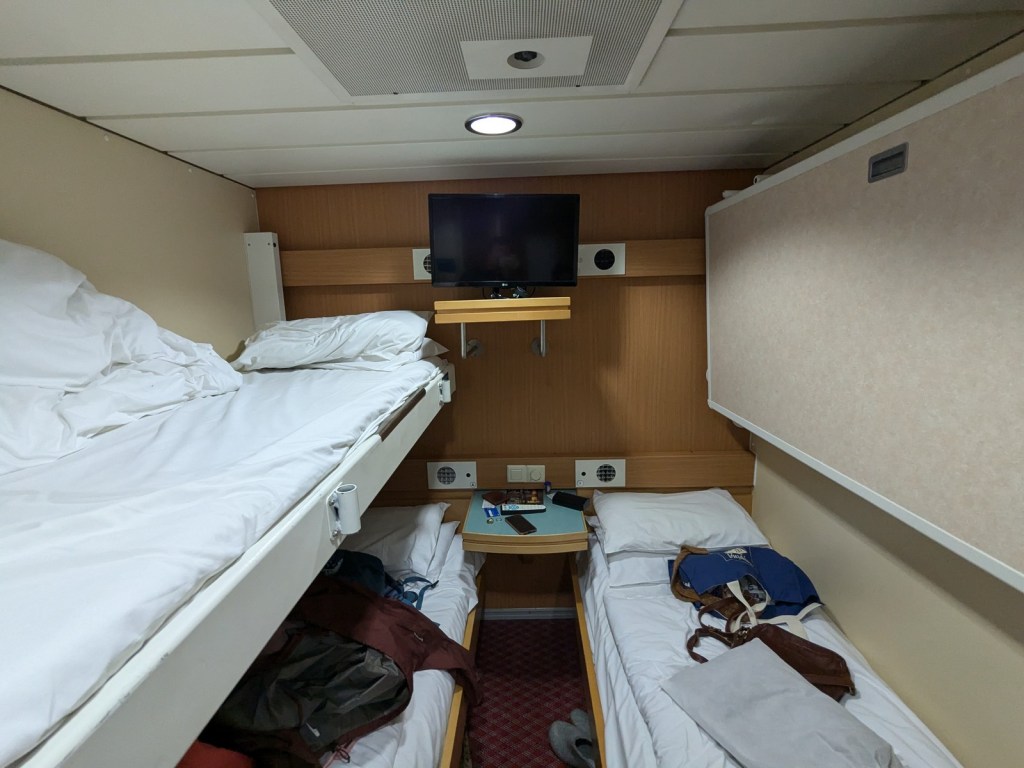
And so we were onboard our chariot, the MV Hjaltland. We unpacked in our spacious cabin (spacious after the Caledonian Sleeper anyway) and settled in. Despite our very anxious time getting there I was even anxious-er to explore the ship, so we went off to poke around. It is super cool. It’s got a gift shop and a bar and a movie theater. As soon as we were underway I insisted we go up and see the deck before it got too dark and we were too far at sea, dragging my super amazing wife away from her tea to do it. The views were gorgeous man, the open sea, the offshore wind farm, the wind in your face, fantastic.

Things were soon not so fantastic though. After we descended down from the weather deck we got in line for dinner. My super amazing wife was starting to feel not so great from the rocking the boat was already experiencing. I thought some food would help, but not really. It made her feel worse though it made me feel better for a bit. We returned to our cabin and although she avoided puking she was soon confined to her rack. I wasn’t far behind. Before long I, too, was seasick. This was a major blow to my ego. My time as a landlubber has made me weak.  I spent a few hours listening to podcasts and feeling nauseous but did eventually recover enough to have a fairly comfortable night.
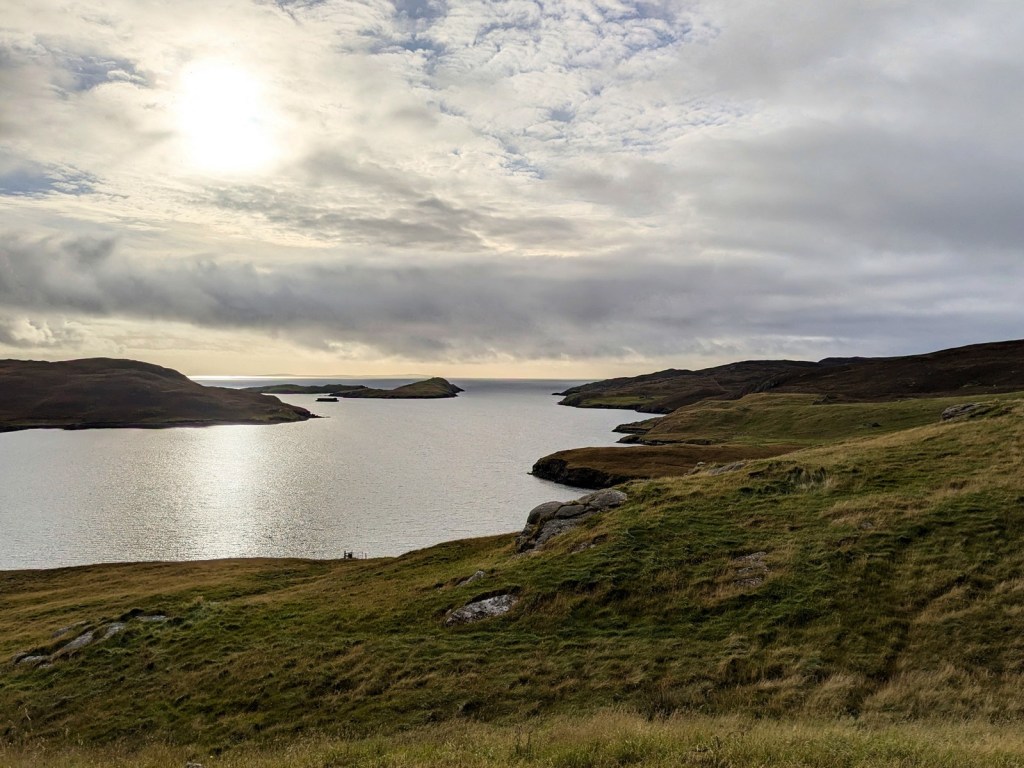
Shetland at dawn.

The next morning I got up early to have a rather nice shower actually in our ensuite and then explore the boat some more. Back up on the top of the ship I caught my first glimpse of Shetland. I always like the first glimpse of a distant land by sea. I remember my first sight of Australia from the submarine, easing up over the horizon its long and low shores. With my stomach feeling better I also got some very good breakfast. It included a banana though, and maybe that was the root cause of all my troubles. We docked before long and so it was back to the cabin to pack and then unload. I think we were some of the last ones off. No matter, because that meant the car hire lady was easy to find. She ran us through the info, with a stern warning that although we had the comprehensive insurance coverage, that still did not cover the car doors being ripped off by strong winds. Quite the introduction to Shetland! But we were glad to be there, safe, sound, dry, and with a new set of wheels.

Welcome aboard!