
Reading this week:
- In Limbo by Tony Gould
A brief interlude in the Berkshires before we return to our Scottish adventures.
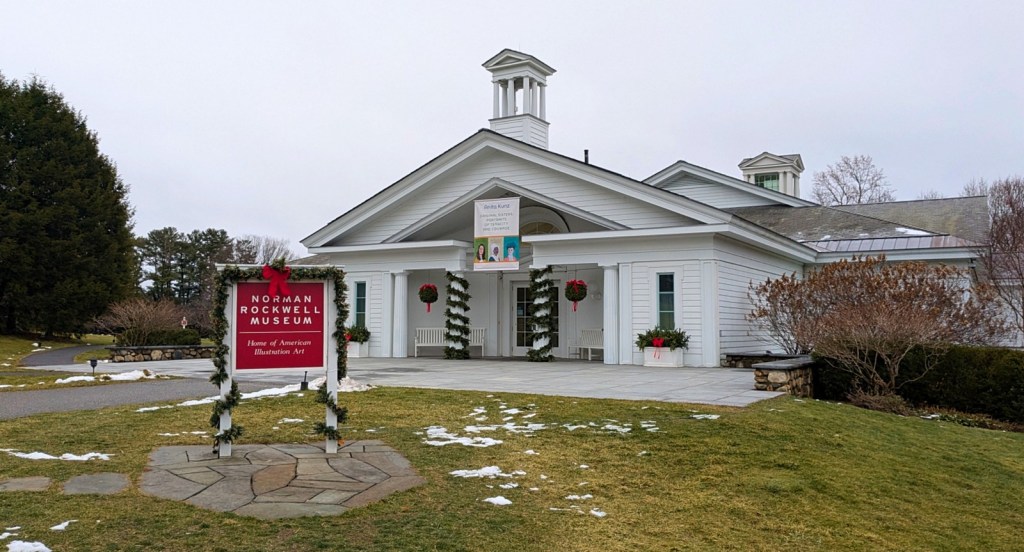
Out of a deep love of the pop girlies, my super amazing wife and super amazing mother-in-law and I went to the Norman Rockwell Museum! (it was not out of the love of the pop girlies, though I do love the pop girlies, it was only because we have an appreciation of art and Americana and local Berkshires sites, but I couldn’t come up with a better Lana Del Rey joke, probably because I don’t listen to Lana, except there was a period of my life that was very tumultuous and more specifically when I was in the shipyard when “Sweater Weather” was on the radio a lot as I was driving myself alone to Panera for dinner most nights, but that song is not by Lana though I thought it was until I looked it up just now for this extended aside, so now I think it is “Summertime Sadness” I was thinking of, as both were on the radio then, along with “Counting Stars,” a trio of songs that conjure up for me cold fog in San Diego, all of which to say is I really expected the album to be in the Norman Rockwell Museum gift shop, which it wasn’t)
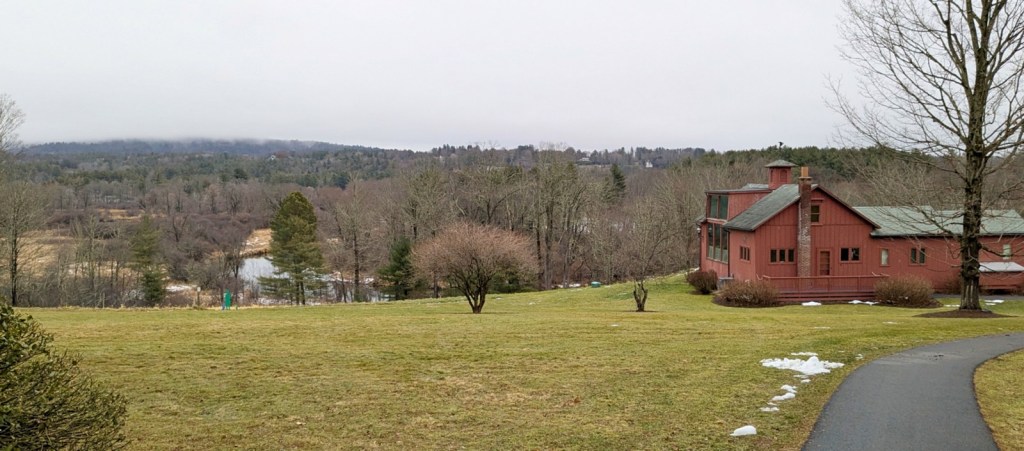
The site of the museum is not like, Norman Rockwell’s house or anything. It is not clear to me how it the museum wound up where it did exactly, but it’s a nice spot (Rockwell did live nearby just not on the site itself). They did however truck his final studio to the spot so now it overlooks a frankly gorgeous view across a river valley. In the summer months you can tour the studio but it was not the summer months when we visited so we didn’t. The studio’s first life was as a carriage barn before Rockwell got a local cabinetmaker to renovate it using a lot of Shaker-type woodwork. Seems like a nice spot.
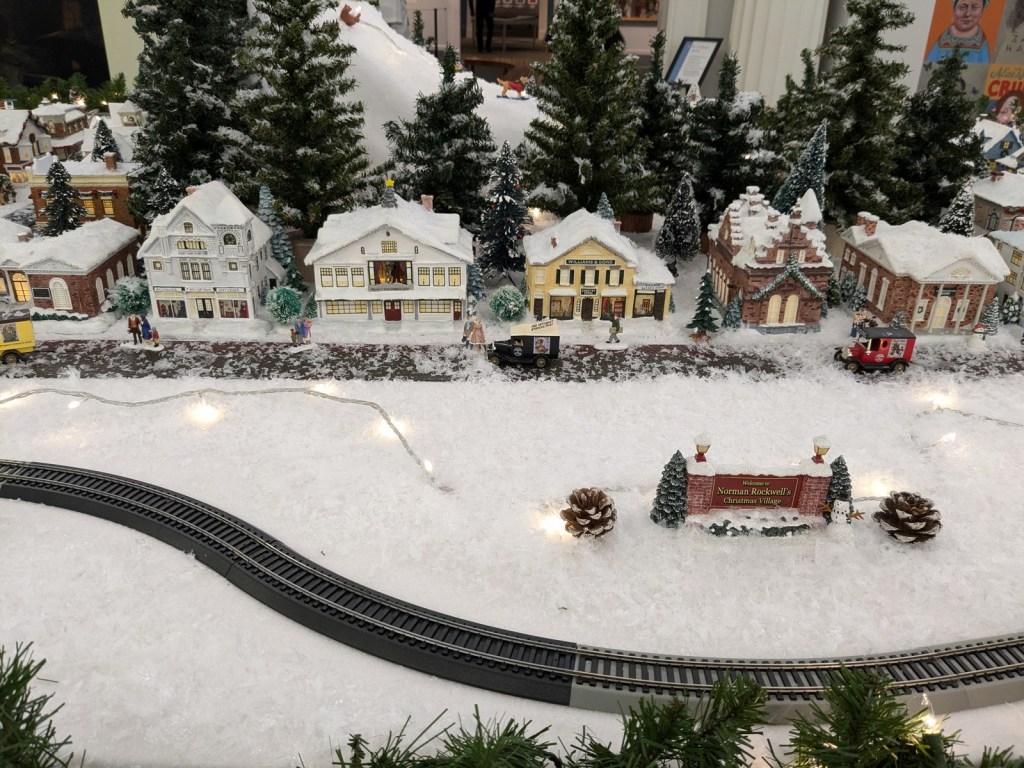
What we did explore was a purpose-built museum housing a large number of Rockwell’s original works. Since it was around Christmastime when we first entered the building we were greeted by a train set recreating “Home for Christmas,” which itself is a depiction of Stockbridge, where Rockwell lived and worked, so maybe the train set is just a recreation of the real town with no middle man in between. Hard to tell. But every year now Stockbridge dresses itself up as the painting, so art and life have simply become one.
Past the train set you get to the original artwork, and downstairs the museum also has hung up one of every Saturday Evening Post cover Rockwell ever did. Norman Rockwell of course represents uncontroversial Americana, a stereotype born of Rockwell’s own work. Given that, the most interesting parts of the museum is where you saw Rockwell push against that oeuvre or try to use his powers to push a harsher message. In his Saturday Evening Post days it was the magazine’s editorial policies that restricted him. One easy example is that in the original version of this Post cover, he had included champagne bottles, because you know that’s what you drink on New Years’ Eve, but that wasn’t family-friendly enough for the cover. Fun, but in the museum I also learned that it was the Post’s policy to only allow depictions of black people on the cover if they were in a subservient role, like a Pullman porter. So once Rockwell leaves the Post, you get him painting works like “Murder in Mississippi:”

That painting is quintessential Americana, too.
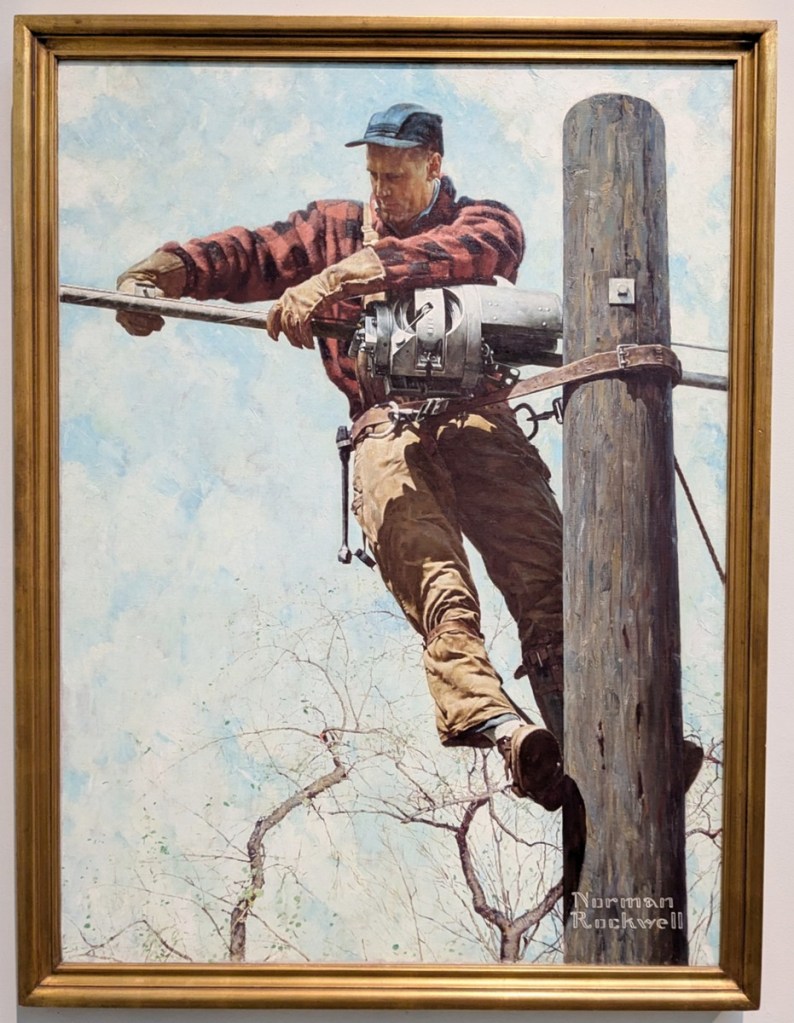
The man was pretty amazing at what he did, which you don’t need me to tell you. A couple other pieces I really liked were “The Lineman” and “Glen Canyon Dam.” Neither of these were for the Post. I like “The Lineman” because there was apparently a lot of technical back and forth. It was for AT&T and since Rockwell worked off of models or reference photos he enlisted one John Toolan to pose for him on a “makeshift pole supplied by the telephone company,” and then when Rockwell sent off the preliminary drawing AT&T had him make nearly a dozen changes, mostly technical, which just like, some group of engineers spent a lot of time pouring over the drawings lest some inspirational ad be inaccurate. On the other hand “Glen Canyon Dam” caught my eye because it is kinda 3D; I don’t think it’s impasto exactly but the ridge the family is standing on sticks out from the canvas, and all those little rocks are actually bumps that you could feel, if they let you, which they don’t, the cowards. The painting itself clearly tells quite the story but I just think its neat.

And then I took a selfie with an internet celebrity:

To finish out the day filled with classic Americana, we went into Stockbridge itself. Having seen the model in the museum it felt like I had been there already, so there was no need to linger, after some lunch and souvenir shopping we were on our way, another day in the Berkshires complete.

 Pat in the World
You must be logged in to post a comment.