Paperwork enthusiast seeking new frontiers of paperwork. Former submariner, former Peace Corps Volunteer. Opinions, thoughts, and comments reflect no actual persons, living or in the Navy.
Our adventures in Skye loom large enough in my memory that I am somewhat surprised in going back through my journal that after only two nights we were already departing. We packed up and got on the road only to quickly meet our first obstacle: a gaggle of guineafowl blocking the road. My super amazing wife eventually had to get out and shoo them away. She reported that there was a sheep dog fenced into the bordering yard who was absolutely locked in on the flock. Very cute.
We cruised on down to Broadford for some final shopping, first into Love from Skye, where my super amazing wife to my chagrin did not try on any rings (I was hoping to find out what her size was in that shop with their strange UK ring size system). But she is swayed only by yarn and not by precious jewels so it was across the street at The Handspinner Having Fun where her eyes really lit up. They had a lot of tempting stuff there, including hand-knit sweaters and multicolor Harris yarn. Per usual I didn’t get anything but she added more yarn to her stash.
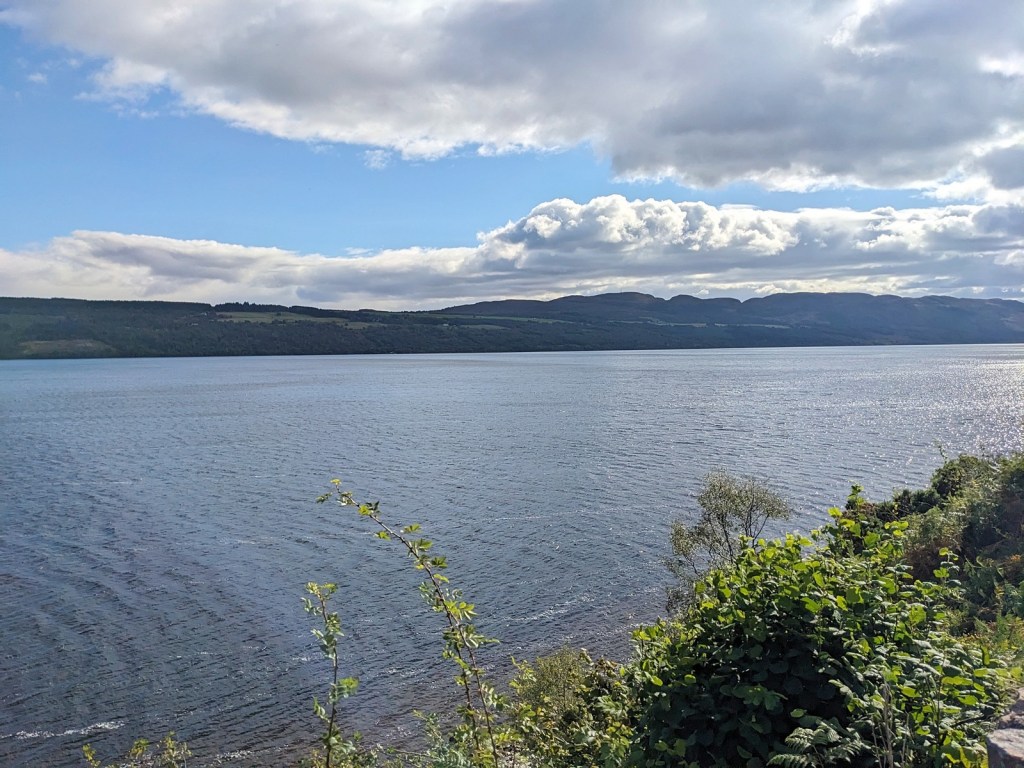
Loch Ness; do you see Nessie???
And shortly after that we were off Skye, heading back across the country to make it to Inverness, our last overnight location on the Scottish mainland. Along the way we cruised on by Loch Ness. I remember visiting Urquhart Castle and at least one of the museums dedicated to Nessie last time I was in Scotland. Alas, this time around we weren’t able to visit the castle (we couldn’t reserve parking) though we did stop into Drumnadrochit for some lunch and to pick up some obligatory Loch Ness souvenirs. My most significant personal discovery was that Loch Ness is big. I didn’t have to do the driving last time but we were cruising on by that lake for a while. Towards the north end we stopped at a turn-off to admire it for a bit, though we didn’t see Nessie.
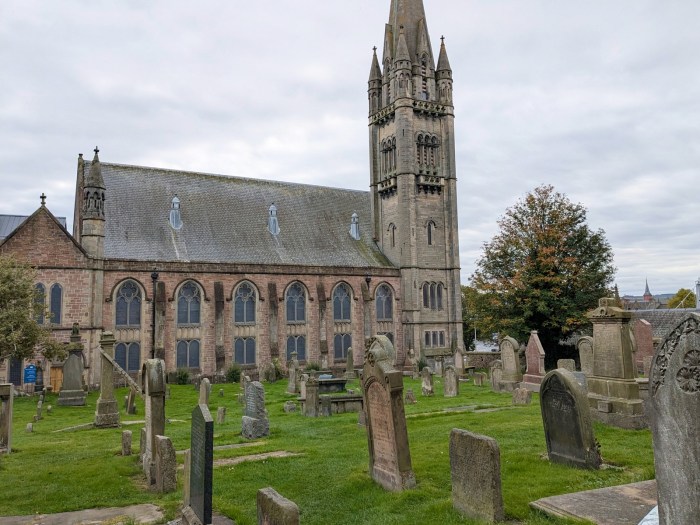
The kirkyard.
And soon we were in Inverness. We did not have a great deal planned. In the evening the highlight was visiting Leakey’s Bookshop, which is charmingly creaky. I hope they take that as a compliment; I walked out of there with two different books on Africa. Then there was dinner at a local Chinese place, which mixed the surreal experience of eating British Chinese food with the discovery that most people were in fact ordering fish & chips. How much we still had to learn about the culture of this strange and exotic country.
I thought she swam?That’s not her ear, her tammie has blow off.
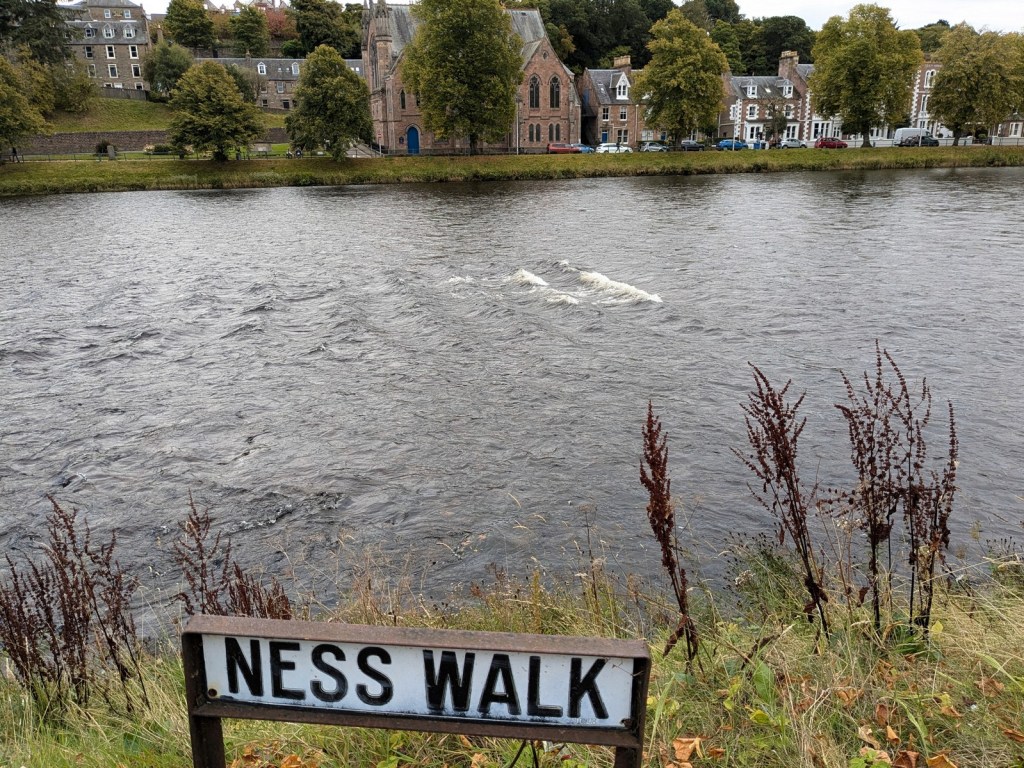
The next morning we awoke and had a massive breakfast, strange only because we had it at Wee Wild Pancakes. My super amazing wife and I both had “Banoffee Pie,” except her in crepe form and me in pancake form, though neither of us could finish it. What we had anticipated being a slow day was unfolding ahead of us, so we did some low-key Inverness sightseeing, checking out the Kirkyard (upon review of that article man that place is ancient!) and then taking a walk up the River Ness. That seems like a very nice little river. As we walked around my super amazing wife kept spotting mini-Nessies (cormorants) until eventually we came to the finish line of a marathon, and spotted Nessie herself!
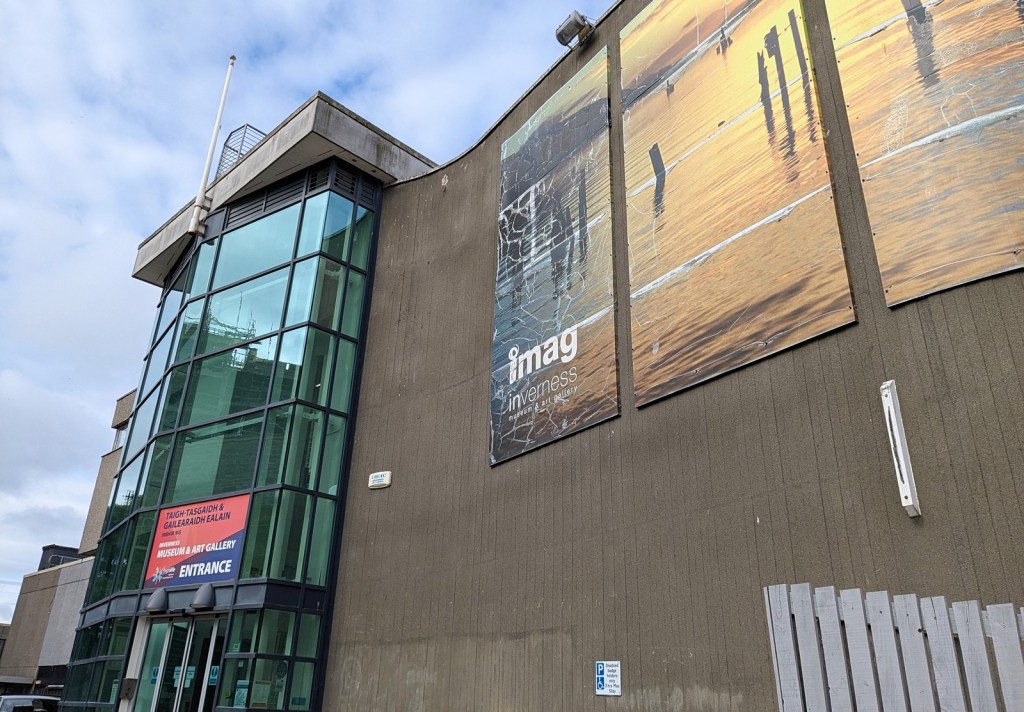
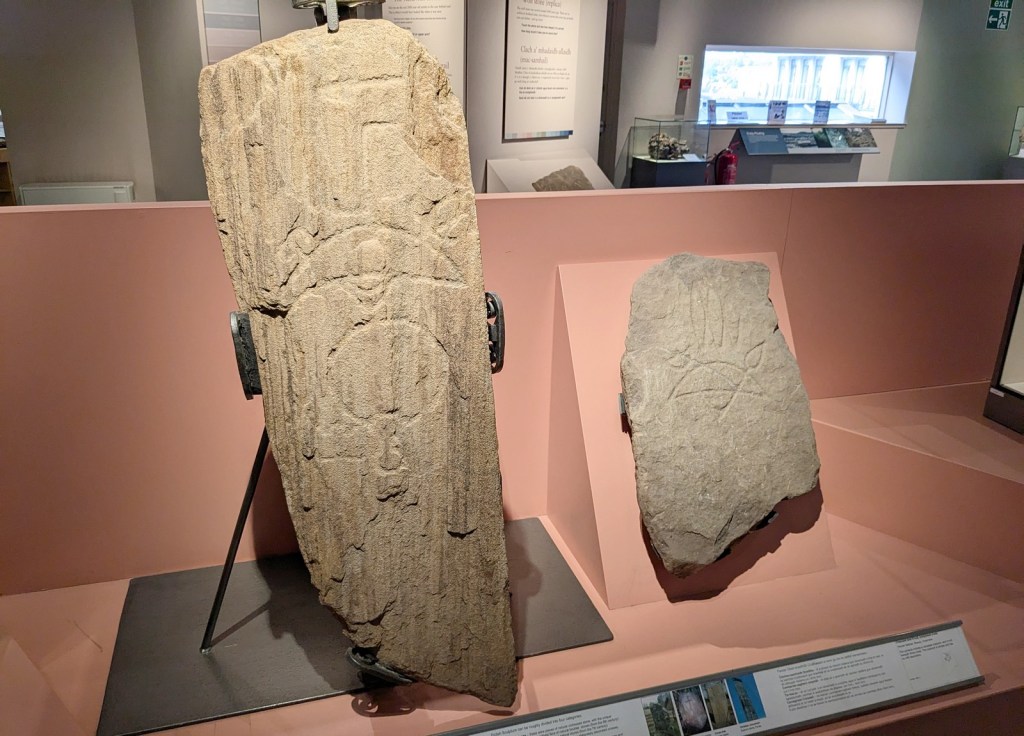
Our final stop in Inverness was into the Inverness Museum & Art Gallery, attracted as we were by the low low price of free (I gave them a donation). It was in fact really nice and you should make time to stop in. We enjoyed an art exhibit they had going on but what I liked the best was all the neolithic artifacts. And then all the Pictish stones! Last time I was in Scotland my grandpa had my mom drive him all around the northern bit of Scotland to look at various Pictish stones. I tagged along, and I remember that being a really great day. So that was nice to revisit some memories, as we hadn’t been able to get up to any of the stones during this trip. Next time we’re in Inverness I’ll have to dedicate more time to the museum and also read a book on those Jacobites. They seem like they were super passionate about their cause.
And from there we packed up in our rental car and head on out to catch the ferry to Shetland!
The Niger Sources by Lieut.-Col. J.K. Trotter, R.A.
Journal of the First Voyage of Vasco da Gama to India, 1497-1499
Having gotten all the castles out of the way, we awoke on Skye for a full day of driving around looking at various things. Our first destination was quite close to where we were staying, the illustrious Skye Weavers. Before going on these trips we like to get the associated guidebook for inspiration and research purposes. We knew that textiles were going to be a major goal of the trip, seeing as the real reason we were in the UK at all was to go to Shetland Wool Week. So I was surprised to discover that I think in all of the Lonely Planet guide to the UK (I can’t check because we abandoned it in Shetland for weight concerns) it doesn’t mention textiles once. Lots and lots of suggestions for whiskey distilleries but not a lick of advice for those that want to see fibers turned into orderly masses of fibers.
So we had to forge our own way and that had brought us to Skye Weavers. It is a small operation. We had been disappointed that we wouldn’t be able to get to the Outer Hebrides to see the weavers making Harris Tweed, but Skye Weavers scratched that same itch. They have the same sort of setup, but aren’t Harris Tweed because Skye is not the Outer Hebrides. But you knew that, as did I. What I didn’t know was how recent the whole paradigm is. To be Harris Tweed the weaver has to be operating out of their own home and only use human power to weave it. What I hadn’t realized is this is the result of the Harris Tweed Act of 1993. Like I thought it was going to be 1883 and people had been using these super sweet pedal-powered looms forever. Not so much! The pedal power came into being once people needed a way (besides using electricity) to up production and also have wider production (like wider bolts of cloth).
Sorry I didn’t actually get a lot of shots of the workshop, guess you’ll have to visit yourself.
All this was explained to us by the very nice man at Skye Weavers who spends his entire day being interrupted from his weaving to explain this to tourists. My super amazing wife had a go at the pedals and frankly I want one of these looms. They are super neat. They don’t use a shuttle but instead have this mechanism that cuts the thread and pulls it across which lets you use the thread directly off the spool instead of winding it onto a bobbin. ALSO! The machines use punch cards, which the weavers (at Skye Weavers anyway) program themselves; they buy the punch card stock and then uh punch the cards. So that is super cool. After this whole explanation we went up to their little shop and my super amazing wife and I both bought scarves for our respective moms and sisters and a blanket for ourselves.
And from there we proceeded on a day of driving around Skye which is a great way to spend a day, you should do it too. We stopped into Portree to have lunch at Lower Deck (great), admire the boats in the harbor, and check out a few shops. Fortified, we head out to do a counter-clockwise loop of Skye’s upper peninsula, just drinking in all the gorgeous views. Among those views were our first highland cows! They are a lot less common along the main roads in Scotland than I thought they would be, lemme tell ya. I had been bothering my super amazing wife for months saying “heelin’ coos” all the time but now she is the one with multiple highland cows (fake ones) around the house. We stopped to take photos, along with everyone else that passed by. We also of course visited the Shilasdair yarn shop that focused on natural dyes using materials from Skye, where my biggest surprise is that heather makes like a golden yarn instead of purple? Chemistry man, beautiful.
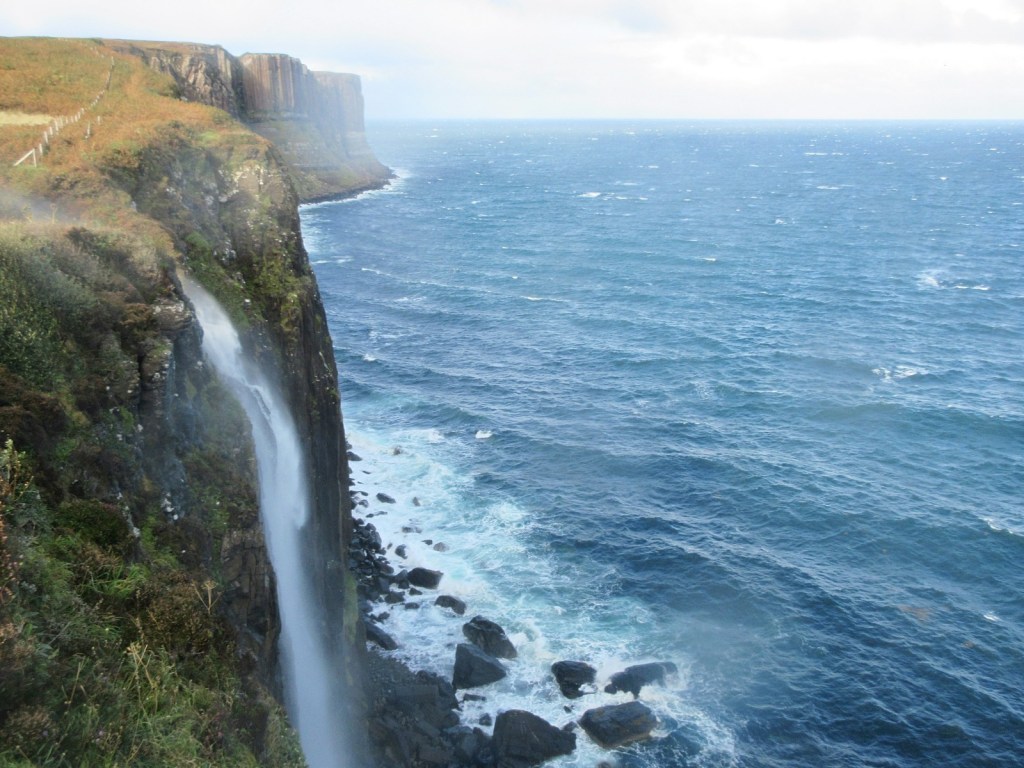
Anyway from there we went to Kilt Rock and Mealt Falls where we were getting sprayed even in the parking lot. It was real windy! I think most of the water went back up on the cliff instead of down into the ocean. We tried to take a few pictures but were mostly getting splashed, but it was very fun. In slightly less wet spots though, the whole skyline out there on that edge of the world is just gorgeous, the whitecaps coming into the bay bordered by a rocky shore. Magnificent.
Falling up.
We also had to (i.e. I made us) pop into the tiny little Staffin Dinosaur Museum, which has rusting farm equipment outside, a stegosaurus over the door, and the first dinosaur fossil discovered in Scotland inside. A nice man ambles up when you wander in to take your entry fee, and then leaves you to admire the bevy of dinosaur tracks they have on display. They also have off on one side a variety of artifacts from Skye life, including a bog shoe. Too bad they don’t allow photographs but I did get a postcard for my brother.
From there a few more stops rounded out our day on Skye. There was Uig Pottery, where we got a cute little highland cow figurine I mentioned above. Then of course there was Gilleasbuig Ferguson Books which was a super fun little stop. They specialize in Skye/Highland/Gaelic books, though they have other interesting stuff as well (I got an Alan Villiers book The Western Ocean). The fun part is that it is a little outbuilding next to the owner’s house and feels like the place where you might dig up a real gem. A couple more little shops and though we pondered joining the many, many hikers which held up traffic a little bit on the one-lane roads my super amazing wife know ourselves and our interests. So we picked up a pizza and after returning to our little place on Skye we settled in for the night, though we did remember to admire the stars.
Departing the David Livingstone Birthplace museum, we still had a long drive ahead of us to Skye. That night we stopped off at Fort Williams, and on the way there were treated to stunning view after stunning view. Every time we stopped to get out of the car and take pictures we felt very silly because another kilometer down the road would be a view even more stunning and dramatic. We pulled into Fort Williams with just enough time to visit the Highland Soap Company and buy some Highland Lotion. On the way to their parking lot you can admire Inverlochy Castle, but we could only admire it from afar because it was undergoing some stabilization at the time. Instead of having a big night out we had a very British night in, picking up a variety of microwavable fare from Aldi and settling on in.
How do they do it.
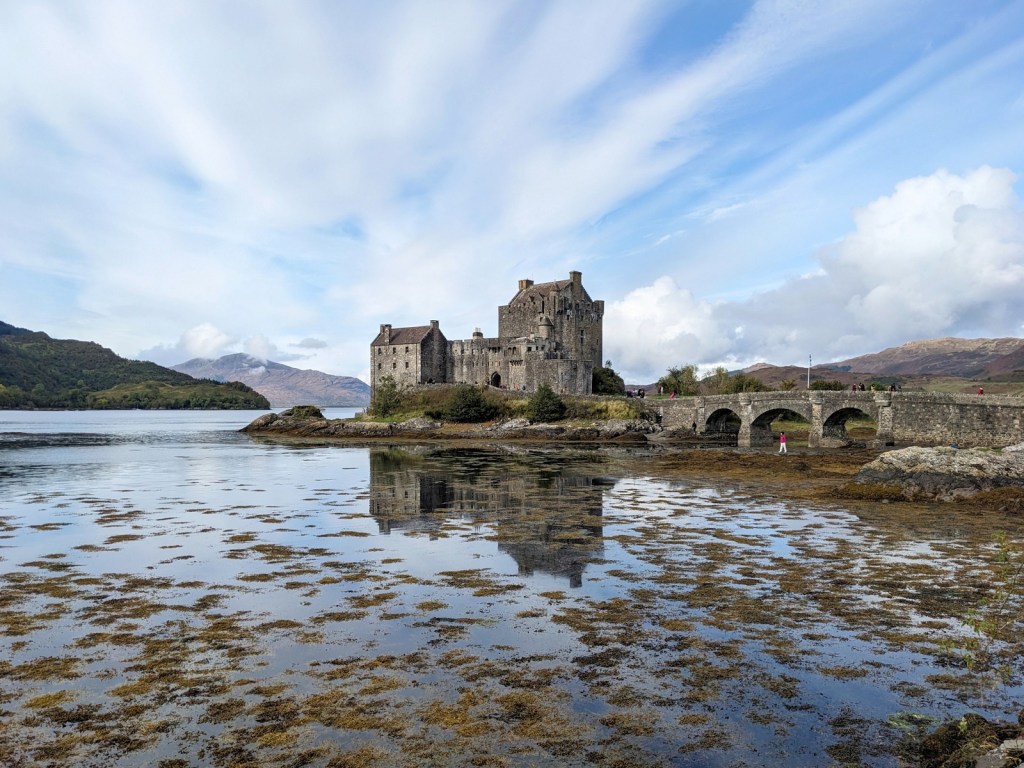
The next day we continued our journey to Skye, once again stopping to take in all the stunning views. We stopped at one point in a little parking area to take pictures of the clouds over a loch and it was ridiculous man, it should be illegal to be that pretty. There was also a food truck called “Burger Queen” and I got a coffee from them mostly in appreciation of their name. The road eventually brought us to one of the more famous sights in Scotland: the Eilean Donan Castle.
We went because of course you have to go. It is not too big though, constrained as it is by the island it sits on. We sprung to take the inside tour, and I was surprised to learn that despite its long history the castle as it stands today is pretty much a 20th century reconstruction. As I was enjoying a haggis sandwich in their café I wondered if Lt. Col. John MacRae-Gilstrap’s vision in restoring it included a visitors’ center and gift shop. The inside of the castle is very cozy though, it seems like a great sorta loch-side cabin. Around the outside they have signs with QR codes to link you to more information about the local lore and wildlife, my favorite one being about the Boobries (heh heh). It’s gotta be a little bit weird though, that it was a stronghold for the Clans Mackenzie and MacRae and is now most famous for being the home of Connor MacLeod of the Clan MacLeod. This fact is discussed neither at Eilean Donan nor Dunvegan Castle.
Me (and also Dunvegan Castle).
Dunvegan Castle of course being not only the actual seat of the MacLeod of MacLeod, chief of the Clan MacLeod, but our next destination. After Eilean we finally, finally drove the final bit of the way to Skye and Dunvegan was our first destination. Despite having made my super amazing wife watch Highlander, neither of us were really actually all that into any of the MacLeodiness of either site and were in fact visiting Dunvegan primarily for their seal tours. This is where Bob the seal tour skipper and wildlife photographer takes you out on the Loch and gets you up close to the colonies of seals on the estate. But tickets in hand we had some time before boarding, so why not we visited the castle.
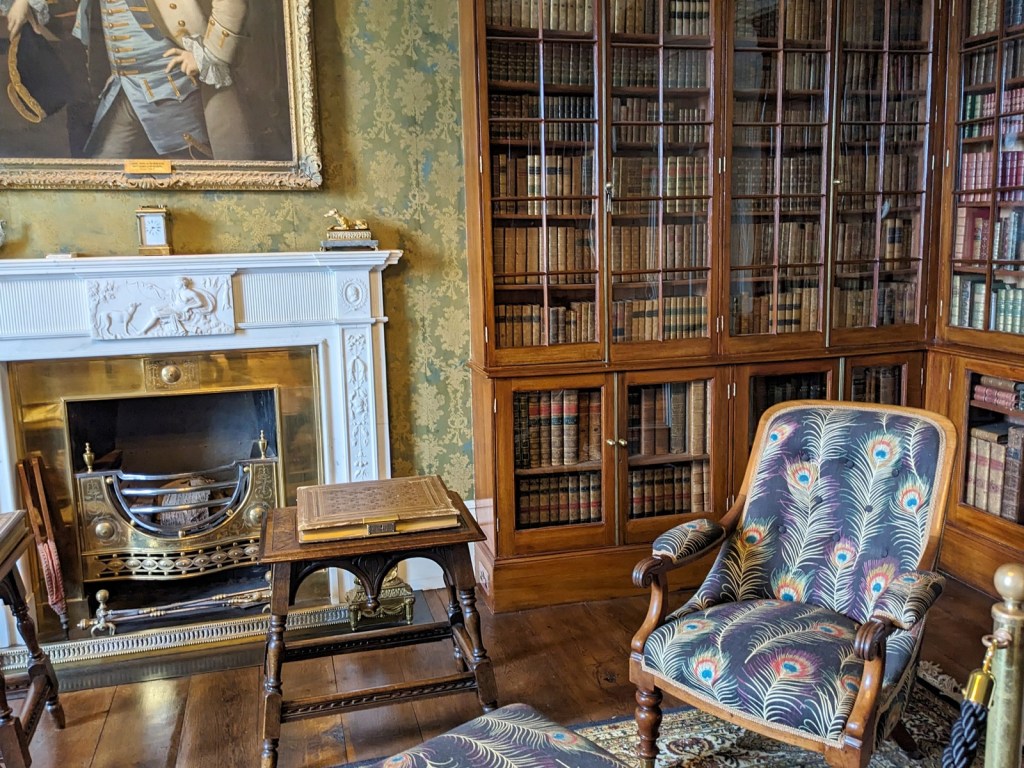
You can just about imagine Leod, relaxing by the fire with a good book in his peacock feather chair.
Like Eilean Donan, this is also a cozy castle. It’s got a nice library and nice portraits and nice bedroom furniture. As we wandered around this place I mostly wondered what Leod would have thought, as he scratched out his defensive position atop an island bluff, about his descendants like, wearing nice outfits and holding dinner parties. But I suppose one works hard so one’s kids can be artists. There was more Walter Scott ephemera and they did have a dungeon you could check out. We also of course saw the Fairy Flag and I am pleased that my blog will now safely return from WWII.
But now it was time for the seal tour. That was lots of fun. Bob is both a skilled skipper and skilled seal tour-er, and we were on one of the last ones of the season. The tour got us real close to two different seal colonies where the seals, used to basking in the glow of fame, are unperturbed as you watch them bask in what little sun there was. Bob also told us about Vlad, which I thought Bob said was a sea lion but upon Googling that doesn’t seem right, but whatever Vlad is he is big and has been eating all the seal colony pups. Bob took this in as just the circle of life. But Vlad is also eating all the otter pups, which had Bob concerned. We did not spot Vlad on this trip or else we would have given him a stern talking-to. Despite learning about predator-prey relationships the tour was a great time and it was gorgeous out there on the water.
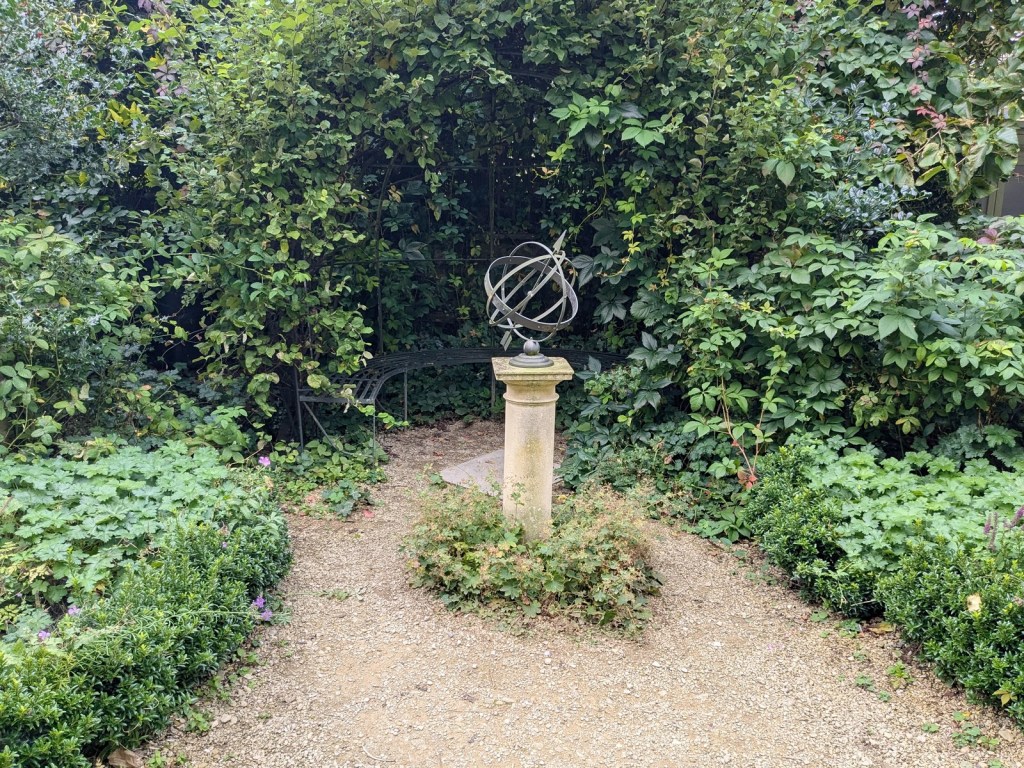
The tour over and our feet back on dry (well kinda damp) land, we exited the castle via the gardens there. They are very nice gardens and look like the sorta place a fairy would hang out when not distributing flags. But it was getting late and finally time to make it to our accommodations for the night, after stopping by a fish & chips place to pick up some dinner. The final bit of driving was the most harrowing part of the day, as it finally brought us to some single-track roads. Although I had studied the YouTube videos about passing etiquette, and was trying desperately to be unfailingly polite, I still got it wrong and a man in a van I couldn’t see (his window was much higher than ours) stopped to tell me off about it. Although gruff I suppose this was really very kind of him and the rest of the time we were in Skye and Shetland the single-track roads were no problem, except that one time I kept pulling u-turns to look at a broch. But that was still some time away, and until then we were ensconced in the beautiful landscapes and looking forward to a couple more days in Skye.
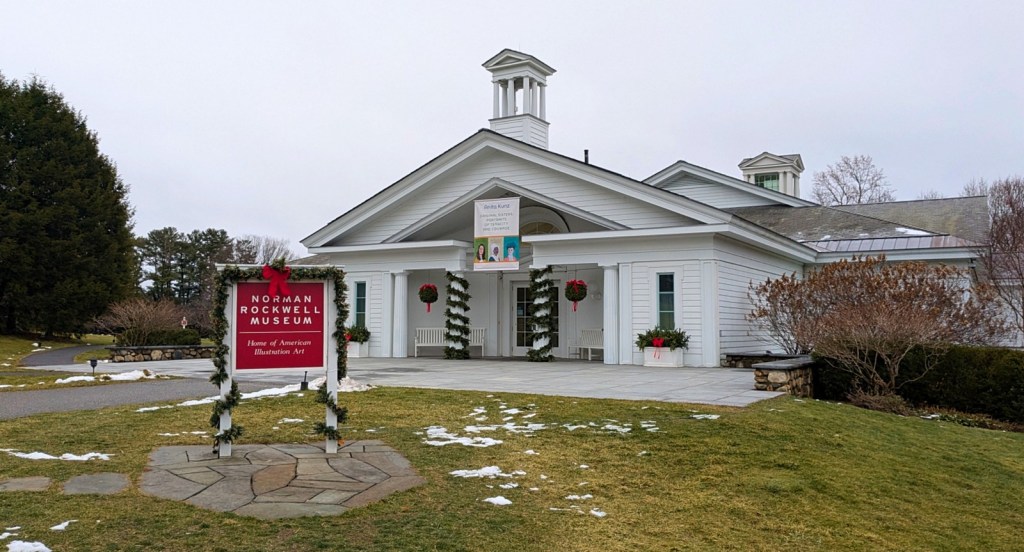
Out of a deep love of the pop girlies, my super amazing wife and super amazing mother-in-law and I went to the Norman Rockwell Museum! (it was not out of the love of the pop girlies, though I do love the pop girlies, it was only because we have an appreciation of art and Americana and local Berkshires sites, but I couldn’t come up with a better Lana Del Rey joke, probably because I don’t listen to Lana, except there was a period of my life that was very tumultuous and more specifically when I was in the shipyard when “Sweater Weather” was on the radio a lot as I was driving myself alone to Panera for dinner most nights, but that song is not by Lana though I thought it was until I looked it up just now for this extended aside, so now I think it is “Summertime Sadness” I was thinking of, as both were on the radio then, along with “Counting Stars,” a trio of songs that conjure up for me cold fog in San Diego, all of which to say is I really expected the album to be in the Norman Rockwell Museum gift shop, which it wasn’t)
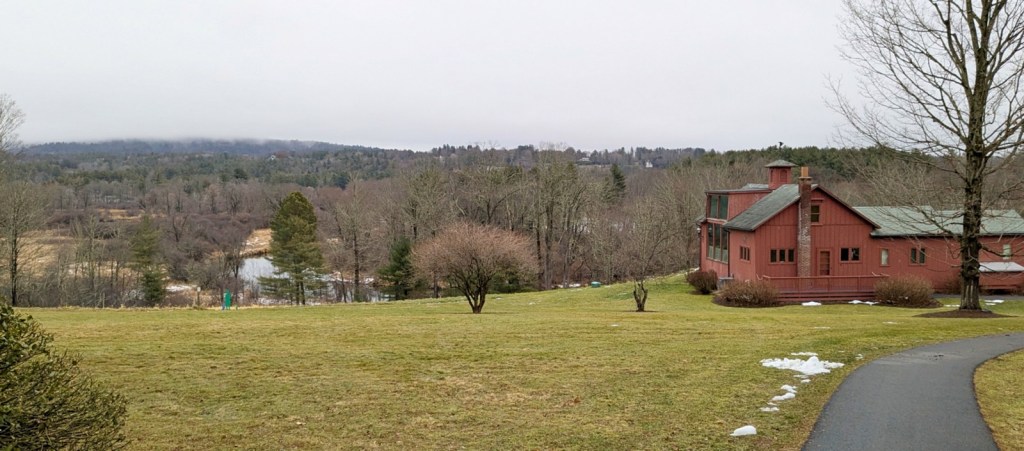
The site of the museum is not like, Norman Rockwell’s house or anything. It is not clear to me how it the museum wound up where it did exactly, but it’s a nice spot (Rockwell did live nearby just not on the site itself). They did however truck his final studio to the spot so now it overlooks a frankly gorgeous view across a river valley. In the summer months you can tour the studio but it was not the summer months when we visited so we didn’t. The studio’s first life was as a carriage barn before Rockwell got a local cabinetmaker to renovate it using a lot of Shaker-type woodwork. Seems like a nice spot.
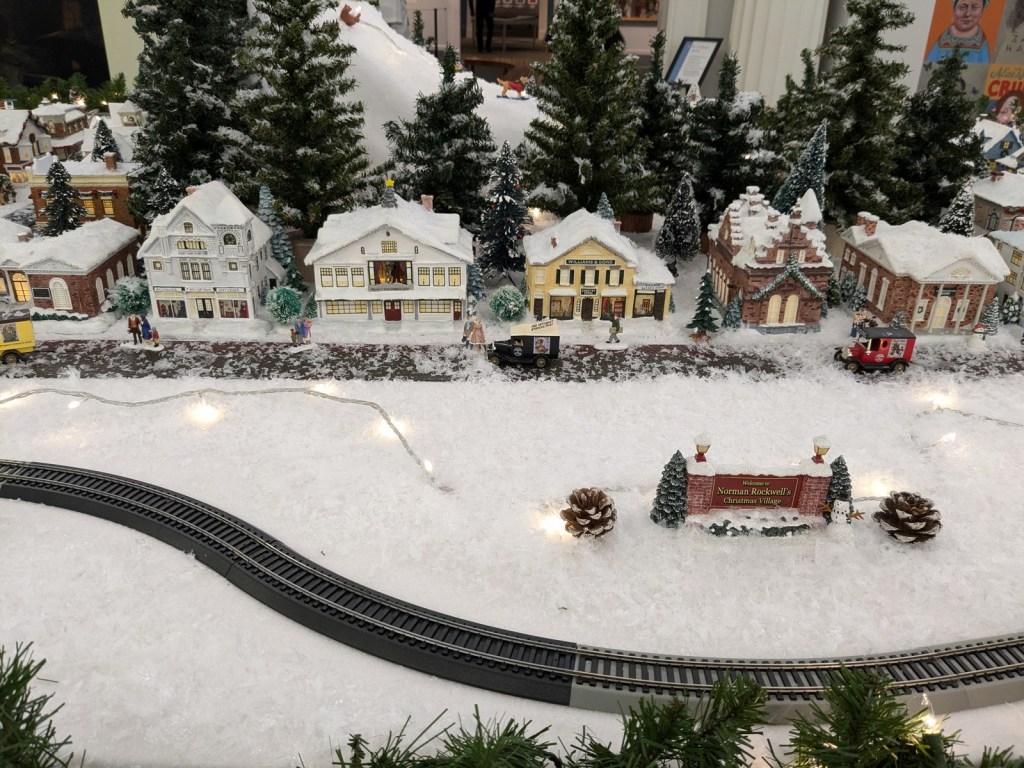
What we did explore was a purpose-built museum housing a large number of Rockwell’s original works. Since it was around Christmastime when we first entered the building we were greeted by a train set recreating “Home for Christmas,” which itself is a depiction of Stockbridge, where Rockwell lived and worked, so maybe the train set is just a recreation of the real town with no middle man in between. Hard to tell. But every year now Stockbridge dresses itself up as the painting, so art and life have simply become one.
Past the train set you get to the original artwork, and downstairs the museum also has hung up one of every Saturday Evening Post cover Rockwell ever did. Norman Rockwell of course represents uncontroversial Americana, a stereotype born of Rockwell’s own work. Given that, the most interesting parts of the museum is where you saw Rockwell push against that oeuvre or try to use his powers to push a harsher message. In his Saturday Evening Post days it was the magazine’s editorial policies that restricted him. One easy example is that in the original version of this Post cover, he had included champagne bottles, because you know that’s what you drink on New Years’ Eve, but that wasn’t family-friendly enough for the cover. Fun, but in the museum I also learned that it was the Post’s policy to only allow depictions of black people on the cover if they were in a subservient role, like a Pullman porter. So once Rockwell leaves the Post, you get him painting works like “Murder in Mississippi:”
“Murder in Mississippi,” Norman Rockwell, 1965
That painting is quintessential Americana, too.
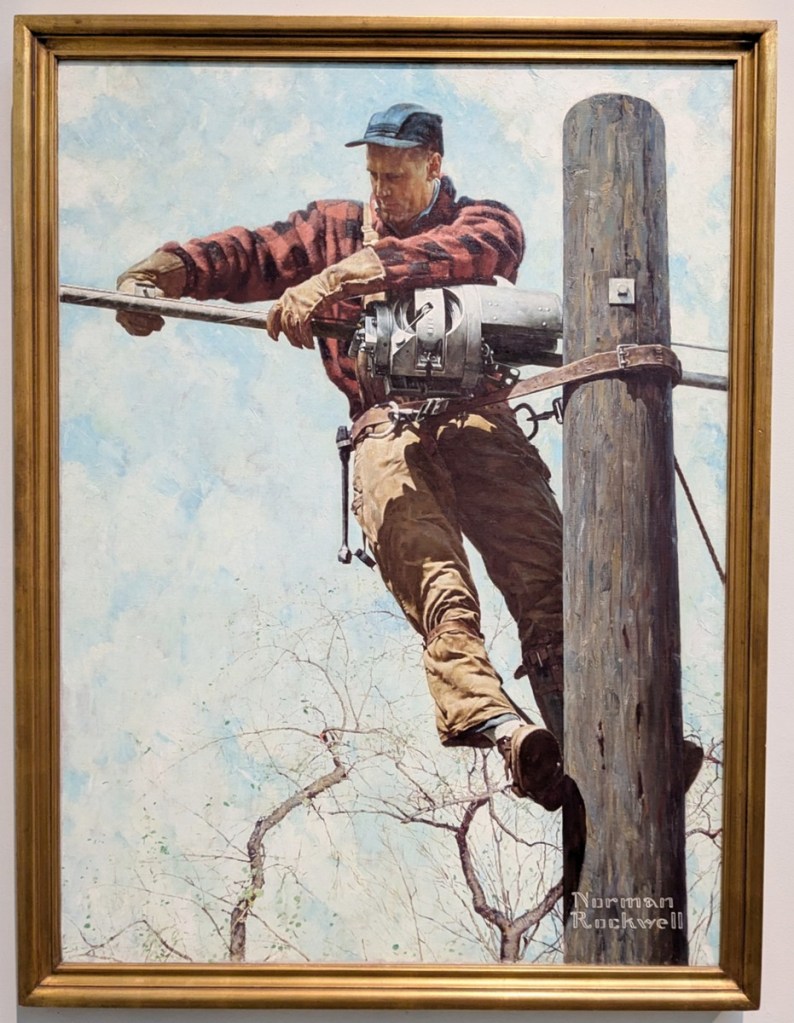
The man was pretty amazing at what he did, which you don’t need me to tell you. A couple other pieces I really liked were “The Lineman” and “Glen Canyon Dam.” Neither of these were for the Post. I like “The Lineman” because there was apparently a lot of technical back and forth. It was for AT&T and since Rockwell worked off of models or reference photos he enlisted one John Toolan to pose for him on a “makeshift pole supplied by the telephone company,” and then when Rockwell sent off the preliminary drawing AT&T had him make nearly a dozen changes, mostly technical, which just like, some group of engineers spent a lot of time pouring over the drawings lest some inspirational ad be inaccurate. On the other hand “Glen Canyon Dam” caught my eye because it is kinda 3D; I don’t think it’s impasto exactly but the ridge the family is standing on sticks out from the canvas, and all those little rocks are actually bumps that you could feel, if they let you, which they don’t, the cowards. The painting itself clearly tells quite the story but I just think its neat.
“The Lineman,” Norman Rockwell, 1948“Glen Canyon Dam,” Norman Rockwell, 1969
And then I took a selfie with an internet celebrity:
To finish out the day filled with classic Americana, we went into Stockbridge itself. Having seen the model in the museum it felt like I had been there already, so there was no need to linger, after some lunch and souvenir shopping we were on our way, another day in the Berkshires complete.
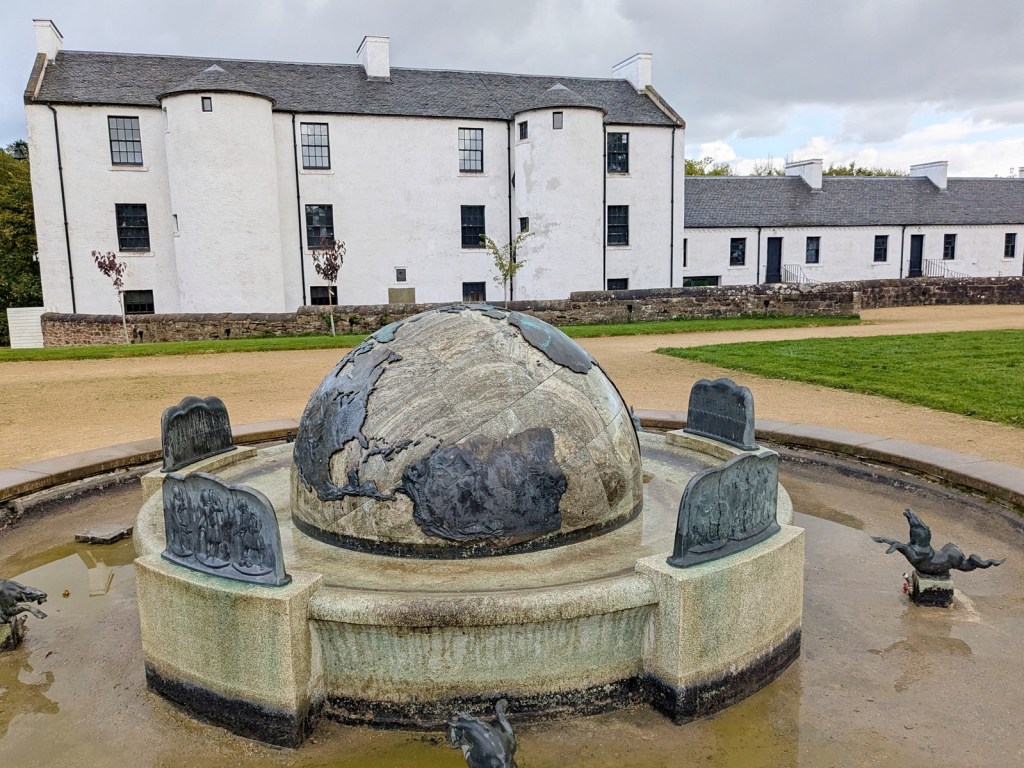
It was time for us to leave Edinburgh and so we got on an airport transfer bus and picked up a rental car, marking the first time I had driven a stick shift with my left hand. Our final destination was Skye but instead of driving there all in one day we were going to stop in Fort William. This gave us time to see in a leisurely way some of the sites, and my top priority was the David Livingstone Birthplace museum. I have been to the David Livingstone deathplace, and so visiting here meant, in physics terms, that I would have experienced Livingstone’s entire life. Despite it being my top priority I had not expected much of the place. However, having visited other David Livingstone museums and now this one I am willing to say: this is the greatest museum to David Livingstone in the world.
The reason I had not expected much was both bad assumptions and the online reviews. Like, I have been to the George Washington Birthplace National Monument and it didn’t really have a lot about George Washington. Or that’s how it seemed to me, though I visited in the last hour of the day it was open so maybe I did not look as closely as I could have, but it’s mostly a farmstead (seems to be a trend). David Livingstone was born at the Blantyre Cotton Works, so based on the George Washington experience I was anticipating a museum mostly about how cotton works work. The other factor is that the reviews my super amazing wife looked at mostly cited it as a nice place to walk a dog.
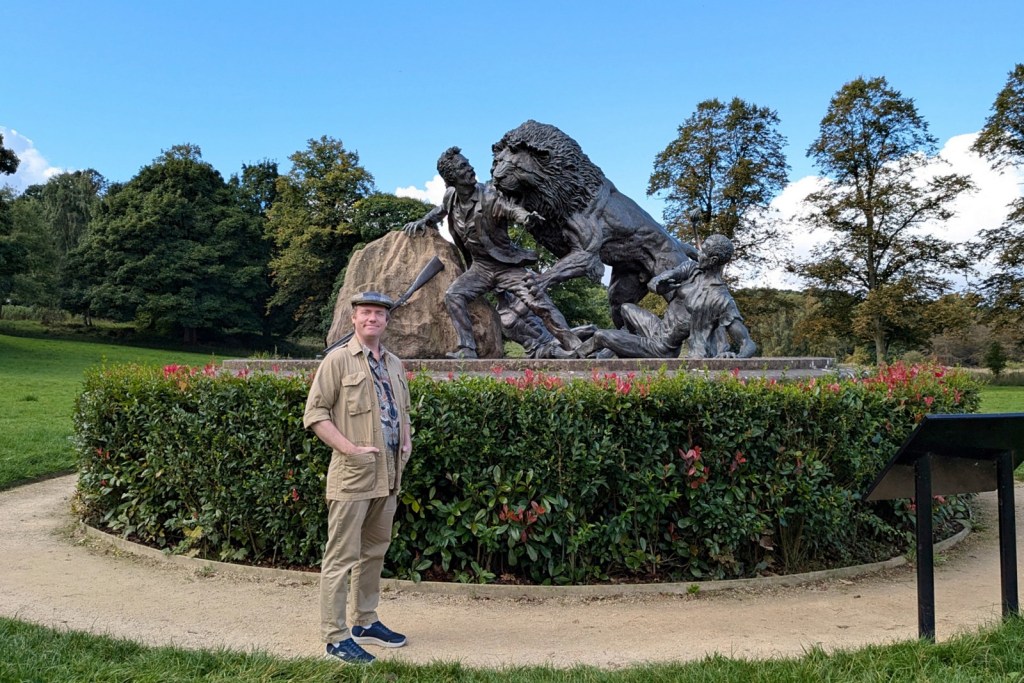
Me in front of the statue they made of what must have been a like terrible day for Livingstone.
And you know what, it does look like a really nice spot to walk a dog. You drive through a pretty little village/suburb to get to the museum, and as you turn into the parking lot there is a big field with trees on the edges and a path that leads down to the river (the cotton works being where they are so they could be powered by that river). They also have a lovely café where you can get tea or lunch (they have full table service! At a museum café!), and a playground for kids (they had one of those pirate ship play-sets which one sign said was inspired by the boats that Livingstone used on the Zambezi, and like, uh-huh). But we were not here for leisure, we were here for history, and so in we went to the museum.
The museum is extremely well done. Although now juuuuust about a century old, back in 2017 it got a £6 million grant and did a lot of work on conservation and updating the exhibits, reopening in 2021. The museum is laid out chronologically through Livingstone’s life. Actually a bit to my disappointment there is not much at all about the cotton works themselves, though do they have on display a spinning mule and a model of what the cotton works would have looked like while Livingstone was there. When they talk about the works it is in the context of David working there as a boy and young man, saving up to put himself through medical school.
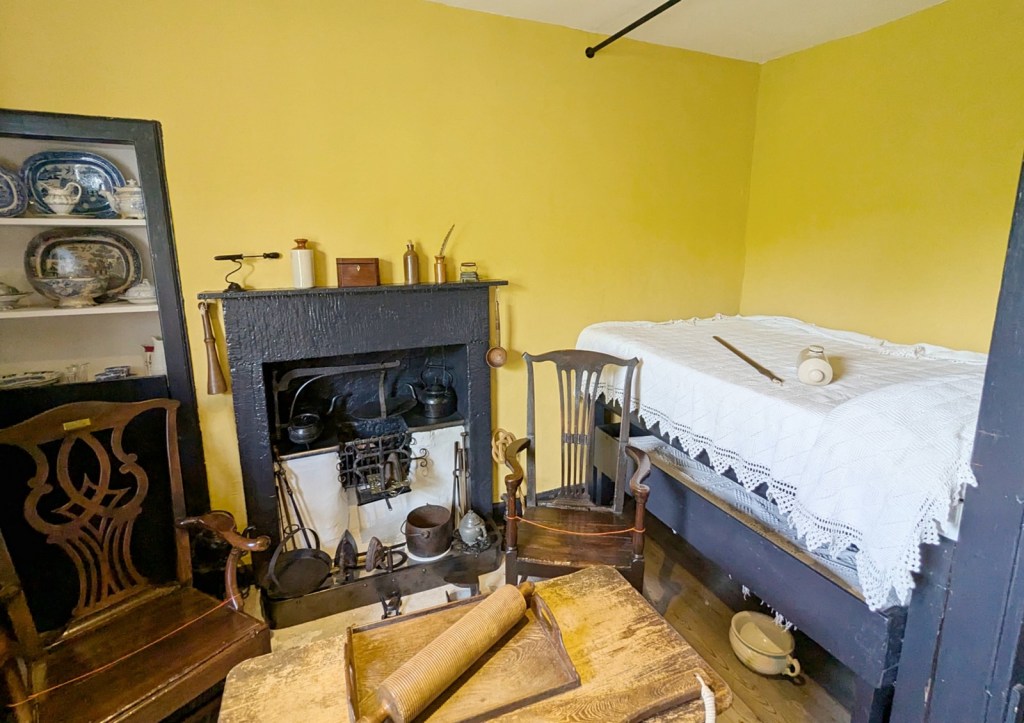
The room where David Livingstone was born and where his whole family lived.Me in the room where David Livingstone was born and where his family no longer lives.
On our visited we unexpectedly joined a guided tour when the tour guide invited us along. The one other person touring with us was apparently related to Livingstone and had met with Chief Chitambo (the current one) in Zambia. She had brought along some photos to give to the museum. The biggest advantage of having joined the tour and there being only three of us is that the guide let us past the rope barrier into the very room where Livingstone was born (and where he lived with his grandparents, parents, and siblings, all in that one room – and it was some of the nicer accommodations). I had been on the very spot where Livingstone died and now I was on the very spot where he was born (very completionist of me).
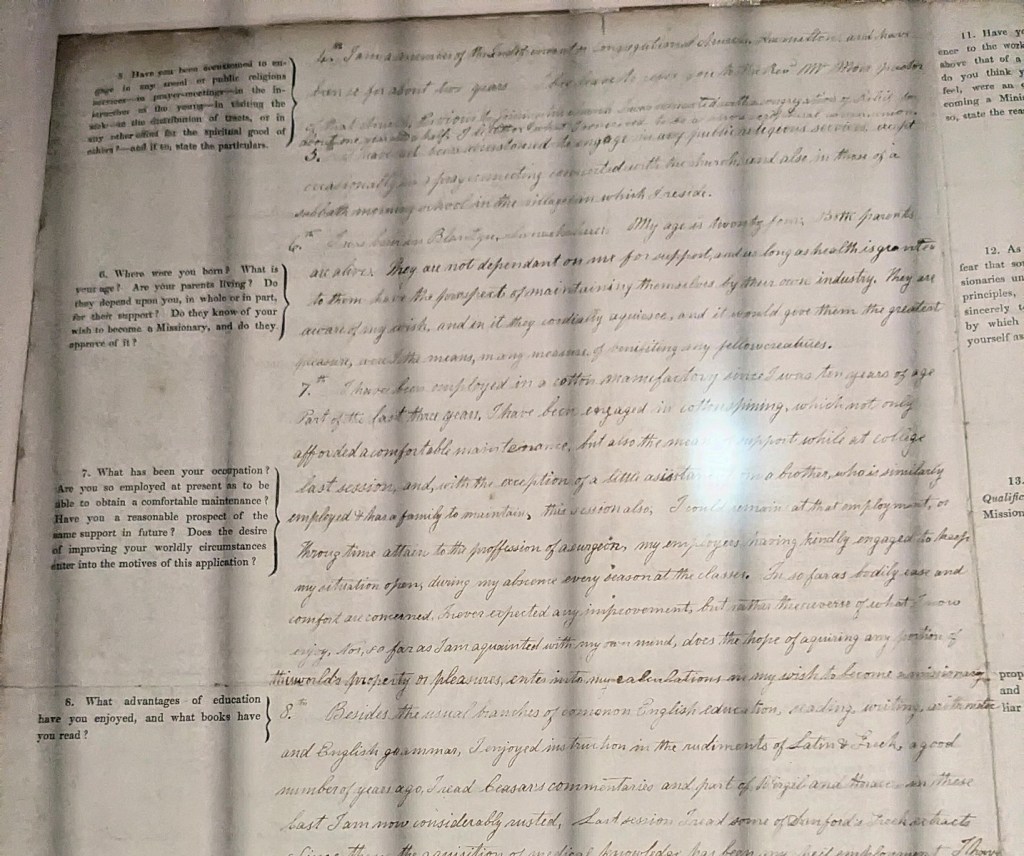
From there they talk about his early life and education, and proceeding through is career. Livingstone had decided he wanted to become a medical missionary and so started working toward that. The museum has some displays dedicated to his medical training, including his surgical instruments. For Livingstone, it was a bit of an accident he wound up in Africa at all, originally wanting to go to China and only being prevented by the First Opium War. He joined up with the London Missionary Society (they have his application at the museum!) when the cotton works wouldn’t have him back, forcing young David to get funding from elsewhere. Although I have read Tim Jeal’s biography, these were all new facts to me.
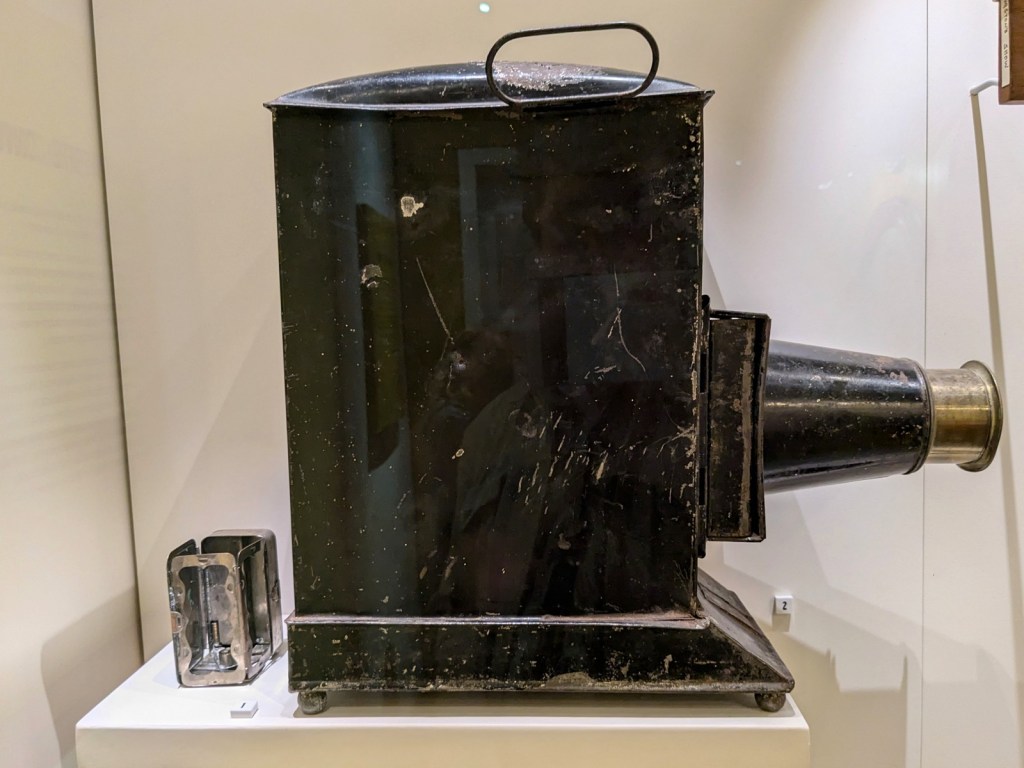
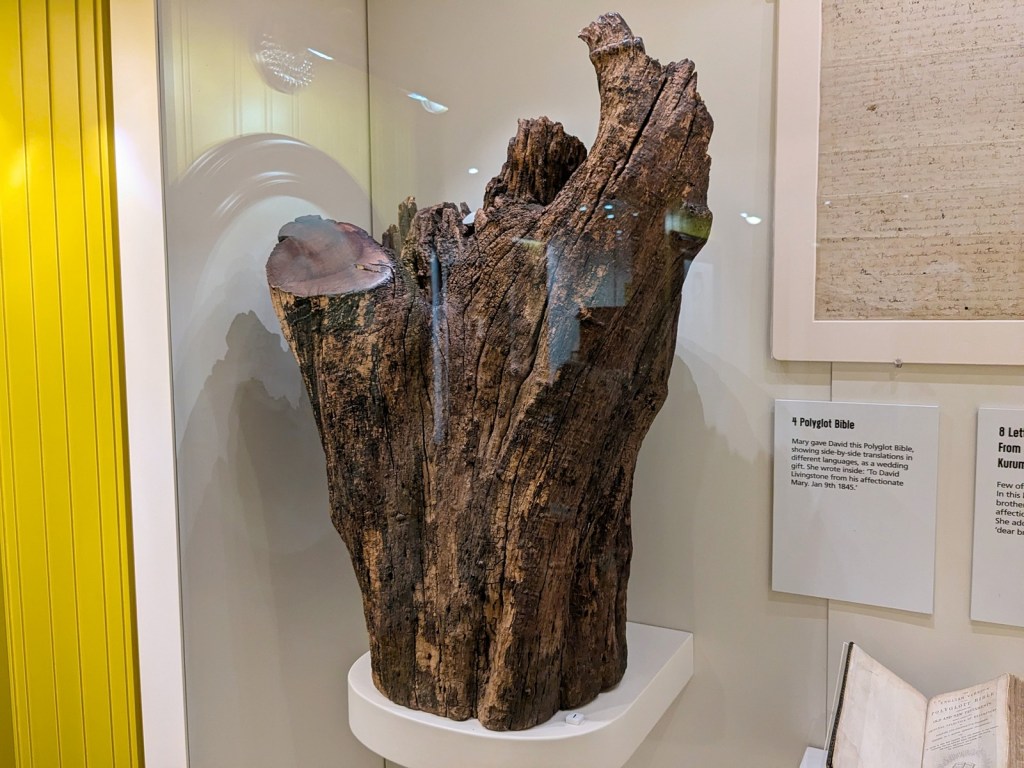
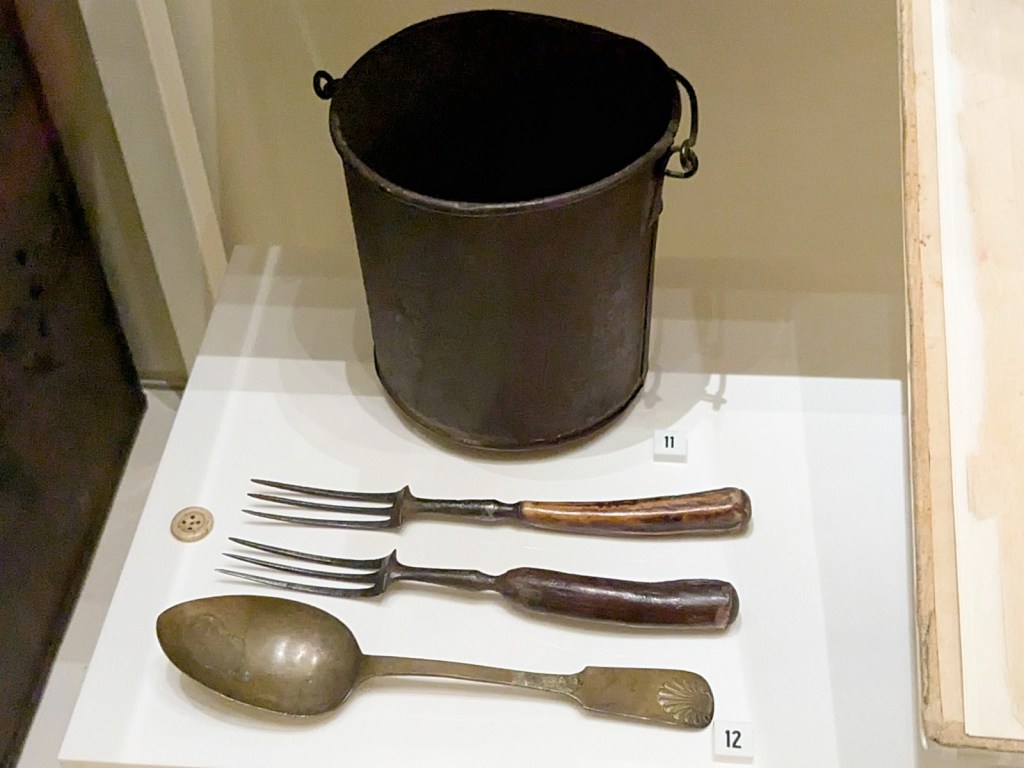
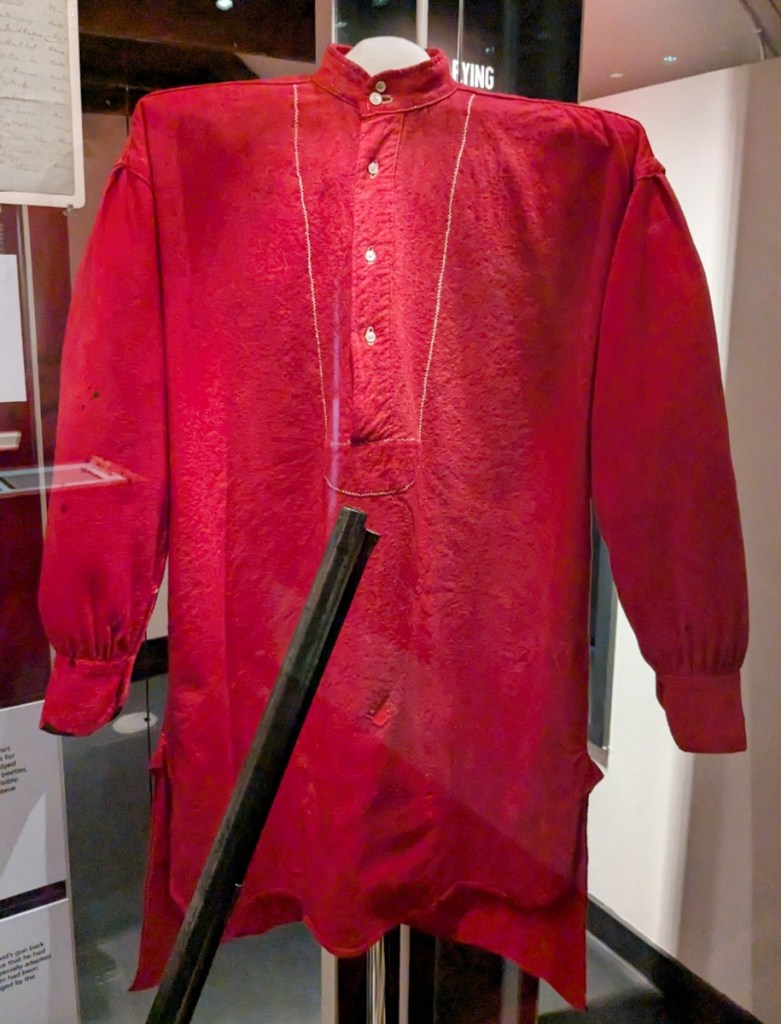
Magic lantern (it’s not really magic).Magic lantern slide.Mary Moffat’s wedding ring and a piece of foundation stone from David and Mary’s house in Kolobeng.Chunk of the almond tree under which David proposed to Mary in Kuruman.David’s forks, spoon, and billycan.Model of the Lady Nyassa.Red cotton shirt that Livingstone was wearing when he met Stanley, including ink stains.
Throughout they have some interactive displays clearly meant to appeal to a slightly younger audience, but overall it is a really in-depth and serious museum about David Livingstone’s travels and impact, with special focus on the people that helped him along the way. They do this through what is an astounding array of artifacts. Like George Washington, David Livingstone was clearly the sort of person that inspired admirers to collect relics. Many of these relics were clearly put in the museum to appeal to me, specifically, like various navigation instruments that Livingstone used. But I mean they go deep. They got a chunk of the tree under which he proposed to his wife, Mary Moffat. They got a chunk of David and Mary’s house in Kolobeng. They got David’s forks and spoon even, and they have the very shirt that Livingstone was wearing when he met Stanley. They got everything.
Livingstone’s application to the London Missionary Society, which he submitted with an essay on the Holy Spirit.Livingstone’s sextant!!!
On this particular day and throughout the tour we kept spotting various bits of the walls that had been covered up. Our tour guide explained that recently a protester had come in and written on the walls about colonialism and Palestine. My initial reaction was that the anger was a little misplaced towards Livingstone, seeing as he mostly seemed to want to help people. But that doesn’t necessarily mean much. The whole reason I got interested in the London Missionary Society in the first place, after seeing what info they had on the Mambwe, because they are a case study I think of people doing development work out of a fervor to help people. Their work wound up shaping the way colonialism in central Africa played out, and over a hundred years later we can look back with some perspective, useful as we continue to do development work out of a fervor to help people. So that doesn’t absolve you.
Combatting the slave trade was the raison d’être for Livingstone and those that followed him. These displays include implements used by slavers, and the yoke is one that Livingstone removed from an enslaved person.This is an ivory loudspeaker used by Tippu Tip, underneath a photo of Mlozi.
The museum also works to paint a holistic picture of the man. The obvious case is the failure of the Zambezi expedition, and the museum talks about the impact that had on his reputation. I also learned from the museum and the guidebook that Livingstone wrote out of his narrative at least sometimes the efforts of other people, such as William Cotton Oswell and Mungo Murray. Those men travelled with Livingstone to be the first Europeans to see Lake Ngami, but Livingstone wrote to the Royal Geographic Society taking all the credit. And then there is of course his wife Mary. Mary was born and raised in South Africa, and all her family was there. Although she joined him on his early travels, he eventually had her go live in the United Kingdom, shuffled between various houses while he went exploring in Africa. He could have treated her a lot better and eventually realized this after she died, but man, that is a revelation to have before you leave your wife to raise your children for like five years while you go trekking.
These thoughts were on our mind as we finished the tour (the room on his legacy is the last room of course so it is designed to be on your mind. We head out to explore the rest of the grounds, including walking down to the bridge across the river. It is a lovely place to consider the impact someone can have on the wider world, whether those impacts are intentional or not. What I can say in the end is that the Birthplace museum is a must-visit spot for anyone interested in David Livingstone, early European travels in Africa, or the history of Europe in Africa in general. Or if you need a really nice spot to walk your dog.
Virunga, Archives and Collections of an Outstanding National Park edited by Patricia Van Schuylenbergh and Han de Koeijer
Our final day in Edinburgh began with some light shopping, first of all for donuts at Kilted Donut. That place was great. Between the two of us we got three donuts and couldn’t finish them. We ate them on a bench in the shadow of the castle, looking majestic (the castle, not us, we were stuffing our face with donuts). Though feeling a little bit like we shouldn’t be there (maybe like the Edinburgh Seven did), we popped into the Edinburgh Futures Institute to check out some more tapestries before heading to Victoria Street for my super amazing wife to buy a tweed bag, and finally to a vintage store where I got a tweed jacket. With our new wares I don’t think anybody could tell we weren’t Scottish.
Above the entryway to the museum there is yet another tapestry!
These adventures brought us to our final must-do while in Edinburgh: The Writers’ Museum! This place was really neat. It is tucked away in Lady Stair’s Close, one of Edinburgh’s many steep alley-like little streets (if you were well-to-do back in the day I guess you got yourself carried around in a sedan chair so you didn’t have to hike up the stairs yourself), in a narrow and winding house. The museum is dedicated to the “three giants of Scottish Literature;” i.e. Robert Burns, Sir Walter Scott, and Robert Louis Stevenson. The museum houses a variety of artifacts from each of them. As far as I could tell, the museum was three for three on having locks of the writers’ hair, but only had the writing desks from two of them, Burns and Scott (they did have Stevenson’s Samoan headrest however, and I learned at the museum that Stevenson lived on the islands for the last five years of his life, which is the way to do it if you ask me). The museum doesn’t have a particular narrative, but via the artifacts they have on display they effectively explain the impact that these men had on Scottish literature and culture and it is well worth stopping in. No lapel pin in the gift shop though, their only oversight.
On the Revolutions of the Celestial Spheres by Nicolaus Copernicus, 1543.
This being our last day in Edinburgh we had to make sure to hit all the other places we hadn’t quite managed to get to. Up next was a visit to the National Library of Scotland. We didn’t see the stacks but they have an exhibition area and they had some really interesting stuff out, by which I mean old stuff, including a lot of medieval and early modern navigation texts and treatises on how the world is put together. Fantastic. As we continued down the hill the next stop was the Scottish Parliament building. Yet again this is a place I remember visiting on my last visit to Scotland (my dad got a silver quaich from their gift shop), and again I was stunned to learn that last time I visited it was practically brand new, the building having only opened up in 2003. Oh how things change. But yeah they have a wonderful little exhibit on the history of democracy in Scotland and then we went up to see the Parliament chamber itself. Since there wasn’t anything going on we were allowed to take pictures.
The parliament chamber.
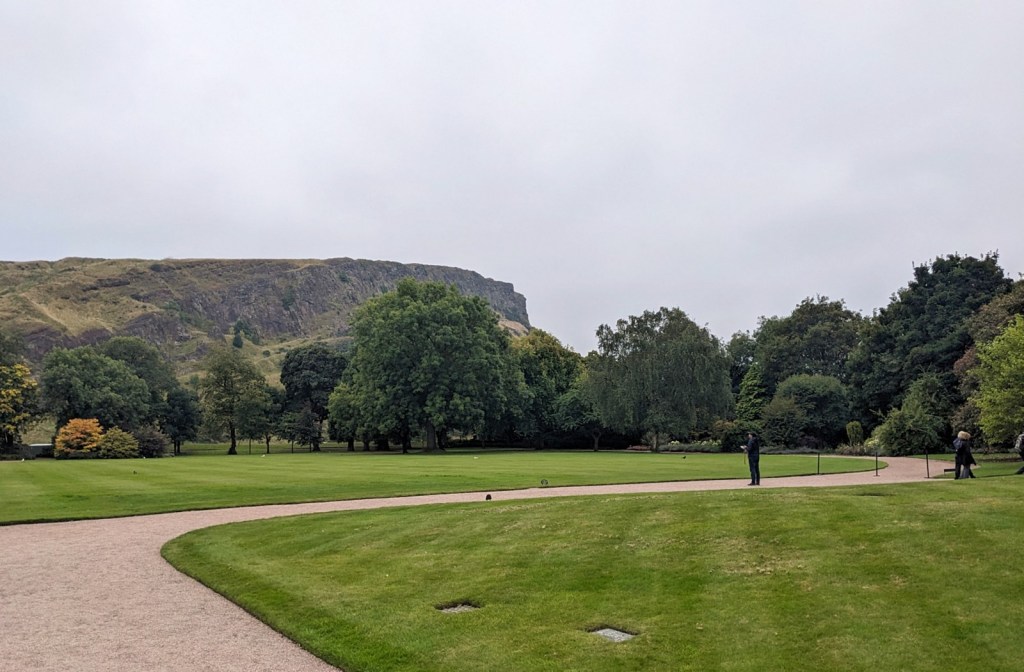
Then speaking of government it was finally time to head across the street to the Palace of Holyroodhouse, this being the King’s official residence in Edinburgh. The admission was more than we expected BUT the visit was better than we expected (no pictures here, what are they hiding). They had the most advanced audio guide we had seen, and we were unprepared for the amount of history that had happened in the place. I mean for example it all started with David I founding the abbey to Mary Queen of Scots suffering through her secretary being murdered by her husband. They still got the bloodstain on the floor. They had a lot of artifacts from Mary and it is worth visiting for those items alone. My favorite part was the Great Gallery. Charles II had commissioned Jacob de Wet to paint all the real and legendary kings of Scotland, but to cement his right to rule of Scotland all the portraits share Charles’ very particular nose. They just don’t do statecraft like they used to. I was also interested that they referred to all the royals by their Scottish titles, since this is Scotland, but it took me a sec to figure out who like the Duchess of Rothesay was. But then the real treat is the tail-end of the tour, when you walk through the palace’s gorgeous gardens which have the benefit of being backdropped by Arthur’s Seat. David I had good taste in real estate.
The front of Holyroodhouse.The back of Holyroodhouse, with the gardens overlooked by Arthur’s Seat.
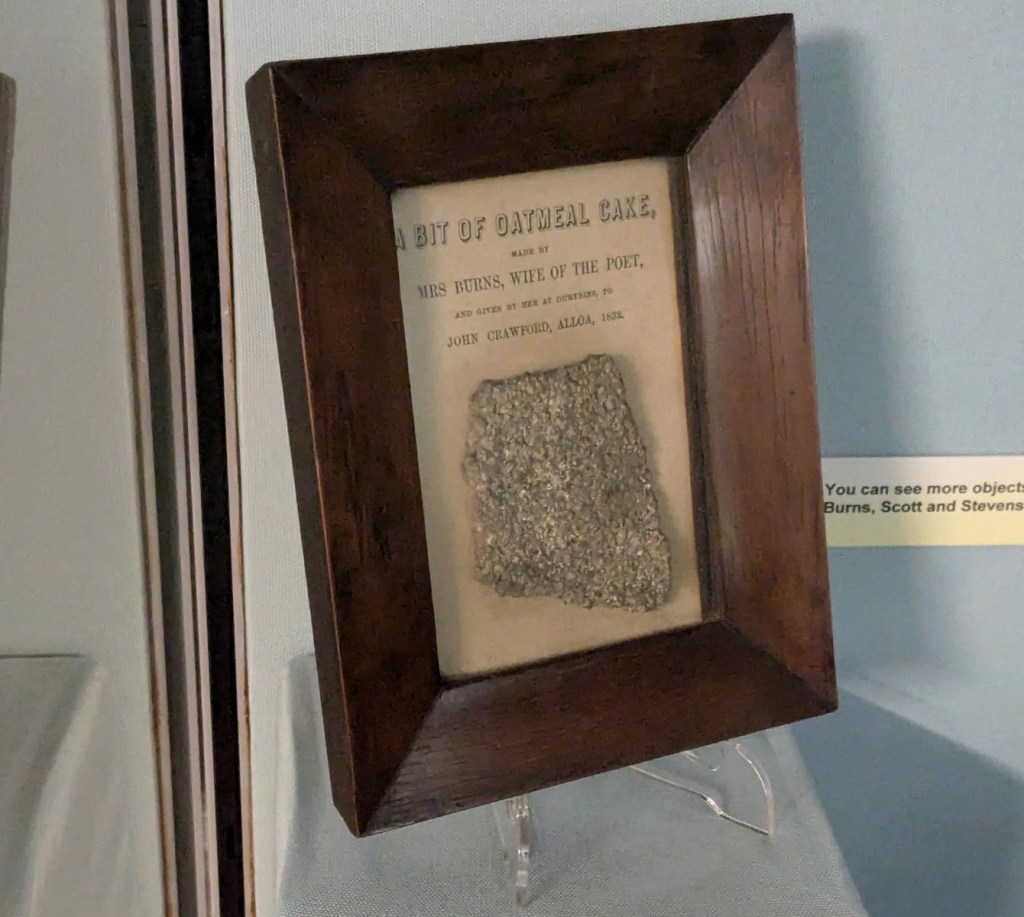
From there I dragged us into the Museum of Edinburgh since it was free and open for 40 more minutes. Another place with an eclectic collection of artifacts, including Robert Louis Stevenson’s golf ball and nutcracker, a basket made by Adam Smith’s (the economist) mother, and in my favorite genre of things in museums, “a bit of oatmeal cake made by Mrs. Burns, wife of the poet” in 1832. To cap off our Edinburgh experience we had dinner at The Witchery in the Secret Garden. We had the best table in the house, right on the balcony. An absolutely fantastic Edinburgh experience and I am excited to go back, hopefully sooner than in another 20 years.
I’m not sure the level of irony here, but the plaque beneath notes “This biscuit is made by one of Robert Burn’s many sweethearts, this time his wife, that ‘winsome wee thing’ Jean Armour… at the time Burns died in 1796, Jean Armour was caring for five of her own children and a daughter of Burns from an illegitimate affair, and so must have had a tried and tested recipe for these oatcakes.”
Today we would be absolutely mired in Scottish history. The first place we were going was the top destination (get it) in the city: Edinburgh Castle! We arrived not too long after the place opened, showed our tickets and went in. Audio guide in hand, we admired the views and then walked up to the very tippy-top.
St. Margaret’s Chapel from the outside.
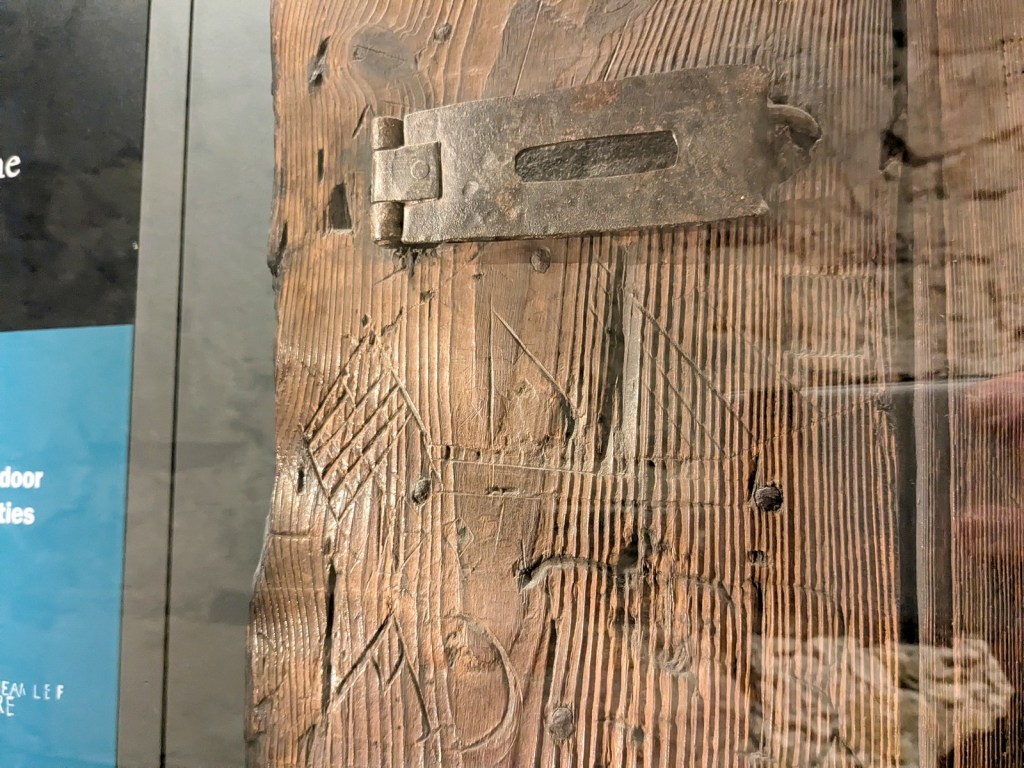
I think the coolest bit of Edinburgh Castle is St. Margaret’s Chapel because it is the oldest part. I had remembered it from my previous visits in Middle School, and you know what it was about the same. I was surprised though at how small Edinburgh Castle was; in my memories of the place I seem to have imported various bits of Stirling Castle as well. What surprised my super amazing wife was how not particularly dark and dungeon-like it was, as one might imagine a castle to be based on the movies (this was her first real-life castle). However eventually we went into the Prisons of War exhibit they had going on and that satisfied some of the dungeon itch. Edinburgh Castle housed various prisoners of war in the 18th and 19th centuries, including Americans captured either during the War of Independence or the War of 1812. One particularly cool thing they had was graffiti carved into the door depicting an early version of the Stars and Stripes. I think I saluted it.
What I like about this photo is I think I look like a proper bloke. You could see me at the pub, yeah?American Graffiti, but like two hundred years earlier.The Great Hall really is.
But no in general the castle seemed like a pretty nice place to live. We had lunch consisting of a cheese plate in the tea room, where my super amazing wife got tea but I got Edinburgh Castle whiskey (this being Sunday, they had to wait 15 minutes until 12:30 to serve it to me), before exploring the royal residence. Besides hosting the very impressive Scottish crown jewels (no pictures allowed), you can also see the room where Mary, Queen of Scots gave birth to James VI (well, you could look at that room around a corner with the help of some mirrors, but it’s not like either Mary or James were there anymore anyway). After paying our respects to Scottish history and poking around some more we departed the castle for the rest of our day in Edinburgh.
We went in a different door, actually.
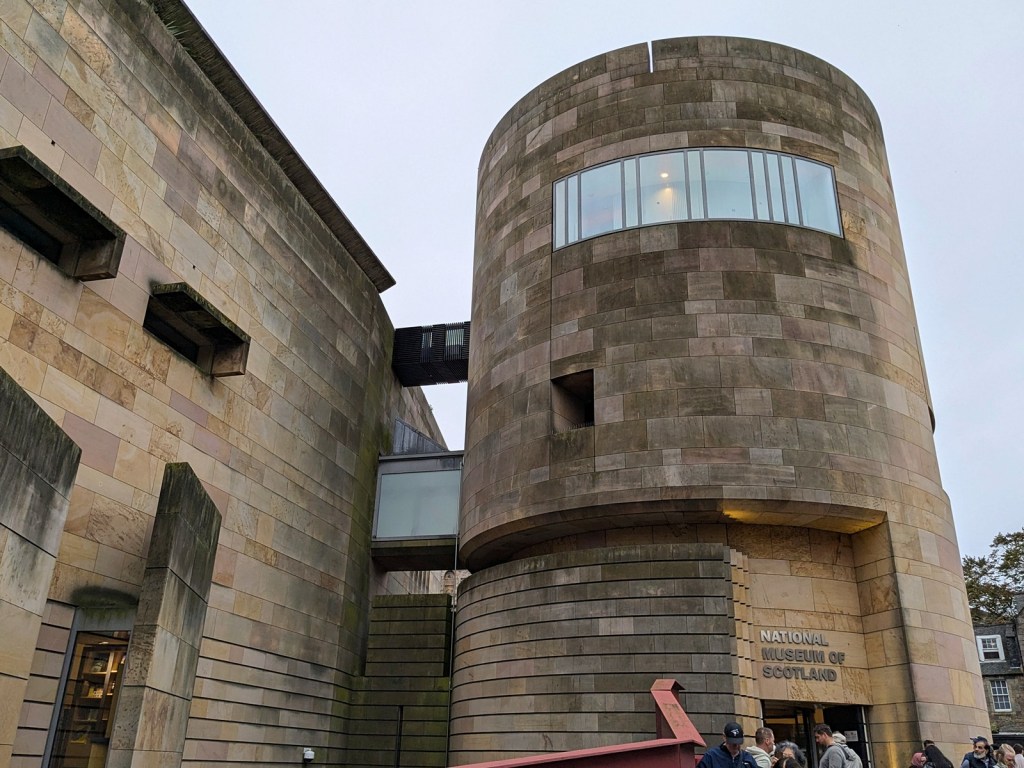
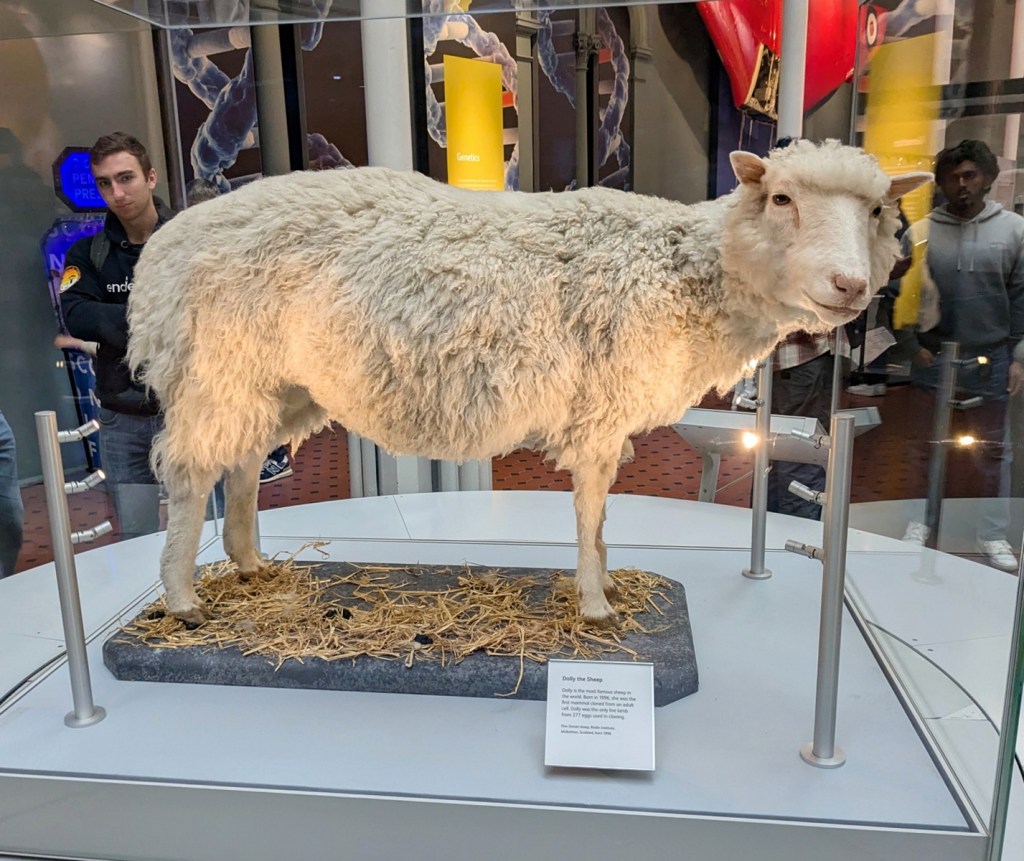
From there we took a circuitous route, hiking out to Ginger Twist Studio (where my super amazing wife got a skein of yarn and a book on walking through Scotland knitting socks) and then back to downtown to visit the National Museum of Scotland. That place is BIG. We had not allotted ourselves much time to see the place so we had to narrow our scope, and my super amazing wife decided to focus us on the Scottish history portion. On the way over there though we spotted Dolly the Sheep, who they have on this spinning dais thing to give everyone a good look at ‘er.
Dolly the Sheep! Nice they gave her some hay.
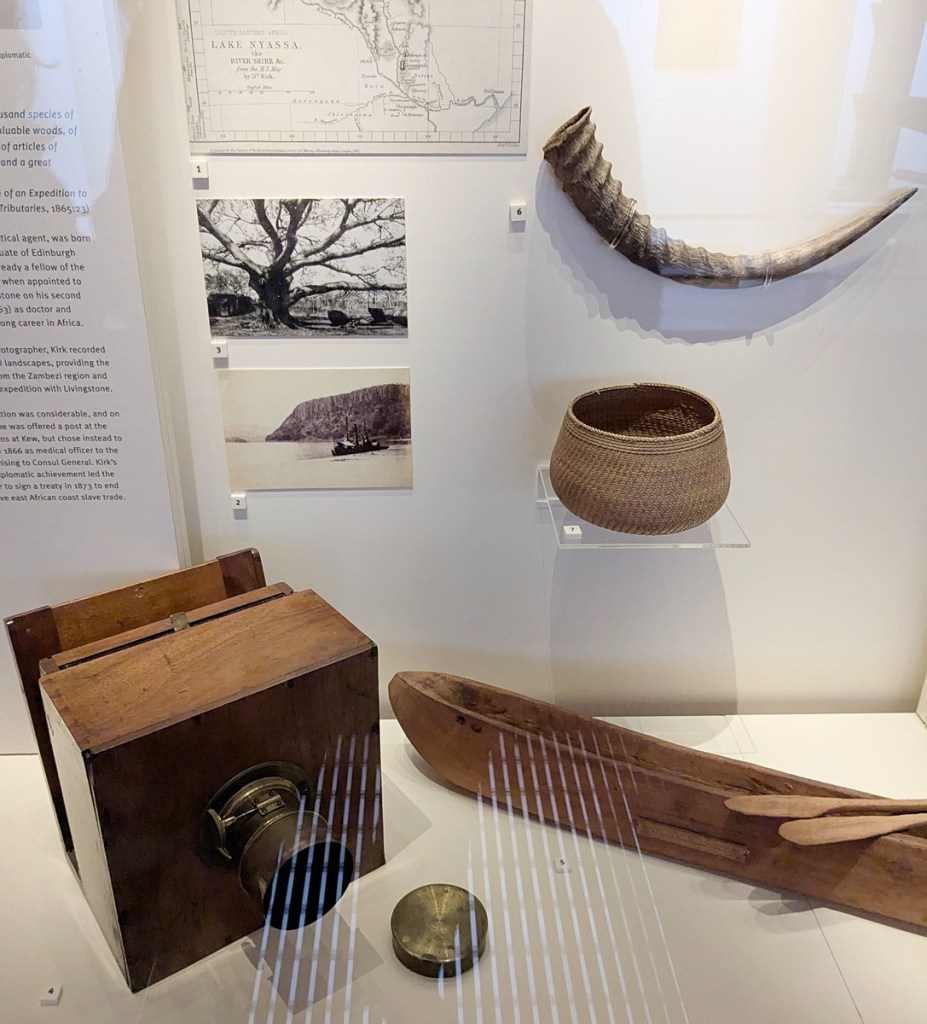
Anyways they have many many artifacts from Scottish history, including very ancient history, and it is all really extremely neat. The craftsmanship on some of the ancient jewelry and objects they have found is really astounding. They also have more grisly bits of history. Though the room that made both our eyes light up was on the industrial revolution, because it was a room that housed not only several looms but also several large early steam engines and like, man, they designed a room for us. As we wandered the rest of the museum the particular sorts of items I was on a lookout for was anything related to missionary societies in Africa or African explorations, and in this I was rewarded. I spotted not only various artifacts from Dr. John Kirk but also the gold medal awarded to Joseph Thomson (who I thought was the brother of John Boden Thomson, but in writing this entry I now realize the LMS missionary is notJames Baird Thomson, author of Joseph Thomson’s biography), both very cool things to see in person. I was contemplating how I could get us to the Joseph Thomson Heritage Center on this trip but it just didn’t work out logistically, unfortunately.
The loom & steam engine room!Various items from Dr. John Kirk’s travels in the Zambezi delta.Joseph Thomson’s gold medal, awarded by the Royal Geographical Society.
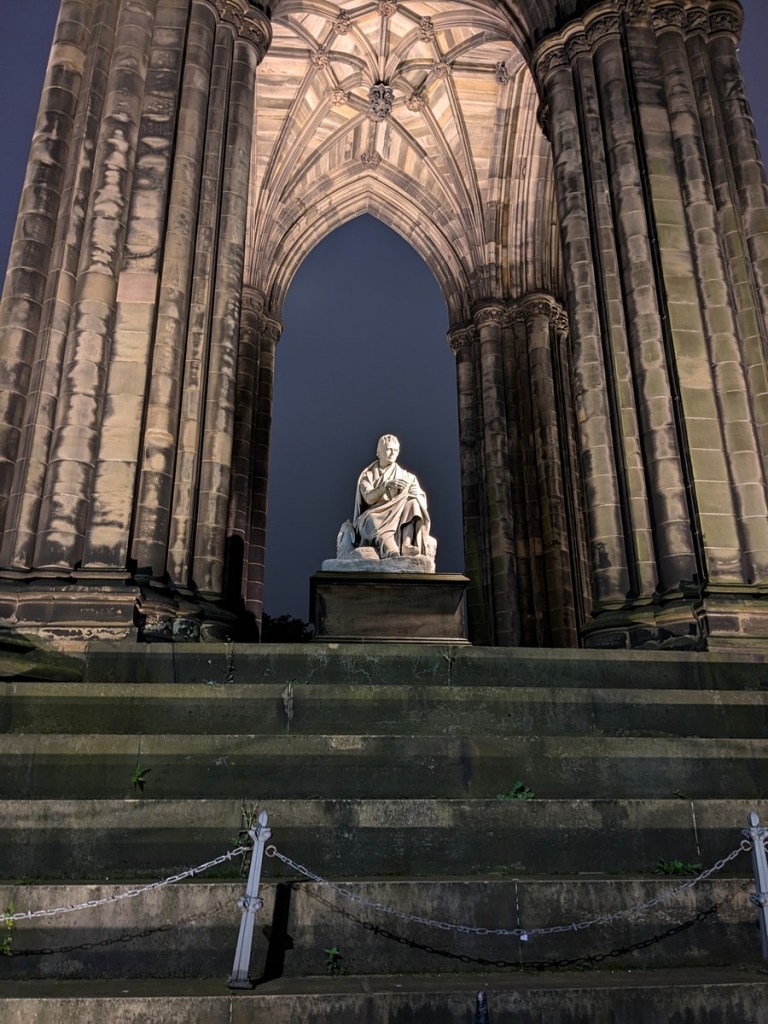
Anyway if you are at the museum do make sure you go and visit the rooftop terrace, which gives a great view of the castle and of downtown Edinburgh. We closed the place down on this visit and were eventually shuffled out the door, though not without the necessary diversion to the gift shop. In the evening we contemplated various tweed purchases and had a lovely dinner featuring “haggis bon bons” as an appetizer, really a very astoundingly Scottish evening. In that vein a quick stop to memorialize Sir Walter Scott and see what he was up to rounded out a very very nice day in Edinburgh.
A major thing I kept learning throughout the day was how much this man did to shape our modern perception of Scotland, quite a figure.
After having thoroughly enjoyed the southerly bits of England we set our sights on our real destination: the veritably sheep-filled country of Scotland. I realize the fact that there are more sheep than people in Scotland is due to a terrible history, but nonetheless we went with hearts full of hope to see as many as possible.
Boarding the Caledonian Sleeper.
To get to Scotland we travelled in style aboard the Caledonian Sleeper. I was very excited about this experience and in the end it was indeed quite the experience. The fundamental reason we took the train was to save ourselves a day spent just travelling and for this it worked out pretty well. But I was also looking for an excuse to take it because I like trains and it wasn’t too hard to convince my super amazing wife. We departed Bath via one train, took the tube over to a different train station, and then boarded the Caledonian. Because of how late we bought the tickets we wound up with the most luxurious option, which gave us lounge access beforehand (where I got in the Scottish mood by enjoying Irn-Bru and shortbread cookies). It also meant we had a shower in our cabin which I took advantage of. The room was still very tiny and barely had enough room for both us and our bags but nonetheless. In the end the thing that would have made the ride better was if it were longer; it is only like a seven-hour train ride so by the time we were onboard and settled we only got a few hours of sleep before it was time to wake up and get breakfast. Sleeping through the ride in the dark also means you miss out on any potential scenery viewing. We arrived in Edinburgh as we were eating breakfast at the same table as a very nice couple from Indiana, before gathering our things and alighting.
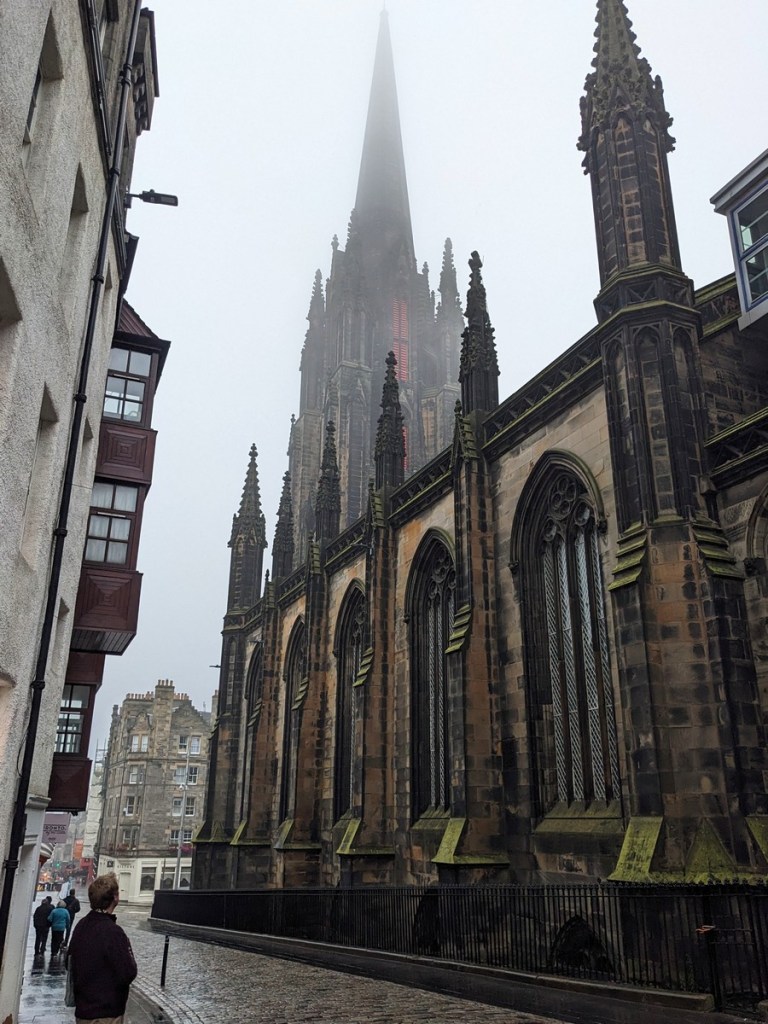
Exactly what you would expect Edinburgh to look like.
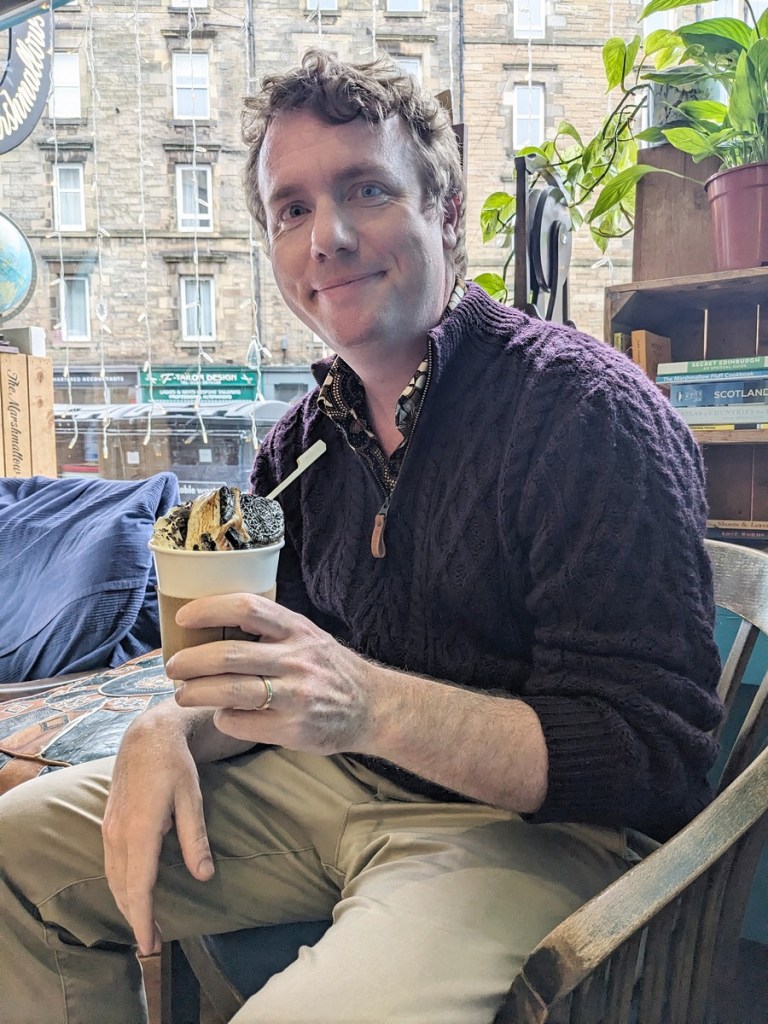
After dropping our bags at the hotel we set out for the day’s adventures, which with our early arrival on the Caledonian put us on the streets of Edinburgh at about 8 in the morning. And what a morning in Edinburgh. Misty, foggy, and very atmospheric. It was early enough that almost nothing was open but we had the Royal Mile nearly to ourselves. We took in the sights and did some window shopping and eventually settled into a café to kill some time. Fortified, we spent the largest chunk of the morning hiking through greater Edinburgh to do some shopping, stopping by Topping & Company and Kathy’s Knits and The Gently Mad, where I once again was somewhat disappointed at not finding the exact bits of London Mission Society ephemera I had imagined would just be all over Edinburgh. Oh well. On our way back to the Royal Mile we enjoyed a hot chocolate at The Marshmallow Lady.
Oreo marshmallow hot chocolate, a series of words with no consequences at all when strung together.
Despite being hopped up on marshmallow sugar we still needed lunch which turned out to be somewhat of a struggle on the Royal Mile. During my family’s now much-ballyhooed house exchange in Scotland while I was in middle school, the house we exchanged was actually in the suburbs of Edinburgh, which meant I have many fond memories of the Royal Mile. So that means I can’t tell if I am just misremembering how crowded it was back then or if it has gotten significantly more crowded, but every day while we were there the Royal Mile was PACKED. And maybe I was just a kid back then so I can’t tell anyways but it did seem a bit Disney-fied since then as well. But after several attempts we finally got some very good ramen for lunch.
A weaver working.
But the real highlight of the day was Dovecot Studios which was just phenomenal. This was a destination picked by my super amazing wife so I did not know what I was walking into when we arrived but man it was magical. What they do is tapestries. Some rich dude in 1913 wanted tapestries for his castle or whatever so he just hired some people to start a studio and eventually started taking commissions. You could go up and see the tapestry weavers at work (or the singular tapestry weaver, while we were there), and they had some just fantastic art on the walls as well, both in tapestry form and in other media.
Seamark, tapestry in collaboration with Tania Kovats, 2024.
Downstairs they had an exhibition for The Caged Bird’s Song which was just mind-blowing. The first part of the exhibition was about the making-of, and then there was a video with the final product and I was just blown away by it. The tapestry is based off of a watercolor and the tapestry looks like watercolor, like you can see in the weaving the pooling effect of the watercolor pigments and the expressiveness of it all. How do they do it man. And I was satisfied with just a video of the finished piece until my super amazing wife pointed out that the real thing was like right behind me and man. What a craft, what a thing to see in person. Dovecot takes on a new apprentice every three years or so, which means there might be a slot in 2026 and might be worth it to turn one’s life upside-down to learn such magic.
The Caged Bird’s Song, Chris Ofili and Dovecot Studios, handwoven tapestry, 2015-2017.
Shaken and inspired we went back out into the somewhat overcast Edinburgh light and spent the rest of the day doing circumnavigating the Royal Mile to visit a few more shops. The best part of the Scottish Textiles Showcase was a very friendly dog who wanted you to kick his ball for him to chase, but at Greyfrairs Kirkyard we couldn’t find any of the Harry Potter graves. At Armchair Books the very knowledgeable saleslady was impressive but we didn’t get anything there either. The day ended with dinner at a Nepalese restaurant and us subsequently collapsing at the hotel, very footsore.
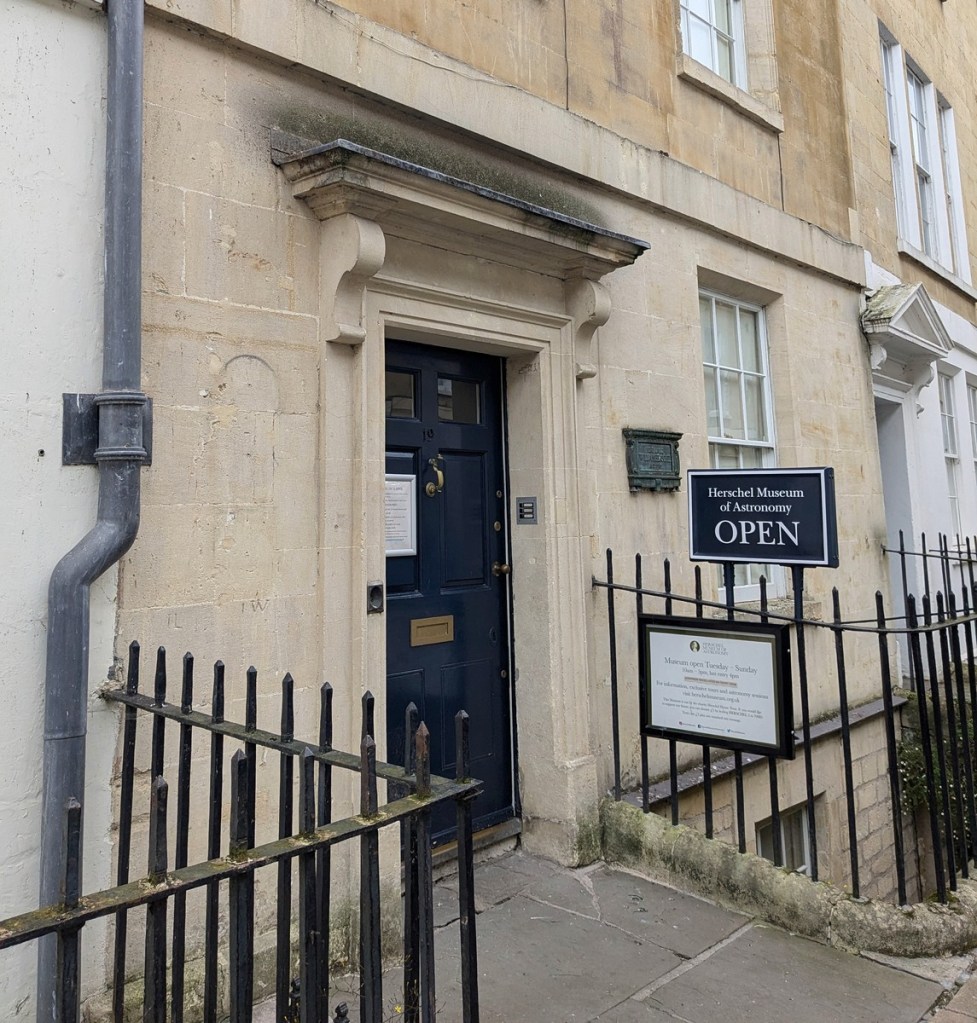
Our third day in Bath would in fact be spent in Bath but would be our last. So we had to make the most of it, and walk among the stars. Which meant of course that we started the day at the Herschel Museum of Astronomy.
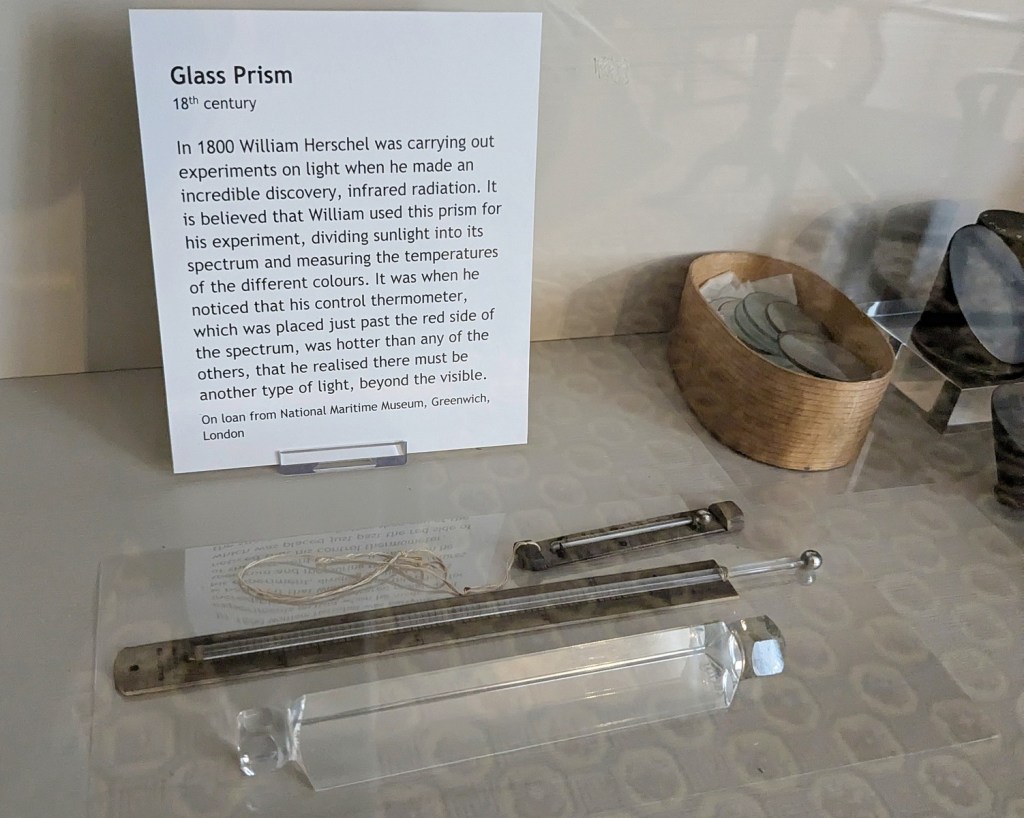
It is a very nice little museum and is in the very house where William Herschel discovered Uranus in 1781. To be specific, it wasn’t in the house that he discovered Uranus, because he took all the observations from the back yard, so I guess it was outside the house. But then again I guess the discovering part in astronomy is mostly like math and stuff and he probably did that inside so maybe I am splitting hairs. Or splitting the light spectrum, because William Herschel also discovered infrared radiation, and the museum houses the prism he (maybe) used to discover it (on loan from the National Maritime Museum in Greenwich).
The infrared prism.Statue of William and Caroline Herschel in the garden.The very spot where they took the observations of Uranus.
One thing I really appreciated about the museum is they do a lot of work to credit William’s sister Caroline Herschel. William and Caroline started off as musicians which is what brought them to Bath in the first place. But William’s hobby was astronomy (though I dunno maybe his real hobby was telescope-building, he would apparently skip meals because he was in the middle of grinding mirrors) and he enlisted Caroline to help do all the math (and also grind mirrors) and she took to it. So the brother-sister duo discovered a whole bunch of stuff, together and each on their own. A very cool little spot.
The fountain of mineral water in the Pump Room.Me in the Pump Room having a wonderful Jane Austen time.
This brought us to tea time (or more accurately time for tea, but it was really lunch). Since this was Bath and the place to see and be seen we were off to the Pump Room! This was a lot of fun. The Pump Room is a feature of several of Jane Austen’s novels and so we had to go for the authentic Jane Austen experience. After navigating our way past a somewhat gruff security guard used to turning away people who were looking for the Roman Baths, we were seated and ordered tea. We had ordered in advance the Traditional Pump Room Afternoon Tea service. As I mentioned in Bath I we were in Bath during the Jane Austen Festival, which meant that several of our Pump Room compatriots were in Regency dress which greatly added to the atmosphere. They also had live music in the form of a pianist who would alternate between classical fare and more modern hits. We couldn’t figure out where we had heard one song until my super amazing wife identified it as the K9 Advantage flea commercial (don’t worry I am cultured). I tried to make up Regency-era gossip but it was unconvincing. To finish off your meal they have a fountain in the Pump Room dispensing hot spring mineral water. With fond memories of the water downstairs in the baths I had some, and then had to have some more when my super amazing wife hadn’t gotten a picture the first time around.
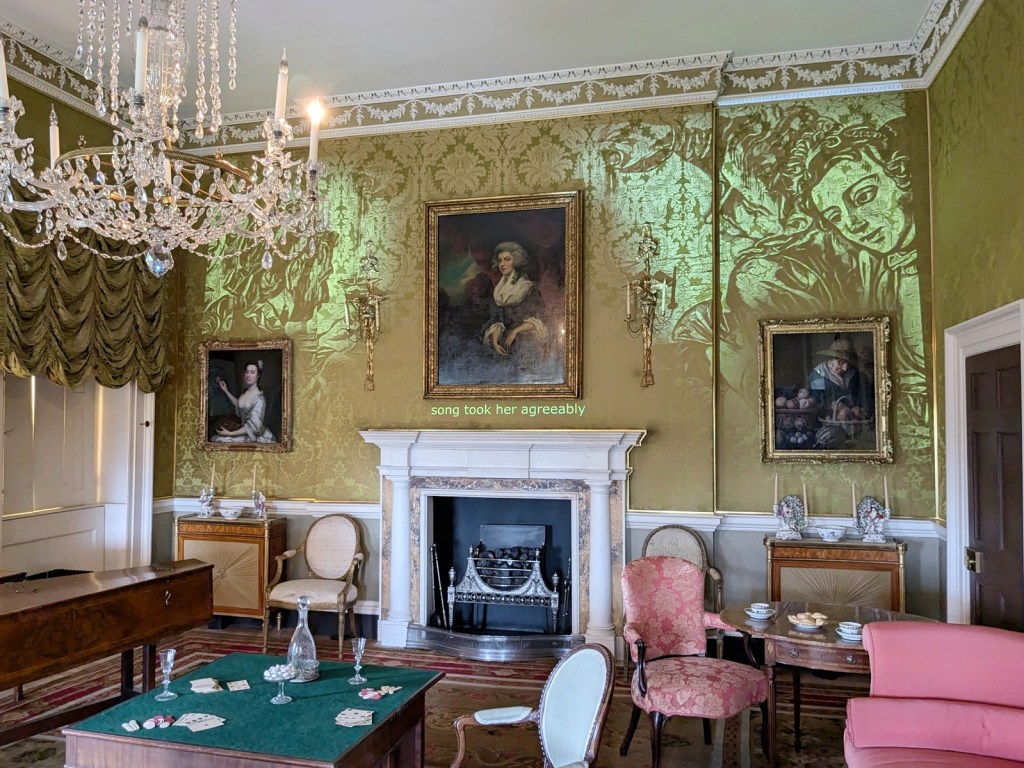
One of the walls of the museum in the midst of a projection.
Sated, we wandered Bath, visiting a yarn store and some book shops until finally making our way to the No 1 Royal Crescent Museum. As alluded to above, Bath is a popular backdrop to movies, especially Jane Austen adaptations, and my first glimpse of Bath was via the eyes of a lovelorn Dakota Johnson. The Royal Crescent features prominently, so we had to go, and also conveniently the museum at No 1 shows you what life was like in the Georgian era if you were wealthy and also lived in Bath. It is a very nice museum, with an interesting system where in each room there were videos explaining Georgian Life via Jane Austen excerpts. The videos were projected discreetly onto walls or played from screens hidden in vanities, and as each video ended you had time to walk to the next room before that video started playing. The only confusing part about the whole thing were of course the Jane Austen festival-goers who I kept thinking were tour guides. I always like the wallpaper in these 18th-century houses and the furniture and I take pictures imagining I am going to decorate similarly someday. But my proudest moment was instantly recognizing a setup for a turnspit dog in the kitchen. Man I am so cultured.
Turnspit dog workplace.
The rest of the day was spent acting like a Jane Austen couple and strolling about, looking into more shops and having a drink. We were taking the train back to London that night and had the bright idea to move up our train ticket time, a plan which was thwarted for various reasons not least of which was that a car had hit a bridge which delayed all the trains so the first one running was in fact the first one we were going to be on anyway. But with another lovely day behind us, we eventually boarded the train and were on our way to wilder pastures.
Some of the Avebury stones within the massive earthworks.
Fortified with sausage rolls and knowledgeable about the height of stone engineering, we departed for the much larger though less famous henge to the north: Avebury. I had never been to Avebury and this is a much different experience from Stonehenge. On the way there we admired various houses with thatched roofs which we were surprised to see, who knew people were still using that tech in earnest there in the UK. Eventually we arrived at the Avebury parking lot and walked the short path on down to the museum.
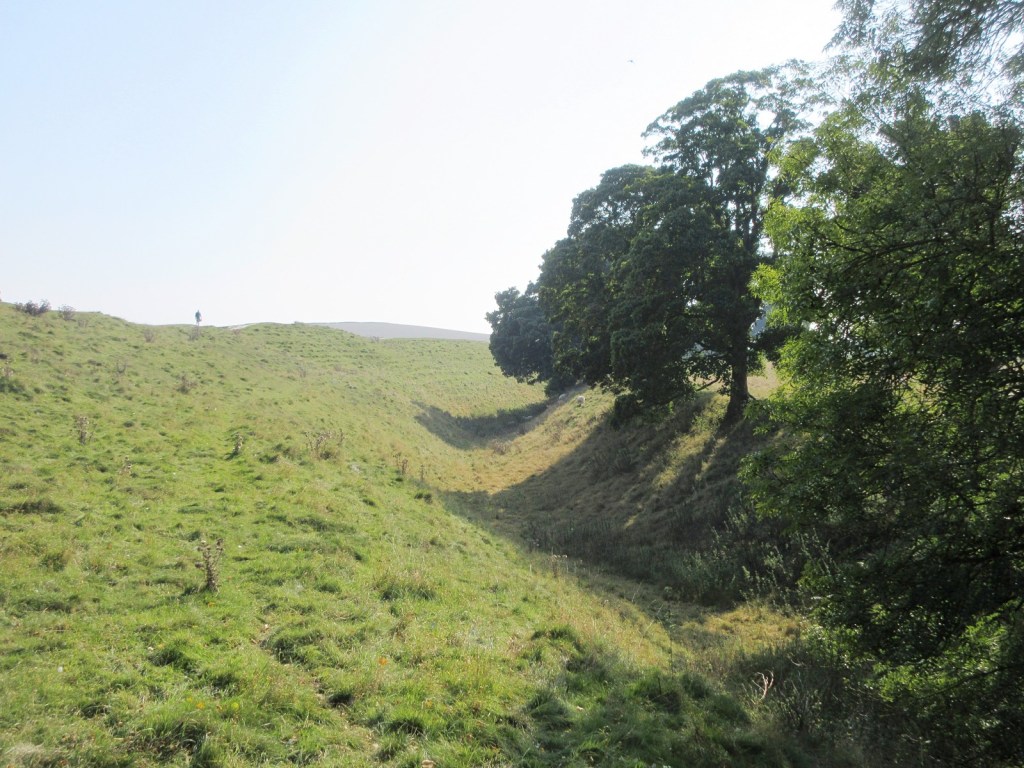
Avebury is quite the spot. It is the largest stone circle in the UK, so large that the town of Avebury sits inside of it. Which, is that where you would put your house? Wild, people just moving into the middle of the thing. The stones themselves are impressive for having been propped up despite their size, but the stones aren’t really the main attraction of Avebury since there isn’t any of the architectural stacking that you get at Stonehenge. Instead what is most impressive about Avebury is the massive earthworks. Their full extent is only evident via archeology, but even today when they are a shadow of their former selves it is still astounding how much soil and chalk they moved to construct the place. You get a hint of this as you walk down the path to the museum and necessarily make your way through a cut in the circle.
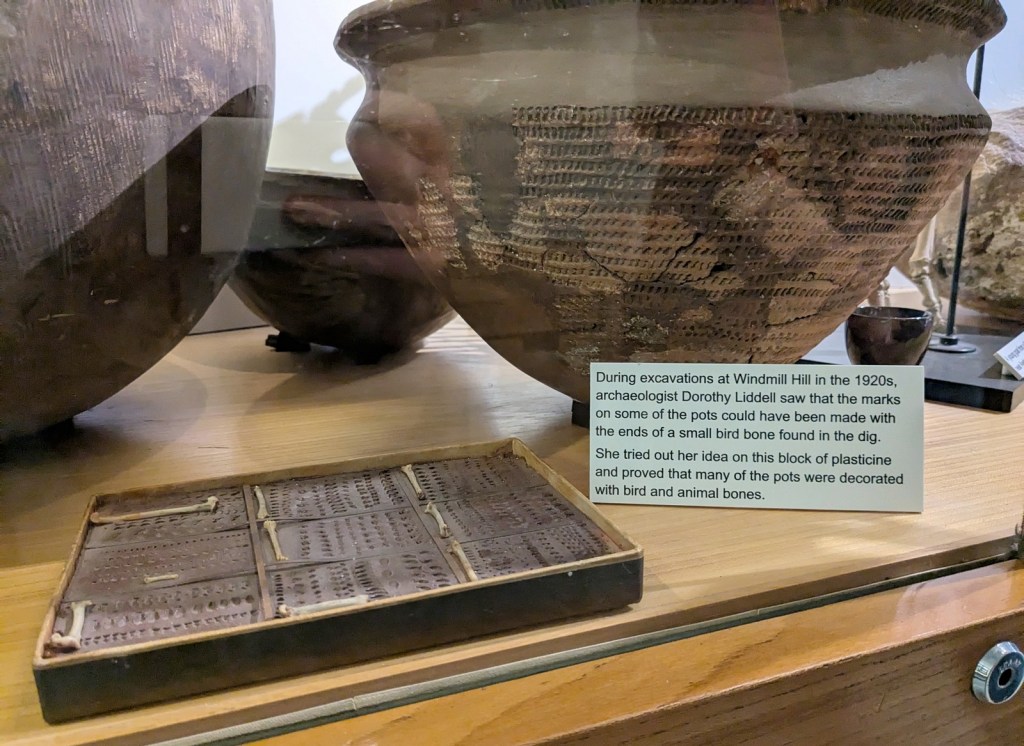
The museum entrance.Cool dude at the musuem.Advanced pottery techniques.
In the museum, which is small but good, they have a number of artifacts on display from the henge. Despite its magnificence and proximity to Stonehenge there were not many people at all visiting so you could take your time strolling through. I was most interested in some of their experimental archeology, specifically how to decorate ceramics with small bird bones, so make sure to keep that technique in your back pocket, ceramicists.
From atop the outer circle; in the past it would be even more impressive.
From the museum we set out on the path around the circle. You have to be careful crossing the street as the circle is bisected by the road and town. The houses obscure a bit of what the site would have been, where the earthworks created a place apart from the surrounding landscape. The ditch itself has been filled in by time some, as alluded to above, but as you hike up the ridge you can get a sense of the scale of the place. But the most exciting part, especially for my super amazing wife, is that whereas Stonehenge was surrounded by sheep, here the sheep were inside, amidst the stones. That is a significant point in Avebury’s column. We spotted from afar one particular sheep using a standing stone to give its butt a really good scratch which, amazing, a compression of the ages, the past comes alive, the works of these ancient peoples slamming into the present day as a sheep uses their handiwork to just really get at a hard-to-reach itch. Incredible.
Scratch that butt.
Also like Stonehenge, Avebury is set within a larger landscape of ancient monuments. Our circumnavigation complete we checked out some of the Avebury shops and then departed for the four-minute drive to the path for the West Kennet Long Barrow. Across the street where you park is also Silbury Hill, which I didn’t think would be so significant when I read about it, but in person is quite the thing. Its regularity sets it apart and it really is pretty gigantic, monumental as it were. You walk away from it as you hike up the path through the barrow. To get there you have to cross a field of cows which frankly was a delight, two of them accompanying us across the bridge. On our way up a person descending pranked us a bit by telling us the barrow was about to close, so we hustled on up, but it doesn’t close, it’s just sitting there on top of the hill.
The barrow and me.
The barrow is pretty neat. There are explanatory signs and you can walk inside which maybe is weird because it was a tomb, but very cool to be so close to history. You can also walk on top of the barrow to get the widest views of the landscape; the rolling hills are really gorgeous and you can ponder the connection between Silbury and the barrow and what it meant to these people. But about this time we were needing to get back so we walked back on down the hill and said goodbye to our cow friends before making the drive back to Bath. Dinner was at Thai Weir, which has just fine Thai food but a great location right beneath the Pulteney Bridge, and we reflected on how easy it was to drive through 5,000 years of history and have your meals span everything from a full English breakfast to a green curry dinner.




































 Pat in the World
You must be logged in to post a comment.