LMS in Bembaland IV

A photo of Mr. Joseph Kalulu along with another of him and his wife & children from Mbeleshi in a History of the London Missionary Society. Sorry the scans are so bad; if I had realized they were the only photos of Kalulu I had I would have done a better job.

Reading this week:

  • A Training School for Elephants by Sophy Roberts

I said it before but as you can see from the titles the framing device for this series of posts is the efforts of the London Missionary Society to extend their Central African Mission into Bemba territory. Despite that being the framing device, I am going to wind up doing a very bad job of explaining the whole saga of said extension because there are large bits of it for which I don’t have scans of the letters. Instead, for the definitive story of this expansion I have to point you to the book Mbeleshi in a History of the London Missionary Society by Rev. Dr. Bwalya S. Chuba, available for your perusal at the Library of Congress.

From that book I can tell you in February of 1900 that Mr. and Mrs. Purves took a trip through Bemba country, visiting Chief Mporokoso and Chief Ponde. This was reported briefly in the June 1900 issue of the Chronicle: “Mr. and Mrs. Purves have been away from their station on a tour of inspection to the Bemba country, where it is hoped soon to begin work.” Based on that success of that “tour,” Mr. W. Govan Robertson then set out in July 1900 to open an out-station at Mporokoso. There he built a house and church-cum-school house, all apparently for the whopping sum of £12.5. To staff the school and do the preaching, Robertson installed one Mr. Joseph Kalulu as head teacher, along with assistants Mr. Kisama and Mr. Kawene, two younger teachers. Robertson himself returned up to Kawimbe.

One more detail necessary to explain the letter below is that around the time this was all going on, Mr. Robert “Miser of Headingley” Arthington offered to give the LMS a cool £10,000 to help with establishing a mission to the Bemba. This is double what he offered for them to put the SS Good News on Lake Tanganyika 25 years prior. This was reported in the Chronicle in September 1900.

Anyways that brings us to the below telegram:

I skipped transcribing it because it is explained with the benefit of punctuation in the below letter from John May to the LMS Foreign Secretary R. Wardlaw Thompson. For those who want more transcription action than I am providing here, this is the same letter quoted from in the March 1901 edition of the Chronicle:

Kawimbe

Nov 8th 1900

My dear Mr. Thompson,

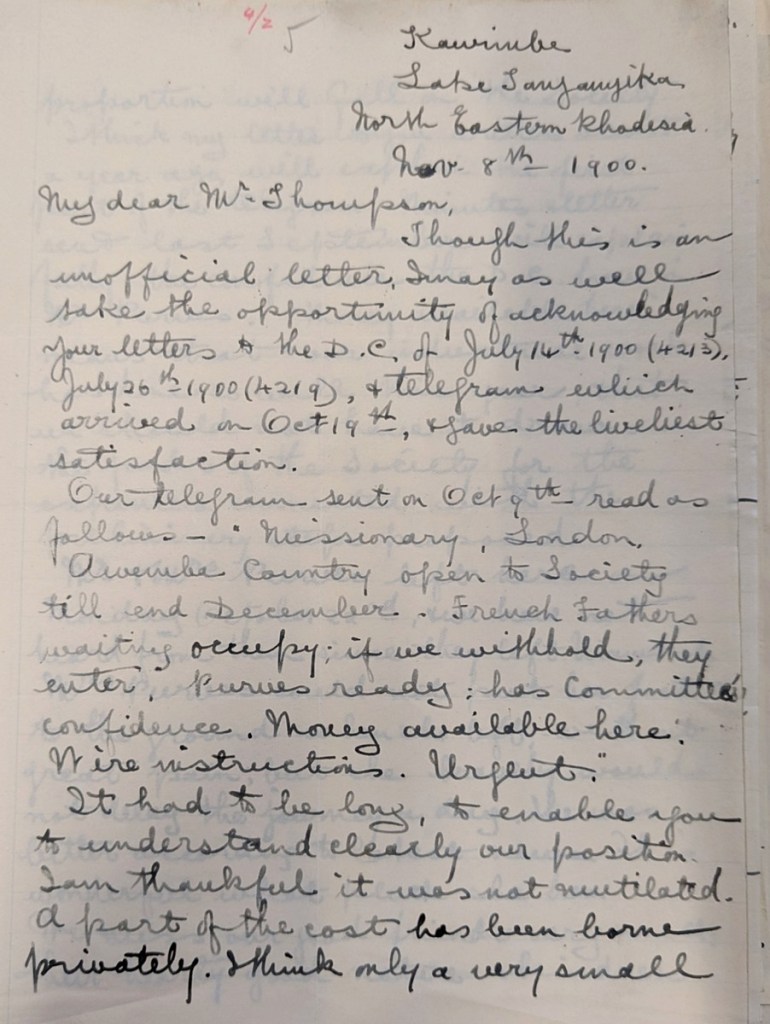
Though this is an unofficial letter, I may as well take the opportunity of acknowledging your letters to the D.C. of July 14th, 1900, July 26th, 1900, & telegram which arrived on Oct 19th, & gave the liveliest satisfaction.

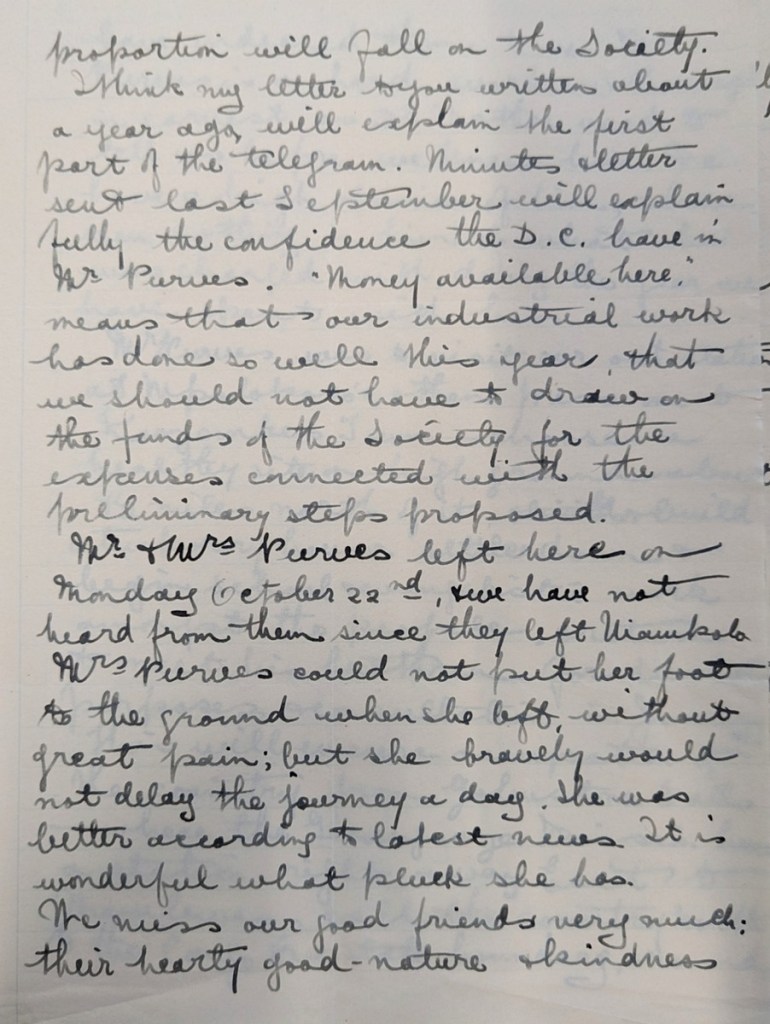
Our telegram sent on Oct 9th read as follows – “Missionary, London, Awemba Country open to Society till end December. French Fathers waiting occupy; if we withhold, they enter. Purves ready; has Committee’s confidence. Money available here. Wire instructions. Urgent.”

It had to be long, to enable you to understand clearly our position. I am thankful it was not mutilated. A part of the cost has been borne privately. I think only a very small proportion will fall on the Society.

I think my letter to you written about a year ago will explain the first part of the telegram. Minutes & letter sent last September will explain fully the confidence the D.C. have in Mr. Purves. “Money available here,” means that our industrial work has done so well this year, that we should not have to draw on the funds of the Society for the expenses connected with the preliminary steps proposed.

Mr. & Mrs. Purves left here on Monday, October 22nd, & we have not heard from them since they left Niamkolo. Mrs. Purves could not put her foot to the ground when she left, without great pain; but she bravely would not delay the journey a day. She was better according to latest news. It is wonderful what pluck she has.

We miss our good friends very much; their hearty good-nature & kindness have endeared them to us. Mr. Purves is a hard worker; & thoroughly in earnest, as Dr. Mather used to tell us before we knew him. We have a high opinion of him; & have seen nothing in him of what he was charged with, during the year we have spent with him.

Mr. Purves was to visit our out-station at Mpolokoso’s [Mporokoso’s], & then pass on to Kazembe’s Town – choose a healthy site on high ground about 7½ miles north of it, build a temporary house, settle down & begin school & evangelist work amongst the people; & return to meet his brethren for devotional purposes & consultation, in January. This will ensure occupation of the country from Johnstone Falls – where the Garanganze Mission have a station, right away east to Mambwe, & all the country north to the Congo Free State boundary, & round the Lake shore as far as Kasanga. This gives us a piece of country about as large as England. We trust nothing will happen to prevent our occupation of it. God has opened the way so far, & we are persuaded He will lead us right into possess the land for Him.

The D.C. are engaged in considering a report to send to the Board, as you ask in your last letter. The question of the best position for a second station cannot be considered until Mr. Purves reports to us early next year. One at any rate must be near Kazembe’s.

We were overjoyed & humbly thankful to get the good news of Mr. Arthington’s splendid offer for the Awemba Mission. We see God’s hand very manifestly, & are greatly encouraged in going forward.

We were very glad to have Mr. Draper & Mr. Mackendrick with us; & liked them very much. I think they will prove a tower of strength to the Mission. Soon we hope to hear of further reinforcements – Mr. Stewart Wright, a Doctor, etc. I trust your efforts to obtain a doctor will eventually be successful. Dr. Scott would have been just the man. I wish it might be possible to secure him; as far as our own experiences of him goes he seems almost an ideal medical missionary for Central Africa.

Thinking of how the Livingstonia Mission has run away with medical men you were hoping to get for our Mission – reminds me of the Semi-Jubilee Conference, which was held last month at Livingstonia. We are looking forward to Mr. Robertson’s return, to hear all about it. There were 33 missionaries & wives there & 4 babies!

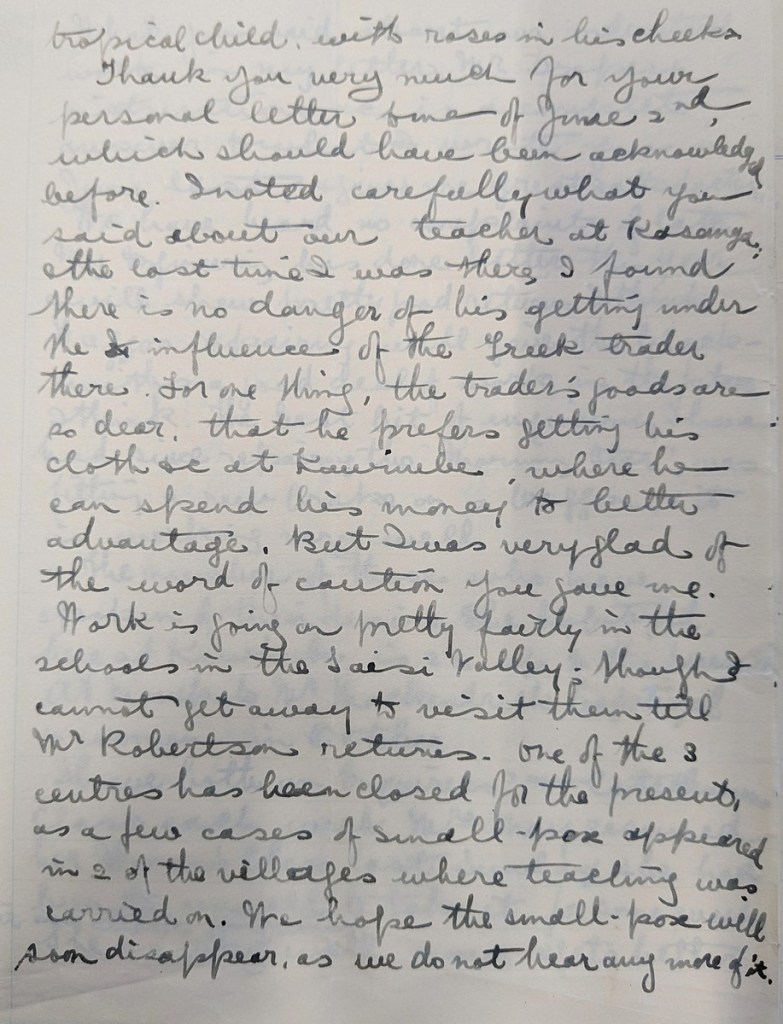
Our baby grows & flourishes, & is in splendid health; is 8 months old today & has 6 teeth. He does not look like a tropical child, with roses in his cheeks.

Thank you very much for your personal letter to me of June 2nd, which should have been acknowledged before. I noted carefully what you said about our teacher at Kasanga, & the last time I was there, I found there is no danger of his getting under the influence of the Greek trader there. For one thing, the trader’s goods are so dear, that he prefers getting his cloth etc. at Kawimbe, where he can spend his money to better advantage. But I was very glad of the word of caution you gave me.

Work is going on pretty fairly in the schools in the Saisi Valley, though I cannot get away to visit them till Mr. Robertson returns. One of the 3 centers has been closed for the present, as a few cases of small-pox appeared in 2 of the villages where teaching was carried on. We hope the small-pox will soon disappear, as we do not hear any more of it.

What you said about our industrial work in my letter, Mr. Draper’s instructions, etc., is a complete answer & what I wrote you in June last & gives me great satisfaction. We have heard no complaints of late. My engineering has done better this year & will show pretty good returns I think. Wagon repairing will give the blacksmiths a good deal of work in the future, I think. The best bit of engineering I have had since repairing the “Morning Star” was fitting a new brake on a wagon; & it is working very well.

The number of those who have spoke of their desire to be baptized, here at Kawimbe, is 23 up to the present. At Niamkolo Mr. Mackendrick baptized 4 women in October.

I have both an Enquirer’s & Catechumens’ Class each week. Mrs. May resumed her Women’s Class last Sunday; she had been too unwell to take it for some weeks (after an attack of quinsy). She is very well now, & gets better nights with the baby. Before the Purveses went away, we both had 6 days at a disused school-house, 4 miles from Kawimbe, & were the better for the change. Mrs. Purves took charge of Baby.

We have heard of the fearful heat you had last Summer, & are convinced you would have enjoyed the fresh breeze & bracing air of the Tanganyika Plateau during that sweltering time.

It will be well on in the New Century when you get this letter; & Mrs. May & I are only two of very many who are sending you hearty greetings & all best wishes for the New Year & Century.

That God may richly bless you & your wife is the earnest prayer.

Yours very sincerely, John May
LMS in Bembaland III

“Niamkolo House” from the same source as these photos.

Reading this week:

  • Craftland by James Fox

Although the overall framing device for this series of posts (meant mostly to show you things I found in the SOAS archives) is the efforts of the London Missionary Society to extend their Central African Mission into Bemba territory, we continue our detour into the internal tensions and dissensions between the missionaries themselves. The last post was all about people falling apart, but because I am a hopeful kinda guy now here we are pulling them back together.

The first of the two letters in this post is from John May, writing as Secretary of the missionaries’ Tanganyika District Committee to the LMS Foreign Secretary in London, Rev. R. Wardlaw Thompson. In Mr. Purves’ letter to Thompson, dated a month prior to the below one and featured in the last post, Purves was defending himself against accusations, it seems like, of drunkenness. In the below letter, May reports the happy news that Purves has been reconciled with Mr. Johnson. It does not say the nature of their dispute. In the last letter, Purves had noted that Johnson was in a position to defend him against accusations of drunkenness, and presumably did so on the committee, so who knows what the below amended dispute was (scans of this letter and next are at the bottom):

Kawimbe,

May 24th 1900

Dear Mr. Thompson,

Mr. and Mrs. Johnson are here with their children, on their way home; they leave probably tomorrow, the 25th inst.

Mr. Johnson informs me that from the last letter he received from you, he sees his way clear to go home on furlough, in accordance with Resolution c. of the Directors, contained in letter of Dec 9th 1899.

Yesterday he expressed the wish to meet Mr. Purves and talk matters over with him. I had previously received the enclosed letters from Mr. Purves containing a similar wish to meet Mr. Johnson. So the two gentlemen conferred together in the presence of Mr. Robertson and myself; and after mutual explanations, they were able to come to a good understanding.

Mr. Purves’s letter paved the way for this agreement. I trust the Board will be satisfied with this letter, especially as Mr. Johnson now feels he can work in harmony with Mr. Purves.

We are hoping that soon Dr. Mackay and Mr. Hemans may also be able to come to an understanding with Mr. Purves.

With very kind regards, I am, dear Mr. Thompson, Your respectfully,

John May

Secretary Tanganyika D.C.

It is jumping far ahead in our timeline, but in addition to overcoming whatever the issue was between him and Mr. Johnson, Purves managed to bury the hatchet with Mr. Hemans. Again it is unclear exactly what came between them in the first place (Hemans being the other man named in the exact same sentence as Johnson as someone who could defend Purves against drunkenness charges), but nice they were able to come to terms. So nice how talking to people can help. As for what is going on in the rest of the letter, also very unclear. Some nice words about Rev. George Mackendrick (who would be dead two months after this letter), and then obvious and reasonable offense that his affairs were available for perusal by the other missionaries:

Niamkolo, Tanganyika

Feby. 20, 1901

Dear Mr. Thompson,

I beg to acknowledge your very kind encouraging letter of Sep 15.

To be again reconciled with Mr. Purves has lifted as it were a very great burden off us. After seriously considering the matter, I felt that we should do as the Master would have done if he were here: thus I met Mr. Purves & spoke plainly to him; he then acknowledged his wrongs & apologized for his past action; and our difficulties have been settled most amicably. I am glad to say that we have since been drawn closer than ever to one another & have been laboring shoulder to shoulder.

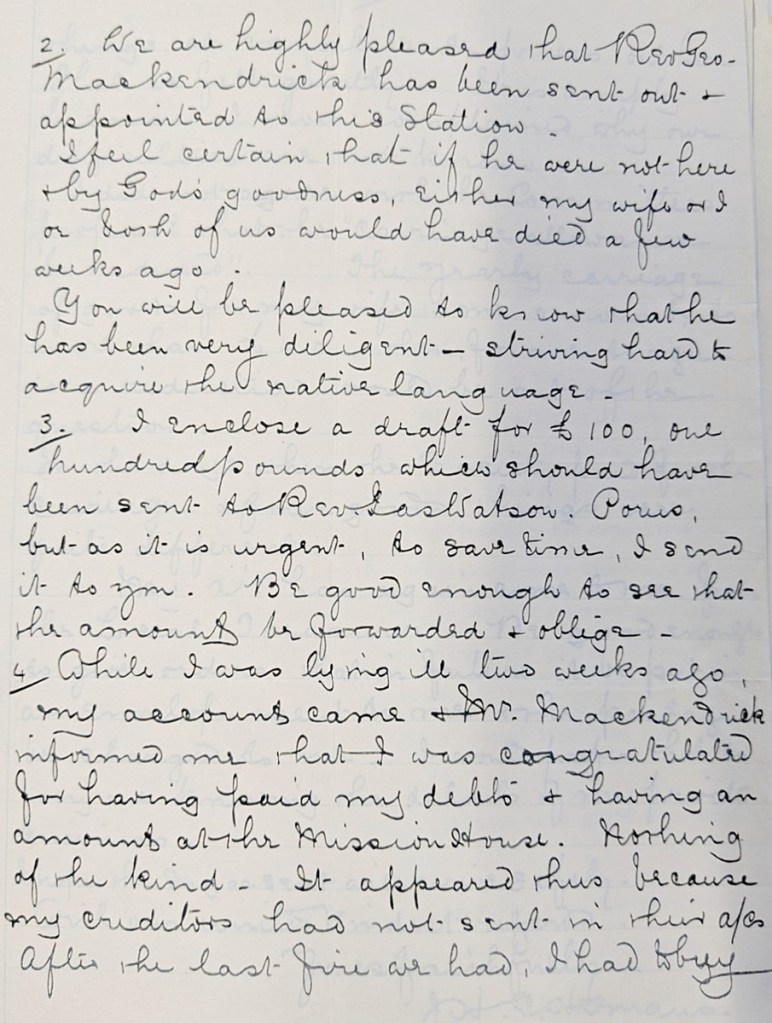
2. We are highly pleased that Rev. Geo Mackendrick has been sent out & appointed to this station. I felt certain that if he were not here & by God’s goodness, either my wife and I or both of us would have died a few weeks ago. You will be pleased to know that he has been very diligent – striving hard to acquire the native language.

3. I enclose a draft for £100, one hundred pounds, which should have been sent to Rev. Las Watson. [?], but as it is urgent, to save time, I send it to you. Be good enough to see that the amount be forwarded & oblige.

4. While I was lying ill two weeks ago, my accounts came & Mr. Mackendrick informed me that I was congratulated for having paid my debts & having an amount at the Mission House. Nothing of the kind – it appeared thus because my creditors had not sent in this a/c. After the last fire we had, I had to buy things at exorbitant prices out here that are felt greatly. It is simply because I never complained why our difficulties are not known.

I did not agree with the Committee’s proposal that the “carriage allowance be reduced.” The yearly carriage of goods for my wife & me amounts to more than £40. Then, for me to agree to a reduction would be out of the question.

In the days when the Society paid for the carriage of our goods, things were quite different.

My a/c has again come to me from the Local Treasurer. Be good enough to give orders that in future it be put in an envelope & sent to me & the postage to be charged to me. I would prefer that to everyone knowing the details of my private business.

I hope the [?] will arrive safely.

With our united kindest regards, Yours faithfully,

J.H.E. Hemans

I realize it is a bit distasteful to air 125-year-old laundry but these are the human dimensions that shape history, the casual aggressions that indicate how we see each other and how organizations function. I still hold grudges from my Peace Corps days serving in the exact same spots as these guys where I have no recollection what my original complaint was, so I am sympathetic the pressures the conditions put you under. And here, from across the chasm of history is a reminder that the answer is so often to sit down and talk it out. And also to keep your mail private.

LMS in Bembaland II

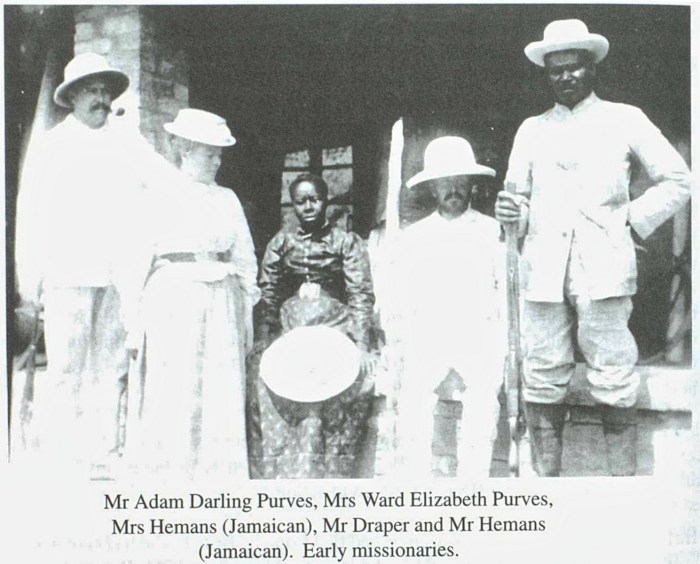
I covered this photo a bit here, and though I am not sure I think based on the caption on the back the seated man is Purves; it is hard to tell blurry mustachioed men apart.

Reading this week:

  • The Devil That Danced on the Water by Aminatta Forna

Last week we covered a letter from James Hemans to the London Missionary Society Foreign Secretary Rev. R. Wardlaw Thompson urging him to authorize the Central African Mission to open up a new station in the heart of Bemba-land. We immediately part from that journey with a detour.

There was a good amount of drama and tension within the ranks of the LMS’ Central African Mission. I am still picking up on this, because although I spent a whole bunch of time transcribing the Chronicle they spare their readers any of the interpersonal drama and unsavory things that occurred out there. But to quote a paragraph of Robert Rotberg’s Christian Missionaries and the Creation of Northern Rhodesia:

The Missionaries to Northern Rhodesia… were fiercely independent men and they fought bitterly with one another and with their overseas directors, usually to the detriment of their evangelical objectives. In their individual journals and correspondence, expressions of fractiousness, spitefulness, and jealousy compete with one another for space in numerous letters supposedly written more in sorrow than anger.

This will be a long entry but mostly one of other peoples’ texts, so while I am at it I will include another quote from the same chapter above. Hemans was a Black missionary from Jamaica and there was not a little bit of racism among the LMS ranks. This whole Bembaland story could have taken place back in 1894, when the missionaries sent their first expedition to the area. From Christian Missionaries:

Once, when the Bemba paramount chief wanted specifically to ask Hemans about Christianity, the synod forbade him to visit the chief. They thought that a white missionary should be the first to explain the Society’s principles, and to discuss the possible expansion of the London Mission into Bembaland. For the chief, however, only Hemans would do… But the synod was obstinate. It sent a white missionary, who was refused an audience with the chief, and the White Fathers instead occupied most of the Bemba country.

There will be more as this story unfolds, but for now, a letter from Mr. A.D. Purves to the LMS Foreign Secretary, perhaps written more in anger than sorrow:

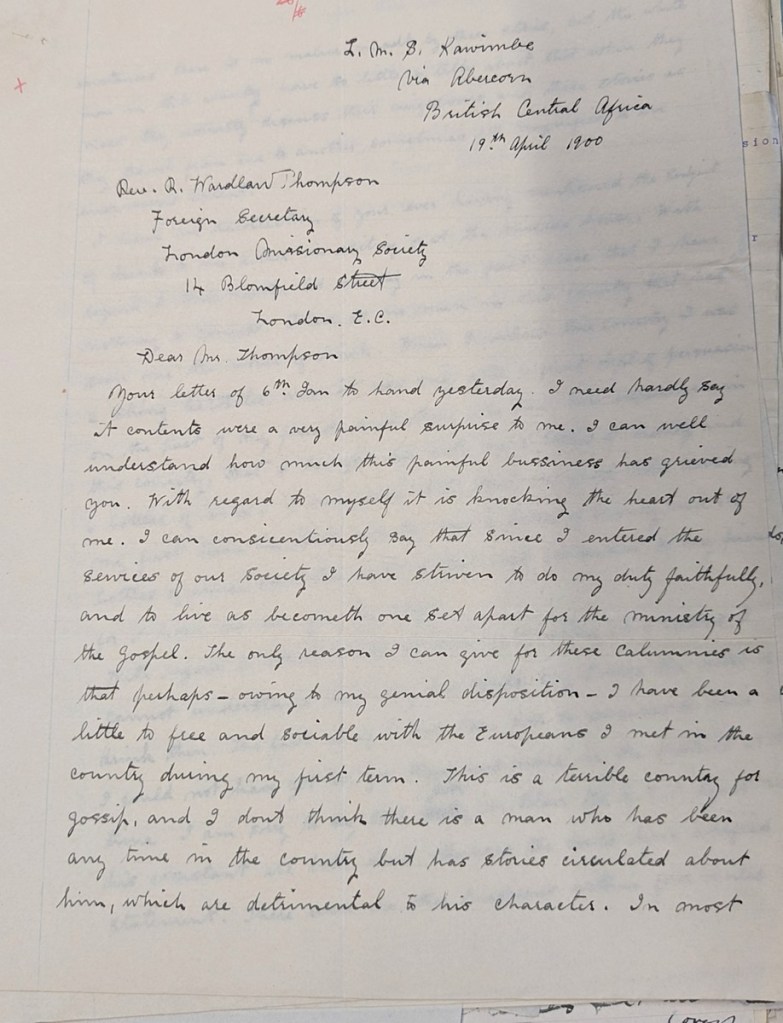
L.M.S. Kawimbe

19th April 1900

Dear Mr. Thompson,

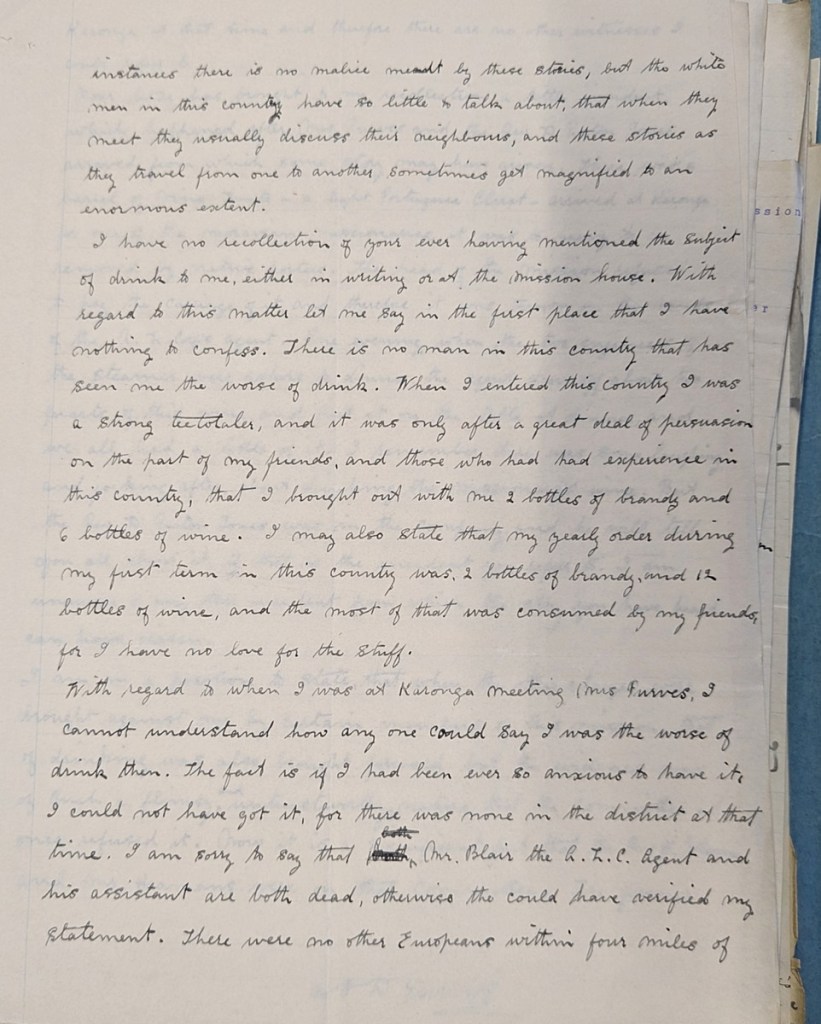
Your letter of 6th Jan to hand yesterday. I need hardly say its contents were a very painful surprise to me. I can well understand how much this painful business has grieved you. With regard to myself it is knocking the heart out of me. I can conscientiously say that since I entered the services of our Society I have striven to do my duty faithfully, and to live as becometh one set apart for the ministry of the Gospel. The only reason I can give for these calumnies is that perhaps – owing to my genial disposition – I have been a little too free and sociable with the Europeans I met in the country during my first term. This is a terrible country for gossip, and I don’t think there is a man who has been any time in the country but has stories circulated about him, which are detrimental to his character. In most instances there is no malice meant by these stories, but the white men in this country have so little to talk about, that when they meet they usually discuss their neighbors, and these stories as they travel from one to another sometimes get magnified to an enormous extent.

I have no recollection of you ever having mentioned the subject of drink to me, either in writing or at the Mission house. With regard to this matter let me say in the first place that I have nothing to confess. There is no man in this country that has seen me the worse of drink. When I entered this country I was a strong teetotaler, and it was only after a great deal of persuasion on the part of my friends, and those who had had experience in this country, that I brought out with me 2 bottles of brandy and 6 bottles of wine. I may also state that my yearly order during my first term in this country was, 2 bottles of brandy, and 12 bottles of wine, and the most of that was consumed by my friends for I have no love for the stuff.

With regard to when I was at Karonga meeting Mrs. Purves, I cannot understand how any one could say I was the worse of drink then. The fact is if I had been ever so anxious to have it, I could not have got it, for there was none in the district at that time. I am sorry to say that Mr. Blair the A.L.C. [African Lakes Corporation] agent and his assistant are both dead, otherwise they could have verified my statement. There were no other Europeans within four miles of Karonga at that time and therefore there are no other witnesses I could refer to.

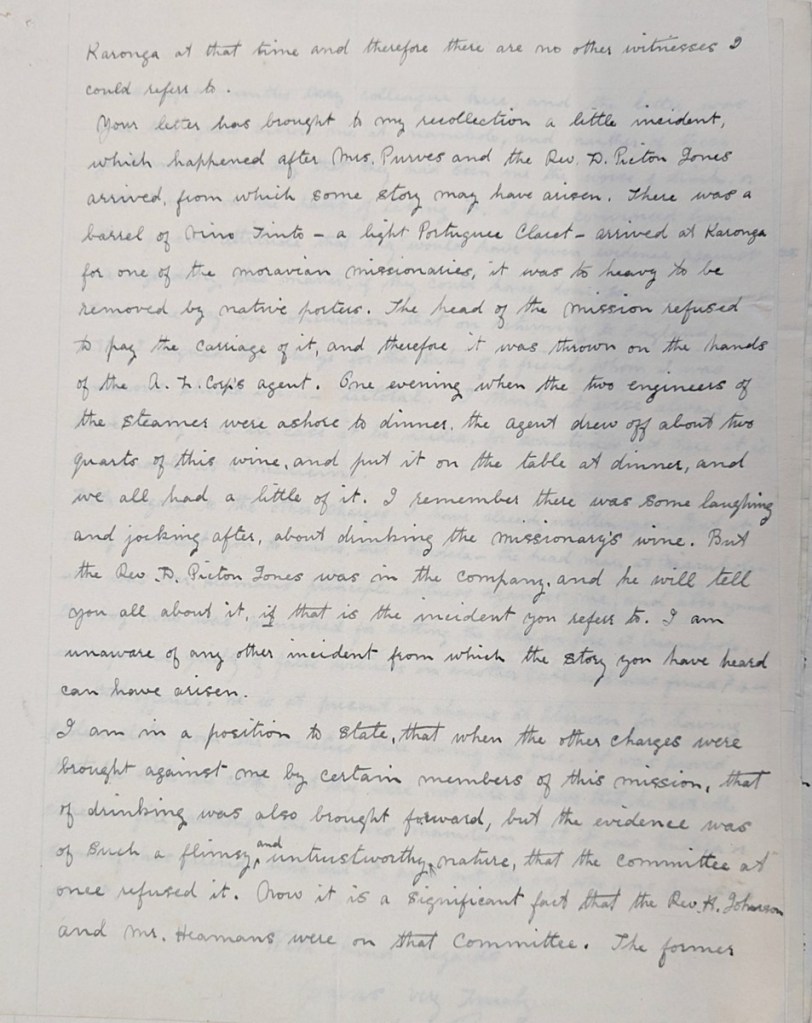
Your letter has brought to my recollection a little incident which happened after Mrs. Purves and the Rev. D. Picton Jones arrived, from which some story may have arisen. There was a barrel of Vino Tinto – a light Portuguese Claret – arrived at Karonga for one of the Moravian missionaries, it was too heavy to be removed by native porters. The head of the Mission refused to pay the carriage of it, and therefore it was thrown on the hands of the A.L. Corp’s agent. One evening when the two engineers of the steamer were ashore to dinner, the agent drew off about two quarts of this wine, and put it on the table at dinner, and we all had a little of it. I remember there was some laughing and joking after, about drinking the missionary’s wine. But the Rev. D. Picton Jones was in the company, and he will tell you all about it, if that is the incident you refer to. I am unaware of any other incident from which the story you have heard can have arisen.

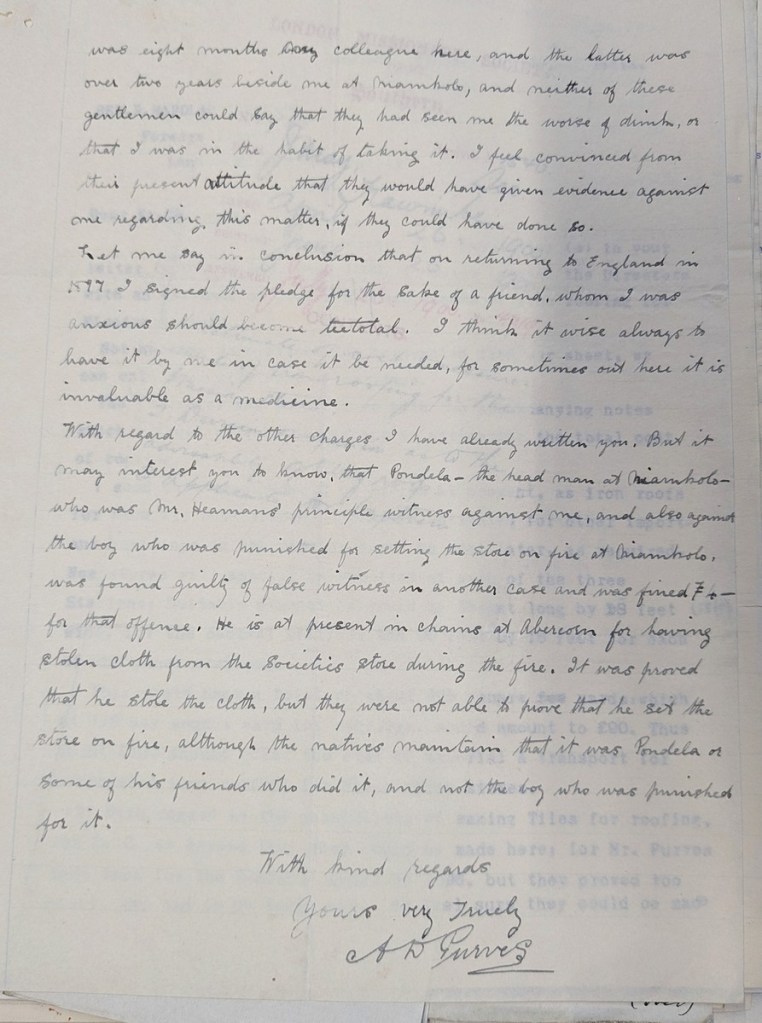
I am in a position to state, that when the other charges were brought against me by certain members of this mission, that of drinking was also brought forward, but the evidence was of such a flimsy and untrustworthy nature, that the committee at once refused it. Now it is a significant fact that the Rev. H. Johnson and Mr. Hemans were on that committee. The former was eight months my colleague here, and the latter was over two years beside me at Niamkolo, and neither of these gentlemen could say that they had seen me the worse of drink, or that I was in the habit of taking it. I feel convinced from their present attitude that they would have given evidence against me regarding this matter, if they could have done so.

Let me say in conclusion that on returning to England in 1897 I signed the pledge for the sake of a friend, whom I was anxious should become teetotal. I think it wise always to have it by me in case it be needed, for sometimes out here it is invaluable as a medicine.

With regard to the other charges I have already written you. But it may interest you to know that Pondela – the head man at Niamkolo – who was Mr. Hemans’ principle witness against me, and also against the boy who was punished for setting the store on fire at Niamkolo, was found guilty of false witness in another case and was fine £4 for that offence. He is at present in chains at Abercorn for having stolen cloth from the Societies store during the fire. It was proved that he stole the cloth, but they were not able to prove that he set the store on fire, although the natives maintain it was Pondela or some of his friends who did it, and not the boy who was punished for it.

With kind regards, Yours very truly,

A.D. Purves

LMS in Bembaland I

Reading this week:

  • Tribal Cohesion in a Money Economy by William Watson
  • Ancient Light by Dr. Melanie King

Our series on “things I found in the SOAS archives” continues. These will be some rather lengthy letters and reports, so I will split it up into a few posts. This series of letters (almost) all have to do with the missionaries “opening up” Bemba country, or as they called it Awemba country. Driven by missionary zeal, they of course wanted to get as many converts as possible, and maybe more importantly prevent other denominations from getting converts.

When the London Missionary Society had first arrived on the southern shores of Lake Tanganyika and worked among the Lungu and Mambwe people, the Bemba were considered warlike and unapproachable. The Bemba had apparently softened a bit over the years, I think not least in the face of encroaching British colonial expansion (I wrote that sentence, and then read Tribal Cohesion in a Money Economy which tells me “in 1898 the British pacified the Bemba” so there you go). The LMS in turn had attempted to make approaches into Bemba territory, and in 1894 Reverend William Thomas and Alexander Carson went on an expedition down to Bemba country alongside Kalulu and Pondella, the headman of I think Niamkolo village. That trip is reported on in the January 1895 edition of the Chronicle. They were able to see Chief Ponde, though the messages coming from the Chitimukulu (they spell it Kitimkuru) were not welcoming.

Flash forward a bit to 1900 and the picture had changed. It now seemed possible to go and settle and set up missions in Bemba country, and various missionary societies were banging on the door to be let in. Long time readers will recall that I visited Chilubula Mission near Kasama, founded in 1899 by the White Fathers. This is in Bemba territory. The British colonial authorities, I gather, were much more sympathetic to the LMS because we can’t forget that the White Fathers were not only papists, but also French (I want to be clear I have no horse in this race but I am trying to convey what I think were the attitudes of the local authorities). So around this time they were preventing the White Fathers from extending their mission much farther into Bemba territory in order to allow British protestant missionaries to get a foothold first. But there would be only so long they could hold the White Fathers back.

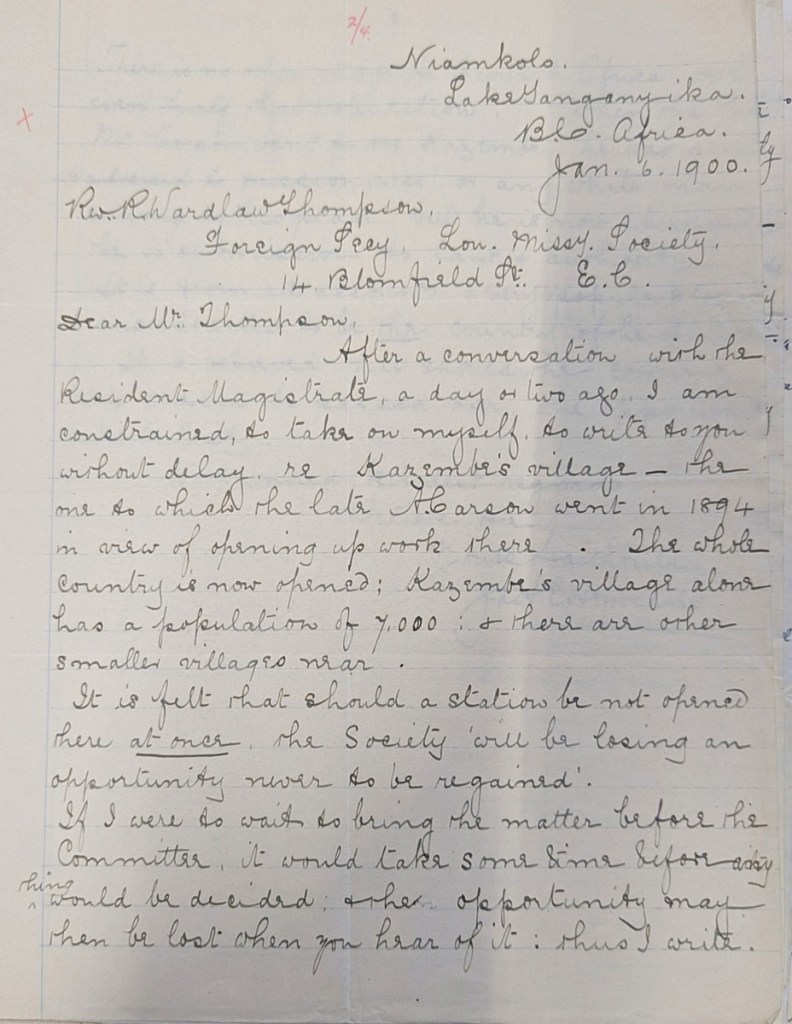
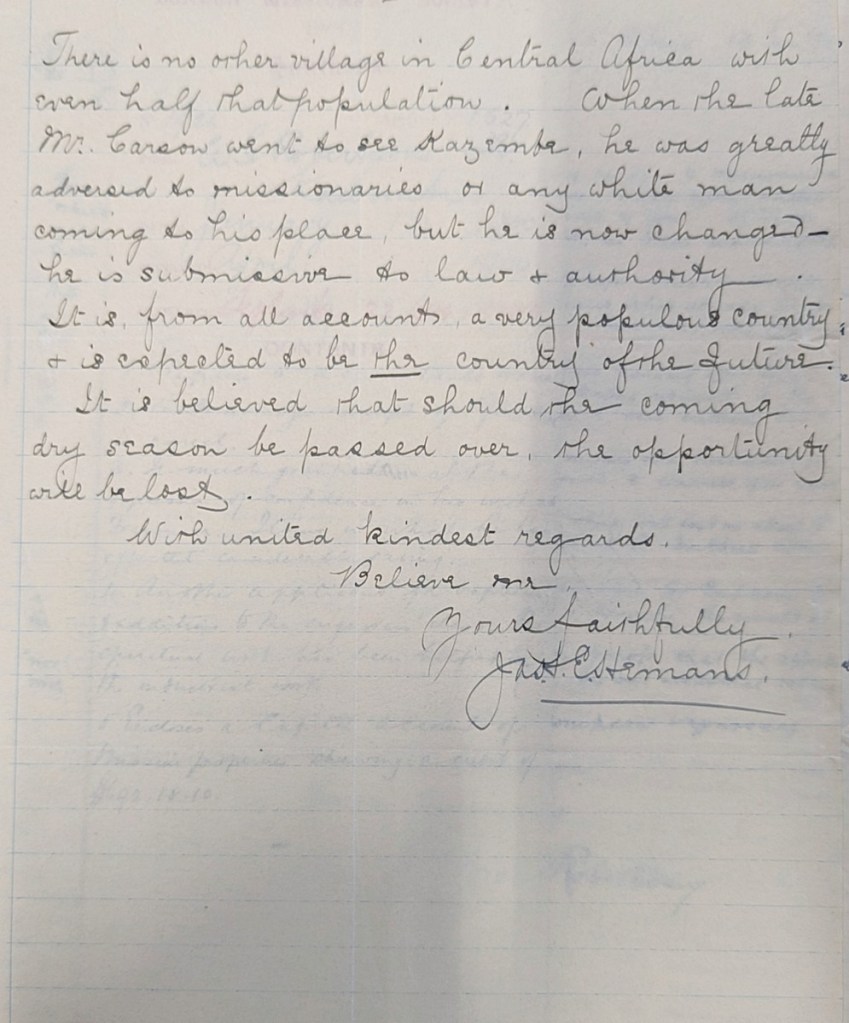
Hence, this letter from James Hemans to the LMS Foreign Secretary Rev. R. Wardlaw Thompson:

Niamkolo

Jan 6 1900

Dear Mr. Thompson,

After a conversation with the Resident Magistrate, a day or two ago, I am constrained, so take on myself, to write to you without delay, re Kazembe’s village – the one to which the late A. Carson went in 1894 in view of opening up work there. The whole country is now opened; Kazembe’s village alone has a population of 7,000; & there are other smaller villages near.

It is felt that should a station be not opened there at once, the Society will be losing an opportunity never to be regained.

If I were to wait to bring the matter before the Committee, it would take some time before anything would be decided; & the opportunity may then be lost when you hear of it; thus I write. There is no other village in Central Africa with even half that population. When the late Mr. Carson went to see Kazembe, he was greatly adversed to missionaries or any white man coming to his place, but he is now changed – he is submissive to law & authority. It is, from all accounts, a very populous country, & is expected to be the country of the future.

It is believed that should the coming dry season be passed over, the opportunity will be lost.

With united kindest regards, Believe me, Yours faithfully,

J.H.E. Hemans

LMS Land Swap Letter

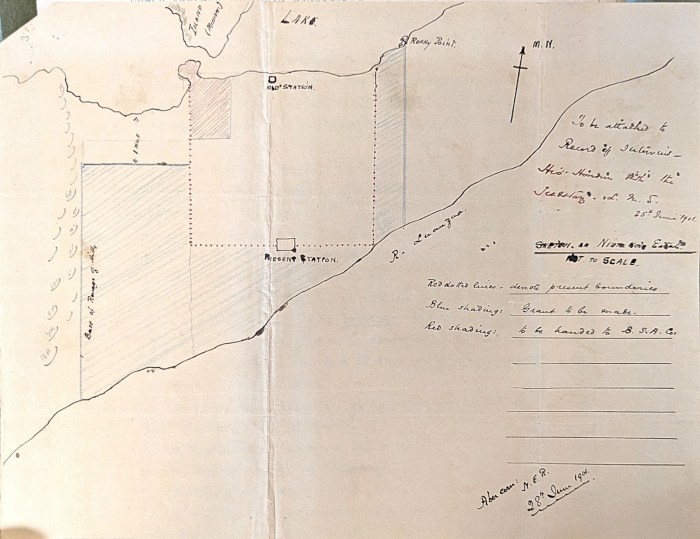
A mea culpa: just two posts ago I talked about how I didn’t really have an explanation for the above map (and an accompanying letter), which was illustrating land that the London Missionary Society was swapping with the British South Africa Company (BSAC) around their Niamkolo station. That post was part of this ongoing series where I put online things I found in the SOAS archives, and this post continues that because if I had scrolled a little bit farther down in my file I would have found the answer. I didn’t fail to do that just to stretch two posts out of it, I was just silly. I had speculated in the previous post that maybe the answer was trains; much more excitingly, it was boats!

The letter transcribed:

Tanganyika Concessions Co. Abercorn

Dec 4th 1900

Dear Sir,

                Mr. Irwin, our Traffic Manager, who is about to put together our steamer “Cecil Rhodes” on the lake, has carefully examined the two sites that I had chosen, namely Niamkolo and Kasakalawe. Mr. Irwin has decided to build his steamer at Kasakalawe because he is in hopes of getting there erected houses and sheds of the Flotilla Company. Also there is a good road to the place and no uncertainty about freehold possession. However, there is no anchorage there and Niamkolo is the only possible place where we could with safety erect our patent slipway, being an ideal anchorage. In the future we shall have to find some good anchorage for the repairing & docking of our steamer & other companies’ steamers. The other Cos will probably gladly avail themselves of our slipway.

                I therefore shall ask your Committee to consider whether you would let us have permanently one half square mile at the mouth of the straight opposite the island by the shore, about 2 ½ (or 2) miles from the Mission house, & out of sight of it. A road would be made to it from Abercorn, which would skirt the [?] village at some distance – we should be glad to pay for this land, to give you a site in the new Abercorn, which will be begun next year, and which is absolutely the property of our Company, and to grant you special rates in steamer passage & transport on Tanganyika – the B.S.A. Co. have the right to ground enough in our new town to build there their offices, but they will not encourage anybody to build outside our township, except at very large prices as they wish our Company to succeed. I have no doubt that Mr. Codrington will grant us the 2 square miles that I have applied for at Kasakalawe to make an official port, but we would far prefer to be at Niamkolo, as a better anchorage. If there is a possibility of a mile square being sold to us at Niamkolo, we would let Kasakalawe lapse & make the official port at the former place, but if only half or quarter mile is allowed us we shall only be able to put a few [?] and our slipway there – A half-mile would possibly be ample – a quarter mile is rather cramping.

                Kindly let me know the Committee’s views on the subject. I hope that if you consult your Directors at home you will be good enough to forward them a copy of this letter. This would be more direct than if I sent a copy through my Directors to yours.

Believe me, yours faithfully,

M.J. Holland, Lake Tanganyika Concession Co Ltd

And photos of the letter itself:

“M.J. Holland” I assume must be Michael James Holland. He worked for Tanganyika Concessions Limited, which was nicknamed “Tanks,” an appropriate moniker for an inherently dispossessive colonialist enterprise. Though still different, it seems to have been closely related to the BSAC. But for our purposes, as you can see from the letter the important bit is that they were putting together the Cecil Rhodes. Loyal readers will recall that I visited the boat’s boiler, which still lies in the village of Kasakalawe right to the west of Mpulungu. I didn’t find it last time I looked, but this page and this page contains more information on the Cecil Rhodes, including pictures of the hulk as it rests on the Tanganyika lakebed.

According to the letter, Tanganyika Concessions was looking for a place to build and anchor the Cecil Rhodes. The LMS was sitting on the best anchorage around so they asked to do a land swap. If my assumption in the previous post that the letter dated July 12, 1900 had something to do with this land swap, then something must have been discussed prior to the above letter, dated five months later. But everything must have worked out between the LMS missionaries and Tanks because according to The Great Plateau of Northern Rhodesia the Cecil Rhodes was launched in October 1901. The above-linked Mr. Codrington described Lake Tanganyika’s merchant marine in a May 1902 article in The Geographical Journal:

The vessels now plying on Tanganyika are – the “Tanganyika Concessions” steamer Cecil Rhodes (twin screw), with a carrying capacity of from thirty to forty tons; the German Hedwig von Wissmann, with about an equal capacity; the African Lakes Corporation’s steamer Good News, with a carrying capacity of twenty tons; and the Congo Free State schooner, carrying about one hundred tons. Some five or six dhows, the property of Arab and Greek traders, compete in a small way with the European-built vessels. The lake, though said to be more stormy than Nyasa, is considered a safe waterway by the skippers of the vessels, no dangerous rocks being reported. The level of the lake in June, 1901, was 4 or 5 feet higher than in the corresponding month of 1900, the Lukuga outlet having again silted up.

A couple points of the above: by this time the LMS had sold the Good News to the African Lakes Corporation, explaining the ownership status. I did notice the conflicting dates with the fact Mr. Codrington’s journey started in June 1901, before The Great Plateau says the Cecil Rhodes was launched. And finally, before looking into this again I had never heard of the “African International Flotilla and Transportation Company” and so I will have to research more. Nor do I have any idea what the 100-ton Congo Free State schooner could be. So many more questions than answers out of one short paragraph.

But again back to land swaps. Not only did it all work out for the Cecil Rhodes and Tanks but that land is still where the Mpulungu Harbor Corporation is today. It is not immediately clear to me what the exact corporate lineage is between the Tanganyika Concessions Company and the MHC but I am sure it is interesting. Also very interesting is this cool video about the Mpulungu Harbor Corporation from four years back:

Tanganyika Sailing Directions

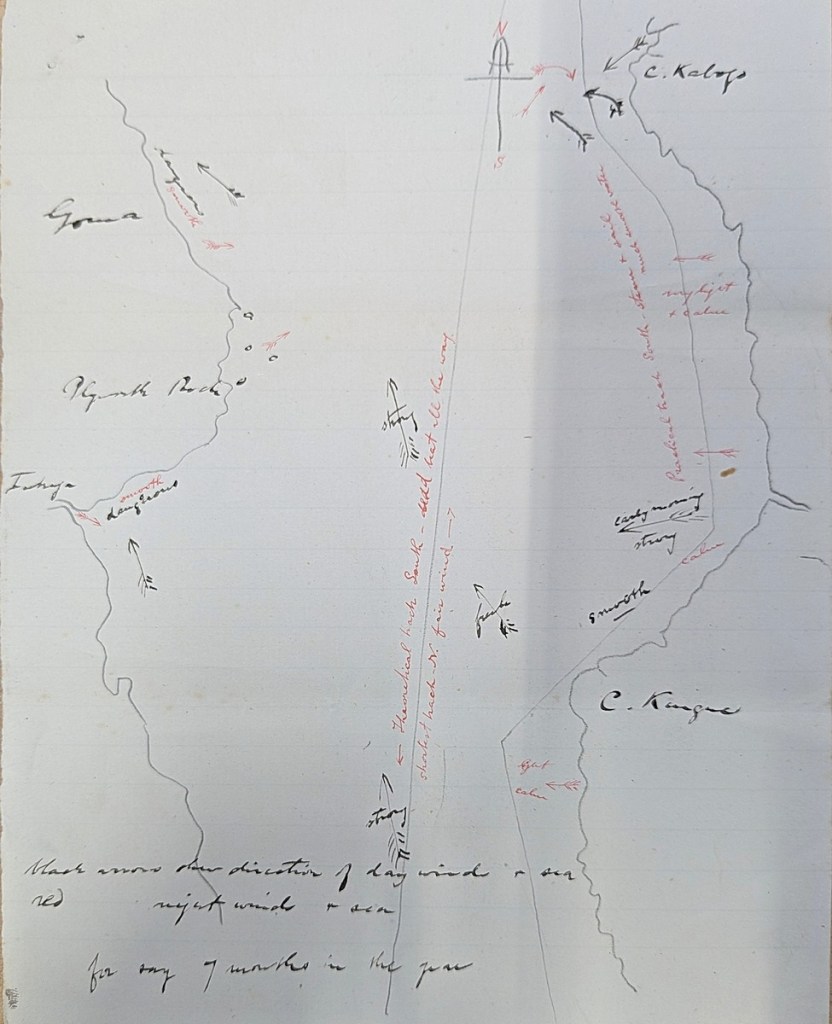
We return to our series on “things I took pictures of in the SOAS LMS archives” with two more maps, these ones drawn by Ed Hore:

Sailing directions for the middle of Lake Tanganyika
Close up of Plymouth Rock (Bendela) and Kavala Island

Reviewing my notes I don’t think I noted when these are dated, if indeed they came with dates. I think it might be around 1881. I included transcriptions of some letters from Hore in this post, and in the 1881 letter he is discussing the prevailing winds and some of the different port conditions around the lake as an argument for a sailing ship with steam auxiliary for the Good News. Since the maps are of sailing conditions and have bits marked as “dangerous,” they might be in support of the themes of the letter. Plus, Plymouth Rock/Mtowa is marked on both maps. This station was established by Rev. William Griffith and Walter Hutley in October 1879 (that story is covered here and also in the March 1880 edition of the Chronicle). What is not particularly marked on the map though is Kavala Island (the second map marks it but the first map only has a couple dots).

The lack of Kavala is significant because that is where Hore established the headquarters of the LMS marine station, from 1884 (Chronicle, November 1884) until I think Hore’s departure from the mission in 1888. So if the map was drawn after 1884 I think Kavala would have been much more prominently marked. Now the rest of this post will be sharing some relevant links and thoughts about Kavala Island. Hore had established the Marine Station up there when the mission thought the north end of the lake was going to be much more important to them, with iterant missionaries doing lacustrine preaching. Instead they wound up settling on the south end of the lake and into modern-day Zambia.

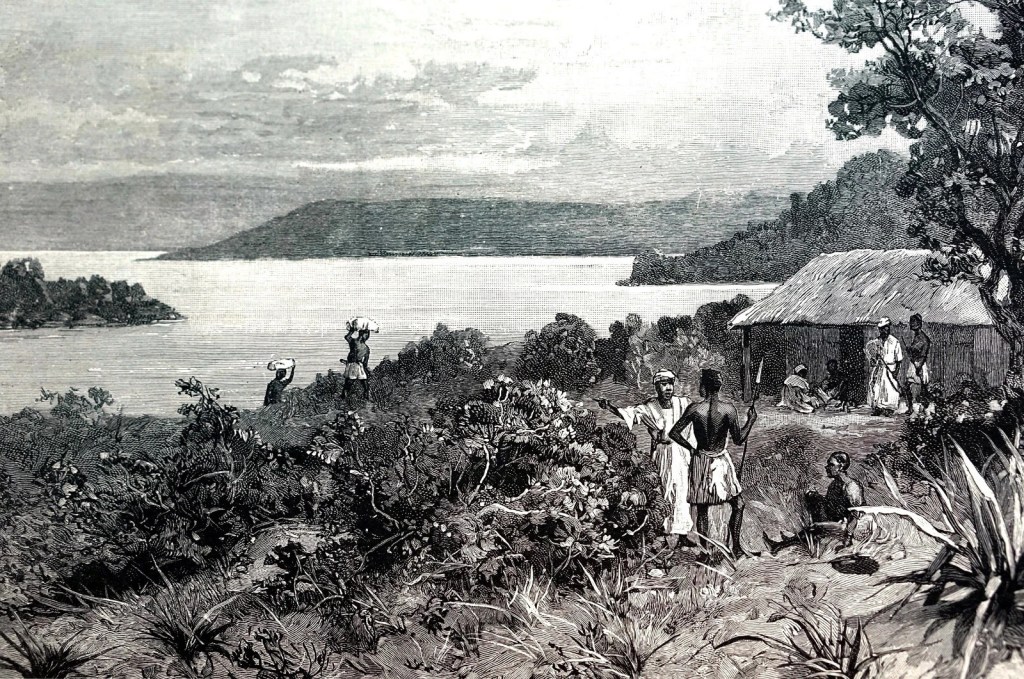
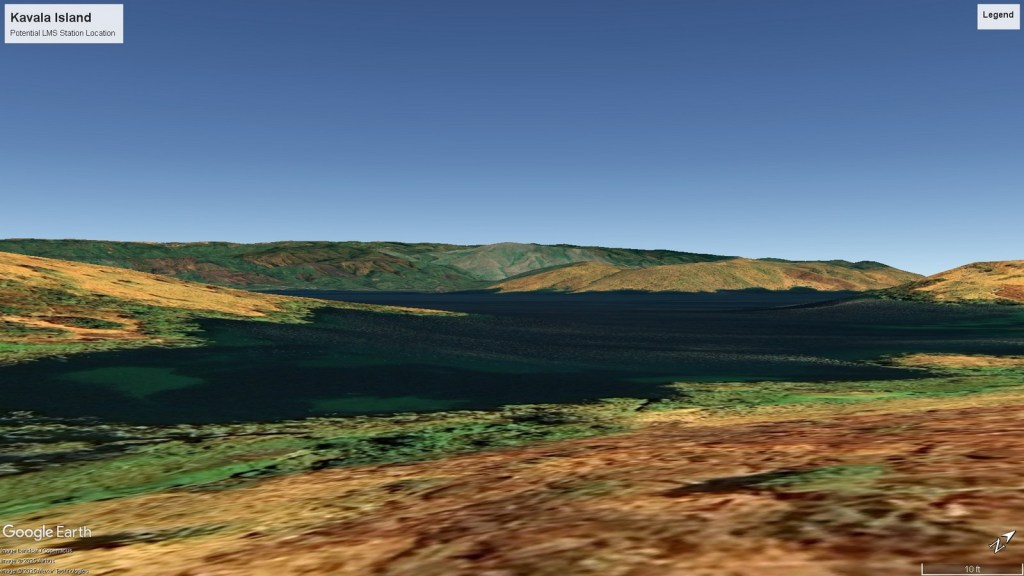
I’m not sure exactly where on Kavala the Marine Department was, though I think it was maybe right about here. This is based on trying to recreate the woodcut of the station in Google Earth. This technique has led us astray before but for now it’s all I got. First, the woodcut. The picture at the very top of the post comes from Tanganyika: Eleven Years in Central Africa, Hore’s book about his experience with the mission. When I was looking at the fold-out picture of Ujiji, I found out it was based on an earlier illustration. Turns out the picture of Kavala is too, though in this case it is still referencing Hore’s experience, being from a write-up of his missionary work in The Graphic in June 1890 (two years before Hore’s book). The book’s picture is a little different from the The Graphic, showing a more permanent house and road, but the background showing the mainland from across the strait looks the same, and in Google Earth you can get pretty close to the same picture.

Of course the dream would be to go to Kavala and tromp around and see if I could see it in real life. That would be difficult given visas and language and location, and anyway there probably wouldn’t be anything left to find without significant archeological work, but a boy can dream. There is also not a lot of documentary evidence online about what Kavala Island looks like on the ground as far as I can find. I linked to it for Plymouth Rock above but this website about cichlids (Tanganyika’s most famous export) has some photos of Kavala aka Bilila Island (like Zanzibar, apparently Kavala refers to the group of islands). Then besides that, this man visited the island, though the YouTube video of the trip doesn’t show much of the island at all (start right at the 13-minute mark):

And that are some maps of sailing directions and some more bits about Kavala Island. Lake Tanganyika’s long and interesting history continues.

Map of LMS Niamkolo Station

As you all will recall I went to visit the London Missionary Society archives at SOAS back when we visited the UK. I am trying to put the stuff I dug up online. I already did some of this, putting the real exciting photos and things up already. I already put one map up, but now here are two more maps, these of the Society’s stations at what is now Mpulungu:

Map dated June 28, 1901
Map dated June 2, 1902

I say “what is now Mpulungu” because according to the Wikipedia page for Mpulungu, the harbor was only built in 1930 and presumably the town grew up around that. The LMS referred to the location and Niamkolo. The maps above still map pretty closely onto a more modern-day map of Mpulungu. Niamkolo church is marked on Google Maps which provides a reference point. The Lunzua River is marked on both maps though it is not plotted as accurately. By the time of the maps though the stone Niamkolo church had been abandoned for healthier climes at a more elevated spot, labelled in the first map as “Present Station” and in the second map as “L.M.S. Station.” I think the newer spot must be the location where the photo at the top of this page was taken, which was covered in this post.

In the first map there is red and blue shading referring to a land swap arrangement between the LMS and the British South Africa Company (BSAC). I am not quite sure what is going on there. If the Wikipedia is right, no one would have been too interested in what is now Mpulungu harbor for another couple decades (outside of missionary work). By chance I took photos of another letter (transcribed below with photos at the bottom) from John May, answering a question from headquarters about the LMS’ landholdings in Niamkolo, Kawimbe, and Kambole. So clearly something was being contemplated but as for what that was is still buried in the archives. Though they are still discussing extending a railway to Mpulungu; maybe BSAC was contemplating it even then?

Kawimbe

July 12th, 1900

Dear Sir,

                In reply to your letter of March 2nd, 1900, I am sending you the following information trusting it is what you require:-

I. (1) The property belonging to the Society in the Central African Mission is –

Land at Kawimbe and Niamkolo.

A brick dwelling-house, and wattle-and-daub buildings at Kambole.

(2) The property at Kawimbe is held in the name of the Rev. D.P. Jones of this Mission, on behalf of the Society.

That at Niamkolo in the name of Alfred James Swann, Esquire, formerly in this Mission; on behalf of the Society. Mr. Swann agreed to the conditions attached to the deeds, on behalf of the Society.

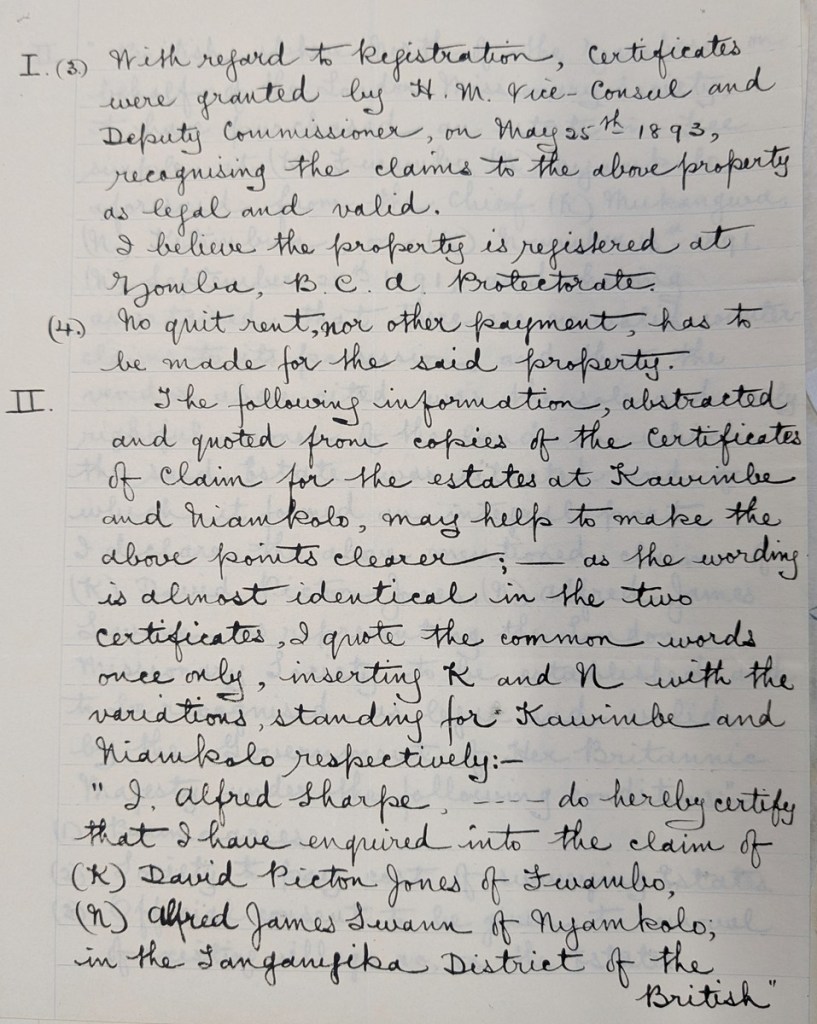
(3) With regard to Registration, Certificates were granted by H.M. Vice-Consul and Deputy Commissioner, on May 25th 1893, recognizing the claims to the above property as legal and valid.

I believe the property is registered at Zomba, B.C.A. Protectorate.

(4) No quit rent, no other payment, has to be made for the said property.

II. The following information, abstracted and quoted from copies of the Certificates of Claim for the estates at Kawimbe and Niamkolo, may help to make the above points clearer; – as the wording is almost identical in the two certificates, I quote the common words once only, inserting K and N with the variations, standing for Kawimbe and Niamkolo respectively:-

“I, Alfred Sharpe, —- do hereby certify that I have enquired into the claim of (K) David Picton Jones of Fwambo, (N) Alfred James Swann of Niamkolo; in the Tanganyika District of the British sphere north of the Zambezi, on behalf of the London Missionary Society, to have purchased an estate in fee simple at (K) Fwambo, (N) Niamkolo, aforesaid from the Chief (K) Mukangwa, (N) Kitimbwa, on (K) November 13th 1891, (N) September 25th 1891; and having ascertained that there are no valid counter-claims to the possession, and that the vendor above-cited was the sole and only rightful owner of the land on which the said Estate was situated and of which it formed an integral part, I declare the above mentioned claim of (K) David Picton Jones, (N) Alfred James Swann, as representing the London Missionary Society to be established and to be recognized as legal and valid by the Government of her Britannic Majesty under the following conditions:”-

(1) Boundaries.

(2) Society to pay cost of surveying Estates.

(3) Official consent to be given to removal of existing villages, etc. on the Estates.

(4) Royalty of 5% to be paid to the Government on minerals found on the Estates.

(5) Government has the right to make public roads, railways, or canals, across the Estates.

(6) Government has the right of control over water not wholly included in the bounds of the Estates.

“And in witness to the validity of the above mentioned claim of the said (K) David Picton Jones, (N) Alfred James Swann, as representing the London Missionary Society, subject to the foregoing six conditions, I have hereunto set my hand and seal this Twenty Fifth day of May Eighteen hundred and Ninety three at Blantyre, British Central Africa Protectorate.

(signed) Alfred Sharpe, H.M. Vice Consul and Deputy Commissioner

“I, Alfred James Swann on behalf of the said London Missionary Society, do hereby agree to the foregoing six conditions which are attached to this recognition of the claim of the said London Missionary Society.

(signed) Alfred James Swann.”

III. We have applied again for an extension of the Niamkolo Estate, and for a grant of land at Kambole. We understand there will be no difficulty in getting a secure title to this extra land. The draft deeds would be made out in the name of the London Missionary Society Corporation, and would of course be submitted to the Board for approval before completion.

I am, dear Sir, Yours very faithfully,

John May
Secretary, Tanganyika D.C. [District Committee]

And the original letter:

Zanzibar IV: Seaside Rendezvous

Well folks here we are at the grand finale of our Tanzania adventure. We awoke for our last morning in Stone Town and asked the hotel to hold our bags as we wandered around one more time. Here for the first time in our entire end-of-the-rainy-season safari did we see rain and for a while there it came down in absolute buckets. That was a lovely time though as we spent it in a café looking out through the open windows at the downpour, warmed by Zanzibar tea and coffee. It lightened up just in time for us to try to get Lanzhou noodles again, only to be thwarted by a lack of electricity. Instead we lunched at a different Chinese place I had been to before, my last full circle moment before we left Stone Town for the beach.

Going to the beach is of course inevitable in Zanzibar and we embraced it as a last few days of calm and tranquility before making the long journey back home and back to work. We stayed at Sharazad in Jambiani, and after a serpentine car ride around various road constructions we arrived in the midst of another torrential downpour. It was at the beach that we saw the most rain but even then it was mostly sunshine. The hotel was very nice. There were I think four pools if I counted correctly, including a secluded one conveniently right outside our room.

Besides lounging poolside we could also lounge next to a forest which came with monkeys. They had the run of the place though they mostly kept to themselves. The waiters never had to shoo them away from breakfast. Now that I am thinking of all the hotels we stayed at monkeys were only a slightly less standard accoutrement than juice. Very fun to see though mostly we only heard them as they rustled through the treetops.

When not lounging there were yoga classes my super amazing wife took advantage of. When she was doing that I instead took advantage of the hammocks to do some reading. We both got a lot of reading it, making this vacation one of the rare instances of me successfully reading all the books I had brought along. Usually my eyes are too big for my stomach.

Who can say what those azure waves will do?

We barely left the hotel. We had meant to and were very much looking forward to a seaweed tour we had pre-booked. But after our arrival and much conversation with the hotel desk we mutually discovered that the tides would not support a seaweed tour. Tragic but I was very understanding as tides are notoriously unpredictable. As far as we got were some long walks up and down the beach. The entertainment these provided were several fold. One, we could admire the menus of nearby hotels and imagine that we might eat there instead of our own hotel what with the subtle menu changes we could have experienced. Another were the Maasai warriors with their mobile souvenir stands offering to show us their wares. And then third were the kite surfers. I think most of the ones we saw were the guys who worked at the resorts and tried to sell you kitesurfing lessons and by golly they were very good and very impressive.

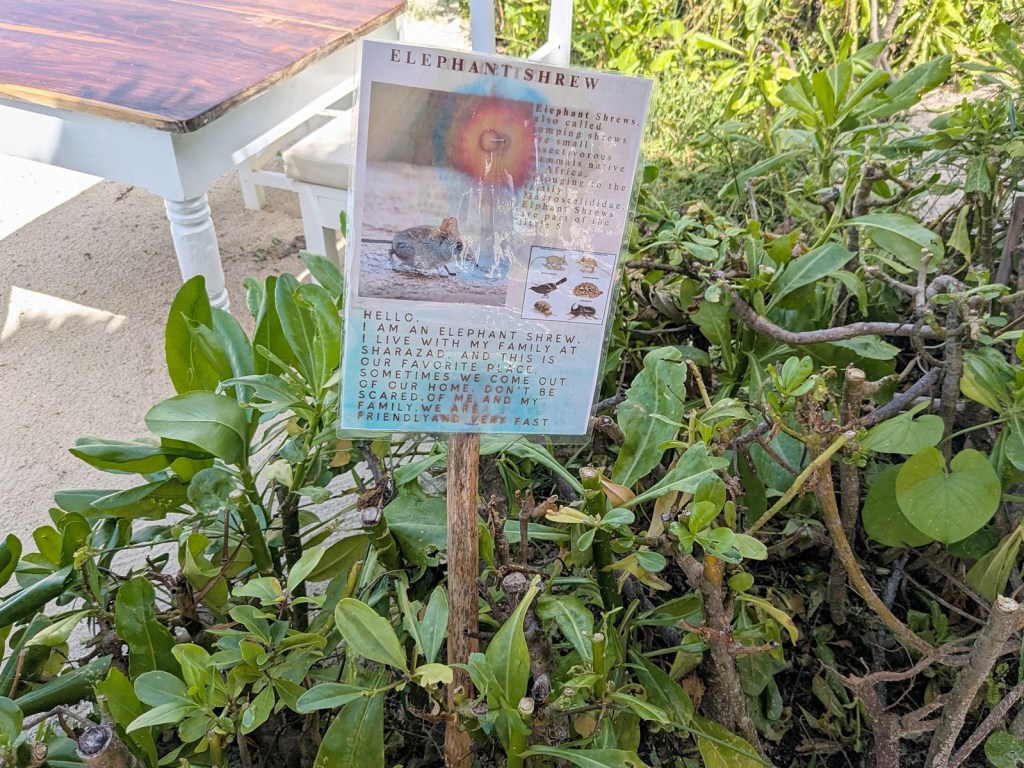
When not out and about we did manage to get lunch and a show when some kids put on their best acrobatic acts in order to draw us to their wares, a smaller pile than those of the Maasai warriors but the warriors never gave us a show. No matter, we bought from neither. Also, charmingly, a family of elephant shrews was promised to be living next to the dining area, though I wasn’t honored with the presence as far as I ever noticed. And yeah. It was the beach. Lounging, relaxing, bliss. Eventually though it did have to end. We left in the wee hours of the morning to make the drive back to the airport. The Zanzibar airport was much more polished when heading out via the international terminal than when arriving via the domestic terminal. We spent the last of our shillings and looked forward to lunch in Nairobi. I may chase some of the same experiences these British travelers did a century and a half ago but even I admit air conditioning can be nice sometimes. I can’t wait to come back.

Zanzibar III: We Will We Will Cook You

Darajani Bazaar

I went with a Queen song title for the first Zanzibar post and it has become much harder to keep it up than I thought so I am sorry. After a glorious night of sleep in a hotel we actually wanted to be at we woke up the next day to the sun streaming into our window. We enjoyed yet another marvelous breakfast on the room of the Emerson Spice Hotel and just hung out until it was time for the day’s adventure, a spice tour and cooking class.

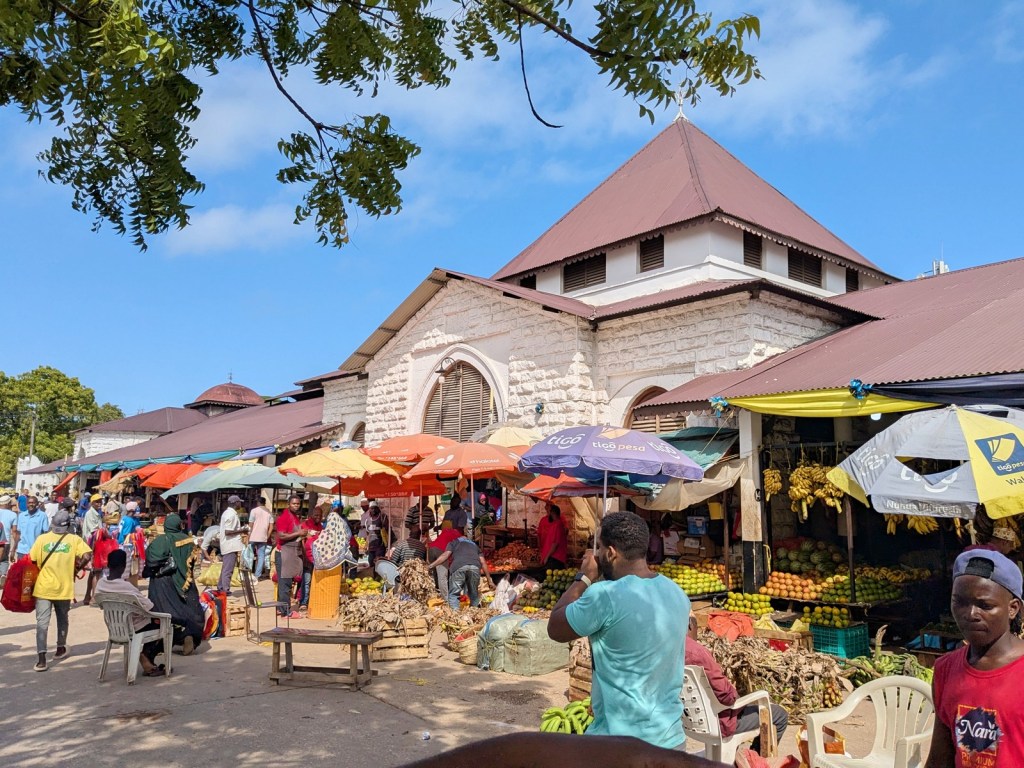
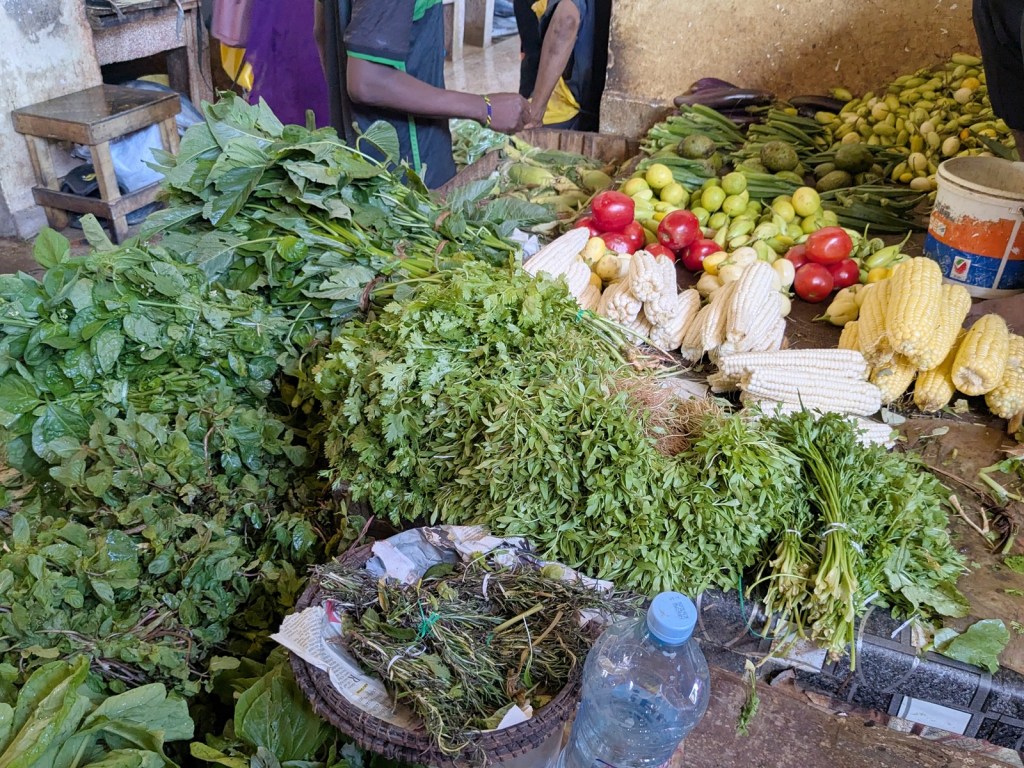
Our guide picked us up in the hotel lobby and after an in-briefing when we picked the meal we were going to cook he led us on foot over to the Darajani Bazaar to do some shopping. That was a lot of fun going through the bazaar with someone who knew what they were doing and also knew what they needed to get. To give us the full experience he went through a routine where he chatted with the sellers and then told us the word in Swahili to say and then gave us the money to pay for the vegetable or spice we were buying. It was all very thrilling.

This wasn’t our taxi but might have been cool if it was

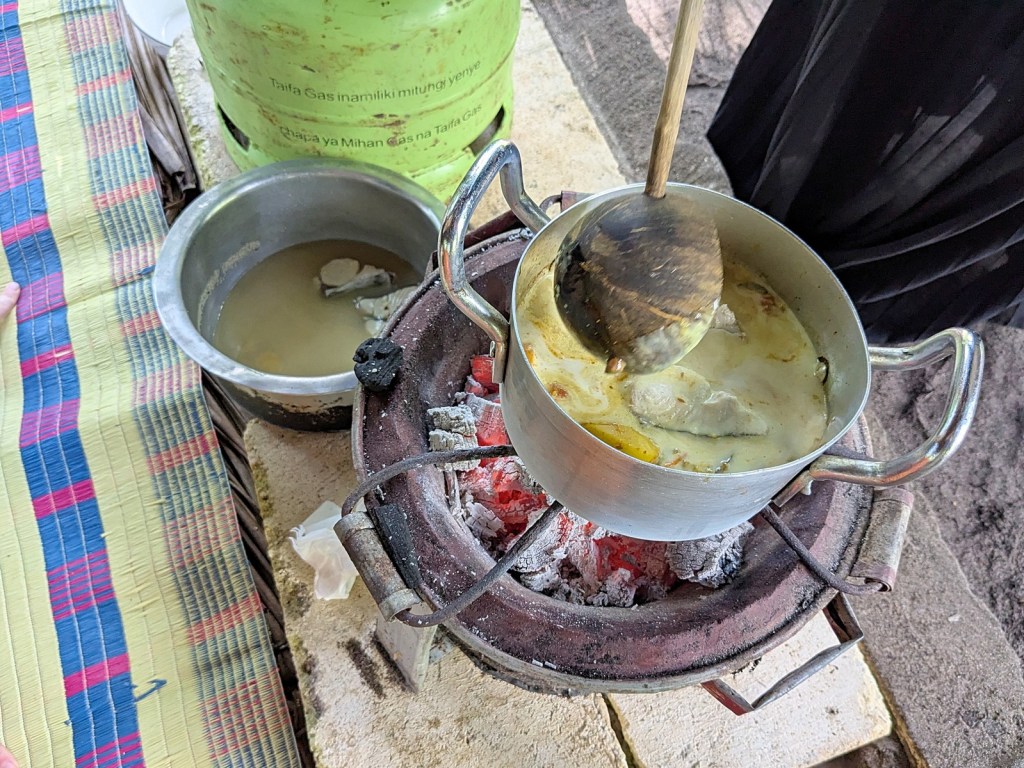
Then we found a taxi and we were off to the spice farm. In a throwback we were first served passionfruit juice but then it was time to cook.  They were in the midst of rebuilding the kitchen so we were under a pavilion on a mat which was a much cozier experience anyway. Our teachers were Hariun and Hazilah, two lovely women with tons of cooking experience. We sliced us some vegetables and started making the sauce, which unsurprisingly involved a lot of spices. We also made rice and a fish “soupu,” where they pre-boiled the fish and then used the fishy soup for other bits of the recipe. I say rice but it was a pilaf; we fried up some onions and other vegetables and then eventually put the fish in the middle of it and the whole thing was baked with coals on top of the pot.

For dessert we made a banana and coconut milk dish with cardamom and cinnamon. The most interesting part of this was making the coconut milk ourselves. I had never quite considered how coconut milk was actually made, I always figured it was maybe condensed coconut water or something? Clearly though that was wrong because what we did was spend time scraping out the coconut meat. During this process you are supposed to sing, they told us, though Hairun and Hazilah were generally too shy to sing in front of us. We all eventually did do some singing as we worked, that was fun. Then the coconut milk was made by adding some water to the meat shreds and then squeezing out the milk. The first squeeze gave “strong milk” for one part of the recipe and the second pressing a lighter milk. With lunch merrily boiling away we went out on the spice tour.

I dunno man I am a little disappointed by both spice tours I have been on. Very cool to see the different plants and stuff. But deep down maybe I am an infrastructure guy and what I want to see if the mass growing and harvesting of spices. Or maybe they don’t do it that way, maybe both the spice farms I have been to have in fact been intensive examples. We did both enjoy the tour for what it was but it was early afternoon and we were fading a bit. So, too, were the spice tour guys I guess. The guy that normally would have gone up the coconut tree, singing all the way, told us that the clouds were wrong and he couldn’t do it. I think he had just done it for some other guests 10 minutes before and didn’t want to do it again. We didn’t really want him to do it either so good thing about the clouds. We also got hats made for us out of leaves but mine was taken away because apparently I got the design for women; gender essentialism much? I thought I rocked it.

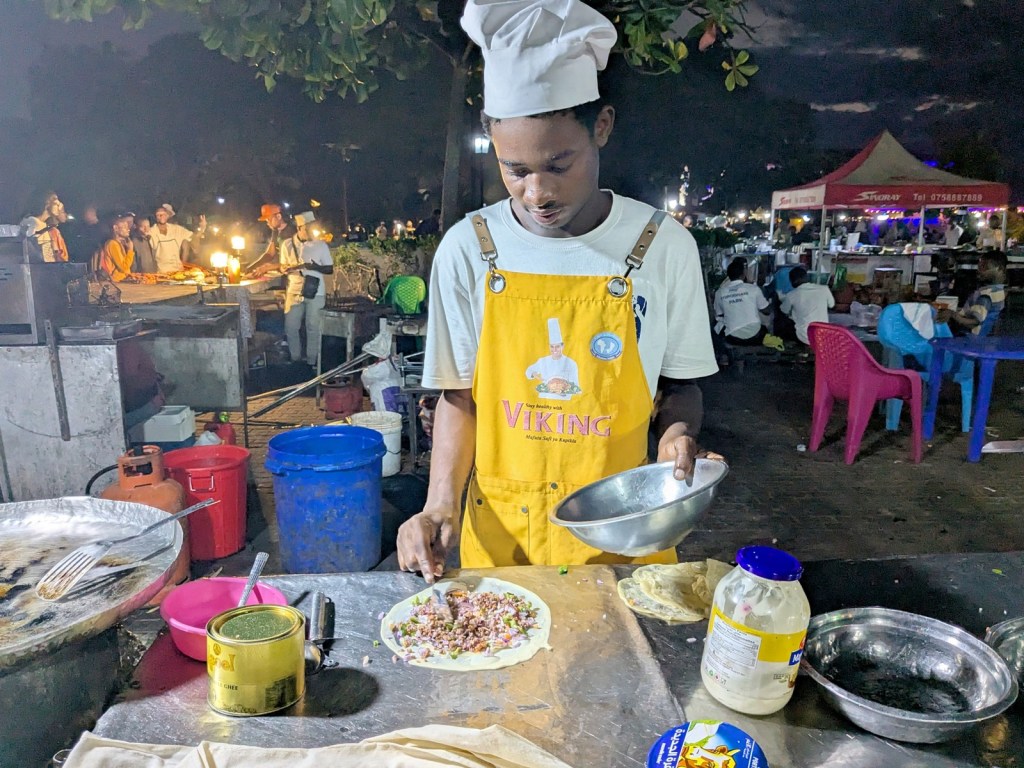
Anyways then we sat down to our lunch which was phenomenal if I do say so myself. I mean we couldn’t have done it without Hairun and Hazilah but still I did some good vegetable slicing and coconut squeezing there. After this we took the ride back to Stone Town. After relaxing a bit in the room we head out to get some shopping in for gifts for various relatives. Our big plans for the evening were also food-based, going to the Forodhani Night Market. With all the people hustling us to come to their stands the one we picked was the least hassle-y one. Our goal was a Zanzibar pizza and we went with the most classic option available. While we were waiting I got some fresh-squeezed sugar cane juice which was way better than I was expecting; it was great and I regret not getting more. As we sat down we gathered a small crowd of feline admirers which we very much enjoyed. For dessert we got a Nutella pizza, also very good, and then decided to go someplace quieter. We eventually concluded we could use a second dessert and had some drinks and sweets at The Secret Garden. It did in fact feel secret and garden-y and was a great way to wrap up the night.

Zanzibar II: Princess of the Universe

Reading this week:

  • Status and Identity in West Africa edited by David C. Conrad and Barbara E. Frank

It only occurred to me after posting the last one that this should really be Zanzibar III. But alas. I left you off last time after we had finally made to Zanzibar and wandered both into and out of the Freddie Mercury Museum. My whole thing with Stone Town is that it is not very big. You can, if you are determined, and don’t get caught up in too many shops, see pretty much everything in a day I think. It was easy to go directly from museum to museum. So off we were to the slavery exhibition at the Christ Church Anglican Cathedral.

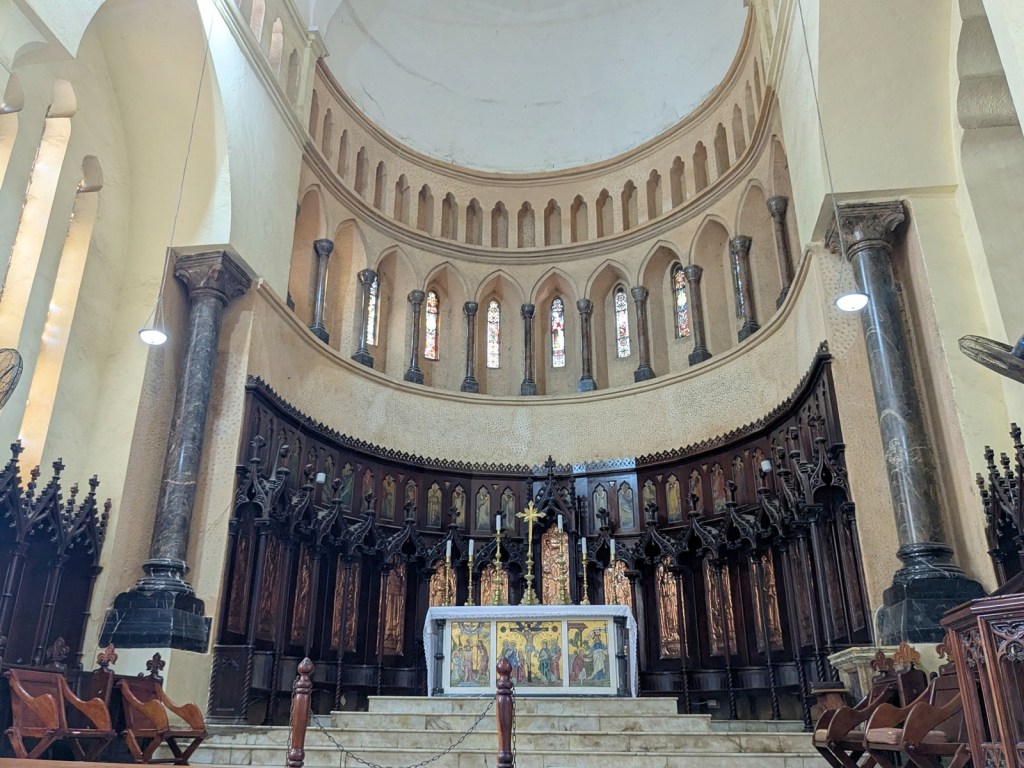
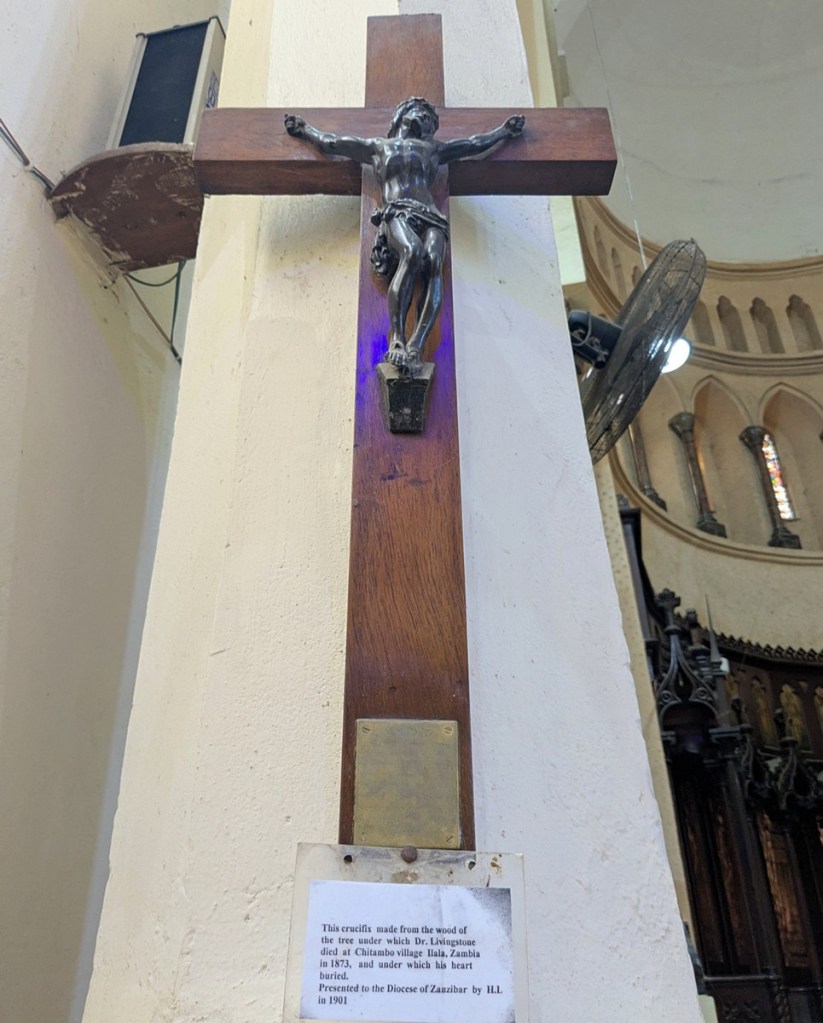
I went to the same exhibition last time I was in Zanzibar and found it very impressive. This time a tour guide took us around the church which is an experience I don’t remember from before. We must not have gone in. It was indeed pretty interesting to see the inside of the church and in there our guide gave us a history of the east African slave trade. My most significant takeaway is the particular way the guide said Bagamoyo (“bwaaaga, bwaga moyyy-yo”) to emphasize the etymology which apparently means “to lay down your heart” in Swahili. Inside the church there is also a cross made from the wood of the tree under which Livingstone’s heart was buried. I don’t actually think the list of objects made from that tree is too long, but here is a chunk of it and here is another chunk of it (different from the chunk of a the tree under which he met Stanley) and I reminded of all the pieces of George Washington’s house that I’ve seen in various museums and things and you wonder how any of it could be left. To be clear none of the original Livingstone tree is left but you get my point.

After the interior of the church we visited the holding cell/dungeon where the enslaved persons were imprisoned to await being sold. Then we were left on our own to visit the exhibit itself. Here the lack of sleep from the night before was starting to hit us, so we did not have the wherewithal to read every portion of all the signs. As I have done much more reading on the slave trade in the years between my visits I now understand there is more nuance than I had thought in the story that is displayed, but I still think the exhibit is very good. My super amazing wife and I learned most significantly that Connecticut was a major center of the ivory industry. Next time we are up there we will have to figure out a way to explore that subject more deeply.

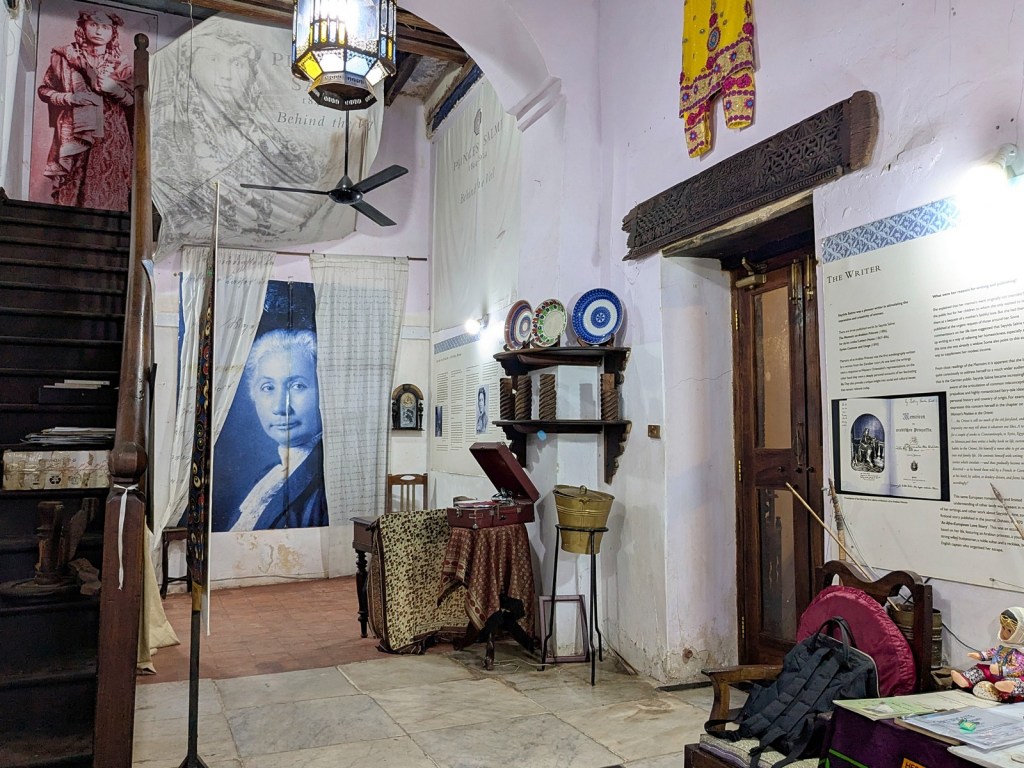
From here we were drawn closer to the orbit of our hotel, Emerson Spice. We managed to run into a new Zanzibari museum for me, the Princess Salme Museum. A slightly surreal experience; we thought it was closed, but someone was in there and took our fee, and then promptly disappeared. Later the museum’s proprietor showed up, also surprised about the lack of his colleague. One of the two mentioned that it was “the smallest museum in the world” though having been to the Freddie Mercury museum I’m not sure it’s the smallest museum in Stone Town. There is quite a bit of scholarship in there and we learned a lot about Princess Salme, aka Emily Ruete. She had quite the life and certainly had to scrap for herself. We both fought the urge to buy a copy of her memoirs, each thinking about our large stacks of unread books at home. Before we departed the museum the proprietor took our pictures at the museum for us and put rose water on our hands as he wished us on our way. Then, if I am recalling the series of events correctly, we ducked into an art exhibit being put on by Emerson themselves, which was fairly moving.

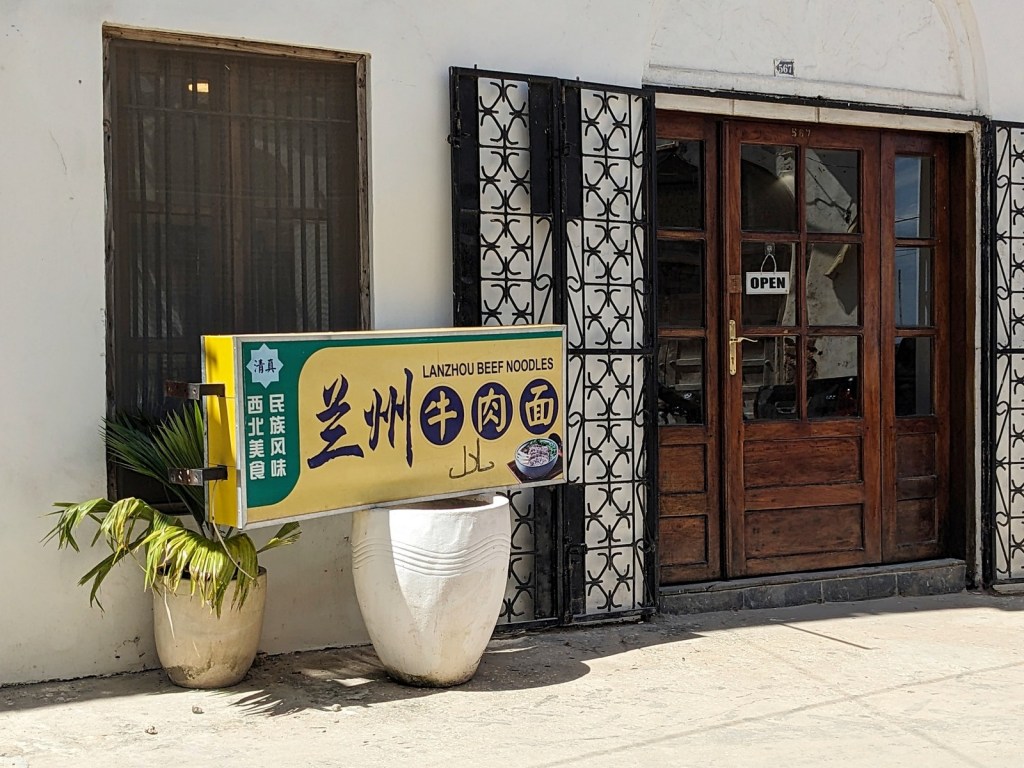
Three-ish museums and we hadn’t even had lunch yet, which we rectified by going to a Lanzhou noodle place. This is noteworthy because my super amazing wife had the eponymous noodles in Lanzhou and really enjoys them and now here we were in Zanzibar of all places having the noodles. We tried to go back the next day but they did not have electricity so we were glad we got to go at least once. It also fueled us up adequately to do some Tanzanite shopping, which we were doing at the behest of some relatives. This was less intimidating than anticipated; all the salespeople were very nice and not pushy. But this was after visiting Tippu Tip’s house. I had thought I had done this the first time I was in Zanzibar because back in those days I only had a paper map to go off of and misinterpreted the building, but now I could be sure. Plus the sign was a good indication I was in the right spot this time.

Tippu Tip’s house, finally

From there the day wound down until we were enjoying cocktails and then an astounding multi-course meal on the room of the Emerson Spice Hotel. The courses were all creative and delicious and produced somehow in the tiny open-air kitchen, also on the roof. In my last post I commented how it was nice to be in a medina and linked to our trip to Fez, but over dinner that night my super amazing wife pointed out that Stone Town was more like Tangier, both in seaside color scheme and in being an international entrepôt. Wherever it is I was glad we were there.