Paperwork enthusiast seeking new frontiers of paperwork. Former submariner, former Peace Corps Volunteer. Opinions, thoughts, and comments reflect no actual persons, living or in the Navy.
Future Boy by Michael J. Fox and Nelle Fortenberry
Like I warned last week, oops, I have become a train guy. I mean not quite but almost. I complained a few weeks ago about how the history of Sierra Leone wasn’t so obvious to me like it had become in northern Zambia, but things are clicking into place. To the point where, as of writing this (early 2024), I am worried about drifting away from my dream of writing a book about the Central Africa Mission of the London Missionary Society (which I am totally going to do, as soon as I 1) spend weeks in the archives in London, 2) gain journalistic training and travel to Mbala for weeks to gather reflections on the current impact of the mission, and 3) achieve a sort of self-starting discipline I can’t even keep up to keep this blog updated). But things are clicking into place. As I’m starting to find some of the colonial history of Sierra Leone that shape the physical and societal patterns of the place you can spot the remnants of history. Like Hill Station.
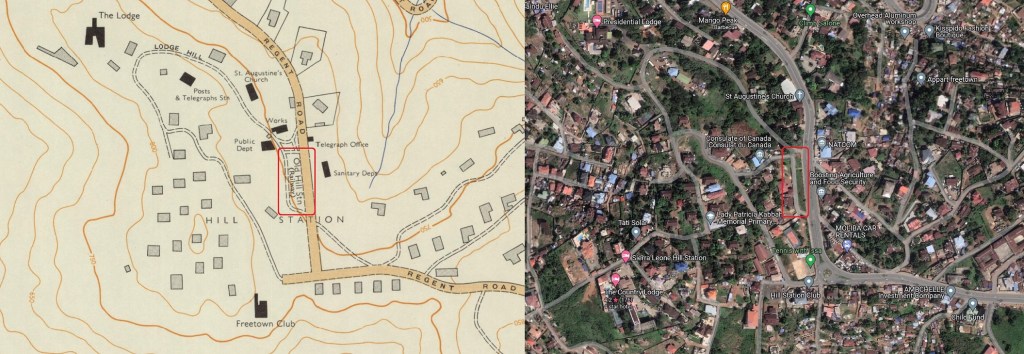
So we have been living here (again as of writing) in Hill Station the neighborhood. It was upon visit to the train museum and reading the little pamphlet we bought in the gift shop that I realized that comes from like, Hill Train Station (a little more research later I’m unclear if that is true, this Hill Station was patterned off a Hill Station in India so the technical etymology of the name might not be a literal train station). Since I like looking at the remnants of history, I wanted to figure out where the actual Hill Station was. I spent a little bit of time looking around on Google Maps satellite view for anything that looked like an old train station or a train right-of-way, but I pretty quickly deemed that as unlikely to yield results. Luckily though I thought of looking at old maps and hit the jackpot right away.
In the top right corner of this map, if you zoom in, you can see a little traffic island sorta thing labelled “Old Hill Stn (Railway).” Well that solved that mystery. It also pointed out where “Hill Station” (the neighborhood) actually was. When I was zooming around Google Maps I was looking too far up the hill. Another thing looking at the old maps is that it is remarkable (to me, I am remarking on it) how much more developed the area is than it was at the tail end of colonialism. These hills are now covered in neighborhoods and houses whereas before Hill Station was an isolated little enclave in a sea of forest.
Speaking of which, what was Hill Station, the neighborhood? Like I just said, an isolated little enclave. Around the turn of the century the British administrators decided that living up on a hill would be a lot better idea than living down in Freetown where their offices were. This was ostensibly for health reasons, to get up into the breezes which hopefully would mean there were far fewer mosquitoes. However, as explained in this excerpt fromThe Creoles of Sierra Leone by Leo Spitzer, in implementation it was a bit more racist than that. Not only would the neighborhood be mosquito-free, but it would also be largely free of anyone non-white, except for the adult servants of the white administrators living there. They put signs up a mile out to keep anyone from even planting a garden. Leo Spitzer’s book is about how Sierra Leonean society split from the British colonialists, and Spitzer credits this spatial separation of administrator and administrated for part of that.
Anyway the other thing about Hill Station is the old houses. Sierra Leone is known for old houses but these old houses are different. The Hill Station neighborhood was not only racist but also expensive. To get all the way up to the hill they had to build a whole railroad, hence the creation of the Station of Hill Station. The neighborhood and railway were built roundabout 1902-1904. The houses they built were referred to as “Harrods Houses,” because they were ordered from Harrods (as in the department store), shipped to Sierra Leone, and constructed on the spot from the kits. So scattered around the hill are apparently 12 of the original 24 or so Harrods Houses with their distinctive look. Not too bad for some pre-World War I kit houses (here is a site with some interior shots).
Circling back to trains, once I figured out where the Hill Station Railway station was, I wanted to figure out where the old railway line was. There was not conveniently wonderful old maps of the railway line that I could find easily. The line only ran until 1929 when there was a nice enough road and enough of the administrators had cars to make it no longer necessary. So any maps I found would have had to be made in that era. One map I did find (via this blog) was on this wonderful website all about post offices that existed on trains and ships, which is a wonderfully niche hobby that I am in real danger of falling into the very moment I turn 40 (check out their committee page). It is not a very exact map but I started to try to trace the route which led me to discover the road with the extremely convenient name Old Railway Line so there’s another mystery in the bag.
But the whole point of this blog post is that after all this research on the Hill Station railway line and hill station itself I went over there and checked it out. It was a lovely little walk on a Sunday morning (to try to make sure it was relatively quiet). First I went to the spot of the old railway line hoping to find some evidence of its existence, but alas not really:
There used to be a train station here.
Then I walked up the hill to check out the Harrods Houses. I had spotted them before on the way to the Country Lodge Hotel and thought to myself they had looked colonial, so I was pleased in the course of all this research to discover they really were. They are popular houses to photograph (and, for the artist Frédéric Lère who I found via Google Maps of all things, to paint) though I tried to be a little discreet.
A pre-World War I Harrods House, intact and still in use.
So the point is, history is cool, trains are cool, and going on walks is cool.
A Fortune-Teller Told Me by Tiziano Terzani (not quite the book I remember)
The same weekend that we were resting and relaxing at Banana Island we also went to the world-famous Sierra Leone Railway Museum. It was really great! I had been itching to go to a museum in Sierra Leone (there are three), but they are typically only open on weekdays which makes it tough to go unless we have a holiday Monday or Friday off. So when we had the chance I insisted we leap at it.
The Railway Museum is pretty nice and is a labor of love for all involved. It was started in the aftermath of the civil war when noted Train Guy Steve Davies found that some engines and rolling stock were laying forlorn in the former Cline Town railway works. They managed to get a railway museum up and running and have since managed to visually restore the items on display.
When we visited we were the only visitors and they were pretty excited to have us. I think most of the traffic at the museum is school groups and it looks like they do a really great job teaching all the kids about trains and stuff. We paid our entry fee and were taken around on a guided tour. We managed to briefly visit the national museum and also got taken on a guided tour, so it seems on-your-own museum browsing isn’t really a thing around here. The first part of the tour focused on the history of the museum itself before going into the history of railways in Sierra Leone. The purpose of the railways was of course colonial-era extraction but hey I suppose we can’t hold that against the trains themselves. The railway eventually folded up shop at the behest of the IMF told the government in the ‘70s. According to the group of train enthusiasts that run the museum, this was due to the evil machinations of the car lobby. This tracks with most train vs. car experience in history, so once again boo stupid car lobby.
For train cars, one of the ones they are most proud of is the train car that was supposed to be used by Queen Elizabeth II when she visited Sierra Leone. I guess the train ride never happened and the train car wound up fairly derelict but the museum has restored the exterior. The interior is bare (they’re working on it), but on the inside are pictures of Queen Elizabeth and signs about Sierra Leone’s relationship with the monarchy. Our tour guide certainly knew how to lead a tour because one of the first things he did was request my phone so we could run outside the train car so we could stand on the back on the reviewing platform and wave to a non-existent crowd like Queen Elizabeth would have while he took pictures. Extremely cute. Other train cars they had included a steel goods car and a payment car for the railway to pay its employees.
This is a Hudswell Clarke 0-8-0 diesel locomotive No 105 (works No. D1180), built in 1959. Specs: 145HP, top speed 20mph, mostly used for shunt work. This is well documented online, both on the museum website and on the specialized wiki. Man there are a lot of train guys out there in this big beautiful world. And, I have to assume, train women.
Besides the cars they had the engines. Most of the engines they had were pretty small diesel engines from the latter part of the railway’s history. They are pretty cute! They had some even smaller steam engines and a larger steam engine. These all look pretty complete but I think are a far way off from running. What does run however is one of those railway pump cars you always see in cartoons and stuff. They got it on a short length of track and under the careful supervision of our tour guide we got to take it for a spin which was a hoot. An absolute delight.
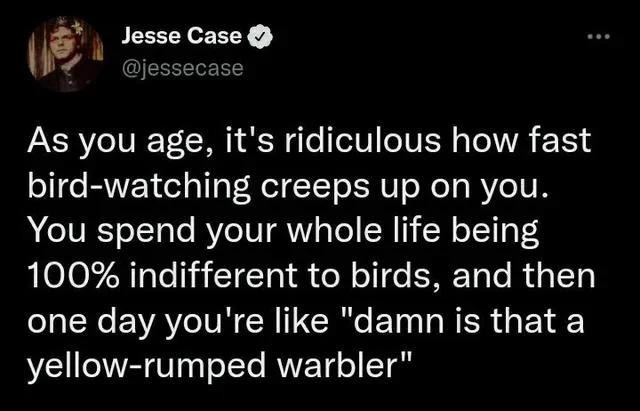
We wrapped up our tour in the giftshop where I bought a marvelous little booklet on the history of the museum and the railway and then my super amazing wife got two postcards with old photos of the railway which is cool. This is not the most expansive railway museum in the world but the staff is enthusiastic and the history is neat and I mean you gotta go see trains. Last week I was worried about becoming a bird guy but now I think I might become a train guy. Of course, isn’t every man a train guy at heart?
Hot on the heels of our weekend of rest and relaxation of Tacugama, we decided to do even more rest and relaxation with an overnight on Banana Island. The Banana Islands are off the coast (as many islands are), a couple miles to the southwest of Kent, a fishing village. Getting to Kent was a two-hour drive from Freetown (the way back was three hours with traffic) and once we got to Kent it took some directions from some friendly people along the side of the road to find the little port with a boat that would ferry us over to the resort. We were staying at Bafa Resort, which offers glamping stays on the island. And so we arrived around noon and settled in.
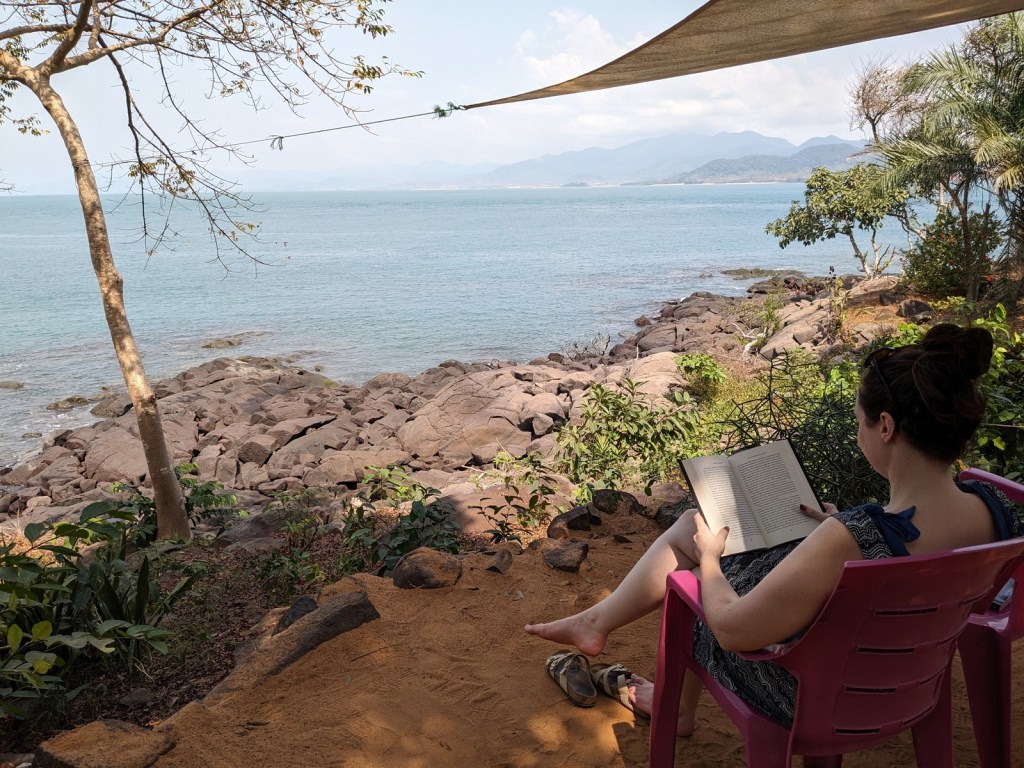
If there was not much to do at Tacugama there was even less to do at Bafa for most of the time. I mean this is what we were there for so it was perfect. After my harrowing experience on our last relaxing weekend of forgetting to bring a book, this time around I brought two, but didn’t manage to finish reading the one while we were still on the island. I should say you can do activities at the resort (snorkeling, fishing), we just didn’t really. For no extra cost you can go swimming though it was better at high tide and we didn’t get the timing right. You can also eat and drink and that was fantastic. The food there was really really good. We favored the seafood and the menu changed for every meal. We also had a few drinks while we were there, and one of the highlights was that after years of reading about palm wine I finally got to try some poyo. It was good! Faintly nutty flavor. It would be fun if I could find a more regular supply.
Our overnight of rest and relaxation.
Anyways so we spent our time that afternoon hanging out overlooking the ocean and reading. An utterly perfect activity. The weather was beautiful, the company was great (my wife is super amazing), and admiring Sierra Leone from the sea was beautiful. It was cool to see the peaks of the Western Area disappearing into the mist as the continent rose from the ocean. Very cool. We also got to admire the stars and then eventually turned in for the night.
The highlight of the visit for me was the historic tour we did the next morning. We almost didn’t get to do it and I would have been crushed. Our boat was leaving at noon and though we had originally arranged to do the tour starting at 10 the resort didn’t tell the guide that so he didn’t show up until 11:15 or so and we had to do the whole thing speedily.
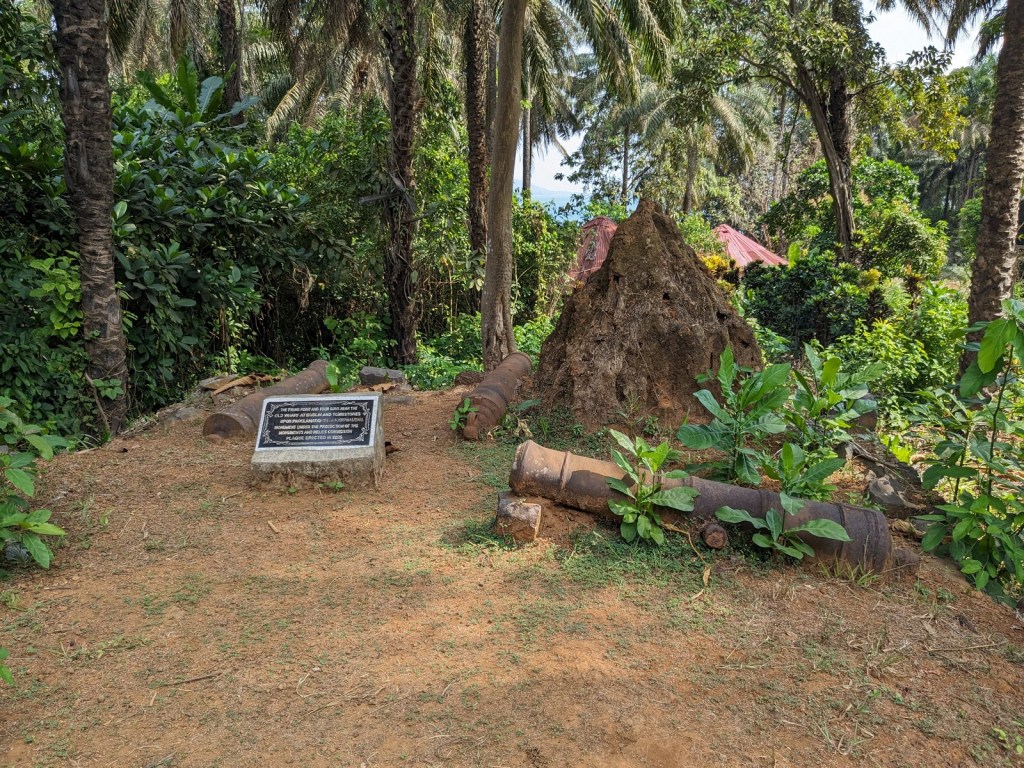
Firing Point
The history of Banana Island I have found to be frustratingly difficult to dig up. Maybe this is just because I now fancy myself as something of an expert on the history of a certain chunk of northern Zambia, and starting from scratch and not knowing where to look is simply frustrating. Most of the easily accessible histories of Sierra Leone I’ve found focus on Freetown and not so much the outlaying areas. Even if you go on the Heritage Commission website there’s not a whole lot about the only national monument on the island, the Firing Point. There is some conjecture and that’s really about it. Even in the book I found with a chapter on the Banana Islands is mostly just concerned about ownership status and doesn’t really dive into what happened on the islands. I have found reference to the islands in a few other sources (sometimes they are the Bananas and sometimes the Bananoes) but no nice comprehensive history. Maybe I’ll have to write a whole blog post about them or something.
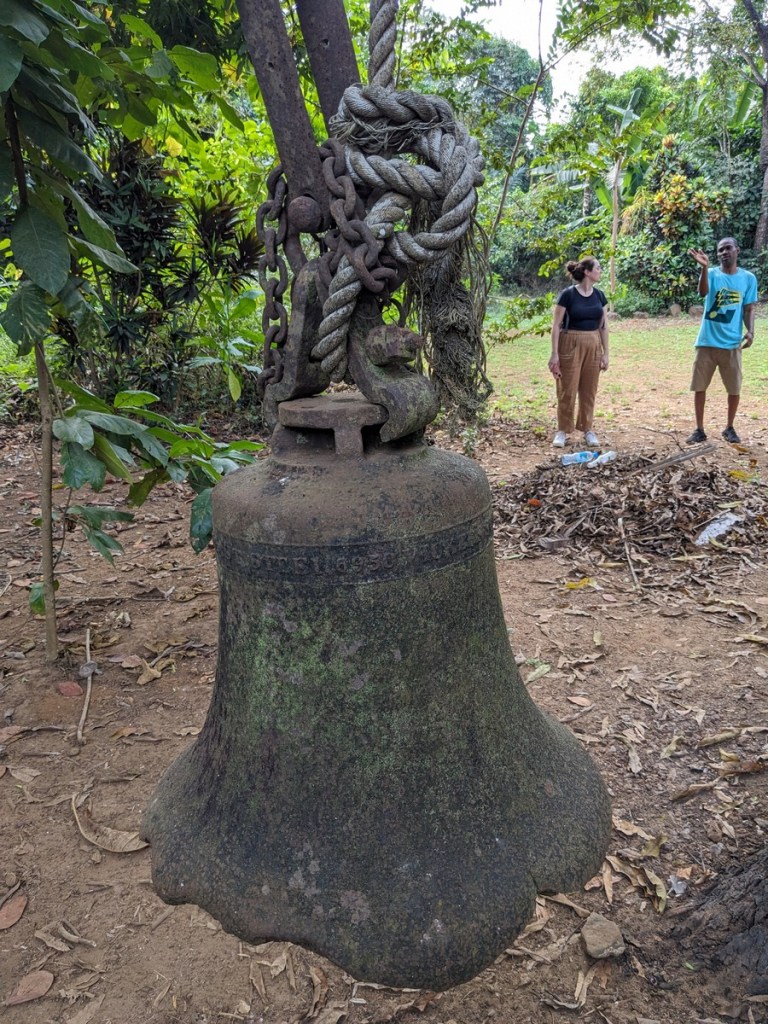
1881 Anglican bell.
But enough complaining, the historic tour was great mostly because it got us out of the little resort area. The town of Dublin on Banana Island is really cool. Apparently it is a very old town with streets laid out in a kinda regular grid with street signs and antique lampposts. There were fruit trees everywhere and like I always am I was mesmerized by everyone’s gardens and all the things they were growing. I saw cassava and bananas (obviously) and oranges and breadfruit and coconut and taro and chickens and goats but didn’t have time for a really in-depth look. Besides the Firing Point the other historic thing we saw was an old bell from the Anglican church. They had built a new church next to where the old one was, and since the bell tower had burned down (I think) the bell was hung from a tree. The bell was from 1881. I think the Anglican church must have been founded by the Church Missionary Society when they were invited in by one of the early governors of Sierra Leone in his attempt to establish townships for the former captives of slave ships the Royal Navy had brought into Freetown and condemned. But I’ll have to look into that further in my Banana Islands blog post.
After zooming through the tour (which included a plug for the resort on the island we weren’t staying at), we had to head back to our resort, settle the bill, jump on the boat, and head on home. It was a great time and I can easily imagine going on, if only to explore even more of the island this time around. There’s always so much more to see!
Hello again future readers. I am writing to you from the long-ago time of early 2024. Although my previous Tacugama entry will have gone up only a week before this one, in real time it was about four months in between our visits. Life here in Sierra Leone has been a hoot but getting out and about to explore stuff was a bit more difficult than initially anticipated. Some of this is artificial but the morning we departed for Tacugama we finally got a car and so finally had some independent mobility. Plus it has taken a while to understand what was going on in the area, historically, which meant we didn’t quite know where to go. But my super amazing wife’s birthday was coming up, and Tacugama was a place we knew to go, so we had an extremely lovely weekend just relaxing there. We spent two nights at Tacugama in one of their eco-huts and it was great.
We left for Tacugama on Friday night after work, in such a hurry that I forgot to bring a book. Cell phone reception up there isn’t the greatest and there wasn’t much reading material on hand so this was potentially a disaster. The whole plan for the weekend was to spend the large majority of the time just hanging out and reading and I was left without reading to read. Oh no! The solution to this was to go through a backlog of stuff I had meant to read on my phone, and also, when she was busy crocheting, to steal my super amazing wife’s book that she had brought. So that worked out well and when I was reading and we weren’t eating (we also spent a large chunk of time eating during this trip, the food was phenomenal) I could nap in a hammock.
Speaking of thirty-something-guy activities, our real big adventure during our time at Tacugama was going on the birdwatching tour. This we did Saturday morning. We set our alarm for 6:30, hoping in a metaphor reversal the worms we caught were in fact the early birds. Our tour guide was Alfred, who simply made the whole adventure. Alfred loves birds. He got so excited about the birds we saw, even the common ones. If you are going on a bird tour in Sierra Leone ask for Alfred.
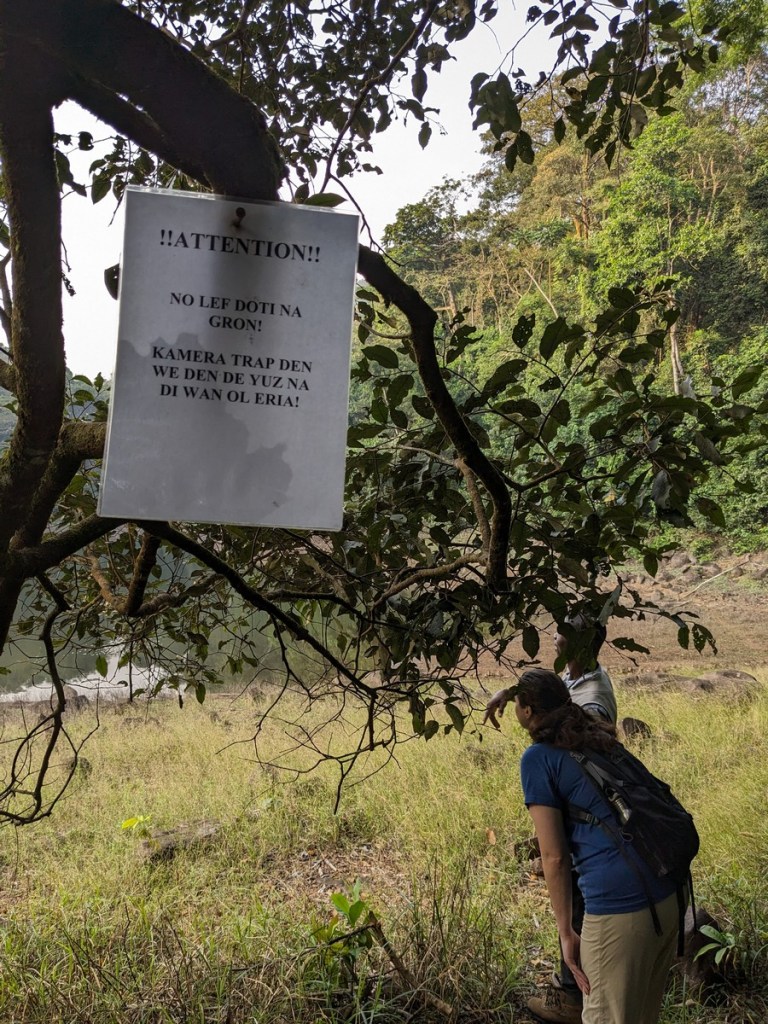
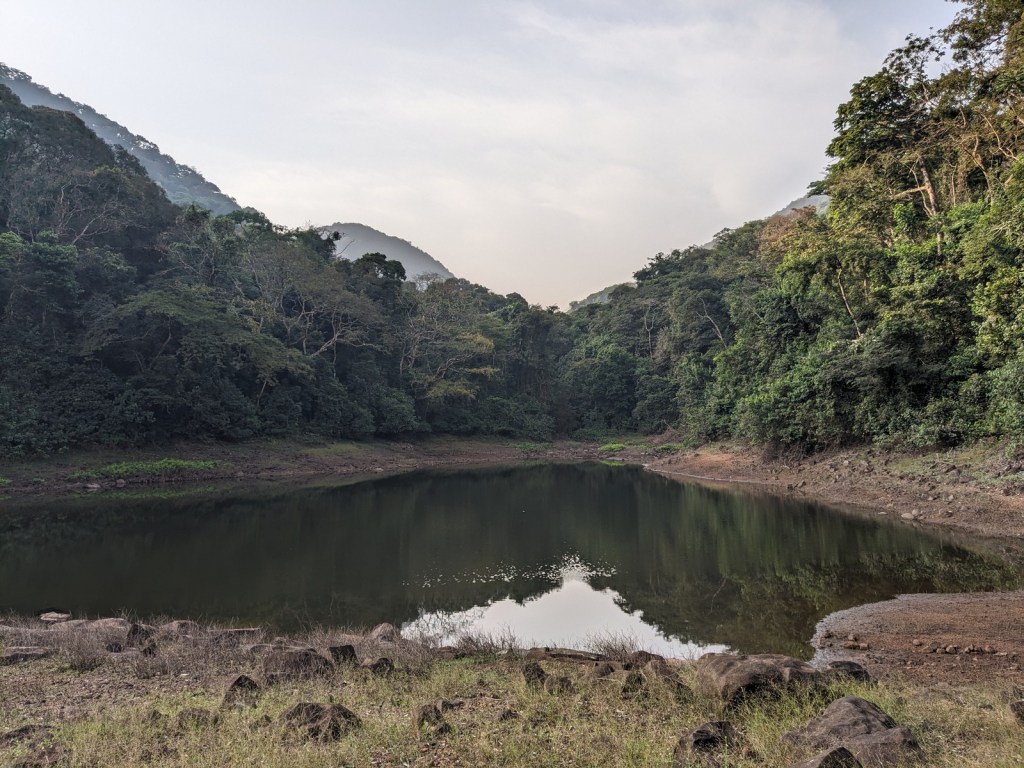
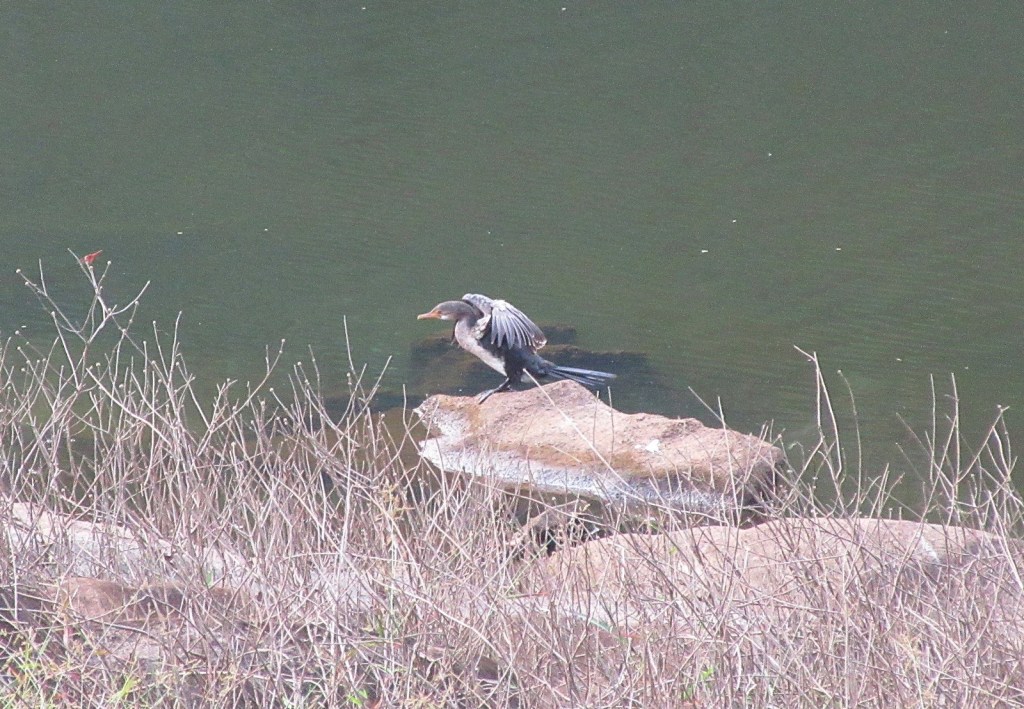
For the birdwatching tour we went up to the top end of the reservoir. On our last trip to Tacugama we hiked over the dam of the reservoir, but this time we were seeing the other end. On our last trip it was also the rainy season, and this time around it was the dry season, so it was neat to see the reservoir with a lower water level. This is a much preferable indicator of the change of seasons than like snow or something is. Boo snow. Yay tropical jungle. We didn’t see way too many birds on our birdwatching adventure. I got a number of pictures of the same reed cormorant. Birds I didn’t get pictures of were a flycatcher with a very colorful orange tail and a green turaco.
Upper end of the reservoir.An agreeable cormorant.
The most dramatic part of the adventure however is when we almost caught a glimpse of the Great Blue Turaco. Turns out Alfred’s absolute favorite bird is the Great Blue Turaco. We had spent our time at the reservoir and were about to head back when Alfred saw a rustle of leaves and heard the Great Blue Turaco call. We couldn’t leave now that we had a chance to see one. We stayed still and waited and heard a few more calls but alas it was not to be. So we hiked back along the trail and over the dam again and wound our way back to camp.
Wet season reservoir.Dry season reservoir.
The afternoon we went off to see the chimpanzees. They were much the same as last time though this time around I got much better pictures of the babies playing around thanks to a zoom lens. And I was prepared for the alpha chimp throwing rocks at us, though there was also a much bigger crowd so individually I wasn’t as much of a target. We also saw some chimpanzees grooming each other much more intensely this time around, and it was funny to watch one manhandle (chimp-handle) another’s leg and spin its friends around to ensure they got all the angles.
The rest of that day was spent in various comfortable chairs reading or in the hammock napping or up in the kitchen lean-to eating. Minus the reading part I now realize this is the life of a chimpanzee at Tacugama so I guess we really got the full experience. We went to sleep that night and the next day had another delicious breakfast and a very relaxed morning before heading on home. Not a shabby weekend at all.
After two years I can finally reveal that the undisclosed country we have been living in is Sierra Leone. I can now finally reveal this because we have left. I assume anyways. By the time this gets posted I will have written it two years ago, so hopefully I got like two years of posts saved up because I figure it is better to write about these things in real time so they’re fresh-seeming and then post them later so I can build up the content. I hope it’s been a good two years!
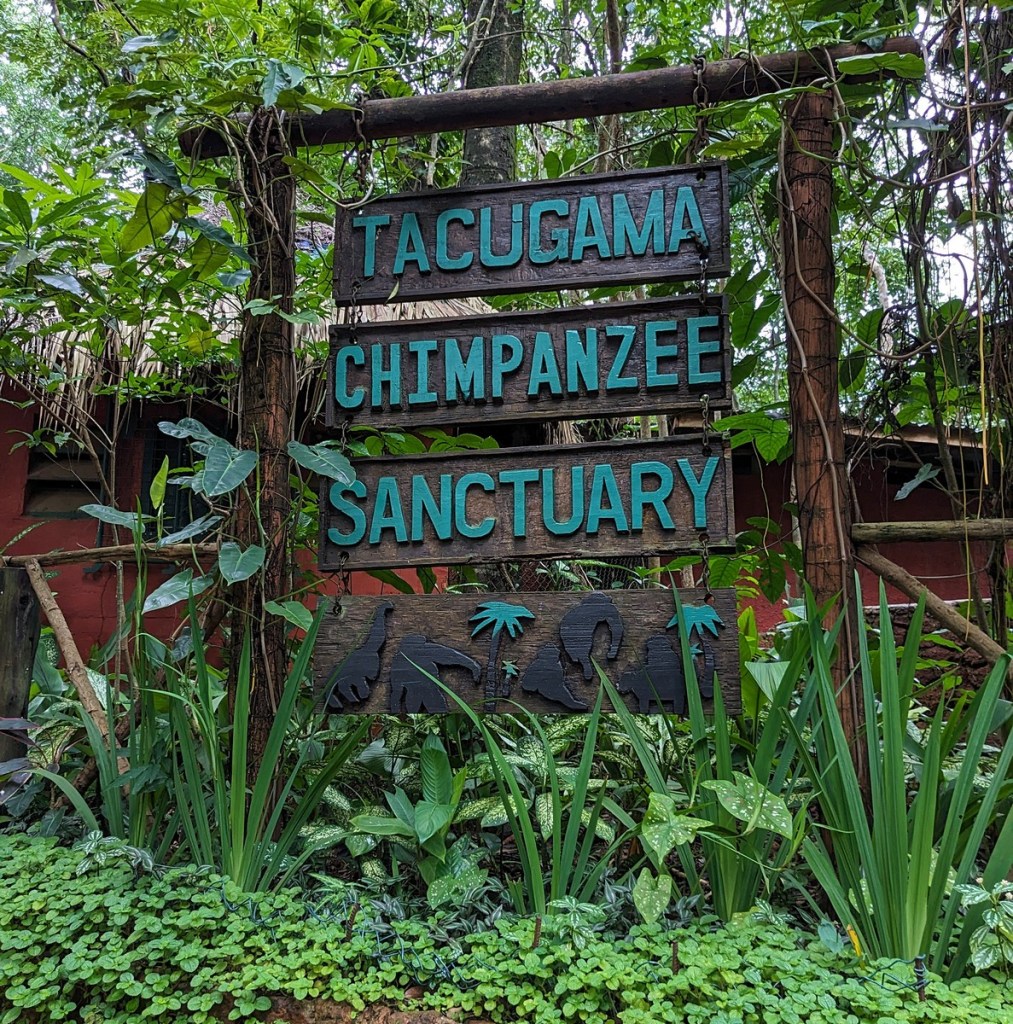
Anyways, one of our first big adventures here in Sierra Leone was visiting Tacugama Chimpanzee Sanctuary! These weren’t the first chimps I ever saw but they were the first chimps I ever saw with my super amazing wife. Tacugama wasn’t actually that big of an adventure. It is essentially in the middle of Freetown which makes it relatively easy to access. It was like a 30 minute drive, tops. The most difficult part is that the visitor’s center is at the tippy top of the hill and the road up it was unpaved, single-lane, and kinda steep. At least it was in the far distant past of August 2023. When we were heading up they had plans for a nice new visitor’s center and a paved road, so maybe more recent visitors have gotten to partake in those luxuries.
An angry chimp is as strong as five men.
During our visit we had two major activities. The first was a tour of the facilities. We were led around by our very friendly guide Sulayman who was eager to tell us chimp facts. There were various helpful signs around the place. Tacugama’s main raison d’etre is rehabilitating chimpanzees that people have kept as pets. It is illegal to keep a chimpanzee as a pet in Sierra Leone, and honestly it is my understanding that chimps make terrible pets anyways, but some people just aren’t satisfied with a cat. When Tacugama finds out about someone keeping a chimpanzee as a pet they kindly ask that person to turn the chimpanzee over no harm no foul. If the person refuses they’ll get the authorities involved but like all organizations like this one a big focus of their mission is community outreach so they try to be nice.
Once a chimpanzee is taken in by the park it goes through three stages of rehabilitation. At first the chimpanzee is quarantined as chimpanzees are susceptible to human diseases and they want to ensure it won’t bring anything bad to the group. Once the chimpanzee is done with this hurdle it is introduced to the Stage 2 group. This stage is about the chimpanzee learning how to interact with other chimpanzees and be part of the group. They are carefully monitored and fed regularly.
The guy in the foreground was the current leader of the group. He really didn’t like us watching the group and kept throwing rocks at us, which honestly was totally fair. Besides him though it was cute to watch all the rest of the chimpanzees hanging out and climbing around. There were two little babies that kept swinging around and having a grand ole’ time.
After Stage 2 the chimpanzees are sensibly moved onto Stage 3. This is more of a wilderness type setting. It is still enclosed and the whole scenario kinda gave raptor pen vibes because it was this electrified fence surrounding pretty dense jungle and you were just told that there were animals in there somewhere. Potentially dangerous animals too. Apparently the chimpanzees test the fence sometimes and they have escaped before. Like I said raptor pen vibes. But in the large enclosed space there are plenty of fruit trees and the chimpanzees mostly fend for themselves though they do get fed regularly, just not as often as in Stage 2. They prefer living in the jungle anyways. They’re chimpanzees after all.
Unfortunately so far there has never been a Stage 4, which is releasing the chimpanzees back into the wild. Maybe this problem has been solved in futuristic 2025, but in 2023 there is still a lot of habitat loss and poaching of chimpanzees in the wild, despite chimpanzees being Sierra Leone’s national animal. Tacugama is afraid that if they release the chimps into the wild they’ll just get poached. Very sad but as I said before Tacugama is big into community outreach and does a wide range of educational and developmental programs for people surrounding the park and throughout Sierra Leone in order to protect the wild chimpanzees along with the other wildlife in the area.
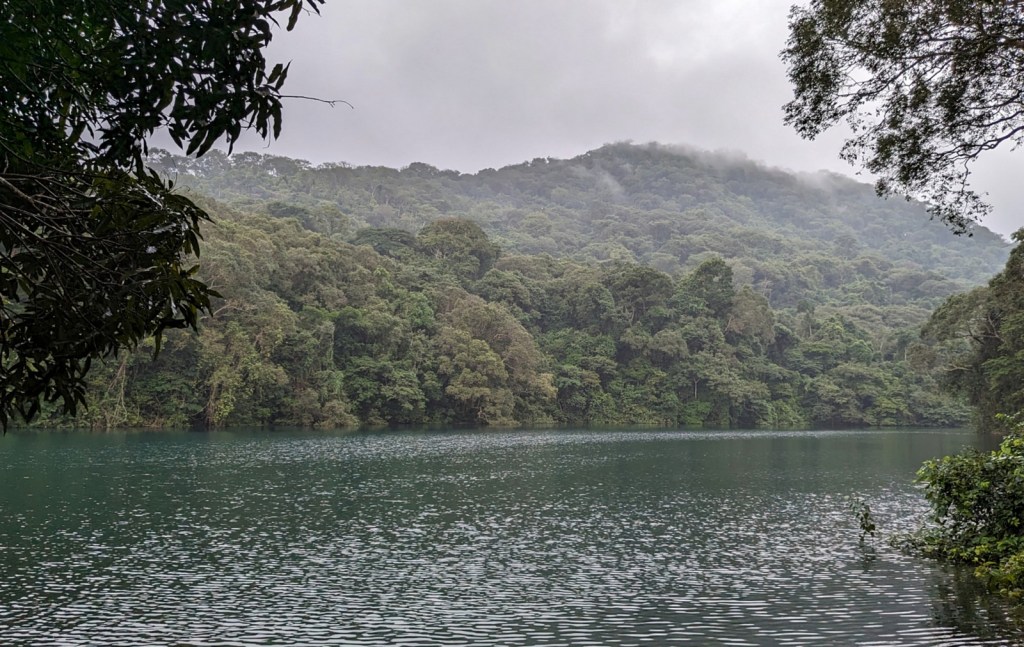
But enough about animals! After the tour the next big thing we did was go on a hike. We went on the waterfall hike. This was very picturesque. It was the rainy season so everything was lush and green and very wet. Clouds often kiss the hilltops and the jungle roars with life as water cascades down the hills. The below picture is actually of a reservoir that apparently dries up in the dry season. That’s how wet things were.
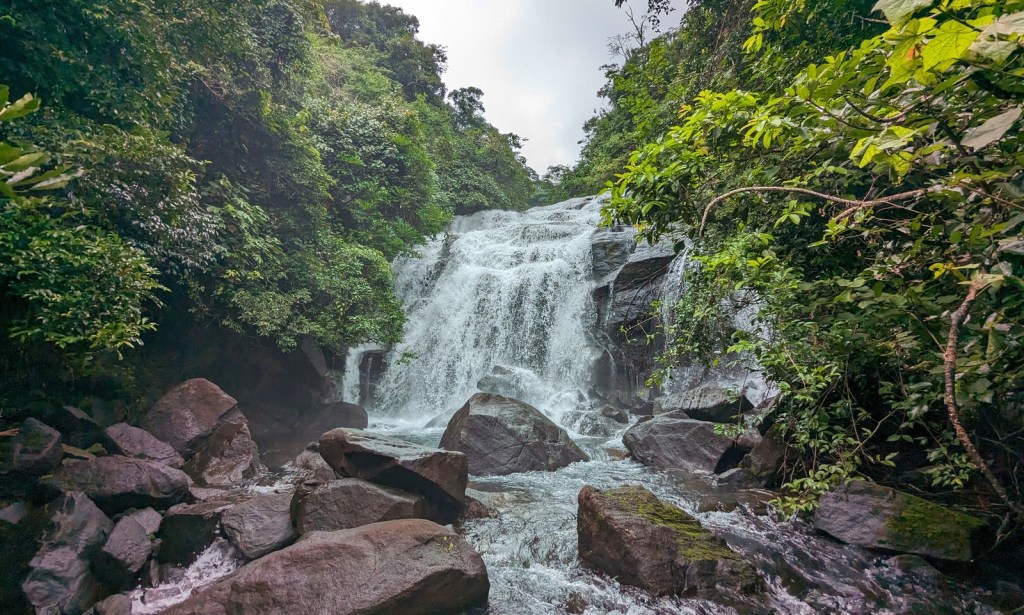
The hike itself was very pleasant. The guide warned us we would be out and about for three hours but I think it was closer to two. I think mileage wise we didn’t go very far but we worked our way down the hill along a river as the guide stopped to explain various bits of infrastructure and what Tacugama was doing to protect the park and try to preserve swaths of jungle. People are of course hungry to make a livelihood and send their kids to school so it is a balancing act for them. The sort of finale of the hike was being led across a rope and wood plank bridge to get a good view of the below waterfall. As I was looking at it I was thinking about how one of the first things we did in the Peace Corps was visit a waterfall, and now here I was doing the same in Sierra Leone. Peace Corps was a hoot, so I guess this is an auspicious way to start a new adventure in a new country. I hope so anyway. I’ll know how it turned out by the time this is posted.
Hunting Trips in Northern Rhodesia by D.D. Lyell, F.Z.S. (pretty racist)
As it has been over a year since my previous update on our garden, it is time to give you all the latest, and the last. You see our time in undisclosed country is drawing to a close and so therefore too is our time with this particular garden. And um there isn’t actually a whole lot to update. We did not grow as much this year as in previous years. The seeds we had did not really take this time, so there was no big harvest of various foodstuffs. For a while there some pumpkin vines were sprouting of their own accord, and really taking over the garden area. The trellis we had gotten set up the year before was still there, even though it never really served as a rain shield, but with the pumpkin vines it could instead serve as a very nice sunshade with vines growing all up an around. But although the vines covered the sky and ground and there were many flowers, never did any begin to grow a pumpkin. Oh well.
Instead my real big successes were trees. This was all touch and go for a while. I see in my last post that I was excited for my avocado tree to grow taller than I was, and I can happily report it is significantly taller than I am, all in only about two years. Still no avocados of course, but I am sure the next occupants of the house will find them delicious. In the dry season the leaves were getting coated with some sort of grime, or perhaps a fungus, though it would still push out new leaves occasionally. In the rainy season it seems to have recovered its mojo and shot right on up. It is my single most successful tree I’ve ever grown.
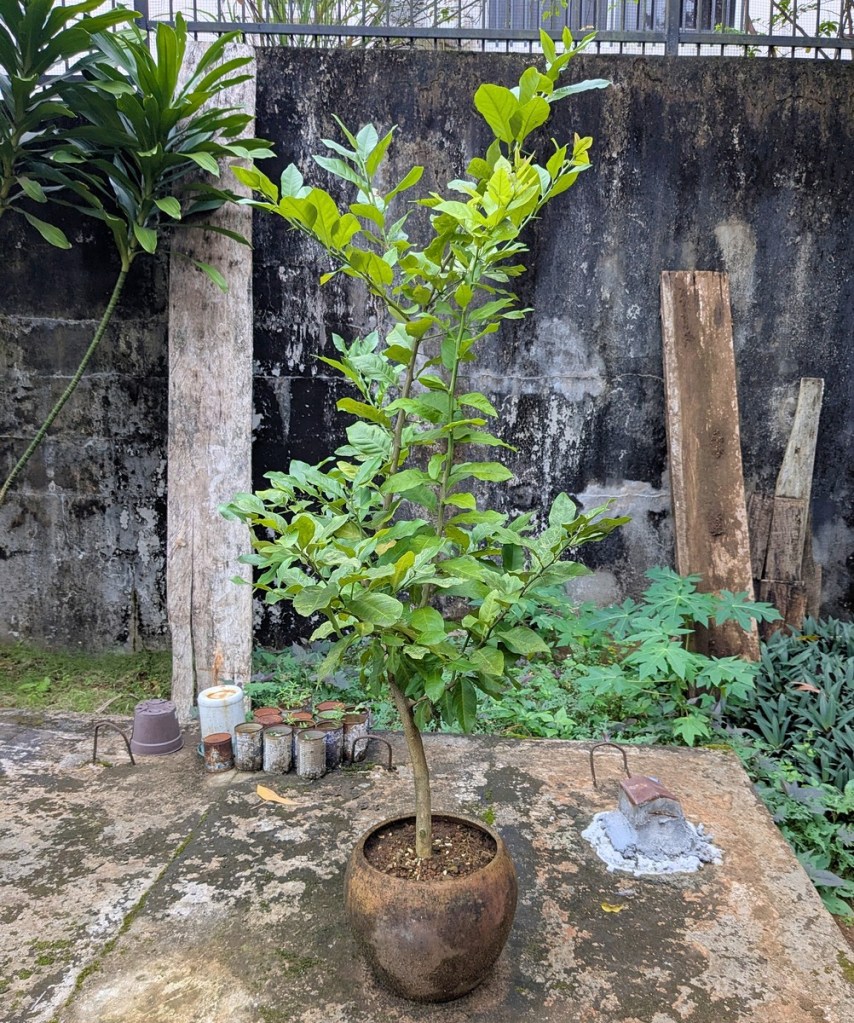
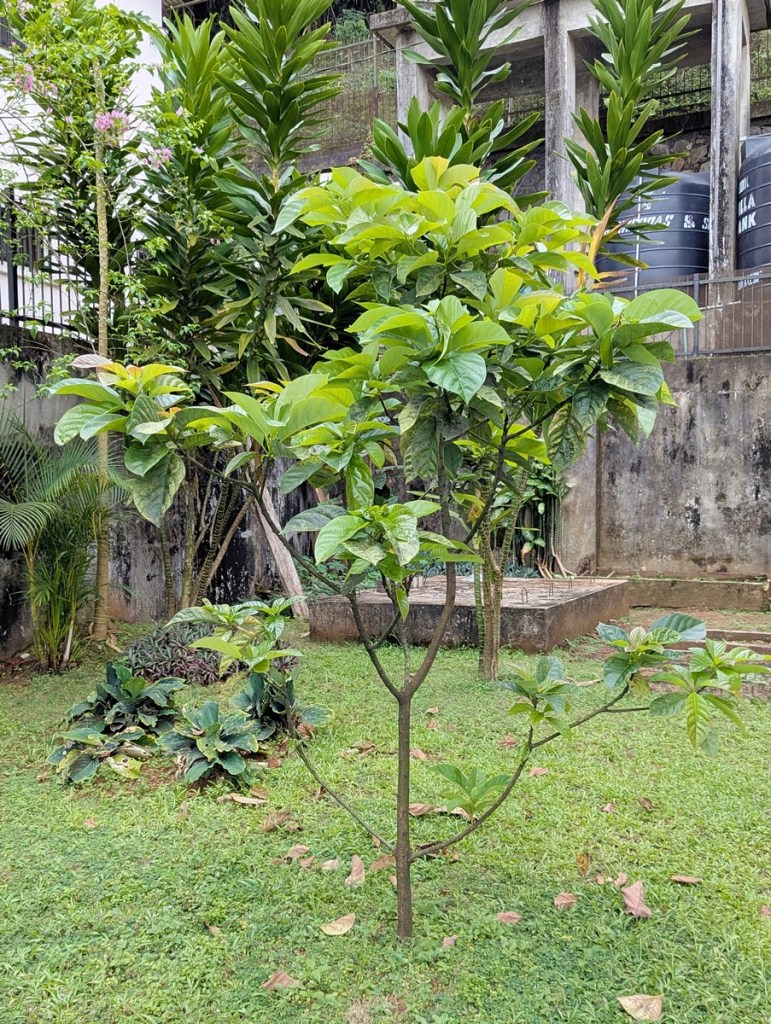
In that last post you’ll also recall my small citrus tree in the ground. Unfortunately it has remained small and rather unhealthy. I don’t know what is wrong or what to do right, though it is still hanging on. Instead above is a picture of a totally different citrus tree, this one I think orange though I mixed up all my seedlings and can’t remember. I think keeping it in a pot on that concrete platform helped, as it made it harder for pests to get to it from the grass. I think. It is really now much too large for that pot but I was reluctant to change it as I knew I would give it away and didn’t want to make it too unwieldly. In our wrap-up here it has indeed found a new home where it will live for some time, and they have already created a much larger box in which it can reside. A proud legacy! Though also in the back of the house there are several small citrus trees I planted which were quite sickly for a while but are now growing quite strong. Maybe someday there will be tons more citrus.
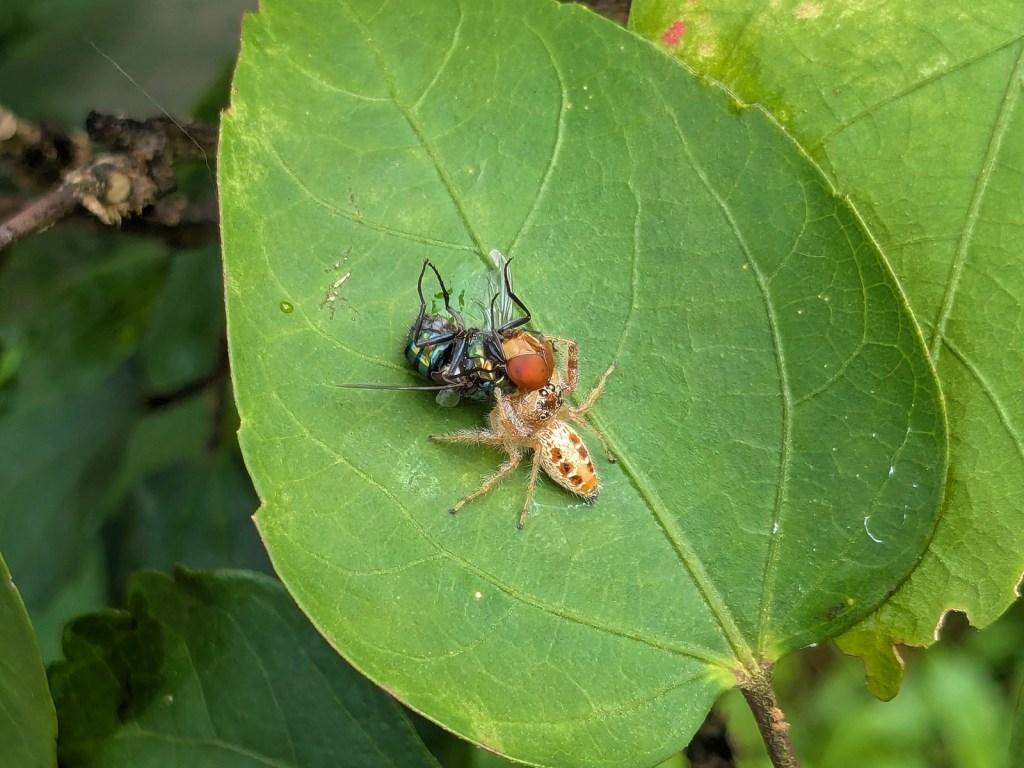
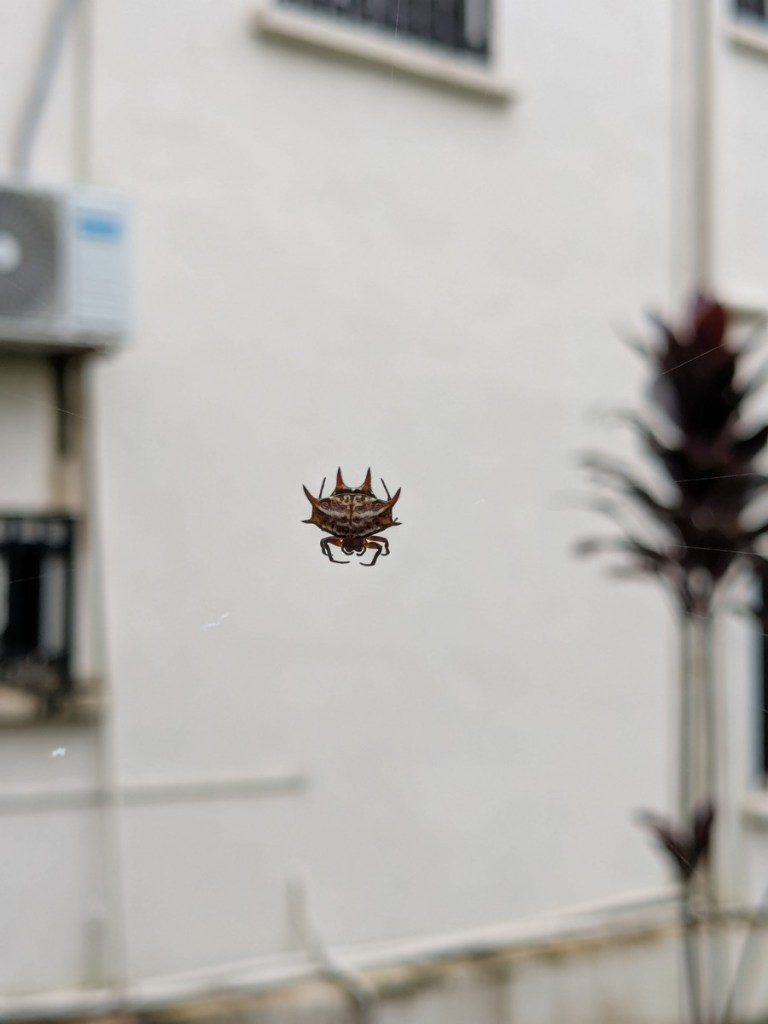
A fun part of the garden (when I am not accidentally walking through spider webs) is all the bug (and frog) life. In fact the frog above is the first I have seen, and I spotted it hiding out in a new leaf. I suppose that might actually be a baby toad, and those we have seen plenty of, but I am no herpetologist. The various other critters have also been cool, and it has been interesting to spot them as I walk around. Some I see often, like the spiders, but I only ever saw one of the anime-looking mantis, and the pictured jumping spider is the only one I’ve seen in the midst of catching prey. Life is truly wonderful. Besides the tiny critters and the toads, also this year a rather large rat-looking thing moved into some of the bushes in the corner. I was happy to have it there, as I figured that its presence meant our yard must not have many snakes. Not that I dislike snakes in general, but I wouldn’t want to disturb one in surprise as that would be unpleasant for both of us. Oh and lizards! There are lots of lizards!
At any rate that has been our gardening experience here in undisclosed country. It has been a lot of fun and it is so nice to have some greenery outside the window. I hope the trees will continue to grow big and strong and bear fruit, and more importantly that the friends we are leaving behind will take pictures of the trees with that fruit and send it to me. I will be so proud.
The Uttermost Part of the Earth by E. Lucas Bridges
Back when we visited Shetland Wool Week, one of the things we really wanted to do was go to a natural dyeing class. I have a whole degree in chemistry so that sort of thing of course interests me. Unfortunately we were thwarted by the overwhelming popularity of Wool Week and so couldn’t do it there. But why go all the way to Shetland when you can do something at home? The answer to that is Shetland is beautiful but that is not the point.
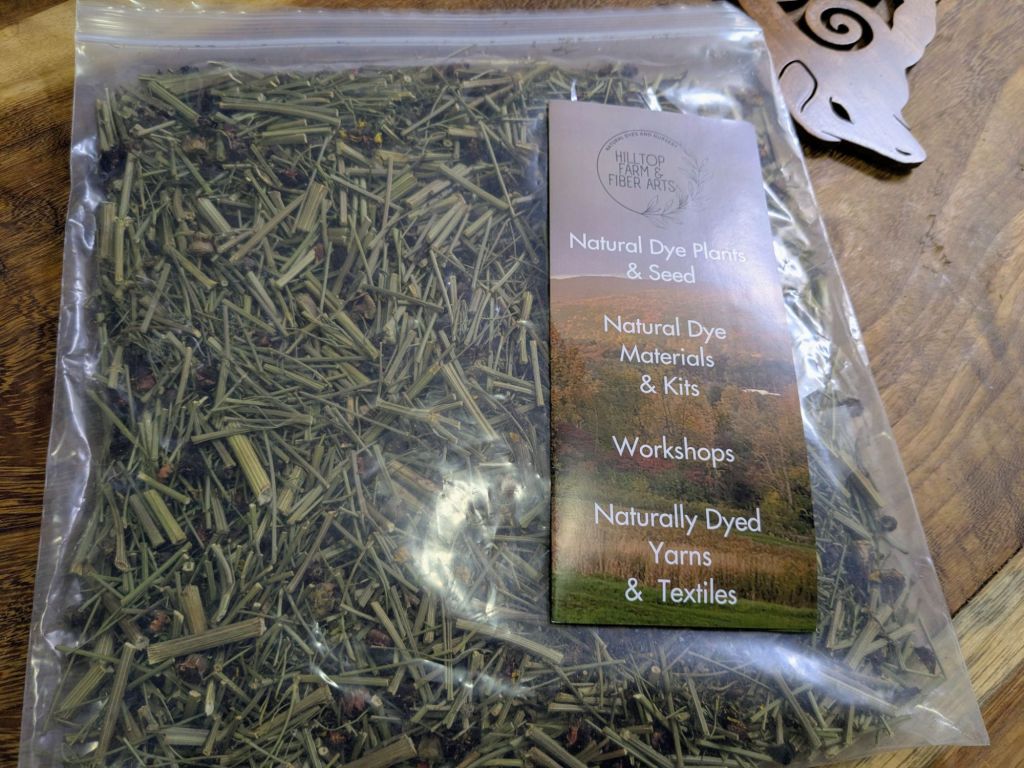
We had managed to pick up a natural dye kit from Hilltop Farm and Fiber Arts while we were up in their neck of the woods. These kits contain pretty much everything you need to try out some natural dyeing. It comes with a skein of yarn, ready to be dyed, mordant, the dye stuff (in our case a bunch of marigold bits), and some safety items like a mask and gloves. All in all pretty comprehensive.
Our skein, ready for the time of its life.
The caveats in the above paragraph, “pretty much” everything you need and “pretty” comprehensive are because the thing we lacked was a big ole’ pot. You should keep your dye equipment separate from your cooking equipment, and while we have a fair-sized pot we didn’t actually have a BIG pot, so the hardest part of this whole adventure was going out and sourcing a hefty stainless steel cauldron in which to do our chemistry adventures. But we felt it was worth the investment, even if we couldn’t use it to make the overwhelming amount of spaghetti of my dreams, because we hope to do more dyeing in the future now that we are experts courtesy of this kit.
Anyways! Although we were willing to invest in a pot we were only willing to invest in the one pot, so we had to do everything in series instead of doing some things in parallel. Turns out the process of natural dyeing is heating water up to 180F or so and keeping it there for an hour, and doing that multiple times. The first time around was to put the mordant on the yarn. In our case it was aluminum sulfate, and the kit came with a pre-measured pack. So you just had to dump it in water, let it dissolve, heat the whole thing up to temperature, and put in the yarn. The trickiest part was keeping it at the right temperature, as you don’t want it to boil lest that felt the yarn and ruin it (ruin it for knitting purposes anyway).
With that out of the way, next was to make the dye itself. This was very similar to making a pot of tea, because it’s pretty much the same thing. We had dumped out the remaining mordant mix, filled the pot up again, added all the marigold bits, and then of course we just had to keep it at 180F again for an hour or so. I notice now, perusing Hilltop’s website, that they sell dye bags, which would have been handy. We were making this pot loose-leaf style, which was well and good but made it rather difficult to filter out all the marigold bits once we were done with them. For us this involved an additional bucket or two. We got there in the end but an oversized tea (dye) bag would have made our lives much easier.
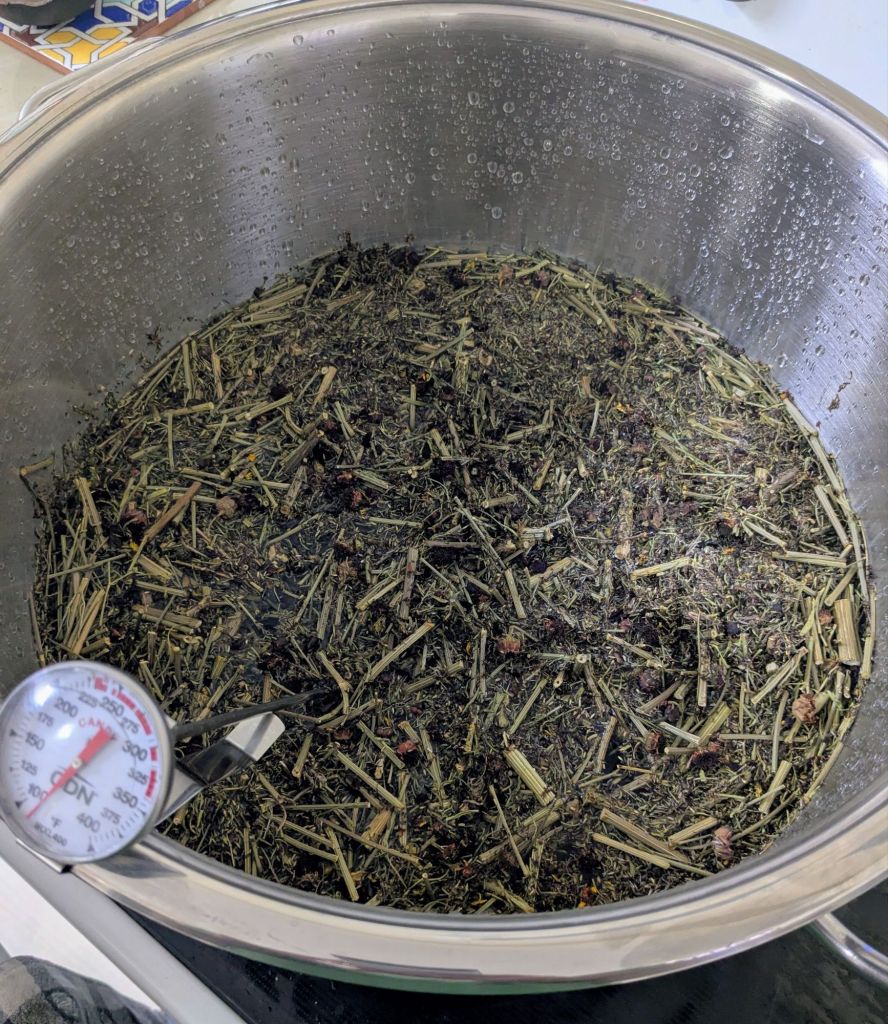
Then the real exciting part! Now that we had dye, we just had to add back in the yarn and yes of course then keep it at 180F for an hour (photo at the top). If our dye to yarn ratio had been closer, the yarn would have sucked out all the dye out of the liquid which would have been cool to see, but we had made a very strong tea. So the water was still very brown when we extracted our new golden yarn, but that’s fine, we had a beautiful yarn. The next step did not involved any temperature control, but just letting the yarn cure for two weeks (aka let it hang up and stay dry) and then give it a regular wash. And we had natural-dyed yarn, extremely cool! My super amazing wife isn’t quite sure yet what she’ll make with it but it is exciting to know that we had an intimate hand in making the yarn ready for use:
As a fun diversion, the below is a school assignment my mom sent me recently and which I apparently wrote when I was 11. What the exact assignment was is likely lost to time. The story itself reflects at best a medium understanding of fish biology, but I think that is compensated by an excellent showing of story structure and that certain je ne sais quoi of PatInTheWorld writing. Please enjoy:
Hi! I’m Mr. Fishy Dude! I would love to tell you a strange story of adventure and sadness. It’s a story of hard work and mayhem. Yeah, but who cares?
My story starts one nice spring day, when I and one hundred thousand other fish suddenly got this strange feeling that we should go on a mission to lay eggs and die for our offspring.
Welcome to the ocean with me and a school of one hundred thousand fish. Due to just plain instinct, we are going from this ocean into the estuaries and rivers. From there, we will go further into the streams and creeks to our spawning grounds. Exciting, huh?
When we first started migrating, nothing much was happening. We were following the distant smell of our spawning grounds, and having smaller fish for lunch – the usual. Then, out of nowhere, a school of striped bass came along! I guess I forgot to mention that I’m a herring. So striped bass are bigger than us and to them, we’re lunch! So, we dodged, we swam, but in the end, one forth [sic] of us got digested. Now, we were only 75,000 fish. We were all sad at the loss of our companions. That will always be in my mind, along with a deep fear of striped bass.
We swam on. Very soon, though, we ran into a fisherman’s net. All of us escaped through holes just big enough for us. We also saved most of the fish from another school, but they’d already lost a lot of their fish. That school swam on with us for awhile [sic], but unfortunately, we must have gotten greedy, because some more of us died because of lack of food. I’m so sorry that we were greedy.
After that, we had finally found, by following the scent of the distant spawning ground, what we had traveled the ocean for; the estuaries and rivers.
When we got to the estuaries and rivers, that other school split up from us. They asked if we would meet again, and I said it was always a possibility. After swimming around for a while, I got the feeling that something bad was going to happen. And it did. It was a horrible scene! Our fish were just being ripped apart, stomach and eyes flying. I guess I’ll always have nightmares about it. The striped bass were back! One fourth of us perished. Our school only had fifty six thousand, two hundred fifty fish left in it. After that terrible scene, we saw another poor school get caught in a gill net and choked in mud. Only a few of them survived. That will be in my nightmares too!
Next, we found strange man made objects. It had little pools that went up and up to another part of the river. I figured out that we were supposed to jump from one pool to the next until we got to the top. We did, and it worked. When we got to the top, it was the beginning of the streams and creeks, the last step to the spawning grounds!
We thought we were home free, but we were not. There was more trouble ahead. The spawning ground was within our grasp. We met the two schools we met before and they joined us. After awhile [sic], we found anther strange man-made object. It wasn’t a fish ladder, it was a flood control. It started sucking our fish in and destroying them! A lot of places to spawn were destroyed. One half of us died. Now, we only had 28,125 fish in our school. We were in bad shape.
The other schools that joined us shared our luck. Some of their eggs got covered in mud, and others got nibbled by small fish. The other school separated from us. And then, our hearts jumped! It was the spawning grounds.
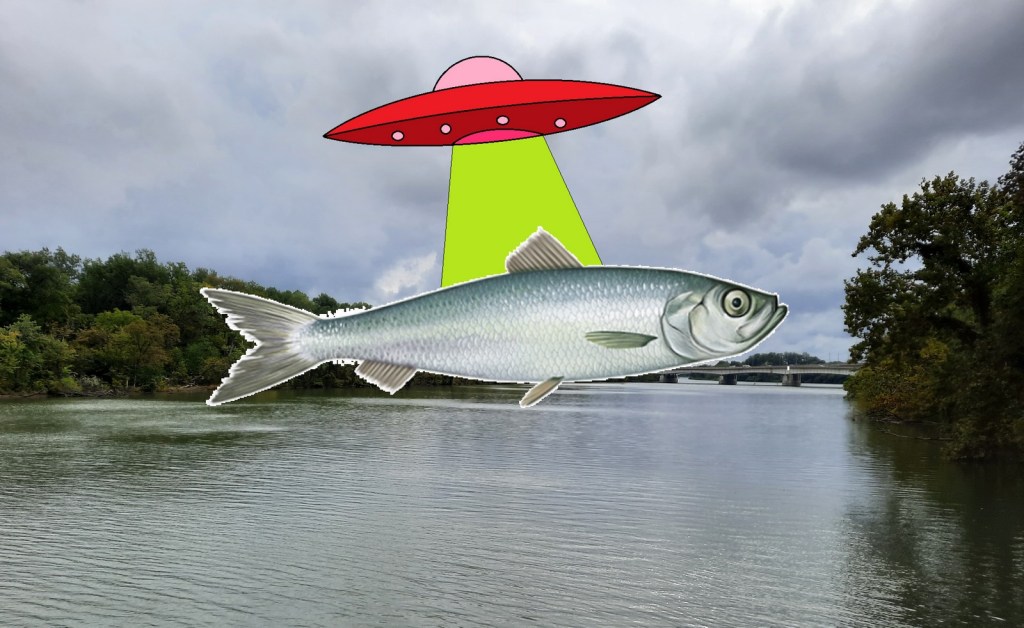
We were all glad to get to the spawning grounds. We made it! I decided to leave this part out because its got a lot of love and mushy stuff you wouldn’t like. After mating, we laid eggs and died. However, my conscious self is passed on to my child most like me. I got this power from an alien species who were not so smart by human standards. They felt that we were smarter than humans, which, was, of course, right. They gave one fish, me, that power. It also made me immortal as long as I manage to spawn. Our school had 843,750 fry (baby fish). After taking some time to grow, our offspring returned to the sea.
The streams and creeks were not familiar to me. The flood control had changed them. Still, out of instinct, we knew where to go. When we were swimming, I saw something that was a strange color. Then I realized, that’s toxic sludge, also known as toxic chemicals. I told my school to go around it, but they wouldn’t listen. Half of my school swam through it. They died. Now we only had 421,875 fish left. So, the lesson of this little story is always listen to the immortal fish in the school.
We decided to put that behind us, although we were sorry for those poor fish who did not listen to their elders. We swam on. Then, we found the fish ladder – the gateway to the estuaries and rivers! In the estuaries and rivers all we really did was swim, swim, and for a change of plans, did some more swimming. We saw some striped bass, but easily got around them. Finally, we found the ocean.
In the ocean, we all swam off with the current to find lunch and grow up so that we could make the amazing journey that our fathers and mothers had made. This, my friends, is, at long last, the end of my story.
I think this could be the grave of John May. I have said it before but I wish I had taken better pictures. I am basing this on making out what I think are “Ma” and “BA,” as in “Rev John May, B.A.” Though the thing below is looks suspiciously to me like “35” and what that could be I don’t know. For more from this graveyard, see here.
First just to say this is another in my ongoing series of posts where I put things online that I scanned in the SOAS archives. This post is, clearly, about the death of Rev. John May. Of the various people in the annals of the history of the London Missionary Society Central African Mission, the people I have been most intensely interested in are Edward Hore and then the Mays. Hore I am interested in because of his relationship with the SS Good News and his role as an irascible scientific mariner, a series of words that resonates with me. The Mays though are interesting because it is easy to project a lot onto their story.
I first came across the Mays looking into Mama Meli, and this post is really a prelude into hopefully talking about the central mission of looking into the SOAS archives, which was to try to find a trace of Meli there. In Mama Meli’s story, she talks about Mrs. May wanting to see her (Meli) married before departing the Mission following the death of Mr. May. In looking into that I found that the Mays had attended college together, both earning a B.A. before getting married and heading off to the Central African Mission together. She was born Elizabeth R. Burton, and from the archives I learned that her and John were cousins, and that she went by Rose or Rosa (her middle name, though I found it elsewhere as Ross; looking back at my biographies they could use a revamp).
But his post is about John. Based on the lengthy obituaries he received in the Chronicle, he seems to have been immensely popular within the LMS. So many missionaries died in Central Africa, and some only get brief mentions, but following his death on August 21, 1901, John got a two-part series spread over October and November of that year. He had been with the mission four years, having departed England in June 1897. As we saw in previous letters, he served as Secretary of the Tanganyika District Committee, and so was in a leadership role among his fellow missionaries.
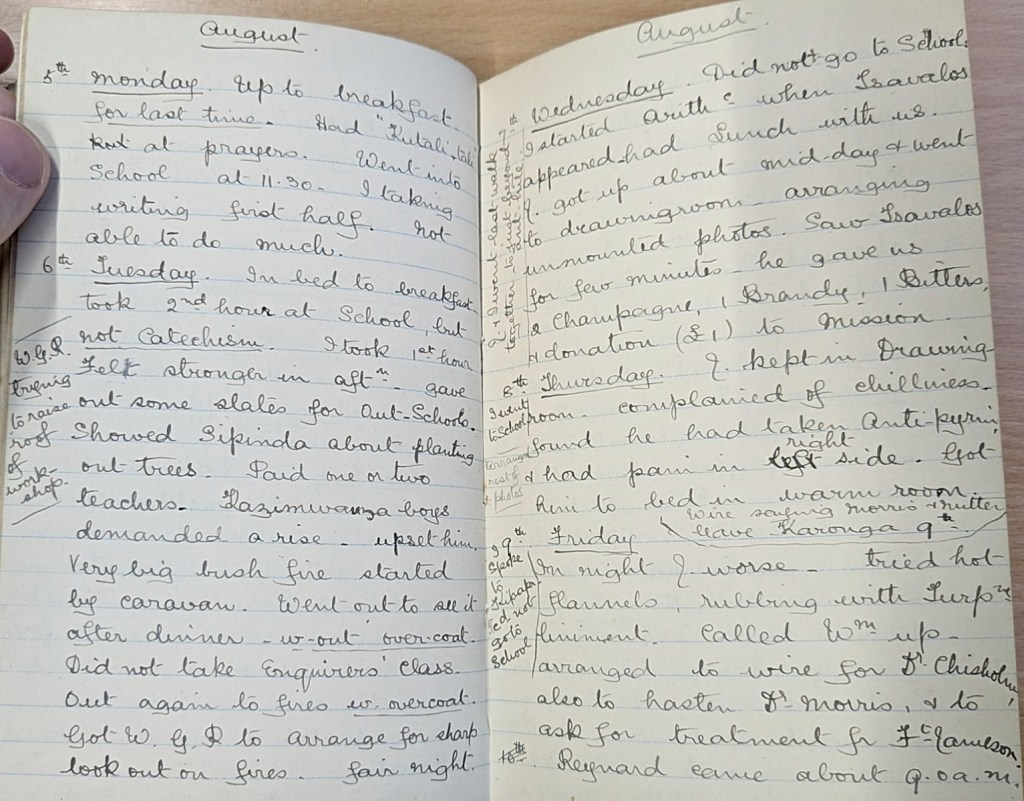
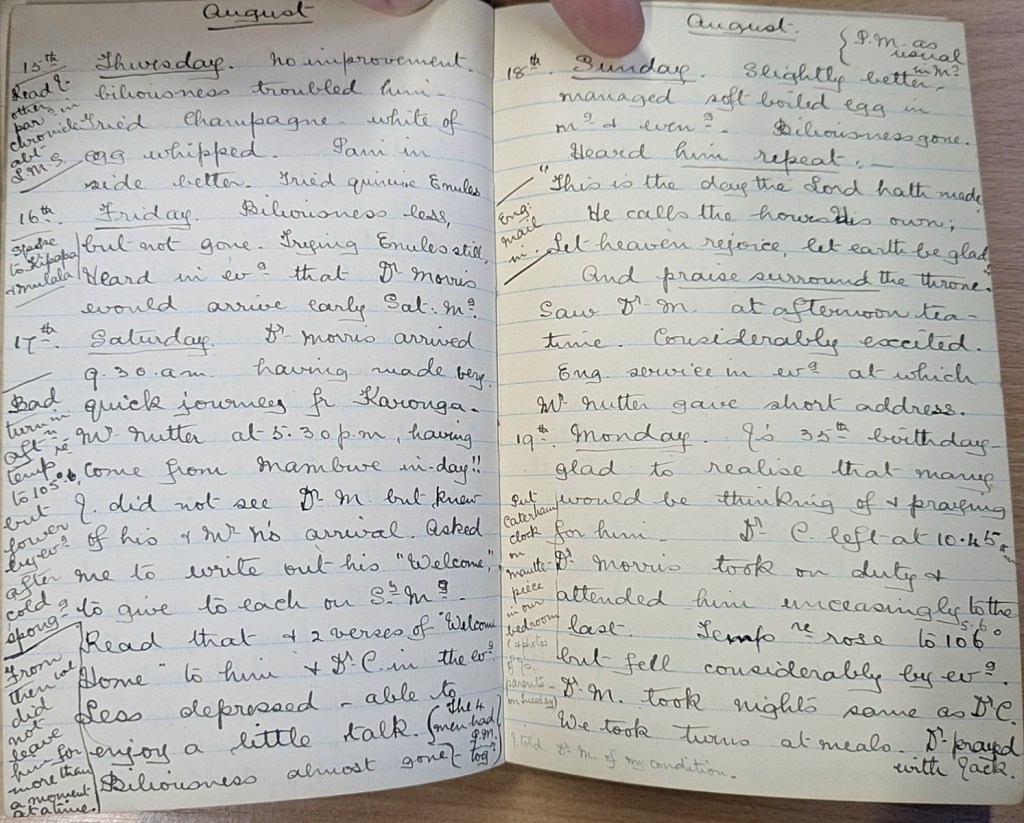
The documents I have for you in this post are journal entries leading up to John May’s death, and then the letter from Dr. Sydney Morris back to headquarters about May’s fatal illness. The journal spans July and then August 1901. The very first entry is in John May’s hand, and then Rose takes it over. It seems silly now having read more of their letters, but their handwriting was to me similar looking enough that at first I didn’t notice that the journal was initially written by two different people. Re-reading it, I think that May’s portion of the journal is backdated; she references for example John’s getting up for breakfast for the last time on August 5. If so then this is her looking back at the month over which she lost her husband and she still found space to discuss mundanities. In thinking about these missionaries and their mindset when they went out there I have to remember the Victorians (and all peoples back then) were always so close to death, and try to consider how that shaped the way they approached what they saw as their God-given calling.
1901
July
24 – Wednesday – W.G.R. got off over 80 men to Karonga. Zombe’s uncle or brother, Kitimbiti came in in after with 3 men & 2 boys. Wrote LMS sending school orders, etc. Wrote Purves, Hemans & heard from Hemans, sending Report for 1900! Sent off loads to Abercorn.
25. Thursday. J went to Niamkolo by bicycle. Left about 7:30 a.m. I took writing in Senior School & went into Junior Sch. Before breakfast. Heard of Savage’s illness, so J did not see Marshall. Had pleasant reception at Niamkolo.
26. Friday. J went to “M. Star” store with J.H.E.H in morning. Advised getting in grass for reroofing store -also Church. Saw Irwin in aft re fire. He agreed (a) to ask for compensation from T.C.L. Directors at home or (b) to request donation to L.M.S. or (c) make private compensation. Saw “Cecil Rhodes”. Saw Hart – looking very ill. Language talk with Hemans & revision of Hymn 1.
27th. Saturday. Bicycled back from Niamkolo – picked up Marshall at Abercorn, who returned to dinner, & cycled back again by moonlight. Very tired but in good spirits.
28th. Sunday. Very tired. Went to early p.m. – did not preach or take Ch. Members’ class. Attack of ague. 104.5°. Went to bed. Better in evening. Fair night.
29th. Monday. Temp almost normal but kept in bed.
30th. Tuesday. Slight rise during day – still in bed. Sharp shower in aft.
31st. Wednesday. Smaller rise than yesterday – keeping quiet. Savage came.
1st. Aug. Thursday Getting better slowly. W.G.R. took class.
2nd. Friday. Kyenidi spoke at service. Still keeping indoors & out of way of teachers. Jose came & Leisceira [?]
3rd. Saturday. Kept in dining-room, seeing to School Registers. Savage & Leisceira [?] left.
4th. Sunday. Did not go to any services – kept out of sight of teachers. I made arrangements with them. Together we wrote out Registers for Saisi Valley. Mr. Stevens came en route for Abercorn, stayed night. Had English service in dr. room. I conducted & prayed. I read Robertson’s advent Sermon on “I am debtor,” “The Roman” Series I. To bed direct after.
I took my class – spoken on Leza – mulembo ware.
(+ Discussed names of expected little one in bed. “John,” “Mary Bunnell”)
5th. Monday. Up to breakfast for last time. Had “Kutali lale” at prayers. Went into School at 11:30. I taking writing first half. Not able to do much.
6th. Tuesday. In bed to breakfast – took 2nd hour at School, but not Catechism. I took 1st hour. Felt stronger in aft – gave out some slates for Out-Schools. Showed Sipinda about planting out-trees. Paid one or two teachers. Kazimwanza boys demanded a rise – upset him. Very big bush fire started by caravan. Went out to see it after dinner – w-out over-coat. Did not take Enquirers’ Class. Out again to fires w. overcoat. Got W.G.R. to arrange for sharp look out on fire. Fair night.
W.G.R. trying to raise roof of work-shop.
7th. Wednesday. Did not go to school: I started Arith when Lsavalos appeared – had lunch with us. J got up about mid-day & went to drawing room – arranging unmounted photos. Saw Isavalos for few minutes – he gave us 2 champagne, 1 brandy, 1 bitters, & donation (£1) to Mission.
J & I went last walk together – w just beyond and hill.
8th. Thursday. J kept in Drawing room. Complained of chillness, found he had taken anti-pyrin & had pain in right side. Got him to bed in warm room. Wire saying Morris & Nutter leave Karonga 9th.
I went to school. Arranged rest of photos.
9th. Friday. In night J. worse – tried hot flannels, rubbing with turp liniment. Called W.m up – arrange to wire for Dr. Chisholm also to hasten Dr. Morris, & to ask for treatment fr Ft. Jameson.
Reynard came about 9:00 a.m. had him in to meals thro’ Wm’s room. Kept house quiet – mustard poultices gave J. relief. Wire from Dr. C in evening saying he was coming soonest possible – cheered J. considerably.
Spoke to Kipapa – J not go to school.
10th. Saturday. Mustard poultices still – pain very much better. Easier day, but fever persistent.
11th. Sunday. Fair day – fever still constant, but pain in side gone. Did not take my class. Read parts of Ch. Service to J. & part of Ps. 107 “Exile,” “prisoner,” “sick-man,” “traveler.” “So he bringeth them unto their desired have.” Giving hypnotic every night. Wrote to P’s at J’s request.
12th. Monday. Fever still – depressed. Dr. Chisholm arrived 5:30 p.m. – consequent excitement. My last night alone with J. Small English mail. Letters from Annie in m. & At Lizzie to him. “Chronicle” & “News fr Afar’ came. My article in latter. Very encouraging para about C.Q. Mission in Chronicle – J. deeply thankful. “Light after darkness.”
13th. Tuesday. Dr. Chisholm took up constant attendance. Most kind & good. I insisted on taking the nights, I sleeping in dining room & going into J. when wanted. I read “The Eternal Goodness,” & “Our Master” to J. & Dr. C a hymn. Pain in rt side rel’d slightly.
14th. Wednesday. No better. J. told the Dr. about me – he suggested possibility of Mrs. C. coming here for my confinement. Great comfort to J’s mind. Diving these days constant nervous depression, with occasional brighter intervals when he enjoyed talk with Dr. C & me about our engagement, his parents, the mission work etc.
Mustard poultice again. Pain relieved in side. Only moved him from side of bed to other.
15th. Thursday. No improvement. Biliousness troubled him – tried champagne – white of egg whipped. Pain in side better. Tried quinine emules. Read J other par in Chronicle abt L.M.S.
16th. Friday. Biliousness less, but not gone. Trying Emules still. Heard in ev that Dr. Morris would arrive early Sat M. Spoke to Kipapa & Mulala.
17th. Saturday. Dr. Morris arrived 9:30 a.m. having made very quick journey fr. Karonga. Mr. Nutter at 5:30 p.m., having come from Mambwe in-day!! J. did not see Dr. M. but knew of his & Mr. N’s arrival. Asked me to write out his “Welcome” to give to each on Sy. M. Read that & 2 verses of “Welcome Home” to him & Dr. C in the ev. Less depressed – able to enjoy a little talk. Biliousness almost gone.
Bad turn in aft. Temp re to 105° but lower by ev after cold sponge.
From then did not leave him for more than a moment at a time.
The 4 men had p.m. log
18th. Sunday. Slightly better – managed soft-boiled egg in m. & even. Biliousness gone. Heard him repeat: – “This is the day the Lord hath made. He calls the house His own; Let heaven rejoice, let earth be glad and praise surround the throne.” Saw Dr. M at afternoon tea-time. Considerably excited. Eng service in ev at which Mr. Nutter gave short address.
Eng: mail in.
P.m. as usual in M.
19th. Monday. J’s 35th birthday – glad to realize that many would be thinking of & praying for him. Dr. C left at 10:45 a.m. Dr. Morris took on duty & attended him unceasingly to the last. Temp rose to 106° but fell considerably by ev. Dr. M. took nights same as Dr. C. We took turns at meals. Dr. prayed with Jack.
Put Caterham clock on mantlepiece in our bedroom & photos of J’s parents on Tuesday.
J. told Dr. M. of my condition.
20th. Thursday. Pain in left side with difficulty of breathing; put on bread poultice. Letter from A.D.P. which I read him in aft. In some ways an easier day. Decidedly better night. I did not go into him till morning. Before going to bed Dr. M. told me that J. had pneumonia – he had found no malaria in blood when examined under microscope, but all symptoms – sputum, temperature, difficult breathing – pointed to pneumonia. This had evidently been the disease on right side, no repeated on left side. He considered him seriously ill, but thought the case hopeful – a crisis probably coming on Friday or Saturday. A good night granted me in preparation for the morrow.
21st. Wednesday. Somewhat easier first thing in morn, but between 11:00 & 12:00 severe rigor had to call in W.m & Nutter; cold sponging reduced temperature from 110° to just over 100°. Moved him to other side of bed, lay for some hours semi-conscious, just knowing me & the Dr. heart failed. Temp rose again – reduce again. Hypodermic injections failed. Between 6:30 & 7:30 p.m. another rigor followed by brief delirium & he sank to rest – at peace with his Savior – his battle fought & won. 8:30. The Dr. & Wm saw to things. I went to dining room & lay on sofa – Nutter prayed with me. Slept there – or dozed with light all night. Greatly helped & strengthened all thro’ day with a power utterly beyond my own.
Rose’s journal continues but that is for another post. In the meantime, below is the letter where Dr. Morris writes back to LMS Foreign Secretary R. Wardlaw Thomson at headquarters about John’s illness. The missionaries had also sent a telegram the Chronicle described as “laconic.”
L.M.S. Kawimbe, B.C.A
August 22-01
Dear Mr. Thomson:
There is yet another name to add to the already long list of lives laid down for Central African Mission.
I regret to have to report the death of the Rev. John May B.A. of his place – who died here on August 21st of pneumonia following a severe attack of fever.
As Nutter & I were leaving Karonga we received a wire stating that Mr. May was seriously ill & that Dr. Chisholm of Free Church Mission at Mwenzo (few days away) had been summoned. I therefore left Nutter behind with the baggage & set out for Kawimbe by myself.
When I arrived here I found that Mr. May had been ill for nearly 3 weeks & he had been doing some extra hard work, & had overtired himself – but little anxiety was felt at first & his illness was regarded as a touch of fever resulting from extra fatigue.
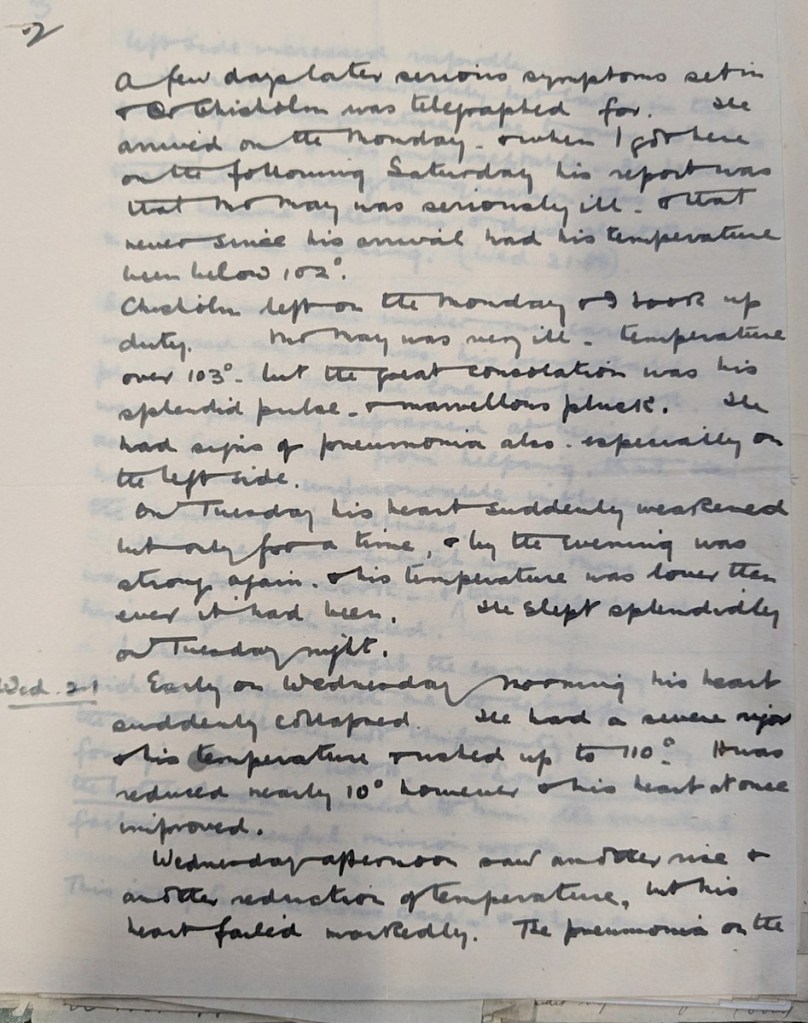
A few days later serious symptoms set in & Dr. Chisholm was telegraphed for. He arrived on the Monday & when I got here on the following Saturday his report was that Mr. May was seriously ill & that never since his arrival had his temperature been below 102°.
Chisholm left on the Monday & I took up duty. Mr. May was very ill – temperature over 103° – but the great consolation was his splendid pulse & marvelous pluck. He had signs of pneumonia also – especially on the left side.
On Tuesday his heart suddenly weakened but only for a time, & by the evening was strong again & his temperature was lower than ever it had been. He slept splendidly on Tuesday night.
Wed. 21. Early on Wednesday morning his heart suddenly collapsed. He had a severe rigor & his temperature rushed up to 110°. It was reduced nearly 10° however & his heart at once improved.
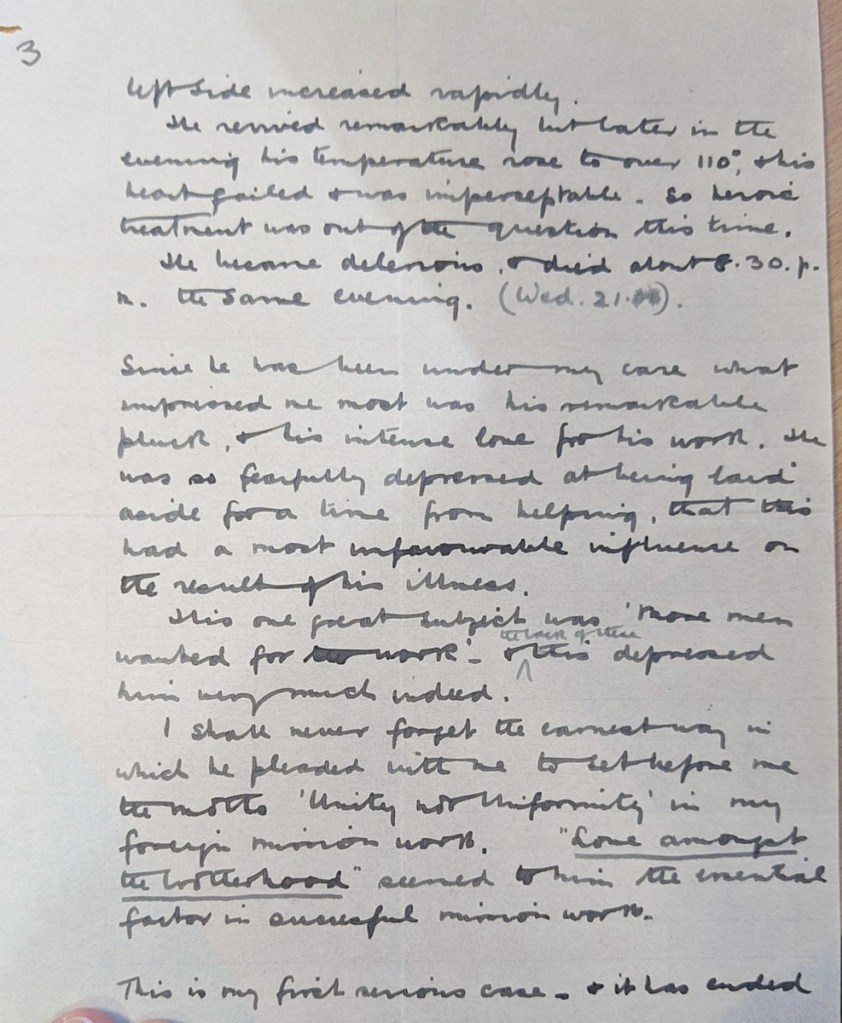
Wednesday afternoon saw another rise & another reduction of temperature, but his heart failed markedly. The pneumonia on the upside increased rapidly.
He revived remarkably but later in the evening his temperature rose to over 110°, & his heart failed & was imperceptible. So more treatment was out of the question this time.
He became delirious & died about 8:30p.m. the same evening (Wed. 21).
Since he was [?] under my care what surprised me most was his remarkable pluck & his intense love for his work. He was so fearfully depressed at being laid aside for a time from helping, that had a most unfortunately influence on the result of his illness.
His one great subject was ‘more men wanted for work’ – the lack greater [?] depressed him very much indeed.
I shall never forget the earnest way in which he pleaded with me to set before me the motto ‘Unity nor Uniformity’ in my foreign mission work. “Love amongst the brotherhood” seemed him the essential factor in essential factor in successful mission work.
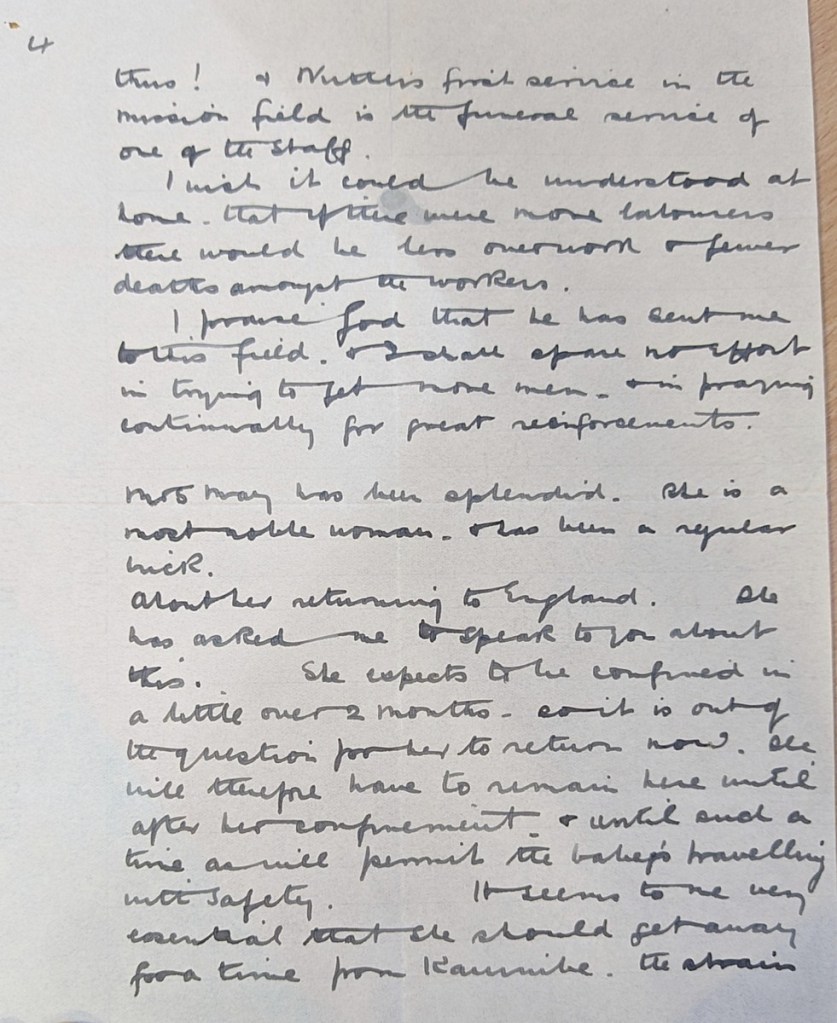
This is my first serious case – & it has ended thus! & Nutters first service in the mission field is the funeral service of one of the staff.
I wish it could be understood at home that if there were more laborers there would be less overwork & fewer deaths amongst the workers.
I praise God that he has sent me to this field & I shall spare no effort in trying to get more men & in praying continually for great reinforcements.
Mrs. May has been splendid. She is a most noble woman & has been a regular wick.
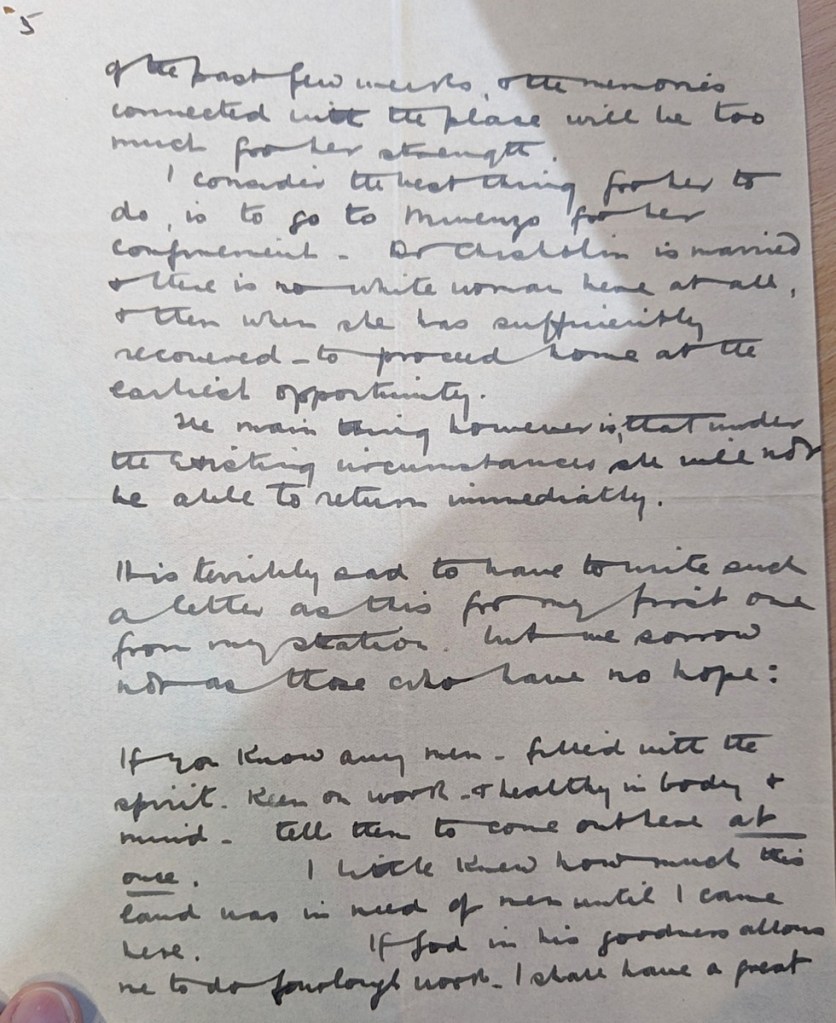
About her returning to England. She has asked me to speak to you about this. She expects to be confined in a little over 2 months – so it is out of the question for her to return now. She will therefore have to remain here until after her confinement & until such a time as will permit the baby’s travelling with safety. It seems to me very essential that she should get away for a time from Kawimbe. The strain of the past few weeks & the memories connected with the place will be too much for her strength.
I consider the best thing for her to do, is to go to Mwenzo for her confinement. Dr. Chisholm is married & there is no white woman here at all, & then when she has sufficiently recovered – to proceed home at the earliest opportunity.
The main thing however, is under the existing circumstances she will not be able to return immediately.
It is terribly sad to have to write such a letter as this for my first one from my station. But we sorrow not as those who have no hope:
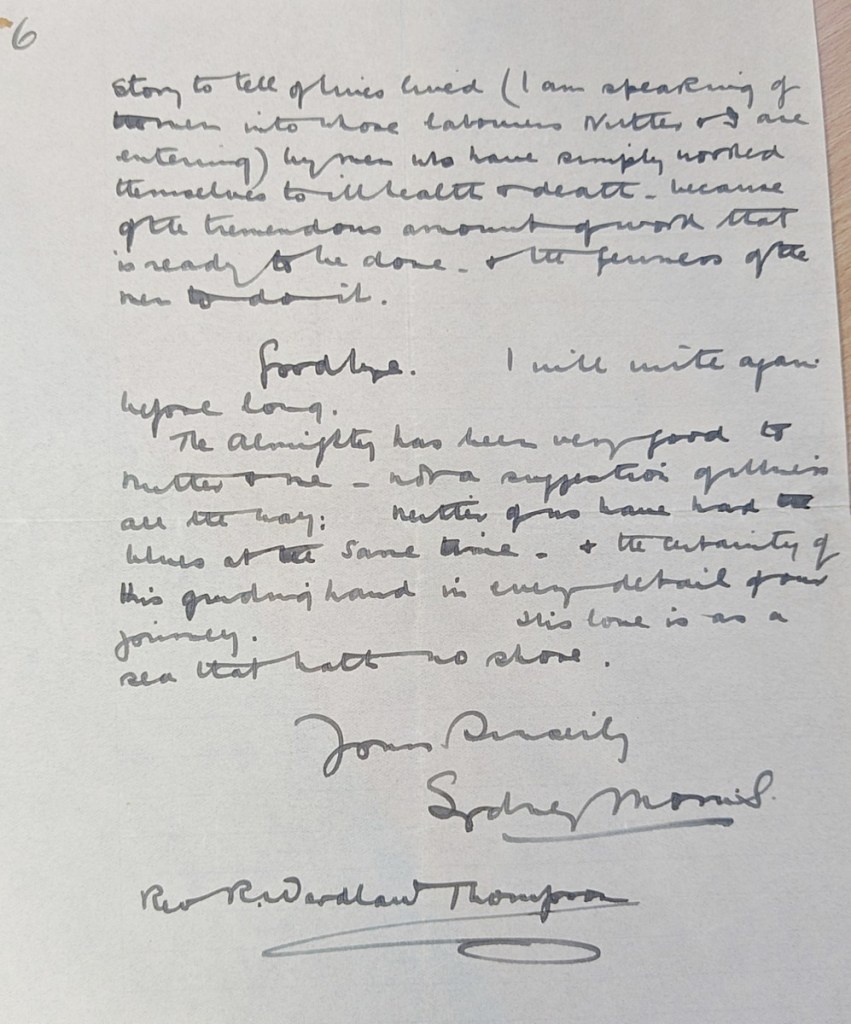
If you know any men – filled with the spirit, keen on work & healthy in body & mind – tell them to come out here at once. I little knew how much this land was in need of men until I came here. If God in his goodness allows me to do furlough work, I shall have a great story to tell of lives lived (I am speaking of men into whose labors Nutter & I are entering) by men who have simply worked themselves to ill health & death – because of the tremendous amount of work that is ready to be done & the few men of the men [?] to do it.
Goodbye. I will write again before long.
The almighty has been very good to Nutter & me – not a suggestion of illness all the way; neither of us have had illness at the same time & the certainty of this grandest hand in every detail of our journey. This love is as a sea that hath no shore.
This is the final post in my little series of posting letters from the SOAS archives that pertain to the London Missionary Society extending their Central African Mission to the Bemba (I have more letters on other topics, don’t worry). The LMS had made some exploratory forays into the area and earlier in 1900 had set up a station staffed by their first convert Mr. Joseph Kalulu, aided by two younger teachers Mr. Kisama and Mr. Kawene. Through 1900, the British administration was preventing the Catholic (and French) White Fathers from moving in and setting up their own mission, but there was only so long they could be kept out. The LMS therefore were in a rush to set up their own European-led mission in the area lest the competing denomination win the souls they were vying after.
David Kawandami in his later years, from Mbeleshi in a History of the London Missionary Society.
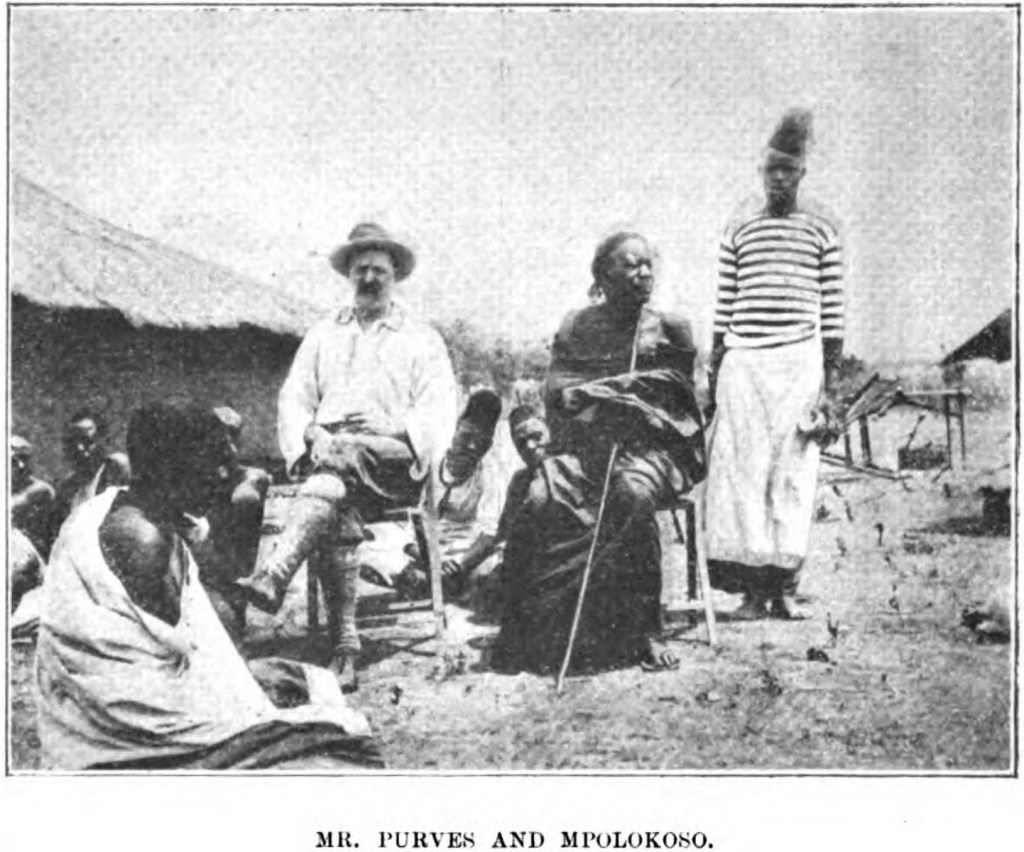
The LMS therefore sent Mr. A.D. Purves and his wife to go set up that mission, accompanied by Mr. David Kawandami, another locally trained teacher. The letter below is I think his first letter back to the LMS Foreign Secretary Rev. R. Wardlaw Thompson in London, reporting on how it is all going. Long time readers will remember some of the contents because this letter is quoted from in the May 1901 edition of the Chronicle, and then a longer account of the establishment of the mission is given in the September issue.
Purves though would be dead from malaria within a year of sending this letter. Mrs. Purves, widowed, went home to England. This was not, however, the end of the LMS mission to the Bemba. For that full story though I will point you to the definitive account, Mbeleshi in a History of the London Missionary Society by Rev. Dr. Bwalya S. Chuba.
Mbereze [Mbereshi] River, Lunda
17th Dec 1900
Dear Mr. Thompson,
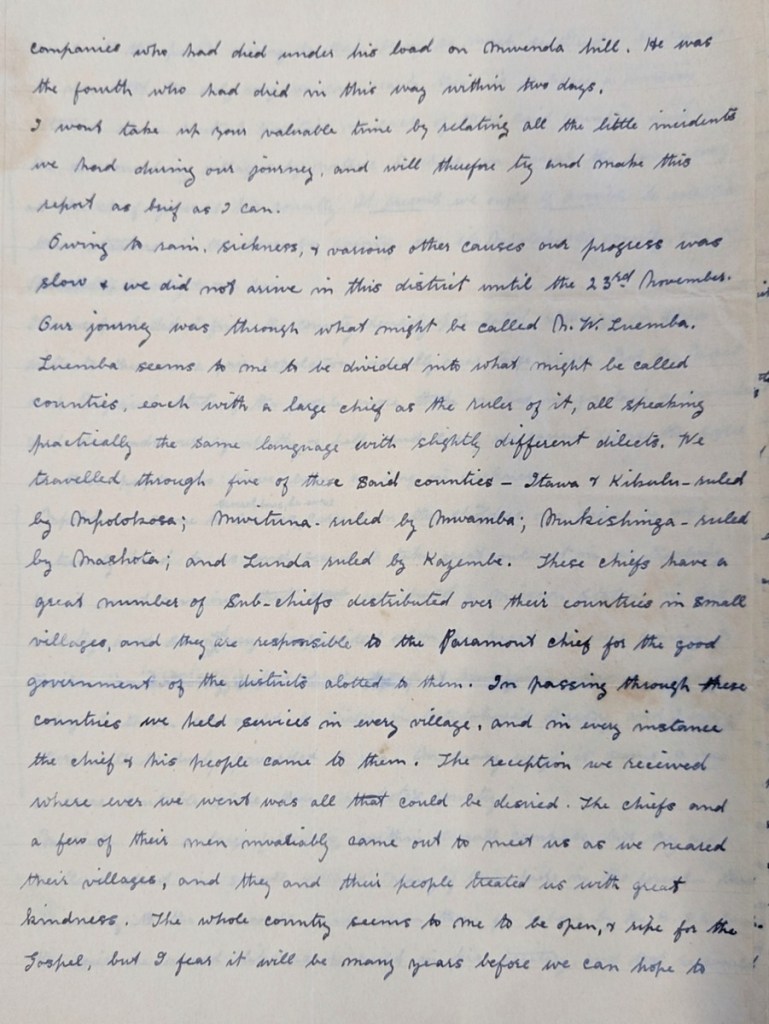
Two days after your wire arrived – 22nd Oct – we left Kawimbe. You would see by my letter of Oct 17th that we were preparing for this journey before we received your wire. I assure you it was a great relief to me when it came as I felt the responsibility of undertaking this work without the sanction of our Directors. Owing to the cultivating season being near at hand I had some difficulty in getting the numbers of carriers we required, but by leaving some loads to follow us later, and taking my cycle, we managed to leave on the above date. All went well the first day, but the second day we had not gone far until we encountered a rough piece of road & the tubes of my cycle got so completely cut that I had not enough stuff to repair them, so I had to walk the remainder of the way to Niamkolo where we arrived about seven o’clock at night pretty tired. Mr. Hemans & Mr. Mackendrick kindly got me a few carriers for my machila and we were therefore able to go on in comfort. The first day from Niamkolo I came across a group of natives standing over the body of a man belonging to one of the transport companies who had died under his load on Mwenda Hill. He was the fourth who had died in this way within two days.
I won’t take up your valuable time by relating all the little incidents we had during our journey, and will therefore try and make this report as brief as I can.
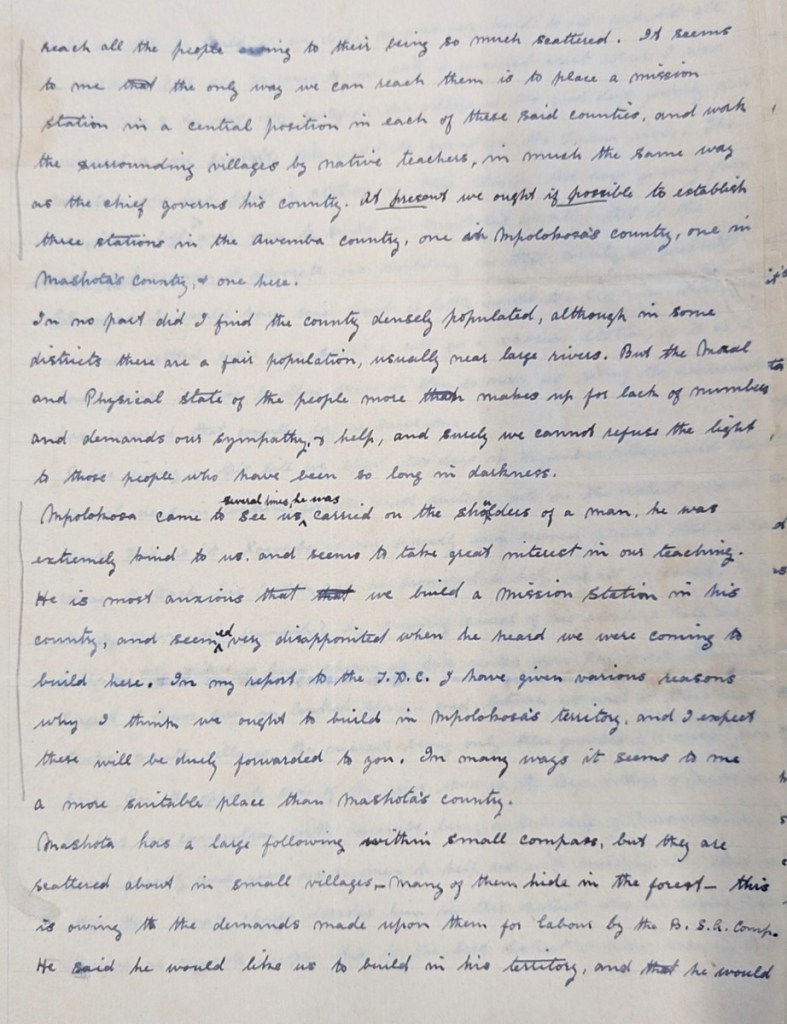
Owing to rain, sickness, & various other causes our progress was slow & we did not arrive in this district until the 23rd November. Our journey was through what might be called N.W. Luemba. Luemba seems to me to be divided into what might be called countries, each with a large chief as the ruler of it, all speaking practically the same language with slightly different dialects. We travelled through five of these said countries – Itawa & Kibaba – ruled by Mpolokoso [Mporokoso]; Mwituna – rulled by Mwamba; Mukishinga – ruled by Mashota; and Lunda ruled by Kazembe. These chiefs have a great number of sub-chiefs distributed over their countries in small villages, and they are responsible to the Paramount chief for the good government of the districts allotted to them. In passing through these countries we held services in every village, and in every instance the chief & his people came to them. The reception we received wherever we went was all that could be desired. The chiefs and a few of their men invariably came out to meet us as we neared their villages, and they and their people treated us with great kindness. The whole country seems to me to be open, & ripe for the Gospel, but I fear it will be many years before we can hope to reach all the people owing to their being so much scattered. It seems to me the only way we can reach them is to place a mission station in a central position in each of these said countries, and work the surrounding villages by native teachers, in much the same way as the chief governs his country. At present we ought if possible to establish these stations in the Awemba country, one in Mpolokoso’s country, one in Mashota’s country, & one here.
In no part did I find the country densely population, although in some districts there are a fair population, usually near large rivers. But the moral and physical state of the people more than makes up for lack of numbers and demands our sympathy & help, and surely we cannot refuse the light to those people who have been so long in darkness.
Mpolokoso came to see us several times, he was carried on the shoulders of a man, he was extremely kind to us, and seems to take great interest in our teaching. He is most anxious that we build a mission station in his country, and seemed very disappointed when he heard we were coming to build here. In my report to the T.D.C. [Tanganyika District Committee] I have given various reasons why I think we ought to build in Mpolokoso’s territory, and I expect these will be duly forwarded to you. In many ways it seems to me a more suitable place than Mashota’s country.
Mashota has a large following within small compass, but they are scattered about in small villages – many of them hide in the forest – this is owing to the demands made upon them for labor by the B.S.A. Company. He said he would like us to build in his territory, and that he would help us all he could if we did. He was very kind to us and did all he could to help us. He came to me with a sprained wrist which I was able to cure & he was very grateful. His village is two good days journey from here and a very suitable site could be found on the Luena [?] river. The Catholics who had built a station in this territory two days journey from here have left it, and gone to build in Mashota’s country, that is the principal reason I advocate our building in that country at present. Otherwise I would have said wait a little until the people in that district are settled before you select a site for a mission station, as it is I don’t think it wise to allow them to stay so near us seeing the Administration has reserved that country for our mission.
Before joining on this site we spent two days in Kazembe’s village, and spent several days in looking for the most suitable site in the district, and I think this is it. Kazembe is very friendly and seemed pleased that we had come to teach his people, and he promised to help us all he could. He had already shown his friendship by sending several of his people to help us to build. The site we have chosen is six miles from Kazembe’s town – the largest I have seen in Central Africa – and between us and it there are twelve small villages, the nearest being only three quarters of a mile from here. On the opposite side of the river there is the large village of Mwabamakapa [?] – he has no connection with Kazembe, being a sub-chief of Mwamba. He is most friendly and gave us 90 men to help us with building etc. There are other three small chiefs besides him in this district who are under Mwamba, therefore as regards people this is the best district I have seen in C.A. We are building on high ground about six hundred yards from the Mberezi river, the site has a good freestone bottom & is therefore dry, and we have a fine prospect. The people in this district will not fluctuate like it does in some others, for there is an abundance of good garden ground near at hand, and the rivers abound in splendid fish, it is therefore the kind of place a native likes best. Our being so far from water is the only thing I see against this site, but we could not get one nearer water without being near a marsh. I hope to be able to bring the water nearer by sinking wells or drainage.
During our journey we crossed five large rivers – the Lofu, the Luangwa, the Kalungwize [Kalungwishi], the Luena, and the Mbereze. We had some difficulty in crossing them owing to this being the rainy season, but we had not a single accident and got all the good we brought with us here in safety. There is one large village between the Luangwa & the Kalungwize which is worthy of notice, it is the village of Sunkata – the son of the chief Mwamba – he is a young man, and is very friendly towards our mission. If we decide to build in Mpolokoso’s territory I think a school ought to be built in this village as soon as possible.
I have not yet met Mr. Crawford of the Garanganze mission, but hope to do so soon. We are five days journey from their nearest station and therefore there is little fear of our intruding in their sphere of labor.
We have over two hundred people working for us at present and we have service with them every morning at 6:45 before we commence the day’s work. I am now able to speak a little to them in their own language. I have several boys who speak both this and the Kiemba language and they have been of great service to me. We have translated three hymns into Kiemba and I am busy translating the third chapters of John’s gospel. During my journey in the beginning of this year I compiled a fairly large vocabulary of Kiemba words and they have been a help to me.
The people seem to have great faith in our medicine and some have come a good distance for it. It is difficult to estimate the influence for good the relief given by our medicine & surgery has over the people, one thing is evident however, which is, it strengthens their faith in us. We had one serious accident here lately. Some boys were digging at an ant-hill, suddenly it collapsed and fell on the hand of a little boy crushing it dreadfully. I managed to patch it up by amputating the two middle fingers. The wounds are healing nicely although at first it looked as if I would need to take the whole hand off. I find the little knowledge of medicine & surgery I have acquired when at home on furlough of great service out here, and it has enabled me to give relief to a great number of suffering ones.
We started a school here with the boys who came for work, Mrs. Purves and the native teachers we brought with us helps me in this work. Mrs. Purves made the alphabet by cutting the letters out of old magazines and pasting them to an old tin box.
We are building a good wattle & daub house & I hope to see it finished in a fortnight from now, with the exception of the doors & windows. It is an object lesson to the people in this district, and many come to look at it. It is set on a hill and can be seen for many miles around and I trust many a wanderer will be led back to the fold by the influence that will radiate from it in the years to come. We have a sawpit dug and the sawyers are already at work cutting up planks. We have made a rough carpenter’s bench and the three carpenters who came with me from Kawimbe are busy making door & window frames. It is wonderful what has taken place here during the past three weeks. When we came here we commenced by cutting down the bush & clearing the grass away, and now there are between thirty & forty grass huts, and the frame of a fair-sized house where three weeks ago there was nothing but bush.
We feel that Our Father has been with us in this work, blessing & guiding us, and helping us during our travels. We have had very little sickness, only a little fever & a slight touch of dysentery during our journey. Since settling here we have had no sickness and we like this climate very much.
Mrs. Purves took a few snapshots with her camera during our journey and she has sent a few negatives to a friend in Edinburgh, asking him to forward you copies of them as they may be of interest.
With kind regards, Yours very truly,
A.D. Purves
P.S. I forgot to mention I found the hymns etc. translated into Kiemba by Mr. Robertson of great service during our journey. They help us in the services very much, and I believe them to be very good translations. A.D.P.
P.S.2. Please excuse soiled papers as all my writing paper has got destroyed by water getting into the box amongst my [?]. A.D.P.


























 Pat in the World
You must be logged in to post a comment.