Bath I: Eponymous Bath

Reading this week:

  • My Second Journey Through Equatorial Africa by Hermann von Wissman

We alighted from the train station in Bath and were instantly enamored. How does it keep all this Georgian architecture intact? We had arrived in the morning, much before check-in time at the hotel, but they nonetheless were kind enough to store our bags so we were off to priority #1: the Jane Austen Center!

The Center, or Centre, is a museum dedicated to Jane Austen with its home in a house down the road from where Jane Austen lived alongside her mother and sister after her father died. It is a fun place and works to give you a good insight into the Regency setting of Austen’s novels. You start the tour with a lecture from one of Austen’s characters, in our case Emma from Emma, who was great. I learned a lot of interesting stuff on the tour, like the fact that there is no real contemporary portraits of Jane Austen. I was very hurt on her sister’s behalf however, because at one point Jane’s sister Cassandra painted a watercolor of Jane, but as soon as they tell you that they go on and on about how terrible of a painting it is and like, come on. Be nice. Sorry she didn’t have a camera.

From there we wandered Bath for a bit. The Regency atmosphere we just learned about in the Jane Austen Center was heightened by the fact we were visiting Bath in the midst of the Jane Austen Festival. We didn’t attend any of the Jane Austen-specific events, but what it did mean is that we would be in a restaurant and at the next table over would be a couple in full Regency dress, which was a delight. Another highlight of our wanderings was Persephone Books, which is based out of Bath. They specialize in neglected books by (mostly) women and besides being a very good concept for a shop is just also a very nice shop. Be sure to stop by.

Come on in the water’s fine.

But enough dilly-dallying, on to the main event: the Baths! The Roman Baths, specifically, the reason the town is named Bath. But you knew that. This was a significantly better museum and experience than I thought it was going to be. I thought it was going to be hokey and it has a bit of a hokey veneer but is in fact quite in-depth. We were on a guided tour but they tell you to show up an hour early, and we did, and that is actually a good idea. The guided tour and self-guided tour are different experiences so it is worth it to make time for both.

On the un-guided tour you of course walk around the complex. You start on the terrace of the baths and eventually descend to bath-level, which is now below ground. The baths themselves do not look too relaxing these days. Because they are open-air and the water is at a perfect petri-dish temperature, they are full of algae and green. They do clean them occasionally but we were on the tail-end of a cleaning cycle. Back in the day the baths would have had a roof which would have kept the pool much more pool-looking. But after admiring the baths then you wind through the museum, which was really fascinating.
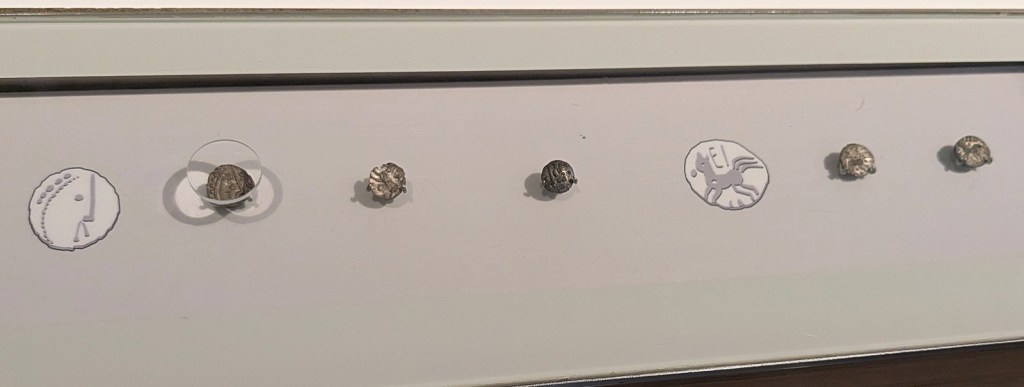
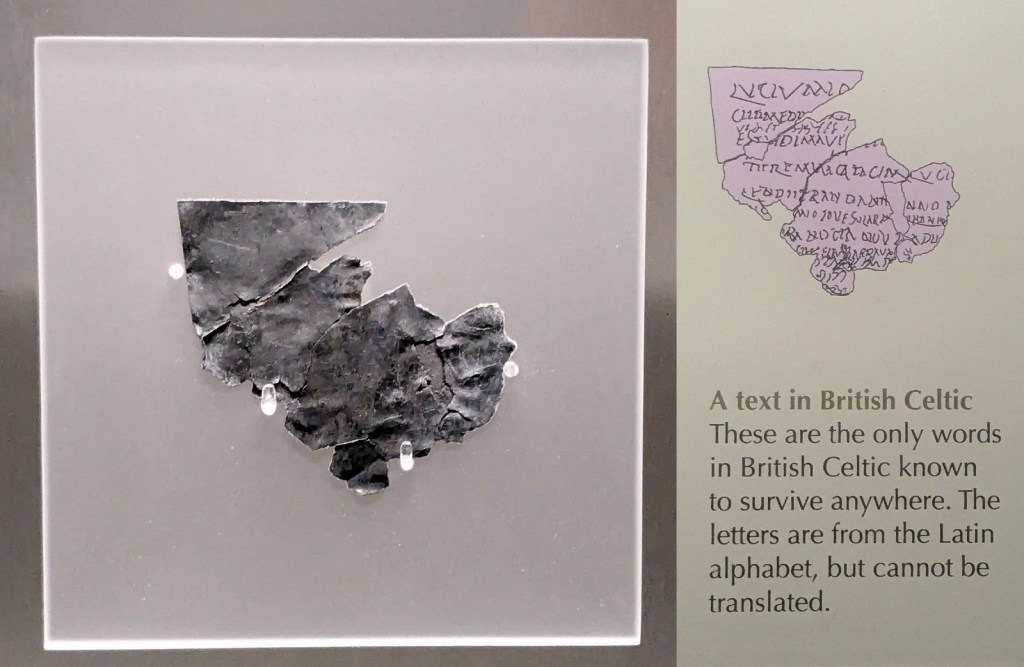
The museum really works to paint the long, long history of the site. Before the Romans showed up in 43 and built a big ole’ temple/spa complex on top, the hot springs had long been a pilgrimage site for the peoples of Britain. Which means that the museum has all sorts of artifacts from the Roman and pre-Roman eras. The second coolest thing they have in there are pre-Roman coins which I think is fantastic just because it is a glimpse into a whole strange and alien civilization. Plus some of the coins had boats on them. But that of course leaves the coolest thing, which had to be the only words in British Celtic known to survive anywhere. One of the uses for the springs was cursing people, and you could write your curse on a lead tablet and fold it up and toss it into the waters for the gods to take care of. They have in the collection one of these curse tablets written with Latin letters but in British Celtic. They don’t know what it means, because this is the only surviving record of the language and like, imagine that person. Speaking Celtic, but a) knows Latin and b) has a beef with someone they want the Gods to take care of. That is a person who bridged worlds.

Undergrounds bits of the temple; they didn’t used to be.

At the designated time we met our guide and compatriots for the guided tour, which focused a lot more on the archeology of the baths. Like the Globe, there are chunks of the baths that they can’t do much archeology on because the buildings on top of the baths are also historical. Oh well. But our guide was deeply knowledgeable and really loved the site and really tried to let us see the site through his eyes. Like at one point on the floor there are indentations apparently where the oyster bar used to be (common bath snack doncha know), and he explained these were from generations of people clamoring for oysters as they enjoyed the holy and very relaxing waters. At the end of the tour there is a fountain of Bath water which you can sample (but direct from the spring of course, not the green stuff). Our guide said he drank it every day and it kept him fit and healthy. I thought it was fine-tasting but my super amazing wife didn’t like it. The highlight of the gift shop was me saving the day by nabbing a small dog that had escaped from its owners and was evading them in the store. Fun stuff!

After the baths and a bit more walking, dinner was Sally Lunn’s very historical bunns. That was a lovely meal orchestrated by two women who were absolutely running trying to keep up with the dinner service. Sally Lunn’s also has a museum but it was closed by the time we finished dinner, so it was finally time to retire to our hotel room, which my super amazing wife was delighted to discover included a bathtub.

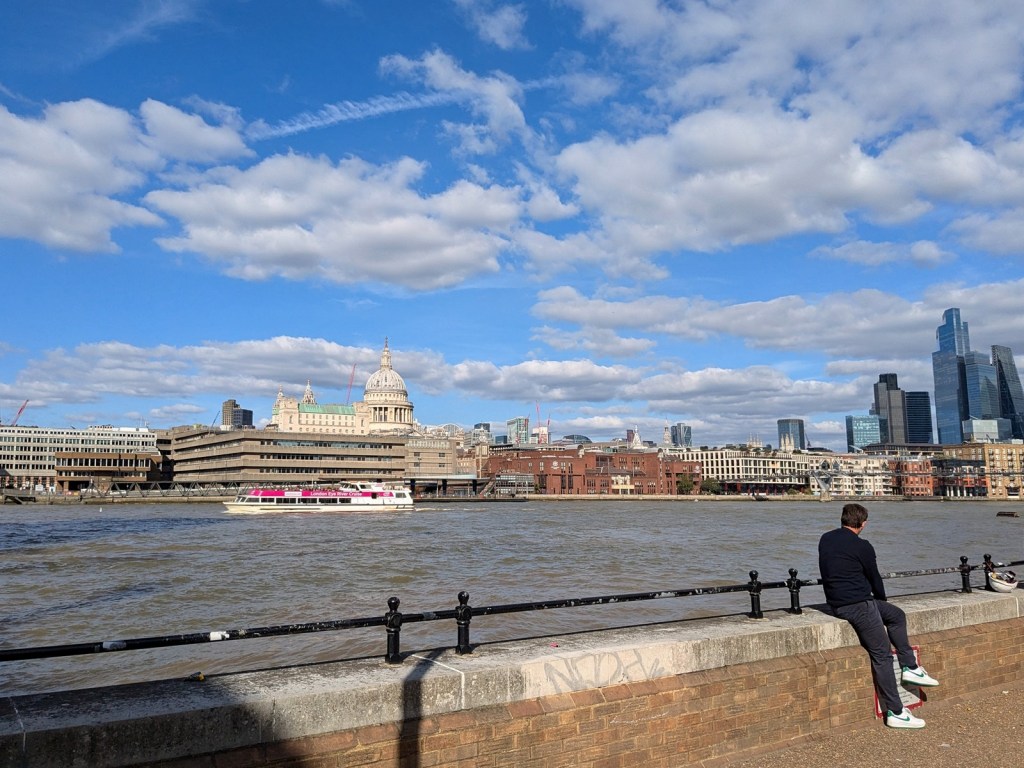
As Jane Austen knew, Bath is just a wonderfully beautiful place to wander.

London V: Sore labor’s Bath

A lovely day on the Thames.

After I had run through my three boxes of archives it was time to rendezvous with my super amazing wife, who had entertained herself rather than watch me go through boxes of old records. Lunch under our belt we detoured to things more squarely in her realm of interests, in this case tea and Shakespeare. After a brief stop at Twinings tea where she took advantage of their 3-for-2 deal, we head for the first time across the Thames to south London to make the pilgrimage to Shakespeare’s Globe.

This is aesthetically the better header photo but didn’t really make sense because Twinings is only an aside in this post.

This was not actually my first visit to the Globe. Back in middle school my family did a house exchange in Scotland, except dad figured out that it was cheaper to book a package deal with a week in London than to just book the airline tickets by themselves, so this whole trip was over my old stomping grounds. I don’t think having viewed these places as a preteen and then as a 30-something provides any particular insights. My biggest surprise upon revisiting the Globe was that although I knew it was a recreation (albeit on a somewhat smaller scale), I didn’t realize it had been built only in 1997, so when I visited it last it was like, new. Though my biggest memory was that they did not have any lapel pins in the gift shop back then, so I had to go with a pin-back button, the kind of move I would mostly refuse to make these days, because the other difference between me as a 30-something and me as a preteen is that now I have standards by golly.

This is somehow the only picture in/of the Globe I took. I like what they’re saying here.

On this visit to the Globe we took the guided walking tour, which was very good. It started off in their little museum there in the basement. It is pretty good and especially with the guide it gives you a good grounding in why the theater was where it was and what sorts of entertainments they were putting on and how. The big competition around there for eyeballs was bear-baiting which is just like, those poor bears and those poor dogs. But after the museum we went out into South London to let the guide paint for us the Elizabethan world on the backdrop of the modern world. Besides pointing out where all the bear-baiting was happening (one of the spots is like a nice-looking seafood place now, history is wild), you also got to learn about ferrymen, and the local brewspots that were there were breweries for centuries and centuries. They also showed you the original spot where the Globe was, except they can’t do much archeology on it because a large chunk of the spot is covered with a newer building, but not a “new” building because that building is also historical and they can’t modify it or take it down at all to take a look at the Globe. Man must be wild to be a country with so many layers of the sort of history that leaves brick walls, specifically.

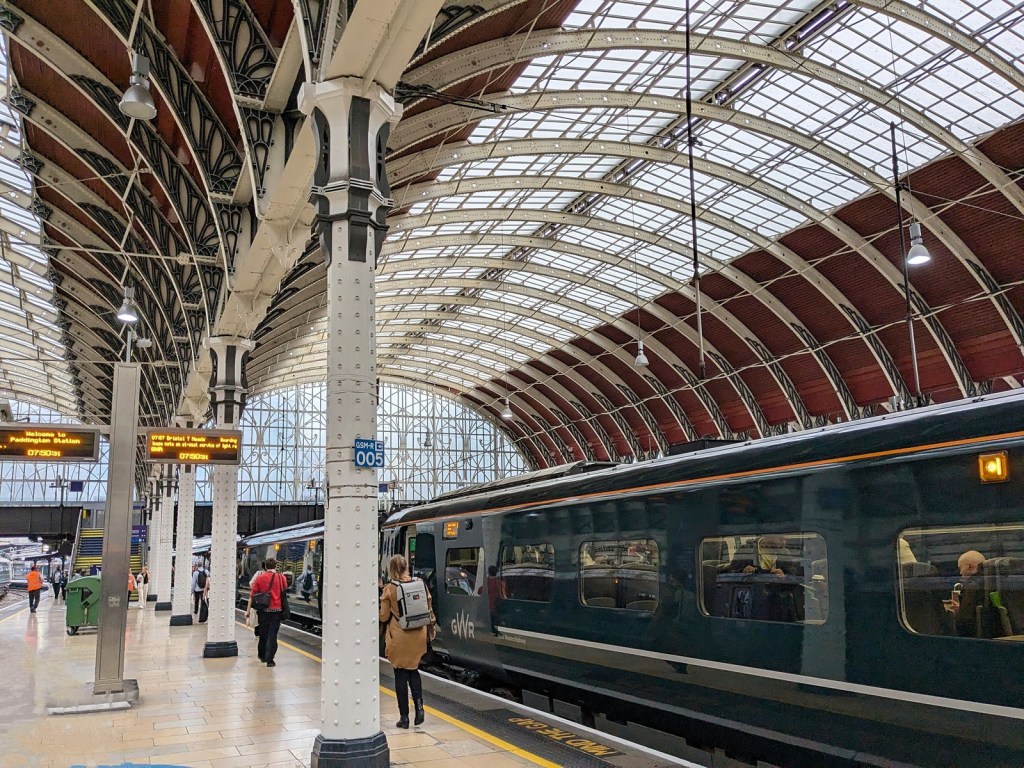
The tour ended at the gift shop, where I was distressed to learn that although they now have lapel pins, none of them said “Globe Theater” (I try to ensure my lapel pins say the name of the place I got them from), so I had to go with a cat holding a skull instead. You all will have to remind me where it is from. But with that bit of Elizabethan atmosphere absorbed, we head back across the river. There we took in some of our last sights of London, including fun things like Roman wharf timber and remaining bits of the Old London Bridge (conveniently both are in the same spot). It was important to absorb these things because the next morning we were off to the next big city of our vacation. So we tubed back to the hotel, had a good night’s sleep, woke up early, schlepped our too big suitcases through a couple of Tube stations not designed for too-big-suitcase-schlepping, and eventually arriving at Paddington. I had time to grab a sausage roll before we caught our train, which was a very nice ride. I was stunned to see we were going at over 110 miles per hour, but I suppose that sort of thing was just normal around there. But all the better because we were excited to finally arrive in the city of Jane Austen’s dreams: Bath.

London IV: My Particular Interests

After tumbling out of the V&A the next 24 hours or so of our trip was very me-centric, though we approached it gradually. We swung by Buckingham Palace to see if Chuck was home but we decided not to bother them and then went on down by Westminster Abbey where I was hoping to see Livingstone’s grave but we didn’t get there in time. We wandered on past Elizabeth Tower (I schooled my super amazing wife that Big Ben is actually the bell, man I am so knowledgeable about England) to the riverfront, which marked the first time in our several days in London that we actually saw the Thames, and eventually had some wine in a cave.

But this was all prelude to the main event of the evening, we were finally getting some culture, that is right we were going to see Back to the Future: The Musical! When I first saw that this was a thing it was like, of course we have to go, we are patrons of the arts around here. Plus my super amazing wife likes theater (before we started dating I did a series of elaborate maneuvers one time to get us seated next to each other at a play) so it was something I could drag her along to. I mean I didn’t drag her, she enjoyed it, I promise. Being in the theater was a lot of fun, they have really decked it out with all sorts of stuff. It was dazzling, you can see in the below photo that I look really dazed:

Seriously what is that face?

The musical itself was very good. Beforehand I got the t-shirt (I am wearing it right now), I got the deluxe cast recording, I got the lapel pin which unfortunately is “just” a DeLorean and doesn’t say like “musical” on it or anything, but whatever. There was less Huey Lewis than I was expecting but my absolute favorite part was whenever Doc sang because he got backup dancers “that just appear whenever I start singing” which is great. They swapped out some plot points to make the whole thing easier to stage (my only quibble there is the unrealistic portrayal of radiation poisoning, we can’t mislead the public like that in a musical about time travel) but it was really great. The effects were cool and it has to be one of the best musicals I have ever seen (I haven’t seen many but still).

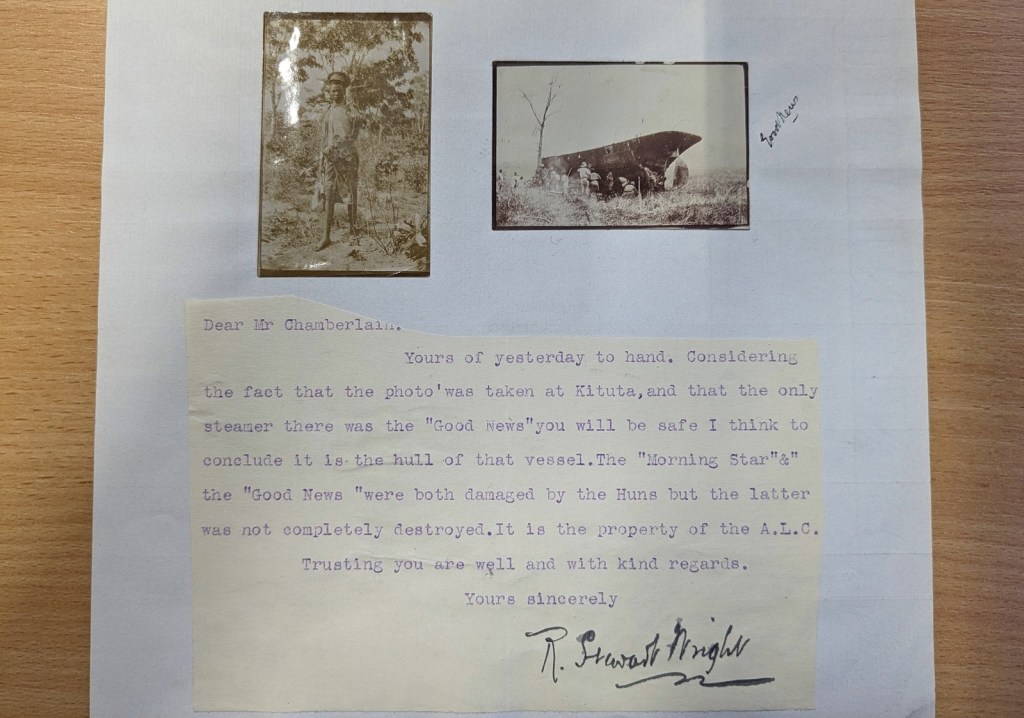
Just one page from the archives.

Then we went back to the hotel and went to bed. But the next day was the single event I was most excited for, which was visiting the SOAS Archives in London! I have already revealed some of what I saw but I have been wanting to visit these archives for ages, specifically the archives of the London Missionary Society. They have all the letters and records of the Central Africa Mission and I wanted to see the original papers of these various people I have been obsessed about. In advance you have to request boxes and apply for a library card if you want to do the same, but it is free and when I went everything went perfectly smooth. I hiked on over to the SOAS Library as soon as it opened and checked in with the front desk, who issued my card and gave me directions to the special collections room. They had the boxes I requested (the maximum of three you can request at any one time), and handed me my first one.

It is just wild to be able to handle these documents. In a way it feels voyeuristic. Because of looking into Mama Meli, John and Elizabeth May are two of the people I have tried to find out the most about. In the archives is their private diaries and those happened to be in the box I was handed first. In my limited time I couldn’t go through everything page by page necessarily, so to narrow it down I went off of the dates I knew from the Chronicle, which is unfortunately births and deaths. Flipping right to the dates of tragedy feels weird but I suppose this is why they wanted their diaries preserved, so as to be known in some future time. I did start to feel like I knew these people better, as I quickly knew who wrote what based on their handwriting alone. And telling, maybe, that John and Elizabeth’s handwriting was so similar at first I couldn’t tell them apart. Even in a small chunk of archives I learned a lot of new things, like that Elizabeth actually went by “Rose,” her middle name.

A page from E. Rose May’s personal diaries.

To try to get through everything eventually I was reduced to just skimming through and taking pictures that I could transcribe later, but the overwhelming feeling was just wow, this stuff is just sitting in boxes. There was what was labelled as one of the original manuscripts of one of Stanley’s books, which just like, how is that just sitting in a box here. But this is the beauty of libraries and academic research and museums, that these things are saved and we can learn people’s stories. Even skimming I saw hints of fights and foibles and stiff upper lips, hints of people trying to smooth over arguments or defending themselves from accusations and just the mundane work of getting on with it when your husband or yet another close friend dies. I have so much more work to do on these archives but I think even this little chunk will keep me busy for a while.

London III: V&A&more&more

Of the various museums we were going to go to on this trip, the one we were perhaps both the most excited for was the Victoria & Albert Museum, or the V&A for those who are into abbreviations. It’s an art and design museum, you see, and art and design are some of our most favorite things. Having decided you can’t have too much of a good thing we went once again to Café Tropea for breakfast and then had our first tube adventure. This was fun and easy and we just used our credit cards which is a technology our American minds could not comprehend and we took a straight shot on the Piccadilly Line and I was pleasantly surprised to find out that we didn’t even need to go above ground to access the V&A, we could just take a tunnel and pop out into the basement. Fun!

Tell you what man we were excited for the V&A and it lived up to the hype. My super amazing wife had done her reading more than I had and so was aware of the Cast Courts. These are wild. So the theory was that it is hard to go see say Michelangelo’s David in person and so what they did was bring David to you (provided you are in London) in the form of a plaster cast. They went into a lot of effort to do a good job on these casts and also used other reproduction methods, and a chunk of the exhibition was just about different reproduction techniques. The Cast Courts themselves were built around the dimensions needed for the largest casts, those of Trajan’s Column, which lemme tell ya, are HUGE. Since my super amazing wife was familiar with the Cast Courts we went there first, and since I am such a hound for showing up to museums early we were there before nearly anyone else, so here we were in these cavernous rooms just chock-a-block of the world’s finest sculptural works squeezed together for an admiring public which consisted of just us. It was revival architecture but for interior decorating. My kind of style really, but I nearly lost my super amazing wife somewhere between the Portico de la Gloria and the Tomb of St Peter Martyr. We were off to a great start at the museum.

Cast of Trajan’s Column. Man they are so big, they picture does not convey this.

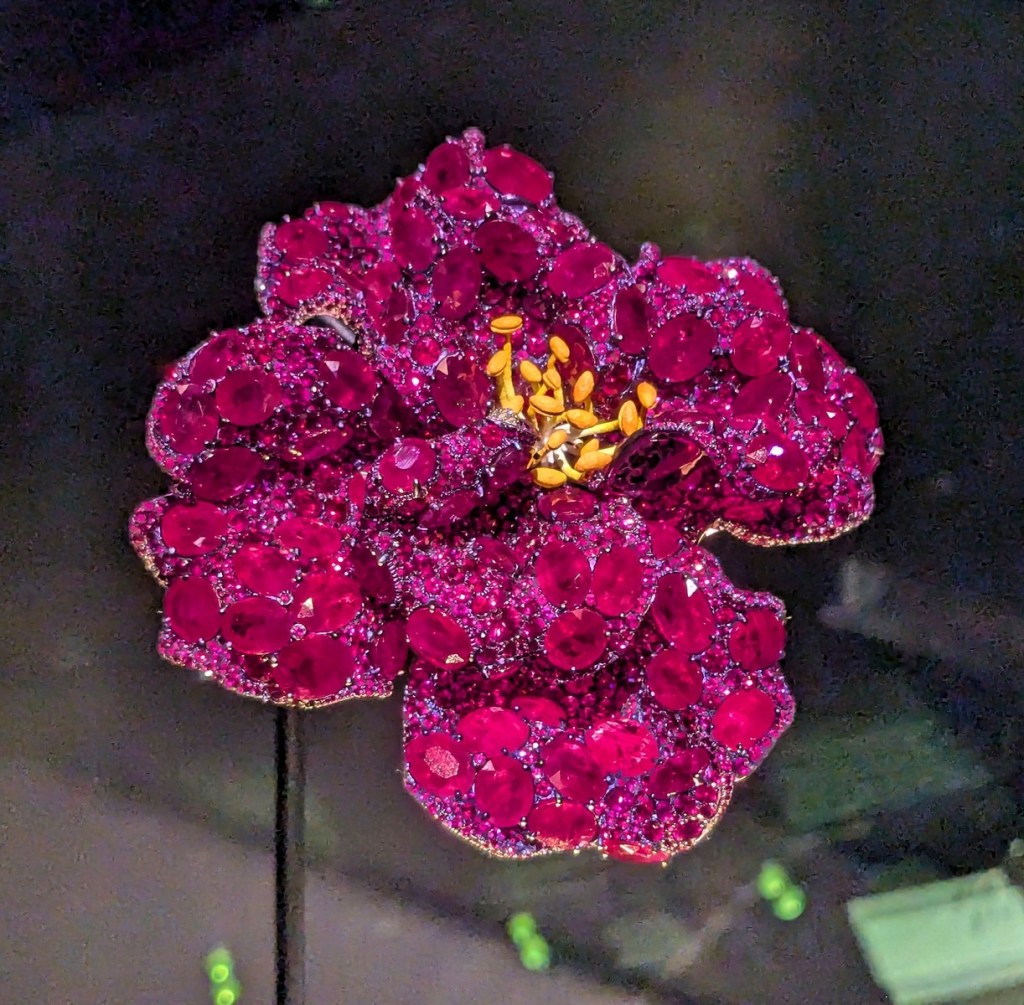
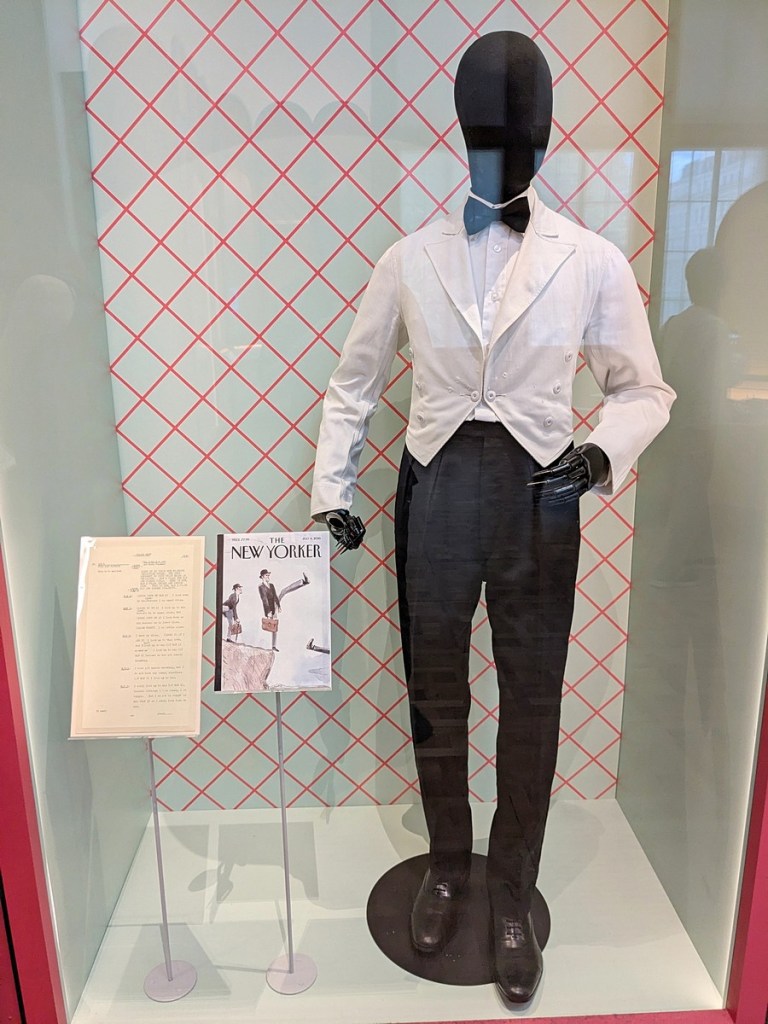
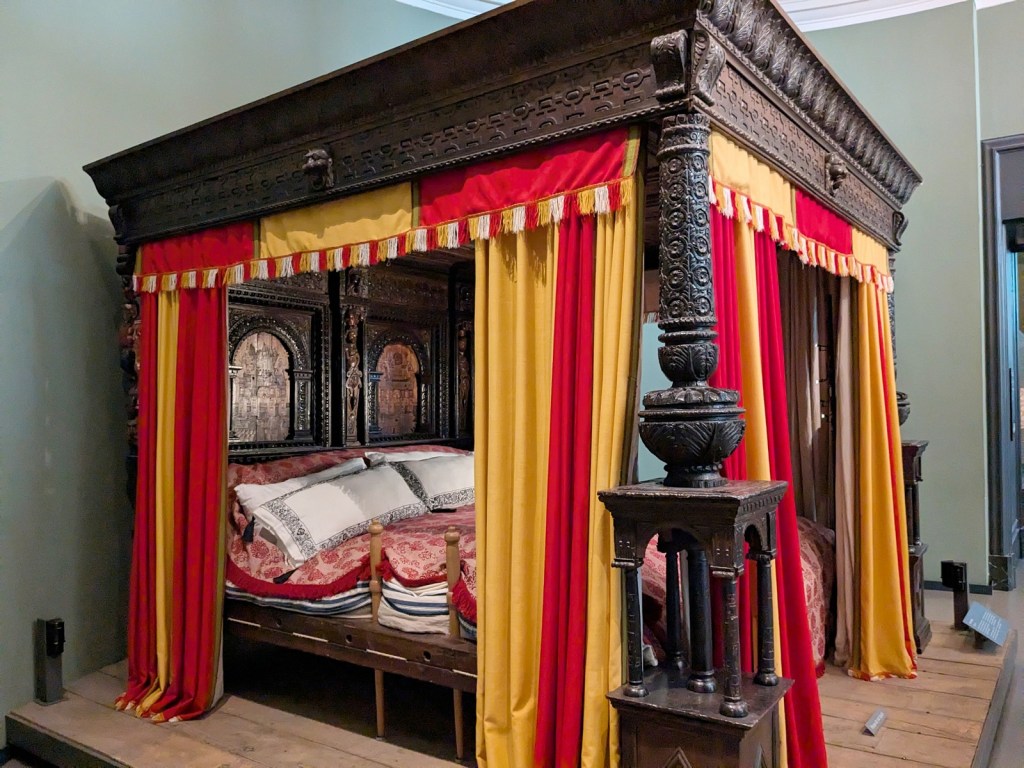
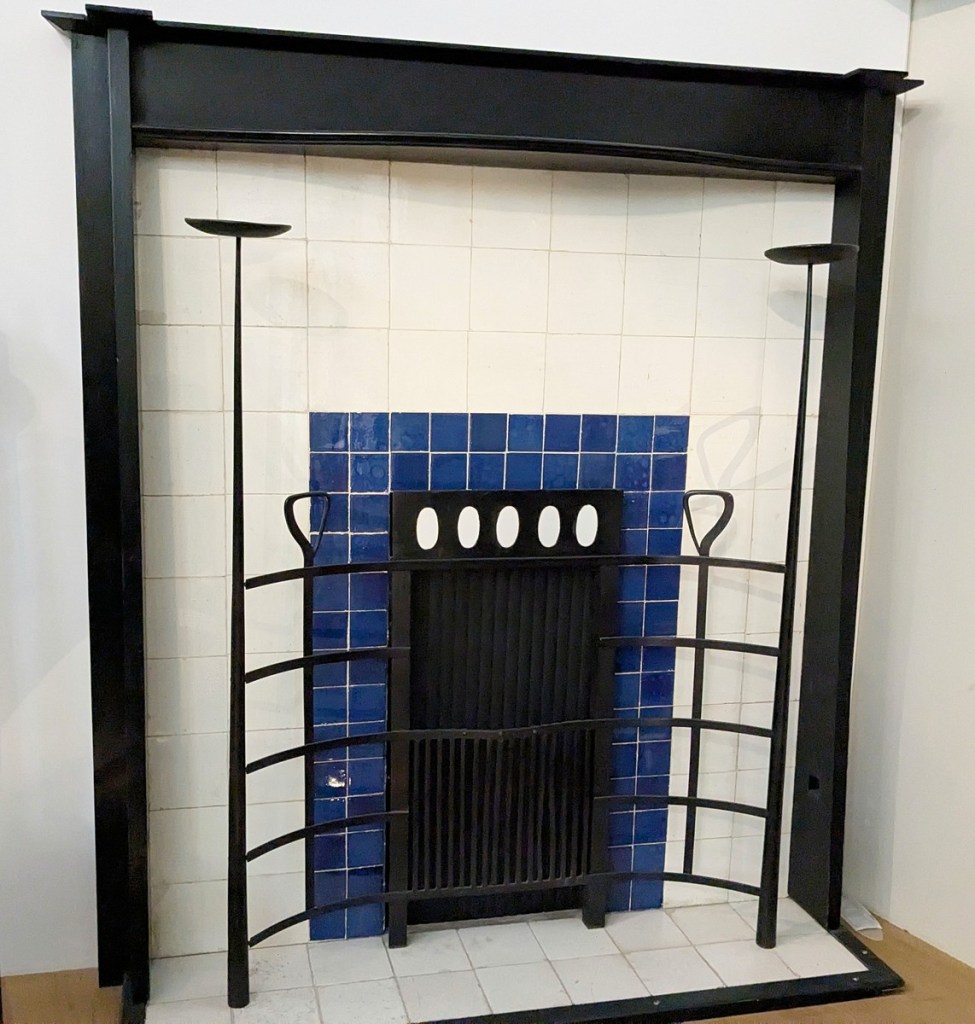
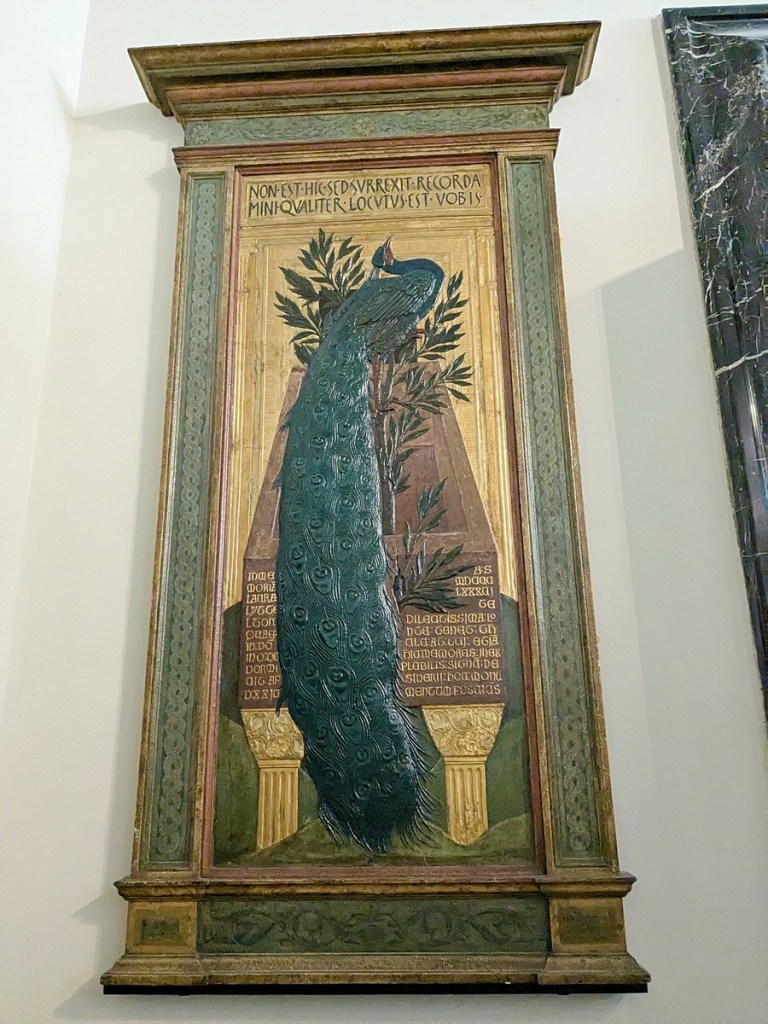
Look from here I will simply have to recreate the experience of going through the rest of the V&A, which was just absorbing like body blows of beautiful object after beautiful object by telling you about them one after another, relentlessly, making you jealous, like I was, that there is so much beauty in the world and yet we have only a limited time in order to perceive it. In the guts of the museum itself our first stop after the Cast Courts was the extensive jewelry collection. We had wanted to see some particular pieces, and we did, but why limit yourself to one when they have thousands of pieces spanning millennia. After that we just stumbled upon a hall full of tapestries, and like, we like textile arts, we have to go see the tapestries. We are here to see the tapestries! I couldn’t stop saying that in my head. But here are these works of art, gigantic, 500 years old, how did they do that, what luxury to decorate your house with such things just to keep out the drafts. From there we just blast through the theater and arts section, catching glimpses of Dua Lipa’s Mugler bodysuit alongside Stormtrooper armor alongside the biggest celebrity they have to have had, the costume worn by Manuel in Fawlty Towers, yes, Manuel! Manuel from Fawlty Towers, one of the greatest British TV shows of all time (though I can’t even watch The IT Crowd it is too funny), they had that sucker just on display in a corner, now we are going through a whole section from William Morris of the Arts and Craft Movement, which is another highlight that my super amazing wife really wanted to see, but on the way there you have to stop by the particularly famous bed, and now we are very nearly lost and also hungry, but we manage to find the café, itself just a gorgeous environment, surrounded by Victorian-era tile which in itself is a delight to the senses but also we were eating some rather good salmon, alright back at it, gotta view the fashion special exhibit, I liked it all, it was all super great, up and at ‘em through another hallway, what is that chair, it has to be modern, it is so chic and sleek and minimalist, but no, it is Victorian, how did they even know to do that back then, you have to explain it to me, wait there is no time, now we are in an entire hallway, an entire hallway! of ironwork, wrought and cast and bent and shaped which we admire because my dad is a blacksmith and we want to find things he would like, and there are so many things, it is too much, my heart can’t take it anymore, we gotta get out of here and we stumble out into the sun instead of going back through the tunnel to the tube because by then we needed the cleansing rays of daylight to let it all wash over us. It is a really fantastic museum, you should definitely go.

London II: The Museums Begin

Reading this week:

  • How Did the Great Bear Originate?, Translated by Damdinsurengyn Altangerel, andedited by Professor Choi. Luvsanjav and Dr. Robert Travers

Our first full day in London dawned bright and early and to start it off right we got a full English, almost. For breakfast we had landed at the very cute Caffè Tropea, which has a trademarked (so they claim) breakfast called “The Anglo-Italian Job” which was really good, and just a full English breakfast but with Italian-sounding meats. Fortified, we got the next full English experience: The British Museum.

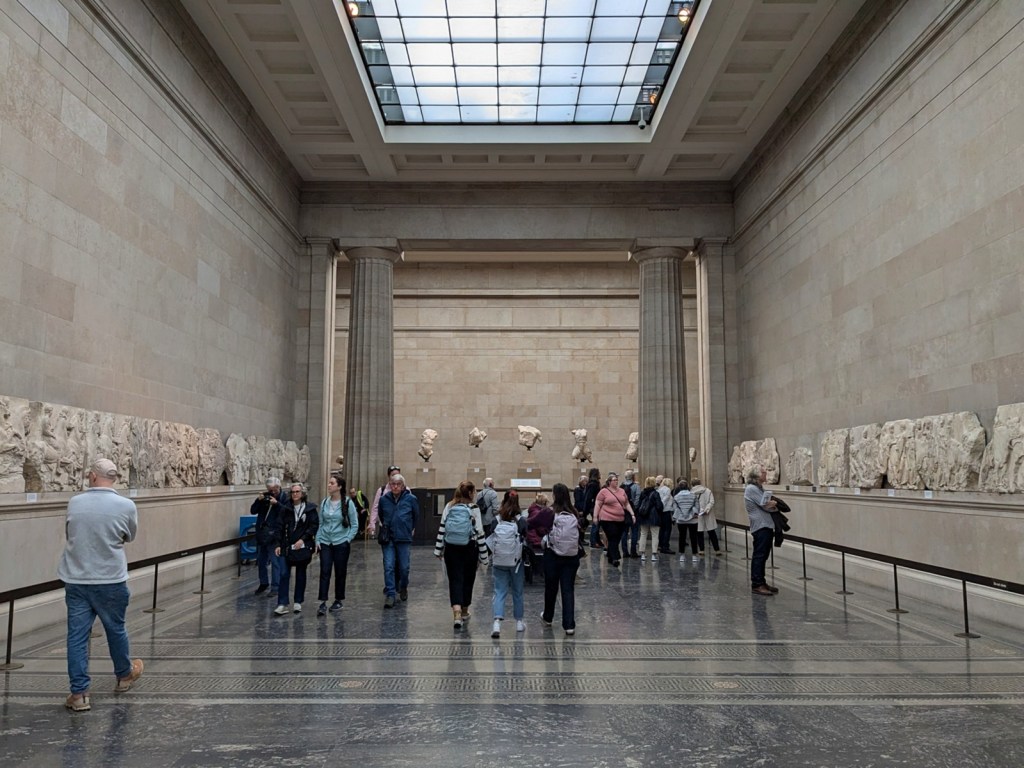
Because of other bits of our schedule this was a flying visit to the museum so we were really only there for the highlights. They keep the highlights conveniently close to the door though which is thoughtful. A quick left brought us to the Rosetta Stone where we oohed and aahed. The crowds weren’t quite what I hear they are for the Mona Lisa but I felt like the vibe was similar. The Rosetta Stone is larger than the Mona Lisa though and you can also see the back. Passing around the crown brings you almost directly to the Parthenon Marbles, where I showed off some podcast-acquired knowledge to my super amazing wife.

The main advantage of seeing the Parthenon Marbles though is that in the short corridor between the Rosetta Stone and the Marbles is the entrance to the Assyrian section which neither of us expected. I was at least passingly familiar with Assyrian works from reading Gods, Graves and Scholars, but the real treat was introducing it all to my super amazing wife who wasn’t familiar at all with what these cool cats did. And by cool cats I mean the various lions depicted in all the carvings of lion hunts with details so intricate and lively that we were both extremely taken with them. Much like the British, who took them. This is a zing that will serve to cover everything about the British Museum, but man it is such a privilege to be able to see this stuff, a privilege that the whole world should have without having to suffer through Heathrow losing your luggage.

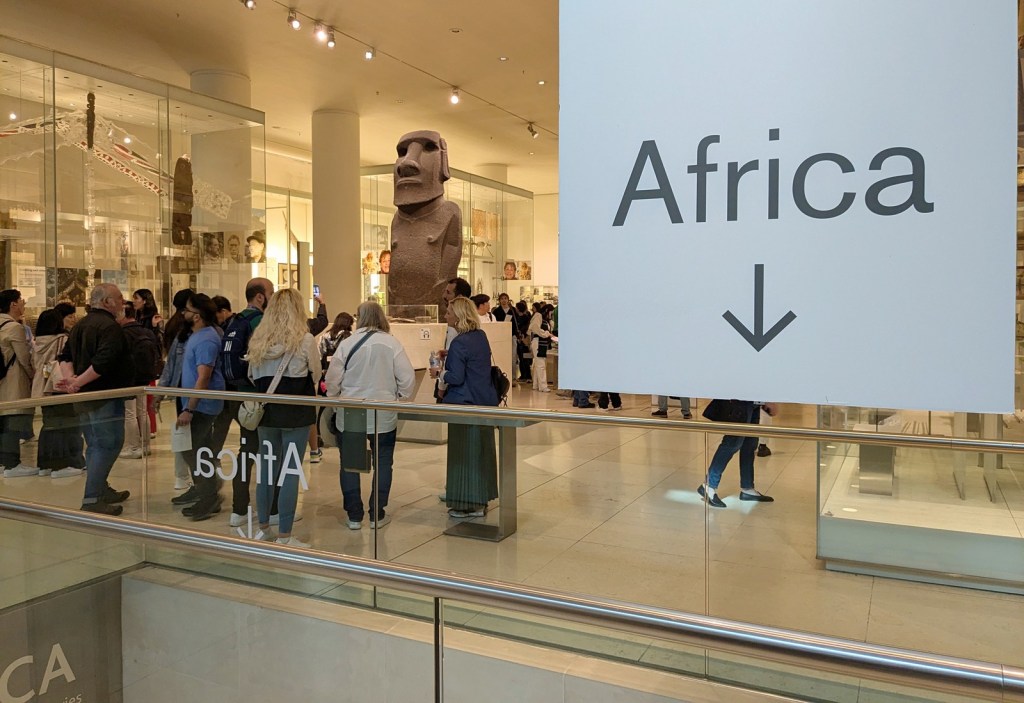
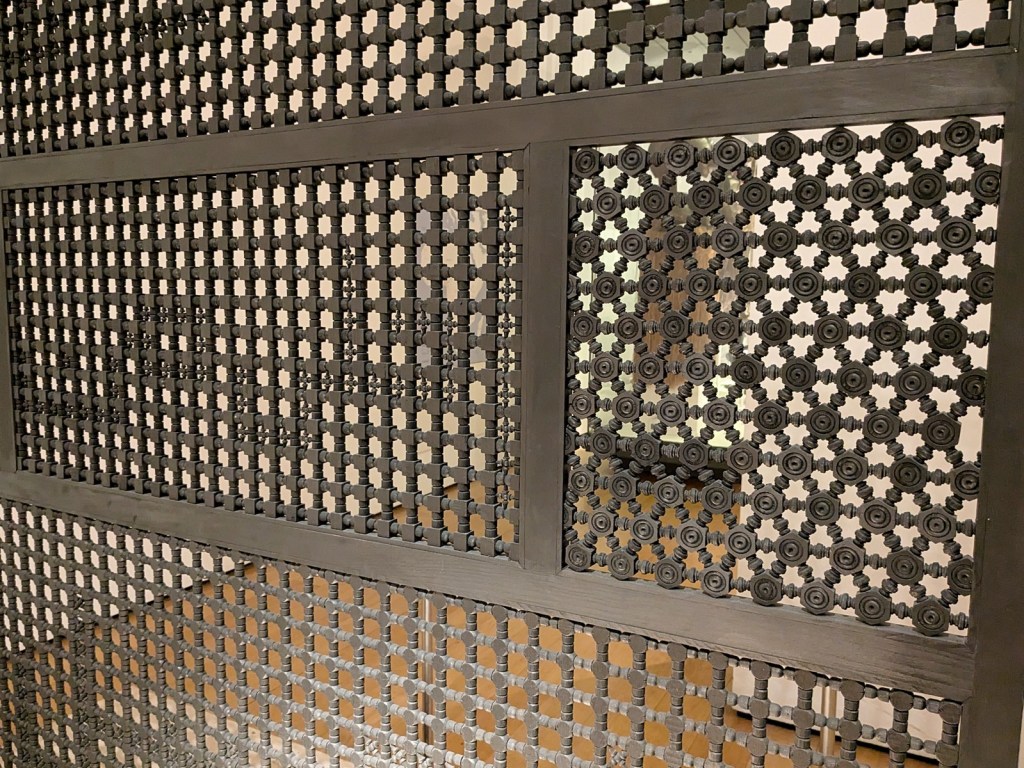
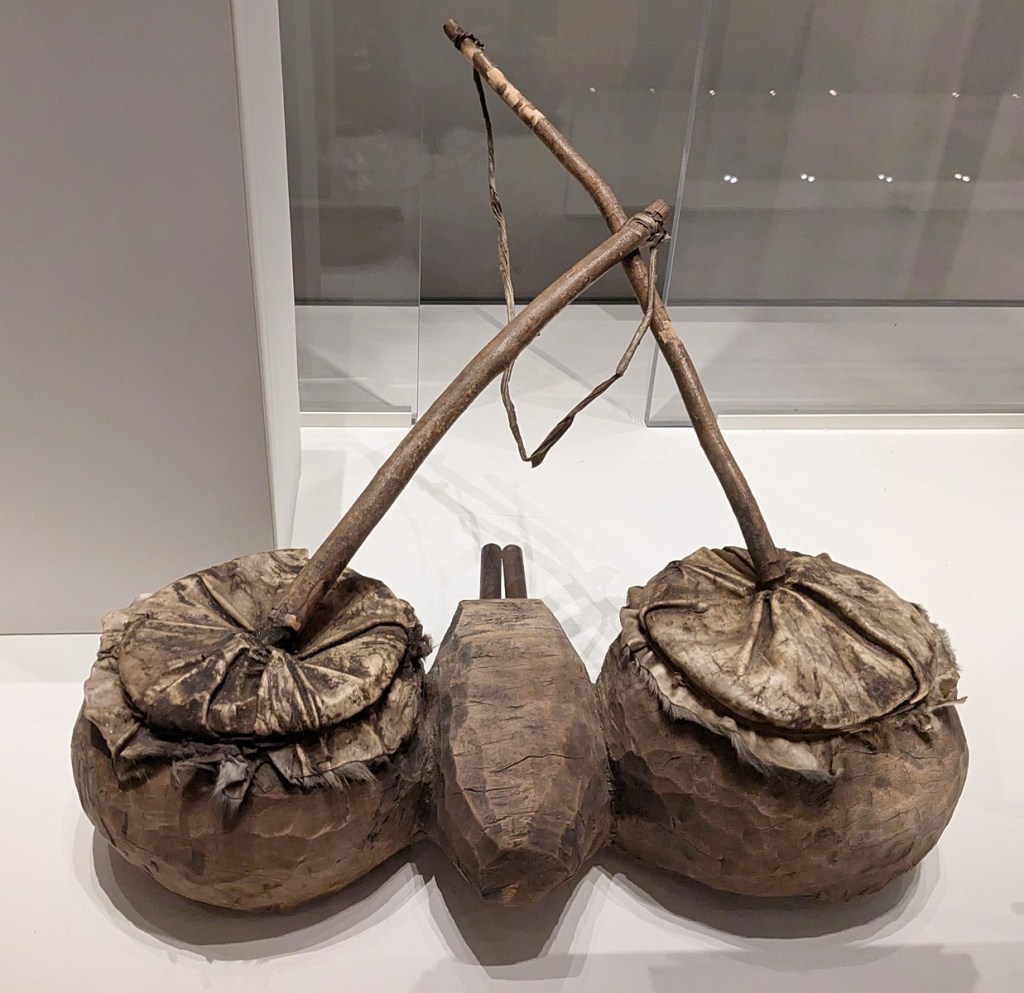
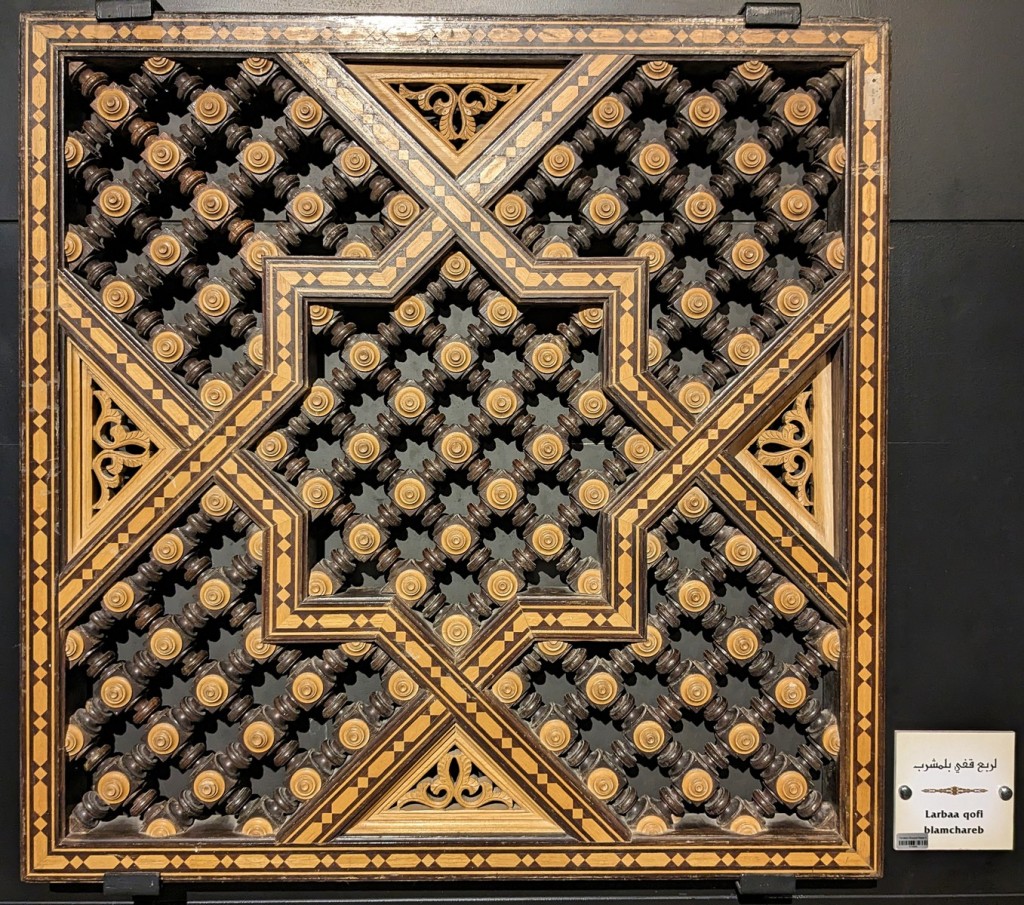
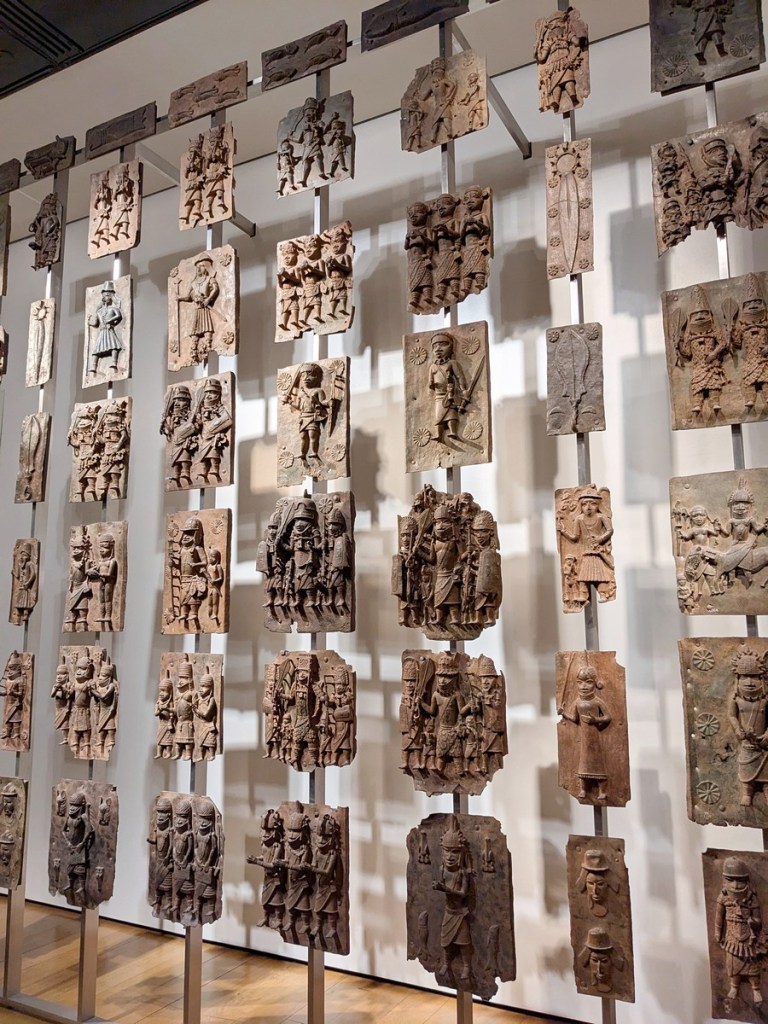
The major major major highlight for me was of course the Africa section, which I was somewhat distressed to learn was in the basement. On the way we passed Hoa Hakananai’a. I had thought the museum would have their samples of Rongorongo on display, but I was disappointed. I had to console myself with the phenomenal (and morally acquired) artwork they had on display. My super amazing wife was impressed by Tree of Life, a sculpture made out of pieces of rifles from Mozambique. Meanwhile I spent a large chunk of time admiring two Moko Jumbie figures commissioned by the museum from Zak Ové. I was really drawn in by the otherworldliness created by their wings before noticing how the use of new materials (like sneakers) manages to create an old-world object. And then finally in the commissioned artwork genre is “Knowledge is Sweeter than Honey” by Susan Hefuna, a really beautiful way to inscribe additional meaning onto the gorgeous carved screens the likes of which we saw in Andalusia and Morocco.

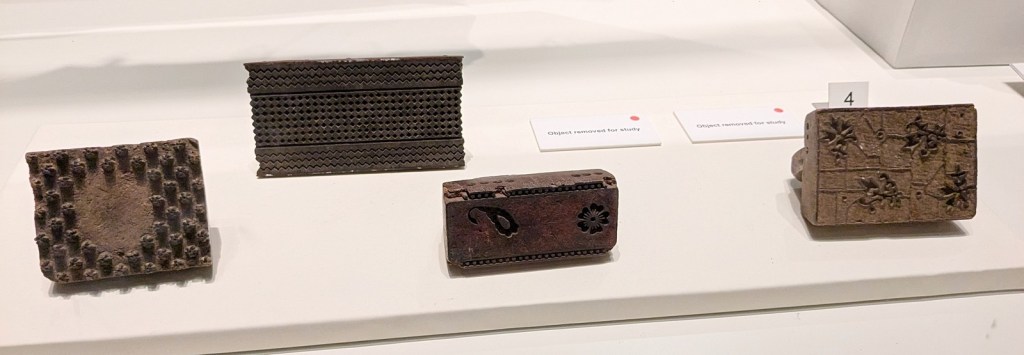
Of the non-commissioned art, there was so much packed into a relatively small gallery. Their textiles display was thorough, with all sorts of different types on display. Of interest were also carved wooden printing blocks, used for printing on fabrics. My super amazing wife, in addition to the textiles, was drawn to the towering display of pots, while I was checking out all the different products of blacksmithing. This included a set of traditional bellows and about as many different ceremonial knives as I could possibly imagine being all in one place. And a hand plow, which I hadn’t seen before.

They really pack it in there man. Sadly though like I said this was a flying visit so soon after this we were off, only taking time to marvel at possibly the world’s greatest kava bowl (from Hawaii).

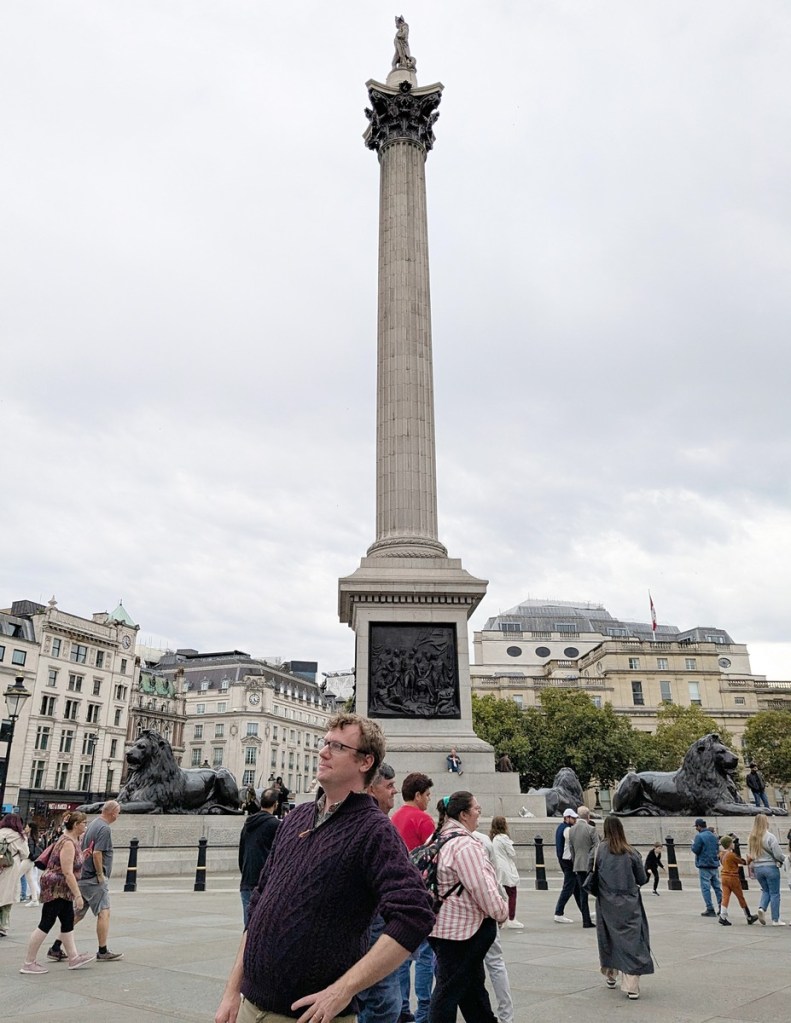
Although the rest of our day would largely bore you we did at one point drop on into The National Gallery (I was going to make a joke about the real National Gallery but I don’t appear to have ever written about visiting, maybe I am just not checking thoroughly enough, I’ve definitely been) where I was wowed by how impressively restored some of the artworks were, with color and vitality despite being 600 years old, but I didn’t take any pictures or write down what those works were so you’ll just have to take my word for it. But the best part of that whole experience was of course seeing Trafalgar Square, because who doesn’t love Nelson (I mean maybe the French and Spanish?) but here is me trying to be him, though with more arms:

London I: Novelty

Loyal readers, my super amazing wife and I have been on another vacation so as I am sure you are all overjoyed to hear that means you all get another set of lengthy writeups about our various adventures on said vacation. This one should be good though; it was a lot of fun for us and therefore I am sure it will be a lot of fun for you to read about.

Our destination this time was the UK, more specifically London and Bath and then swaths of Scotland before ending up in Shetland for Shetland Wool Week. But first we had to get to the UK, which went largely pretty smooth except that the airline misplaced my super amazing wife’s suitcase for a while. This meant she was wearing my socks and sweatpants the first day, but I do that every day so it must not be so bad. They eventually delivered the bag to our hotel a day later, which like, I think the traffic can get bad in London but it’s not that bad.

Anyway we had arrived in the morning after an overnight flight, which meant that we were dazed, confused, and not necessarily in our own clothes as we set out into the bright London afternoon (the weather was stunningly good the whole time we were in the UK, though almost everywhere we went people were telling us how bad it had been just a week before, so we had good timing). After fortifying ourselves with lunch (Chinese food, very culturally appropriate for the UK I know) we arrived at our very first destination: Novelty Automation.

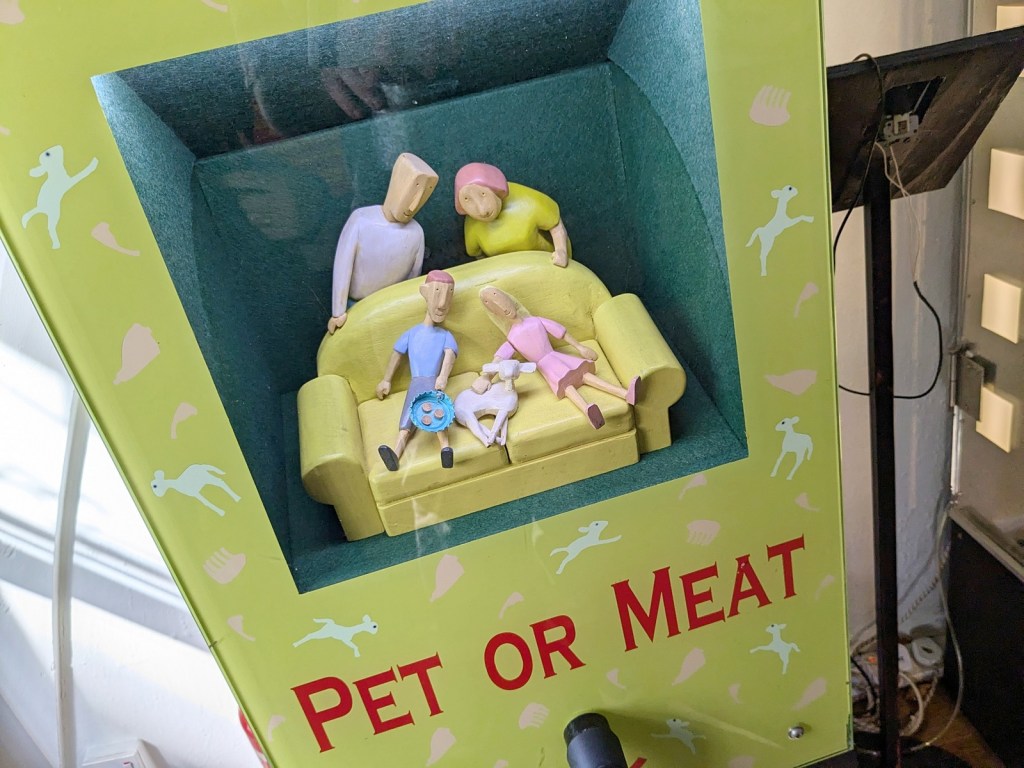
Pet!

For those poor souls not in the know, Novelty Automation is the project of the engineer and artist Tim Hunkin. I learned of the esteemed Mr. Hunkin via his YouTube channel, where he has a series of videos sharing his practical engineering knowledge, which he applies to (among other things) making the arcade machines which populate his arcade. I tried to explain this all to my super amazing wife to justify dragging her to an obscure street in London (conveniently close to the hotel though which is why we went there first), but she didn’t get it until we walked in the door.

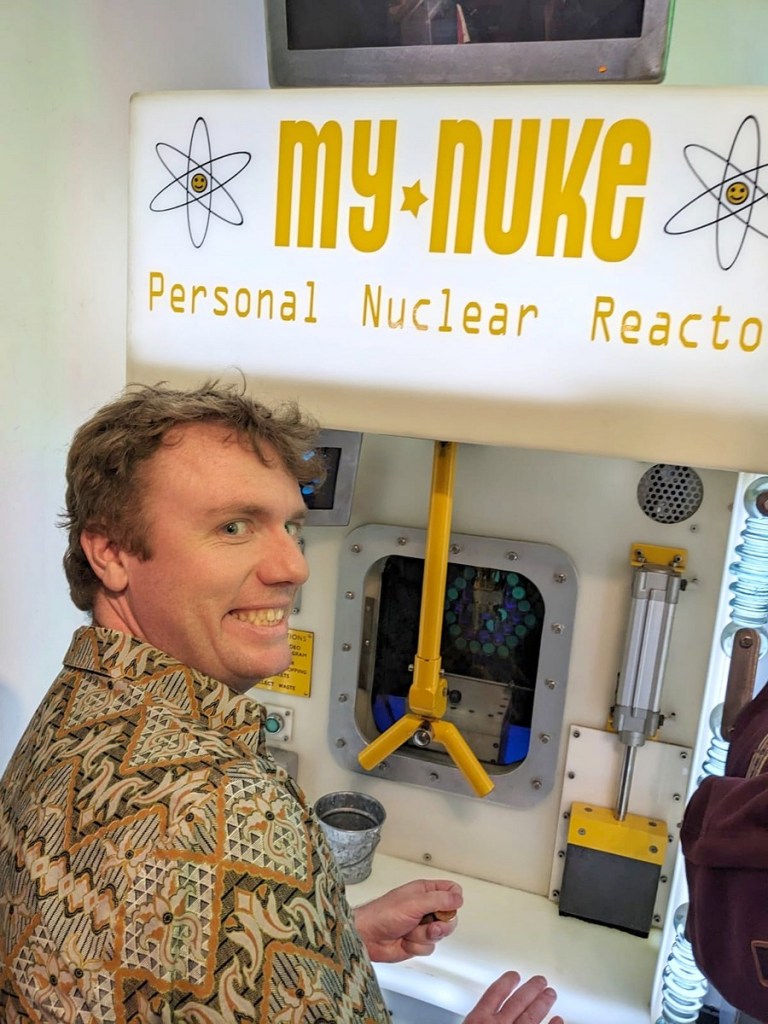
But once we got in there I think she was sold. It is a cramped, tiny little alcove of a shop but tons of fun. It was crowded when we got there (like eight or ten people inside) but I got us some tokens and we started playing games. Since I had seen the videos it was like meeting celebrities in real life. Right inside the door was the game that my super amazing wife was most enamored with. She is, as discussed many many times here, a big fan of sheep, so she had to have a go at Pet or Meat. We got pet! In retrospect I’m not sure which one she would have preferred. Meanwhile I played The Fulfilment Center and won a zero-hours contract, and My Nuke, where my extensive nuclear training did not come in handy and I dropped several fuel pellets and as a reward got some nuclear waste. Overall the arcade was super fun and I would totally host a birthday party there, which they note is one of the services they provide.

A happy customer but very unsafe and unreliable nuclear operator.

Our time at Novelty Automation concluded our only real big destination on the first day. A big part of the reason we were in the UK and London was honestly to shop and so we spent the rest of the afternoon zooming around to the different sorts of shops we wanted to go to. But not like high end luxury shops mind you, no no, our tastes were niche. I mean not that niche, it was tea and books, two notably popular things. But we were looking at special teas and special books. Destinations included Mariage Frères, which I thought was fine, and Postcard Teas, which I now note bills itself as London’s Finest Tea Store and might just be. It is small but they were very knowledgeable and passionate; while we were there the man behind the counter asked a Chinese lady where she was from and then they talked extensively of the various tea regions around there off the top of his head. We also wandered into TWG Tea at some point because we thought it was Twinings (which we went to another day) but you can give TWG a pass.

As for books our first destination was Cecil Court. My dream in London was that I was going to go to an antiquarian bookstore and then just find all sorts of London Missionary Society books and ephemera for (relatively) cheap because London is where the Missionary Society is from and various people from previous generations would have had their libraries liquidated and people just wouldn’t know what they had but with my extensive knowledge I could pick it all up at cut-rate prices and have the world’s finest LMS library but this did not happen. I was a bit disappointed with the antiquarian book selection overall (this could be my fault I admit) and Cecil Court didn’t seem to have that many bookstores frankly. Though I did pick up a book from Tenderbooks, they were a great little shop. To be completionist we also went to the big Waterstones which was you know a bookstore and then also Hatchards which was pretty nice.

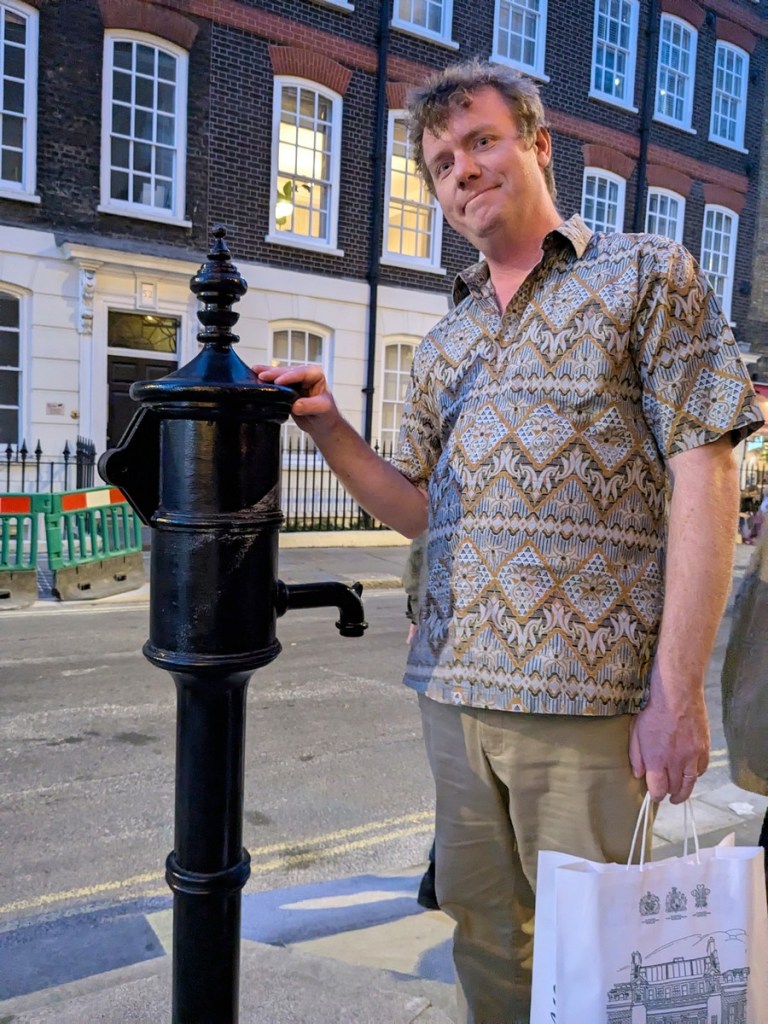
By this point it was late in the day and our feet was killing us so we went on back to the hotel, detouring only slightly to see one final celebrity:

It was very crowded and my super amazing wife was very tired and didn’t understand why we were here but how could I not get a picture?

Lola ya Bonobo

Reading this week:

  • The Adventures of Ibn Battuta by Ross E. Dunn
  • The Travels of Ibn Battutah, abridged, annotated, and with a forward by Tim Mackintosh-Smith
  • Sierra Leonean Heroes

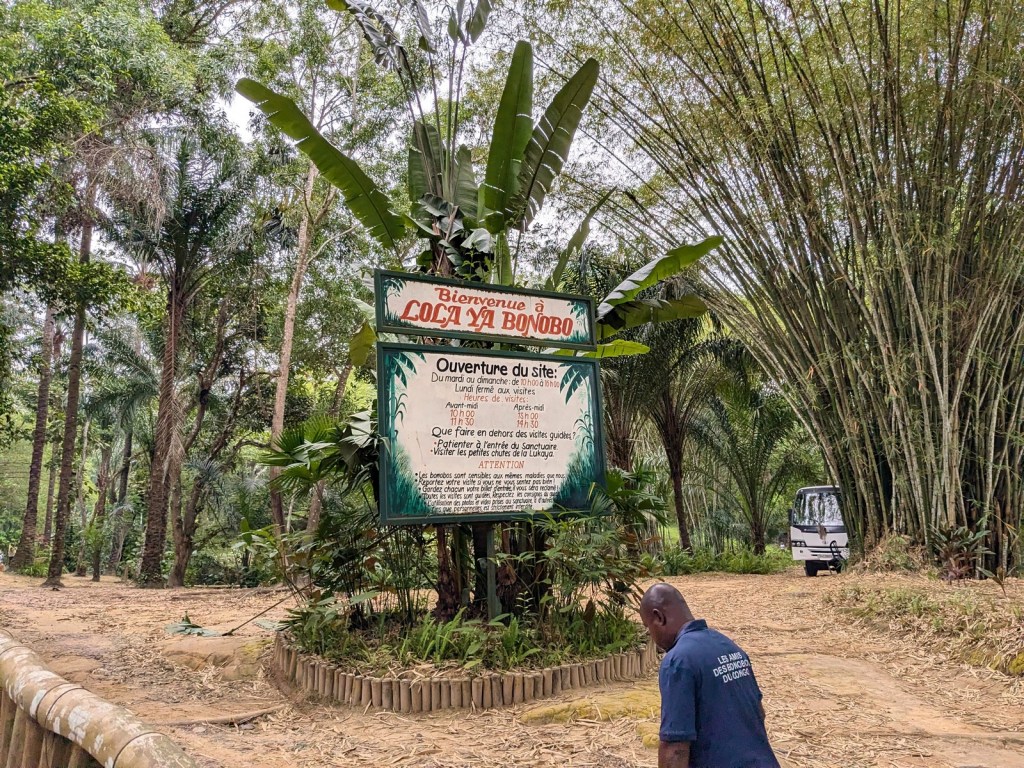
A little bit ago I once again found myself in Kinshasa, and this time the big adventure was going to Lola ya Bonobo! It was a lot of fun. Lola ya Bonobo is a sanctuary for orphaned bonobos. The name in Lingala means “Paradise for Bonobos” which seems fairly accurate. It’s on the outskirts of Kinshasa, which as the crow flies is not so far, but we are not crows, we are people, and we have to drive, and that means traffic, and so it is quite the journey out there. But pretty! The city center turns into suburbs over hills and valleys with pretty little gardens along the way and eventually becomes forest and you find yourself on the side of a small river in a copse of bamboo being offered drinks while you wait for the next tour time.

Lola ya Bonobo is the only sanctuary in the world for orphaned bonobos. I think this is because there aren’t really a lot of other great spots to put an orphaned bonobo sanctuary, what with the range of bonobos being relatively small and circumscribed by the Congo river and its tributaries, as our very nice tour guide explained via a diagram he drew. I think this is what he was explaining anyway; the tour was in French, which I really need to get around to learning. The bonobos wind up orphaned both through habitat destruction and their parents being hunted for meat. The babies are often sold on the black market, and it is from there that Lola ya Bonobo rescues them and helps to raise them. After all of this was explained to us, we set off on the tour. The whole place is extremely gorgeous, as it is set within the forest, so you have paths set within the trees and facilities where they take care of the bonobos.

At least raising these kids comes with a paycheck.

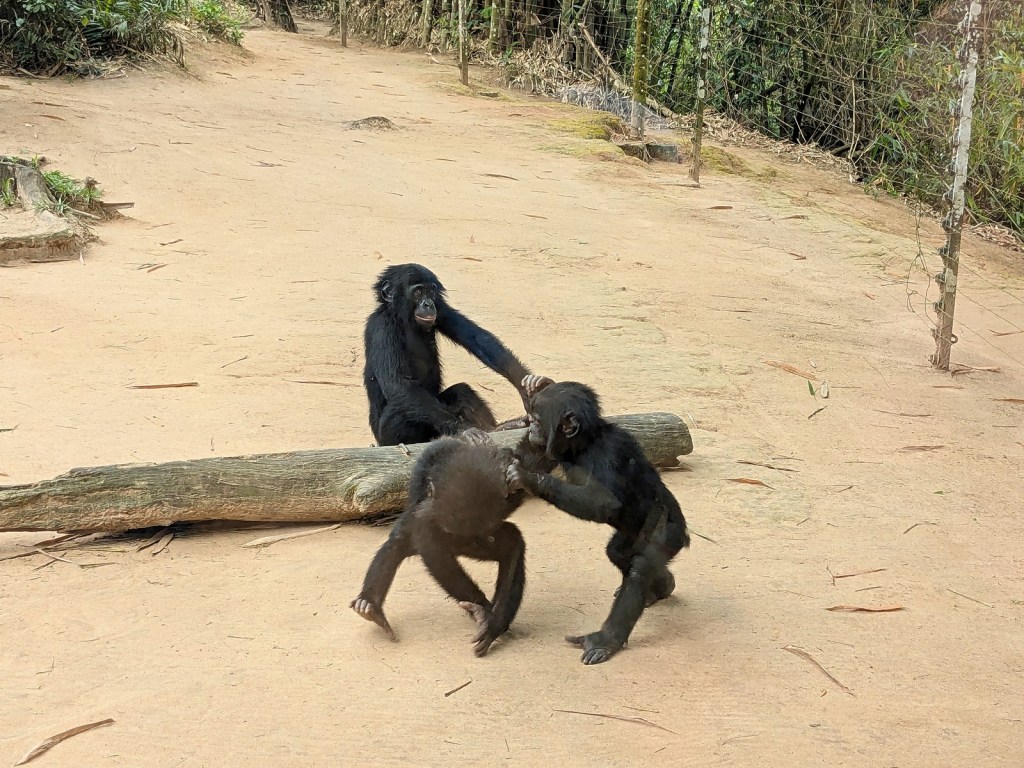
The first enclosure was the cutest because the first enclosure was for the baby bonobos. It was insanely cute. The babies are taken care of by “surrogate mothers,” i.e. some Congolese women who are looking after them. So we approach this enclosure which had a zoo-like glass front and there are just three women in there with baby bonobos clinging to them and then running around and playing and stuff. I imagine these women spend all day taking care of toddler bonobos and then go home and take care of toddler humans and man that must make for a full day. The babies had playground equipment including a trampoline and a swing but the best toy of course was the leaves on the side of the paths which the babies would push onto the paths and then the women would grab a broom and sweep them up. It was just like absolutely the cutest.

Wrasslin’

From there we went down to a series of different enclosures with mostly older bonobos, though I didn’t really understand the difference between the enclosures. The first enclosure had several families it seems and we watched them rub their rather pronounced butts together. The tour guide tossed them some bananas to give us a better look and being no bonobo expert I am sure this is okay. The bonobos were kind enough to show off for us.

Posing for a banana.

The next enclosure bordered a small dammed lake which made the whole setting extra pretty on top of the regular gorgeousness of the other bits. We watched a couple sanctuary employees row across the dam in a boat and then toss a family of bonobos a bunch of papayas, and wow that’s a dream job.
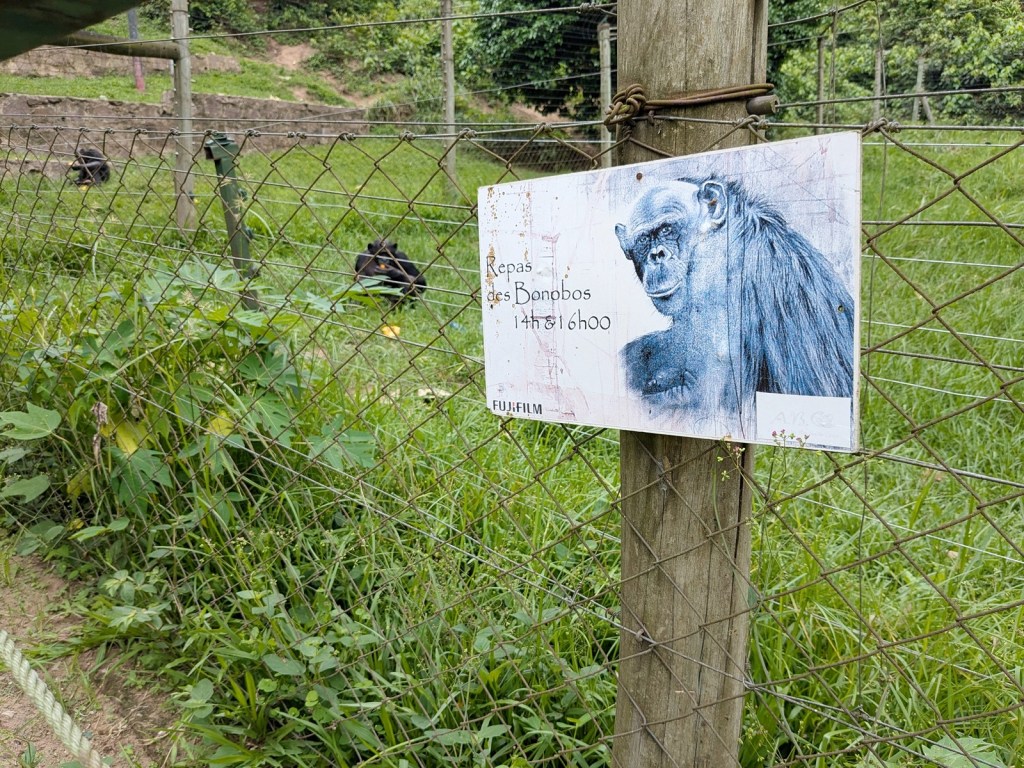
The sanctuary had a few different signs with illustrative bonobo drawings.

The final enclosure we visited seemed to be for the rowdier bonobos. They were tricky these bonobos. One mom in this enclosure had a super cute baby she would use to bait people who wanted to take pictures, and then when you approached would toss sand at you. One bonobo had a water bottle he had gotten from somewhere and the tour guide warned that if you get too close to the enclosure they’ll tear at your shirt or rip your purse off, so that’s fun. Can’t blame ‘em, frankly, the bonobos here are in the right. Still pretty neat!

Finally from there we exited via the gift shop. I got a pretty sweet “Amis des Bonobos” t-shirt and a carved wooden spoon with a little bonobo on top. Always happy to support a good cause, and these people do seem pretty great. They do some great education and are helping out an animal unique to the DRC. If you ever find yourself in Kinshasa, it is well worth the trip.

National Museum of the DRC

The South Korean flag is because the South Koreans funded it.

Because I was very lucky I was able to go to the Musée National de la République Démocratique du Congo! The lucky part was that I was in Kinshasa and therefore able to go. Getting to Kinshasa is the hard part. If you’re already in Kinshasa it is pretty easy and you should definitely go, it is great.

Although the institution is older the physical museum itself is pretty new, having opened only in 2019. It’s a really nice location, with a brick fronting and an open and airy interior. It is such a nice location that when I arrived I originally thought it might be closed for an event as there was a wedding (I think) going on out front. But it was very much open, and despite it being a Saturday is was rather packed with school groups, which is just awesome. It is those kids that this museum should really exist for and by golly it was existing for them. Though I suppose it is a pretty alright wedding venue as well.

I took a taxi to the museum and he was nice enough to wait for me in the parking lot, which itself was pretty neat because it had shade structures built of solar panels and a cool display showing you how much power the solar panels were generating. Paying for admission was a bit confusing though, because from the parking lot I actually had to go back out the gate to find a guy who took down my info and who handed me a slip of paper. This slip of paper I handed to lady in a booth across from info guy, along with the entry fee. This lady gave me a receipt. I then walked in past the wedding to the front desk, who took my receipt and at that point handed me a ticket, at which point I was I guess fully in the museum.

A hall showing musical instruments from different cultures within the DRC.
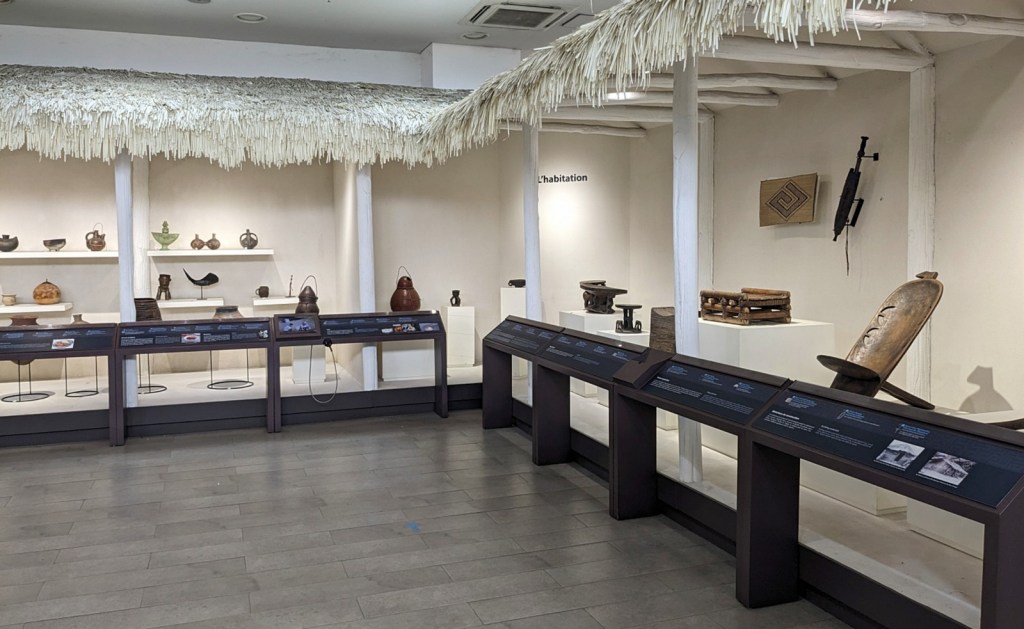
Displays showing various household objects.

The museum is not terribly large but packs in a good chunk of stuff. There are several permanent and a couple temporary exhibits, arranged on two floors. Since the museum is new the displays are very well done with explanations mostly in both French and English. One thing that confused me is I couldn’t tell at first if different exhibit halls were open, as they are behind rather large sliding doors/walls. The exhibits are in fact open, it’s just that the exhibit rooms are air conditioned while the hallways are not, so they doors are keeping in the cold air. A lot of the items on display were familiar to me, what with having gone to the Royal Museum for Central Africa. One object that it took me a moment to realize was familiar was a Kakuungu mask, pictured below:

Kakuungu Mask

What was significant about this mask is that the Royal Museum had made a bit of hay about having returned it to the DRC, with President Tshisekedi himself having participated in a ceremony. So I recognized it from the Royal Museum and now here I was seeing it in the flesh, pretty cool. The mask isn’t officially owned by the National Museum, as Belgium doesn’t have the laws on the books to officially return it, so when you go to Kinshasa to see this mask it is merely “on loan.” As I discussed in my post on the Royal Museum this is a bit of a thin excuse but I guess possession is nine tenths of the law and right now the mask is in possession of the DRC so that’s something I guess.

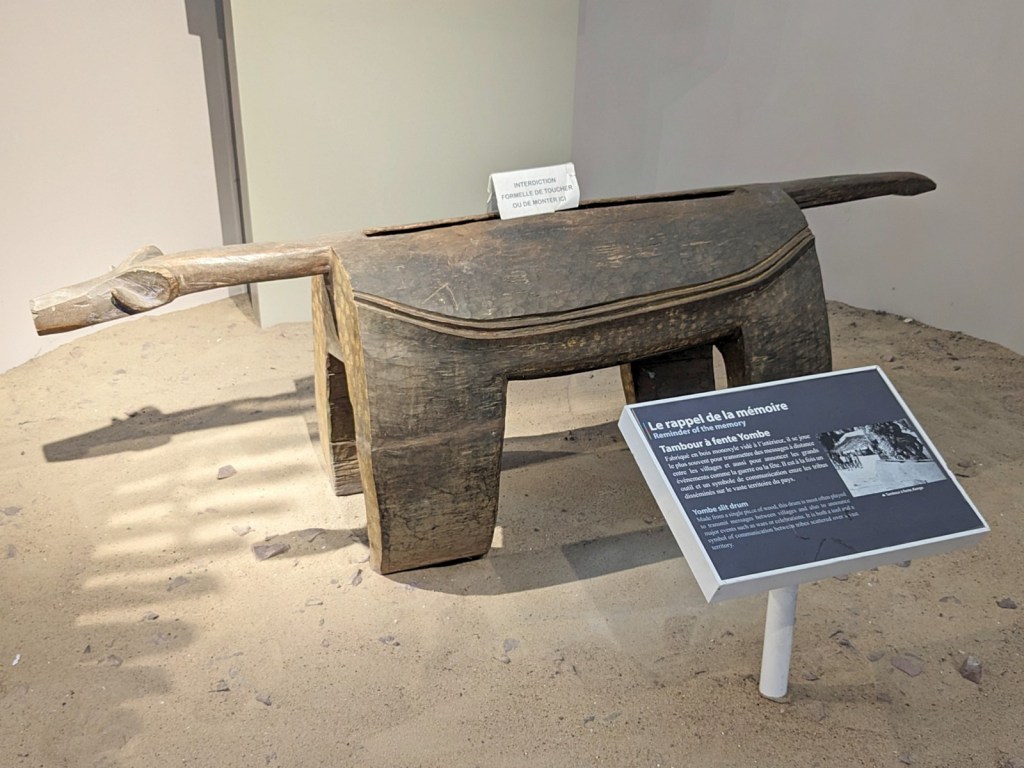
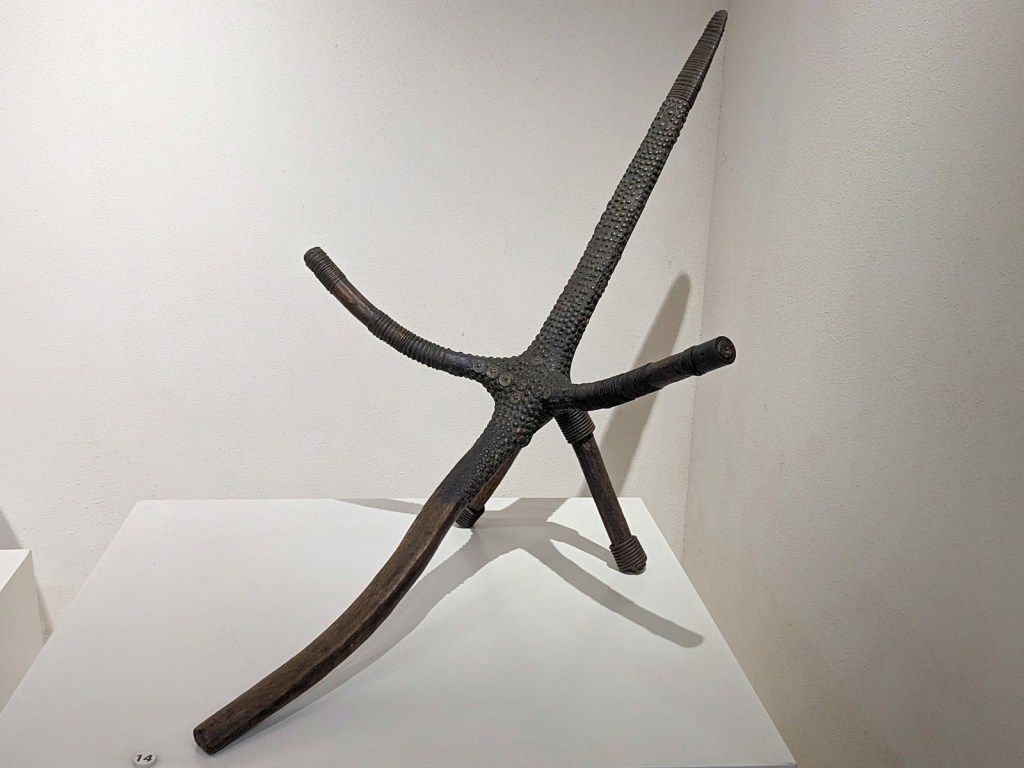
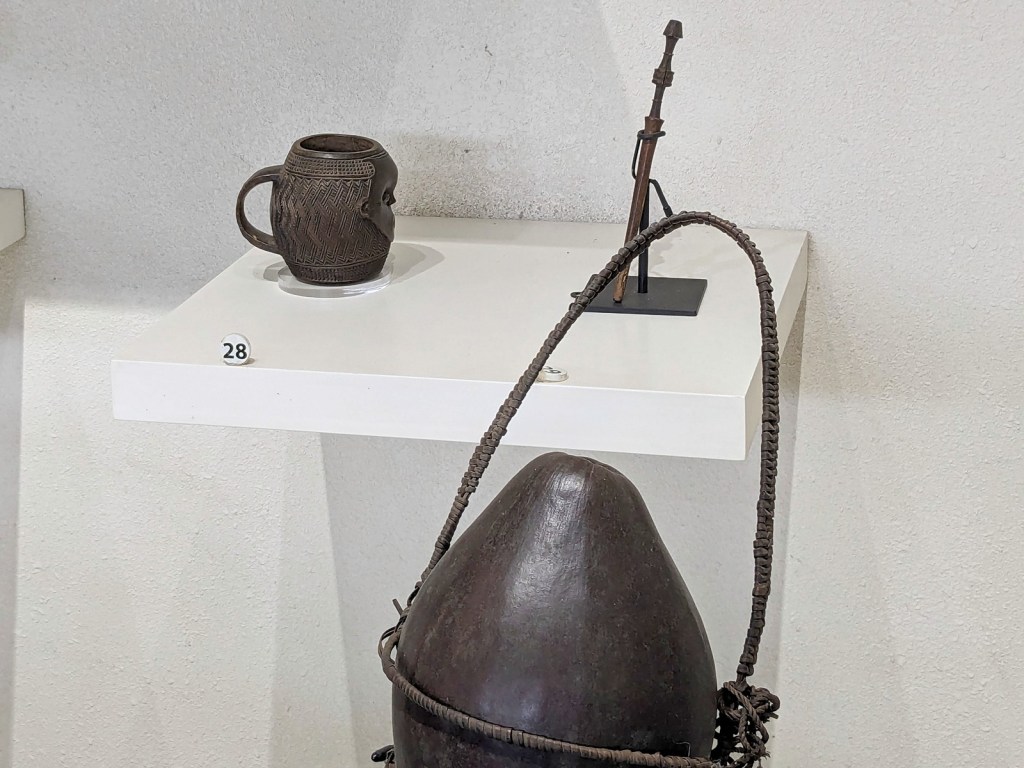
Despite my familiarity with a good chunk of the objects on display, a good many were new to me. We are interested in witchcraft and divination on this blog, so seeing the divination basket was pretty cool. I was also entranced by the collar in the below gallery. That sucker must have been really heavy to wear but I suppose that is the burden of status. And when I first looked at the Monzombo backrest, I thought it was trying to be a chair of some sort (it was next to some other chairs), but I thought surely it must be something more utilitarian like a sword stand or something. But I guess it is the sort of chair you give to dignitaries. But maybe it was for dignitaries you don’t like? Or maybe it is more comfortable than it looks? And then finally in addition to being fans of witchcraft on this blog we are also fans of palm wine, and now I need a palm wine cup and a palm wine cork or else my kitchenware collection will never be complete.

In addition to the household objects it is was the mellurgy and blacksmithing displays that I was particularly interested in. They had a whole recreated forge set up with hammers and anvils and bellows and everything so that was very neat to see. Then on the wall next to it they had the blacksmiths’ products on display. The utilitarian objects that the blacksmiths produce, like hoes and other farm equipment, are impressive in their own right, but the arts pieces are really what blow me away. I saw more decorative and ceremonial knives and objects like the bells shown below are really what give you an insight into the mastery of craft that these guys had achieved.

Alas I am sad to say that I didn’t spend way too long in the museum. Like I said it is not particularly large anyways but the masses of schoolkids moving through the place made it feel pretty hectic. I am super glad to have seen those kids in the museum though; me visiting all by myself would have been rather sad. The museum isn’t really meant for me and I have access to places such as the Royal Museum for Central Africa in Belgium that these kids might not be able to see. But here they were very, very excitedly going around the museum entranced by the tour guides telling them about their own history and culture and that was really great. After kind of zooming through I instead found refuge in the gift shop, where the very kind sales lady showed me the different crafts and postcards and souvenirs. I eventually bought a ceremonial stole covered in cowrie shells that was really beautiful before heading back out into Kinshasa. The National Museum of the DRC is really really great and really well done and is existing to serve the people of the DRC and Kinshasa and if you are in town you should visit too to see all the cool culture they have on display and to support their mission. And maybe get married, who knows?

Morocco IX: Casablanca

We were off to our final city, Casablanca. Before we left we found out some fun information about the tortoise in our Fez riad. For 11 years the tortoise had been named Paul. Then a friend of the owner brought over another tortoise and after it had been around for a bit they found Paul laying eggs, and so they changed her name to Paula. Oh, love. The trip to Casablanca was fine. It was another slow speed train, and we were a little mortified to discover that instead of individual seats we were in a compartment with four other people. The other people were lovely, but the mortifying part is there was no place for our large suitcases except bumping up against the knees of our fellow passengers, which to their credit were extremely nice about it (they took it all in due course). The final leg of our ride to the hotel was a taxi ride, made unfortunately exciting by our bags flying out the bag of the car as we headed down the highway. The taxi driver stopped and we recovered our bags with all their contents unharmed, though not without damage to our calm demeanors. Settled into our hotel (the Hôtel Central, which I’ll charitably say looks good for being over 100 years old), we got some dinner and settled in for the night.

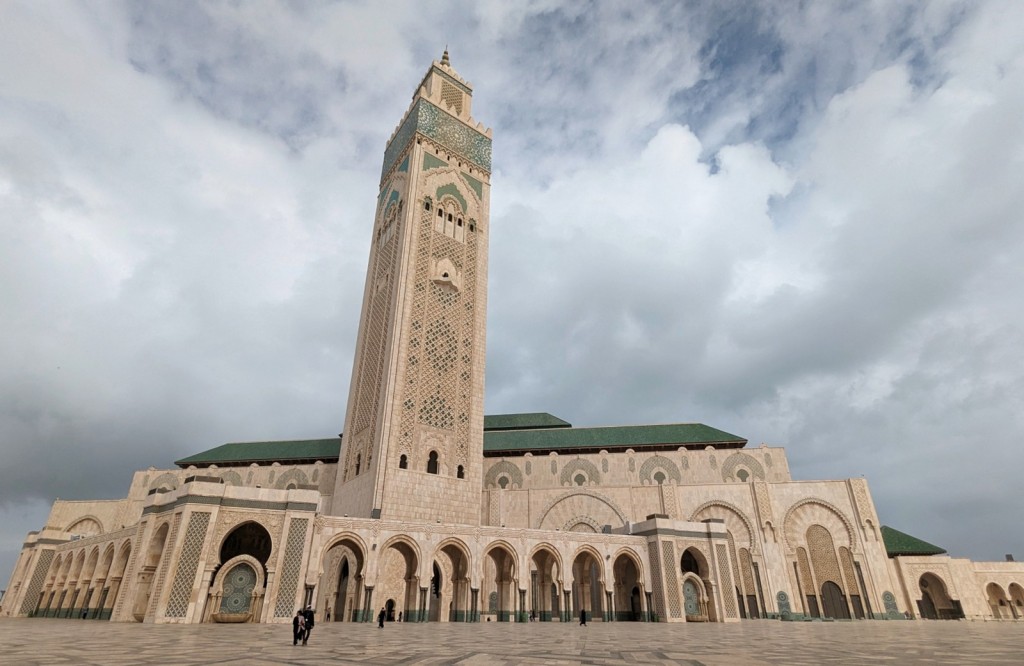
The big tourist attraction in Fez is the Hassan II Mosque. And I will say it is big. This is very much its defining trait. Quoting from Wikipedia, it is the second largest functioning mosque in Africa, with a capacity of 105,000 worshippers and a minaret 60 stories high. We decided to walk to it from the hotel, because we thought we were relatively close, but we were not, it was in fact kind of far away but because it is so big it looked closer. We got a little lost trying to find the entrance, which turns out is via the museum, but once we got there someone there very kindly gave us a ride in a golf cart so we could make our designated tour time.

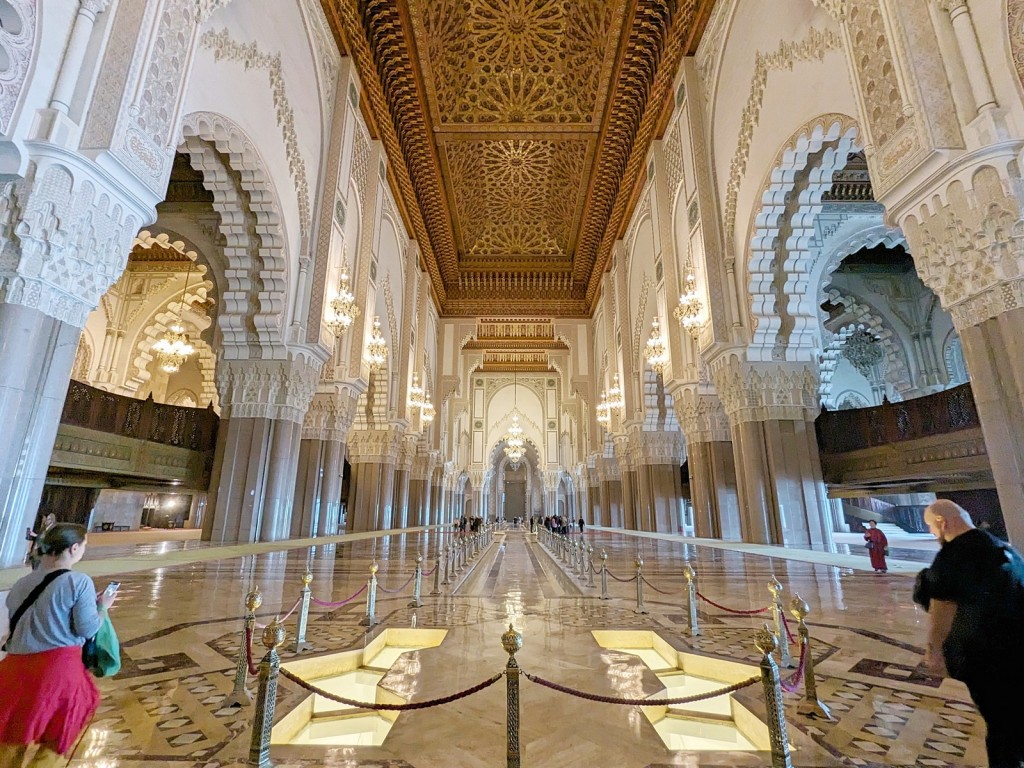
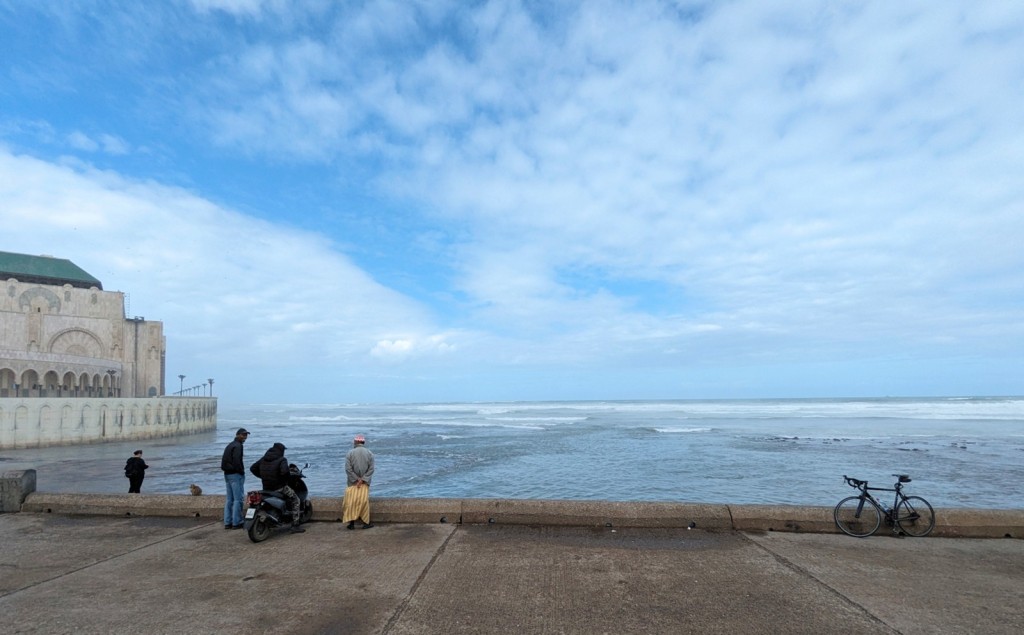
I enjoyed the mosque. Going in I thought it was going to be an interesting comparison to the Mezquita in Cordoba but man. I mean, it is. They are both mosques. There is a mosque style. Open floor plan, etc. But this thing was just on another level. The columns are gigantic. It has to be one of if not the largest room I have ever been in. Enormous. Colossal. Truly monumental. It is a beautiful structure. I had expected it to be rather plain, like many of the more modern cathedrals I have been in. But the mosque delivers, no expense spared. The walls and ceiling are covered in mosaics and patterns and the stalactite-mimicking ceiling in the corners. One aspect I particularly liked is that the mosque is built on landfill due to a Koran verse and the western “doors” open up into a sea view. The sea off Casablanca and the mosque was so powerful. The entire time we were there it has been nothing but heavy Atlantic rollers crashing into the reef. They come straight it off the ocean and curl over the shallows to bash themselves into the seawalls. Adjacent the mosque, the sea becomes part of the majesty of the hall.

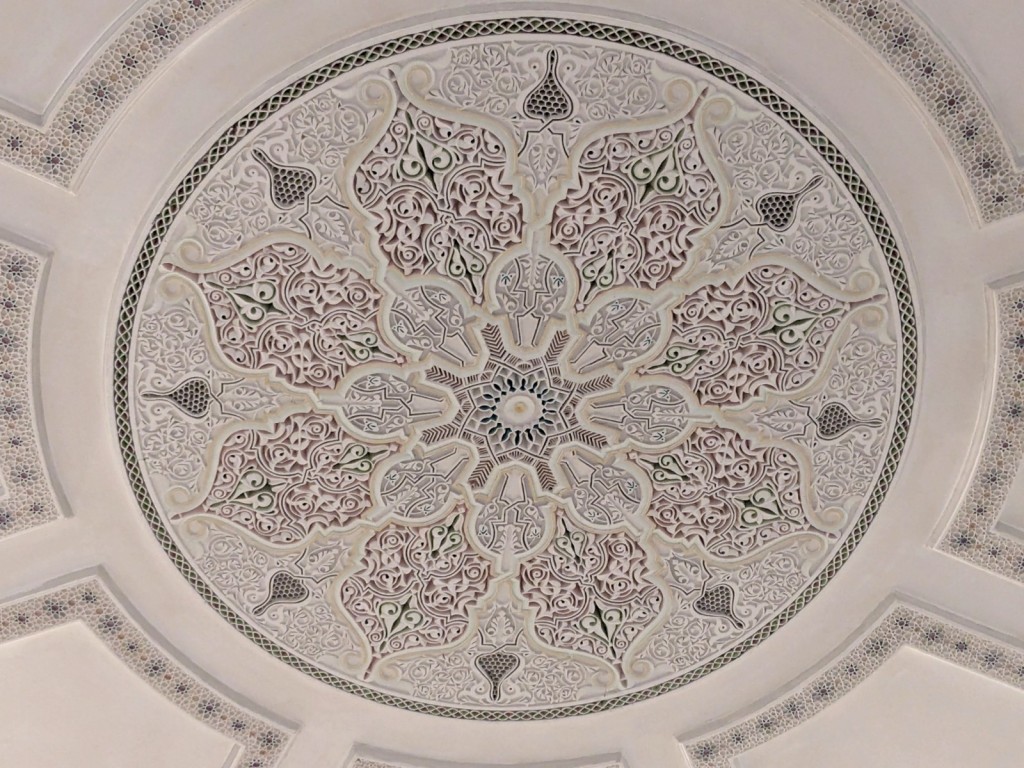
One question that the tour guide got asked over and over is how long it took to build the mosque. When I was viewing some of the other large cathedrals and mosques that took centuries or more to put up (like the Mezquita), it made sense. It seems like you would just need that much time to stack so much stone and plaster atop other stone and plaster. But this sucker got put up in six years! With no detail lacking for the compressed timeline! We had learned over and over on this honeymoon that there are so many mosaic motifs that the mosaicists will use and when they put up this mosque it seems like they made sure to use every single one. My super amazing wife also pointed out in the more ancient mosques there is a more limited color palette but in this mosque they really expanded their repertoire given modern-day color technology. This included more pinks and purples and different hues of green.

After the main area we went down to the ablution area with the sturdy and delicate fountains that I would have liked to see in action. And after that we filed out of the titanium doors and the tour was done, but for us walking farther and farther away to finally be able to get the whole thing in frame. Before our visit I was pretty whatever about it actually but afterwards I was glad I went. My super amazing wife didn’t feel the weight of history in the Hassan II Mosque, especially as compared to the ancient sites we had seen, but I felt the weight of sheer weight in the thing. “It belongs to God,” the guide said, and it looks it.

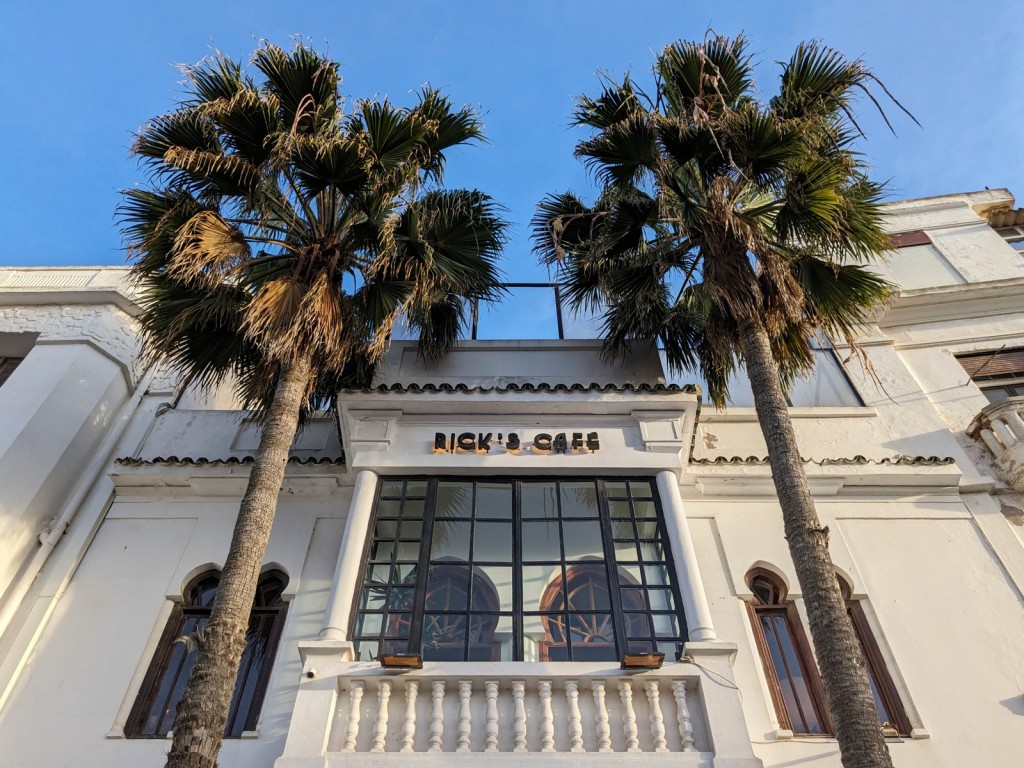
But onto our final event. No trip to Casablanca would be complete without a trip to Rick’s Café. We went there for our final dinner of the trip. Lemme tell ya it was really great! The place doesn’t look anything like Rick’s Café from the movie in terms of layout but on the other hand they got the ambiance just right and it is in fact a really nice restaurant, and not too expensive to boot. We split some oysters and my super amazing wife got the seafood linguine and I got the duck confit and man that was to die for. Melt in your mouth. The waiters wore waistcoats and fezzes and the service was prompt. The piano player showed up as we were having dessert. He started of course with “As Time Goes By.”

And that, dear reader, was the last thing we did on our honeymoon and the last thing we did in Morocco. After dinner we packed our bags and went to the airport to take an overnight flight back on home. It was a beautiful country and we can’t wait to go back, hopefully when we are filthy rich so I can buy all the mosaic tables I could want.

Morocco VIII: View from Above

Reading this week:

  • Memories of the Slave Trade by Rosalind Shaw
  • The Lake Steamers of East Africa by L.G. “Bill” Dennis

Don’t worry loyal and overextended reader, our journey through Spain and Morocco is coming to a close. The morning dawned on our last full day in Fez, and since we were now experts on the artisan scene in Fez, and since there would be no other towns after this (we go to Casablanca after this but didn’t expect to do much shopping), it was our last chance to pick up any particular souvenirs we wanted.

Adjusting the kettle lid.

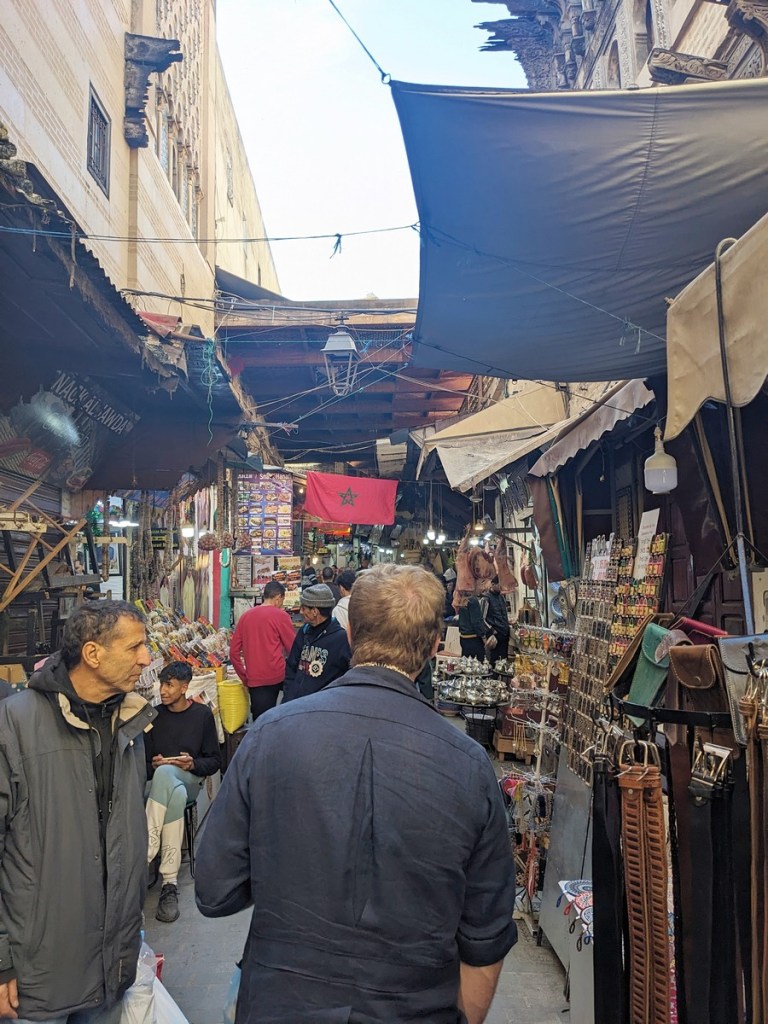
One thing my super amazing wife coveted was a copper tea kettle. In our artisan tour adventures the previous day we had swung by the metalworking street (the damascener was on the saddle street) and although didn’t really stop to check anything out it meant we knew where to go. Many of the things for sale were like, large copper pots, but we found a shop with a few copper teakettles. We asked after a few, got rather high-priced quotes and so walked away for the moment to go back to the leather street. I had wanted a weekender bag but after poking around I didn’t find anything that I really loved or cheap enough to settle for less. But it gave us time to gird ourselves for copper kettle negotiations. I was letting my super amazing wife do the haggling though I tried to act unenthusiastic as a foil to help her lower the price. The most entertaining part is that when I pointed out the lid of the kettle she was looking at didn’t fit (I was trying to get the price lower), the guy just took it over to the anvil to reshape it until it did. The was pretty neat to see actually. We eventually walked away with the kettle and in my recollection we paid more than we should have but what that price was I don’t remember, so it couldn’t have been that bad.

The weirdest buying interaction I had is when I noticed a stall selling wooden buckets that they use in the hammams. My dad at the time wanted a wooden bucket for his blacksmithing purposes. The one he was looking at was expensive but here was one at a very reasonable price, hand-made I assume by the two older dudes who were lounging on the floor of the shop when we stopped by. I was eventually convinced that it would be difficult to a) fit a whole bucket into my suitcase and b) ship it back home to my dad, but on the other hand they had these very cute wooden mugs made in the exact same style of the buckets with staves and copper bands and everything. That was much more doable and I did eventually buy one but the dude seemed kind of confused about me wanting one and also I couldn’t understand what he was saying but presumably eventually I handed over enough money. Dad liked it a lot.

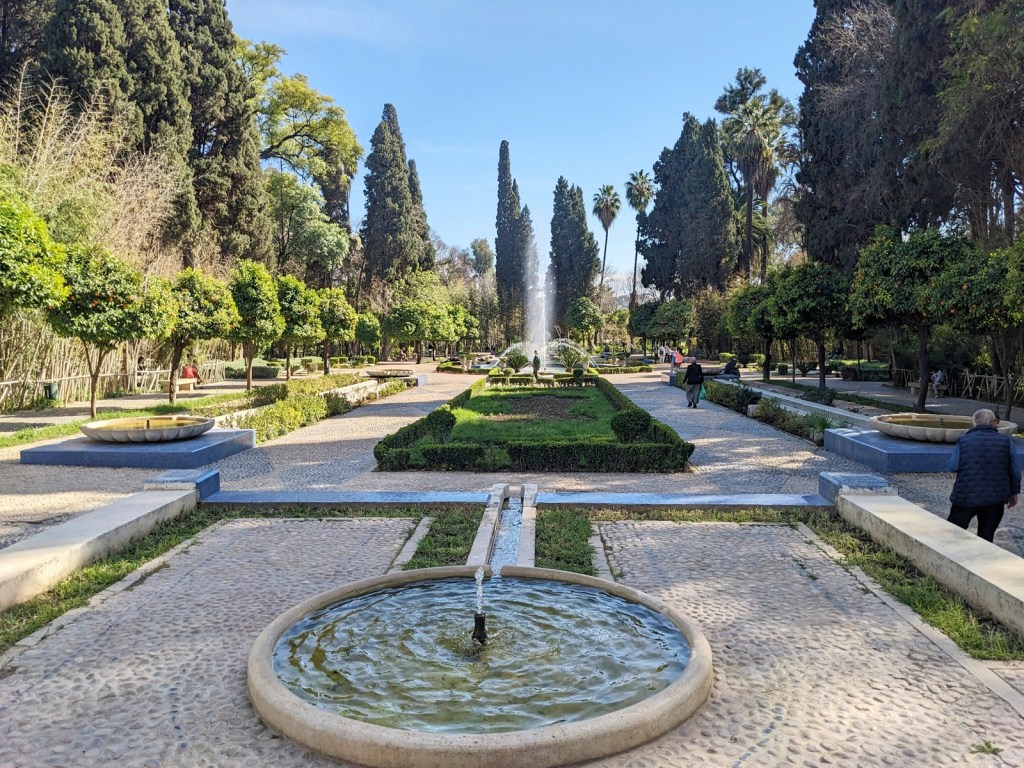
The Jnan Sbil Gardens.

And that was very nearly the end of our shopping. We poked around for some slippers but didn’t find any we liked, so with our two purchases in hand we head back to the riad before setting off on our next adventure. We had gotten a thorough tour of inside the medina, so now we were going outside the medina. To do this we arranged a car tour and met our driver Sadiq at one of the gates of the medina. He drove us around to look at different things while trying to explain them. It was fun but a lot of being driven around to different spots, which is suppose what we asked for. First we stopped at the Jnan Sbil Gardens, which were pretty. Sadiq had us wander around them for a bit. There was a section with guinea pigs, chickens, and pigeons in cages for reasons we were unable to determine. From there we popped over to the Jewish Quarter and looked at the cemetery. We checked out the door to the palace (or more accurately the seven doors) before it was off to a panoramic viewpoint. Sadiq had the joke of the day when he called it the “parabolic viewpoint” because of the all the satellite dishes. That was really good.

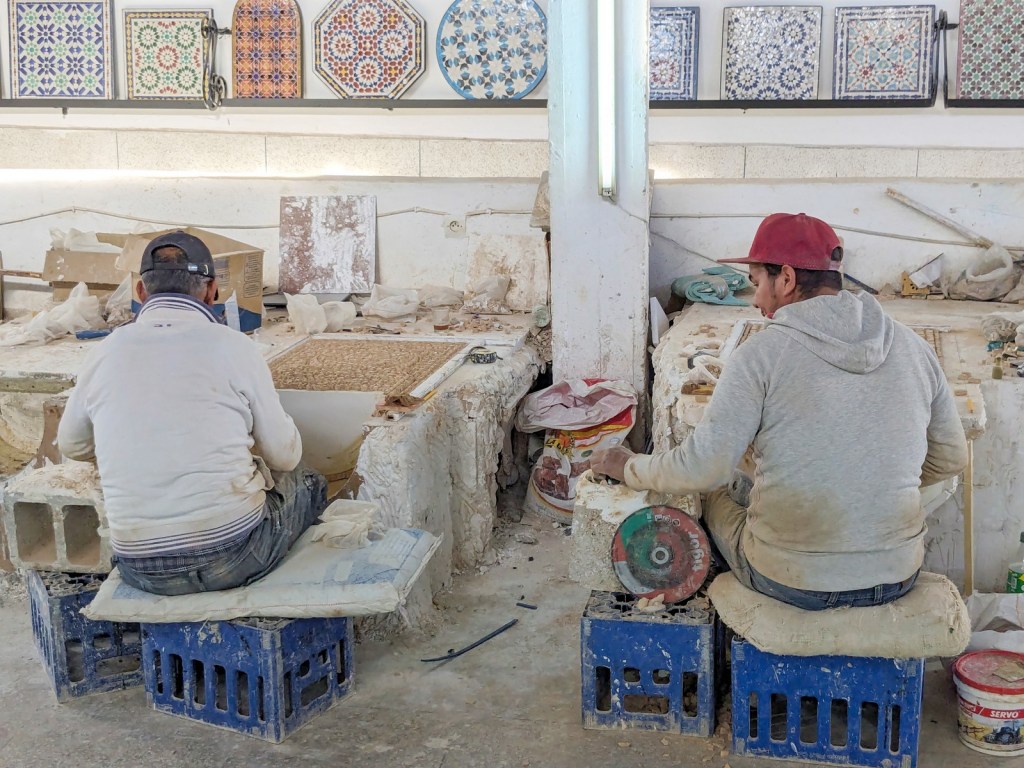
The highlight though was checking out Art Naji! Man that was really great. My super amazing wife was interested in the pottery and they have a whole factory there and they are super impressive in the way that people doing a certain thing day in and day out for years and years are. We had a little tour of the pottery making which included a guy throwing a tajine in just a few seconds entirely freehand. Then we saw them painting the things and while the main painter had some measuring tools mostly everyone was just again free-handing the things and they all looked perfect. But the most amazing part was the large-scale tile pieces they did. I was honestly blown away they so were gorgeous and intricate. Truly, very truly, poetry without words. The helical borders were the most amazing to me. Our guide from Art Naji made sure to point out their secure shipping methods but we couldn’t bring ourselves to ask the price. We did check out their gift shop but of the things in there I didn’t get any because they didn’t quite live up to the song in my heart that watching the process had inspired (it was more pottery in the shop than mosaic).

The ancient and new.

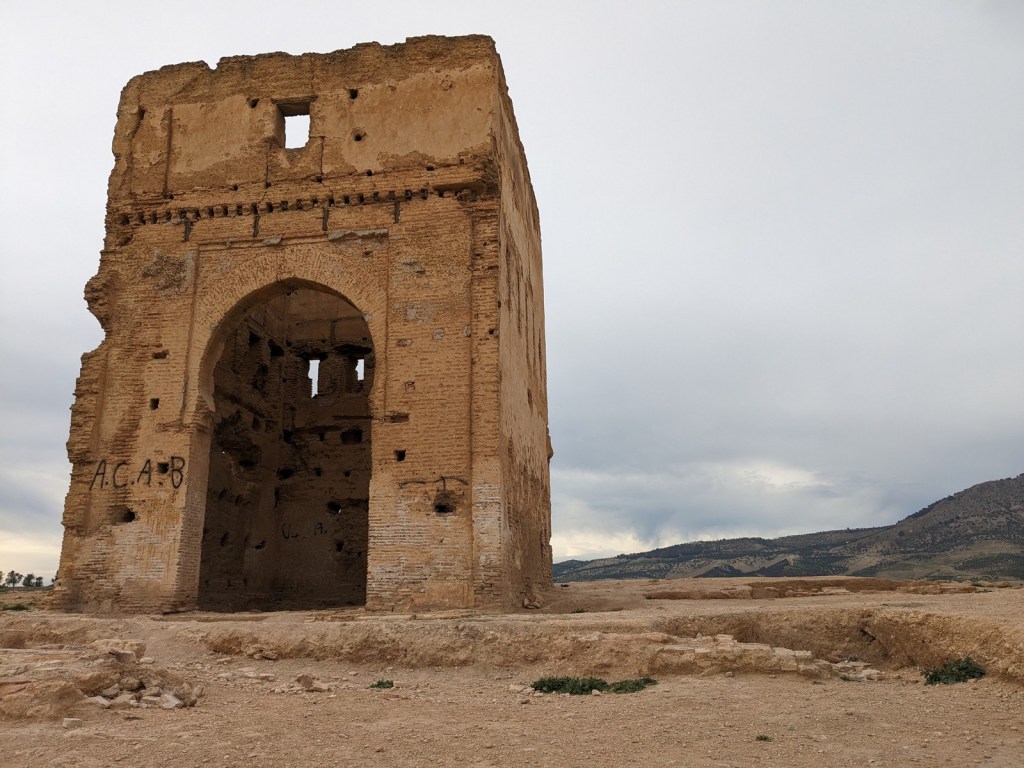
Filled with beauty though we left for another viewpoint, across from our parabolic view and beside the Merenid Tombs. We had been ensconced in the city but to see it from above was a different experience. The view really is stunning. A whole medieval city full of people and life and you are looking down upon it from the Atlas Mountains and it becomes mysterious and distant and a mass of puzzle pieces to pictures you’ll never see. Perfect.