YPs!

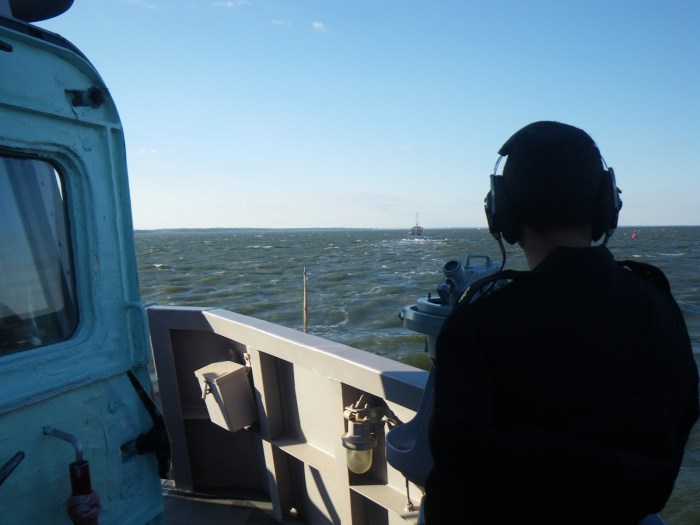
IMGP2814

Inspired by spotting that YP last week, I thought I would spend some time writing about them this week. YPs (technically short for “Yard Patrol,” Wikipedia, US Navy) are 110 foot long boats that are more or less designed to be a standard boat. Their purpose in life is for midshipmen to practice driving ships without having to like, go through all the time and expense of driving a destroyer around. Plus they’re smaller, so they fit in the Severn River a lot more nicely. They have two propellers and two diesel engines and a bridge and lookout stands and you can take ’em out and practice driving them around.

Every midshipman has some interaction with YPs. If you ask me, they should put a lot more effort into training midshipmen into surface warfare officers (SWOs), but nobody asks me. But you do things like seamanship classes and the like, and the practice evolutions for these classes are going out on YPs and driving them around. Some midshipmen interact with them even more and go on summer cruises on them for training. And then some midshipmen, some midshipmen are on the YP squadron.

IMGP2883

Some YPs from above.

For my first three years at the Naval Academy, I had less interaction than most with Yard Patrol craft. I was on the sailing team, you see, and we had a particular disdain for YPs. Why motor around on a YP, practicing going in straight lines and then turning on command, when you can sail around on the sleek, clean lines of a sailboat? But then halfway through my 2/C (junior) year, I decided to quit the sailing team when they wouldn’t give me a slot on a donated boat. Everyone at the Naval Academy is required to do a sport, and for that spring semester I was on my company’s intramural basketball team.

Senior year, however, I had come to miss my days on the water with the sailing team, and chose instead for my sport to do… YPs. I joined the YP Squadron, mentioned above. So this is wild. Like I just said, everyone at the Naval Academy is required to do a sport. Everyone. But one of the “sports” you can choose is to join the YP Squadron. What is wild is that it counts as a sport. What the YP squadron does is go out on Tuesday and Thursday afternoons and drive YPs. This mostly involves different people standing around in different, discreet spots, and maybe moving their hands or something and then saying things to each other. Absolutely wild that is a sport, but that is the sport I chose so I could get out on the water again.
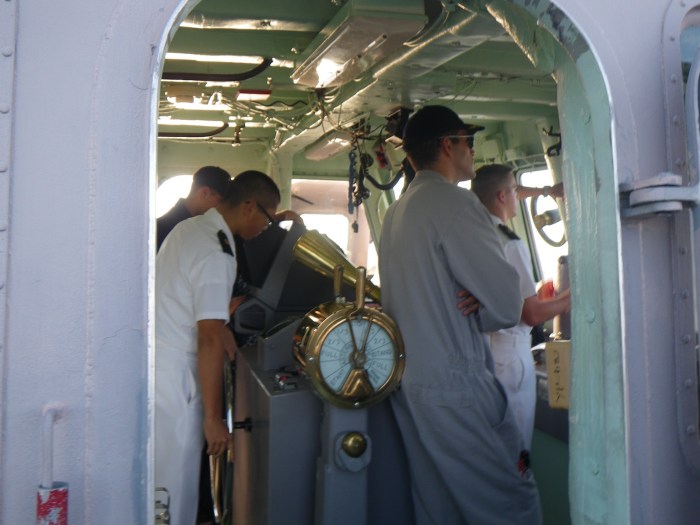
IMGP2813

Looking into the bridge from the starboard bridgewing.

The Naval Academy, as far as I could tell from my time there, does not have a chess team. It was my opinion that all the people that would have joined the chess team instead joined the YP squadron. You had to be a special kind of nerd to do this. What you practice on the YP squadron is standard commands and docking and undocking boats and then like, navigation. All of which I love, but YP squadron is your sport, so you had to love it more than like, playing dodgeball. Rare breed at the Naval Academy indeed, despite what you’d think. The YP squadron actually gets a fair number of Plebes to sign up every year, because over Plebe Summer the squadron gives them a talk about how amazing and awesome it is and Plebes sign up, not knowing better.
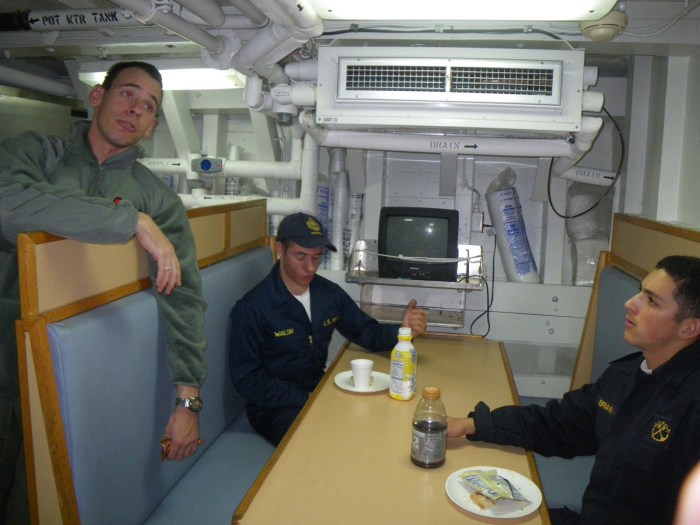
IMGP2876

Down in the galley, with our zoomie on the left.

The squadron itself is in a lot of ways pretty bonkers. If you’re an officer at the Naval Academy, and you just love SWO stuff, you try to help out with the YP squadron. The squadron also attracted the exchange officers. The British guys were always a special kind of crazy because they have a longer naval tradition, and their deck officers are just deck officers; they don’t tend to do engineering stuff too like American officers. So they are fanatical about navigation and try to instill this fanaticism on the YP squadron members. I don’t know if it worked but it was fun to watch. When I was there, the squadron also managed to attract an exchange cadet from the Air Force Academy. I guess he just wanted the full experience. If I didn’t care much about what we did, the zoomie really didn’t. Plus one time we toured a destroyer and he kept calling it a “boat,” much to the annoyance of the officer showing us around, and that was funny.

I actually had a great time on the YP squadron. I was a 1/C (senior) at the time, so no one really like, tried to tell me what to do. And you got to be on the water twice a week, which was fun. And no one got too mad if I just missed it (I actually had a chemistry lab scheduled concurrently, but it usually ended early). I actually did love navigation, and was pretty good at it, so I spent most every afternoon with the YP squadron taking one of the hapless plebes and teaching them navigation, which was relatively undemanding and pretty rewarding. I hope there are navigators out there who might not remember but at least picked up a practical tip or two before their navigation class. Plus it was nice just being out on the water.

Where other sports go to competitions or whatever, the YP squadron went on MOs (Movement Orders). That is, we would just drive the boats somewhere. This was usually pretty neat, because navigating the boats around was fun, and you got some good parking spots. When we went to Norfolk we parked right next to the Wisconsin, and when we went to Baltimore we parked right in front of the aquarium. The squadron also went to the Army-Navy game in Philly, which compared to the bus is a pretty luxurious way to travel. Then we parked next to the Olympia.
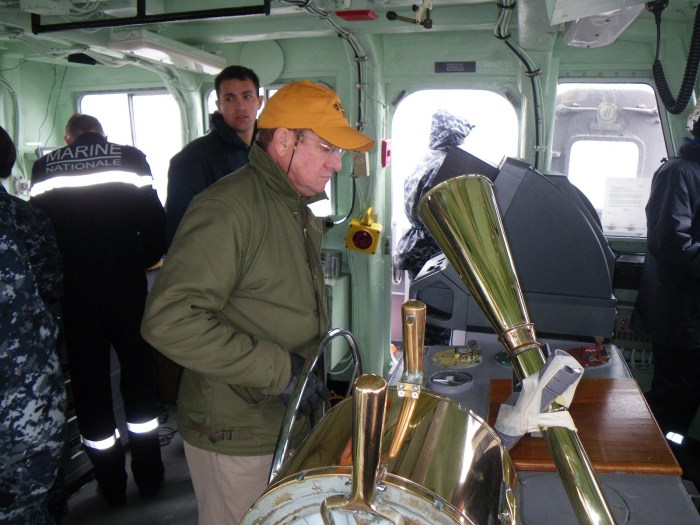
IMGP2921

Dad at the helm.

The trip to the Army-Navy game was especially fun because on the way back I got to bring dad. Turns out dear ole’ dad was actually commodore of the YP squadron back when he was a Mid, cementing him as an absolute bonkers NERD. But he had YP experience, and I asked nice, and he got to come with us on the way back down. I told him to not miss our underway time, and he was diligently waiting in the mess decks on the ship before the sun came up and before anyone was even awake. He spent some time at the helm while I was driving (standing officer of the deck), so I was ordering him around and that was fun. He tried to be chill about it all but he had a grand time, even digging up and busting out his old deck jacket from when he was driving destroyers around.

YPRON Cool

Imagine like, a bald eagle screeching too, please.

All in all my time on the squadron was absolutely great. For a professional writing/communications class my senior year, I even made a poster that was meant to promote the YP squadron, depicting some Mid on a lookout post looking patriotic (pictured above). I was hesitant to go to the YP Squadron annual dinner, feeling a bit like an interloper, but due to all the Plebes being underage and the organizers accidentally ordering too much toasting port, we had a great time talking YPs long into the (Tuesday) night. So I stand by my opinion that the YP squadron are all nerds, but for a bit… they were my nerds.
Navy Life Story: Sub Ride Part II

Reading this week:

  • Mimi and Toutou’s Big Adventure: The Bizarre Battle of Lake Tanganyika by Giles Foden (a perfectly normal adult book, besides the name)
  • Cry, the Beloved Country by Alan Paton (I worry this is a feel-good book for white people)

One of the more exciting times came when we did Midshipmen ops. During 2/C (Second Class aka Junior) Summer, Naval Academy Midshipmen go on PROTRAMID (PROfessional TRAining MIDshipmen), which involves a lot of stuff, but includes 24 hours on a submarine. The submarine pulls into port, a whole bunch of Midshipmen board, the submarine goes underway, dives, does some typical submarine-y type operations, serves everyone pizza, and then pulls in and discharges its Midshipmen cargo with them hopefully buoyed by wonder at the submarine life. Midshipmen ops on the Montpelier started about three days after the rest of us had come aboard, so by this time I was practically an expert in all things submarine-related. The Midshipmen that came aboard where actually ROTC Midshipmen, so I didn’t know any, but we had the same rank insignia and therefore I was a friendly face. I guided them in the essentials of Midshipmen life on a submarine, such as “how to ask to go up to the bridge to look at the ocean” and “where are the bathrooms.” That was fun showing off, but I was equally glad to be rid of all the other Midshipmen, and hear the crew complain about how annoying Midshipmen ops are. “Ah but you’re different,” they told me, a Midshipman, mostly because I was sitting within earshot (to be fair to me, Midshipman ops are annoying because doing all those different activities in 24 hours is taxing on the crew, and the Mids take up a lot of space and force people out of their bunks so the Mids have a place to sleep, whereas the longer-term ride-alongs like us don’t really impose any additional requirements on the submarine except that we occasionally bother people by pushing the “test lamp” button on the Tomahawk firing panel to make all the lights light up).

I remember being most impressed by the captain of the ship, who’s name I entirely forget. One time I came up to the bridge to find the captain already there. He had both the legs and sleeves of his coveralls rolled up, and his hat on backwards, enjoying the weather and driving around his nuclear-powered warship. I remember thinking that was just so cool, him relaxed as can be in total command of his domain. This trip was also my first real glimpse of the terror a Navy captain can instill. One of our limited duties as Midshipmen onboard the submarine was to get the movie ready every night in the wardroom. This involved loading up the DVD and getting the popcorn ready. One night we finished watching the movie, and the captain said “Tomorrow we’re gonna watch Talladega Nights.” So the next night we go to set up the movie, and flip through the wardroom’s large binder of movies, but we don’t find the ballad of Ricky Bobby. We ask around, and no one’s got it. So, being the enterprising young Midshipmen we are, wanting to forge ahead and not bother Garcia (I hate that book), we simply chose another movie. Shortly before the movie was about to begin, we casually mentioned this to the XO. “Oh no,” he said, fright evident in his eyes, “that’s not good.” This initiated a flurry of activity. People were woken up. Audio-visual systems were to be rerouted. Additional potential sources of movies were hunted down. Panic commenced when none of these options were bearing fruit. Suddenly, the captain walked in! We told him that we didn’t have the movie. The captain then simply walked out. We figured we were doomed. We couldn’t find the movie! How much of an abject failure could each of us be? But then shortly thereafter the captain simply returned to the wardroom, tossed a copy of the movie on the table, and stated flatly “Man to do a man’s job,” and we watched the movie.

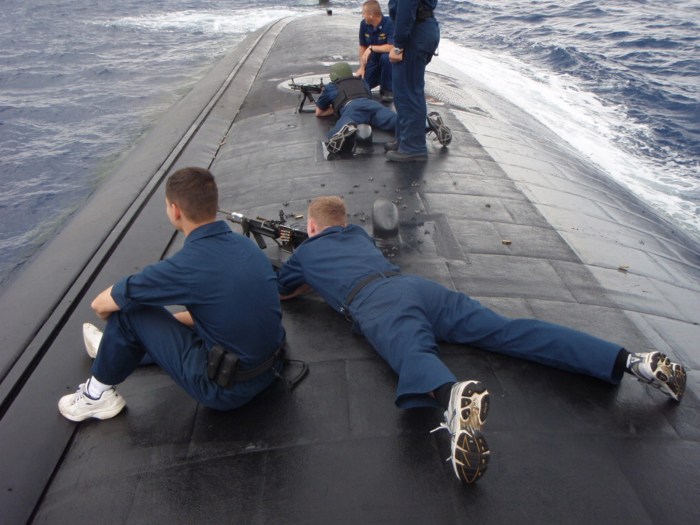
Other exciting things happened during our time on board. We had two swim calls, to take advantage of the Caribbean weather. These are what it sounds like, where the submarine surfaces, stops, and people can go topside and go swimming. Also during this event we had a gun shoot (on the opposite side of the ship as the swim call). The ship came up with some excuse that they needed to shoot the 50-cal they had onboard for force protection, and we got to fire it and some boxes they had wrapped in plastic bags (submarine cruises are very very much recruiting trips). In the battle of AUTEC, the boxes lost, let me tell ya. Smoking was banned on submarines in 2010, but on this trip I also made sure to smoke a cigarette or two just for the novelty of smoking underwater. I had been given the advice to bring a pack of cigs or two onboard even if you didn’t smoke, because hanging out in the smoke pit and giving a away a few cigarettes was an effective way to make friends. I also fondly remember the ship’s gas-station-style cappuccino machine; the galley was small enough that in the right spot you could sip your cappuccino and then reach over and refill your cup without getting up from you seat. Heaven, truly.

Like I said at the beginning, this trip is what convinced me to go submarines. What I liked is how small and tight-nit the ship and the crew seemed. No one seemed aloof or distant, and there were few enough people it seemed you could get to know everyone. People were friendly, or at least willing to give you their time. The crew was irreverent that seemed especially appealing to 19-year-old me. I remember one Chief yelling to another that was disembarking “DON’T FORGET MY GOAT PORN” for when he was to return to the ship. It was a short ride, and after nine days we were off, loaded onto a tugboat that came to meet us and bring us back to shore. Quite the good time.

Swim call cigars.

Navy Life Story: Sub Ride Part I

OLYMPUS DIGITAL CAMERA

Reading this week:

  • The Savage Wars of Peace by Max Boot
  • A Problem From Hell by Samantha Power

If you’ll allow me to briefly skip over the entirety of Plebe Year in my Navy Life Story, I’ll talk about my submarine cruise during Youngster Summer. Every summer at the Naval Academy, you have professional training. This was split up into several different blocks, and on one of those blocks you went on a Fleet Cruise, wherein you did something with the fleet, aka the Navy outside of the Naval Academy. Each summer is named after the following school year, so Plebe Summer becomes before your Plebe (Freshman) year, and Youngster Summer comes before your Youngster (Sophomore) Year. My Youngster Summer I went on a submarine cruise.

During your Youngster Summer, your options for your fleet cruise are limited to either a surface cruise, where you go on a surface ship, or a submarine cruise, where you go on a submarine. The point of this cruise is to give you a taste of what life is like for an enlisted summer. Back in the day, like 1900, you would actually do like, work, but I think these days mostly Midshipmen just sorta wander around the ship looking lost. I can’t remember if submarine cruises or surface cruises were the more popular choice (you did whatever the Academy told you, but you got to put in preferences). Anything submarines-related was generally unpopular at the Naval Academy, but the submarine cruises had the advantage of tending to be shorter. The surface cruises were all for a month, but I wound up on a submarine for a whopping 9 days. I had put in my preference to go on a submarine because I was genuinely interested in submarines, I promise.

This cruise really cemented my desire to go submarines. Usually when I tell the story, I pithily say that “I found my people; they took me in, fed me coffee, and I was quite happy.” The first step was reporting to the Naval Academy, where we stayed overnight for some processing. I was to go on the USS Montpelier, which was stationed in Norfolk. Since it was pretty close, they just drove me down there, along with some other Mids. There was to be three of us on this particular submarine. We were driven by a newly-minted Ensign, who was at the Naval Academy on temporary duty, and had no real idea what was going on. He drove us to Norfolk Naval Base, and then drove along the pier until he found a submarine, and tried to just drop us off. We objected to being dumped on the pier next to some random submarine, so he next drove us to the squadron headquarters. This went better and we checked in with squadron and eventually checked into the on-base hotel for the night. Our submarine was leaving the next morning, and we’d come on board then before departure.

Now that I am writing this I am struggling to remember anything about the first day or so of being underway on the submarine. It must have been fairly overwhelming. Honestly I’m not even sure about the hotel thing, but it seems right. I do remember two officers from the ship picking us up and taking us out to dinner, which was fairly exciting because like, here we were meeting real life officers out in the fleet doing fleet stuff. Also they bought us dinner, after one guilted the other into it, citing the fact they got paid way more than we did. The next morning we must have gone to the submarine with our stuff. We probably sat in the wardroom for a bit while doc got us our TLDs (thermo-luminescent dosimeters, aka radiation detectors) and someone briefed us on the ship and had us sign whatever paperwork we had to sign. We were assigned bunks. I do remember getting the “Iron Cross,” as that particular bunk in 9-man berthing is known. Unlike most bunks, it is half hidden behind some other bunks, leaving a relatively small hole where you can enter it. And it’s the top bunk, all of which means you have to do some particular gymnastics to get up into it. I tried to minimize the number of times I had to crawl into that thing, unusual for a Midshipman.

There frankly wasn’t a whole lot for us to do on the submarine. We were assigned crew buddies, who we were nominally supposed to shadow. I don’t remember his name, but my buddy was a firecontrolman, who stood his watches in the control room. That was convenient because it gave me a pretty good excuse to hang out in control and sit at the fire control stacks. The major advantage there is that was the easiest way to figure out where we were in the world, by looking at the chart on those stacks. This was my first time underway on a ship, and since a submarine doesn’t have windows, it’s a little disorienting figuring out where you are in the world. Over the nine days we were on the submarine, it was slated to first drive down to Cape Canaveral for some Midshipman ops (I’ll explain later), and then to AUTEC in the Caribbean to do, uh, something I guess. I tried to spend a reasonably large amount of time with my crew buddy there to learn the ins and outs of submarine stuff. I eventually figured out someone friendly on each shift I could hang out with and so that’s mostly what I did, hanging out with people on watch. Quite the life.

Please come back next week for Part II, so I can stretch this into two weeks of content. Thanks!

CelNav

IMGP0802

This story doesn’t really have a point, but I was asked in a conversation recently if I had ever learned to navigate by the stars, and I didn’t really get to answer, and there is a pandemic going on. The short answer is yes.

Back at the Naval Academy, I was on the sailing team and over the summer we would compete in various races with the team. That year I competed in the Marion-Bermuda Race, which runs in the years that the more famous Newport-Bermuda race doesn’t. The exciting part of this race, unlike its more famous cousin, is that it is a celestial navigation race. You got more points (or more accurately weren’t penalized) if you navigated the entire race using celestial navigation instead of GPS.

So that was pretty exciting! We got to learn how to use a sextant and stuff! I think I was officially the assistant navigator on this little journey, but firmly the celnav guy, and dove right into it. I was already firmly a Bowditch fan, so this was a lot of fun. I learned all about how celestial navigation worked, got pretty familiar with a variety of stars, and would plot sun lines by hand even though we wound up using a computer program to try to plot star shots. Before the Bermuda race we also did the Annapolis-Newport race, and although that was a GPS race we took the opportunity to practice our celnav skills and it was all pretty great! (that photo up top is of me doing navigation stuff on the sailboat)

Then came the actual race itself, which was overcast the whole time. It is pretty hard to do celestial navigation when the sky is covered in clouds. We got exactly one star shot during the trip, and we frankly weren’t sure whether to trust that more or our dead-reckoning position more. The most significant lesson I learned on that trip is you can dead-reckon your way across an ocean. The rule was that you could turn on your GPS within like, 30 miles of Bermuda, so when we thought we were within 30 miles we turned it on, discovered we were really like 50 or something out, turned it back off again, and repeated that process until we were in fact like 30 miles out. We got second in the race! Pretty good!

Anyways, flash forward about five years when I was a submarine officer and held the title of Assistant Operations Officer which, due to reasons, put me in nominal charge of navigation department. My most significant task in that role was approving the maintenance schedule, which is how I discovered that we had an annual maintenance item to check the ship’s sextant. This is how I discovered that we had a ship’s sextant. That was cool! A sextant onboard! Sextants are cool! I have no idea why we had one. I mean, presumably in was in case of emergencies, but I really cannot conceive of the scenario where a submarine would use a sextant. Like first the GPS system would have to go down, and then with all the backup and inertial navigation systems on board, and then the fact we would have to surface to use the sextant, there just isn’t any way we’d use it. I also had trouble figuring out how you would actually go about using it, even if you were on the surface. Not that anyone on board would know how. Except, you know, for me.

Since I knew how to use a sextant, navigation division decided to have a training on celestial navigation, which I would lead. I was looking forward to this, the division was looking forward to this, it was great! Until I was in the wardroom happily putting together my training PowerPoint. I didn’t usually hang out in the wardroom, almost entirely due to reasons like what happened. The squadron ops officer, who used to be our navigator, was on board for an exercise or something. He saw me putting together the Power Point, and asked what I was doing. I explained what I was doing, and then he asked why the hell I was doing that.

There’s actually a lot of use in learning celestial navigation, even if there is no conceivable reason a submarine would ever use a sextant. There’s a lot of really basic navigation concepts that you get to flex in interesting ways. And lemme tell ya I think submarine crews (maybe not navigation division itself but officers for sure) lack knowledge in basic navigation concepts. You have all these systems and computers that put a lot of it out of sight and out of mind, and so people just come to expect a magical box to give them their position and don’t think much about it, but things can go wrong and it is important to both understand what the magical box was doing and the thought behind it so you could actually rely on the magic box. Somethings the magic didn’t work right and when you run a $2 billion submarine aground people don’t really accept the excuse that “well I didn’t really question the magic box.” So there was a lot of use to it! Plus people were excited for it! No one is ever excited about training!

But the SQOPS apparently didn’t approve of celestial navigation training despite my reasoning. But that didn’t matter, he’s not in my chain of command. But then I guess he told the XO, who yelled at the current navigator, who was my boss, and who yelled at me. This was mildly annoying because the navigator APPROVED the training plan! That said I was going to be training on celestial navigation! And now he was yelling at me for trying to carry out the training plan he approved! It’s things like this that made me quit the Navy. But thankfully nav bought my “it’s really training on basic navigation concepts disguised as celestial navigation training” and so I got to do the training and play with a sextant and everyone loved it and it was a great Power Point to boot.

Lying II

VOST 143

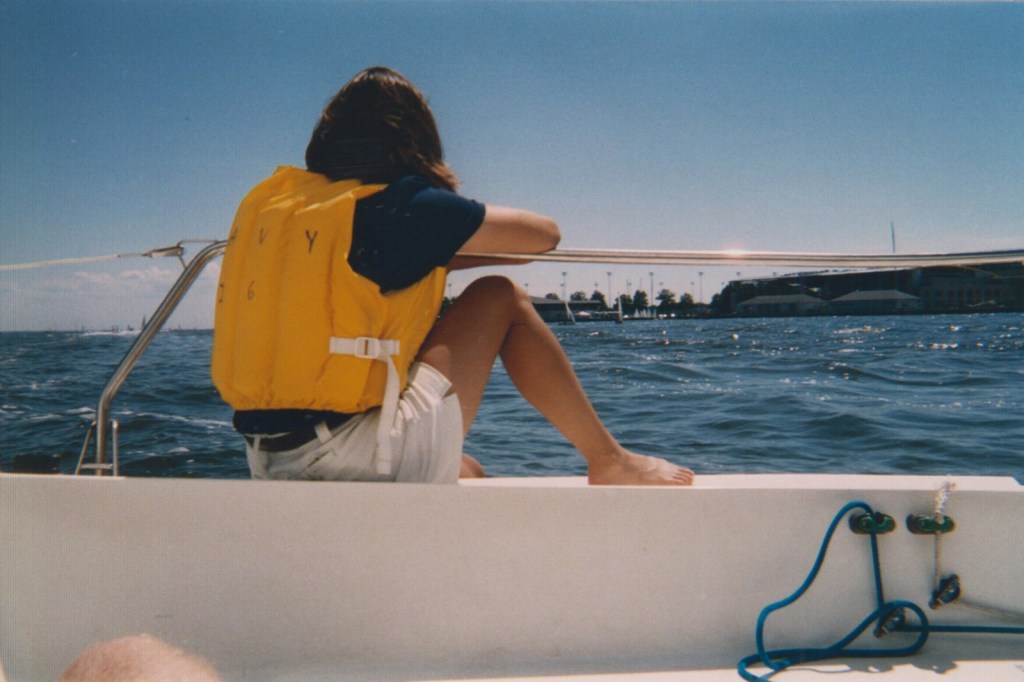
Pic also unrelated; before I was on YPs I sailed.

Reading this week:

  • Do Morals Matter? by Joseph S. Nye (this was not, as I was hoping, an analysis of how moral frameworks impacts presidential foreign policy decision-making)
  • Disasters and Development by Frederick C. Cuny
  • Famine, Conflict, and Response by Frederick C. Cuny with Richard B. Hill

It was a lie by omission, to be sure. I very purposefully didn’t tell the Engineer what I had done. Instead I frantically tried to call the divers back down and get them to sign my tagout sheet, because if they signed that then there would be no evidence that I cleared the tags improperly. I guess that’s more than just lying by omission, and I was trying to implicate others (unbeknownst to them) into my scheme. Eventually the diver came back down, because he realized he had not signed the sheet. He signed it, and we were Good to Go. Until I was discovered the next day when my Shutdown Reactor Operator reported me to the Chief of the Boat. He didn’t actually know I lied, he just thought there were double standards at play over what an officer would get in trouble for versus an enlisted sailor. But he made the right call and I never begrudged him for reporting me.

Once I was discovered to have lied, everything I thought would happen did in fact happen. I was removed from watchstanding, issued a letter of reprimand, and it affected my reputation with the crew and the chain of command. I learned lessons from all of that, but that’s not really the lesson I wanted to share with you. I learned that day why people lie.

I learned that it isn’t stupid people that lie, or lazy people, or bad officers, or bad people. I learned there isn’t anything inherently wrong with someone that lies (let’s except sociopaths and the like from this discussion). I learned that people will take the easiest path, and people lie because it is the easiest path.

That sounds disingenuous to people. People make the tough decision all the time. They take the courageous path and certainly don’t take the easy way out. But I think it is a matter of framing. We train people on integrity so as to make the thought of lying so distasteful and so unimaginable that it won’t be perceived as the easy way out. We try to make it so that to lie would be to condemn yourself to endless days of questioning your own identity and self. We punish lying severely so the consequences of lying are clear to all. But still I lied that day about the tagout violation, and I lied because the consequences of telling the truth and reporting myself seemed so unimaginably overwhelming that lying was simply the easier thing to do, and I did it.

The lesson I learned about leadership is that if one of your subordinates lies, that is a huge and immediate signal that something has gone wrong with your leadership and the system you have set up. If someone lies, they are still responsible for that lie, and that lie should be met with the appropriate consequences. But if a person lies that means that you, as a leader, have set up an environment where telling the truth is no longer the easy answer, and you need to immediately rectify that. Sometimes that is hard or impossible. The sheer nature of the submarine service means that there are huge pressures on everyone nearly all the time, and so a lot of times the only option is to make lying have even more devastating consequences.

But nonetheless analyze the rest of the situation. Why did this person feel like lying was the easy way out? Is it that when they tell the truth, it is met with such negative consequences that it doesn’t make telling the truth worth it? Have you set up bad incentives? Do you shoot the messenger so no one wants to tell you the truth and only tells you what you want to hear? Maybe instead your subordinate has been heaped with such responsibility and innumerable tasks where it is impossible to get them all done. If they’re honest that the tasks they have been assigned are impossible, is something done about that, or are they told to just get it done anyways? And if the answer is that these impossible tasks have to get done, no matter what, why wouldn’t they lie? What other choice were they left?

When a subordinate lies, look at the situation they were in and figure out why the choice they made was the easy choice to make. Expand your scope to the other people that work for you. See if they are in a similar situation, and be proactive to make telling the truth the easy and obvious answer. Training people on integrity is important, and it is important to do it regularly. But people only ever act in response to the situation and environment they are placed in. You, as a leader, don’t get to make people’s choices for them. But you are the one that creates the environment in which they make those decisions. Make sure it is an environment in which people can make the good choices you want them to make.

Decisions II: Regret

Emory S. Land Executes Operation AJAX

US Navy again.

Having just written about decisions, and having just watched a documentary on Robert McNamara, I wanted to write a follow-up. Towards the end of the documentary the interviewer asks Bob there if he had any regrets about the war. I decided a while ago that when it came to regret in decision-making, that would have a very specific meaning for me.

If you make enough decisions clearly some of them will go poorly. But as I wrote in the last blog post, you can never know the counter-factual about your decisions. If decisions go poorly, you should look back and analyze what went wrong and how it could have gone better, in order to extract lessons learned from the event. If there was a bad outcome, you should look back and be sad about the negative consequences of the decision. But that’s not the same as regret. A lot of things become more clear in hindsight, and forces and factors will play out how they play out after your decision is made. Instead, I would reserve regret for decisions you knew you had made wrongly or poorly at the time you made them. Regret is reserved not for decisions that necessarily went poorly, but for decisions where you did not do your best in making them.

Back on the submarine, we would have critiques and a common “root cause” people tried to cite for when things went wrong is that they felt rushed, or had an “undue sense of urgency.” This usually actually translated into “it was near the end of the work day and I wanted to go home, so I rushed the work.” So our XO called us into the wardroom one day and clarified that “an undue sense of urgency” would be reserved for situations where someone was holding a gun to your head and telling you to get it done.

Flash forward a bit and we’re in the shipyard in shift work. The days in shift work are endless and we were coming up on a deadline to get out of there. I was the Reactor Control Assistant at the time, and the division was supposed to get a piece of testing done. If we didn’t get the testing done, we couldn’t leave the shipyard when we wanted, and this would have made people upset. I got relieved from my shift as Engineering Duty Officer, and was trying to help get the maintenance started per the schedule. The on-watch EDO didn’t want to do the maintenance. I pushed where I thought appropriate, but it was getting late and the the guys that were supposed to do the maintenance were coming up on 20 hours without sleep, and the maintenance was supposed to take several hours. So I gave up and went to the wardroom to work on my own qualifications.

There I found the XO. I sat down and he asked me about the maintenance my division was supposed to get started. I explained that I Just Couldn’t Get It Done. Then this man, that had explained that an “undue sense of urgency” was “someone holding a gun to your head,” he looked me straight in the eye and said to me “you know, sometimes you wish you could just take people out back and shoot them.”

The XO and I did not have the greatest relationship. This was not friendly banter. I understood that he was talking directly to me and about me. And reflecting on the gun comment, I thought I had top-cover. This was exactly the undue sense of urgency he talked about, and if things went poorly I would walk into the critique and say proudly exactly why I thought that sense of urgency was undue. So I got up, left the wardroom, and went back to the engineroom to Just Make It Happen. I cajoled the EDO, and told him the Division Chief and I would personally supervise the thing. So he relented and let us do it.

The guys were pissed. They were not happy about this. They needed sleep. They too were going to just be coming back up on watch soon. They were exhausted. But we felt like we needed to make this happen, and I felt like I had been threatened. So I “supervised” the maintenance but mostly I was standing guard to wake guys up in case the XO or the Naval Reactors rep came around the corner. My guys were falling asleep in the midst of this maintenance. This was Reactor Controls Division maintenance too, on the systems that monitor the nuclear reactor. I was myself falling asleep standing up but since I was standing I was slightly more awake than the guys.

And the whole thing went fine. We completed the maintenance. No mistakes. We reviewed and submitted the paperwork. We did our bit and after a lot of other stuff the ship left the shipyard on time (well, way delayed, but “on time” on the delayed timeline).

The decision to go ahead and push that maintenance is one of my bigger regrets.

That maintenance did not need to get done. It was going to prevent the ship from getting underway if it wasn’t completed, and a delay would have delayed other things, but no lives were in the balance here. It would have been annoying and caused a lot of headaches to get delayed, but no one would have been unsafe. But because I felt some pressure from my chain of command, I went ahead and made it happen. I set a bad precedent for my guys, and overturned every discussion we had ever had about fatigue and safety and the importance of doing reactor controls division maintenance right.

And most importantly, the whole time I knew the right answer. The right answer would have been to push back, to say, look, it’s impossible to get this done right now, my guys are too fatigued, and here’s the schedule for getting it done. It doesn’t matter what the XO said or a theoretical threat to get taken out back, I was there as an officer in the US Navy to make the right decision even when there is pressure to do the wrong thing. And I failed that test. I reflected and learned and grew from that experience, and I was young and inexperienced as a leader and decision-maker, but I don’t get that decision back. If I had just been stupid and made the wrong decision out of stupidity, I could forgive myself for that. But because I didn’t do my best in making the decision that day, I regret it. It wouldn’t be the last or the worst decision I came to regret, but it was an early one and indicative of the framework I would eventually develop.

Plebe Summer Part V: A Love Story

This is hopefully my last “Plebe Summer” post, though depending on how long this pandemic lasts I reserve the right to circle back around.

The story I should have actually told by now in my Plebe Summer series is that I was dating another Plebe at the time. This has gotta be fairly unique. Sure, you meet a lot of people over Plebe Summer, but it’s not exactly a great time to meet someone.

Let’s call her K. I was in love. I was in love with that teenage love that made her seem like she was the only part of the world really in focus. We had started dating in High School. We were in the same program, and it was a small program, so we knew each other. Senior year I finally asked her out and she accepted. We didn’t start dating because of our mutual desire to go to the Naval Academy, but I guess having mutual interests doesn’t hurt. Like the majority of women in my life, she was much more dedicated and organized and tenacious than me, and she had been much more successful far earlier in the application process than I was, and was accepted way before I was. We talked briefly at one point about my backup plan if I didn’t get in, which consisted entirely of hitchhiking to Florida, stealing a sailboat, and going to the Caribbean.

Thankfully, I did eventually of course get in. The first thing I did was drive to K’s place to show her my acceptance packet. That was a good day. So we knew we had the rest of the semester together, and our short summer, and then it was off to the Academy. We didn’t plan on seeing each other much over the summer. You don’t want to draw a lot of attention to yourself as a Plebe, and having another Plebe as a girlfriend would have been a pretty big way to go about doing that. We also didn’t think it would work, or maybe it would just be suspicious, to send letters directly to each other, so we planned on sending them to our respective parents, who would then forward them to us. I think we only did that once. She also managed to get a note passed to me via some mutual contacts, and we wound up being able to see each other about once a week.

You know I was about to write “in a lot of ways it was nice to have a girlfriend going through Plebe Summer with you.” On reflection I don’t know if that was true. I was going to say that it was nice to have someone who knew what you were going through. But then again everyone I knew at that point knew what I was going through. I guess one advantage is that she, specifically, knew what I was going through, so I didn’t get the breakup letter some other people got. But I think I was probably a burden on her, and the relationship, or rather the existence of the relationship, probably mostly worked to feed my ego. We (I) managed to keep our relationship a secret for about half of Plebe Summer, I think. We wound up being able to see each other on most Sundays, because the Chaplains hosted a thing on Sunday mornings where they served donuts and Cadre weren’t allowed in. So we met up there, though sometimes I worried about shining my shoes and cut our time short. We’d also occasionally run into each other during PT or events like that. Later in the summer, when I was getting dangerously brave, I even wandered up to her room.

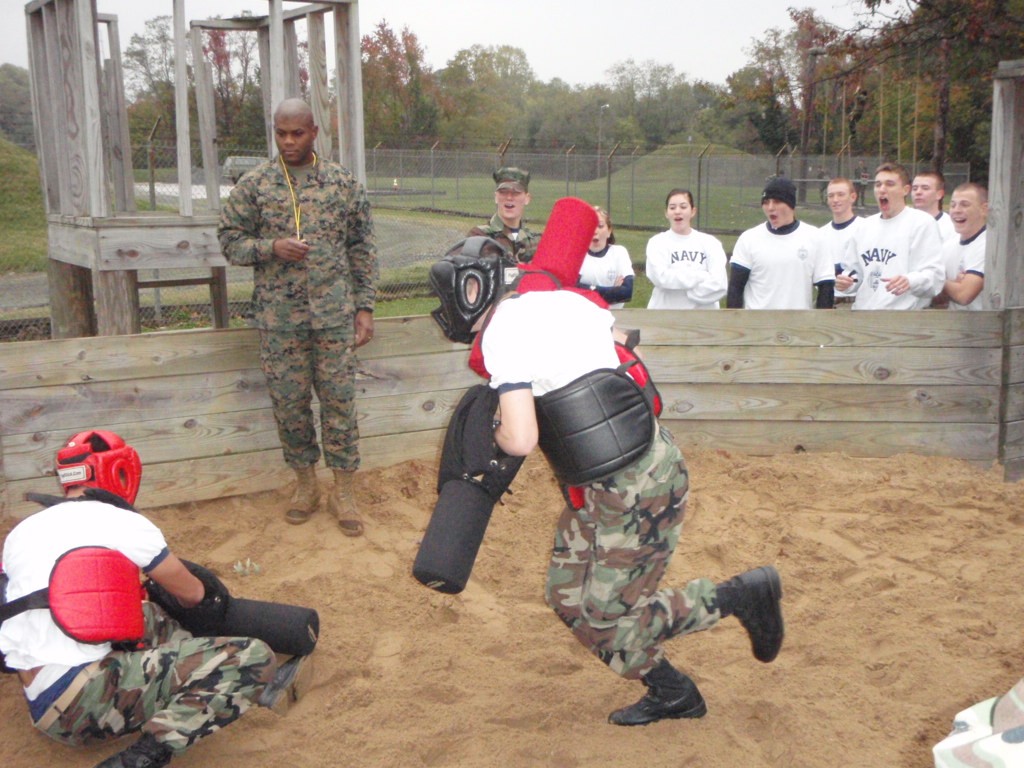
I was the one that let our secret out of the bag. I was stupid man. All Plebes are stupid, the act of becoming a Plebe makes you stupid, but I was stupider than most in a lot of ways, as I have mentioned. It was breakfast one morning and our Squad Leader decided to ask us all where our girlfriends were. So we were going around the table shouting (Plebes are always required to shout) various towns. I could have just said “Annapolis,” which was technically true and also very reasonable because I was local. Instead I got the bright idea to shout “SIR FOXTROT COMPANY SIR.” I still regret doing that. I mean at the time it fed my ego but the poor woman was just trying to fit in as a Plebe and not make waves and there I went blowing our secret out of the water. Man I was dumb. In some ways letting the secret out was nice. I remember during the Plebe Boxing Smoker I was allowed slash forced to go over and hang out with her and her squad. It was nice to see her, though again all I was really doing was attracting attention.

I don’t know if Plebe Summer was good or bad for the relationship. It probably wasn’t great? I thought about her a lot. At some point I thought it would be romantic to write her a letter that mostly consisted of the lyrics to a particular marching cadence, but thankfully I came to my senses before I wrote that out. That note she got passed to me was actually a note saying that we should talk, because she intended to break up with me. For better or for worse, by the time the note got to me and we could steal away for a tête-à-tête, she had changed her mind. Plebe Summer just changes you so much that we were really two new people figuring out who we were and who we were in relation to each other. Since in a lot of ways you change in the same direction it can kind of cover that up. The first time we got to spend any real amount of time together was Plebe Parent’s weekend, when we finally got some liberty. We of course went home and hung out with each other there. But we both refused to wear anything other than the proscribed PT gear, and kept our shirts tucked in, in accordance with the uniform regulations.

We survived Plebe Summer as a couple, and the rest of Plebe Year. We technically lived in the same building, though in different wings, and were busy enough that we would go days without seeing each other. She would eventually dump me early on in Youngster Year, and rightfully so. She hasn’t talked to me since.

Plebe Summer Part IV

Not Plebe Summer, but I don’t have many/any Plebe Summer pics. We didn’t have cameras, you see…

My Plebe Summer saga continues. I remember being sweaty, terrified, and confused most of the time. Most days, except for Sunday and Wednesday I think, started early with PT. We got up and got dressed and ran on down to the field to do whatever exercises they told us to do. I hated this. I was not exactly the most athletic Plebe on the field. Over the summer I got a whole lot skinnier, and although I got better at strength exercises my run time on the Physical Readiness Test actually went down.

After PT is was time for breakfast. Meal times over Plebe Summer were a mixed blessing. On one hand: there was food, and you got to sit down for a while. You ate as a squad, and we had the same squad for all of Plebe Summer, so that was kinda nice. On the other hand, your squad leader, who was the Firstie Cadre training you, was there, and their job was to grill you on all the pro-know (professional knowledge) that you were supposed to know. I tried to avoid getting any attention directed towards me, which is a good strategy for all of Plebe Summer, and one I failed at spectacularly. One of the most useful things about the Naval Academy is that they work really hard to beat the ego out of you, and while they were very successful when it came to me, my ego was large enough that whatever portions were and are left still manage to shine through. One of the bad habits I still hold onto from Plebe Summer is eating really fast. I gulp down food even when I’m trying to slowly. This winds up with some awkward situations on dates.

During the rest of the day there were a great many different activities. Plebe Summer has a whole program to train you up on the absolute minimum knowledge required to be a functioning little member of the Brigade of Midshipmen. Sometimes there were classroom sessions where we would learn about Navy history or the different ranks or something. Sometimes there were hands-on lessons about damage control or something. We had sailing lessons over Plebe Summer, which were always a great deal of fun. We never knew we’d be going sailing that day until we were ordered to change into our sailing gear, which was fairly identical to PT gear, but included wearing our standard-issue boat shoes, our standard-issue ballcaps, and putting on the standard-issue sunscreen. We even had a fine dining etiquette lesson one day. That’s a little surreal in the midst of Plebe Summer. You are running around getting yelled at and then one day the Cadre drop you off in this room you’ve never been to before and you’re told to sit down at these tables set with nice dinnerware and you learn to tear your roll to butter it instead of cutting it, to scoop up your soup by moving the spoon away from you, and to put your napkin on your chair to signal you’re coming back and to put it on the table to signal you’ve left for good.

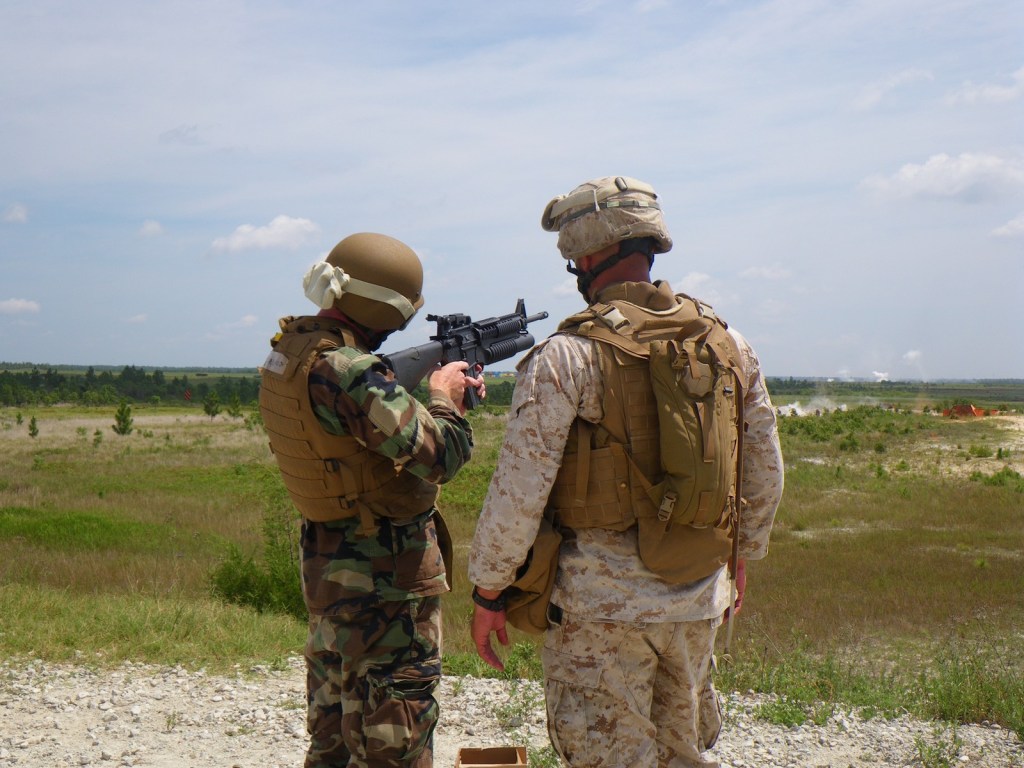
We also got to go shooting for a day. That was a lot of fun. The shooting range is across the Severn River, and I always enjoyed going across the river because you went across it in the troop transport boat things. Then the whole day was spent shooting, with the morning on rifle and the afternoon on pistol, or vice versa. They teach you how to shoot the things, and then you do some target shooting, and depending on how well you shoot you qualify and get to wear ribbons for “Qualified,” “Sharpshooter” (I think), and “Expert.” I managed to qualify Sharpshooter on the M-16, and Expert for Pistol. Qualifying Expert lets you wear a medal instead of just a ribbon, so that’s cool. This was the peak of my pistol performance, and as I requalified every year on the ship I just got worse and worse. This experience makes me forget though that some people out there have never shot a gun. I had shot rifles before in the Boy Scouts, but I am always vaguely surprised when other people haven’t shot a gun before just in the normal course of their college orientation.

One final part of Plebe Summer were the academic placement tests. Here’s a fun fact about me and Plebe Summer: I didn’t know that I was going to college until about halfway through Plebe Summer, when we were choosing our classes. I had thought that the Naval Academy as like, happy fun time boat school instead of, you know, a fairly normal academic setting that is tacked onto a military training command. It didn’t even click when I was doing the placement tests, which I managed to do pretty darn good on by the way. I managed to validate chemistry and got placed pretty high up in math, despite forgetting a calculator for my final placement tests. Doing well on the placement tests was nice from an academic perspective, but even better from a Plebe Summer perspective because not everyone qualified for the later placement tests, and doing a placement test meant that you had a few extra hours by yourself in air conditioning, away from the cadre. I was disappointed that I only validated one semester of the two required semesters of English, but the second test was mostly poetry analysis and while I think I am actually pretty okay at that I apparently wasn’t good enough. I still got to go around mentioning that I was a “Plebe High Validator” when I was getting myself into the French classes that Plebes normally aren’t allowed to take.

The final note I guess to make about Plebe Summer is communication home. Back in my day it was kinda limited. I hear the kids these days get like hour long phone calls every week or something. We got three phone calls total over the course of Plebe Summer. Those were an event. We all got to retrieve our cell phones from the big room where they kept all of our civilian stuff. We were lead out to the courtyard where there were these big paving tiles, and told to pick one and keep at least one between all of us, so we were each probably about six feet apart. We were told to dial, and wait to hit “send” until the appropriate moment. When the clock started, we hit “send,” and the call began. Our parents were given a heads up for when our call times were, so they could be prepared (we were kept in the dark). We were warned sternly to call our parents instead of our girlfriends or boyfriends (still Don’t Ask Don’t Tell then, so this is a gendered statement). This was mostly because our parents would inevitably miss us, and no matter how much we thought we were in love our significant others were likely to dump us. This was true for me, and is famously true for 98% of everyone else. So I called my parents every time (my girlfriend was actually also in Plebe Summer with me, which maybe I can detail next week) but I didn’t quite know what to talk about? Things were fine at home, I was doing fine (relatively), and so I would run out of things to talk about before the five minutes were up. At five minutes, the Cadre told us to hang up and we were yelled at if we didn’t. Other than that I wrote a good number of letters; this was encouraged and you got a talking to if you weren’t writing home (out of concern for your mental health). My parents sent a large number of letters and packages, which generally included cookies and drink mixes. This is what you want to receive over Plebe Summer, believe me.

I suppose I should stop there for this week. Maybe next week I can talk about the saga of dating over Plebe Summer. It went… fine.

Navy Life Story: Plebe Summer Part III

In case you’re not a longtime fan, the previous entry is here.

As I sit down again to write this, after only like a three year hiatus from the last entry and a span of 13 years since the events happened, I’m trying to think of a narrative to weave. I wander around thinking about it and I’m really surprised by all the little events and things I remember. It was so long ago. I was confused much of the time, though “confused” isn’t really the word for it. I am pretty good and simply shedding my perception of those things that aren’t really necessary for day-to-day existence and only focusing on the task at again, a skill that is useful for an event like Plebe Summer. There was so much that I simply didn’t realize was going on, through the sheer force of my own ignorance. I feel like a lot of the other Plebes simply knew more about the Academy than I did, having done much more research on the institution prior to applying, or maybe just because they paid attention at more of the right times. I didn’t know that Company Senior Enlisted was even a position for a long time, and so never quite figured out why that one Chief was always hanging around us. This is something I very much should have known – I think I probably cited her name multiple times a day when reciting the chain of command but it never clicked that this Chief walking around was the name I was yelling when ordered.

I covered up a lot of my ignorance with knowing a lot of other stuff. I grew up around the Naval Academy and used to live there when I was a small kid. I could suddenly put a lot of my dad’s stories into context so I had these weird little nuggets of information that allowed me to convey a broader understanding that I didn’t have. Plus I actually read Reef Points like you were supposed to whenever you had a second of downtime to just stand there. And I didn’t just focus on the stuff you were supposed to memorize, because that was boring, but read all the history and gouge in the back. So I think that must have made me seem like I knew what I was doing. Plus then again it’s Plebe Summer – it doesn’t require a whole lot of smarts, just enough sense to do what you’re told. I wasn’t great at that, but apparently just good enough.

Then again maybe it shouldn’t be remarkable to remember so much about Plebe Summer. It is an incredible time of forgetting and learning all in once. The point of Plebe Summer is to prepare you to enter the Brigade of Midshipmen, to become a fully functioning member of the society that is the Naval Academy. The Naval Academy made me in almost every way the person I am today, and Plebe Summer was the staging point for that growth and transformation. There is a weird phenomenon that happens over Plebe Summer that you shed so much of what you were before. We were warned at the beginning by one of the Cadre that we would simply forget much of what had occurred over High School and before. Not forget, I still remember High School, but the events that occurred before Plebe Summer fell from such significance to the person I became that they are relegated deeper into the subconsciousness just out of sheer irrelevance.

The first few days of Plebe Summer were about establishing the routine and habits that would carry us through the rest of the experience. Many of these were very weird, looking back. Many of these efforts were about saving time. I dry shaved over Plebe Summer for reasons that are still somewhat unfathomable to me – but it seemed to work. And I suppose it saved time in the morning. It was weeks or months into the Academic Year (so after Plebe Summer had ended) when I realized I could use shaving cream – and shaving became worlds nicer. We also didn’t use soap over Plebe Summer? Olsen suggested, and the rest of us simply took as gospel, the advice that we just use shampoo. There were four of us in the room, and when it was time to shower we simply left the shower running the entire time. The first person would get in and turn the water on. We each had been issued shampoo as part of our standard-issue supply, and one of these bottles was stationed in the shower. We used the shampoo as shampoo and as body wash. When one person was done showering, and they showered as quick as possible, they left the water on and the next person rotated in. I guess this saved time?

I’ll end with that for this entry, since it’s late and I’m already at like 800 something words. I’ll fill the rest of my Plebe Summer posts with memories about stuff. Someday it’d be a project to go back and put them in chronological order. I wrote letters home like you’re supposed to, and I’m sure mom has those saved somewhere. They probably smell like the rest of Plebe Summer did, which was a mix of sweat and Febreze. I still can’t smell Febreze without shuddering.

Battleship

Battleship Poster.jpg

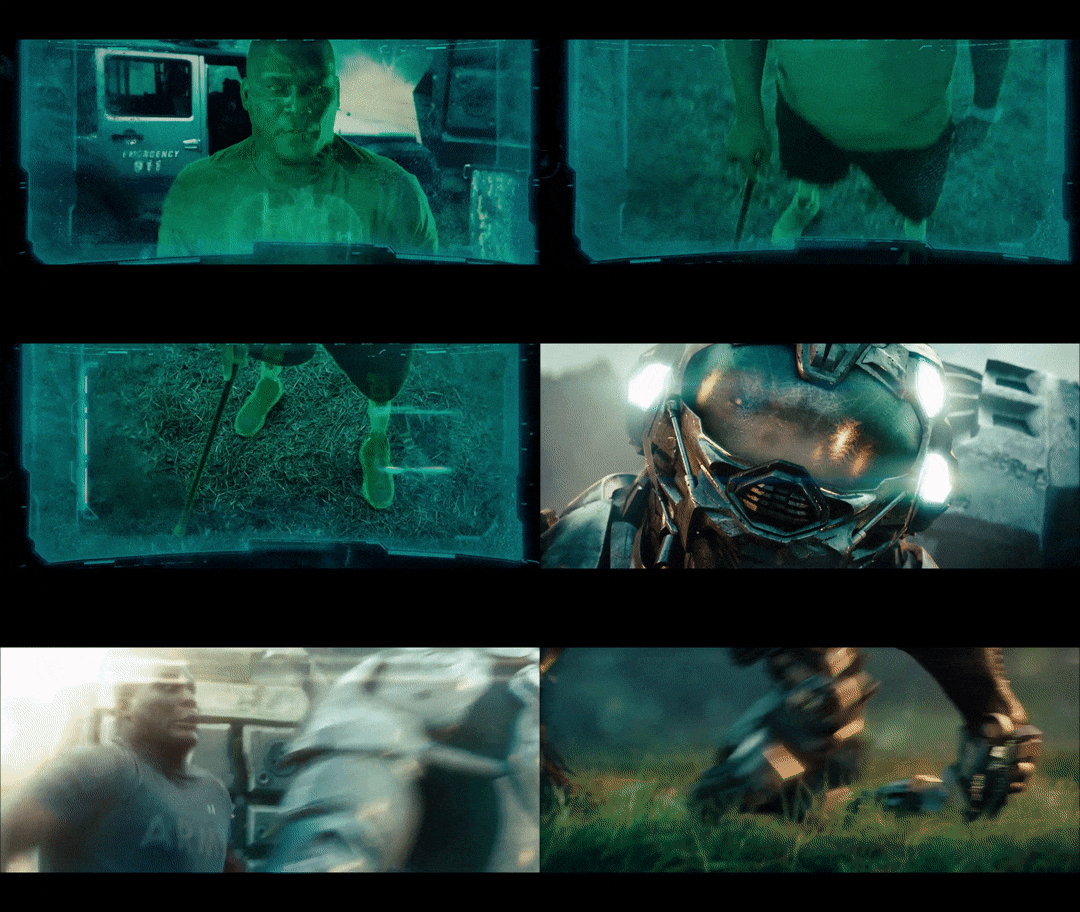
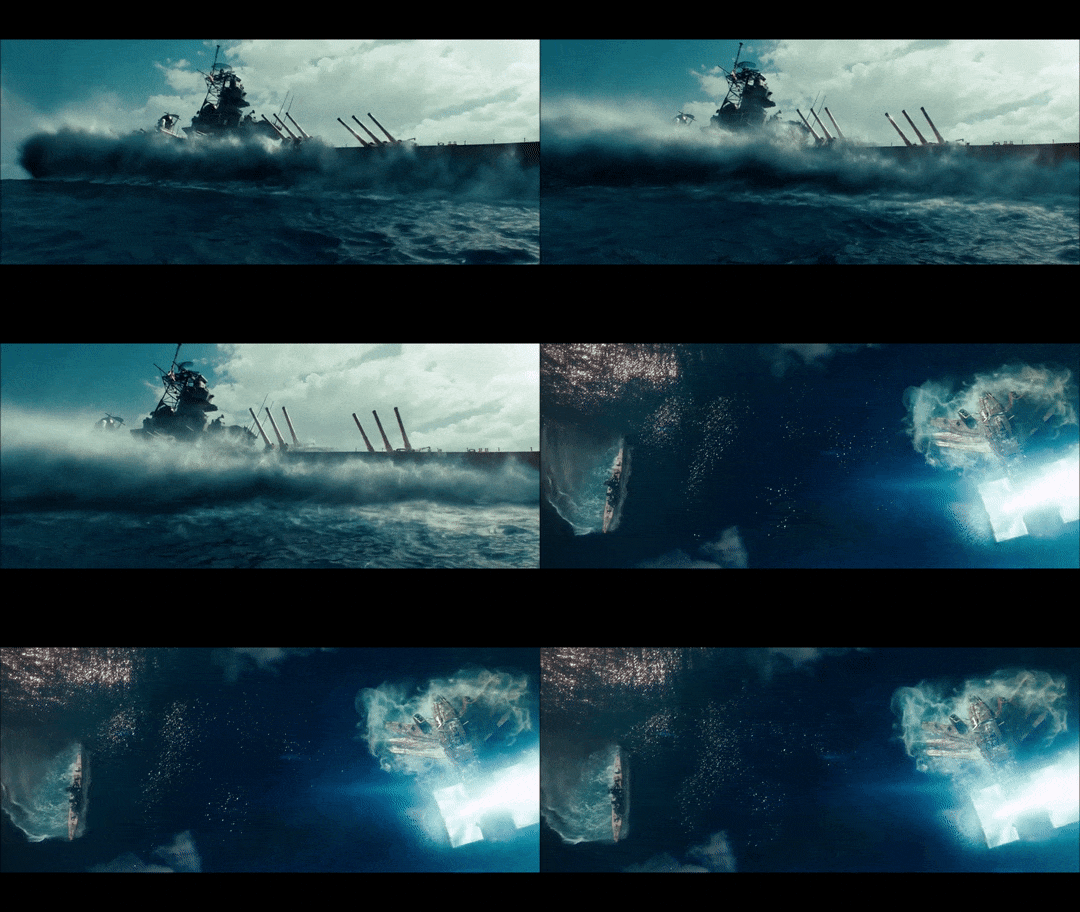
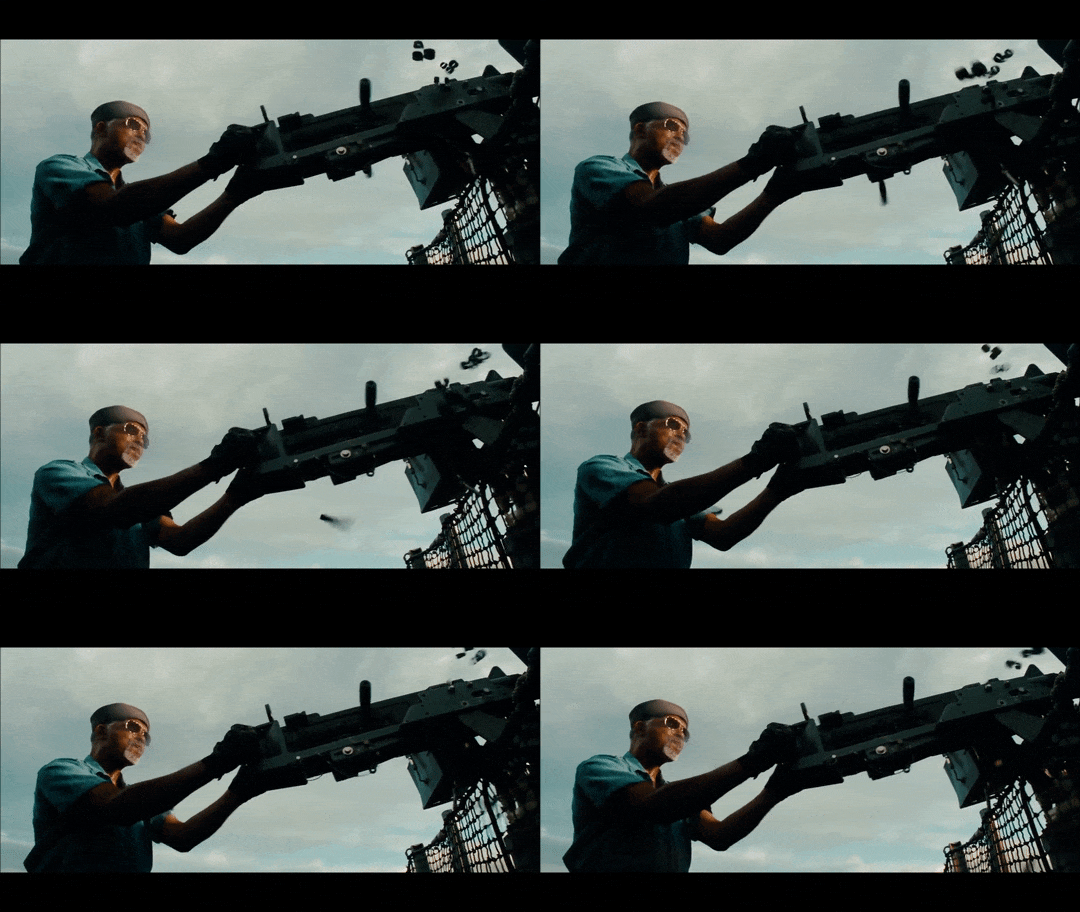
The greatest movie ever made was the 2012 blockbuster Battleship. I love this movie un-ironically. It is amazing. It is fantastic. It exceeds everything else that has ever hit the silver screen, and quite possibly any other form of art or self-expression that has been hoisted into the human consciousness. I will be having a totally normal day, and I am not joking here, but suddenly this absolute cinematic masterpiece will pop into my head and I can’t think of anything else. This happened today and I spent a few hours clipping out some of my favorite scenes and creating the gifset below with the hopes that magnificent triumph of storytelling will reach a greater appreciation throughout the world.

Let’s start with the basics of this movie. I am not so blinded with love that I don’t notice the movie’s flaws. The movie spends the first ten or fifteen minutes attempting, for some reason, to set up a love story or something. If I was director I would have skipped this and gone straight to fighting aliens. It features Taylor Kitsh as an undisciplined bad boy, forced into the Navy by his older brother (played by Alexander Skarsgård!) after he steals a burrito. The love interest is Brooklyn Decker, who’s admiral father is played by Liam Neeson! The cast this movie puts together! An absolute powerhouse collection of movie stars assembled so that the real stars of the movie, the ships, don’t too far outshine these bit characters. Other significant players include Tadanobu Asano as the captain of a Japanese destroyer inserted to play the straight man, and Gregory D. Gadson as an Army double amputee inserted to provide a message of overcoming setbacks, or something, and also beat the shit out of some aliens. And I haven’t even mentioned that this movie includes freakin’ Rihanna, who is an absolute badass in the role of Petty Officer Cora Raikes.

After the movie sets up this love story/bad boy plot, aliens land. Frankly the Navy handled the first encounter kinda poorly but who gives a shit because now we’ve set up the thrust of the movie: aliens have landed and it is them versus the finest goddamned Navy the world has ever seen. Due to that first encounter our bad boy Taylor Kitsh is in charge of the small fighting force left to actually fight the aliens, with a ragtag crew at his side. The rest of the movie is them kicking some serious alien ass.

So let’s discuss Battleship as it compares to some other examples of the Navy movie genre. The most famous Navy movie of all time is Top GunTop Gun is okay. Launching planes to “Danger Zone” is a great thing to do, but because of that scene the movie peaks right at the start and it’s all downhill from there. Then the rest of the movie you get like what? One and a half dogfights? Psh lame. Plus as a general rule aircraft carriers are pretty uncool; they have Starbucks onboard. Movies like the recent Hunter Killer have a special place in my heart for being submarine movies, but even that action-packed thriller suffers for featuring a Virginia-class; fast attacks are supposed to be nuclear-powered sports cars and any boat with bilge keels is more like a minivan. But what does the movie Battleship offer you?

Mahalo Motherf

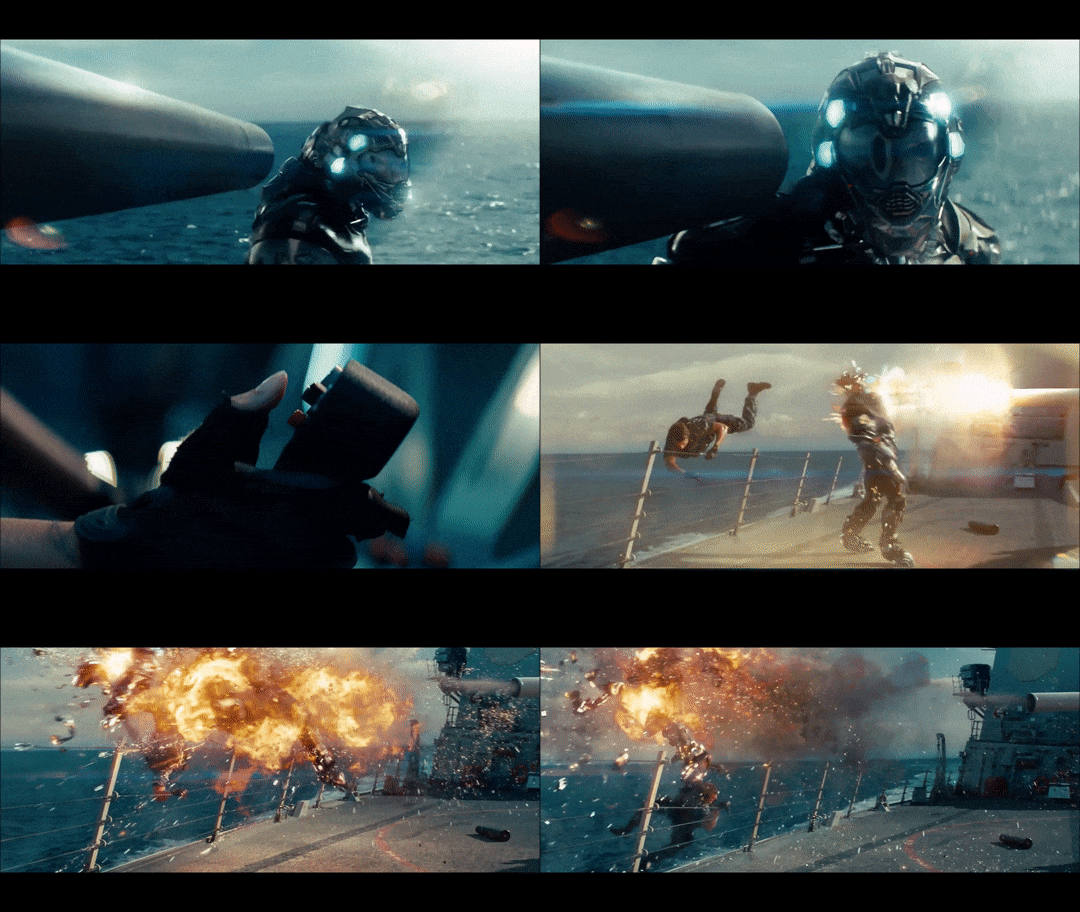
Battleship offers you RIHANNA SHOOTING AN ALIEN IN THE FACE WITH A FIVE INCH CANNON. Citizen Kane parades itself around as the greatest movie ever made, but at no point in Citizen Kane does an absolute fantastic piece of naval hardware get used to obliterate an alien at point blank range by one of the most versatile women of the modern era.

Fire Everything

The whole movie (except for the love story portions) is just badass nautical action after badass nautical action. It doesn’t hold back. In the above scene they think they’re down to a one-on-one battle, and they decide to throw literally everything their destroyer has at the alien ship. They launch every missile, they got all the dudes on machine guns, and our bad boy and his Japanese buddy are on the bow with 50 cal rifles for absolutely no good reason except for that it is fucking awesome.

Approach

But the real star of this movie, the real reason you came to see it, is the titular battleship, the USS Missouri, BB-63, the Mighty Mo’ herself. Here is another sincere, deeply held belief of mine: the Iowa-class battleships are the most beautiful thing mankind has ever created. The four sister ships are the largest and most powerful warships to ever float (that survived the war anyways) and represent the pinnacle of warship design in the final glorious age of that artform. Those babies got curves. Left without other options, our ragtag crew decide to try to bring her back to life and go head to head with the aliens once again.

Old Guys

And thus kicks off the greatest 10 minutes of cinematic history to the tune of “Thunderstruck” by AC/DC, itself perhaps the finest accompaniment possible to the seagoing splendor of this film. The crew has a problem: they have no idea how to drive the Mighty Mo’. But no worries! Out of the woodwork come the original crew of the battleship. There is a whole scene where old, proud men with even older and prouder mustaches appear in mankind’s greatest moment of need to take the old but gallant girl out of retirement to face battle one more time.

Big Wave

I cannot stress enough that I am being 100% honest here, but the whole scene where they bring the ship back to life gives me tingles every time I watch it. It’s so magnificent. The enginerooms on steamships always get me hot and bothered anyways, but watching, even in CGI, an Iowa-class battleship get the fires in her heart lit once more very nearly brings tears to my eyes. And to watch the bow crash through the waves on her way to her sacred duty one last time would be a sight I would do anything to see for real if I could.

Alien Tackle

A brief interlude here to emphasize this movie has everything. I love the battleship most of all but there is a whole storyline that happens on land, and that storyline is badass. On the ship, they needed a five inch cannon to take out one of the aliens. Our double-amputee friend though, he just straight up tackles one of the dudes. He goes toe to toe with a huge armored alien and he doesn’t even have any toes. He’s an Army dude so that’s points against him but still man, respect.

Power Slide

But back to the battleship. I love the movie Casablanca. Play it Sam, play as “Time Goes By.” We’ll always have Paris. Here’s looking at you kid. Fantastic. But at no point in Casablanca do they powerslide a freakin’ Iowa-class warship and then fire a broadside at an alien spaceship. I mean holy shit. It’s Tokyo Drift but with 57000 long tons. Show me another movie that powerslides an Iowa-class battleship and I’ll show you another movie that has even half a chance at beating this one as the greatest of all time.

Drop Some Lead Small

And just look at that broadside in action. I’m only giving you seconds-long chunks of these scenes, and all silent. It goes on for ten minutes or more, just non-stop battleship action. I could run the thesaurus dry and not have the words to convey it to you. You have to watch it.

Old Dude Shooting

Even the old dudes get in on the action! In Marine Week, we were taught to hold a machine gun burst for the amount of time it takes you say “Die Motherfucker Die.” These old dudes 100% ignore that advice and fuckin’ get some when it comes to shooting aliens. The ship is already launching full broadsides of 16″ rounds at these aliens and they’re still firing 50 cal machine guns I think mostly for funsies. Amazing. Fantastic. World-class.

Stupid Jets

The only major mark against the movie though frankly is right at the end. After all this SWOtivating battle action, after our blackshoe friends do all the hard work and kill 90% of the aliens and knock down the force field that was keeping the rest of the Navy at bay, some freakin’ pilots swoop in and act like they actually contributed. Terrible. Pilots. Ugh.

So that’s the movie Battleship. It’s so fantastic. It’s everything you could possibly want in a movie. It’s got romance. It’s got intrigue. It’s got the Navy’s finest warships going head to head with an advanced alien race and kicking their fucking asses by virtue of being total badasses. I love this movie. Please spread my gospel.