Cat Cafe

On the same day we visited Fort Washington, Ian and I also went to the Crumbs & Whiskers Cat Cafe in Georgetown. Cat Cafes are one of those things that I thought was a bit weird when I read about it in another breathless “the crazy things they do in Japan” type articles, but now that I’ve been to two I can’t believe they aren’t all over the place.

The first cat cafe I went to was in Singapore. I was exploring the city with a friend of mine when we happened to walk by. I stopped us in front of the door and suggested we maybe give it a go, but I tried to act a bit coy about the whole thing lest I knock a few notches off my manliness quotient. He also acted slightly intrigued but less than enthusiastic, but later we figured out we both really wanted to go in and were just trying to act tough if front of the other one. So later on we gathered like four other dudes and hung out in a cat cafe in Singapore for two hours. The man working the counter was slightly incredulous and then I think slightly scared that six adult Americans wanted to visit his otherwise quiet establishment, but we had a great time.

So upon my arrival back in the States I looked around to see if there were any cat cafes. For those of you a bit lost in my cultural worldliness, a cat cafe is a place with a bunch of cats that will also usually serve you coffee. You pay some nominal entry fee and then get to hang out with cats for an hour or two and then also drink coffee. If you’ve never heard of a cat cafe before at this point you’re probably thinking “OMG WOW THAT IS THE GREATEST IDEA EVER WHY DIDN’T I THINK OF THAT?!” and I am over here like “DUDE I KNOW THEY ARE AMAZING WHY AREN’T THEY EVERWHERE?!” so I’m with you. The point is the only cat cafe I could find within several hours of me is the relatively new but absolutely awesome Crumbs & Whiskers Cat Cafe in, as I mentioned, Georgetown.
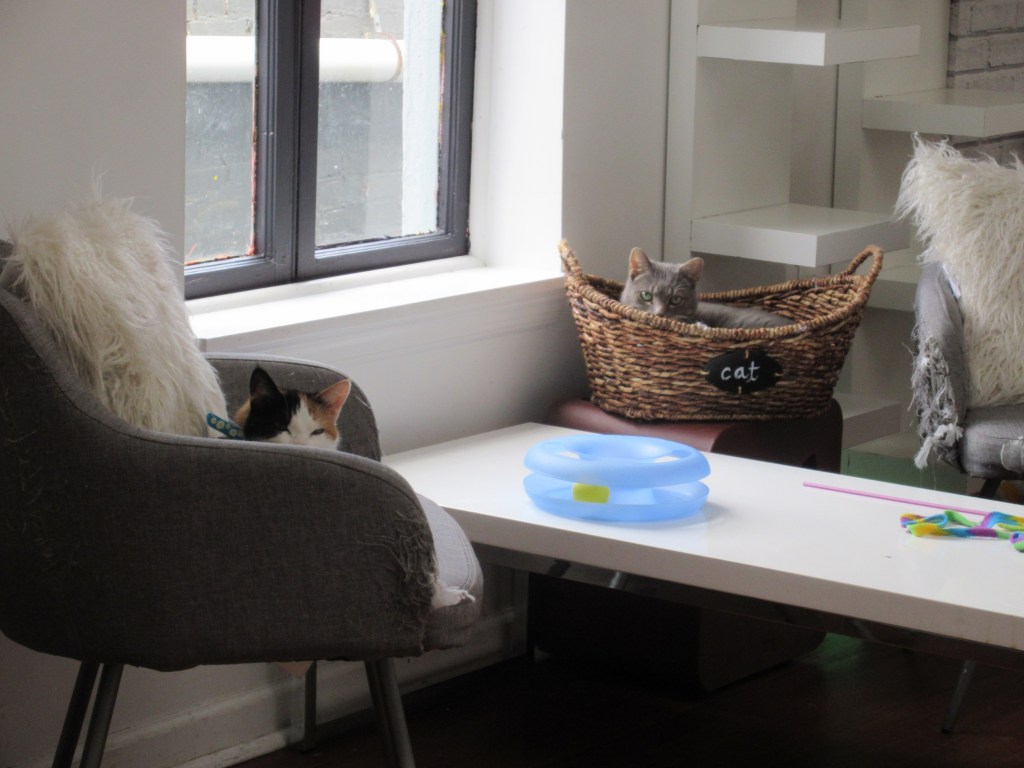
You can make reservations, which the website recommends, and ours was for 3:30. While Ian and I were there on a Wednesday afternoon we had the place to ourselves (and 20-odd cats) for most of our 75 minutes. When you walk in they also take any drink or snack orders you might have. These take a little while to come out, because they run your order to a fashionable-named “Macaron” down the street instead of make it in-house. But that’s alright because what you’re really there for is cats and boy do they have a lot of them.

I surprised Ian with our visit to Crumbs & Whiskers. We had to kill 15 minutes while we waited around for our reservation, so now that we were on location I explained the idea of a cat cafe to my uninformed and unsuspecting brother. He posed such serious questions as “why would you need a reservation for a cat cafe?” and “why would I want to visit someplace with cats?” but as soon as we walked in he had a huge smile on his face. The man loves animals and since we no longer have any pets of our own (man oh man I want a cat) his access to cute and cuddly things to pet is limited.

Ian was nervous at first and we sat sort of awkwardly admiring the cats. Ian doesn’t always have the best luck with animals but these cats are professional cats. These aren’t the amateur cats your friends have, these cats spend their whole lives being petted and loved and played with and are not at all surprised by the stranger calling them cutesy names in a baby voice. That’s their life now anyways; all the cats at Crumbs & Whiskers are rescue cats and are up for adoption, which makes it totally like “why don’t I take all of these cats home with me right now?” So Ian very quickly warmed up to the cats and got to spend a whole 75 minutes petting the very friendly cats and playing with them using the many cat toys spread around the two stories of Crumbs & Whiskers.

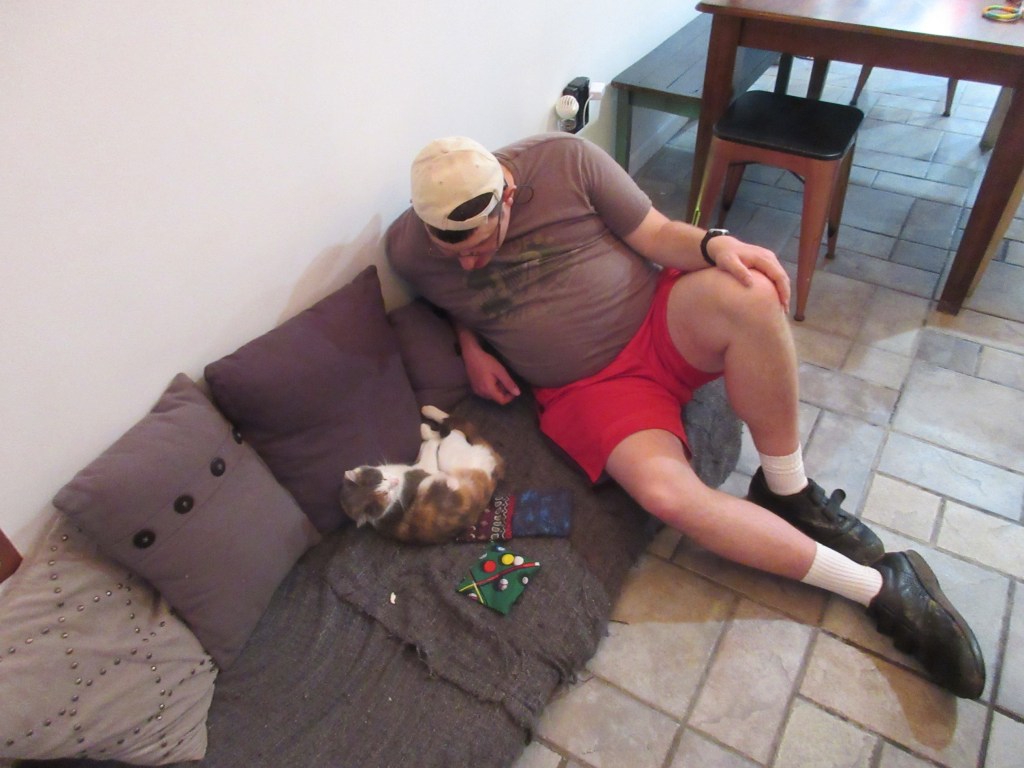
Ian managed to make particular friends with one cat, Brandy. The furniture in Crumbs & Whiskers is largely comprised of very hip pads sitting on the floor that serve as couches. This puts everyone at just about a perfect cat-level. Brandy was a playful little calico that very quickly sidled up to Ian after he sat down on one of the couches. Ian showed some affection and Brandy showed some affection back and Brandy was soon curled up asleep and purring next to Ian while Ian was on the phone telling everyone he knew how awesome it was.

Eventually though it was time to go home and we headed out. My only regret is that Crumbs & Whiskers is not closer to where I live. They offer all-day passes for the person who always wanted to work in an office full of cats, and they offer yoga classes for the person jealous of those YouTube videos. They also have special screenings of the Aristocats which I’m actively considering making the hour-long drive to see. Why aren’t there more Cat Cafes?

Fort Washington

Don’t worry, fine readers, the adventures of Pat and Ian Go To Various Maryland Historic Sites continues. Today we went to Fort Washington. Fort Washington is located on the Potomac River a little south of DC. It was built in 1809 and designed to protect DC from anybody who might want to invade, or whatever. Like that would ever happen. I had never heard of the place until I was looking for National Parks to go visit with all of my unemployment time.

Ian and I set off on a bright Wednesday morning and arrived a little before lunchtime. We very nearly had the place to ourselves; I only spotted one couple walking around and a dude playing some one-on-zero basketball the whole time we were there. Our first stop was the visitor’s center, where the Park Ranger just seemed excited to have someone to talk to. When I first looked up this park, I was expecting something very similar to Fort McHenry. Both of the forts were built at about the same time and have similar(ish) histories. The big difference, though, is that people care about Fort McHenry due to that whole star-spangled banner thing, and I had never heard of Fort Washington before. Consequently, Fort Washington does not seem as well funded.

The visitor’s center has a small but well-done display of the fort’s history and some artifacts from the site. Like I said, the fort was built in 1809 but in a harbinger of things to come was under-funded, under-gunned, and under-manned. When, in the War of 1812, the British did sail up the Potomac, the commander decided his best course of action was to blow up the fort and skedaddle. After the war, the place was rebuilt, and, not wanting to be embarrassed again, the Army built it way better. As our very knowledgeable Park Ranger explained to us, the Confederates were very familiar with the fort’s capabilities and never made an attack, saving Washington but relegating the fort to a somewhat forgotten history.

First off though, the whole place is pretty nice for what they’ve got. The fort itself is a small part of a very large park complex. We drove through most of it and it looks like an excellent place for picnics and the like. From the visitor’s center, the fort is accessed via a short path down a hill and across a wooden bridge. The bridge is a replacement for a drawbridge that used to be there, which must have been awesome in 1840. Despite a lack of drawbridge, the fort itself is still very impressive. It is built on a bluff overlooking the Potomac with hugely large walls constructed of imposing masonry. Inside the walls, we had pretty much free reign of the place. The two barracks buildings inside the fort’s courtyard were locked but on days when they have more rangers around one of them contains a display.

We started out looking into every single one of the fort’s many storerooms. One of them contains some bunks, for some reason, but none of the rest of them that are accessible contain anything. We checked. Ian was excited that the ranger later confirmed that the decaying wooden doors on them are in fact 1840s-era, so that was cool I guess. Up on top of the walls, however, the views were much nicer. Almost all of the cannons from Fort Washington have been removed, I’m sure to serve as decorative fodder for other places, and so you have a clear path to traverse all the various ramparts. Ian has made it a habit now to walk as much rampart as possible whenever we’re at a fort, so we took in the stunning views from every angle possible. Fort Washington has gorgeous panoramas of the Potomac. Looking up-river, you can make out the Washington Monument (we sure really liked that guy). Looking any which-way, you can watch sailboats and river cruisers lazily go by.

Fort Washington these days is also a nature park, and after we were done with the fort we took a stroll down the creatively named River Trail. Signs warned us to report any suspicious animal activity, so I made sure to keep an eye out for any suicide bomber raccoons. I think the most significant nature we saw were some geese paddling around in the river, which I guess might be slightly suspicious. We hiked down the River Trail for a little while, admiring the trees and quiet, and then eventually turned around. Fort Washington was a very nice place to visit and we managed to cover most of the highlights in about two hours. I walked away from the place thinking it was pretty under-loved. Take a visit and learn some history and give the Park Rangers something to do. They seemed like they could use the company.

St. Mary’s City

The latest and greatest entry in my ongoing series “Pat and Ian Go Places When Ian Has the Day Off and Pat Continues to Be Unemployed” is our recent trip to the historic St. Mary’s City. I should get a job. Before that happens though, a brief intro to Maryland history.

The history of Maryland is long (for the US, anyways) and filled with exciting episodes like that one time we had a war with Pennsylvania, that other time people actually fought over the Severn, and a more awkward than most relationship with slavery. The story opens, however, with the founding of the colony that would become the greatest state in the union at St. Mary’s City on the northern shore of the St. Mary’s river. It’s a pretty standard colonial origin story, with dashes of escaping religious persecution, befriending the natives, and important things happening under trees. After about 70 years the capital was moved up to Annapolis and St. Mary’s was abandoned. Fast forward an additional three hundred or so years, and the city has become a major archaeological site you can visit on sunny days in May.

We headed out for our 2.5 hour drive around ten thirty and stopped for lunch on the way at Smokey Joe’s BBQ. We parked at St. Mary’s City visitor’s center to pay our entry fee and look at the artifacts they have on display. St. Mary’s City is apparently an archaeological training ground, so the city is pretty well documented as far as these places go. The visitor’s center gives a pretty efficient run-down of the history of the city. Artifacts on display include an old saker, which is apparently a type of cannon, a variety of pottery shards from the local tavern, and some examples of jewelry and sewing needles and the like. The rest of the city is explored via walking trails. “City” is a bit of a generous term in the modern sense and the whole place is about a mile from end to end.

The first area is a recreated Native American village. The nascent St. Maryites spent their first winter living in part of a Yaocomico village they purchased after some negotiations. Relations with the natives were reportedly very friendly, which is nice for a change of colonial pace. This portion of the city features prototypical huts with various implements on display within them. A very nice man in a polo shirt was explaining some of the finer points of native construction techniques, but Ian was too preoccupied with some of the other huts to let me listen very long. Also on display is a half-finished canoe, but filled with rainwater it looked more to me like someone should be looking for a convenient soap mine.

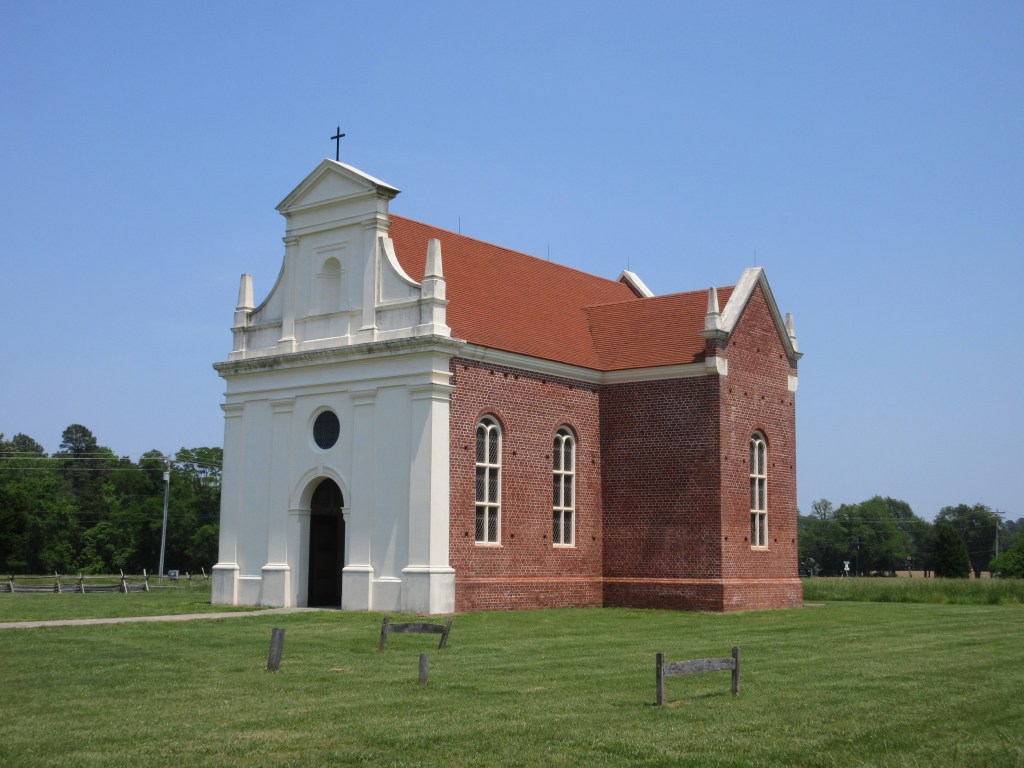
Next up on the path is a reconstructed Jesuit church. Throughout the city are faithful as possible recreations of the original structures. Some, like the church, were built with as original as possible construction techniques and materials, while others are a little less faithful but the discrepancies are noted. Also dotting the site are “ghost houses,” which are wooden frames of buildings as stand-ins for the originals to give you a sense of the density of the place. The church is fairly impressive, with one of the highlights being a glass section of the floor where you can look down and see the original lead coffins of Philip Calvert (the second Lord Baltimore’s brother), his wife Anne, and an unknown child, presumed to be from Phil’s second wife. They were returned to approximately their original locations (the modern reconstructed church is over the site of the historic one) after about 25 years of study and storage. In my old age I am sort of increasingly weirded out by putting dead people on display. I might be the crazy one. The coffins look nice though I guess?

Another highlight of the city is the oldest barn in Maryland. The sign for the barn is titled “Why is this Barn Here?” which is a little philosophical for my tastes but I’ll let it slide. The inside of the barn features displays about barn construction techniques and the details of tobacco packaging & shipping. As a proud Marylander, I am of course very familiar with tobacco farming, with tobacco farms being a standard for Elementary School field trips. At any rate this particular barn dates from 1785, putting it well within the farmland years of St. Mary’s City, but very historic nonetheless.

Walking north from the church brings you to downtown or our bustling historic metropolis. This are includes the most intricate display they have, with a large building representing Garrett Van Sweringen’s Council Chamber Inn. It was purportedly quite the posh place back in the day. You know it was nice because they have a sign denoting the fact that they found a large number of crab remains on the site, proving that Marylanders have been enjoying crab feasts from the start. Also on the back of the property is a coffee & brew house, and I mean with all these features in one spot why did they ever bother to go to Annapolis? This portion of the city also features the town store where you can look at old shoes and axe heads, as well as tour guides in period garb. These were my favorite kind of tour guides in period garb, where they don’t try to make you think you’ve somehow been transported back to 1650, and instead just tell you about whatever they got going while wearing some sweet duds.

They very pièce de résistance of the whole place (for Ian and I, anyway) is a recreated Dove. Although the colonists and their supplies were transported to the city on another ship, the 400-ton Ark, the colonists also brought over the Dove to give them some metaphorical wheels once the Ark departed. The modern Dove is a best-guess at what the original looked like, as the guides for the ship explain ad nauseum. It clocks in at 40 tons and strikes me as a pretty sturdy little ship, although the original was lost at sea on a trading voyage not too long after the colonists settled in. Although we didn’t get to see it when we were there, the Dove goes sailing about once a month to keep the crew exercised and trained.

The endpoint of the walking tour is another recreated building, Maryland’s first state house. The original state house was torn down after the city was abandoned, but the bricks were used to construct the Trinity Church which still stands next door, giving a tangible tie to the past, or whatever sounds poetic here. You can explore the statehouse, which is one of those large cool buildings, designed for hot summers before they invented air conditioning. Along with the church there is of course a graveyard, featuring some more old dead people, though not quite as old (but still as dead) as the lead coffins from earlier. In the graveyard is a marker declaring the position of the old mulberry tree where the colonists gathered to establish their city. Upon reaching this marker and reading the inscription, Ian declared that we were “done” with the city, and with that we turned around for the walk back to the car.

St. Mary’s City was a very nice place to visit. The weather was beautiful and those colonists really knew how to pick scenic riverside real estate. The displays and signs were very well done, and it is evident that the location is well cherished and cared for by the similarly named university next door. I think most people that visit Maryland will wind up in Baltimore or Annapolis, but down southern Maryland is really the state’s agricultural homeland and it is worth the trip.

Blue Angels

Best part of the show!

Last week (by the time this is posted) was graduation week at the US Naval Academy. Highlights of the week include Midshipmen passing out on the parade field, traffic out the wazoo in downtown Annapolis (DTA to you cool kids), astonishing feats of fast-paced horticulture by the Naval Academy grounds team, and of course the Blue Angels flight demonstration. Ian had the day off and I continue to be unemployed so we went to go see the show.

Earlier that morning I had “business” in Annapolis and when I was driving back over the Naval Academy Bridge at 0930 there were already people in lawn chairs awaiting the 2 o’clock show. But Ian and I were only up to make half a day of it, so we set out at 11 with plans to get lunch. We made it in relatively short order and enjoyed a walk from the Naval Academy Stadium (where we parked) into downtown.

Our destination for lunch was the Naval Academy’s world-famous Drydock Restaurant. Drydock is my favorite pizza place. They also, as their website notes, serve sandwiches, but I’m always there for the pizza. The secret ingredient is nostalgia. I go for two slices of sausage with a soda. I had to fight for them today with the massive crowd and line extending out into the lobby, but it was worth it. Totally worth it.

Fueled up, Ian and I headed out to Hospital Point on the Naval Academy. It was quite crowded. The place had a pretty good party atmosphere, with the Naval Academy Band doing their best covers of 80s rock songs and the multitudes spreading out blankets and lining up at the snow cone trucks. I will take this moment to observe that in front of the eponymous hospital (now a clinic) is a graveyard. While I admire the Navy-like efficiency of putting the graveyard right next to and in front of their hospital, it doesn’t speak volumes to your customer satisfaction, does it?

The show started promptly at two. “Fat Albert” does the first fly-by as the warm-up act. It strikes me that the name “Fat Albert” is a little insensitive, I mean body shaming much? But Fat Albert’s act includes flying from left to right, flying from right to left, starting down low and going up high, and starting up high and going down low. During this part I was preoccupied by taking pictures of the YP that was tooling around the river, and especially trying to take pictures of the YP and Fat Albert together.

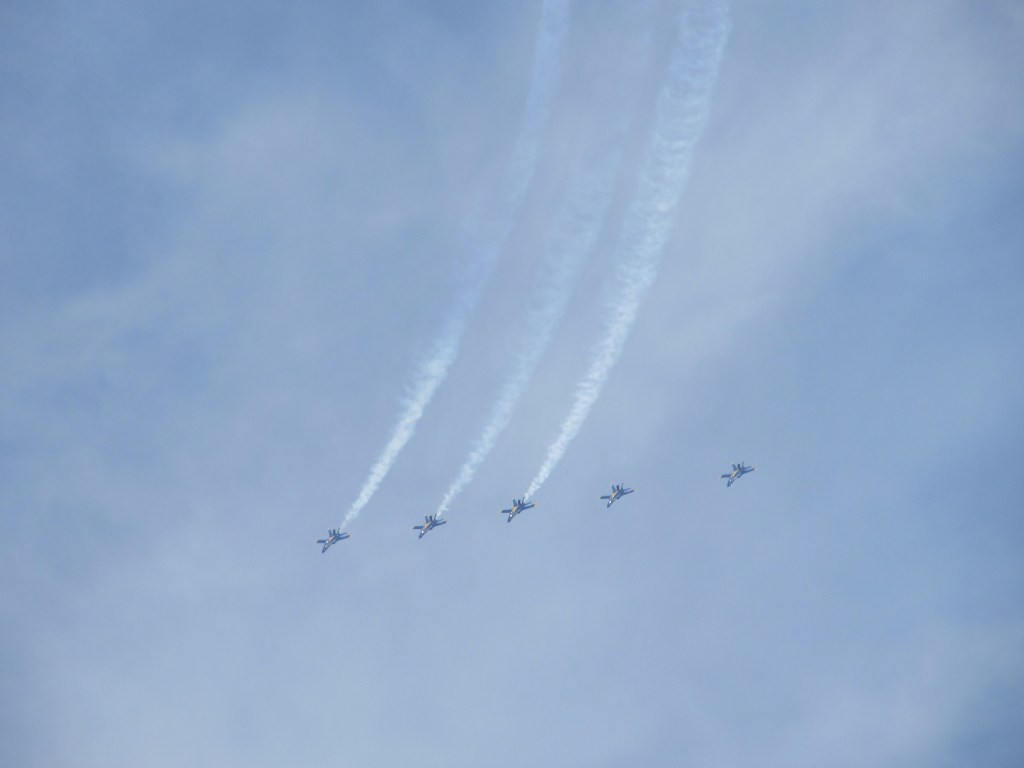
Eventually Fat Albert flew off and then the real show began. The Angels started off flying all together in a diamond formation, but then planes #5 and #6 broke off in a dramatic fashion while #1-4 continued to fly close together and do turns and stuff. #5 and #6 then spent most of the rest of the show playing chicken with each other, doing dramatic (and slightly rude, if you had asked my then very surprised self) flybys of the crowd, and at one point doing a slow flight demonstration. This raised several questions for me. First, how do #5 and #6 feel about all this? #1-4 are all like “Hey guys we’re just going to do normal stuff but kind of close together, but we want you guys to fly at each other real fast and turn away and just the last second so you don’t die.” Then after all that is settled #1-4 go “And you know how the most fun part is flying really fast? Well while we’re busy flying fast we want you guys to fly as slow as you possibly can.” Are #5 and #6 in trouble? Did they do anything bad?

But the show was pretty alright. The Blue Angels replayed some of the Fat Albert routine, like flying both low and high and flying from the left and flying from the right. But they also mixed in some loop-de-loops and some fleur-de-lis things and more flying close together and then some flying not so close together. People clapped. Birds flew around somewhat nonplussed. The YP continued to tool around, enjoying the view. After an hour the show was over though it was a little hard to tell when the finale was; I think they should have shot off a whole bunch of planes at once all rapid-fire. Our desire for jet noise satisfied, Ian and I stopped for slurpees on the way home to finish out the day.

Southern Maryland Celtic Festival

This past weekend (as I’m writing this, anyway) we went to the Southern Maryland Celtic Festival. “We” was my dad, my brother, and me. My family are avowed Renaissance Festival and Celtic Festival enthusiasts. We knitted an entire chainmail hauberk once. Dad regularly wears a great kilt at every opportunity. My brother just earned a degree in Irish Studies from the University of Dublin. All that to say is that whenever a Celtic festival is to be had, we tend to be at it.

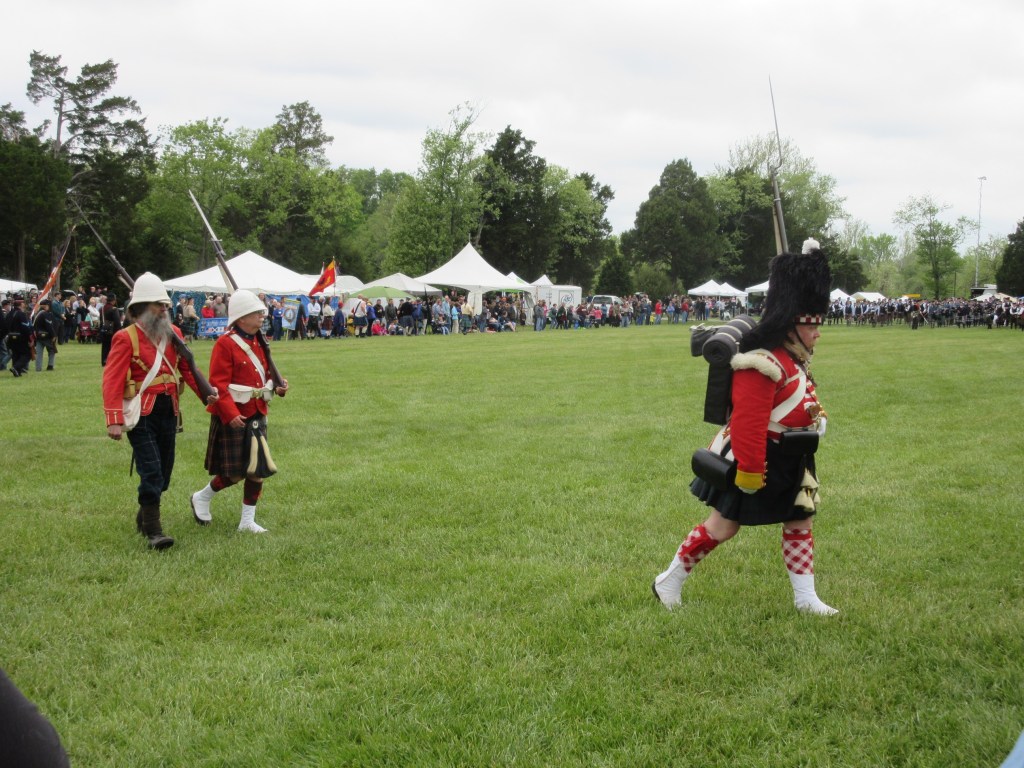
We arrived in time for the opening ceremonies. These were a sight to see. They started with a march-on of all the clans and historic reenactors. This translated into a long line of slightly bedraggled-looking people in period or modern garments walking around a field. They approached their task with enthusiasm, and my favorite were three men dressed for the Anglo-Zulu War (as far as I could tell). Since it was a Celtic festival, they were dressed as one of the Highland regiments, which translated into one fat dude in a skirt, one old dude in plaid pants, and a third dude with a mustache and spats.

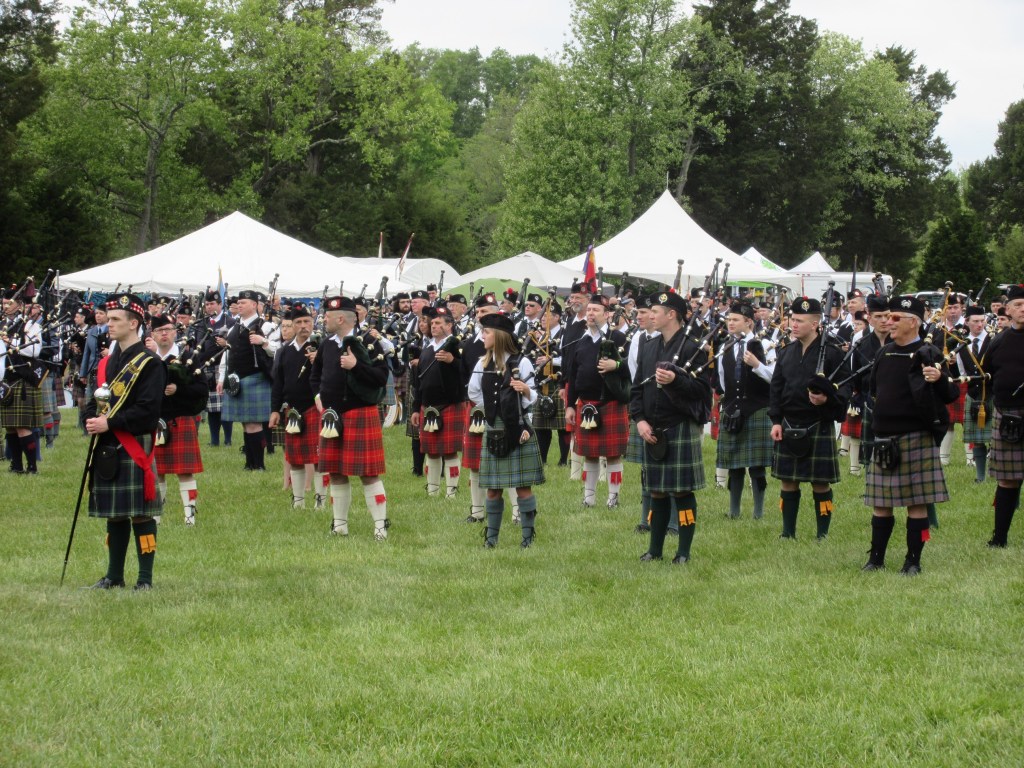
After the march-on of the clans came the bagpipes. I am a fan of bagpipe music; I own several bagpipe albums. So it is with much sincerity when I say that I love the part of every tattoo or Celtic festival where they bring all the pipe bands out at once and they all play together. It has some terribly romantic name that escapes me right now, but the notion is basically “alright, instead of stringing this out, let’s just put all the bagpipes together and get this over with.” The Naval Academy’s Pipes & Drums were playing there that day, so that was nice to see.

With all that done, it was time for lunch. I, of course, had the haggis and fries. Haggis is delicious, it turns out, with Old Bay on it, though that really should have been obvious in the first place. The other wonderful part of Celtic festivals, besides being able to get haggis, is that you can drink IRN-BRU. IRN-BRU is phenomenal, as the ads will tell you. This drink is magical. It is not, as the bottle will tell you, a significant source of iron. Since it is a soda, it is also not a significant source of bru, so I have no idea why they call it IRN-BRU. But when you open it up and take a whiff, it smells like pink bubble gum. When you drink it the flavor is orange cinnamon. I don’t know how they do it. I first drank IRN-BRU in Scotland and loved it, but it is nearly impossible to get in the States, so it is a treat at Celtic festivals. You got to get it.

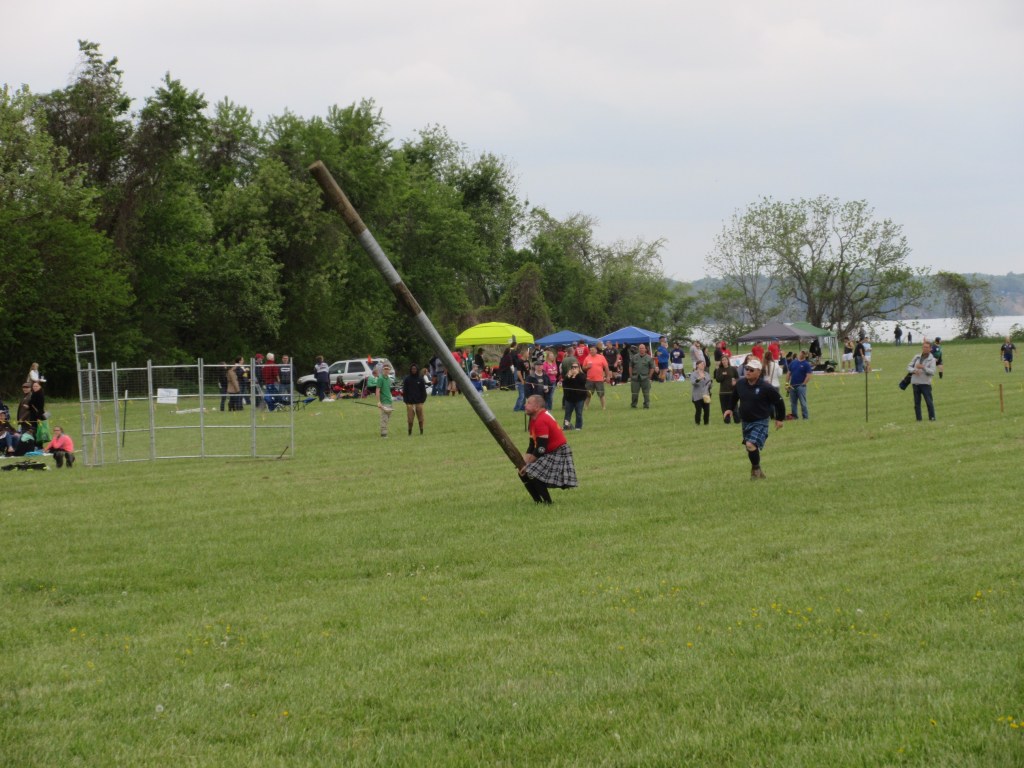
The real excitement at the festival, however, is the Highland games. I love the concept of these games, which very clearly is “we’re big burly dudes, let’s get together and throw things.” Caber tossing is of course the flashiest of the events. This is the one with the log. For years I had enjoyed watching caber tossing, and then one day one of my friends asked me how it was scored. I had no idea; I was just there to watch people throw logs end-over-end. Lately I’ve become more a fan of the sheaf tossing and weight over the bar (a name which demonstrates the extent of creativity in these events). Sheaf tossing (where they take a hay-filled sack and use a pitchfork to toss it over a bar) just seems downright silly to me, even among the Highland games. Weight over the bar has the same appeal as pole jumping at a track meet: exciting to watch and easy to judge.

The exciting competition at the Southern Maryland Celtic Festival this year was the hammer toss. Standing out from the pack in the lightweight division (under 200 pounds, “lightweight” being relative here) were two athletes, one German and one American. They were head to head throughout the day and at the end of it all it the hammer throw and the whole competition was down to the final two tosses. Our German friend stepped up and in two swings around the head managed to lob the 22 pound hammer 76′ and set the day’s record so far. Our stateside friend, dressed in a Captain America shirt (and kilt), stepped up to the bar and picked up the hammer. He swung it once around his head, twice, and then on the third time the hammer head swung off and nearly annihilated a small dog in the crowd (no animals were harmed in the making of this blog post, except for the haggis). This lead to some panic on the court but eventually it was decided that the hammer would be replaced and only the American would throw again. Usually, the announcer told us, if a hammer breaks the entire round is scrubbed. But the American picked up the hammer, put all his might into it, and only managed to lob it 73′. So the Highland games went to a German. Aw well.

Unfortunately for Scottish-American pride but fortunately for our tired feet, that wrapped up the day and we headed off. Without a scrap of self-consciousness dad took us all into Applebee’s for dinner wearing his kilt. They didn’t serve haggis. But if you’re ever in southern Maryland in April, take a swing by the Southern Maryland Celtic Festival. Come for the IRN-BRU, stay for the hammer throw.

Fort McHenry

Today my brother and I both had the day off (he had the day off, I’m unemployed) so we decided to go to Fort McHenry. Fort McHenry is famous as the target of all those rockets and bombs and red glare in the Star Spangled Banner. Despite living all of 10 miles away, before today neither of us had visited before.

The day was running a bit haze gray when the brother and I pulled up to the visitor’s center. The park part of the park is free, but inside the visitor’s center you pay $10 per adult to visit the actual fort. We arrived just in time to catch movie relaying the story of Francis Scott Key writing the Star Spangled Banner. The story, of course, begins with that whole War of 1812 thing. Ole’ Francis comes in when he sails down the Chesapeake to free his buddy, who was being held as a POW. Picking up your friend from jail after a wild night out was a lot harder back in the day. The British fed Francis dinner but kept him overnight, where he had a somewhat safer view of the bombardment than the denizens of the fort itself. Without much else to do, he penned a few lines and also managed to get his friend out of hock.

The video ends with the screen rising up to the ceiling, revealing a view of the fort. The rest of the museum is pretty nice, with a wide variety of cannonballs dredged up from the river and other artifacts that weren’t dredged up from a river. It provides a pretty good context for the War of 1812 and the significance of Fort McHenry in fending off the British attack on Baltimore. Afterwards it struck me that if Battle: LA had been set in Baltimore it would have been a way different movie. But while the visitor’s center is nice, the real attraction is, of course, the fort itself.

The fort is, as forts are wont to do, at the end of a peninsula with a commanding view of Baltimore harbor. From the displays I learned that the fort and surrounding land had a century and a half-long history; it was built in 1800 and used until after WWII. These days, however, the grounds are largely just park. The only structures remaining are the visitor’s center, a Civil War powder magazine, and the fort itself. I always forget that historic forts tended to keep on being forts after whatever historic event happened there, so reading about the long history of the fort in the various displays was fairly informative. The star-shaped structure as it stands was preserved during the New Deal, when the brick pathways were added and structures restored.

The fort is not too big and can be thoroughly explored in an hour or two. We started off by tromping over (o’er) every available rampart and checking out the Civil War-era cannon installed around the perimeter. I was particularly proud of myself for identifying the cannon that dot the fort as Civil War-era before I read any of the plaques; quite the cannon aficionado over here. But around the fort you can duck a little ways into some storage facilities built into the walls and it’s easy to see the place was very well built and would have been very defensible. By this time the sun had started to come out and burn off the fog, so we got a great view of the harbor extending out into the Chesapeake. Inside the fort there are three different barracks buildings that contain the bulk of displays concerning the post-1812 history of Fort McHenry. These were interesting and well-done. They also have wood from the original flag pole that supported the eponymous Star-Spangled Banner, which is cool I guess.

The fort (very) thoroughly explored, my brother and I explored the rest of the grounds by walking the path that hugs the seawall. Dogs, joggers, and jogging dogs were out en masse enjoying the now lovely day and beautiful views. The other things to admire on the grounds were the powder magazine I mentioned and a rather large statue of Orpheus (hero of music & poetry). Our circumnavigation complete we stopped back by the gift shop to pick up a lapel pin and headed out. All in all it was a lovely day and if find yourself with an afternoon to kill in Baltimore I recommend a visit.

The Guam Zoo

I went to the Guam Zoo today. I went just to see it. I don’t suppose there’s any other reason to ever go to a zoo, but I wouldn’t have gone, except that I found myself with some bonus time on Guam and I figured I would add it to my “Second Chance Guam Bucket List.” The Guam Zoo is an attraction I had passed by many times in my time on Guam, and I hadn’t ever really regretted that decision. Most of the signs for the zoo are in Russian, it’s nestled behind a California Pizza Kitchen, and most of the time all I ever heard from the place was the sound of dogs barking, so I hadn’t expected much. Reality didn’t do too much to dissuade me from that assessment, but it was nicer than I thought it was going to be.

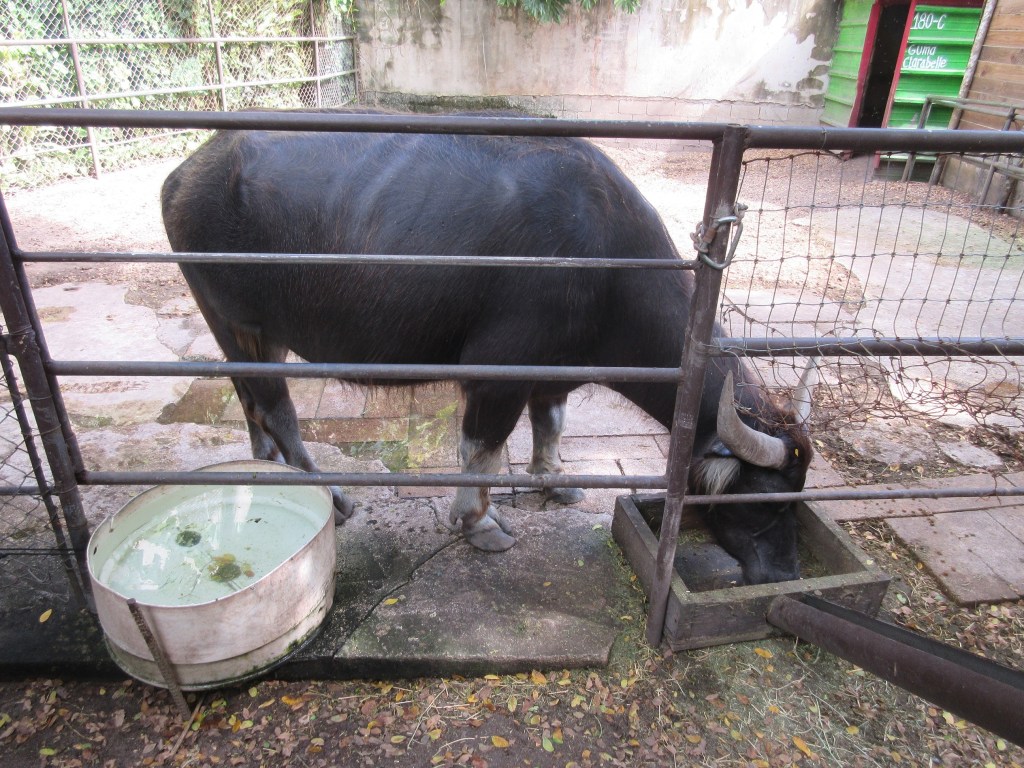
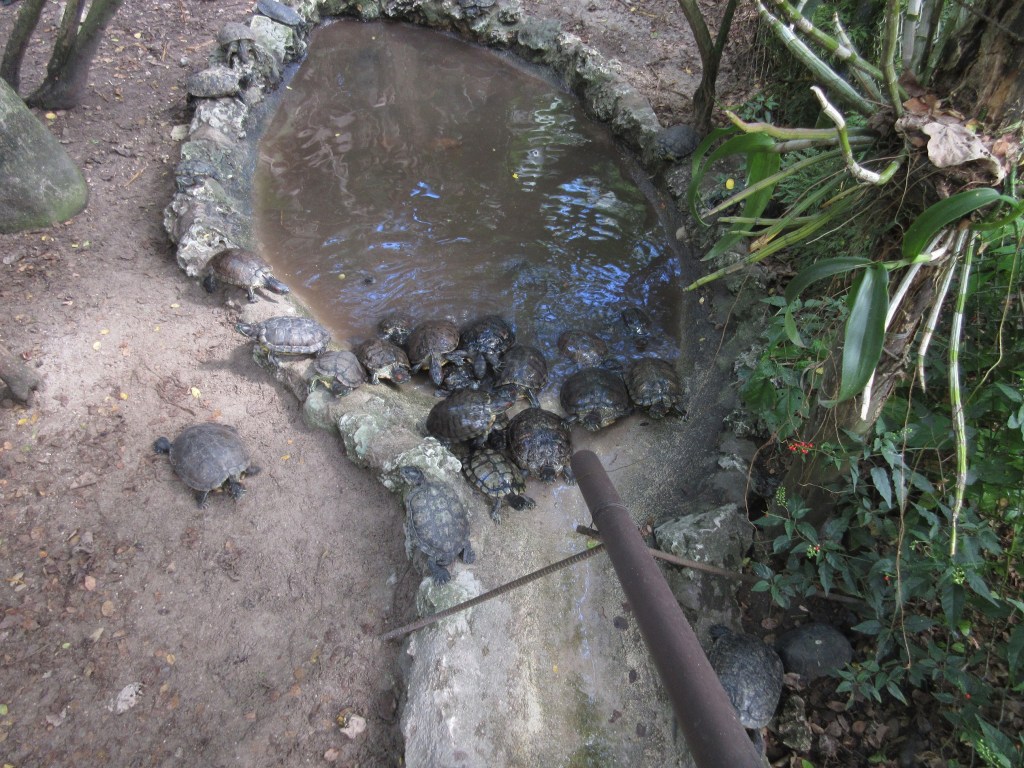
Approaching the zoo, it rather bombastically pronounces itself to be the Guam Zoological, Botanical, and Marine Garden. At the front gate, you push a button to ring for the zoo attendant. He was a nice old guy. He accepted my $20 bill and wandered off to fetch me my $5 change while I inspected the first animal, a carabao. I was already pleasantly surprised, frankly, because all I had really expected was various species of boonie dog. “Boonie Dog,” for those not in the know, is the affectionate name for the feral dogs that can be found in large numbers on Guam. The carabao seemed mildly interested to see me, and I admired his nose ring. As the man returned with my change he also brought a tuna can full of generic animal feed, thus revealing the source of the carabao’s interest. At the zoo various animals had little chutes you could tip some of your tuna can-borne feed into, thus attracting the animals out of whatever hidey-hole the zoo had provided. So that was cool I guess. I was most amazed by how even the turtles knew the gig, following me around the edges of their enclosure until I provided some food.

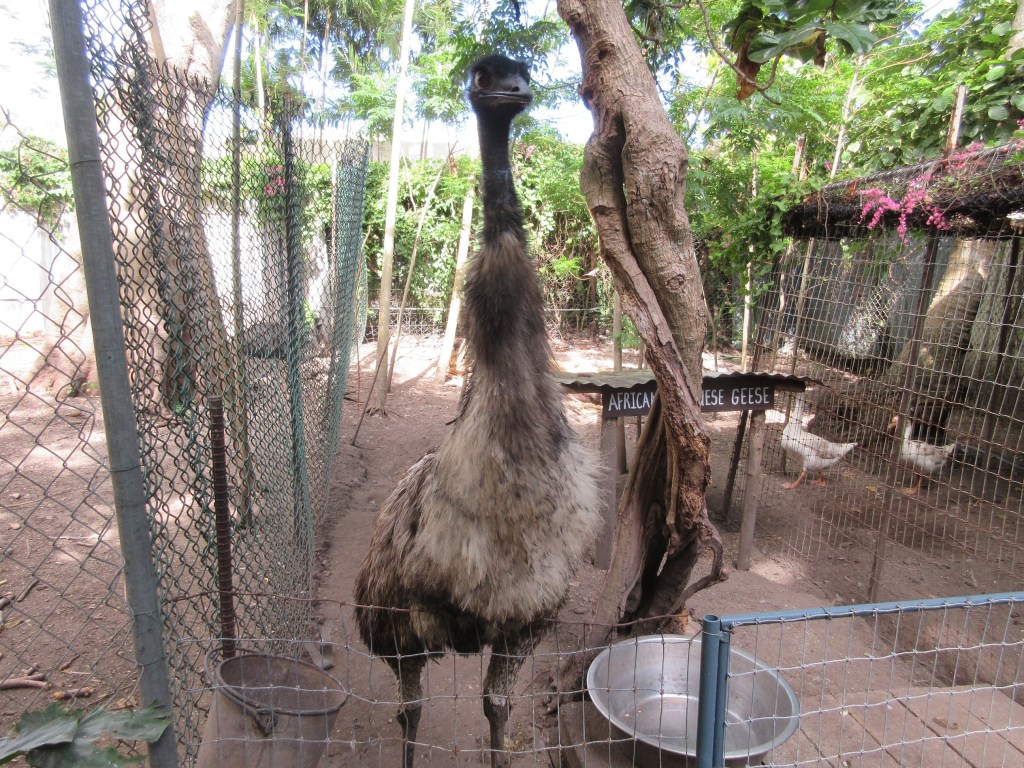
Late on a Sunday afternoon, I had the zoo to myself. If I could read an expression on any of the animals, it was the macaque, and that expression was mild surprise at seeing a visitor. Passing by the zoo attendant building, the white board on the outside delineated that the zoo wish list included a second-hand refrigerator and a rake, to give you a sense of the scale of this operation. Like I said though, the place was nicer than I thought it would be and had a far larger variety of animals than I anticipated. It wasn’t a huge variety, but it was larger than I anticipated. They had emus, and ostrich, the macaque I mentioned, an American and Nile crocodile, African crowned cranes, tortoises, sea turtles, and small sharks. The variety of African animals threw me off; was there a sale someplace at some point? The zoo also had exotic animals like a pigeon, rabbits, pigs, and goats, but it was interesting to see some of the local animals they had on display. The carabao is a given for Guam, but they also had a Sandbar deer, which helped to clear up my confusion on a deer I saw on the south side of the island a while ago. There is also a cage full of Marianas fruit bats, of which there are apparently less than 50 left in the wild. The star of the zoo, however, is the Ko’Ko’ bird, which is a small flightless bird that resembles a kiwi and is extinct in the wild on Guam. It is displayed across from its unnatural enemy, the brown tree snake. Despite the island apparently being infested with them, I had never seen a brown tree snake on Guam before today. So now I know what the enemy looks like.

The Guam Zoo isn’t going to win any awards any time soon for creativity, originality, or overall animal well-being, if the expression on the American crocodile’s face is any indicator. The zoo, however, is obviously trying to do its best to display for the public as many interesting animals as it can and be as educational as any zoo can be. I don’t think it’s the place to go if you’re looking for a solid afternoon of entertainment, but if you’ve got $15 ($8.50 for 12 and under) and are interested in seeing some easily excited turtles, it’s worth a visit. And if the zoo keeps alive at least a small population of the critically endangered species of Guam, it’s a noble enough institution to keep around.