

In my last entry I fast forwarded from Uradale Farms to a talk given by Jamieson’s of Shetland, but we in fact did several other things in between those two events. The most significant one of which was visiting the Ninian Shetland studio!
We didn’t have a tour guide on this excursion, which meant when the bus driver (a different one from our buttonologist) dropped us off at the studio in Scalloway he just sorta told us to head on in and we were very confused (it’s not their storefront so it didn’t really have like an obvious door we were supposed to use). But eventually one of the ladies on the tour knocked on the door and Ninian founder and designer Joanna Hunter answered the door and had us come on in. This gave the whole thing an air of us having just popped in though of course Joanna was expecting us. She was apparently very excited to the Wool Week group as opposed to non-knitting specialists (which I suppose includes me actually) who just didn’t understand what she was all about.

Joanna was very fun and very cool and gave a great talk. Her husband is English and her sister-in-law in French and she interacts with a lot of Americans and when talking about people would do their accent which made things very funny. The thrust of the talk was her design process, and to describe it she absolutely loaded up the table we were all sitting around with various knitwear examples. What she was most excited about was that she had apparently been cleaning out her parents’ attic to put insulation up there when she found a bunch of old family knitwear her forebears had knit so she had been diving into those for inspiration.
She clearly puts a whole lot of thought into textiles (I suppose this is her job). Ninian does machine knitting, and she opened the talk by telling the group that we would all be converts by the end. And you know what I do want to get one of those suckers. I don’t think it would be too bad to get a “domestic” knitting machine, as she called it. Prior to this I had been familiar with circular sock-knitting machines, but it had not occurred to me that you could also have a flat knitting machine. Ninian had recently acquired a gigantic Japanese computer-controlled machine and it was pretty impressive.

Just because a machine does the knitting though doesn’t mean there isn’t a lot of work involved. Joanna had a crew of 10 or 12 women putting together all these items. Although the machine produces the flat pieces of knitting you have to seam them up to make them into 3D garments. There is a machine for this but it still involves someone lining everything up by hand (later at the Jamieson’s talk they told us their limiting factor in how many sweaters they could produce were finding skilled operators of these seaming machines). And that’s still the end-stage of the process; Joanna talked about having to test different tensions for one design because the two layers had different weaves, so it was a lot of R&D to make it lay flat.
My biggest surprise during this whole talk was learning about how recently Shetland had a household-based piecework textile industry. That feels medieval, like in middle school when they are teaching you about the history of industrialization they are like “peasants used to have looms in their homes but then they invented sweatshops” and you bask in the glow of capitalism. But although Joanna had started her knitwear business 25 years ago she really got her start helping her granny out run pieces of sweaters off of their domestic knitting machine. Apparently everyone on Shetland had one (Joanna will still test designs on one in the corner of the studio instead of getting the big computerized Japanese one going), and she talked about her grandma getting deliveries of yarn from the wool companies, which she would knit up and send back. This was, by Joanna’s telling, the thing everyone in her neighborhood did. They taught knitting in schools even, for both boys and girls. This was wild to me but maybe we could learn a thing or two.
To wrap up the talk, Joanna ran off an arm warmer from the knitting machine. To finalize our conversion to machine knitting she wanted to show us how fast it was, and it was indeed pretty fast. The machine spit out the flat version and then Joanna took it over to the seam linker machine to finish it up. It was very cool to see the whole process in action. Later on we would get some pillow cases from Ninian’s which we like very much.
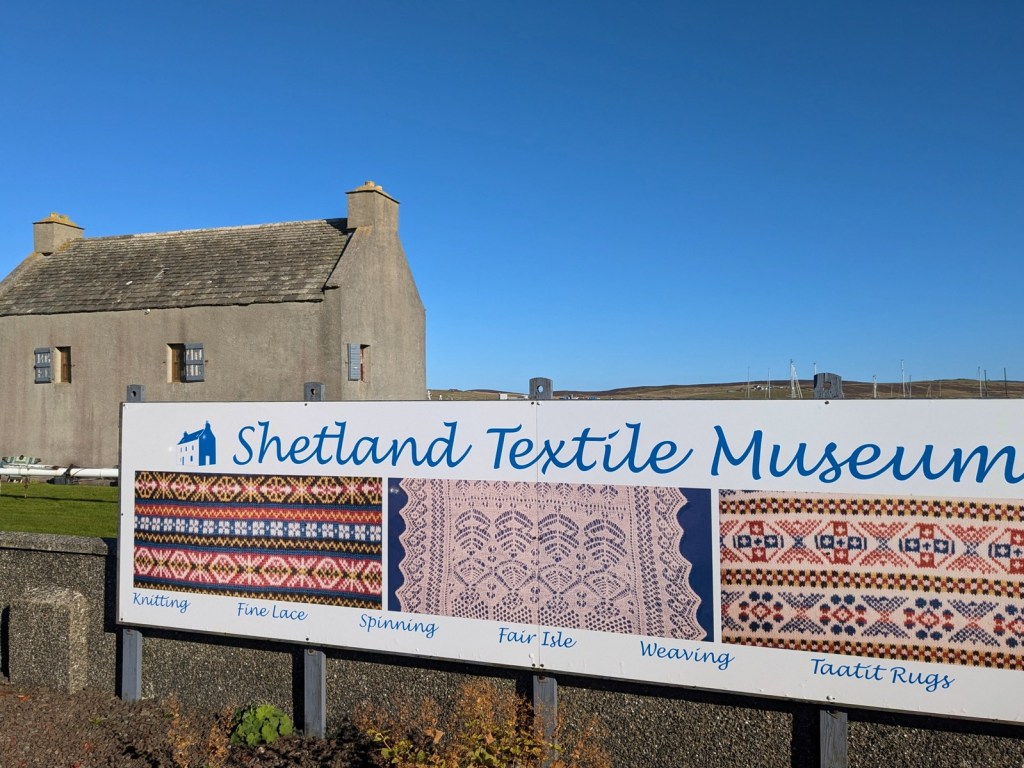
Back in town our next destination was the must-visit Shetland Textile Museum, housed in the dramatically named Böd of Gremista. A böd is a warehouse sorta thing for storing fishing equipment, and also for storing fishermen when they are away from their homes. This particular one was built by the manager of the Gremista fishing station, hence the name. Before the Textile Museum, the böd’s claim to fame was as the birthplace of Arthur Anderson, co-founder of the now-defunct Peninsular and Oriental Steam Navigation Company. But you knew that as I did from the Wikipedia.


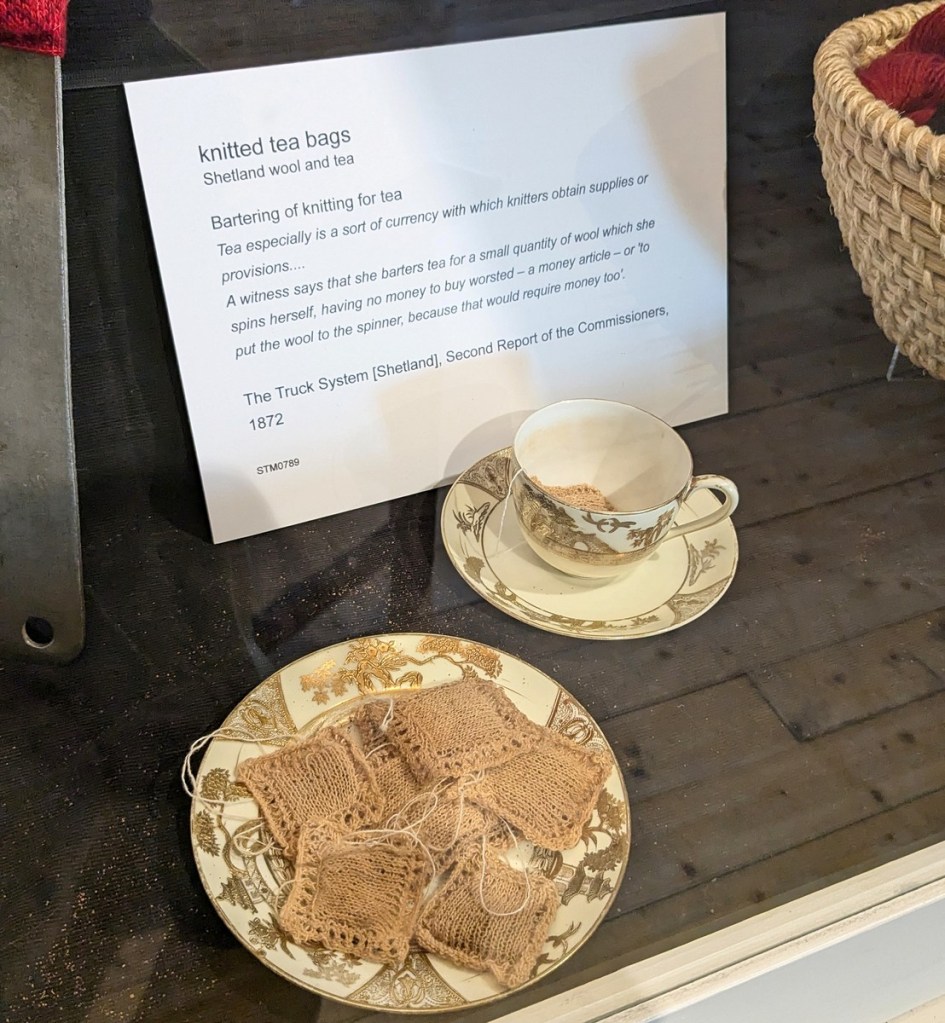
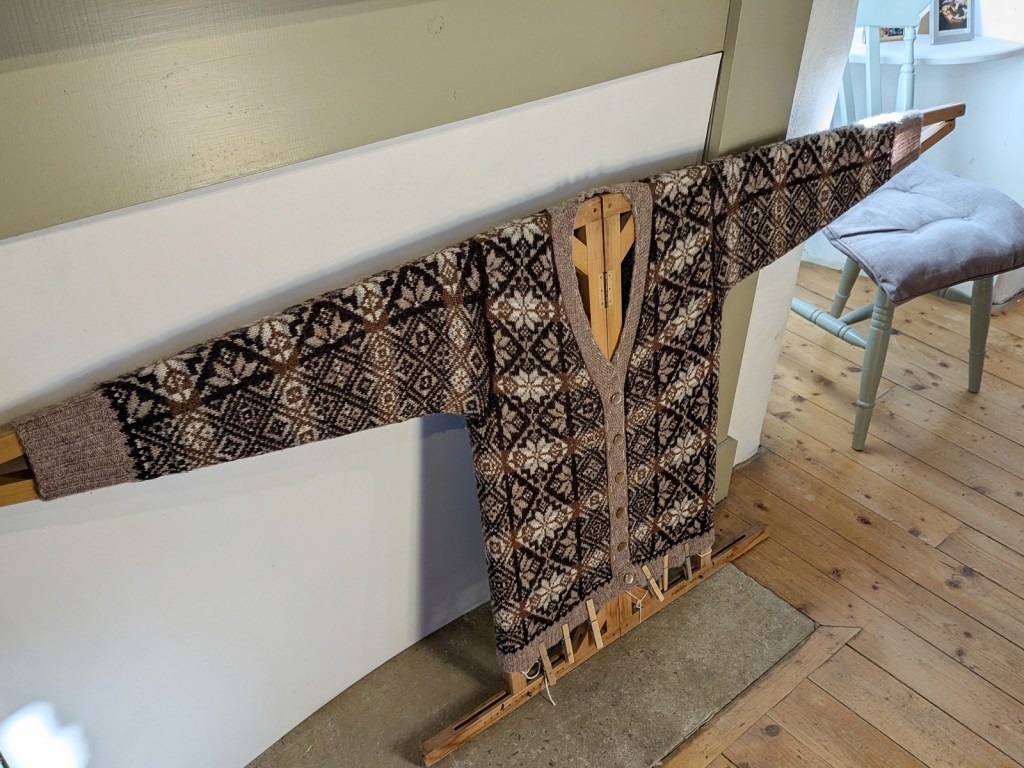
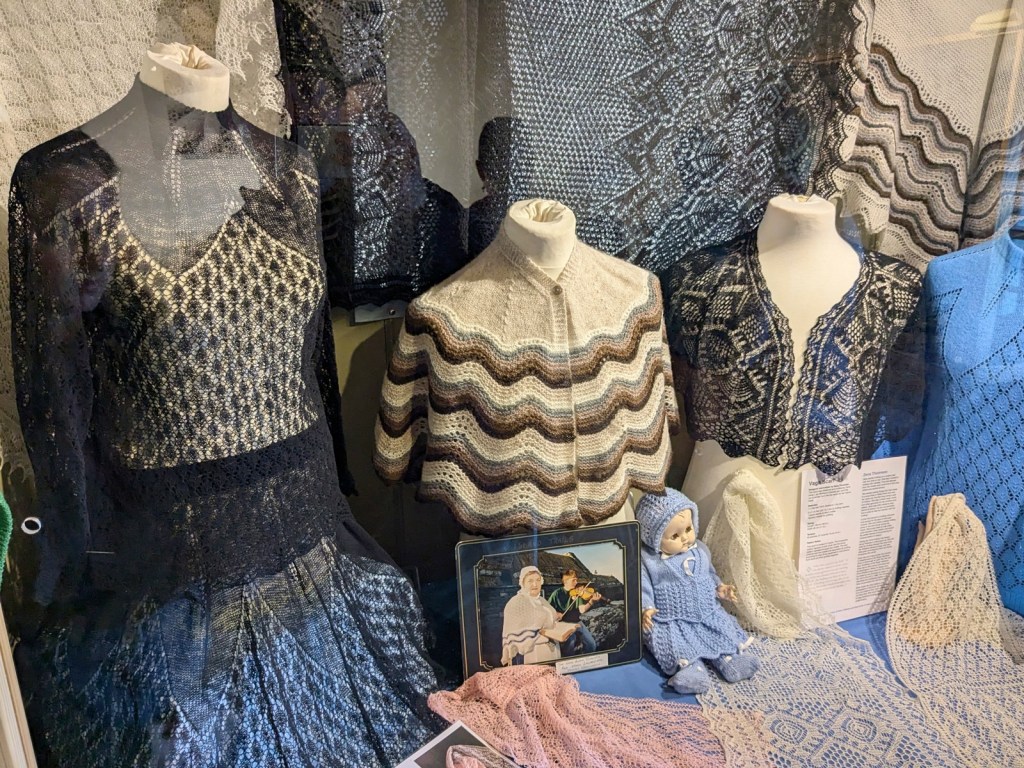
The museum is pretty small but very nice, and seemed to be overwhelmed when we visited with Wool Week visitors. They have a small room with a large loom (perhaps the last of its kind on Shetland), which was the traditional loom for weaving tweed. This room also housed a taatit rug, which at the talk we went to on our final night in Shetland the phenomenal presenter described as the only fully domestic textile on Shetland, what with the knitwear largely being for the export market. But then you go upstairs at the museum and it is stuffed with a whole bunch of displays of various donated traditional Shetland knitwear. Really a great source of inspiration and also history in the flesh (wool). An essential visit when you’re in Lerwick.
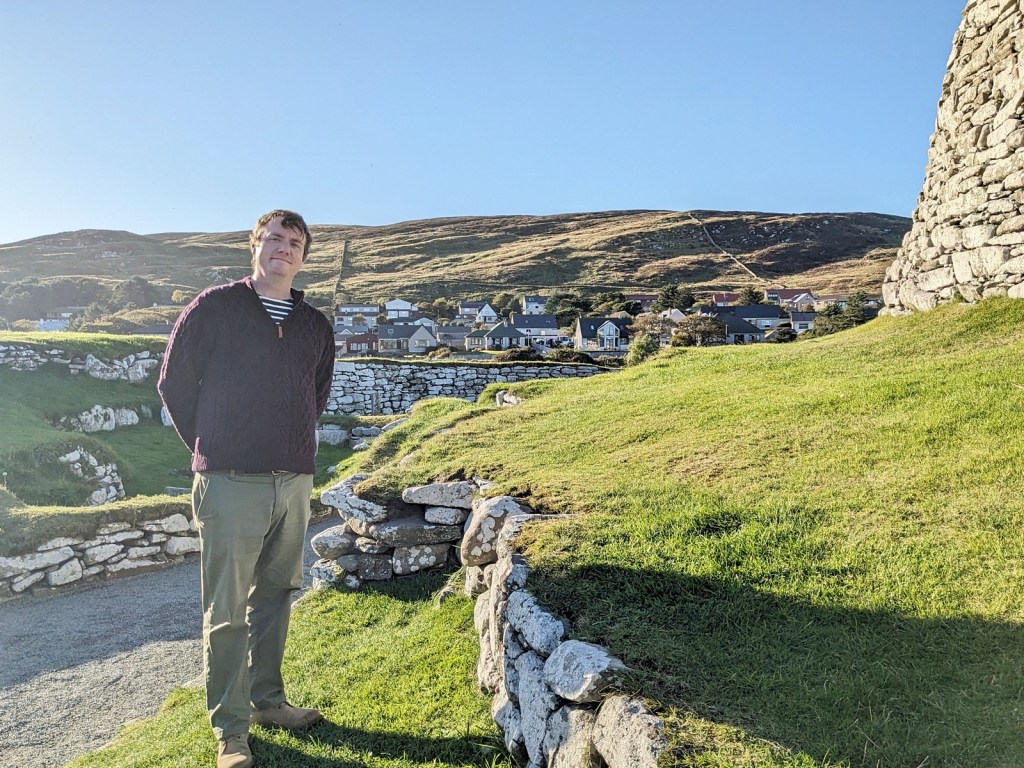
Since you’ve already heard about the very final part of our day, just going to mention here that we also managed to visit Clickimin Broch, which is a pretty well-preserved broch (minus the fact it is a bit shorter than it used to be) right in the heart of Lerwick, across from the Tesco. That was fun to stomp around, even if we were disturbing the teenagers hanging out on top of the wall. The horses in the field next door were pretty to look at as well. On to more adventures the next day!

 Pat in the World
You must be logged in to post a comment.