Spain XI: The Big Pomegranate

Our time in Córdoba had sadly drawn to a close, but no fear, we were off to bigger things: specifically, Granada. We spent our final morning packing, with pastries again for breakfast. Then it was off to the train station, because we got to take another high-speed train, which I was again excited for. We again got to admire the beautiful landscape of southern Spain. The castle we saw this time was the Castillo de Almodóvar del Río, though the more exciting sight was that of Archidona. First off, you know, so picturesque, the white buildings spilling down the hillside. But then you look it up on Wikipedia and find out the site has been settled since Paleolithic times and wowsers, talk about history. Bonkers. Another note is that in addition to the olive trees we saw on the way to Córdoba, we also saw a number of orange groves which was cool. Upon our arrival in Granada I was delighted to see that there as well the trend of orange trees continued, despite the city symbol being the pomegranate. Just can’t keep a good fruit tree down.
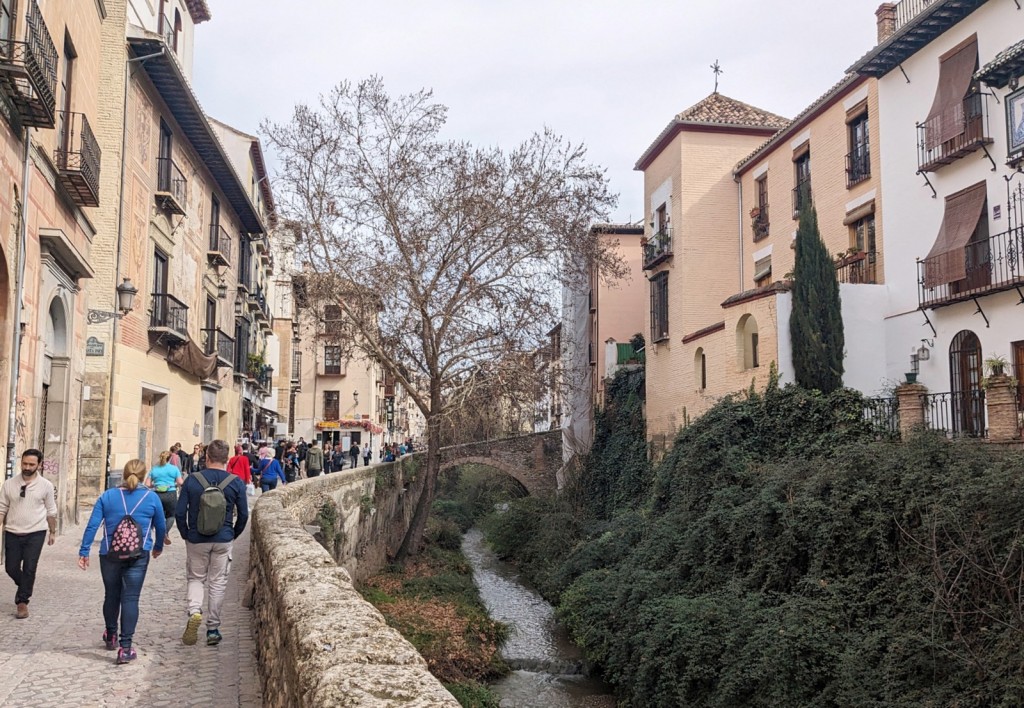
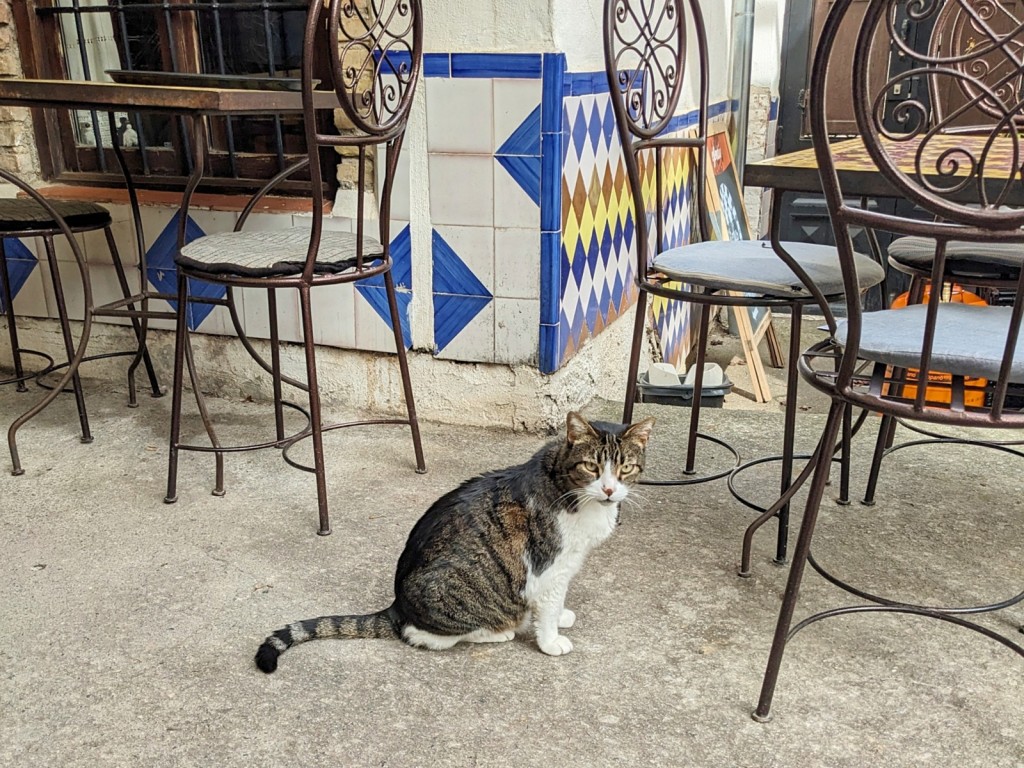
After dropping off our bags at the hotel we went off to wander Granada and man it was gorgeous. All the little streets and ancient history. Our hotel was right on the Darro so we were in the thick of it as soon as we walked out the door. We had gotten lunch but were still up for dessert so after getting our bearings a bit the next place we visited was the Teteria del Bañuelo which my super amazing wife rated as the best experience she had then had on the vacation. It is run by a lovely I assume Turkish woman, and besides having a gorgeous balcony with a view of the Alhambra, it also had a wonderfully friendly big ole café cat that was napping in the sun when we arrived but who soon enough swung by for some scritches. The tables had tile and the sun was shining and the excellent tea was served in cute little Turkish teapots and little Turkish teacups and the chocolate baklava and a “bird nest” dessert was to die for and it was great. Highly recommend.
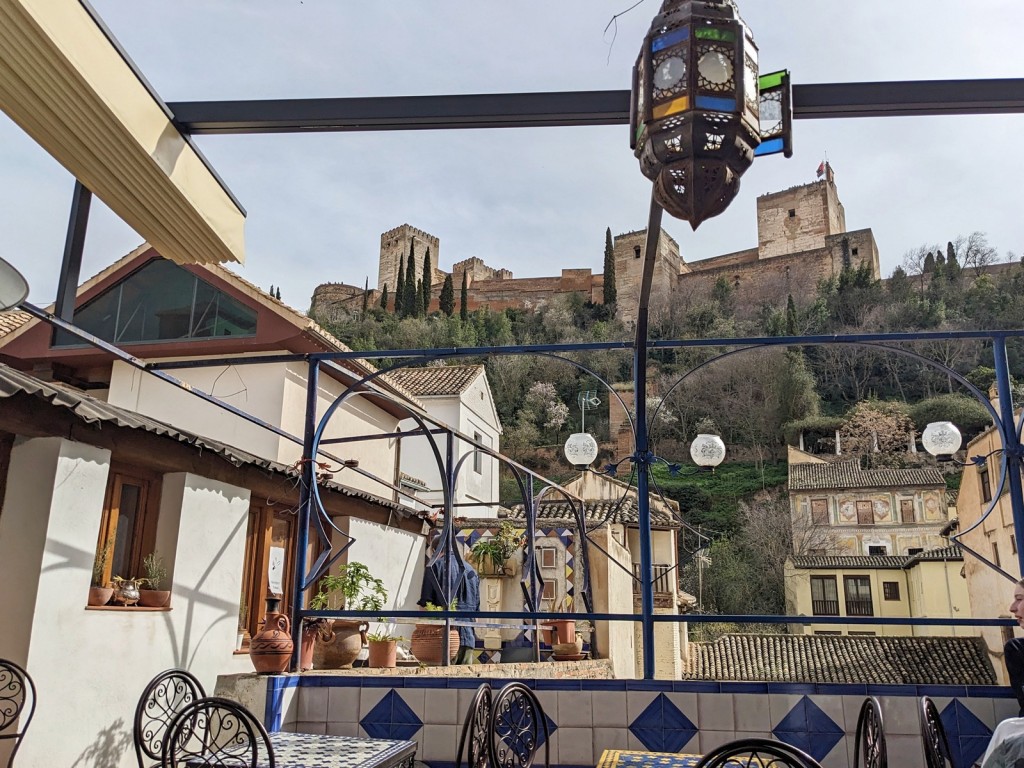
Alhambra views.
Café cat.

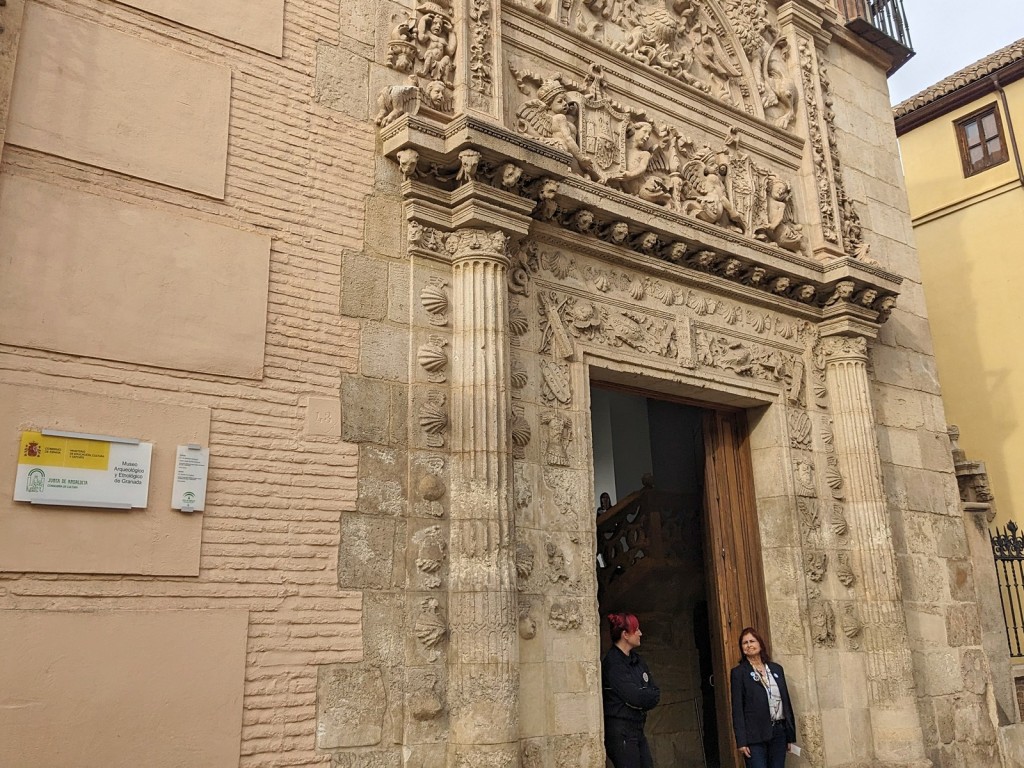
The first real touristy place we visited in Granada was the Archeology Museum. It was small but with an admission price of a whopping 3€ it would have been a bargain at twice the price. The small size was actually an advantage for me; the archeological museum in Madrid was big and so full of stuff but I didn’t know what was going on so it was hard to keep track of it all. Meanwhile this was smaller and easier to understand. Plus according to the handy museum map, it was one of the first to be founded in Spain, having originated in 1842 as an Antiques office before getting a Royal Order in 1879. Neat! The building it is in is from 1539, or the façade is anyway. The sign near the door says it was built by Hernando de Zafra’s grandson, it is called the Casa de Castril, and is “decorated in a Plateresque style with an allegory that represents the lord of the house as a Christian hero hoping his victory over death.” Neat I guess.
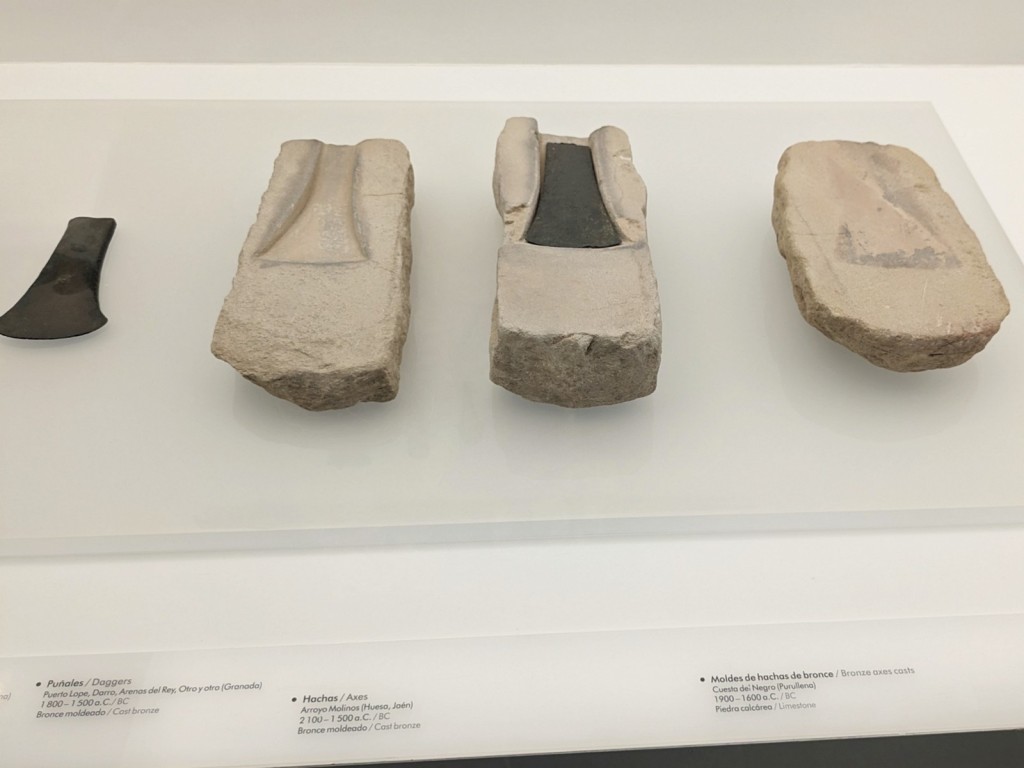
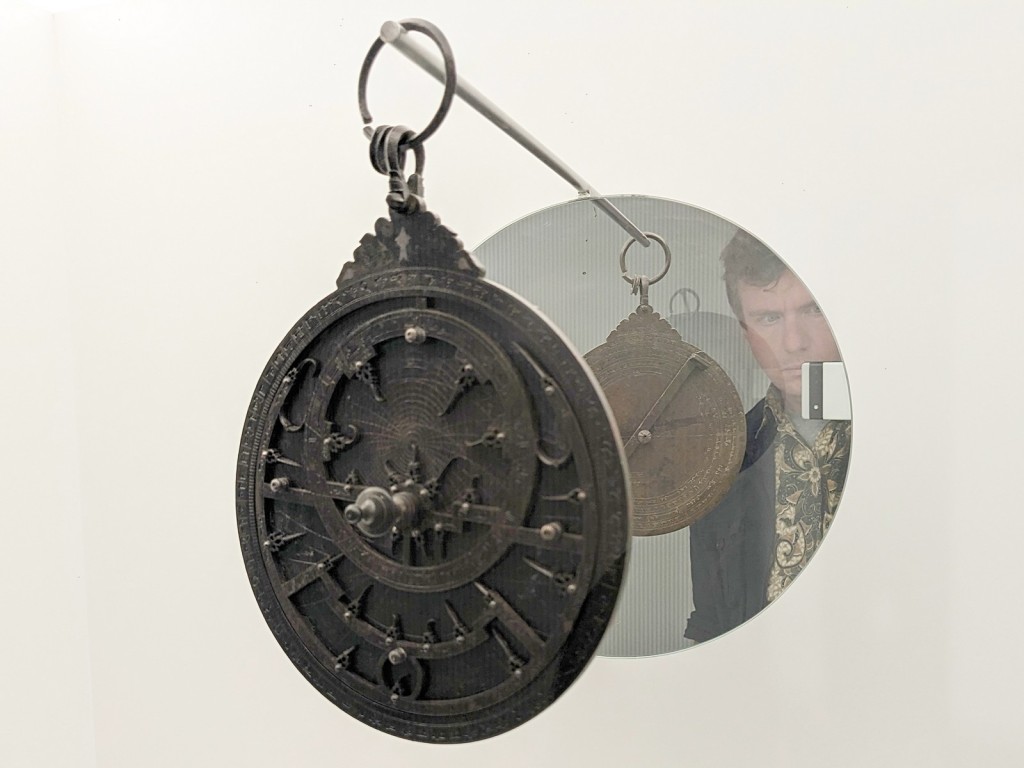
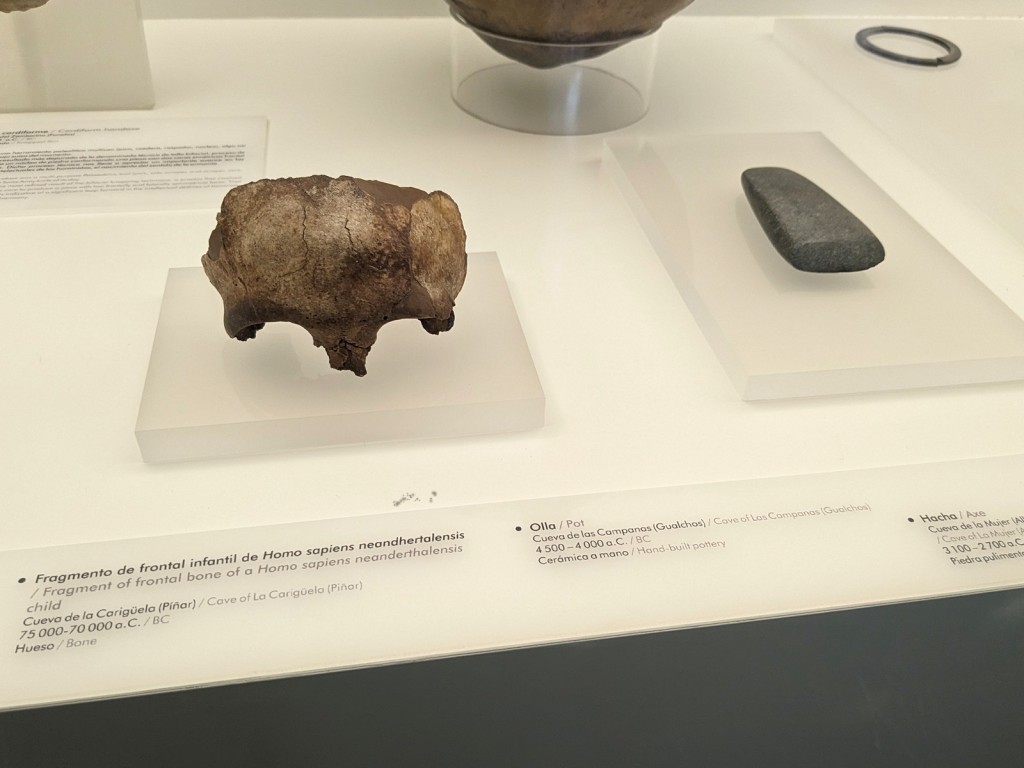
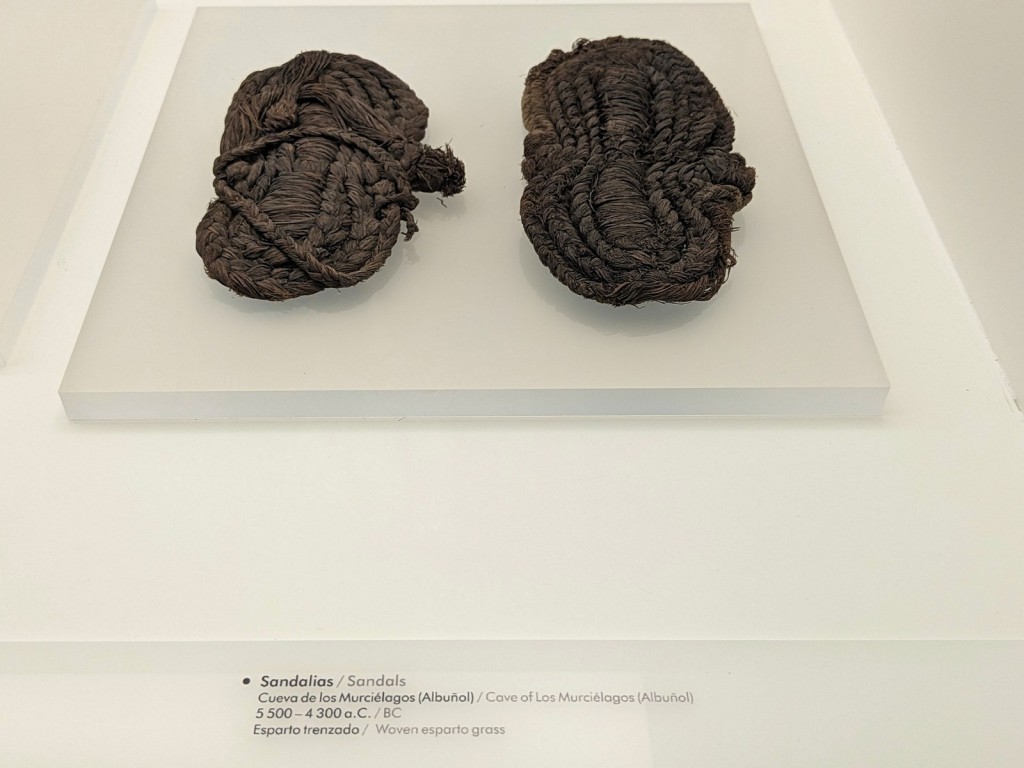
I just said the archeological museum was small but boy does it pack a punch. They had some really cool stuff! There were perfectly preserved 7000-year-old woven grass sandals, which is crazy! Amazing stuff sticks around that long! Some dude or lady from 7000 years ago wove some grass together so their feet wouldn’t hurt so bad and here and unfathomable amount of time later we get to admire their work! Even older were some 1.5-million-year-old humanoid remains. Also extremely cool was a stone mold for bronze casting, and I had never seen that sort of thing before. And, of course, my absolute favorite (though actually I am still blown away by the sandals, I am a simple man that likes old things) was an astrolabe! Here’s another Google Arts & Culture thing of their collections so you aren’t limited to my silly pictures, very worth a perusal.
Despite how great it was the museum was still rather small so, still fortified from our tea and desserts, our first partial day in Granada was still far from over despite being very full already. Our next destination was the Capilla Real! Look man I was really bad this trip at figuring out what was going on with Spanish royalty. There I was back in Córdoba, rather stunned to discover that I was in Isabella and Ferdinand’s old pad, and now here I was in Granada, stunned to discover that the two of them were like a couple blocks from where we were staying! They were staying there permanently of course, because they are dead. Still very cool to see! No pictures again, sorry, you’ll have to go yourself. You walk in and see their big ornate crypt topper (I dunno it’s on top of the crypt) that is statues of them inside a big ornate chapel, and then you can descend a little staircase to see the sarcophagi themselves. You got Isabella and Ferdinand down there of course, but you also have Juana la Loca, which is a mean name, and Philip the Handsome, which is a PR job if I ever saw one and I really oughta hire that same PR guy frankly, and then finally poor little Miguel da Paz. Very cool to see and then as a breather you get to walk through a little museum of some religious iconography and if I recall correctly some monarchial paraphernalia, before exiting through the gift shop. That was a nice little surprise because most museums we had been to didn’t have gift shops and so I had no chance of getting a lapel pin, but the chapel had both a gift shop and a lapel pin for sale.
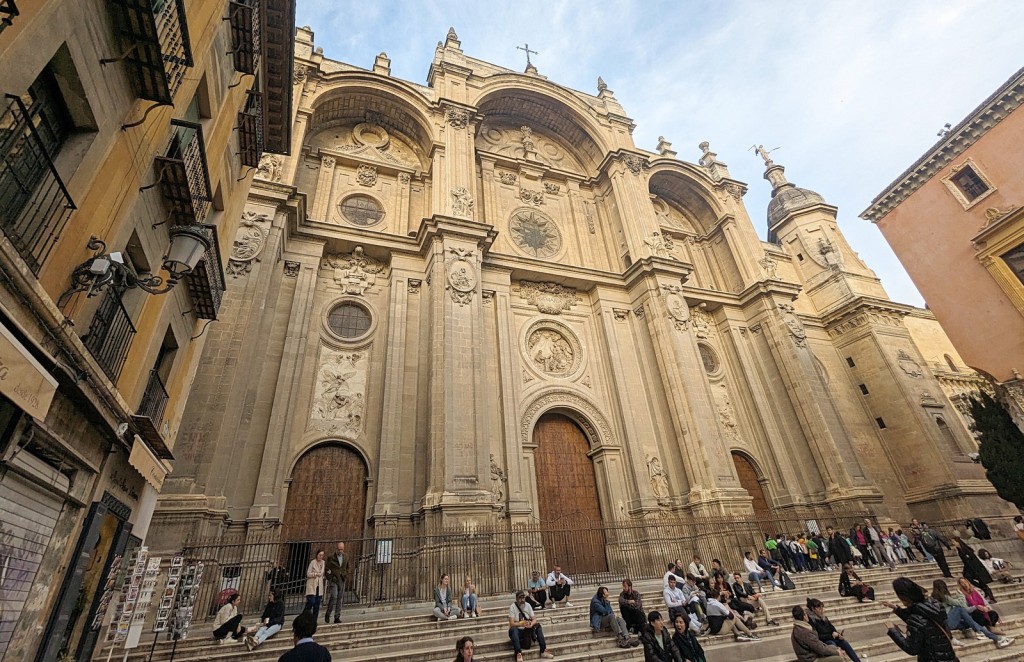
This is the cathedral, not the chapel, but I dunno man same same.

Okay with the royal visit out of the way, now our first day in Granada was winding down. After the chapel we poked our head into the madrassa across the street but there wasn’t much to see, and then wandered into more gift shops where we got some Turkish delight. What the guidebooks tell you about Granada is that it is the rare place in Spain where the bars still give you free tapas, so we were off to experience that. The place we chose was the Bodega Castañeda, I think. One thing I have really enjoyed about Spain is that you can just order a category of stuff. At bars I could just order a beer and receive a beer, no further discussion on brand or type or whatever required. At the train station coffee place I just ordered a “coffee” and the only question the lady had was if I wanted milk. Despite having enjoyed that, it was my super amazing wife learned the lesson better than I did; this bar we were at was known for its vermouth and when it came time to order I was paralyzed about what vermouth to order but she just asked for “vermouth” and lo and behold vermouth appeared! And tapas! It was great! Astounding and excellent. Vermouth in hand I then proceeded to bore my super amazing wife with my various thoughts on the economics of free tapas, like: How do you choose was tapas to serve? Do you try to avoid losing money on every drink or do you occasionally put out a fancy tapas so people feel like they are gambling and might order more drinks? If you wanted to forego free tapas, like as a bar if you wanted to stop giving out the tapas, do the other bars condemn you to keep you in line? I wonder.

But anyway that pretty much capped off our night and then all we had to do was head back to the hotel to rest up for the next day’s big adventure.
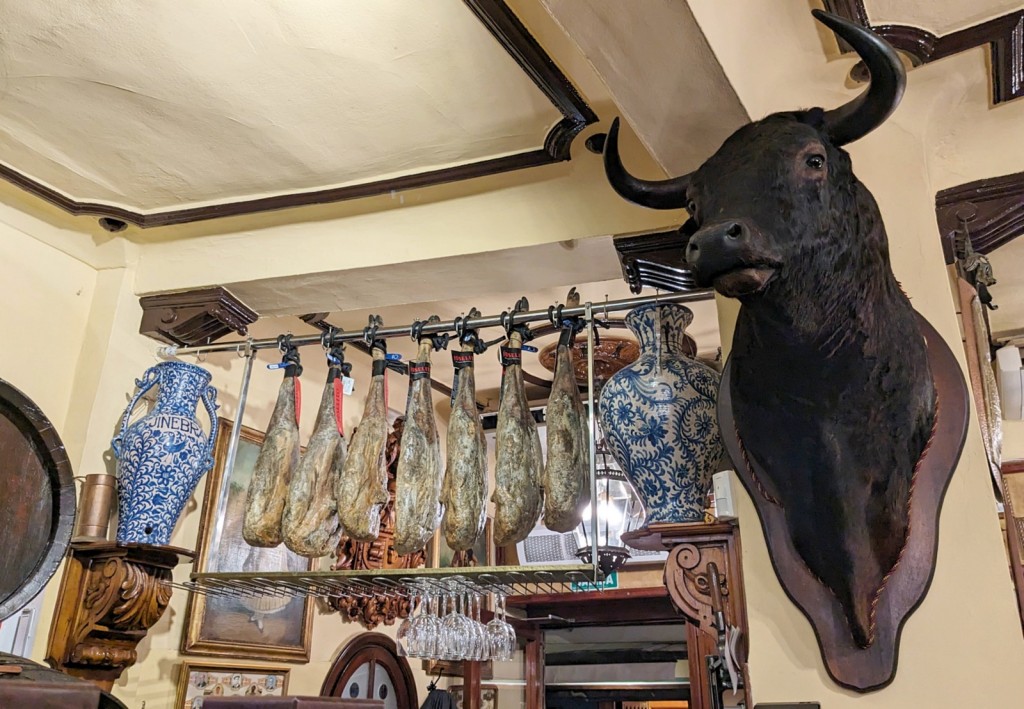
Decorations in the bar.

Spain X: Still and Unstill Life

Despite all the things we had already seen, the day was not over. A remarkable and unexpected gem of Córdoba was the Museo Julio Romero de Torres. We had never heard of Julio Romero there, and I think what we were really trying to do was to go to the Museo de Ballas Artes next door. But they have the same entry way and the lady at the ticket counter I think was trying to ask us which one we wanted to go to and we didn’t understand and we wandered on into Julio Romero’s former home there and I am glad he did. Quite an interesting painter!

Unfortunately they did not allow photos inside the museum so instead of my crappy photos you’ll have to instead rely on the higher-quality ones that Google took. I keep harping on our lack of context as some cultural self-flagellation, but of course we were walking into this museum blind as well. There’s not a whole lot of explanatory text that I recall, and one of the first things they have you do is watch this uh artsy video. Very informative. One thing becomes very quickly clear about Julio Romero de Torres as you walk through the museum though: the man liked women.

The museum is not particularly large, featuring just a few galleries with a number of his generally pretty large-format works. Most of the paintings are about women. A large number of those were of perfectly normal women, as in like, this is a painting of a flamenco dancer. But I thought the most interesting paintings were the gender-swapped ones. The single most intriguing one was of the Archangel Saint Raphael. I suppose I am not deep enough in the cannon as to understand if angels are men or women, but I am pretty sure Raphael is usually depicted as a dude so making him a her is a choice and I wonder what he was trying to say. This was a theme of his, switching up your normal religious iconography. Here is the Pietà, but, you know, sexy. This dude should be way more popular on Tumblr, tell you what.

Alongside a note that the frames were big and ornate, other paintings I wrote down as thinking they were especially cool included:

I wrote down in my notes that I thought Poema de Córdoba was probably my favorite overall for what it is trying to do with myth and metaphor, but one that caught my super amazing wife’s attention was Naranjas y limones. She noticed that the painting only depicts oranges, making the lemons a metaphor, if you catch my drift. Wikipedia agrees with her, so that’s a point for my super amazing wife’s super amazing art analysis skills. The museum did not have a gift shop, but the little shops across the way did have prints, and much to her chagrin I bought one of Naranjas y limones. Speaking of oranges, I know this is just standard in Córdoba but I still love it, so I will note the museum also had a lovely little courtyard with lovely little orange trees and man I think that is all I want in the world:

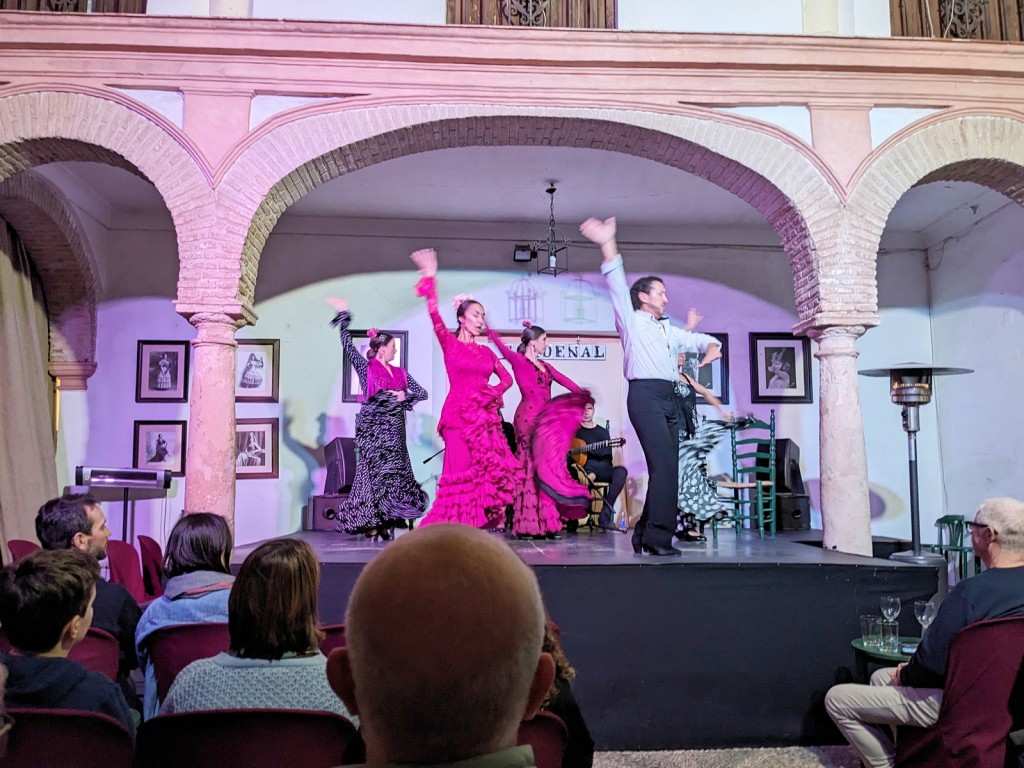
Although we had already experienced quite the day full of culture and history, there was one more thing to do: flamenco! I mean first we had to get dinner, we went to an Italian place, or Italian-inspired anyway, always interesting to see a culture interpreted through a third culture, especially if it’s a different third culture you’re not used to seeing it interpreted through. Such a mix! Oh and also there was even more souvenir shopping, we got a cute little model house. But then, for real, flamenco!

This was my super amazing wife’s first experience with flamenco, but it was not mine. You see, as part of our education to become well-rounded Naval officers, the Naval Academy made us sit through various cultural events. I saw the Russian National Ballet Company put on Swan Lake and lemme tell you, I hated it. A much more popular event though is when they had us sit through a flamenco performance. They had the Academy’s etiquette instructor give us a lesson on flamenco etiquette the day before which annoyed all of us, because it went over schedule making us late for classes (which we could get in trouble for), and she made the other mistake of telling us that it was a complement to shout olé! a lot, so during the actual flamenco performance itself, which I remember being really good (way better than that stupid ballet performance) (this is not a “Russia’s invading Ukraine” opinion by the way, I’ve been hating on this experience for a decade and a half now), we all got to obnoxiously shout olé while in fact being square down the middle of appropriate etiquette. Anyway I was looking forward to seeing flamenco again.

It was really good! We of course went to one of the nightly flamenco performances that caters to tourists, but I read online that most flamenco is for tourists now anyways, so really when you think about it this was the most authentic type of flamenco. Entrance came alongside a drink ticket and we both got sangria (a dangerous drink for me). We settled in and waited for the show to begin. I was really impressed by the guitarist, who managed to look between bemused and bored while strumming out just extraordinarily complex music that these women (and one man) were dancing to. Vocals were provided by a lady who happened to be pregnant, making it all feel like a family affair. My super amazing wife was particularly impressed by the footwork, having experience in Irish step dancing herself. It was all really expressive and I wish I knew more about the subject as to have been even better able to appreciate what it was. I was stunned when 80 minutes had gone by and it was over, despite an encore. A very full day behind us, we finally head back to turn in for the night.

Spain IX: Cattle, Caliphs, & Columbus

Reading this week:

  • A Residence at Sierra Leone by Mrs. Elizabeth Helen Melville and edited by Mrs. Norton

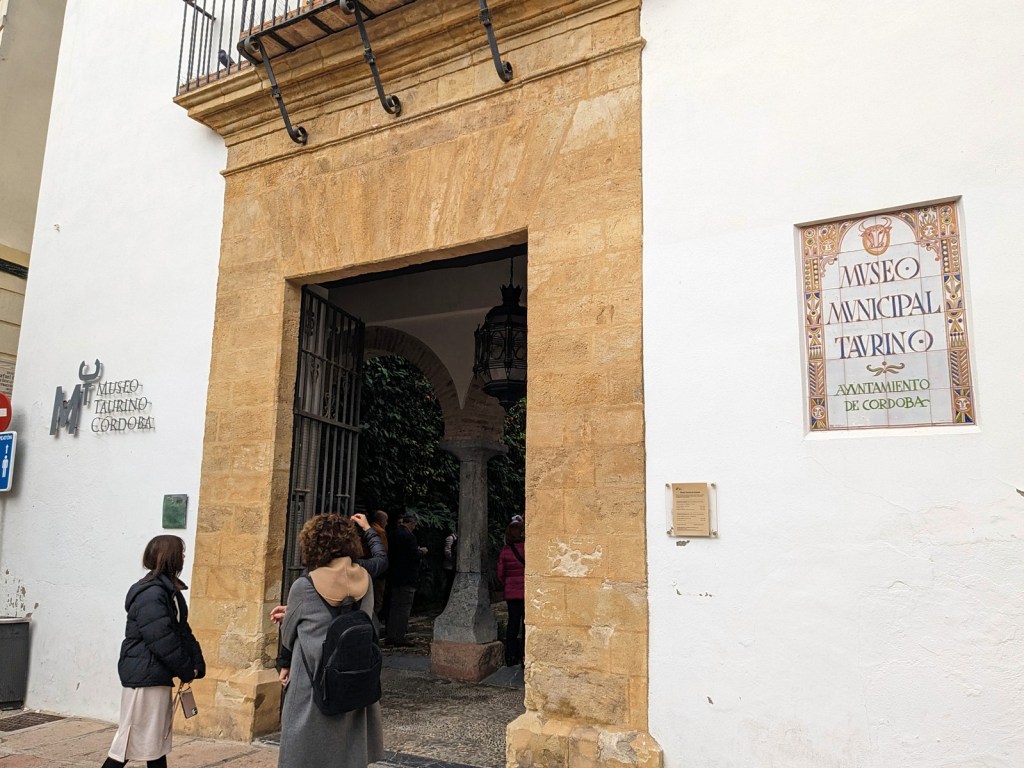
Although the Mezquita was large by the time we finished the day was still young and there was so much more to see in Córdoba. One of the places I wanted to go in Córdoba was the bullfighting museum. Being an American who’s main exposure to Spanish culture is Hemingway, I am into the concept of bullfighting. When I went to Cancun on spring break one time I did actually see a bullfight. I would call it a pastiche of one but they did actually kill the bull. The opening act was dancing and cockfights (not to the death, though I later saw those in Guam). I have a poster from it as an homage to a poster my dad has from a Spanish bullfight we went to. All that to say that if it was the correct season I would have dragged my super amazing wife to a bullfight while we were in Spain, but it was not the season, so the next best thing was dragging my super amazing wife to the Museo Taurino de Córdoba.

Honestly it was a little bit disappointing. Maybe I didn’t know enough Spanish to really appreciate it for what it was but mostly it was just a bit small. I guess I am spoiled, or maybe I was expecting to be fed context that the museum already expected you to have. Again, being a reader of Hemingway I know a thing or two about bullfighting, or think I do, so I could understand some of what was going on but the treatment of bullfighting in the place seemed a bit light. There was some cool stuff about the history of bullfighting in Spain reaching back to ancient times, and the main focus of the museum I think was on some of the more famous matadors, the “Five Caliphs” of bullfighting. I was hoping for more that explained the art of bullfighting, maybe a more intricate cultural history, something like that. Nonetheless it was probably worth the price of admission, but not a place to spend the whole afternoon.

Almost the whole rest of the day in Córdoba was spent poking into interesting little place we more or less stumbled upon. After the bullfighting museum and even after some additional souvenir shopping we had plenty of time so when we stumbled upon the Baños del Alcázar Califal (Caliphal Baths) it was worth wandering in. Here’s the virtual site map, though maybe the Spanish Wikipedia page is more useful. It is a small museum built into the ruins of a hammam built in the 10th century by the Cordoban caliph al-Hakam II, Wikipedia tells me. They were used for a couple centuries and then destroyed when the city was taken over. There’s not a whole lot in the museum, mostly a guided path through the old rooms of the place. Once again lacking context for much of what was going on I didn’t really understand what I was looking at most of the time but I guess neat to wander around. The thing I was most interested in was the heating system for the hot room; apparently there was some cool pipes and there would have been a boiler (I love boilers) but I couldn’t really tell what I was looking at unfortunately. Oh well.

Two places wandered through, it was on to the next location: the Alcázar de los Reyes Cristianos. This is the thing I am most embarrassed about not realizing what it was. I am going to go on and on in this blog post about my lack of context and like, some of that is not my fault. If I grew up in Spain a lot of this stuff would resonate on a deeper level than “cool” or “aesthetic.” But a large chunk is my fault. Like I knew Córdoba was apparently an important city or whatever, but I didn’t realize how important. We had popped on into the Alcázar because it was supposed to have some pretty gardens. And pretty gardens it did have! Super pretty. You had to wander around some throne-room looking thing (reader this is foreshadowing) before getting to them, and we skipped going up the tower because the line was too long, but man the gardens are great:

Huge, too. Several levels, multiple water features, including really cool ones where there are like little water channels that empty into ponds and stuff or go around and all sorts of things. I love any kind of fruit tree, every garden should be full of fruit trees, and this place had a whole orchard of orange trees. In the middle was also a statue of a Columbus-looking guy. Weird, I thought. They also had a section with a bunch of stray cats, each of which was extremely cute. Besides the large garden there were little courtyards with more orange trees. It was calm and peaceful and beautiful.

Walking out, I finally looked up what the place was on Wikipedia. And like, oh. The Reyes Cristianos. Turns out the place was a primary residence of Isabella I and Ferdinand II! The statue of the Columbus-looking guy was because that was Columbus and this was the spot where he had his first audience with Isabella and Ferdinand in order to get support for the whole “journey to the new world” thing! A lot of important stuff happened in this spot and I thought it was just weird there was a throne room attached to the pretty gardens! I felt very silly. I could have really absorbed some history, even some nasty bits I guess. But hey the gardens were cool no matter what.

Spain VIII: Mezquita Muy Masiva

Our first full day in the beautiful Andalusian city of Córdoba dawned bright because we got, you guessed it, pastries. The entire time in Spain I was eating pastries and desserts heretofore unknown to me and they made it worth the trip. But we can’t spend the whole day eating pastries so we spent the time while we were digesting checking out the Mezquita-Catedral de Córdoba!

It didn’t take us long to get to the Mezquita from where we were staying, like I said last time we could see it from the porch of the place we were staying. We had timed tickets and audioguides which made us fret because when we showed up it was confusing where we were supposed to go. I eventually left my super amazing wife in the extremely long line (we figured so many people couldn’t be wrong) while I picked up our audioguides. The timing worked out perfectly because I returned with the audioguides at just the right moment for us to head into the building.

I am still a little unclear if I should feel bad about checking out the place, it being of course at one point a mosque. I mean, probably not, but at one point I overheard a tourist asking I think a tour guide about how Muslims felt about the mosque being converted into a cathedral and the tour guide didn’t quite seem to understand the question. He explained that the site was part of Spanish heritage because the Spanish had taken over Andalusia. There is a whole lot more to interrogate there than I really have the background for.

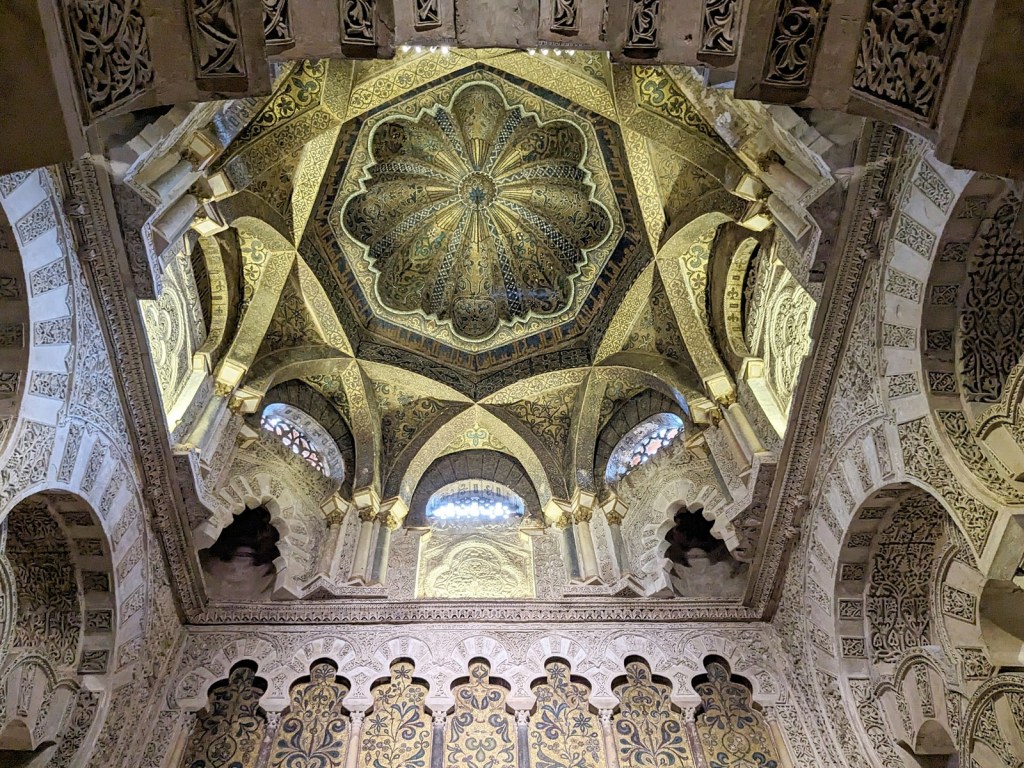
Anyway! The Mezquita! What a place! As I was wondering around I tried to keep myself from blaspheming and using particularly dirty language because, you know, it felt more respectful, but here in the quiet solitude of this blog I will say: holy fucking shit! I was not prepared for the experience! When we were wandering around Córdoba the previous day we passed by and around the Mezquita a lot. It is right downtown so you have to walk around it to get anywhere, and from the outside it is impressively decorated and the size of a city block, but man was I not grasping what the place was.

The thing is so gigantic and just jam-packed with beautiful, intricate, gorgeous details. I ran around the whole place taking pictures of every little decoration and architectural feature. I also tried to listen to the audioguide but a) I was very distracted every single time I saw a new motif and b) it has a very layered history that is hard to grasp in the moment (for me anyway) so I was losing the thread. But the various cultures and additions mean you just keep gilding the lily with more gilding and more lilies and it is non-stop man. Centuries of desiring to add to the profound contemplating of religion and spirituality and stuff really does numbers for the look of the place. As we continued to wander farther south some of this became de rigueur, just slightly, that it lost only a hint of shine, but as a first experience it could hardly have been more intense. You could get a permanent crick in your neck looking at all the ceilings, phenomenal and varied and stunning.

It is also hard to get a solid feeling for the place. Since it has been expanded so many times and is so big but still requires so many different supports for the roof, it almost feels like you are in a maze of warrens. You can’t see the whole thing from any given spot, or even a big part of it, so every time you turn the corner there is something new. For example, the Cathedral. It is called the “Mosque-Cathedral,” and so I knew they used it as a Cathedral, and I knew the Cathedral-y bit was somewhere in the middle. But I thought that meant like, there was a bit in the middle they just used as a Cathedral. But no! You turn the corner and there is a whole-ass Cathedral!

I was already so blown away by the Mezquita bits I could barely take in the Cathedral bits. I didn’t even take many pictures, but it is also so intricate and detailed! If something takes like 10 years to build these days that is a lifetime, but man, you spend a few centuries putting something together you have time to add a whole lot of fiddly bits! So many carvings and figures in stone and wood, not to mention the paintings, and just wowee. I am running out of words, clearly. Eventually we decided there was not much more we could take and head back out into the courtyard.

I have just gone on and on about the interior but I also loved the courtyard. Like the rest of the city it was filled with orange trees, but I really particularly liked what they did with the place. All over the city there was these pavings done with stones and so designs were inserted in, but more importantly for my tastes the trees were placed in basins with channels between them, for easy watering and a really beautiful effect. The courtyard was so beautiful that I lost track of time and we almost missed our tour of the tower. We had tickets and I thought we could go up pretty much whenever we wanted, but my super amazing wife had realized that we were supposed to go up in a single group with the other tourists. We missed that group but the guard let us scramble up after them anyway and so we got to check out Córdoba from above.

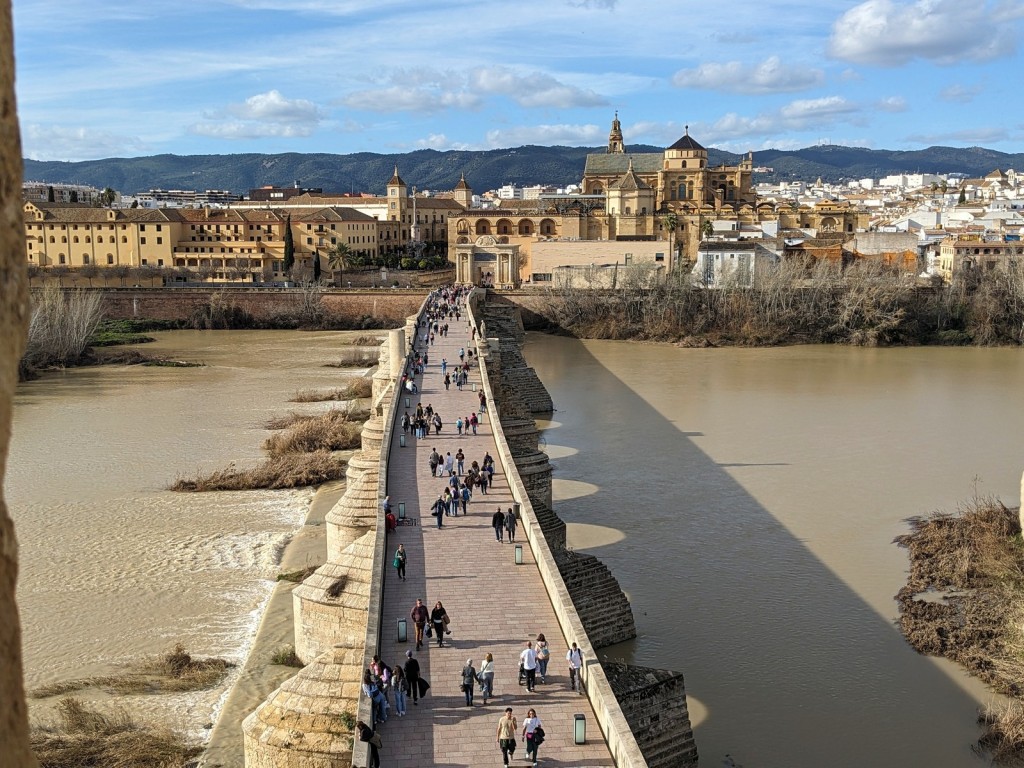
It was really gorgeous, to no one’s surprise. Not only do you get a more holistic view of the Mezquita, with the different roof bits making it more clear the shape of the place, but the city itself sprawls from the hills on one side, down to the river and then across to the rolling plains on the other. You could peer down into people’s courtyards and admire the Mezquita’s own orange grove and yeah man it was great. But the day was far from over, and so when it was time we head on down and off to the next adventure.
Spain VII: High Speed

It was finally time for us to leave Madrid and we were going to do something very exciting: take the train! It would have been cheaper to take the bus, but I am an American and have an intense jealousy of well-developed high-speed rail networks and therefore wanted to take the train. We woke up and packed and got some pastries for breakfast and then off we were to the absolutely gorgeous Atocha Train Station. The only slight hiccup was actually finding the door but that wouldn’t be a problem twice.

They got a jungle in there.
Boarding the train went super smooth and let me tell you so did the ride. My super amazing wife has lots of experiences on high-speed trains but this was my first and I was over the moon at how smooth it was and how fast we were going. At one point I downloaded a GPS speedometer app to see how fast we were going and at that moment we were going 165 miles per hour which might be a personal landspeed record. Wild. But the landscape. Lots of rolling hills and fields just south of Madrid and for the rest of the day. And lots and lots of olive trees. These Spaniards really like their olive trees. Close to Madrid they were in regular orchards but as we got farther south and the land got hillier the trees got less regular. It wasn’t clear to me if they were really still olive trees (but what else would they be?) or if they were regularly harvested. Interspersed with the olive groves were I think hay fields though it was hard to tell, it was just short and green. I also spotted a big solar farm which I loved and the rivers we passed were like, meandering and split into small streams all over the place.
One thing that really impressed us is that we kept passing ruins that when I looked them up on Google Maps were just like, castles??? Out in the middle of nowhere and just sitting there??? Europe man, I guess it really is old. The names I looked up were: Castillo Almonacid de Toledo, Torre de Azuqueca o la Torrecilla, and Castillo de las Guadalerzas. There might have been more but naming every castle in Spain would take a while probably. As we got further south the landscape opened up into like, proper valleys and we were very excited to see sheep. Tell you what I see in art museums these pieces from people’s grand tours and they have like, sheep hanging out in and amongst ruins and groves and I thought it was a fantasy setting but here we are and that is what I saw! It is real! This is like Europeans seeing yellow school busses. The valleys we saw had like arched valleys and dirt roads and pine trees as we travelled through tunnels. It is wild and phenomenal.

Having been transported through a fantasy land we now arrived at our fantasy city: Córdoba! We got ourselves to our accommodations which were right downtown a block from the river (we could see the Mezquita from the porch), and then pretty much dropped off our bags and got to talking through the city. It was a startling difference from Madrid. We were there in February and in Madrid it felt like February. But in Córdoba it was sunny and beautiful and warm. My favorite part was that the streets are lined with orange trees, which is something every city should do. The architecture is ancient and the walls white-washed and the streets narrow and curvy and beautiful. Occasionally cars come by (in the morning when the delivery trucks go through I spotted a traffic jam that happened when one of the drivers popped into a shop for a pastry, leaving his car in the middle of the street) but not many. And these Spanish roof tiles! On the train I could look out across the landscape and see like authentic old Spanish ruins with the tiles, little country houses, just to die for. And in the city there were also old tiles with moss on them, just picture-perfect.

View from the porch.
Orange trees!

We strolled past the Mezquita into the old Christian neighborhood (I think) outside the old city walls and then came back in and checked out some small gift shops where we got some trinkets. We walked across the Roman bridge (nice to see long-term infrastructure investment!) and poked around the other side. At the terminus of the bridge is a tower which houses the “Museum of life in Andalusia.” I dragged us in because I thought it would tell the story of the tower or something but not really. It is a little weird. A meandering audio guide tries to give you a flavor of “east meets west” Andalusia life that maybe lands better in Spanish. But you can go to the top of the tower for the view which is worth the price of admission:

Views taken in, it was back across the bridge and more wandering. We went up to the Callaje de las Flores which didn’t have so many flores at the time but was pretty. There was a leatherworking shop with cool stuff I couldn’t afford. After that we got some gelato, swung by an old book shop by the river, and went out for a dinner which was just sublime. We got anchovies in vinegar for a starter, followed by cod with oranges which is a local dish and a stunningly good combination (little pieces of cod and red onion on top of orange slices, with some smokily delicious olives), and then octopus slices on potatoes and finally oxtail stew with fries in it and man that was good. From there we got some churros for dessert and called it a night, excited in our first full day in Andalusia.

Spain VI: Fit for a King

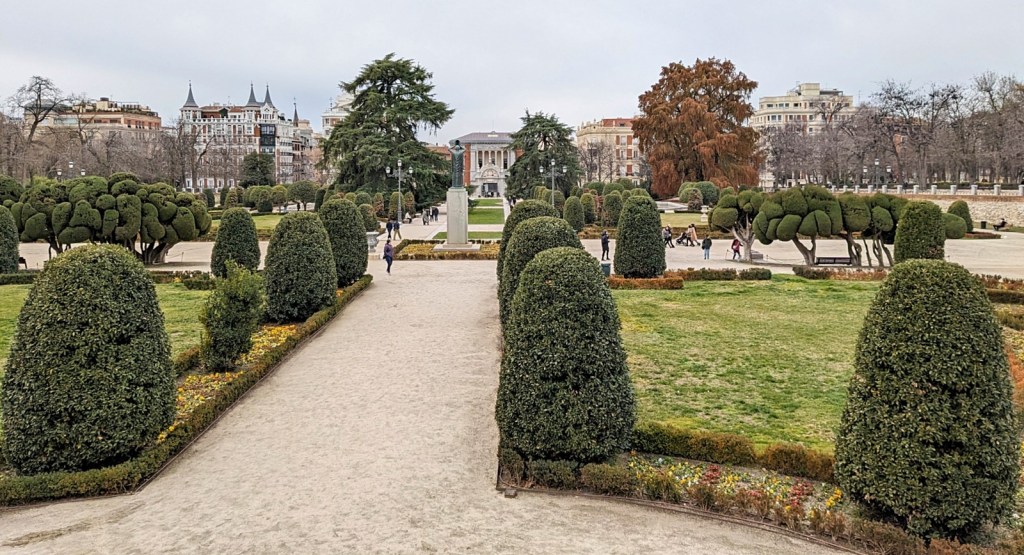
Don’t worry folks, our Madrid journey is almost over. There’s plenty more Spain to come, and we are nowhere close to the end of our whole trip, but Madrid is drawing to a close. We had spent our previous Madrid days wandering around art museums and the like, but now it was finally time to get a taste of the good life. The Royal life. And so our final full day in Madrid began with a lovely walk in the park. Coffee and donuts in hand (you can take the American out of America…) we proceeded to El Retiro. This was really nice, as it should be, since it was originally owned by the monarchy. The day was a bit gloomy but that hadn’t stopped a number of Madrileños from showing up to take walks and play football and do you know your normal park things. We wandered the paths ourselves, seeing that statue of the devil and the big lake thing and of course since this was a royal park we had to stop by and see the palace, namely the Crystal Palace. We couldn’t stay forever however (unlike the oldest tree in the park, which we also saw), we had places to be!

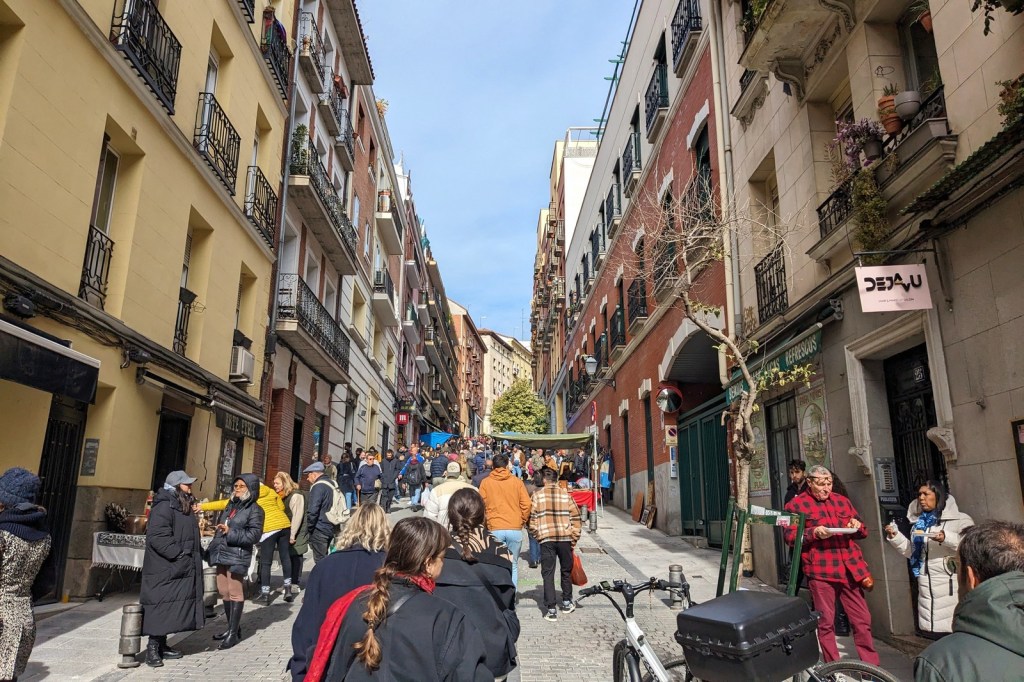
The first of those places to be was El Rastro flea market, which is a Sunday market thing which spans a number of streets. It was very crowded and I was a little nervous because the guide books all warned the place was rife with pick pockets, but we managed to avoid being pickpocketed. Instead all we met were extremely helpful and friendly people selling all sorts of fun trinkets and antiques and the like. We got a Christmas ornament and I regret not getting a cute little brass sheep that looked like the cute little brass things I see in the old houses we visit, but them’s the breaks. It was fun to see this side of the city and worth a stop if you’re in town at the right time.

Part of El Rastro.

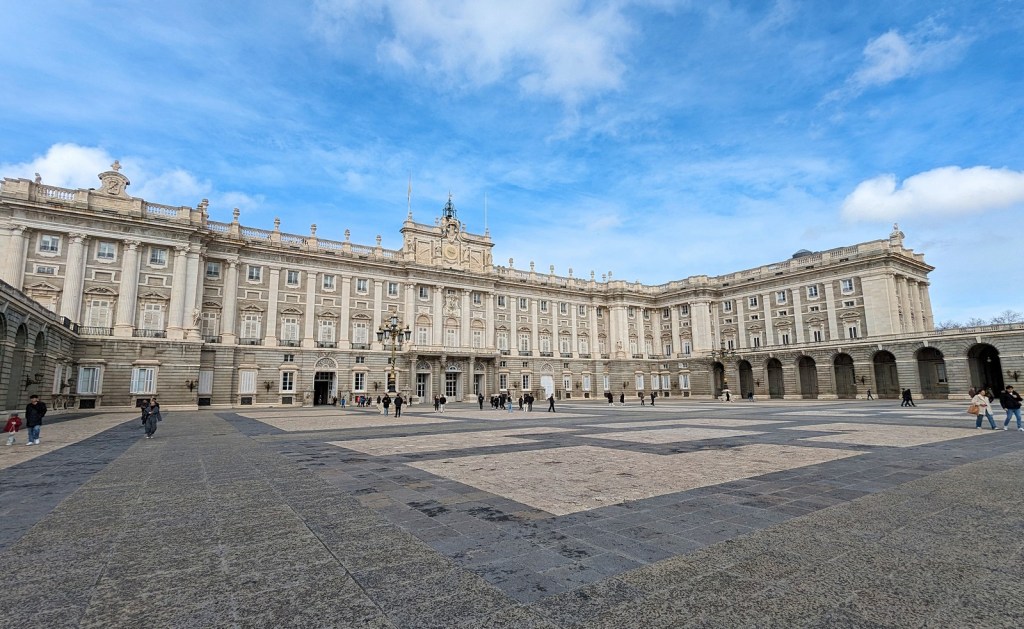
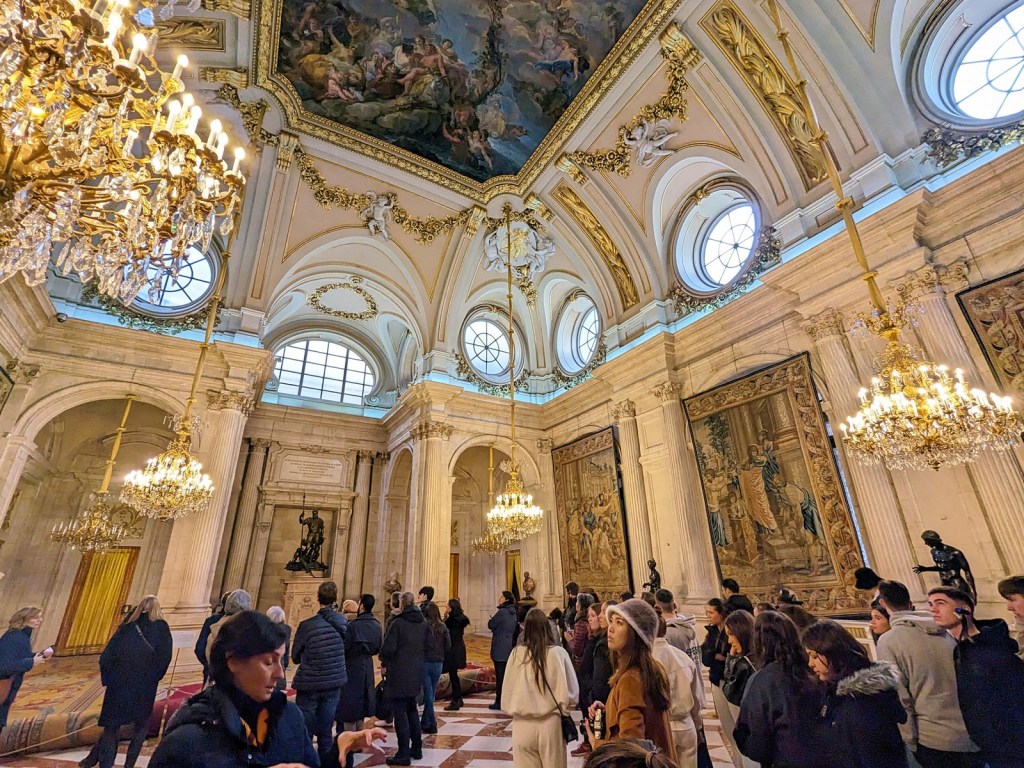
But the real place we had to be (because we had timed tickets) was the Royal Palace! Man what a place (relatively new too, for Europe! dates from “only” the mid-18th century). We had gotten a guided tour and barely made it in time because we couldn’t quite figure out the door but we did make it and off we went. They only let you take pictures in the first couple of rooms, so I don’t have many pictures for you, and believe me this is just a little itty bitty taste:

It was overwhelming. At some point you stop processing the splendor because it just keeps going. According to our tour guide the palace has 3400 rooms (twice as many as Versailles, they say), and I think the tour includes like 15-20 of them. Still a lot! Despite the lack of pictures, I tried to take notes. First thing is the clocks! They like clocks. The palace has 700 of them apparently, all of them working, the tour guide was proud to point out. I spotted at one point a clock endtable, like the entirety of the table surface was a giant clockface (behind glass). Maybe it was a tea table and you could therefore make teatime jokes, or something. More stats: we saw a banquet table that could seat 144 people; apparently the Spanish use the French protocol (the Bourbons are Hapsburgs, or something, I don’t know, who put them in charge anyway). This means that the King and Queen sit in the middle, unlike the English protocol, where they sit at the ends. I’ll try to remember that if I’m ever putting together a seating arrangement for them.

The single most impressive room I thought was the “dressing room,” which was done up in “Chinese style,” which didn’t really look all that Chinese but the place was decked out floor to ceiling in ornate embroidery and decorations everywhere and so much gold. The whole palace was gold, gold, gold. Walking out of the throne room I even spotted a gilded thermostat. It looked good, I gotta get me one of those. One room wasn’t covered in gold and was instead covered in porcelain, like instead of wallpaper (or embroidery) they had porcelain wall panels. To decorate the space they had porcelain statues. All the rage at the time. This was the “toilet room,” which is funny. Another room (they all blurred together, might have been the Chinese room again) there was a gigantic chandelier, which of course there were many in the palace, but this one had this extra hanging layer thing with lions on it. I don’t know man at least they funded artisans, you know?

By the time we got to the chapel I had stopped taking notes because I just stopped processing it all. We saw the crown jewels, which included a large crown, too big to wear because it isn’t worn because, as our tour guide told us, Spanish kings are proclaimed and not crowned and this is somehow an important distinction. An impressive note (among many) about the palace is that since I guess the Spanish monarchy was never overthrown they had a lot of original stuff, such as a golden fleece necklace decoration thingy included in the crown jewels that dates from 1431. Other originals included a whole quintet of Stradivarius instruments, which I think is five more than I’ve ever see before.

Bleary-eyed from staring at so much opulence, we stumbled back out into the courtyard. I could barely process the experience. To give us more time, we decided to see something more down-to-earth: the armory. The palace also has a display of a bunch of old weapons that have been used by Spanish armies dating back to like way back when, and I am amused and impressed by the thought that at some point this was new stuff, and then eventually wound up in storage because it was old, and then presumably someone dug it all out of a closet for inventory purposes or something and they just decided to make a museum out of it. There was a lot of stuff! Lots of medieval stuff (maybe early modern). There was a suit of armor that had like a big skirt (I am sure it has a more impressive and less dainty technical name) with dog motifs on it, which was so weird that I didn’t notice until my super amazing wife pointed out that next to the dog skirt armor was actual armor for a dog next to it. The poor pupper, that must have been uncomfortable. Besides matching your dog I also noticed further on that it was important to make sure your parade armor matched your horse’s parade armor (I guess the other way around) which is cute. Especially interesting was Japanese armor apparently made in 1580, which seemed out of place. Based on the armory’s webpage I am guessing it is the armor sent to Philip II in his capacity as King of Portugal? Pretty neat anyway. But with all the armor looked at we finally departed the palace, disappointed that the gift shop was already closed.

(Finally, as an aside, I wrote down in my journal that I should mention my own experience with the Spanish crown: back at the Naval Academy I of course used to be on the Offshore Sailing team (as opposed to onshore sailing, which is much harder). One of the boats I sailed on was called Tomcat, named after the F-14, but before it was at the Naval Academy, it had in fact been owned by the former Spanish King. Or something. It was called something else then. But then again I don’t recall anything being gilded, so who knows. I also sailed with Ted Kennedy on that boat.)

With some day left to burn we checked out a final few things. Right next to the palace (or I guess right next to the big ole royal (?) cathedral next to the palace are the Muslim Walls of Madrid. They were super nice! I had thought for some reason they were going to be in like a dingy hole but they are in fact in a very nice, very well-kept parklet. The walls date to the 9th century, when Madrid was a Muslim town and known for its springs. There is an apartment building also sitting like right on top of them, which, wow, living on history there, and from the bottom of the wall you look up at the massive cathedral and there is probably a metaphor there besides just being extremely impressive, visually. The park was filled with cats which we cooed over. So cool to be in the midst of centuries-spanning continuity!

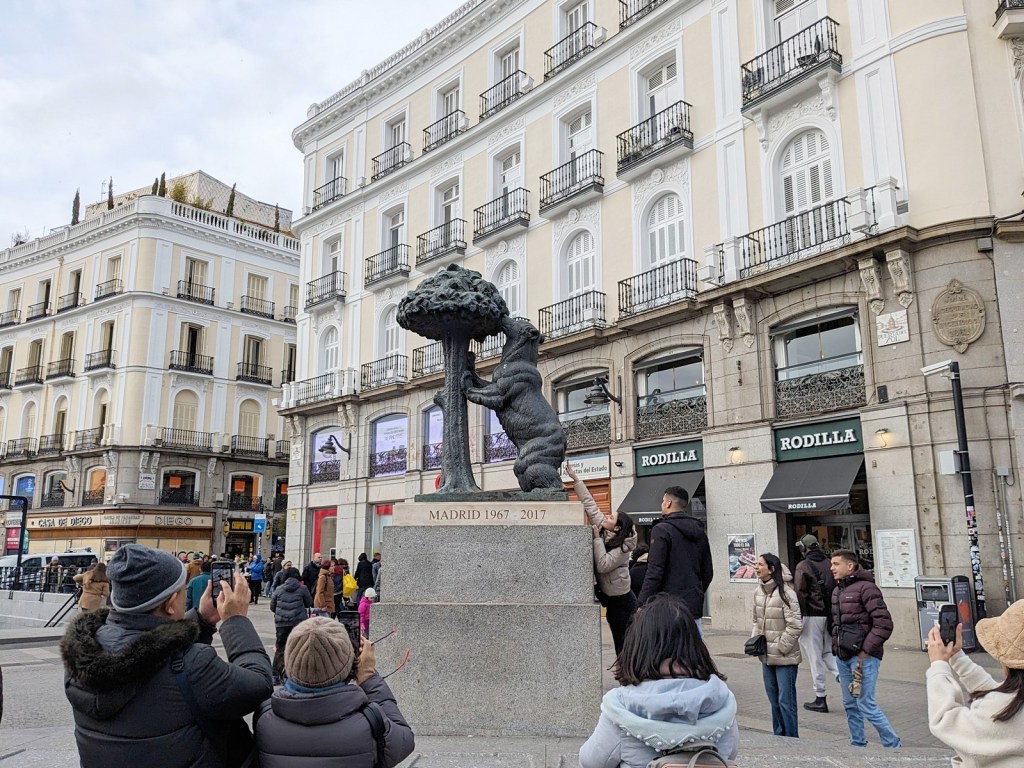
History absorbed, we made our way up towards the Plaza de Sol, though not in much of a hurry. We poked into some gift shops and got some gelato and macaroons (which is a lot of cultures all smashed into one thing). At another candy shop we got some nougat to send home and then finally admired some people trying to touch a bear’s butt:

Not a bad final day in Madrid. But onto the next city and next adventures!

Spain V: Ancient History

Though resplendent with purchases and a happy tired from looking at a bunch of yarn, after we had dropped off said yarn at the place we were staying the day was still young. Or at least young by Spanish standards. I have mentioned it before but I grew up with access to the Smithsonian museums and I always figured they were by far the best museums in the world. But they close at five. Like quitters. A wonderful emergent property of Spanish culture is that the museums stay open until 8 which is a much more reasonable time for a museum to close. We took full advantage of this by going to two additional museums in the afternoon.

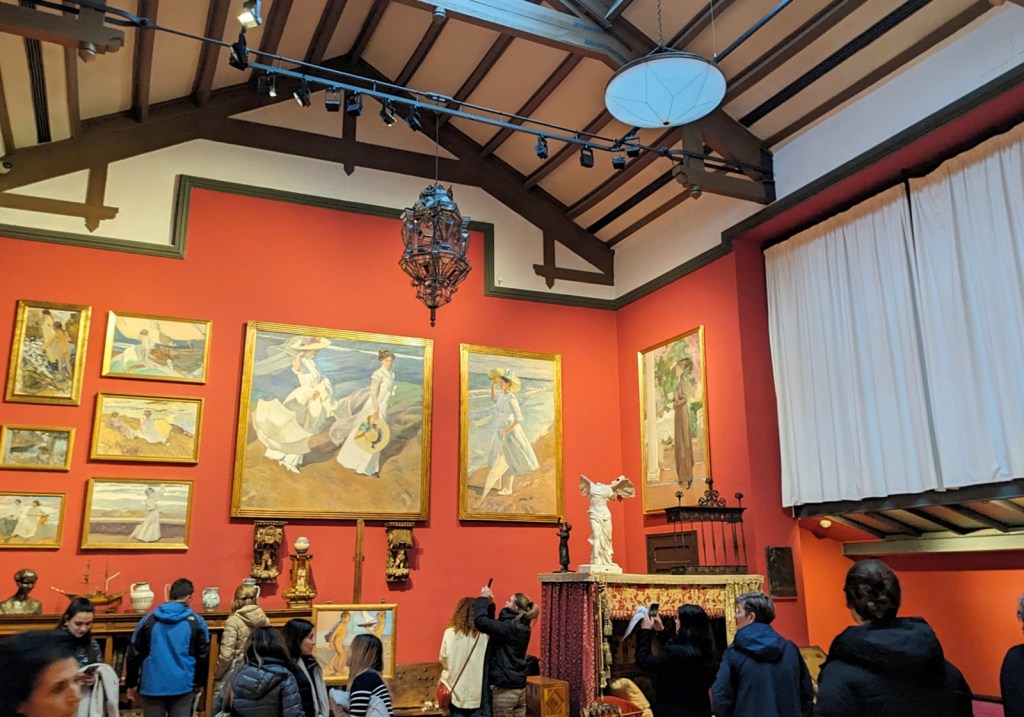
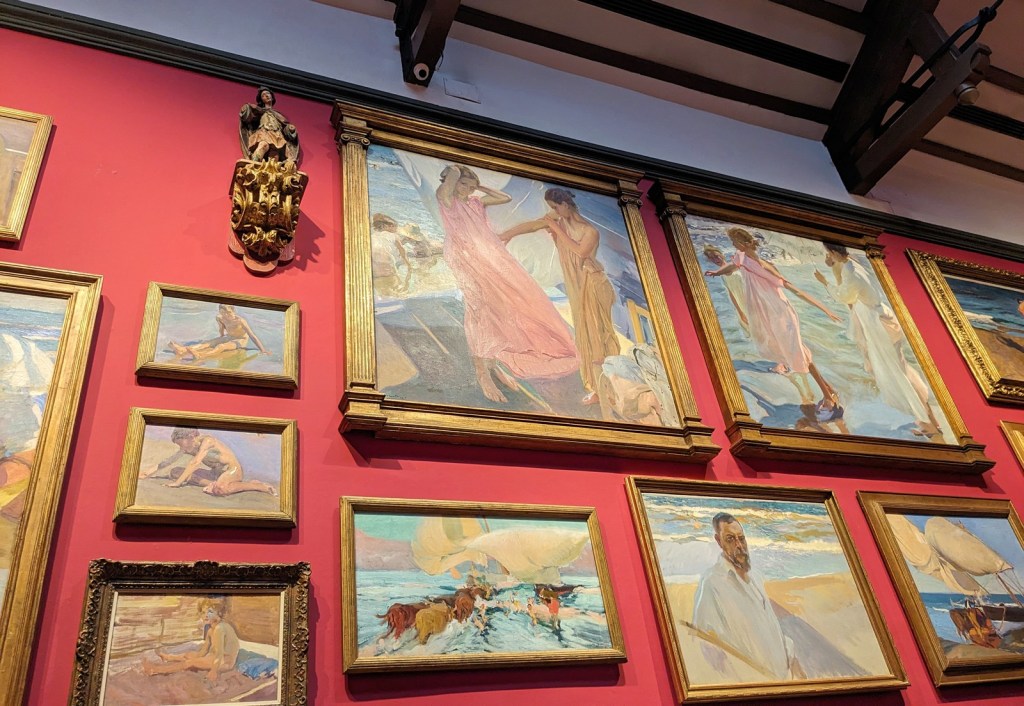
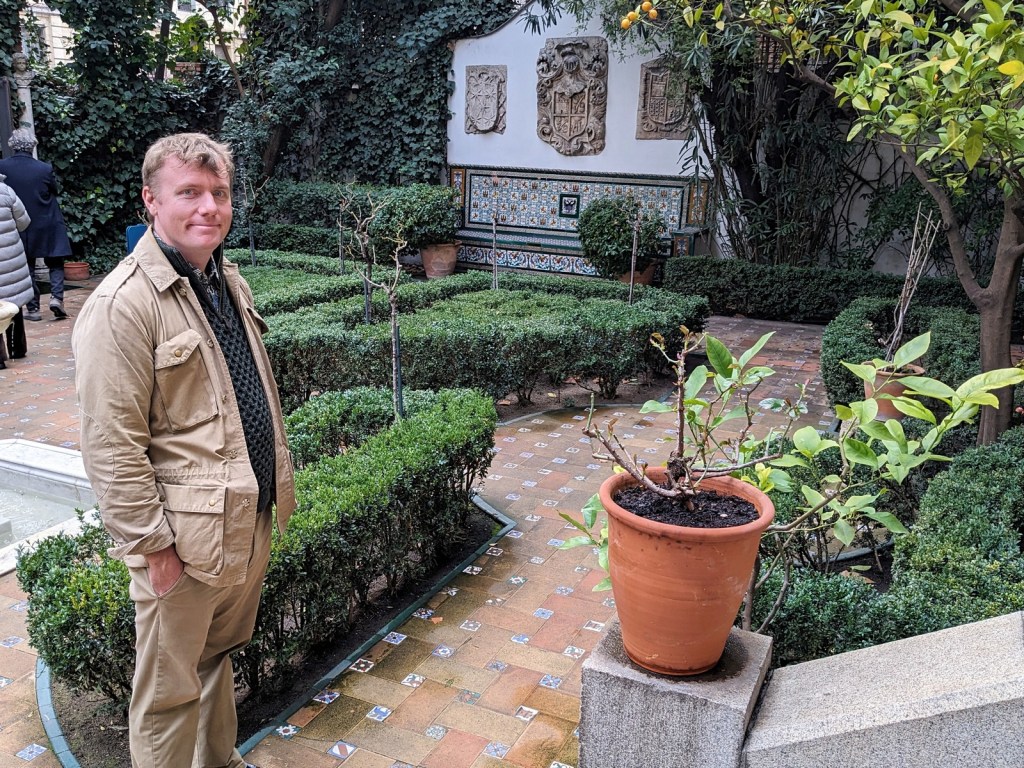
The first, as you’ve guessed from the header image, was the Museo Sorolla. This museum is the former house and workshop of Joaquín Sorolla y Bastida, and the museum is of course dedicated to him. Joaquín there was a painter and his favorite subject was “sun-soaked,” which is just a fantastic thing to be obsessed with (unless you are The Stranger I suppose). There is a handy Google Arts & Culture thing of the collections if you want to see better photos. The first main room of the museum is the room that was historically Sorolla’s showroom, and so they have it jam-packed with a bunch of his paintings just like they would have been back in the day. Except now you can’t buy them, though the museum does have a lovely little gift shop.

While we were there they had a temporary exhibit on the various things that Sorolla painted as he travelled through the Iberian peninsula, which was fun because it let me imagine travelling through the Iberian peninsula, which is what we were doing, except Sorolla got to do it for work and so far I haven’t been able to do it for work. I gotta explore a different line of work man. After that you went on into the rest of his house, which was also jam-packed, except now with artworks by other people and other curious. Also TILES! We were at this point just getting a little taste of what the rest of our trip through Spain would be like, but we loved the tilework. You can also catch just the smallest glimpse in the photo below, but in his yard was an orange tree and this was February and like, oranges in February! Bonkers. Little did I know what was to come. Lemme tell ya, wandering through a gorgeous house with fantastic gardens so we could look at sun-soaked art is a great way to spend the first half of the second part of your afternoon.

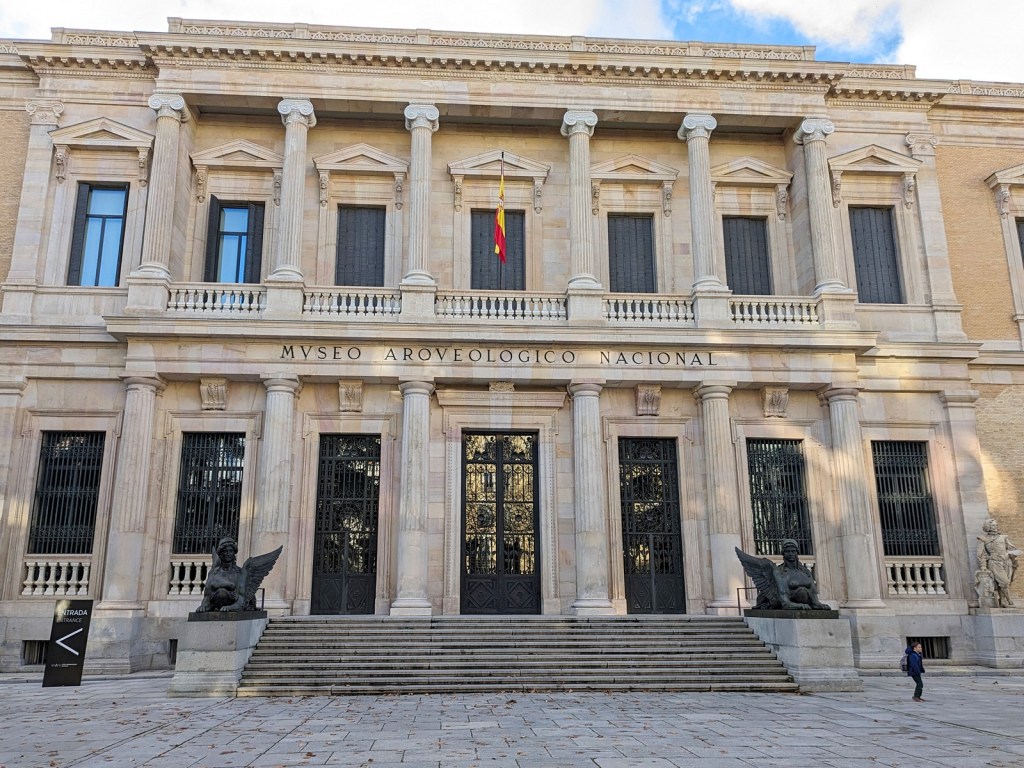
But since it was the first half of the second part of the afternoon, the day was clearly not over! We had hours left until the museums closed! So I convinced my super amazing wife to let us wander on over and check out the Museo Arqueológico Nacional, aka The MAN:

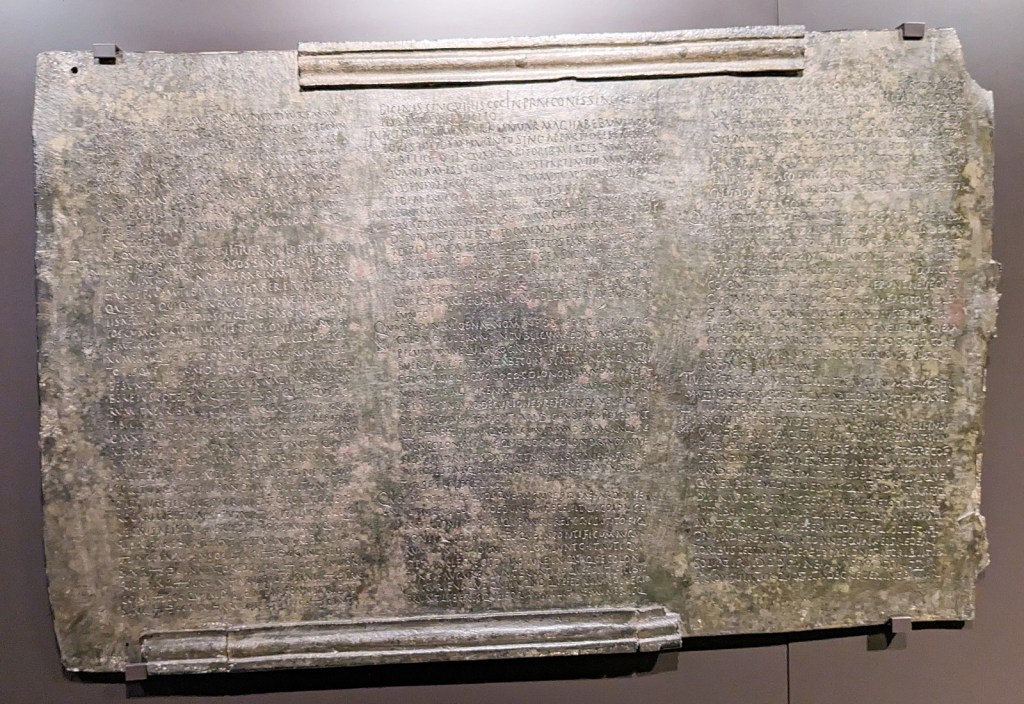
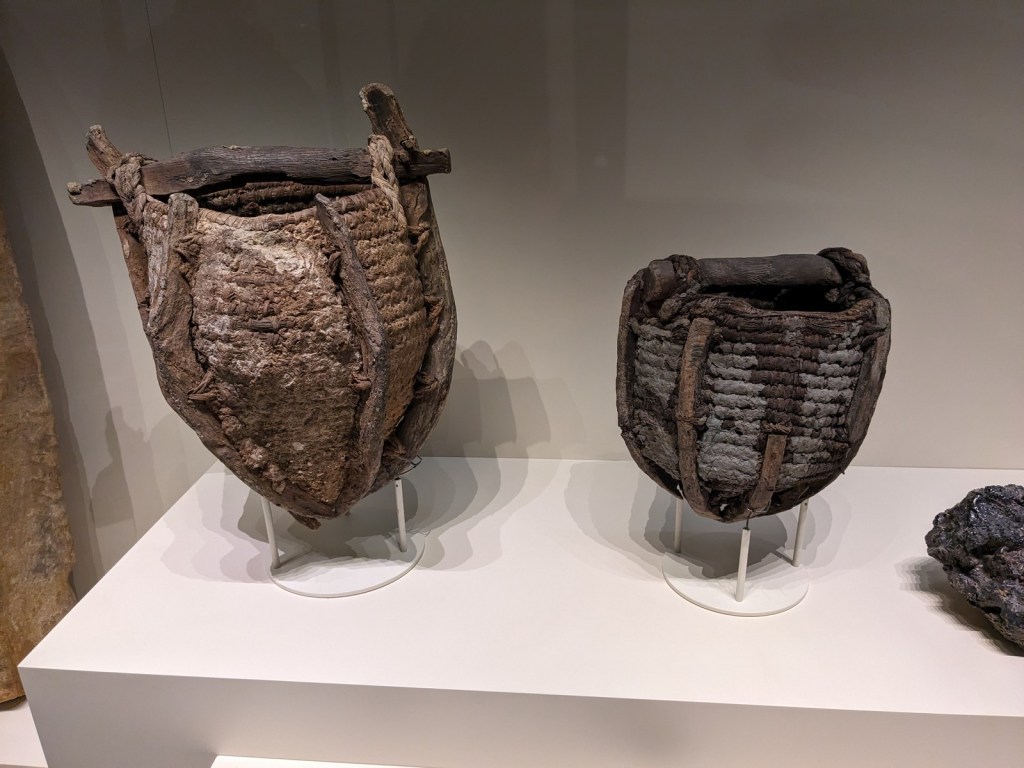
The MAN was really great! I wish we had been able to spend more time here but them’s the breaks when you are trying to do the third major activity for the day. Ancient Spanish history has never really come up in my U.S.-based education or my personal reading, so pretty much everything in the museum was new and exciting and a novelty to absorb. Like for example I had no idea there were Celtic cultures in ancient Spain, that’s totally new and I haven’t been able to really delve into the significance of that. I was very glad to learn about the influence of the Phoenicians too because that really put a lot into perspective. And MAN! The artifacts at the MAN! These were so good! So well preserved! Where was this stuff hanging out before someone dug it up and put it in a museum? I mean look at the stuff below! (I wish I could link to the museum’s own photos of these objects like I usually try to do but they have one of the worst online collections catalogues I’ve seen, though I suppose it’s nice they at least try)

I mean look at those baskets! Two thousand years old and the plant fibers have survived! You could almost still use them to carry around ore! And that water pump! Like toss some new gaskets in there and I think you could once again use it to spray water on superheated ores to cause them to crack, so you can then load them into the plant fiber baskets! And the mosaic! Not as unusual in my experience as the baskets and the water pump but still that is a funky little octopus! And when I talk about “where were they keeping these things” I was really talking about these again two-thousand-year-old lead law documents! Where were those sitting? And finally I mean ASTROLABES AHHHHH!

For serious they had so much cool stuff and we barely glimpsed the collection. I am def going to have to go back someday with a full day to explore. I don’t even think you have to feel bad about looking at any of these things because they are Spanish things from Spain in Spain! And in another twist of glimpses of things to come, they also had stuff from the Alhambra, which was fantastic to whet our appetites. Speaking of appetites, after we dragged ourselves out of the MAN we were hungry and it was time for dinner. On the recommendation of a friend we went to Casa Julio where for the first time in Spain croquettes betrayed us by being too large, meaning we ordered much too much. And so, full on art, archeology, and food, we stumbled back to the pad to prep for our final full day in Madrid.

Spain IV: Love Yarn Madrid

I wrote just last time that the reason we went to Spain was to go to art museums. Reader, this is a bald-faced lie. The real reason we went to Spain is for yarn. And so on our third full day in Spain we went to Love Yarn Madrid (site might not be updated as they prep for the next year, but they have an Instagram).

We are of course yarn people around here. We wanted to make the most of our time at the festival so we woke up early with the goal of getting there right when it opened. This didn’t quite happen but we weren’t far off the mark, and would have been on the mark probably if I had figured out the Spanish metro system better. I told you I would write about this later, but after finally navigating our way through the metro station and on to a train we had a lovely ride and got to enjoy the real sea of humanity that rides the Madrid metro. There was a guy who was riding holding a whole yerba mate setup in his hands, including a gourd and a thermos with more hot water, and another guy playing panpipes for cash but the guy I wanted to tell you about is a whole different guy playing the accordion, which marked like the second accordion I had ever seen played in real life, having been lucky enough to see a Weird Al concert at the Kennedy Center last year. That was great. So was this guy. But eventually the metro served its purpose, having delivered us to the Pabellón de Cristal and thus to the yarn festival itself.

This was of course a yarn festival and not a sheep and wool festival, so sheep were only there in spirit, but it was a really good festival. There was a great deal of enthusiasm and it was really well run and had a pretty excellent array of food trucks out back to satiate our baser desires (though on that note, I always thought it was a little overblown when Italians would get upset at American intpretations of Italian food, except here they had a Mexican food truck from which we got nachos, and man, like, I get it now). The first thing we did on arrival was to buy a tote bag and go to the coat check and then it was off to the races. We went through every single vendor stall to figure out scope out the selection, which again was really good. A lot of your standard yarns you see everywhere but there were some cool Spanish brands and my super amazing wife of course prefers the brands that are not only quality but have some history.

While she was deciding what yarns she wanted to buy we checked out some of the other sites. The funnest thing they had going on was a “Yarn Olympiad.” The idea there was a series of competition of standard yarn skills, such as yarn ball winding which is a fun idea. The competition was fierce and the prizes delightful. They had that throughout the day. They also had a yarn fashion show which I don’t recall seeing at the Maryland Sheep & Wool Festival. The particular show (they had a couple) that we stopped and watched featured the work of Midori Hirose, a designer I had not heard of but with which my super amazing wife was familiar. They had the models walk the little runway with the designs and then eventually Midori herself came out which, you know, amazing to be in the midst of yarn stardom.

Midori in the middle.

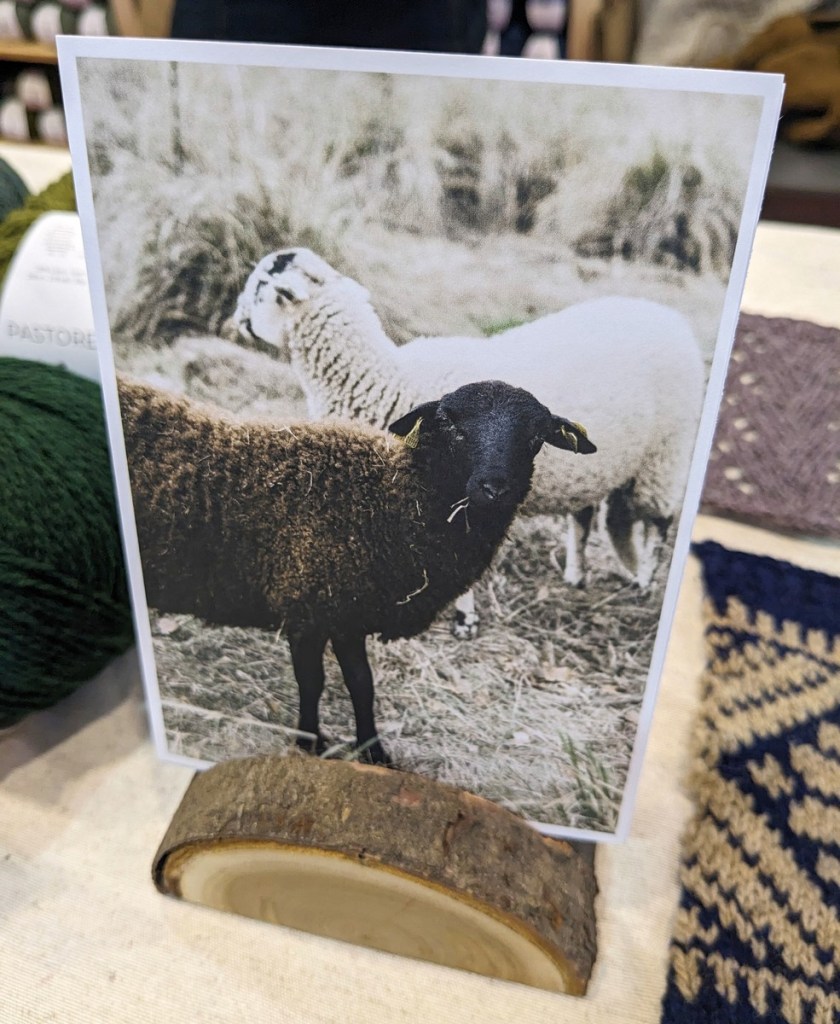
Having seen the sites and carefully considered which moves to make, it was time to buy stuff. The biggest single purchase was that my super amazing wife got enough yarn from a Bolivian brand for a sweater. Before we arrived we were not expecting to find so yarn sellers hailing from former Spanish colonies, but in retrospect it made perfect sense and the reason you come to a yarn festival in Madrid is to be exposed to a whole new segment of the yarn world you hadn’t through much about. The yarn from Bolivia is made from baby llama wool and man, so soft. Those baby llamas know what they’re doing. Unusually, I also got some yarn. It is unusual because I don’t knit, but my super amazing wife said she would make me a hat which is extremely kind of her. The brand is Xolla, and I thought it was cool because the wool they use is from Ripollesa sheep which, according to their website, is one of the three native Catalan sheep breeds, and all are endangered. So good to support! My super amazing wife wasn’t originally going to get any from that brand but then saw mine and totally got jealous and got enough to make herself a scarf. Her final yarn I think was of some alpaca wool, and she got enough to make some socks.

Exhausted at this point from all the yarn shopping and fashion shows and crowds, but resplendent with natural fiber purchases, we head on out and boarded the train back into central Madrid. Love Yarn Madrid is apparently one of the newer yarn festivals, but the organizers really knew what they were doing and there was a wide selection of vendors that we normally wouldn’t have run across. It was cool to get some yarn tied to sheep so particular to Spain along with more exotic fibers from overseas. I am sure we’ll go back someday.

The sheep at the festival were only there in spirit, like the above Ripollesa cuties.

Spain III: Museo Reina Sofia

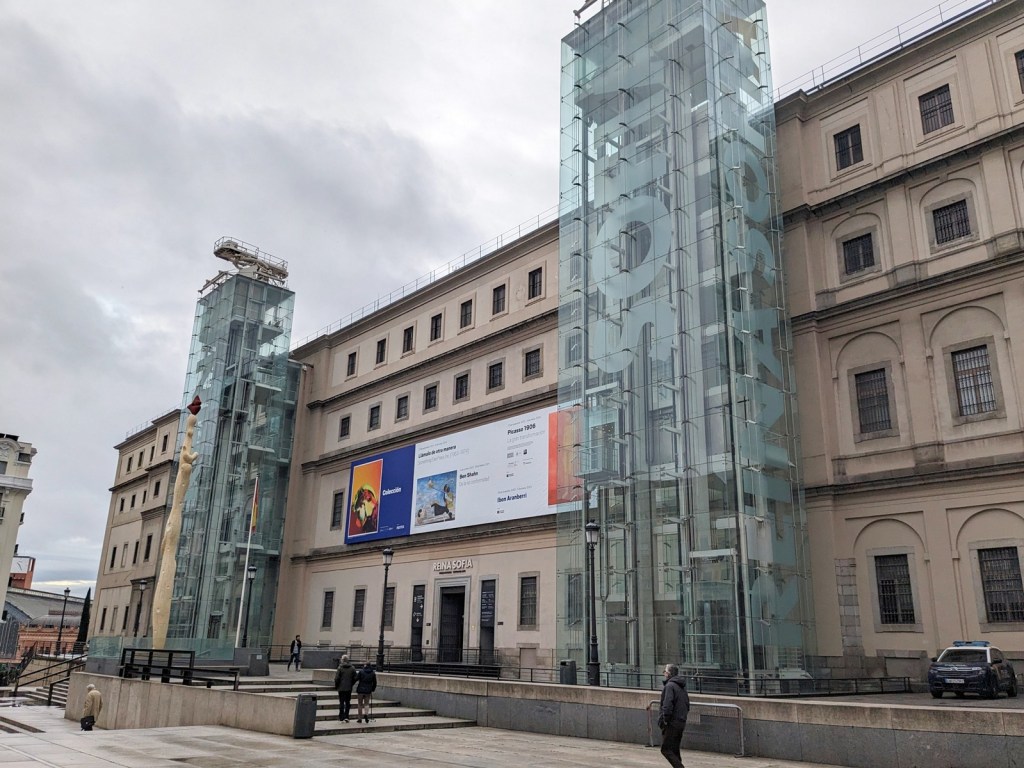
One of the primary reasons we came to Spain was not for the rain on the plains (though it was kinda gloomy in Madrid when we first showed up) but for the art museums. So on the second full day in Madrid we got our butt over to the Museo Nacional Centro de Arte Reina Sofia as early as we could!

“As early as we could” was in fact early enough for breakfast, which we had at the trippy café (“70s fever dream,” I wrote in my journal) they have there. We were not so adept at flagging down waiters in the European style so it took us a while to get some traction and we were a bit grumpy due to low blood sugar because we hadn’t had breakfast (I was grumpy at least, maybe my super amazing wife wasn’t) but it was an alright breakfast in the end. I recall the Reina Sofia being almost oppressively large and confusing. Another grumpiness factor is that we had timed tickets to the “Picasso 1906” exhibition and were rapidly coming up on that time but had no idea where the room was. The Reina Sofia is a very large square but with other shapes poking out of it, and on multiple floors, and maybe our blood sugar wasn’t all the way up from breakfast, but we were at a little bit of a loss until we stumbled across the exhibit finally. I don’t think the timed ticket mattered anyway.

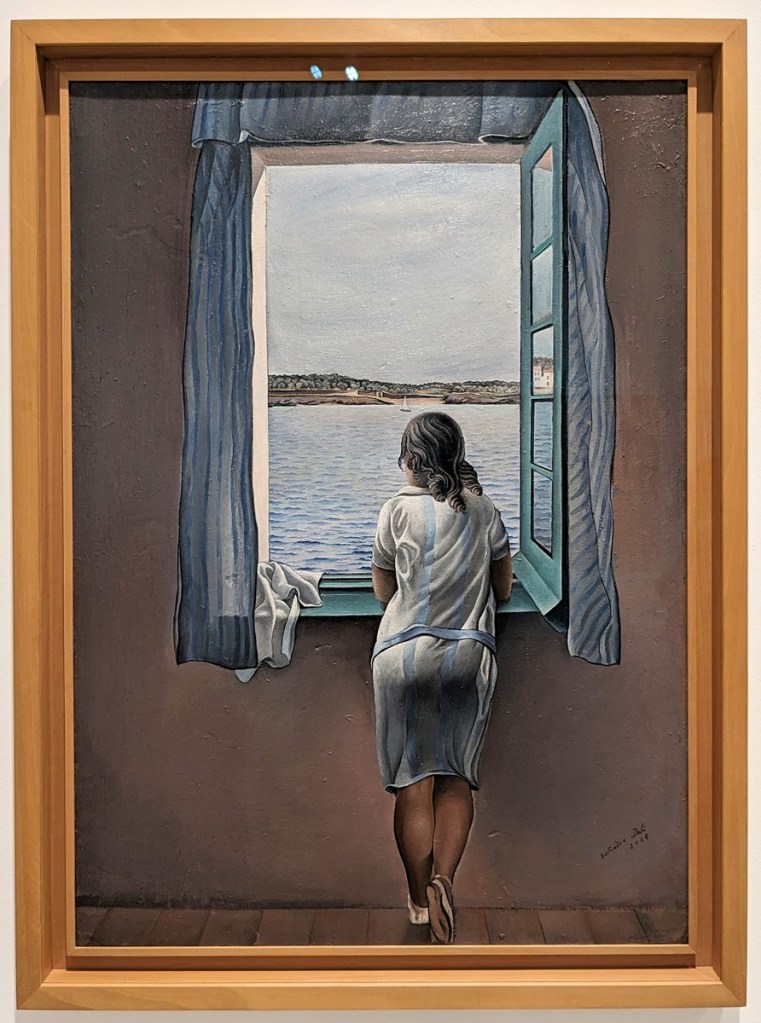
Figura en una finestra, 1925

I did enjoy the exhibit on Picasso (I learned he sculpted in addition to his other work, I don’t think I knew that before), but I think the first thing I was really stunned by was the Dalí above. We of course have a long history with Dalí on this blog, so I thought I knew the man. But lo! Here was something new, a normal-looking painting. Reading about the painting on the internet I found out that the left side of the window is actually missing (for composition purposes), and so maybe that is the surrealist touch. Or maybe the surrealist touch is a surrealist painting a non-surrealist painting as a huge meta commentary on something something something. It’s of his sister, Anna Maria. Later on in the gift shop we bought another portrait (titled “Portrait“) of Anna Maria, so enamored were we with this part of the ouevre. (Do you think when Salvador told Anna Maria he was going to paint her, she was ever nervous? “I’m not going to have large spindly legs and be striding across a desolate landscape or something, am I, Sal?” “No, of course not,” says Salvador, with a wink, “I would never ever do that to you Ann.”)

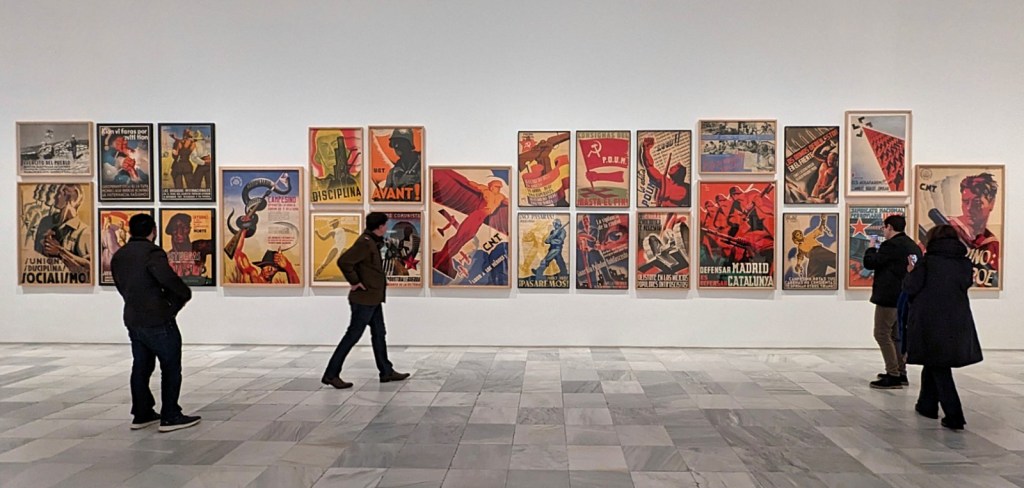
But back to Picasso. The biggest celebrity in the Reina Sofia is of course Guernica. It is not the only thing in the hall in which is resides, but it is the only thing anyone was looking at. We went on a gloomy weekday but there was still a huge crowd (as you can see above), with tons of schoolkids being lectured about the piece. The only other reaction I wrote down about the painting is that it is “really impressively large,” a controversial statement I am nonetheless willing to stand by. Or sit by maybe, like the kids did.

Speaking of the controversial, another thing hammered home in this museum for me is that context matters. Since the art in the Reina Sofia is more modern than the art in the Prado, I didn’t really know what was going on. I mean I’ve read Homage to Catalonia and I am aware that WWII happened, but the intricacies of modern Spanish history that so much of the art was responding to were rather lost on me. There was some people in the art world that will tell you not to read the label next to the art but when there are explanatory notes man do I find those helpful. But lacking those contextual clues I had to enjoy the below posters ONLY for the pretty colors:

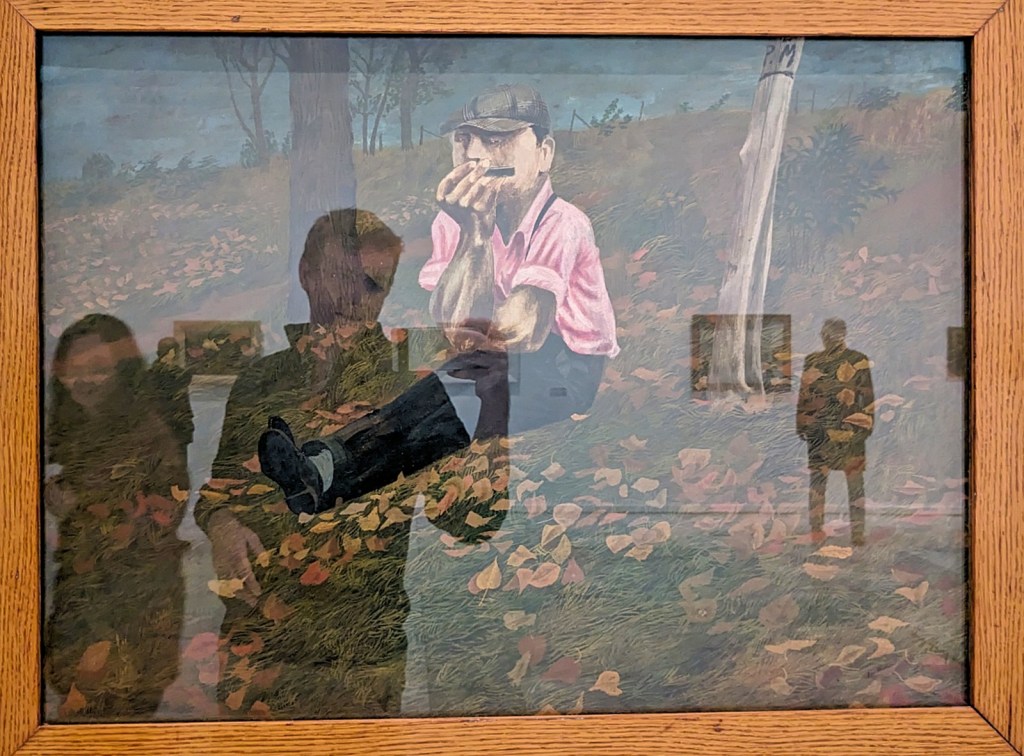
Thankfully though, as we were wandering out in a contextless white void, we eventually stumbled upon something we did have a whole lot of context for, that being an exhibit on the works of Ben Shahn, whose artworks focused on “the rights or workers and immigrants” and “the abuses of the powerful and the privileged” in the U.S. (and globally) during the Depression, New Deal, and into the Vietnam war. We Americans abroad had finally found America abroad and it all made sense. I knew what was going on in this exhibit. An admission though. I included both the pictures below because I thought both works were by Beh Shahn, but it turns out the work on the left (A Mule and a Plow) is by Bernarda Bryson Shahn, who did happen to the “life partner” of Ben but man she’s good. Though unfortunately for Bernarda, Ben had the single funniest work of art in the whole museum, by virtue of naming the painting on the right “Pretty Girl Milking the Cow.” Man I love art.

Anyways full of art it was time to get full of food. To do this we went off to the Mercado de San Miguel, Saint Michael being (I assume from context clues) the patron saint of tapas. We spent a while wandering the place buying ourselves all the little treats we deserved, starting with a calamari sandwich and croquettas before giving into our baser instincts and picking up towering plates of cheese and washing it all down with some very fancy sangria. A wonderful way to spend an afternoon and maybe like in the museum context clues would have helped but are carbs not the universal language?

The remainder of the day was spent wandering in and out of little shops to buy souvenirs and the sort of knick-knacks and olive oil bottles that really drive home to any visitors we have that my super amazing wife and I are seasoned world travelers. To top off the evening, on our final walk back to where we were staying we also of course stopped by to say hi to Cervantes. I left with a sudden urge to buy myself an old suit of armor.

Spain II: Museo Naval

Reading this week:

  • Greasy Luck by Gordon Grant
  • A Working Woman by Elvira Navarro, translated by Christina MacSweeney

I have discussed before in this forum my Spanish roommate that I had during my Firstie year at the Naval Academy. His name was Francisco and he was a semester-long exchange student from the Spanish naval academy. He had been an enlisted sailor before going to the academy, and as such his lived experiences were unimaginable to me (specifically he was 29 and married). I still have fond memories of Francisco and the deep life lessons he bestowed upon me (see the linked post about sandwiches), and so in tribute to Francisco’s service in the afternoon of our first full day in Madrid my super amazing wife and I visited the Museo Naval!

If you Google the Museo Naval you will find reviews describing it has a “hidden gem” and man that is true. The entrance is unassuming and I wrote down in my journal that the foyer was “dingy.” I had greeted the nice lady at the front desk with my limited Spanish and she seemed very disappointed when I said I preferred English as she handed me a pamphlet on Jorge Juan (they had a special exhibit on him at the time). But you ascend the stairs and man WOW. It’s gotta be one of the better if not the best naval museums in the world. It is surprising how big it is as you wind through the twists and turns that reflect the twists and turns of the Spanish navy’s history. You really oughta go but if you can’t luckily it appears Google has turned it into a street view thing so you can catch a glimpse yourself.

The museum takes the prudent choice of starting at the beginning, with the early history of the Spanish navy (or I guess the Aragonian and Castilian naval forces). Apparently it took about a century between cannons being introduced to Europe in the 12th century and people thinking of putting them on ships in the 13th century, but the museum had the above examples of early 16th century shipboard artillery which is pretty neat.

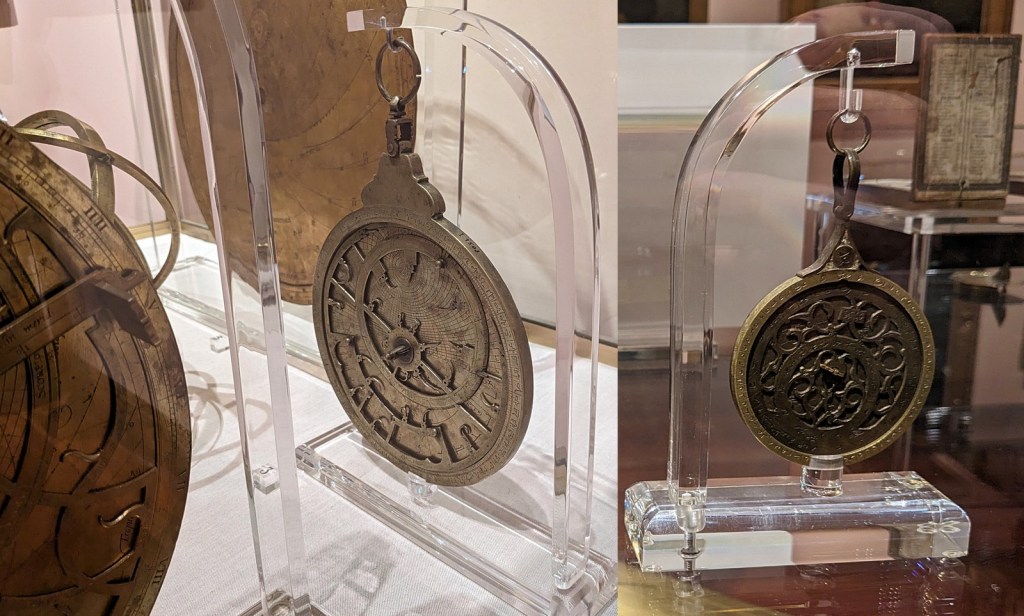
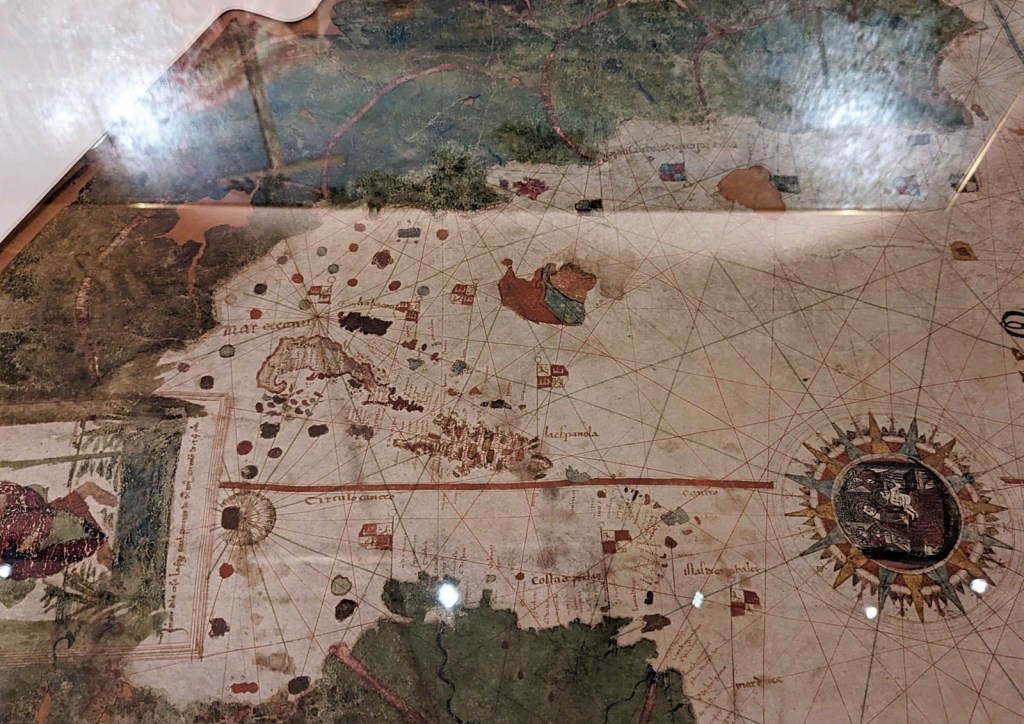
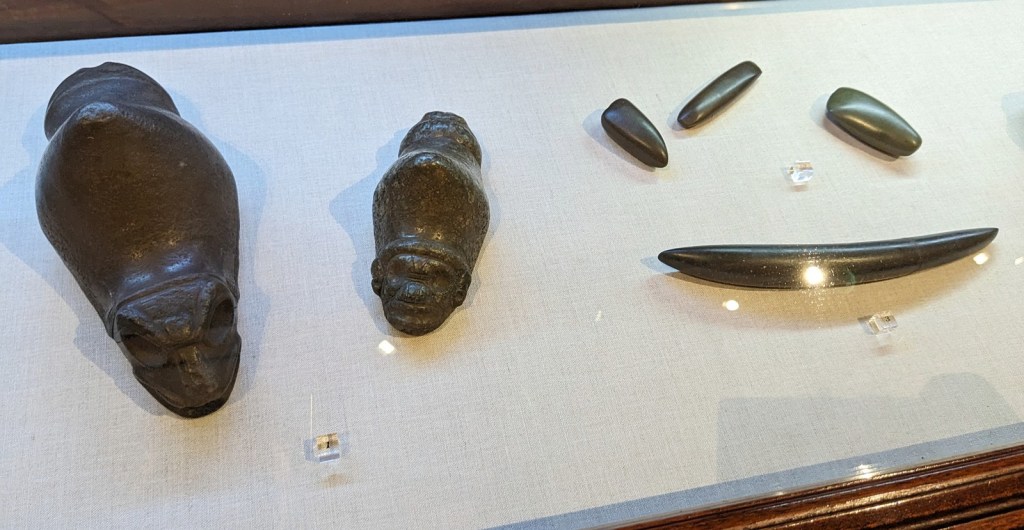
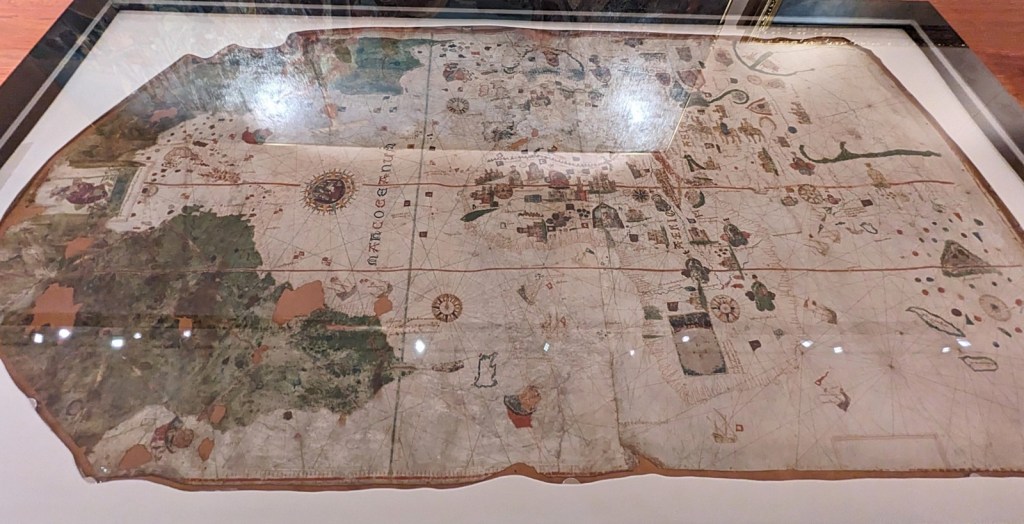
Especially exciting for me was all the bits about early navigation. The collection here really was especially extraordinary. I have just talked about how much I like astrolabes (man I want an astrolabe), and the museum had them in spades. They also had all sorts of old maps, including even a huge globe dating from 1688. The crown jewel of their map collection was the Juan de la Cosa map, below. This is the oldest known map to feature America. Ole Juan there took part in Columbus’ voyages and only 8 years later in 1500 was banging out the below relatively detailed depiction of the Caribbean to demonstrate the majesty and extent of the Spanish empire. On that note, the museum is pretty laudatory and I don’t recollect them struggling to cope with the cruel nature of colonialism. They had a pretty huge painting of Columbus and a collection of Taíno artifacts to really drive home the number of people subject to the Spanish crown. However even in the midst of all this what I personally was most interested in when it came to the Juan de la Cosa map is the depiction of Africa, especially how the Nile and Congo rivers meet in a lake in the mountains of the moon, because I have my very particular interests and those interests are boats and Africa and navigation and steam power and integrated farming.

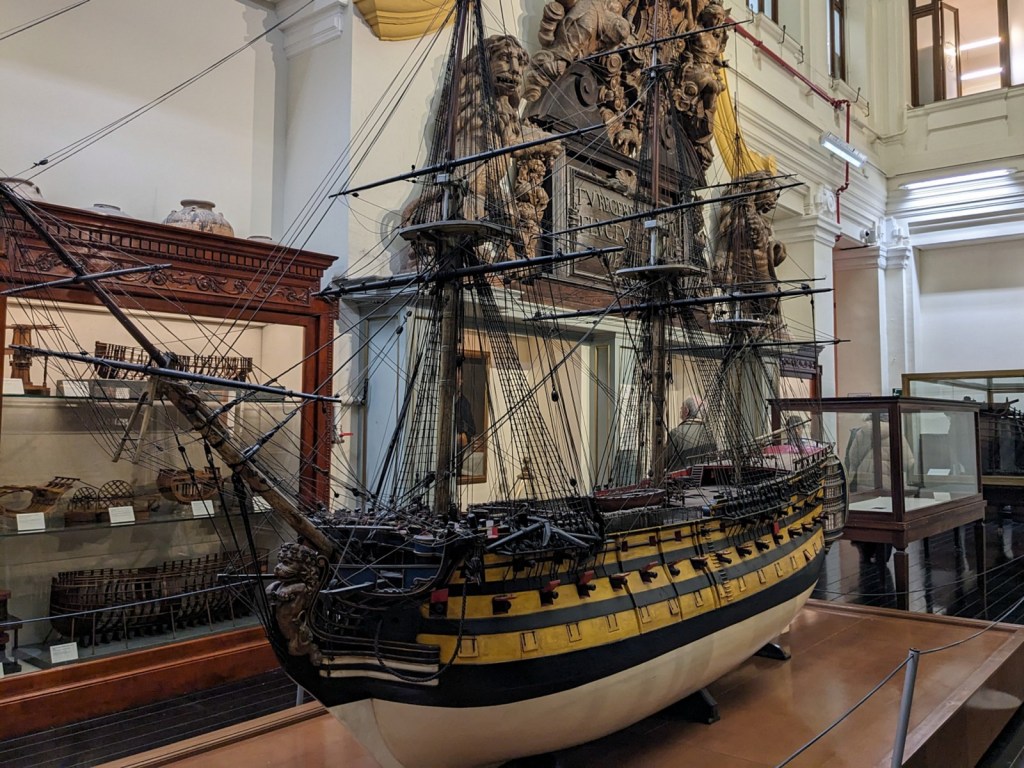
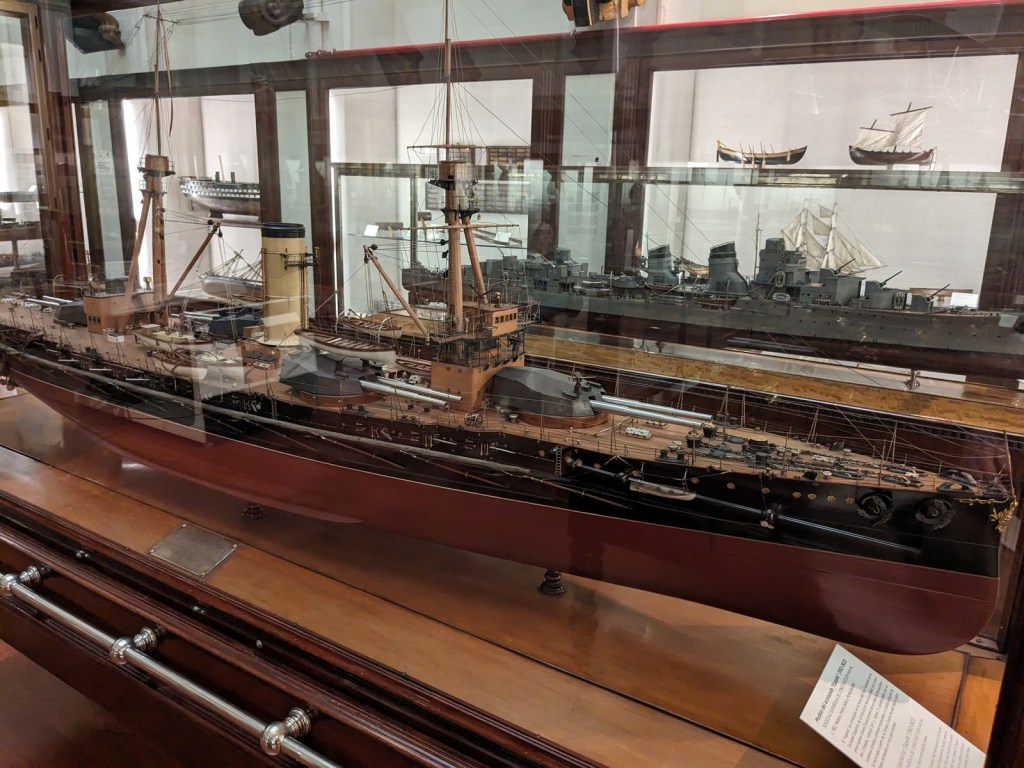
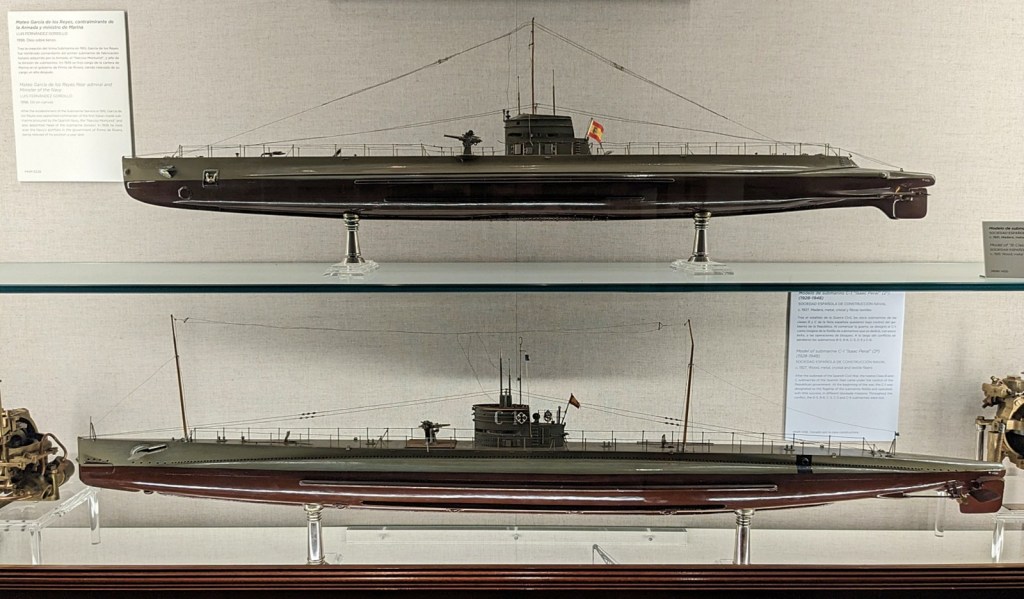
Really the sheer number of artifacts on display in the museum was overwhelming. They even had a whole section full of objects recovered from the Spanish nao San Diego, which was sunk by the Dutch in 1600 in the Philippines. A whole room choc-a-bloc with Chinese porcelain and Phillipines pots and Thai jars and man, you know, commerce! History! Boats! Stunning. And of course how could it be a naval museum without being absolutely stuffed to the brim with SHIP MODELS!!!!

After our visit to the museum my super amazing wife suggested I get into ship model building and I don’t think she knows what she is suggesting. I could become so obsessive, you don’t even know. She clearly doesn’t. But they had a whole bunch of ship models, of ships from every era and from so many locations (check out the Malaysian war boat above), and not just of ships! I just told you I love steam power and they had a whole intricate model of the turbines from España-class battleships and even (not pictured) a model of a water-powered sawmill they used to saw all the planks to build all these ships! Unclear if the model sawmill sawed model planks for the model boats.

So all in all a great museum, perhaps the best Naval Museum. Spanning centuries and full of intricate details and all sorts of information about the huge lifespan of the Spanish Navy, presented in both English and Spanish, if you are in Madrid man you gotta go. And then, I forgot to mention in the last post, after the museum we went off and got churros and chocolate, and if you are in Madrid you have to do that too. Do both. Ships, and churros. This is what is best in life.