NS Savannah

Decked out for the big day!

I know I say this a lot around here, but last weekend I was finally able to achieve a dream and visit the NS Savannah! Look, I know I in fact already made a big deal about seeing the Savannah just a few weeks ago, but this time I got to actually go on it. And it was everything I had hoped and dreamed it would be.

I have known for a few years now that they open up the NS Savannah for tours once a year near National Maritime Day. Since I have known that I have been consistently thwarted in taking advantage of this awesome knowledge by the fact that I have either been like in Zambia or else there has been a pandemic, and then I was nearly thwarted again by not being able to find any details about the open day. But now I am here to save you: go to the Baltimore & Chesapeake Steamship Company website at bayheritage.org. They will have all the info and they are also super responsive on email and extremely nice to boot!

This year’s open house/boat was on Sunday and I arrived right at 10am when everything was kicking off. I walked as quickly as I could to the end of the pier where the gangway for the Savannah was and I was one of the first people onboard after a quick safety brief. I was also quickly one of the first offboard because you had to go back down to the pier to start the guided tour of the reactor compartment and engineroom, which of course are the coolest parts of the ship! Holy crap I love steam power.

Anyways on our tour we were led around by one of the extremely friendly and knowledgeable reactor techs that normally work on the ship. The Savannah is actually well on its way to being a regular museum ship, and the largest chunk of that works seems to be sufficiently dismantling the reactor compartment so that the public can just wander around willy-nilly. In only the last couple of years they have cut a big hole in the side of the reactor compartment so they could more easily extract some of the components. The coolest effect of that is we got to see the cross-section of the secondary shielding, which was primarily composed of several feet of concrete and then several feet of wooden boards.
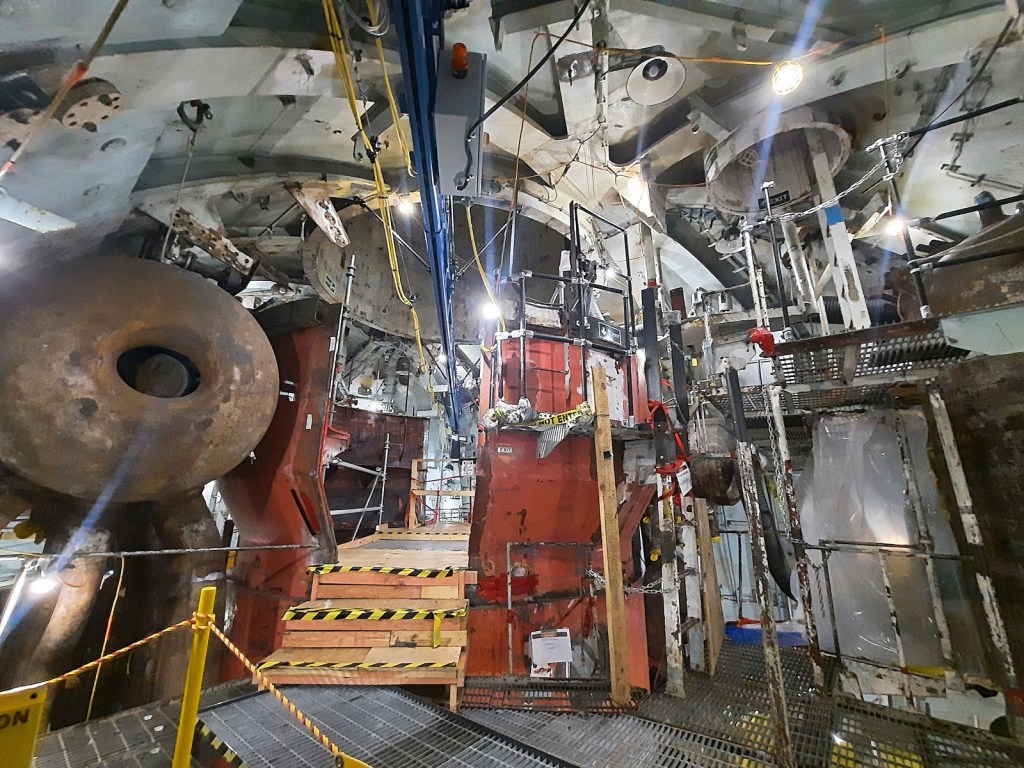
The primary shielding (where the reactor itself sat) is the red thing, with the refueling hatch above it. The rusty thing to the left is the steam dryer, above a horizontal U-shaped steam generator below the decking. Peaking in from the right of the frame is the pressurizer.

Inside the reactor compartment the primary shielding is half gone and the reactor vessel itself is long gone. I commented (lightheartedly!) that the place could use a paint job, and apparently it will get a paint job in the bright primary colors that turns out characterizes the engineering components of the ship. In addition to the remnants of the primary shielding, also easily visible was the pressurizer and the steam dryer, along with the hatch at the top of the ship that was used for refueling. If you peered down through the grating, you could also glimpse the U-shaped horizontal steam generator, which is pretty wild.
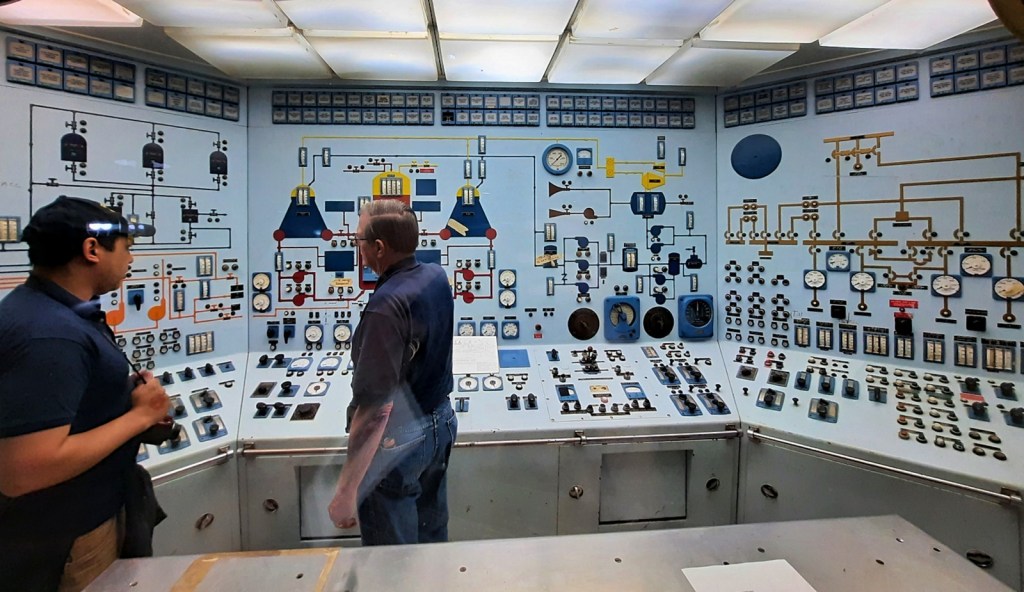
The control panel goes from rod control on the far left, to pumps and steam operations in the middle, to the electrical system far right.

From there we got to go to the control room. The control room was staffed by a man who was actually a reactor operator on the ship back when the reactor needed operating, so he had first-hand knowledge of all the workings of the place (detail I asked about is that it was normally manned by just two reactor operators, a primary and secondary). Reactor control panels are always very fun because they are designed to be the opposite of inscrutable (scrutable if you will), so everything is laid out in very logical orders and you can glean a lot of the reactor and steam plant operation from the layout of the control panel. I spent the whole time admiring rod control switches and coolant pump switches and scram buttons and the like.

Looking down into the engineroom; the control room is behind the woman in the yellow shirt. The red parts are mostly the turbines, and the yellow parts are the reduction gears. You can see the green emergency propulsion motor atop the yellow gears.

Just behind the control room is the engineroom itself, separated by just a window. On the submarine you could sense the engineroom around you from the control room, but you couldn’t actually see it, so this must have been pretty wild. The engineroom is museum-ready with a very colorful paint job. The Savannah only had one screw, so the engineroom only had a single high-pressure turbine and a single low-pressure turbine. We got to admire the emergency propulsion motor and off in a corner were the backup diesel generators. Another very knowledgeable docent pointed these all out to us.
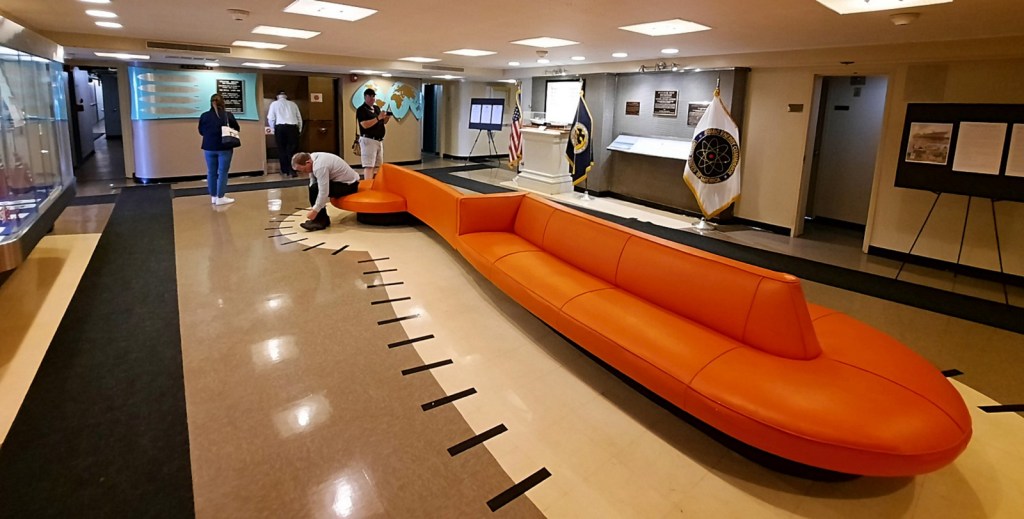
The entry hall into the ship.
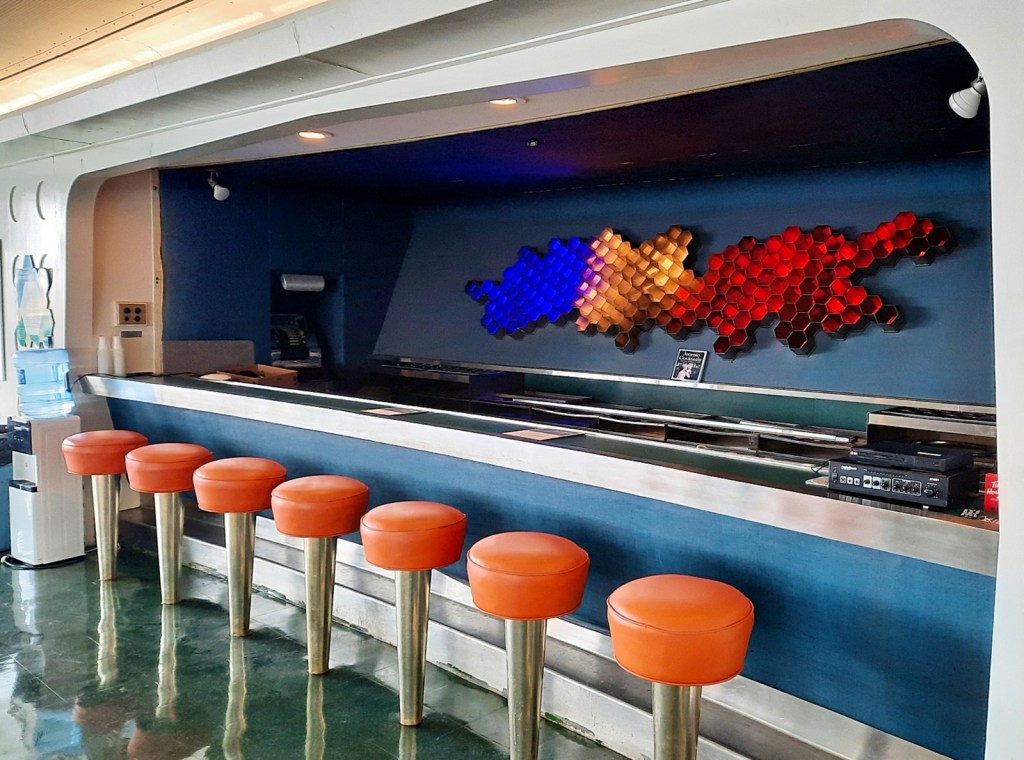
An absolute dream of a bar on the promenade deck.
The dining room; look at the atom symbols in the recessed lighting!!!
They need to sell reproduction sets asap!!!!!!

From there we were let loose for the unguided part of the tour. Let me tell ya, the Savannah is a mid-century dream. The ship was meant to distill every hopeful aspect of the atomic age and it absolutely nailed it. Totally perfect, no notes. For the first few years of its life it was a passenger ship in addition to being a cargo ship, so its entry lounge is dominated by a huge orange couch and a magnificent stairway leads you to the various decks. I’ll have to let the pictures speak for themselves, but when I showed her the pictures even my super amazing wife wanted that dining set. It also wasn’t until I was reviewing the photos that I noticed the recessed lights in the dining room were also atomic symbols. Perfect and gorgeous!!!!
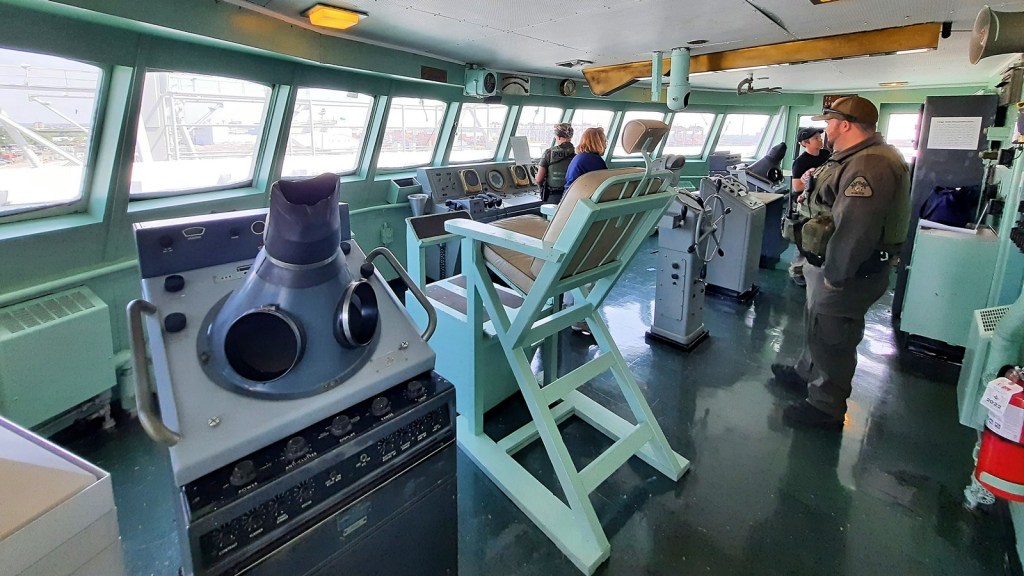
I’m always surprised by how sparse merchant ship bridges are; I’m used to tight-packed radar and sonar screens everywhere but these guys really just need a compass, a helm, and a radar screen (and a comfy chair).
She shares a pier with the SS John W. Brown.

Much of the rest of the ship was pretty ship-like (shipshape?). The bridge looked pretty much like a standard bridge and fairly sparse, so much so that I forgot to look for the scram button the bridge crew had up there (not to be trusted with actual reactor operation, the bridge’s scram button only functioned to turn on a light in the reactor control room that said “bridge scram;” the operators could do with that what they thought best I suppose). Topside was, you know, topside. However I couldn’t leave the ship without visiting the other biggest celebrity onboard, the Radarange!

I had been under the impression the Radarange on the Savannah was the first commercial microwave oven ever put into service, but some quick Googling does not seem to back me up on that supposition. It was still an early model and meant to show the true wonders of the future. I mean not only were we splitting the atom here but we could also harness the rotational spectra of O-H bonds to heat up dinner. Truly the embodiment of a world where the promise of clean and abundant energy would solve all humanity’s problems. If only we had kept at it.

I managed to visit the gift shop where I resisted buying a whole lot of swag, but I soon had to  literally run off because it came over the ship’s speaker system that I had illegally (though accidentally) parked my DeLorean and if I didn’t hustle it would get towed (speaking of visions of the future). I am so glad I got to  finally visit the NS Savannah, especially its super cool reactor compartment, engineroom, and microwave oven, and I am very much looking forward to it being finished with its museum ship conversion so the whole world can see it more than once a year!

Savannah Part 2

Reading this week:

  • I Saw Congo by E.R. Moon

The first place we went to on our second full day in Savannah was the Pin Point Heritage Museum. The Pin Point Museum was fantastic and I’m gonna say it is a gold standard for cultural heritage museums. It is housed in the former A.S. Varn & Son Oyster and Crab Factory, which was for many years the major employer of the Pin Point community. The community of Pin Point was founded by freedmen after the Civil War, and became part of the Gullah/Geechee culture in the coastal region. One of the big claims to fame of Pin Point is being the original home of Justice Clarence Thomas.

The museum was founded and run in a close cooperation with the actual community. Our guide was Herman “Hanif” Haynes, who grew up and lives in the community and told us about his mother and grandmother working in the factory. He brought us through the story of the founding of the community and where the people came from. Then we learned about the fishing culture of the community and the history of the factory. They have a fantastic documentary to watch, and displays talking about how through its exports Pin Point was connected to the surrounding area. I’m going to say the museum is an absolute must-see if you are in Savannah. I always enjoy boats and crabs and the like but what really made the museum great is how it worked to serve the community it was based in.

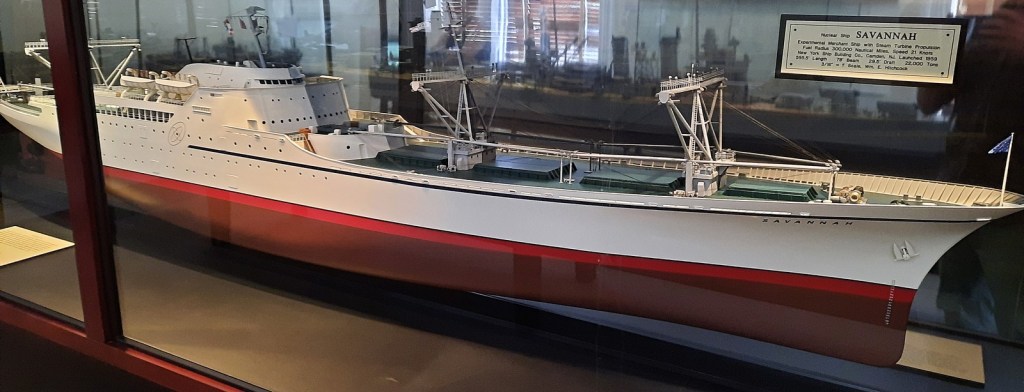
Heading back into town, the next place we went was the Ships of the Sea Maritime Museum. I really liked this museum mostly because it is filled with ship models and that’s great! The museum focuses on the maritime history of Savannah. It’s housed in the William Scarborough house, who made his money as a maritime trader, and besides ship models in general it houses specifically a huge number of models of ships named Savannah, including one of my favorite ships ever the NSS Savannah, pictured above. That sucker was nuclear powered, and although all ships are beautiful, and nuclear-powered ships especially so, the NSS Savannah was meant to be beautiful and I think they pulled it off. Though, on that note, I noticed this time around the model features a tiny Confederate battle flag, which unfortunately does a lot to mar its appearance.

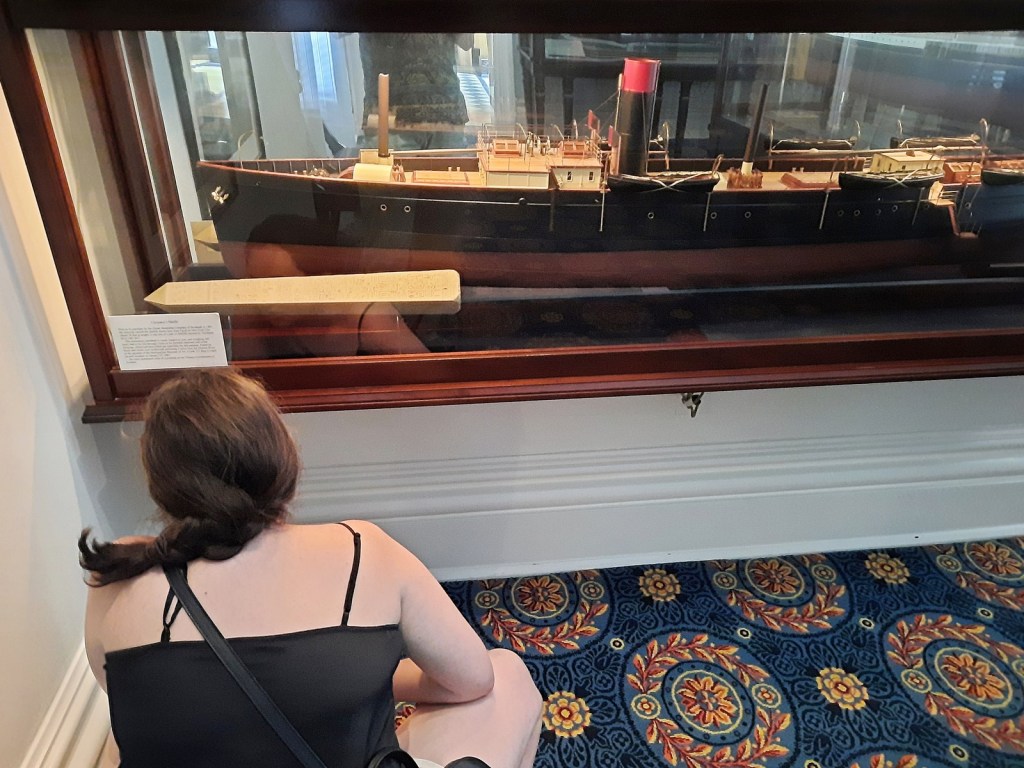
Knowing my boat obsession, my super amazing girlfriend gamely looked at all the models with me. The house itself is pretty neat too. Although it’s one of the historic houses of Savannah, and there are many, it’s not really presented as a house because it’s gone through so many changes throughout the years. One of those changes was serving as a school for Black children. It was, as a sign in the stairway notes, very inadequate, but it existed and at least that was something until Brown vs. Board of Education. After this museum we were pooped, and headed back to the hotel for the night.

Our third and final full day in Savannah was all about the Telfair Museums. This is a group of three museums and we bought the pass to go to all three. There are various different museum groupings in Savannah and I wonder what kind of inter-museum politickings there are. At any rate, we started off at the Owens-Thomas House and Slave Quarters. This used to just be the Owens-Thomas House, but a little bit ago they decided they needed to Do Better and made sure to incorporate the history of the enslaved persons that lived there. Overall I think the museum did a pretty good job at this, though my one criticism is that they were a bit self-congratulatory about it. Maybe it’s necessary to hype it up to get other museums to follow their lead, but it’s really sort of the bare minimum for a space like this. The above picture is the slave quarters themselves.

The rest of the tour is a fairly standard house tour, and this was the first house tour we went on to like, see the house instead of learn about the people or see a bunch of ship models. I guess the house tour was pretty standard overall, but in the basement they have preserved and put on display more of the infrastructure than usual. They have the ice well and cisterns on display, along with a shower room. They also have on display the kitchen, and put a lot of effort into further documenting the lives of enslaved persons here because it is in the basement that a lot of them would worked. This makes it a lot more interesting than the average house tour and I do recommend going.

After the house we went to lunch, and then after lunch we went to the Telfair Academy. We didn’t get a lot of time here because of how late our lunch reservation was, but it was a great museum and apparently one of the oldest in the United States. The above picture is of their very very large octagon room, full of both large pictures and tiny little ones. My super amazing girlfriend particularly admired a picture of a lady with a goldfish bowl, and since the gift shop conveniently had a print for sale I went ahead and bought it. Although I liked that one a lot as well, the below picture was one of my favorites because it displayed what is nearly my ideal future lifestyle:

Titled “Le déjeuner sous les bois,” the one thing it is lacking lifestyle-wise is of course my super-amazing girlfriend.

Upstairs in the museum they suddenly veered into fossils and some of the more old-timey stuff they had. By “old-timey” here I meant the sorts of things popular in old-timey museums, i.e. random collections of interesting things, which I think would make for excellent modern museums, but there are disagreements on this point. They also have some more sculptures upstairs, and although last week I accused my super amazing girlfriend of plotting to steal a spinning wheel, I too am a fan of textiles, specifically old ones, which I mention because they had a small collection that I found cool:

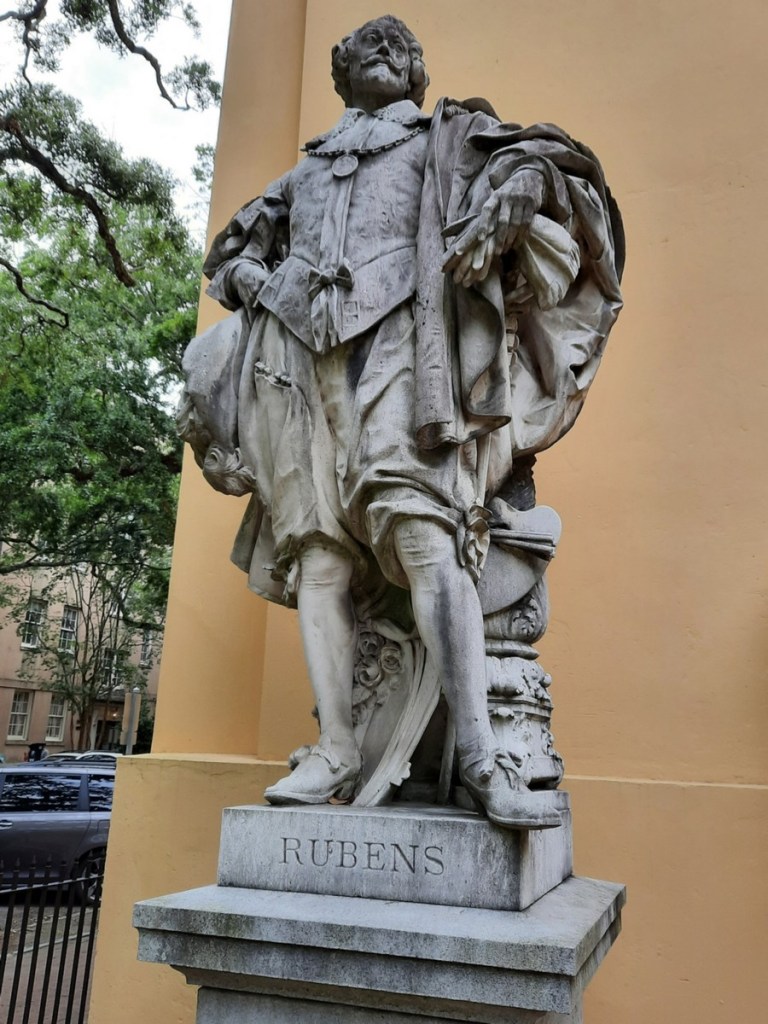
Also, the below statue was outside, but I took a picture specifically to make a joke about sandwiches:

After the Telfair Academy, we did run over to duck into the Jepson Center, but only got a few minutes in there because our day was running out. We were pretty pooped already, but decided to take one last walk along the waterfront to admire the sights. This was a Friday, and by this time the revelers were coming out in full force. It’s a very nice thing to look out over the river and just enjoy being in the place you with absolutely fantastic company. We had a great time in Savannah and hope to be back soon.

Savannah Part 1

Please enjoy the most stereotypical picture of Savannah!

While on our Florida vacation my super amazing girlfriend and I decided to take a vacation from that vacation and headed up to Savannah, GA. We wanted to get as much travel in as possible, see the sights, and explore exciting new cultures (new for her, because she’s from New England. I, raised a Marylander, am technically from the South). It was, overall, a lovely time!

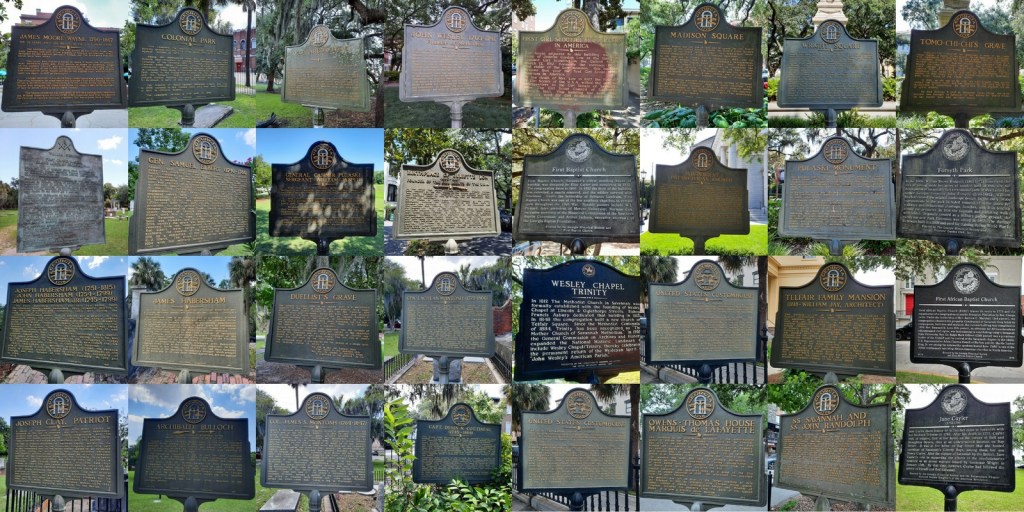
To start, I want to say is that Savannah is first and foremost a city comprised of historical markers. This is how it seemed to me anyways. As we walked around the city I started taking a picture of every one we passed, and this still only represents a small selection because I never dragged us too far out of the way to take a picture. My impression is that most of the signs were put up in the 50s and 60s, so I had to ponder who was trying to shape what narrative. There were also a number of signs put up more recently. Still, it seemed to me at some point the city decided it was now Historical (as an aside, the city was founded a lot later than I thought, only dating to 1733) and went about documenting it.

Picture taken by my super amazing girlfriend.

The very first thing we did in Savannah was stop by the Savannah Seafood Shack to tuck into a lowcountry boil. We ate a lot of good food in Savannah, with other highlights including Treylor Park for their PB&J wings and The Pirate’s House so we could mark off an Atlas Obscura sight (I dragged us to a lot of Atlas Obscura sights this trip, though my super amazing girlfriend has started tracking her sights as well!). I used to live in Charleston, SC, and my only regret during my time there is that I couldn’t go to more phenomenal brunch places, so tucking back into some southern cuisine was a particular treat. On the way back from Savannah we also stopped by a Cracker Barrel so we could really round out the list of stuff-I-have-talked-up-during-our-relationship, but I was a bit disappointed they didn’t have fried chicken gizzards on the menu.

But now into the metaphorical meat of the trip, instead of the literal. Having tucked ourselves into bed after tucking into that lowcountry boil, our first major destination the next day was the Bonaventure Cemetery. The reason you visit the Bonaventure Cemetery is for the vibes. This destination was suggested by my super amazing girlfriend but I am anyways a fan of walking around old cemeteries. This cemetery wasn’t all that old, being only from I think the 1850s or so, but giant oak trees and plenty of Spanish moss made it clear it wasn’t exactly new either. The site was also previously a plantation, and had some revolutionary war history attached to it.

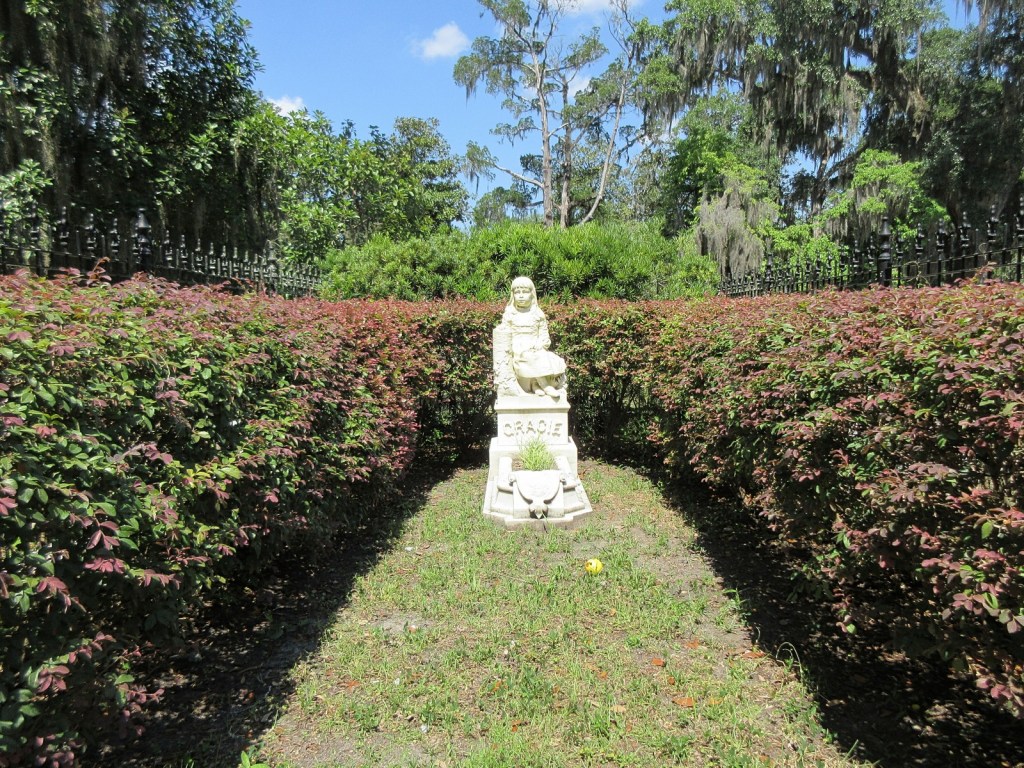
Since the cemetery is a major tourist site for Savannah, it’s got a whole list of popular graves to see, like that of Gracie Watson above. Again, I dragged us around looking for the ones on Atlas Obscura. I’m trying to think of what I liked about the place without just repeating the vibes line I used in the last paragraph, but no yeah the cemetery is in a beautiful location (though, as a former plantation, with a dark history), with a “bluff” overlooking the river and nestled within trees providing shade. And maybe the best part is just walking around with someone you love, thinking about beauty and other philosophical thoughts. After we were done with that, we went to lunch.

A portrait of Juliette Gordon Low
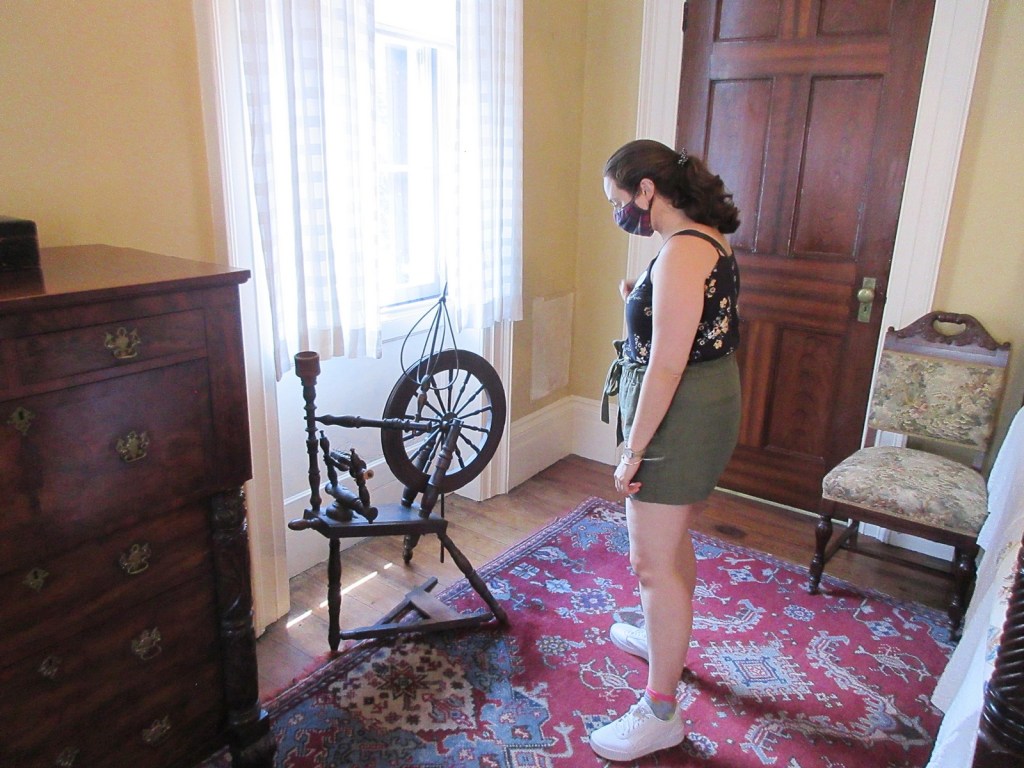
My super amazing girlfriend plotting to steal Juliette Gordon Low’s spinning wheel to add to her collection.

We began the afternoon of our first full day in Savannah at the Juliette Gordon Low Birthplace Museum. She founded the Girl Scouts, and the museum is now run by the organization. This was a pretty quick tour, but well done. Most of the museums we went to were having you do self-guided tours due to COVID of course. They typically had you scan a QR code on your phone which brought you to an audio tour you could walk yourself through with. The tour walked you through the house and focused on what inspired Juliette Gordon Low there to found the girl scouts. Besides her uplifting story of wanting to inspire girls of every race and class to better things, I also admired some very nice crown molding and some of her art collection.

After the museum, we wandered off through Savannah, looking at sights including Forsyth Park pictured at the top. We admired more signs, more graves, and a collection of hats before getting a drink at a rooftop bar and tucking into dinner. Afterwards we head back to our hotel, and in my notes about the day I wrote down “lovely showers.” I used to judge events by how nice the shower would feel afterwards. After a day of hiking around Savannah and getting to know the city those showers felt very nice, giving the day quite a high rank indeed.