
Reading this week:
- The Search After Livingstone by E.D. Young, Revised by Rev. Horace Wallace, F.R.G.S.
Our second day in Bath we did not spend in Bath but instead spent visiting stone circles. The first of these was of course Stonehenge. To get there we would have to drive, and to drive we would have to get a car, so the first task of the morning was (after breakfast) getting to the car rental spot. They did not have the car we had originally booked and so gave us an electric one instead. I of course typically drive a car that is older than I am, and doesn’t even have cupholders, so every time I get in a car that was made this century I am pretty wowed. This one had like a fake overhead camera thingy when you were backing up, wild. This was also my first time driving on the left-hand side of the road and that wasn’t too bad to get used to but I made sure my super amazing wife was keeping me honest about which side of the road I was on at any given time. The biggest thing to get used to was that my left-side mirror was much farther left than I was used to but who needs to turn left anyway. We were also slowed down by some road construction blocking the road we wanted to take leaving us confused and driving in circles instead of to circles in the English countryside, but eventually and without any allisions more serious than bumping a curb we had arrived at the visitor center to Stonehenge.
Visiting Stonehenge was a priority for my super amazing wife, but this was not my first time. As I mentioned before our family had visited the UK back when I was a wee lad and we made sure to get out to what the guidebook describes as “probably the most important temple in Britain [up to about 1500 BC].” This meant I was surprised at the visitor center, which was built in 2013. I was expecting the old one, which this site describes as “a collection of brutalist concrete bunkers,” I think unkindly, though I have fond memories. But the new visitor center is swooping and set into two halves (museum in one, gift shop/café in the other). Entering through the middle you pay your entry fee and then visit the small museum.

I was a bit disappointed in the museum. Maybe I didn’t give it as good a gander as it deserved since it was a bit crowded at the time, but I felt it could have been larger. Though since that impression I have learned that a) there are many Stonehenge-related artifacts in other museums, which I suppose would preclude their inclusion in this one, and b) there has been a lot less archeology on the site than I would have expected. Before reading the guidebook in depth just yesterday I thought there would have been far larger number of excavations but this is not the case, if you don’t count the 17th/18th century antiquaries digging into practically all the surrounding barrows.
Stepping out the back of the museum, the next surprise was that there was a bus to the monument itself. Again I remembered the old visitor center which seemed really close to the monument, but this new visitor center is a mile and a half away, the guidebook tells me. You can make the walk and I think in retrospect I would probably recommend that but we were a bit behind schedule and so we took the easy way out.

Now high up on my list of “things I really like” is continuity of use and so one of the most fun parts of our visit to Stonehenge was that it was surrounded by sheep. And I mean surrounded. The fields around Stonehenge were all grazing pastures and there were sheep everywhere, doing all sorts of sheep things, by which I mean eating, lounging, and walking around. My super amazing wife, as often covered here, is a big fan of sheep, so this was a highlight of the visit. I just thought it was so great that these same fields have been farmed in one way or another for thousands and thousands of years and show no sign of stopping. Apparently starting in about 1500 BC the fields around Stonehenge started getting farmed, as indicated by the wind-blown dust that fills some of the earthworks of Stonehenge, and here it is still going. And I mean, why should a world-famous heritage site keep you from grazing sheep? (I realize the sheep probably help preserve the site a lot more than not having sheep)
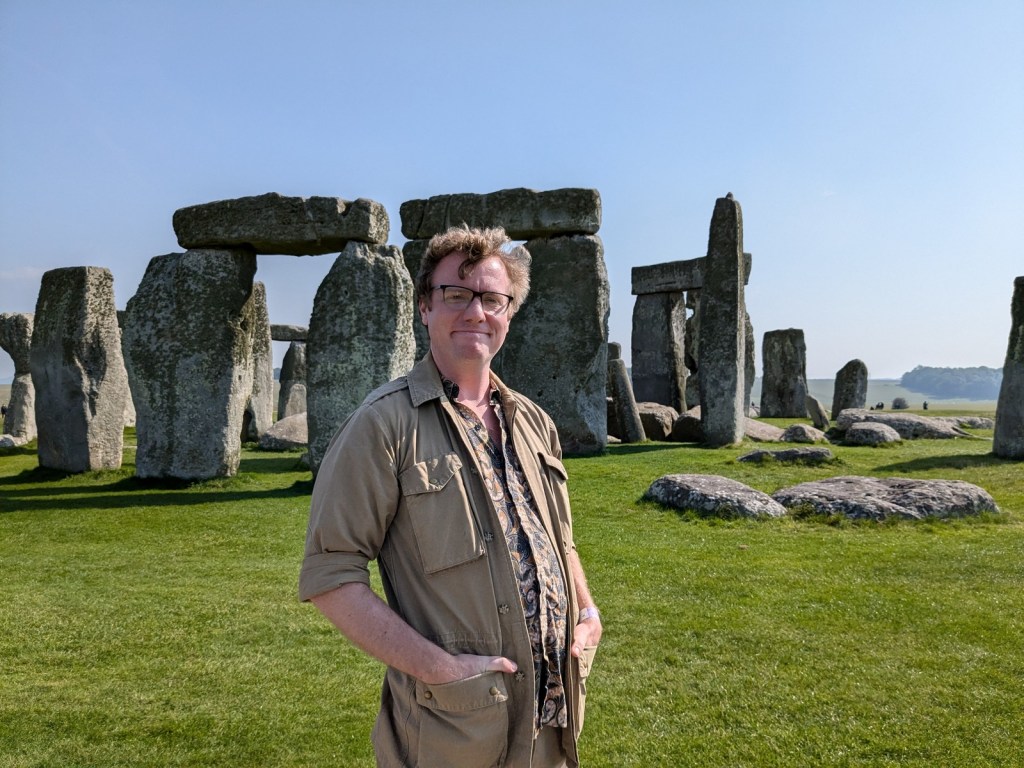
However, I dunno, I didn’t really feel anything upon seeing the stones themselves. I had expected the hair on my neck to stand up, to sense the energy in the lay lines, or whatever, but nope, they were some rocks. Maybe the culture that built them is too distant and alien for their spiritual necessities to resonate across the centuries to me, specifically, but I think walking up to the monument would have helped. We had kind of skipped to the end of the centerpiece of a wider landscape and maybe that was a mistake. If I were to spend a whole day at Stonehenge I think a priority for me would have been to get a better understanding of the wider site in which it stands and explore it much more, on foot. There are many many henges and earthworks and graves that surround Stonehenge, integrating it into a wider landscape. For many centuries you would have approached Stonehenge on foot from the River Avon, up through the appropriately-dubbed Avenue to reach the top of the hill on which the henge resides. You would be surrounded by so many other signs of the deep history of your peoples to this place. And maybe the walk would have replicated that, I dunno.

In the meantime we admired the sheep, and the signs suggesting funny photographs you could take and tag Stonehenge in on social media, and caught a bus back on down to the visitor center. This being lunchtime we got some sausage rolls in the actually very nice and very reasonably-priced café. Then we exited via the gift shop, which was quite extensive and had a lot of cool stuff, including what I liked best which was examples of the different ways people have interpreted Stonehenge through the centuries, such as this neat woodcut by Yoshijiro Urushibara. Loaded with some Christmas shopping, we found our car with all the neat features, and head on out for our next set of stones.
 Pat in the World
You must be logged in to post a comment.