Navy Life Story: Plebe Summer Part II

I might be in this photo? I was somewhere in this group.

A large part of the Plebe Summer experience is about being disoriented. No watches were allowed during Plebe Summer and the clocks were covered up. As part of this disorientation, they didn’t even let us see where we were going on the bus when we were being driven away from Alumni Hall. Since I knew the Academy so well that didn’t exactly disorient me, but they tried. The bus ride dropped you off at Bancroft Hall, where you met your first company Cadre. “Cadre” is the term for the 1/C Midshipmen that are running Plebe Summer. Three years later, when that was my role, we were called “Detailers,” but since I had the last real Plebe Summer they were called Cadre. The Cadre escorted you up to your room where you stowed your stuff and waited until the rest of your company arrived.

I was lucky because in my room waiting was my new friend and current security question answer for “First College Roommate,” Wes. Wes was a great boon because he had gone to NAPS, the Naval Academy Preparatory School, so he knew a great many of the ropes and was the first ally I had met on an already long hard day. He showed me how I was supposed to store my stuff and we chit-chatted for the next few hours while we waited and our other two roommates, Matt and Jester, showed up.

The next event on I-Day was our swearing in. After everyone had arrived in company area, the Cadre collected us and he proceeded down to T-Court. That bag that I had tossed on the truck earlier with all of my underwear that I had just been issued? On this trip to T-Court I spotted it in one of the hallways. I wasn’t going to see it again for three days, so for the next three days I did everything, including PT, in the same pair of underwear I showed up in that day.

In T-Court, we were directed to our seats. There are 30 companies in the Brigade of Midshipmen, and I was in 26th Company. It was an excellent company, but as I found out on I-Day and as I would experience for the next four years, we always wind up in the back and we never have any idea what is going on. So in a confused state and blinded by the sea of white uniforms in front of me, I suppose I was sworn in to the US Navy. I don’t really remember.

The rest of I-Day couldn’t have been much. We went to dinner, came back to company area, and sat down to write our first Thought of the Day. The Thought of the Day was a letter you were required to write every night to your squad leader. Its purpose was to keep tabs on the mental state of each Plebe. When I was a Plebe Summer Detailer, we would all go through each Thought of the Day and flag any as “yellow” or “red” if the Plebes were having suicidal thoughts or anything that needed addressing. The only Thought of the Day I remember was the one time I tried to make a joke – and was swiftly rebuked for it (as an extended explanatory parenthesis, later in the summer we were taking muster and our Squad Leader Assistant, who’s job it was to take muster, didn’t know where one of us was. Our squad leader yelled at us and commented, sarcastically, “did he just disappear into the ether?!” Since it was at the Academy that Michelson disproved the existence of ether, I found this ironic and reported it in my thought of the day. Result: squad leader in my face hissing “that was very witty and insightful and don’t you ever fucking write anything like that again.” Such is Plebe Summer). We came together as a group and, as we were to do every night for our entire Plebe Year, sang “Blue and Gold,” finishing with a resounding “BEAT ARMY.”

Then it was lights out. On our first night, Jester was caught not quite all the way in the covers at lights out. Our Company Commander told an incredulous Jester to burrow all the way to the bottom of his rack and then back to the top. The rest of us tried not to laugh. And that was day 1 of Plebe Summer.

Navy Life Story: Plebe Summer Part I

Me in Quebec. I kept this photo on my corkboard to remind me of the olden times.

After graduating from high school, I had only a fairly short summer to enjoy before I-Day. The highlight was probably a week-long trip to Quebec organized by my former French teacher. During the trip my girlfriend and I made out in a variety of exotic Canadian locations and I mispronounced “poutine.” Then, on June 27th, it was I-Day.

I-Day stands for “Induction Day” and it is the first day at the Academy. I woke up in the morning a civilian, put on a pair of cargo shorts and my favorite Hawaiian shirt, and dad dropped me off in front of Alumni Hall at my designated time. On the way there I made sure to listen to something memorable because we would not be allowed to listen to music for the summer. I forget what song it was. When we arrived at the drop-off point, dad turned to me, shook my hand, and said “worst case, we’ll always take you back.” Thanks dad.

There are some things that happen right off the bat when you walk in for I-Day. I-Day is run by Midshipman, and as you walk in the doors there is a table with a few of them. These guys make sure you’re supposed to be there, hand you a copy of Reef Points, and tell you from then on everything you say will begin and end with “sir” or “ma’am.” They also tell you to tuck in your shirt, which I failed to do and thus that managed to be the very first thing I was yelled at for. I felt sort of special actually because, as a local, I was supposed to get interviewed by the local newspaper. That plan got derailed when, in my confusion and nervousness and embarrassment of a hastily tucked-in Hawaiian shirt I just proceeded up the stairs to begin the first day of the rest of my life.

For the first part of I-Day, you follow a path through Alumni Hall, reporting to various tables and stations. Early on you are told that your basic responses are “Sir yes sir,” “Sir no sir,” “Sir aye aye sir,” “Sir no excuse sir,” and “Sir I’ll find out sir.” Unless asked a question that required some other information, like “what is your name?,” you were to respond with one of those five things. My second major mistake on I-Day after the shirt thing was deciding that, to avoid messing that my basic responses, I would just respond to everything by nodding or shaking my head. That didn’t last long.

As you snake through Alumni Hall, you wonder more and more what you had gotten yourself into. One station was an amnesty booth with a bin where you could dump any contraband you still had on you. I didn’t get a good look into the bin, but I still can’t figure out who would show up on day one with fake IDs or drugs. That seems like a bad idea, right? I also remember hastily signing a wide variety of legal documents. I didn’t have any time to review any of them but the one that stuck out was the “Don’t Ask Don’t Tell” sheet; not that it mattered much to me but it was the only one I noted.

Not me, but someone in my class. Oh Peg.

It is in Alumni Hall in a temporary barber shop that they give you your military buzzcut. This only annoyed me because I had, just days before, already shaved off the long flowing locks that I had been growing out for over a year. So I walked in with a buzzcut and was flabbergasted to receive an even shorter buzzcut. They don’t joke around; they cut everyone’s hair. You also spend a large chunk of your time in Alumni Hall getting issued your uniforms. This is probably the most important part of I-Day, because ill-fitting underwear or shoes will ruin your whole Plebe Summer experience, not that it is that great to begin with. During this process you change out of your civilian attire and into a set of the Plebe Summer uniform while the rest of your newly-issued underwear and socks and t-shirts goes into a large bag which you then put on a truck.

The best part of I-Day was when they drew your blood and gave you any shots you needed. This was nice because you were allowed to sit there and relax for as long as you needed, and there were cookies. This was all done for medical reasons, but still I thought it was funny that the only relaxing part of I-Day was the bit where they literally sucked the blood out of you. The last part in Alumni Hall was when they taught you how to salute. This was a quick and dirty lesson, but then, having entered Alumni Hall as a civilian, and having been given a haircut, put into your brand-new uniform, issued a copy of Reef Points, and taught to salute, you are loaded onto a bus and driven away.

Chrysler Museum of Art

Today I went to the Chrysler Museum of Art. I am in Norfolk again attending another class at the Mid-Atlantic Maritime Academy, and since I was driving down a day early anyways I figured I would stop by some of the sights.

I am a pretty quick study of art museums. I enjoy going to art museums but I don’t really have the education to appreciate most of what I see in them. So my usual style is to zip around at a pretty quick pace until I see something that catches my eye. This probably isn’t the best way to really absorb art, but at the ripe old age of 27 I’ve decided that I like what I like and I won’t make any apologies for it.

That being said, the museum had a lot that caught my eye. Like any art museum with its roots in somebody’s personal collection, the Chrysler Museum of Art has a pretty wide array of stuff. They have a large collection of glassware and glass sculptures, your standard assortment of Renaissance stuff, a modern & contemporary art section, and a selection of ancient western and non-western art.

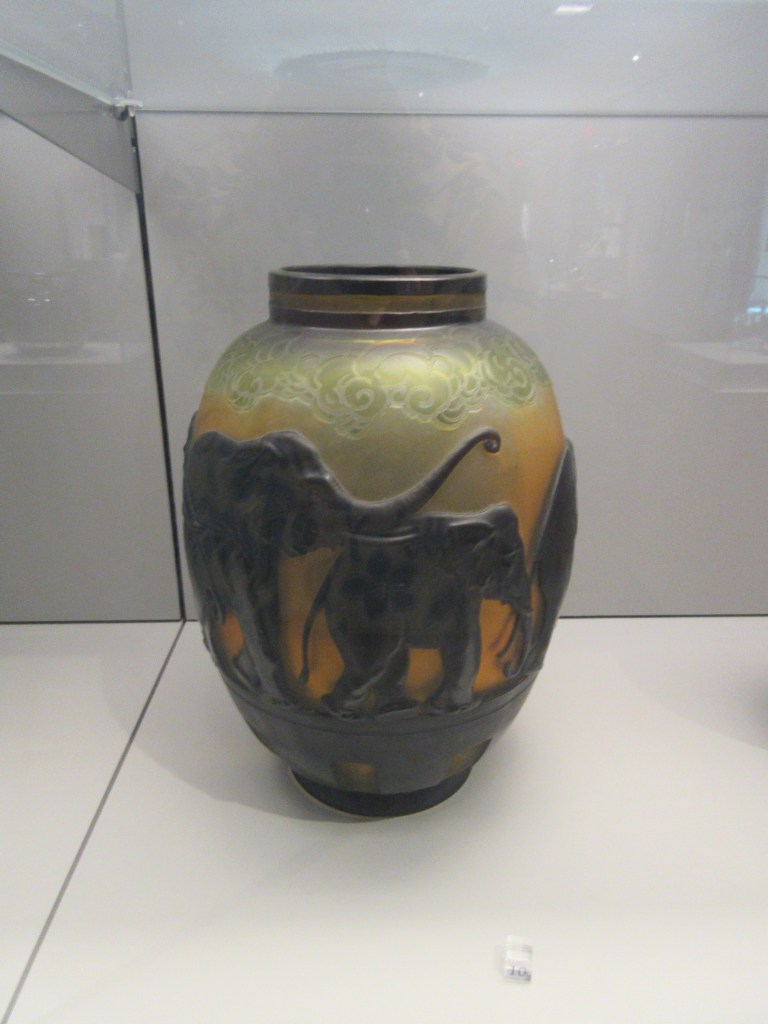
The first section I wandered into was their glass section. They are really proud of their glass. Like, really proud. They have a whole wing of the stuff. They have all sorts of glass as well. The first part of the exhibit is selections of glass stretching back to Roman times. I am always a big fan of ancient stuff like that because I try to really put the years into perspective. More on that in a second when I talk about their Egyptian stuff. I always wonder what whatever Roman craftsman was putting the finishing touches on a glass bowl would think of to learn that 2000 years later the thing was a) not broken and b) on display in an art gallery. The glass section stretches all the way into contemporary pieces done in glass. My favorites were a vase decorated with elephants (titled “Elephant Vase”) and a sculpture of an astronomical calendar encased in a sphere.

The next section was the “non-western” ancient art. This is where that ancient feeling really comes into play, but first off, even with that being said, I’m sort of over Egyptian stuff. I mean, I like it on its own, and it blows my mind to see sculptures and think that some dude painted that 5000 years ago, but I’m tired of seeing dead people boxes. Like, okay, they’re art, but that was a dead dude man. I think I’m the crazy one here, but still. There were also examples of African sculpture in the form of a stool and ceremonial weapons, and in the western section some excellent examples of Roman vases. There were a lot of vases in this museum, now that I’m thinking about it.

Upstairs in the museum is a great deal more of the paintings. Like I said before, they have a good chunk of Renaissance art, but I’m not a big fan. I’m sure its great, and its not the art, its me, but eh. I don’t like it. In the Modern art section I found a Lichtenstein I liked with a fighter jet so that was cool. Also, and perhaps most interestingly, tucked away in the corner somewhere near the Renaissance and Modern art sections is the Norfolk Mace. Apparently, municipal maces used to a thing. The Norfolk Mace was made back in 1753 and “when held by Norfolk’s mayor at public ceremonies, [it] signified that his colonial office was an extension of the British Crown’s prestige and power.” The museum boasts that it is the only municipal mace in the US in the possession of the city for which it was commissioned, but I didn’t even know these things were a thing. I think the world could use more maces.

I rounded out my visit to the museum with a visit to their Monet, “View of Vernon,” because I knew the name and I felt like I should check it out. If you’re in town I highly recommend a visit to the Chrysler Museum of Art. Admission is free, so it is always worth the price, plus their collection is pretty great and I spent a lot of time just discovering that there was more to see. Sorry, by the way, that the pictures are terrible; I’m not really an art photographer.

Advanced Firefighting

This past week I took an Advanced Firefighting Course. This is a requirement to get a license as a 3rd Eng (maybe 3rd Mate, I forget). It is experiences like this that have me convinced that I could never go back to school.

First off, I didn’t really know what to expect out of “advanced” firefighting. On the ship we ran a lot of fire drills, and damage control is a big portion of your submarine indoctrination. Plus, in my three years on the ship I managed to get a pretty good routine down for not having to do anything: when the general alarm goes off, first wait a beat, then grab your EAB and wander up to see if anyone manned DC central. If it was unmanned, swoop in and save the day. If it was already manned, turn around and wander off to the scene. With my “wait a beat and check DC central” routine, I would find the scene chock full of Junior Officers trying to man phones and a rapid response team trying to get past the JOs so they could fight the fire. Seeing that I was obviously of no use, I would duly report to the staging area and wait out the end of the drill in comfort. To all my submarine friends out there, I recommend this technique highly.

Between the Naval Academy and nuclear power training, I got pretty well trained to absorb knowledge via an instructor reading a PowerPoint to me. The modern trend, for anybody who hasn’t been in an academic environment lately, is to encourage class participation and group exercises and get buy-in from the students, or something. I hate this sort of thing. I don’t like participating in class. I figure I’m paying your ass to teach this class, so don’t try to get me to do all the hard work. I’ll take care of my end, you take care of yours. I’m so averse to classroom participation that I also hate it when other people participate in class. I don’t mind it when people ask clarifying questions, but except for that, I vastly prefer when everyone else shuts up so we can get on with the PowerPoint.

In these classes, however, there is always at least one person who feels the need to comment on everything the instructor says. This particular class was bad because there was two. Furthermore, both these people had egos. What an environment like the Naval Academy taught me is that while it is okay to have an ego, it is best to keep quiet about it. If you are the best at something, people will figure it out all on their own, and if you aren’t the best at something, at least you didn’t embarrass yourself by trying to prove otherwise. These guys didn’t get the memo, so anytime either one made a comment in class (which they did often), the other would chime in to try to put himself on top. To top it off, however, our fearless instructor also had a bit of an ego, leading him to try to top the other two. The entire class became three dudes all trying to jockey for top spot. Meanwhile, the other three of us in the class were just trying to go home at a reasonable hour.

It was somewhat unfortunate that our instructor had a bit of an ego as well because he wasn’t as good as he thought he was. For the Advanced Firefighting class the institution got professional firefighters with some mariner experience to teach it. This sounds pretty alright, but of the two instructors we had, neither knew much about ship-specific stuff. After this week I’m confident I could fight the crap out of an apartment fire, but shipboard fire, maybe not so much. It would have been better taught by professional mariners with some firefighting experience. The most memorable part of the class was the time one of my fellow students commented he “wasn’t too good at this book learnin’,” which is, you know, fine, but prompted the instructor to ramble on for 15 minutes about the Forest Service, toilet paper, aspirin, and 9/11, the relevance of which to firefighting I had a hard time figuring out at four in the afternoon when I was trying to go home.

The only other worthwhile things to mention occurred on the day we went to the trainer and actually fought fires. First off, the only people in the world allowed to act like drill instructors are people who are, in fact, currently drill instructors. If you’re just a somewhat overweight firefighter trying to make sure everyone turns in their flash hoods, you acting like a drill instructor shoots my respect level way down. Second, the most significant thing I learned the whole week is that being a firefighter is hard and I would never want to do it. Those fire ensembles are hot, man. So yeah. Good on ya, professional firefighters, and if you’re ever on a ship with me and a fire breaks out, I’ll see you in DC central.

Mariner Training

Hello, it’s 2022 and I don’t have a good photo for this article but I have a DALL·E invitation. Please enjoy one output for the prompt “A man very proud to be rowing around in a large lifeboat by Winslow Homer.”

First off, sorry about that week I skipped there. It wasn’t intentional, it is just that the family and I went off to grandma’s house and it is very easy to sit there reading Hemingway and imagining myself as a writer and that kept me from actually writing. I did get a lot of reading done, however. In the week long vacation to grandma’s house I managed to get through The Sun Also Rises, The Book of Luelen, a book on K-Boats (creatively titled K Boats), The Warriors, and a book called Land Below the Wind which was a memoirs of Agnes Smith. Agnes Smith married a member of the British civil service and moved to Borneo in 1934. I am a sucker for most any book published between 1930-1960, especially ones about Oceania, and more especially written by adventurers, and most especially of all those written by women adventurers, so when I spotted this book in the Annapolis Bookstore there was no way I couldn’t not buy it, which I tried to do. I highly recommend it.

My major project as of late has been trying to get a license as a 3rd Mate and a 3rd Engineer. Of the many career options I have available one of the more attractive is working on merchant ships. This option is attractive because it pays fairly well, lets me grow a beard and stare steely-eyed into the sea, and allows me to apply many of the skills I acquired over my illustrious naval career. I do get a whole lot of credit for the things I have done in the Navy but to qualify to sit for either of the exams for 3rd Mate or 3rd Eng I have a few more classes I need to take. In an effort to get these completed as quickly as possible, I’ve concocted a fairly quick schedule that takes me to nearly every maritime training institution in the mid-Atlantic region. A started a few weeks ago at the Chesapeake Maritime Training Institute, and then the next week at the Mid-Atlantic Maritime Academy.

These classes have been an, um, experience. Prior to these classes I have had exactly zero experience with the wide world of civilian maritime. With that being said, the biggest thing I’m getting out of these classes isn’t so much the subject material itself but a feel for the background of it and what is the “norm” on civilian ships. In a lot of ways it is very similar to what I saw as a submarine officer (having looked into civilian requirements and experienced military requirements, it is very obvious the military requirements for being in charge of a sea-going vessel are written with the civilian requirements very much in mind), but I need to learn how the civilians do it. For example, I am learning what the hell it is that people like Chief Mates and Chief Stewards do. I also learned that there exists a thing called a “Navy Nozzle” that I had never heard of, despite being in the Navy. There are lies being spread somewhere and I don’t know if the fault is with the civilians or with the Navy.

The most entertaining day so far, however, was our on-the-water day in my lifeboatman course. This course was all about lifeboats: when to get into one, how to get into one, and what to do once your find yourself in one. As part of this course, we rowed around an open lifeboat. This is the kind that the Titanic had,so you’re familiar with it. Leading the class and teaching us how to row a lifeboat was our instructor, who in sunglasses had an uncanny resemblance to a low-rent Sylvester Stallone. The rowers were a rag-tag bunch of people from all levels of our exotic maritime industry. A big part of the day was learning all the various rowing commands. These strike me as a bit of a lost art, seeing that we invented motors, but it is comforting to know that if I were to wind up in 18th-century England I could land a job as a coxswain. It was less comforting to learn that rowing an open lifeboat was terrible, and I just kept trying to imagine how much it would suck to be stuck in one in anything resembling weather, especially with 30 other people who I liked a lot more before I was stuck in a lifeboat with them. I think I got a brief glimpse into how it is that people contemplate cannibalism. With a lot of “TOSS OARS” and “OUT OARS” and “GIVE WAY TOGETHER” and other such things we managed to make our little lifeboat go around the harbor. We also made several more or less graceful pier landings and only crashed once or twice. The power of teamwork! The major compliment I received that day was “you’re a deck guy, right?” and the major lesson I learned was “don’t let your ship sink.” These were important things to take to heart.

Cat Cafe

On the same day we visited Fort Washington, Ian and I also went to the Crumbs & Whiskers Cat Cafe in Georgetown. Cat Cafes are one of those things that I thought was a bit weird when I read about it in another breathless “the crazy things they do in Japan” type articles, but now that I’ve been to two I can’t believe they aren’t all over the place.

The first cat cafe I went to was in Singapore. I was exploring the city with a friend of mine when we happened to walk by. I stopped us in front of the door and suggested we maybe give it a go, but I tried to act a bit coy about the whole thing lest I knock a few notches off my manliness quotient. He also acted slightly intrigued but less than enthusiastic, but later we figured out we both really wanted to go in and were just trying to act tough if front of the other one. So later on we gathered like four other dudes and hung out in a cat cafe in Singapore for two hours. The man working the counter was slightly incredulous and then I think slightly scared that six adult Americans wanted to visit his otherwise quiet establishment, but we had a great time.

So upon my arrival back in the States I looked around to see if there were any cat cafes. For those of you a bit lost in my cultural worldliness, a cat cafe is a place with a bunch of cats that will also usually serve you coffee. You pay some nominal entry fee and then get to hang out with cats for an hour or two and then also drink coffee. If you’ve never heard of a cat cafe before at this point you’re probably thinking “OMG WOW THAT IS THE GREATEST IDEA EVER WHY DIDN’T I THINK OF THAT?!” and I am over here like “DUDE I KNOW THEY ARE AMAZING WHY AREN’T THEY EVERWHERE?!” so I’m with you. The point is the only cat cafe I could find within several hours of me is the relatively new but absolutely awesome Crumbs & Whiskers Cat Cafe in, as I mentioned, Georgetown.

You can make reservations, which the website recommends, and ours was for 3:30. While Ian and I were there on a Wednesday afternoon we had the place to ourselves (and 20-odd cats) for most of our 75 minutes. When you walk in they also take any drink or snack orders you might have. These take a little while to come out, because they run your order to a fashionable-named “Macaron” down the street instead of make it in-house. But that’s alright because what you’re really there for is cats and boy do they have a lot of them.

I surprised Ian with our visit to Crumbs & Whiskers. We had to kill 15 minutes while we waited around for our reservation, so now that we were on location I explained the idea of a cat cafe to my uninformed and unsuspecting brother. He posed such serious questions as “why would you need a reservation for a cat cafe?” and “why would I want to visit someplace with cats?” but as soon as we walked in he had a huge smile on his face. The man loves animals and since we no longer have any pets of our own (man oh man I want a cat) his access to cute and cuddly things to pet is limited.

Ian was nervous at first and we sat sort of awkwardly admiring the cats. Ian doesn’t always have the best luck with animals but these cats are professional cats. These aren’t the amateur cats your friends have, these cats spend their whole lives being petted and loved and played with and are not at all surprised by the stranger calling them cutesy names in a baby voice. That’s their life now anyways; all the cats at Crumbs & Whiskers are rescue cats and are up for adoption, which makes it totally like “why don’t I take all of these cats home with me right now?” So Ian very quickly warmed up to the cats and got to spend a whole 75 minutes petting the very friendly cats and playing with them using the many cat toys spread around the two stories of Crumbs & Whiskers.

Ian managed to make particular friends with one cat, Brandy. The furniture in Crumbs & Whiskers is largely comprised of very hip pads sitting on the floor that serve as couches. This puts everyone at just about a perfect cat-level. Brandy was a playful little calico that very quickly sidled up to Ian after he sat down on one of the couches. Ian showed some affection and Brandy showed some affection back and Brandy was soon curled up asleep and purring next to Ian while Ian was on the phone telling everyone he knew how awesome it was.

Eventually though it was time to go home and we headed out. My only regret is that Crumbs & Whiskers is not closer to where I live. They offer all-day passes for the person who always wanted to work in an office full of cats, and they offer yoga classes for the person jealous of those YouTube videos. They also have special screenings of the Aristocats which I’m actively considering making the hour-long drive to see. Why aren’t there more Cat Cafes?

Fort Washington

Don’t worry, fine readers, the adventures of Pat and Ian Go To Various Maryland Historic Sites continues. Today we went to Fort Washington. Fort Washington is located on the Potomac River a little south of DC. It was built in 1809 and designed to protect DC from anybody who might want to invade, or whatever. Like that would ever happen. I had never heard of the place until I was looking for National Parks to go visit with all of my unemployment time.

Ian and I set off on a bright Wednesday morning and arrived a little before lunchtime. We very nearly had the place to ourselves; I only spotted one couple walking around and a dude playing some one-on-zero basketball the whole time we were there. Our first stop was the visitor’s center, where the Park Ranger just seemed excited to have someone to talk to. When I first looked up this park, I was expecting something very similar to Fort McHenry. Both of the forts were built at about the same time and have similar(ish) histories. The big difference, though, is that people care about Fort McHenry due to that whole star-spangled banner thing, and I had never heard of Fort Washington before. Consequently, Fort Washington does not seem as well funded.

The visitor’s center has a small but well-done display of the fort’s history and some artifacts from the site. Like I said, the fort was built in 1809 but in a harbinger of things to come was under-funded, under-gunned, and under-manned. When, in the War of 1812, the British did sail up the Potomac, the commander decided his best course of action was to blow up the fort and skedaddle. After the war, the place was rebuilt, and, not wanting to be embarrassed again, the Army built it way better. As our very knowledgeable Park Ranger explained to us, the Confederates were very familiar with the fort’s capabilities and never made an attack, saving Washington but relegating the fort to a somewhat forgotten history.

First off though, the whole place is pretty nice for what they’ve got. The fort itself is a small part of a very large park complex. We drove through most of it and it looks like an excellent place for picnics and the like. From the visitor’s center, the fort is accessed via a short path down a hill and across a wooden bridge. The bridge is a replacement for a drawbridge that used to be there, which must have been awesome in 1840. Despite a lack of drawbridge, the fort itself is still very impressive. It is built on a bluff overlooking the Potomac with hugely large walls constructed of imposing masonry. Inside the walls, we had pretty much free reign of the place. The two barracks buildings inside the fort’s courtyard were locked but on days when they have more rangers around one of them contains a display.

We started out looking into every single one of the fort’s many storerooms. One of them contains some bunks, for some reason, but none of the rest of them that are accessible contain anything. We checked. Ian was excited that the ranger later confirmed that the decaying wooden doors on them are in fact 1840s-era, so that was cool I guess. Up on top of the walls, however, the views were much nicer. Almost all of the cannons from Fort Washington have been removed, I’m sure to serve as decorative fodder for other places, and so you have a clear path to traverse all the various ramparts. Ian has made it a habit now to walk as much rampart as possible whenever we’re at a fort, so we took in the stunning views from every angle possible. Fort Washington has gorgeous panoramas of the Potomac. Looking up-river, you can make out the Washington Monument (we sure really liked that guy). Looking any which-way, you can watch sailboats and river cruisers lazily go by.

Fort Washington these days is also a nature park, and after we were done with the fort we took a stroll down the creatively named River Trail. Signs warned us to report any suspicious animal activity, so I made sure to keep an eye out for any suicide bomber raccoons. I think the most significant nature we saw were some geese paddling around in the river, which I guess might be slightly suspicious. We hiked down the River Trail for a little while, admiring the trees and quiet, and then eventually turned around. Fort Washington was a very nice place to visit and we managed to cover most of the highlights in about two hours. I walked away from the place thinking it was pretty under-loved. Take a visit and learn some history and give the Park Rangers something to do. They seemed like they could use the company.

Navy Life Story: Joining the Navy Part II

High School graduation

I got my acceptance letter to the Academy one afternoon after school. I came home and mom handed me an envelope I had gotten in the mail. It from the Academy and was one of those 9×11” envelopes and I figured it was way too thick to contain a rejection letter. I tore it open and the first page told me congratulations, I had been accepted. It also came with a thicker sort of certificate-looking thing congratulating you in nicer font on your acceptance. About three seconds after coming in the house and two seconds after mom handed me the envelope, I exclaimed “mom, I have a future!” and darted out with the certificate. I drove up to my girlfriend’s house and caught her in her car as she was pulling up after dropping off a friend at home. I opened my door and just showed her the certificate, which I knew she would recognize as identical as her own. I swear it was one smooth motion how she leapt out of her car and into mine and it was one of the happiest moments of my life.

The next day at school I dropped off a copy of my acceptance letter with my guidance counselor. She was busy so I just dropped the letter off and walked away. No one at the school, except for my girlfriend and the people who wrote recommendation letters for me, knew I was applying. I don’t like people to see me work and I don’t like people to see my failures so I tend to keep projects under wrap until I can see them through. So it was a huge surprise to everyone when they made the announcement over the loud speaker that I had been accepted. It also helped the surprise that at this point I had shoulder-length hair and a huge beard and looked like a total hippy and had never told anyone I had any military aspirations at all, but still. Going from having no future (except for boat thievery) to a Naval Academy future was a huge relief and I had the rest of the school year and a brief bit of summer to make the most of.

If anyone is trying to get into the Academy, here is where I would like to offer my unsolicited advice. The Academy is looking for three major things in potential candidates: physical fitness, academic chops, and leadership potential. They are looking for people who balance all three, so you can’t just rely on one of the pillars, but strengths in one area may make up for weaknesses in others. Make sure you join a school sport or athletic club of some sort. Work hard in school and get good grades, but take challenging classes; easy As will not go as far as hard-earned Bs. The biggest thing I think is proving that leadership potential. When I was doing some recruiting work for the Academy, what I told people is that you don’t have to do anything extra. It is not necessary to join a club for the sole reason of looking good, but in whatever organization you are in, try to get a leadership role. If you are on the soccer team try to be a team captain, or if you are in the chess club try to be the secretary of the chess club. That leadership potential can really set you apart from someone who is smart & athletic but who has never had to lead anybody. The Academy is, at its core, a leadership school.

Navy Life Story: Joining the Navy Part I

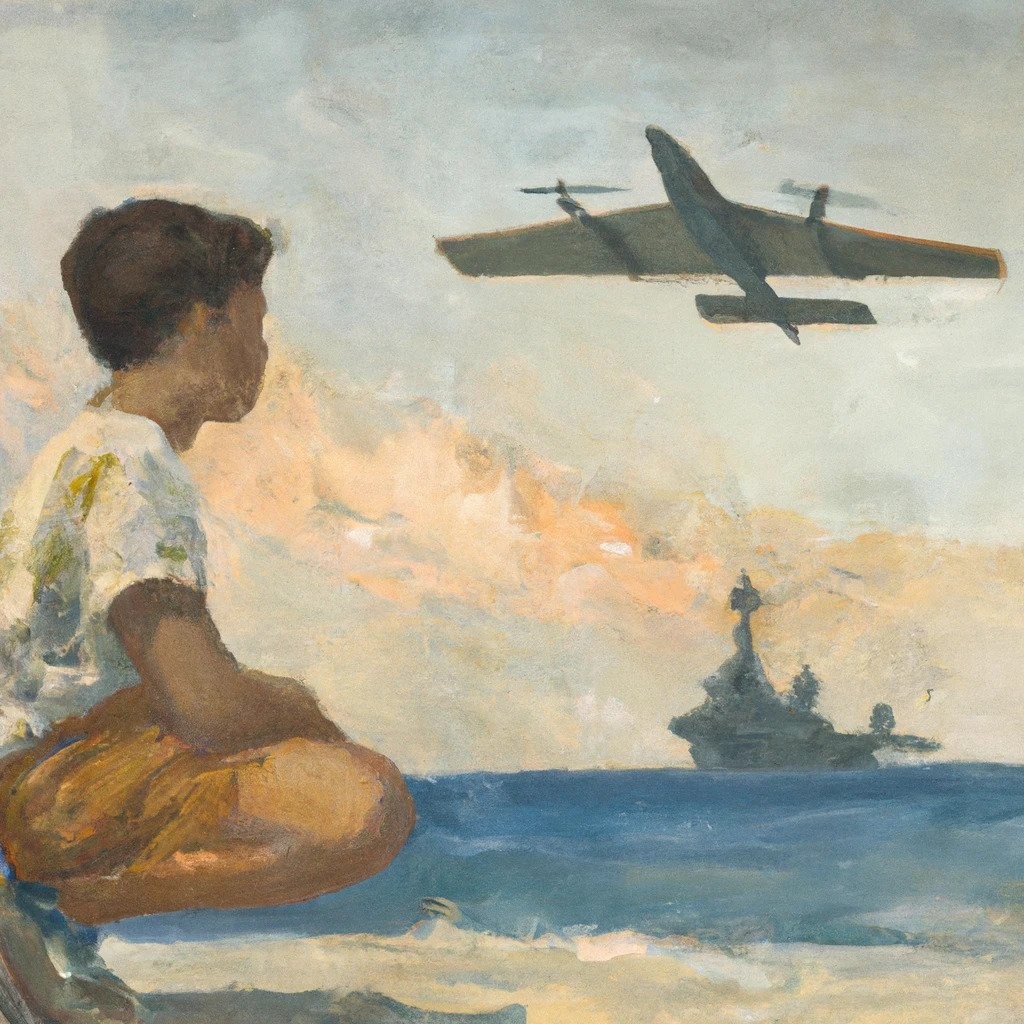
Hi, it’s 2022 when I am finally adding a picture to this. I don’t have any real, relevant pictures, but I got a DALL·E invitation, so please enjoy one result of the prompt “A teenage boy in a Hawaiian shirt at the Naval Academy watching a fighter jet fly by with a ship in the background by Winslow Homer.”

I am going to slowly trickle out my Navy Life Story. Although this blog is about reminding myself to go out and have new adventures, I figure writing down what I’ve already done is pretty important at least for my own sake and maybe for my future biographer’s when I’m rich and famous. The story starts, as most do, at the beginning, with me joining the Navy.

A question I dislike is “why do you want to join the Navy?” When applying to someplace like the Naval Academy, the question comes up a lot. The most classic answer is “I want to serve my country.” That always sounds corny to me and is so clichéd that I wonder if anyone believes you when you say it. I was very afraid not to, though. It is sort of like presidential candidates wearing a flag lapel pin: a meaningless gesture if you do it, but judged if you don’t. But what do you say that isn’t selfish? “I want a free education and a guaranteed job for five years after college that includes excellent routes for advancement, great benefits, and opportunities for travel.” That would be a pretty valid answer anywhere else but here it sounds too self-centered. The best option must lie somewhere in the middle. Neither was me though.

I went to the Naval Academy mostly out of instinct. Both my parents were in the Navy. Dad graduated from the Naval Academy in 1978 and became a Nuke SWO. He served on aircraft carriers and submarine tenders in his nuclear role, and on cruisers in his surface warfare role. His last job in the Navy and the first I actually remember was teaching at the Naval Academy. While he was stationed there we lived in the Navy apartments across the street. Mom was a dirty dirty ROTC grad, but that wasn’t her fault. Mom initially served as a conventional SWO and was the second woman to earn her warfare designation. Due to limited career opportunities as a female SWO in the 80s, she transferred to the intelligence community and then transitioned in the reserves after she had kids. Mom’s career outlasted dad’s and she finally retired while I was at the Academy. Mom and dad met when she was teaching his celestial navigation class at Surface Warfare Officer School in San Diego.

Despite the star-crossed nature of my parent’s Navy romance, I didn’t have all that much direct Navy influence growing up. Dad retired before I entered elementary school, and since mom was in the reserves that experience was her going off to drill once a month. So while technically a “Navy brat,” I spent all but the first three years of my life in Maryland and to me mom and dad were only ever a tax preparer and school teacher. Looking back, I do note some early influences, like the picture of Halsey in the hallway or the giant SWO pin mom displayed in her office. We lived near the Naval Academy and sponsored Midshipmen, so the Naval Academy always had a presence in my life, but more along the lines of “location of a convenient ATM” than “lifelong destiny.”

All of that to say that senior year in high school found me pretty directionless. The concept of a directionless 18-year-old who doesn’t know what he wants to do in his life isn’t all that original, but still. The prospect of college didn’t particularly interest me. Even though I am good at education, I am not a particularly big fan of it. At 18, however, I thought of myself as a pretty big nerd, so I applied to MIT. They rejected me. I also applied to some weird liberal arts farm commune college out west. They also rejected me. One morning though I woke up and it struck me: going to the Naval Academy might be a good idea. Instead of “real” college, I could go to (what I thought was) happy fun-time boat school for four years. So like salmon returning to the river they spawned from, I joined the Navy out of instinct.

Applying to the Naval Academy has two major steps: getting a nomination and actually applying to the Academy. To ensure an even distribution of people from the country (in the least cynical explanation), everybody at the Academy is required to get a nomination before applying. The most common source of nominations are from members of Congress. Each member of Congress has a certain number of nominations they can hand out each year to people they see fit from their district. This ensures Midshipmen come from all over. Every member of Congress has their own process for granting nominations, and for Maryland, my three options all required an application and an interview. I tried hard; I even got a haircut. My efforts, however, were all for naught, and I did not secure a congressional nomination. I can make myself feel better by pointing out that Maryland has some pretty stiff competition. People from Maryland have actually heard of the Naval Academy. States like Montana, while they have the same number of senators, also have a lower population of people who have ever heard of the Naval Academy, which can improve your chances of getting nominated. I instead got a Presidential nomination (there are also Vice Presidential nominations), which is less impressive than it sounds. To secure a Presidential nomination you have to submit a form letter detailing one of your parent’s military service. Apparently mom’s record was good enough to get me in.

Nomination in hand, the next step is actually applying. There are brands of people for whom going to the Naval Academy is a lifelong dream. I knew one of these guys. Out of my class in my high school three of us wound up going to the Naval Academy that year. The guy I’m talking about is the guy you think about when you imagine people applying to the Naval Academy, I think. Football team, popular kid, also smart, did all sorts of extra-curriculars. I watched him make friendly with anybody he thought might give him a leg up in applying. These efforts can be worth it, and he did it with the sincerity of a person with a goal who is willing to fight for it and I don’t knock him for his efforts. However, I was not that kind of person. I wound up joining the track team senior year in order to give myself some athletic credentials, but the concept of “networking” was and remains very uncomfortable for me.

As part of the application process you get interviewed by a Blue & Gold officer. A Blue & Gold officer is a Naval Academy graduate who helps guide people applying to the Academy and submits a recommendation based on their interview. My Blue & Gold officer was not very impressed with my efforts. The other two people that got accepted from my high school got phone calls from their Blue & Gold officer when they were accepted and continued to communicate with them after they were at the Academy. I talked to mine all of once, and that was during our interview. He told me the only reason he was talking to me was because I had somehow gotten a nomination. We met on a winter day in Halsey Field House on the Yard. At the time I wanted to be a pilot, and all I really remember from the interview was him asking me if I was really ready to make that kind of commitment.

The rest of my application completed (which was pretty much like any other college application, except there was a physical fitness test), I awaited the results. At this time the girl I was dating was one of those other two people I mentioned that had gotten into the Academy. I don’t know what the internal system is, but people find out in a staggered manner that they have been accepted into the Academy. Having secured congressional nominations, the other two even got phone calls from their congressman’s office with the good news. While that was nice for them, the President never called me to let me know. Winter turned to spring (if I can take a poetic bent) of my senior year and I had no firm plans for the rest of my life. Plan B at this point, if I didn’t get into the Academy, was to hitchhike to Florida, steal a sailboat, and I guess live a life of adventure/starvation in the Caribbean.

St. Mary’s City

The latest and greatest entry in my ongoing series “Pat and Ian Go Places When Ian Has the Day Off and Pat Continues to Be Unemployed” is our recent trip to the historic St. Mary’s City. I should get a job. Before that happens though, a brief intro to Maryland history.

The history of Maryland is long (for the US, anyways) and filled with exciting episodes like that one time we had a war with Pennsylvania, that other time people actually fought over the Severn, and a more awkward than most relationship with slavery. The story opens, however, with the founding of the colony that would become the greatest state in the union at St. Mary’s City on the northern shore of the St. Mary’s river. It’s a pretty standard colonial origin story, with dashes of escaping religious persecution, befriending the natives, and important things happening under trees. After about 70 years the capital was moved up to Annapolis and St. Mary’s was abandoned. Fast forward an additional three hundred or so years, and the city has become a major archaeological site you can visit on sunny days in May.

We headed out for our 2.5 hour drive around ten thirty and stopped for lunch on the way at Smokey Joe’s BBQ. We parked at St. Mary’s City visitor’s center to pay our entry fee and look at the artifacts they have on display. St. Mary’s City is apparently an archaeological training ground, so the city is pretty well documented as far as these places go. The visitor’s center gives a pretty efficient run-down of the history of the city. Artifacts on display include an old saker, which is apparently a type of cannon, a variety of pottery shards from the local tavern, and some examples of jewelry and sewing needles and the like. The rest of the city is explored via walking trails. “City” is a bit of a generous term in the modern sense and the whole place is about a mile from end to end.

The first area is a recreated Native American village. The nascent St. Maryites spent their first winter living in part of a Yaocomico village they purchased after some negotiations. Relations with the natives were reportedly very friendly, which is nice for a change of colonial pace. This portion of the city features prototypical huts with various implements on display within them. A very nice man in a polo shirt was explaining some of the finer points of native construction techniques, but Ian was too preoccupied with some of the other huts to let me listen very long. Also on display is a half-finished canoe, but filled with rainwater it looked more to me like someone should be looking for a convenient soap mine.

Next up on the path is a reconstructed Jesuit church. Throughout the city are faithful as possible recreations of the original structures. Some, like the church, were built with as original as possible construction techniques and materials, while others are a little less faithful but the discrepancies are noted. Also dotting the site are “ghost houses,” which are wooden frames of buildings as stand-ins for the originals to give you a sense of the density of the place. The church is fairly impressive, with one of the highlights being a glass section of the floor where you can look down and see the original lead coffins of Philip Calvert (the second Lord Baltimore’s brother), his wife Anne, and an unknown child, presumed to be from Phil’s second wife. They were returned to approximately their original locations (the modern reconstructed church is over the site of the historic one) after about 25 years of study and storage. In my old age I am sort of increasingly weirded out by putting dead people on display. I might be the crazy one. The coffins look nice though I guess?

Another highlight of the city is the oldest barn in Maryland. The sign for the barn is titled “Why is this Barn Here?” which is a little philosophical for my tastes but I’ll let it slide. The inside of the barn features displays about barn construction techniques and the details of tobacco packaging & shipping. As a proud Marylander, I am of course very familiar with tobacco farming, with tobacco farms being a standard for Elementary School field trips. At any rate this particular barn dates from 1785, putting it well within the farmland years of St. Mary’s City, but very historic nonetheless.

Walking north from the church brings you to downtown or our bustling historic metropolis. This are includes the most intricate display they have, with a large building representing Garrett Van Sweringen’s Council Chamber Inn. It was purportedly quite the posh place back in the day. You know it was nice because they have a sign denoting the fact that they found a large number of crab remains on the site, proving that Marylanders have been enjoying crab feasts from the start. Also on the back of the property is a coffee & brew house, and I mean with all these features in one spot why did they ever bother to go to Annapolis? This portion of the city also features the town store where you can look at old shoes and axe heads, as well as tour guides in period garb. These were my favorite kind of tour guides in period garb, where they don’t try to make you think you’ve somehow been transported back to 1650, and instead just tell you about whatever they got going while wearing some sweet duds.

They very pièce de résistance of the whole place (for Ian and I, anyway) is a recreated Dove. Although the colonists and their supplies were transported to the city on another ship, the 400-ton Ark, the colonists also brought over the Dove to give them some metaphorical wheels once the Ark departed. The modern Dove is a best-guess at what the original looked like, as the guides for the ship explain ad nauseum. It clocks in at 40 tons and strikes me as a pretty sturdy little ship, although the original was lost at sea on a trading voyage not too long after the colonists settled in. Although we didn’t get to see it when we were there, the Dove goes sailing about once a month to keep the crew exercised and trained.

The endpoint of the walking tour is another recreated building, Maryland’s first state house. The original state house was torn down after the city was abandoned, but the bricks were used to construct the Trinity Church which still stands next door, giving a tangible tie to the past, or whatever sounds poetic here. You can explore the statehouse, which is one of those large cool buildings, designed for hot summers before they invented air conditioning. Along with the church there is of course a graveyard, featuring some more old dead people, though not quite as old (but still as dead) as the lead coffins from earlier. In the graveyard is a marker declaring the position of the old mulberry tree where the colonists gathered to establish their city. Upon reaching this marker and reading the inscription, Ian declared that we were “done” with the city, and with that we turned around for the walk back to the car.

St. Mary’s City was a very nice place to visit. The weather was beautiful and those colonists really knew how to pick scenic riverside real estate. The displays and signs were very well done, and it is evident that the location is well cherished and cared for by the similarly named university next door. I think most people that visit Maryland will wind up in Baltimore or Annapolis, but down southern Maryland is really the state’s agricultural homeland and it is worth the trip.