Annie B. Hore

On the left is Annie from the frontispiece of her book (published 1886), while on the right is a picture c. 1881 from Meyer Family memorabilia, published in an article by Dr. G. Rex Meyer.

Reading this week:

  • Tanganyika: Eleven Years in Central Africa by Edward Coode Hore
  • The Road to Tanganyika edited by James McCarthy
  • Brazza, A Life for Africa by Maria Petringa

One of the interesting parts lately of transcribing the Chronicle is going through the book reviews. It was here I discovered the existence of the book To Lake Tanganyika in a Bath Chair, written by one Annie B. Hore.

I had not given a whole lot of thought to Annie until this point, and that is really an unforgiveable and glaring oversight on my part. She was born on April 8th, 1853 as Annie Boyle Gribbon, the daughter of a prosperous merchant. Annie enters our narrative when she married Edward Coode Hore on March 29th, 1881, while he was on his first home leave after becoming a missionary on the London Missionary Society’s Central African Mission.

I have been trying to dig up information on Annie and besides what I get from the Chronicle, a lot of what I will present here is from a thorough biography of Captain Hore written by Dr. G. Rex Meyer and published in Church Heritage. Dr. Meyer is first cousin twice removed of Annie. It was of course very foolish of me to overlook Annie because she does of course pop up all the time in the Chronicle, albeit it only ever as “Mrs. Hore.”

She was a remarkable woman. This was of course 1881 in Victorian-era England, and if you were a vibrant, outgoing woman and dedicated Christian and wanted to see the world and spread the message of Jesus you were pretty much out of luck, unless you got yourself married to a missionary (I am ignoring the moral quandary of missionary work here). As she says in her writing, she married Edward not in spite of his missionary work but as an enthusiastic partner of it. And so, eleven months after they were married she gave birth to their son Jack (February 1882), and five months after that (July 1882) she found boarded along with her husband and infant son the steamer Quetta bound for Zanzibar.

The act of getting from England to Lake Tanganyika is the story that comprises her book, To Lake Tanganyika in a Bath Chair (a “bath chair” here is like a wheelchair). It was not easy! They started one overland caravan but had to turn back when Annie got sick. She returned to England and then the next time she tried to go to the Lake it was via Lake Malawi (then Nyasa). They had to turn back from that due to fighting along the route, and so they began once again on the overland route. The wheels of the bath chair were not very effective, so it was essentially converted to a palanquin, and it was on the shoulders of 16 porters (though only two at once) that she travelled to Lake Tanganyika, becoming the first European woman to do so. She also thus became the first woman to join the Central African mission and started their first school, a school for girls.

I very much recommend a read of Annie’s book. Unfortunately it is nearly impossible to find. Unlike her husband’s book it only received a single edition. However, thanks once again to the Yale Library, I was able to obtain a copy and spent two who days transcribing it for the benefit of the internet and the world. Please find it below. I think the book is very witty, and Edward claiming that they should just get a move on down the road is channeling the exact same energy my dad has whenever he is on a roadtrip. It is also a unique look into fairly early European travel into Africa from the perspective of someone who is not a militaristic white dude. (When the Chronicle reviewed her book in January 1887, they overall recommended it, but noted that the introduction and conclusion by “E.W.” “does not add much to the value of the book, and is disfigured by some glaring inaccuracies,” which is true, but also that “the portraits of Mrs. Hore and ‘Jack’ are not pleasing likenesses, which is whack and shows the value of certain kinds of people’s opinions.)

Annie’s route, included in her book.

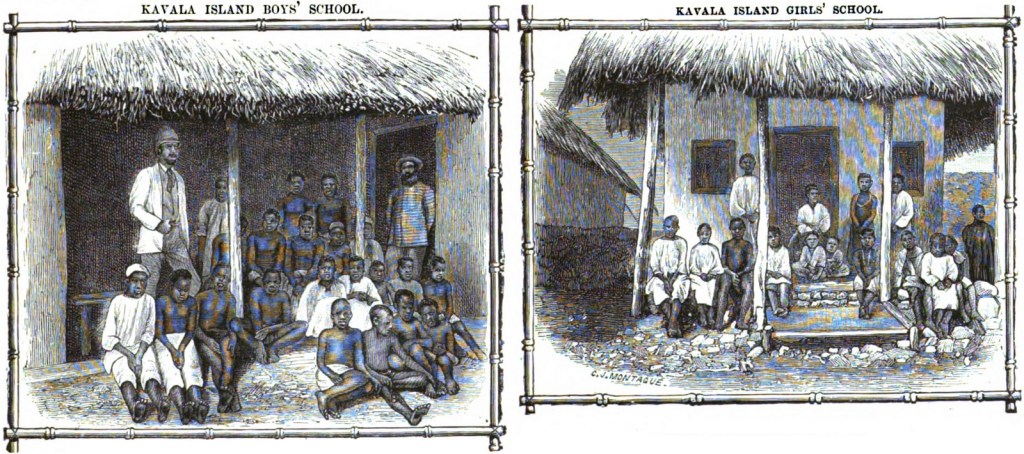
Once in place on Kavala Island, Annie threw herself into missionary work and excelled at it. It was a little slow going as first, as she and Jack were recovering from illness, but she soon started a school for girls, which in turn inspired Edward to finally start a school for boys. From Edward himself: “I may say I have worked from 6 a.m. to 6 p.m., for months past, and it is certainly as master of works that I have gained [Chief] Kavala’s admiration; but the center and strength of our powerful influence doubtless lay in the arrival and presence of my wife and child, and its resulting details in Mrs. Hore’s girls’ school.”

The Hores returned to England from Central Africa for the last time in October 1888. When I read the Chronicle I am astonished that the missionaries would take their children into Central Africa, given the high mortality rate of missionaries there. But for the Hores, although their son Jack survived the rigors of caravan travel and spent his childhood on Kavala Island, it was upon their return to England that he fell ill and died in London in April of 1889. According to deceasedonline.com, he is buried in Camden (search “Hore” and “1889”).

In August of 1890, however, Annie gave birth to a daughter, Joan, and in 1894 the Hores moved to Australia where Edward continued to work for the London Missionary Society for a time. Annie had relatives in Australia, and in his article Dr. Meyer notes that “[Edward] was dour, grey and humorless; a personality in sharp contrast to that of his wife Annie who, while a devout Christian, had a great sense of humor and an ebullient personality and who was loved and admired by all who knew her. When Edward and Annie Hore visited the Meyer [Annie’s cousins] family in Sydney, which they did frequently after 1890, Edward, with his difficult personality, was ‘tolerated’ for the sake of his wife, who was popular and always welcomed.” Dr. Meyer also notes that, in helping fundraise for the Society, Annie’s “contributions were extensive and greatly appreciated… Annie Hore conducted many meetings and gave informal talks, mainly to women’s groups.”

When Edward finally left the Society for good, they settled in Tasmania where they ran a small farm. This farm, again according to Dr. Meyer, was not successful for a long time, but eventually matured into a productive if modest estate and when they sold it provided sufficient funds for a final retirement. Annie and Edward were respected members of the community. After suffering a stroke, however, Edward died in 1912. Annie outlived him by four days short of ten years, with both buried in the Cornelian Bay Cemetery in Hobart, Tasmania. Her epitaph reads “Missionary.”

Notes on this transcription: I have made some effort to proofread this transcription. However, I have maintained several of the book’s typos while contributing some of my own, and which is which is an exercise for the reader. I have included the best scans I could of Annie’s portrait, Jack’s portrait, and the map of her route. The book includes a map of Lake Tanganyika which is the same map prepared by Captain Hore that can be found in a variety of places, including here. I have also tried to put the pdf together in a fairly pleasing way but there was only so far I was able to go.

Book Review: Steam and Quinine

Reading this week:

  • Gravel Heart by Abdulrazak Gurnah

We’re going to venture into all new territory for this blog and do a book review. The book in question is timely and relevant to our discussions here on this blog, which as my myriad loyal readers are aware has lately (though unlikely permanently) become more and more focused on the activities of the London Missionary Society in Central Africa. I promise I have other interests, which have also been documented on this blog, but it is winter and I am a working professional man now and Tim Harford tells me it is good to have serious hobbies so here we are.

One of the things I like about reading into the history of the London Missionary Society and especially the history of their steamer the Good News is that there is not a lot of competition in the space. There are a few other people I have found who have looked into all this which makes it interesting but it’s not like it takes all that much research to rocket to the top echelons of the field. However, the other edge of this sword is that it can make it difficult to access research items. One such item is the subject of today’s book review: Steam and Quinine on Africa’s Great Lakes: The story of the steamers white and gold on Africa’s inland waters by David Reynolds, with illustrations by Keith Watts Thomas.

Given the overall lack of interest in the topic, it is a little stunning that two books were published detailing the lake steamers of Africa in close order, namely The Lake Steamers of East Africa by L.G. Bill Dennis in 1996, and Steam and Quinine in 1997. Unfortunately, it doesn’t appear that either book got a second edition, and although there are copies of Steam and Quinine on sale for $60ish, I haven’t been able to find a copy of Lake Steamers except over in the Library of Congress. Fortunately for us, however, the Yale University Library is still willing to mail me books, which is how I got my grubby little hands on a copy of Steam and Quinine for us to peruse.

This book is clearly a work of passion for our friend David Reynolds. His biography on the back reveals he “was born to missionary parents near the shores of Lake Victoria in 1932” and completed his education in South Africa. This was his third book about African boats, the first being A Century of South African Steam Tugs (which apparently got three (!) editions) and Kenneth D. Shoesmith and Royal Mail, Royal Mail being a shipping line. This is clearly a man after my own heart, when it comes to steamships at any rate.

Although my specific interest in this book are the boats of Lake Tanganyika, and even more specifically as mentioned the Good News, he covers all the great lakes (Nyasa/Malawi, Tanganyika, Kivu, Albert, Victoria, and the honestly not-so-great Kioga) in a northward fashion. My expertise in this area is targeted, but I haven’t spotted any steamships (or some motor ships) that he missed, making this a very comprehensive review of steam navigation on the African Great Lakes. He does, however, devote more space attention to the boats that pique his personal interest, but honestly what is the point of being passionate about something if you’re not going to devote way too much space to it? *cough* this whole blog *cough*

But let’s circle back to my specific interest, the Good News. Honestly I gotta say this section does not come through shining. I think we’re both partisans here, but I am a much bigger fan (or devotee anyways) of Edward C. Hore than he is. Mr. Reynolds spends a good chunk of time maligning Captain Hore’s character, ending his biography with the note that Hore “died, impoverished and institutionalized, in Tasmania.” According to research published by Dr. G. Rex Meyer (kindly provided to me by the former editor of the unfortunately defunct Church Heritage journal), the only part of that sentence that is true is that he a) died b) in Tasmania, which for me throws much doubt onto his scholarship overall.

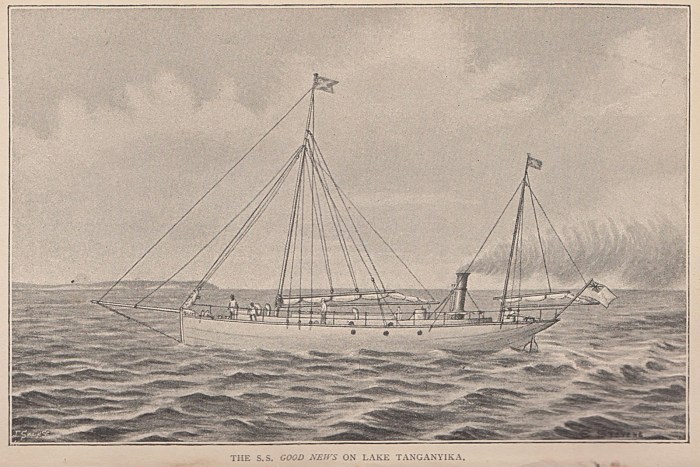
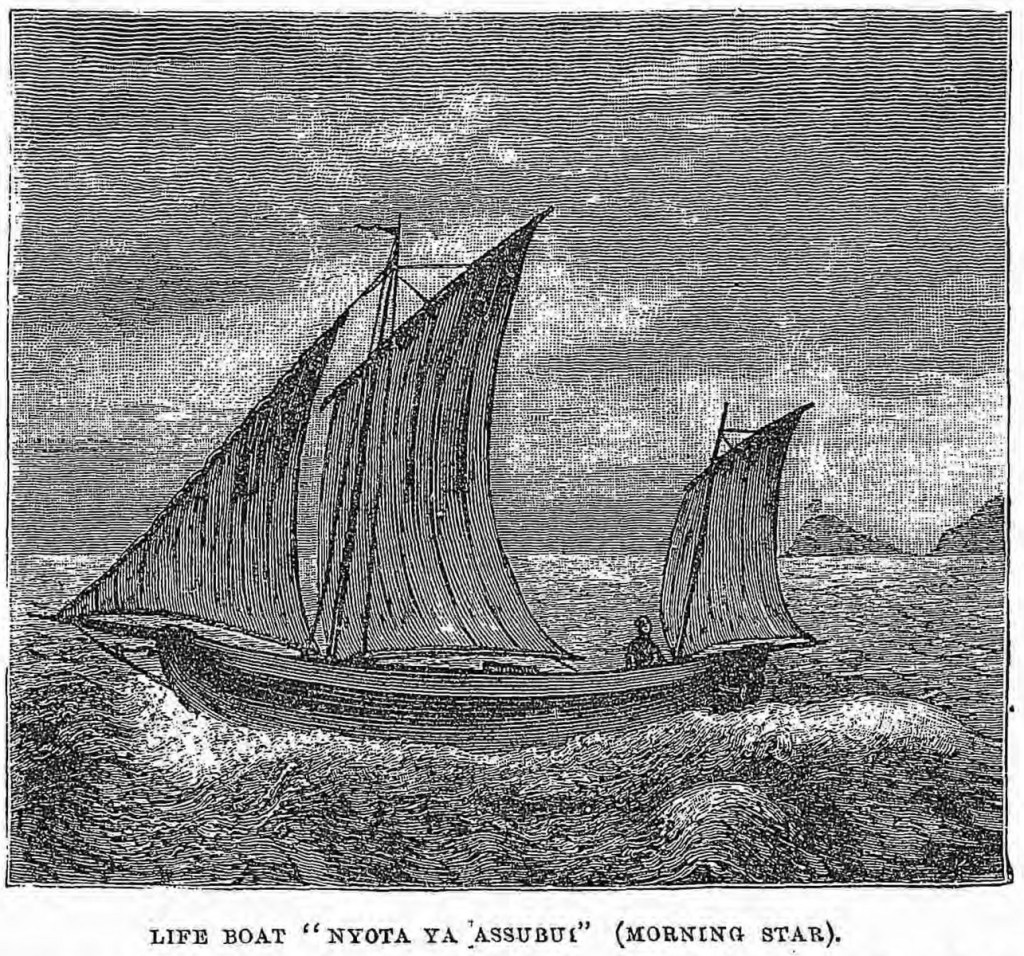
Although a feature of the book are paintings of several of the ships by Keith Watts Thomas, the book is also illustrated with sketches by David Reynolds. One of these sketches is of the Good News, included above. I have another nit-pick here. In his sketch, the ship is depicted with a sort of wheelhouse on top of the main cabin. Being as there are a limited number of pictures of the Good News and I have tried hard to see all of them, I think you, the reader, will agree with me that the sketch is derived from the below picture of the Good News in drydock. The ship that Mr. Reynolds has sketched does not match the layout of the real ship at all, which again puts me in fear for his scholarship, on my favorite boat anyways. The below picture isn’t perfect and shows a Good News under repair (for example, it is missing the booms and funnel), but I have also included below an engraving of the Good News under steam from Captain Hore’s book, Tanganyika: Eleven Years in Central Africa, which still doesn’t match the sketch.

Putative source of David Reynold’s sketch
Engraving of the Good News under steam.

I will try to avoid being entirely whiney here but noting that I did learn something intriguing about the eventual fate of the Toutou of Battle of Lake Tanganyika fame. This tidbit is hidden away in the section on the Graf von Goetzen / Liemba:

The Fifi, considered unserviceable, was towed out onto the lake and sunk in deep water on October 19, 1924. She went down with flags flying and all honours. The Toutou did not last long on the lake. She was transferred to Cape Town and could be seen in the Victoria docks with a brightly polished plate in her cockpit which read: ‘This launch served in the East African Campaign as an armed cruiser. Captured and sank three German gunboats with assistance of her sister launch, Mi Mi.’

This means now I gotta get my butt to Cape Town and see if she isn’t still there. Or better yet, anyone in Cape Town already?

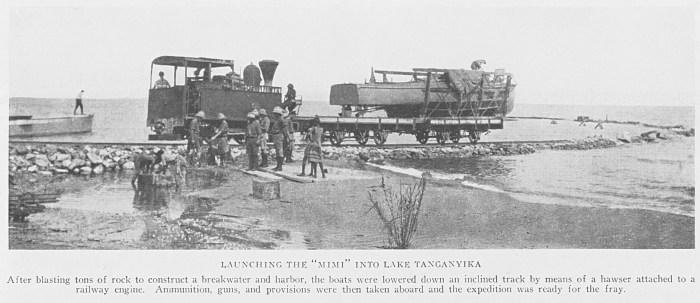
Sketch of the Mimi by David Reynolds, along with the source image, below.

All in all if you want to get one book on the steamships that plied the African great lakes, honestly I’m not sure what book to recommend because there are astonishingly two and I haven’t read the other one. Though then again only one of them appears to actually be available. Though then again again the available one is like $60 and I’m not sure I can recommend it at that price. Then again again again they aren’t making more. I don’t know. It was at times a tedious and at times a very entertaining read, and as I said at the top a lot of passion went into it. I guess to conclude, please enjoy this final image I extracted from the book, the masthead of the African Lakes Corporation:

The Chronicle, 1886-1890

Reading this week:

  • The Last Gift by Abdulrazak Gurnah

This post has been superseded!

In the unsustainably short interval of only five weeks, I am once again pleased to announce the third part of my ongoing project to transcribe every article in The Chronicle of the London Missionary Society relating to their Central Africa mission. The interval was so short because it has been a very slow period at work, but also because this is a teeny-tiny update, at a mere 38,000 words. I was wondering if this update would put the totals for this project above the 200,000 word mark, but it was not to be.

In this third semi-decade of the Central Africa Mission’s existence, it seems to be gaining a very different character. The reporting on the Mission in the Chronicle really took a nosedive. Part of the reason for that is fighting in the area cutting off the mails and therefore communication with the mission, so the Chronicle was forced to just give mild speculation based on rumors they had heard with no actual information. But I think a much bigger reason is that the Mission had simply become just another mission.

By this point they were fairly well established in Central Africa. They had four main stations – Urambo, their first permanent station; Kavala Island, where they had set up their marine department when it was clear they were unwelcome in Ujiji; Niamkolo (spelled Niumkorlo during these years) to get a presence at the south end of the lake; and Fwambo, a newly established mission “fifty miles inland on the route to Lake Nyassa” (I think this is now Kawimbe Mission, but I am not sure). The routes to these stations were well-established, the mail fairly regular (when there wasn’t fighting), and the Missionaries were spending their time building their infrastructure and their trust with the local communities. This is not the exciting part of missionary work. If there was exciting stuff, it wasn’t actually reported in the Chronicle – often the editor notes that urgent news had been reported in the daily papers, and in this magazine they were then just noting that all had turned out well (or not).

The Mission also starts to be swept up in world events. In 1876 they were some of the only Europeans in the area, but by 1890 colonization is starting to firmly take hold. Part of the reason for the fighting that cut off the mails is that the Germans were attempting to take hold of what would become German East Africa, and the native peoples were fighting back. Then in March of 1890 the Chronicle is reporting on a speech from the Duke of Fife where he discusses the recently founded British South Africa Company. And in December of 1890 they even note that Urambo is likely to be made a military station. The London Missionary Society in 1890 is no longer the vanguard of the European takeover in the Tanganyika region.

For our interests here in this blog there are a few other developments. This era is when James Hemans heads to the mission. On the other hand, our man Ed Hore has left the mission, with the latest news that he has gone on a tour of the Society’s missions around Australia. His wife, Annie Hore, was left in London to give birth to their daughter. Annie had been the first woman sent out to Central Africa by the Society and founded the Mission’s first school, the Kavala Island Girls’ School pictured above. While she was the first, in this era it is now becoming common for men to go out with their wives, a further signal that Central Africa was no longer the wild domain of only people like Livingstone and Stanley, as far as Europe was concerned.

Although the London Missionary Society might have felt that Central Africa was no longer so dangerous, with family life taking hold in the Mission comes the normal tragedies of everyday existence. In June 1889’s “Announcements” they report under Births: “Jones – November 16th, at Fwambo, Central Africa, the wife of the Rev. D.P. Jones, of a son.” Then, on the very next line under Deaths: “Jones – December 26th, at Fwambo, Central Africa, the infant son of the Rev. D.P. Jones, aged 6 weeks.”

As ever, if you find this work useful, please let me know. I’d be excited to collaborate.

Dumbarton Oaks

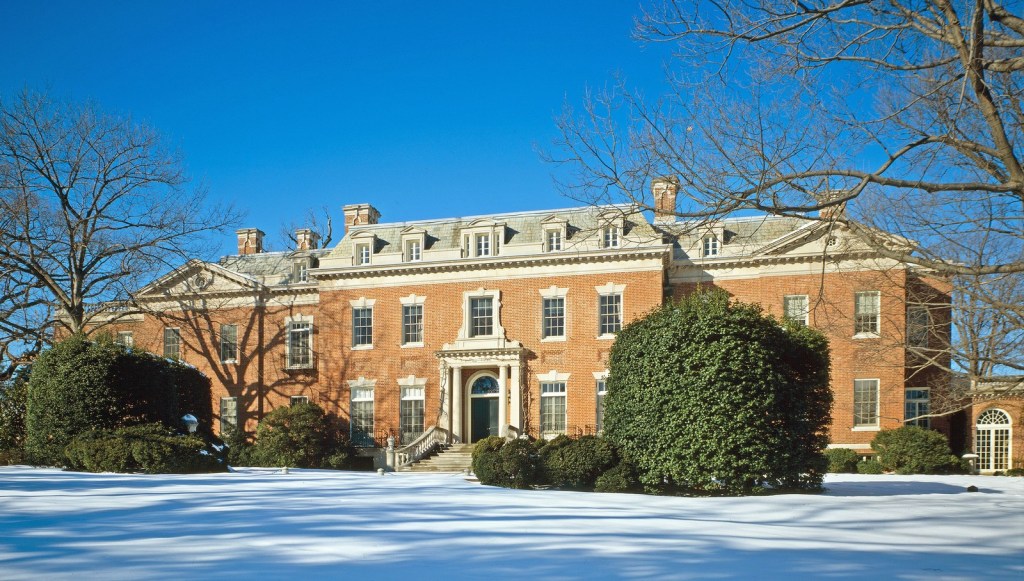
I forgot to take a context photo once again, so this is thanks to Wikipedia. We never saw this view, having scuttled in from the street entrance.

Reading this week:

  • Steam and Quinine on Africa’s Great Lakes by David Reynolds

The other day, in our continuing efforts to visit every museum in DC, my super amazing girlfriend and I set out to explore Dumbarton Oaks! Remember when Harry and Meghan turned down “Earl of Dumbarton” for their son? Anyways off we went!

Except we didn’t go there first. My super amazing girlfriend is very sensibly into teahouses, and so our first stop for both tea and lunch was Ching Ching Cha which I recommend you go to because it comes highly recommended by both me and my super amazing girlfriend. They have a wide variety of teas available. I went with a black tea while she went with I think a hibiscus tea. Below you can see a picture of me looking at the tea, appreciating its terroir and stuff before sipping it down. I followed the tea with a delicious egg custard. All in all an A+ experience.

Sated and energized, we went off to Dumbarton Oaks. We had timed tickets and they mean it there. We tried to sneak in about 30 minutes early but a much harried woman was guarding the desk and making sure everyone followed COVID protocols, which I appreciate. I hope she is paid well. After a short jaunt to a flea market we finally got in.

I wasn’t sure what to expect at Dumbarton Oaks. I don’t tend to like, read ahead on these things, so I enter wide-eyed and impressionable. The impression I got was that man, it seems like it would have been fun to be a rich person in the early 20th century going around just buying up people’s cultural heritage and not being worried about it at all.

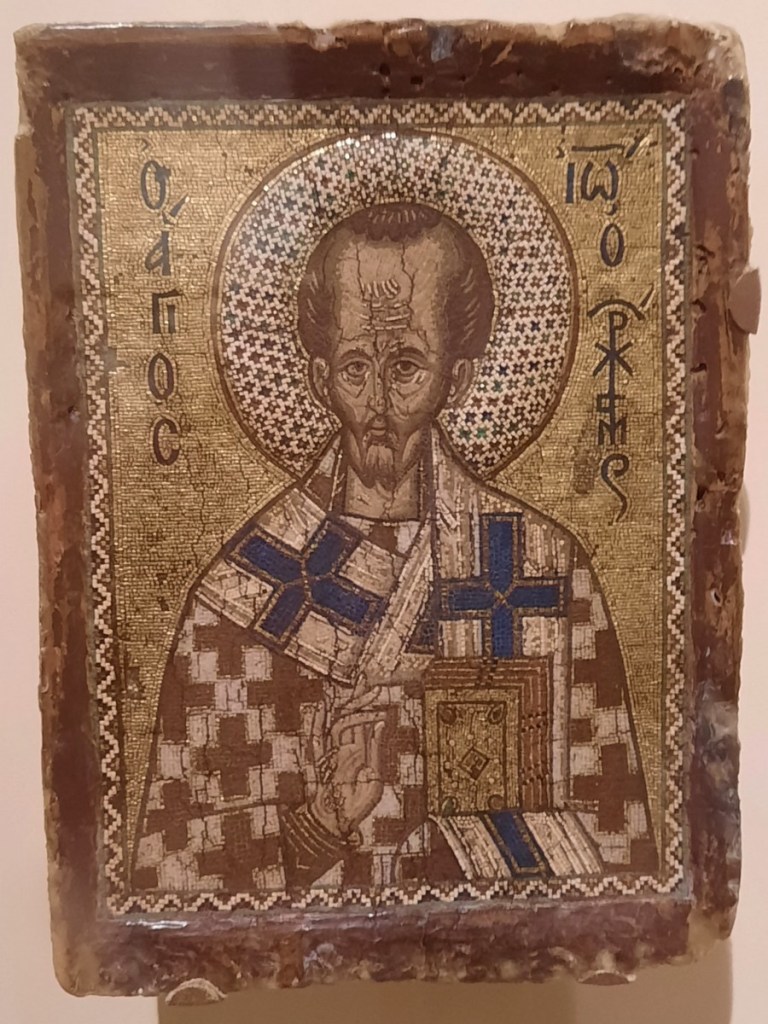
Icon of St. John Chrysostom

I can direct you to the webpage for the History of Dumbarton Oaks, where you can learn that the museum was the result of the collecting efforts of Robert and Mildred Bliss. A fun fact I learned from that webpage is that Robert and Mildred met because their parents married each other; Mildred’s mom married Robert’s dad. Interesting! Robert was a diplomat and it was apparently in Paris that they caught the aforementioned bug of buying up cultural heritage. They wound up specifically interested in Byzantine artifacts and also pre-Columbian artifacts from the Americas. We couldn’t figure out and I haven’t found why they were interested in those two topics in particular.

I know I have already brought it up twice but what I am trying to get to here is that this place gave me an especially weird feeling of like, wow this is a bunch of other people’s stuff just sitting here in Georgetown for some reason. This is an unfair criticism of this museum in particular because I realize this is in many ways just sort of what museums do, a fact which has not stopped me from going, again as discussed, to as many museums as possible. But something about this one just drove that home. Maybe it was because it is so explicitly a museum designed around two people’s particular and unrelated interests. Or maybe it is because of the two sarcophagi they had next to each other, both of which lacked any particular explanation of what happened to the dead dudes previously using them:

Top: “Sarcophagus with Architectural and Apotropaic Imagery,” Bottom: “Seasons Sarcophagus

I hope those dead guys are okay besides, you know, being dead. I know I am being negative about this museum so far but there was a lot to like. I haven’t particularly ever been into the Byzantines at all so I didn’t really know how to process the artifacts they had on display but there was some really cool stuff. The first artifact pictured, the icon, is a mini-mosaic and is maybe the size of a hand, so all those little tiles it is made of are in fact very tiny. Impressive! They have a huge collection of Byzantine seals, which they use to tell the story of the Byzantine empire in a compelling way, showing how the events going on in the Byzantine world are reflected in the seals used to uh seal official communications. I have also been shitting on the Blisses for buying up people’s cultural heritage, but if you go to the linked pages about the different artifacts they have fairly detailed acquisition histories and they bought I think all of this stuff from dealers and the like, so they are not directly responsible for the pilfering. Except of course for the mosaics on the floors they repurposed from millennia-old archaeological sites via digs they sponsored. Anyways!

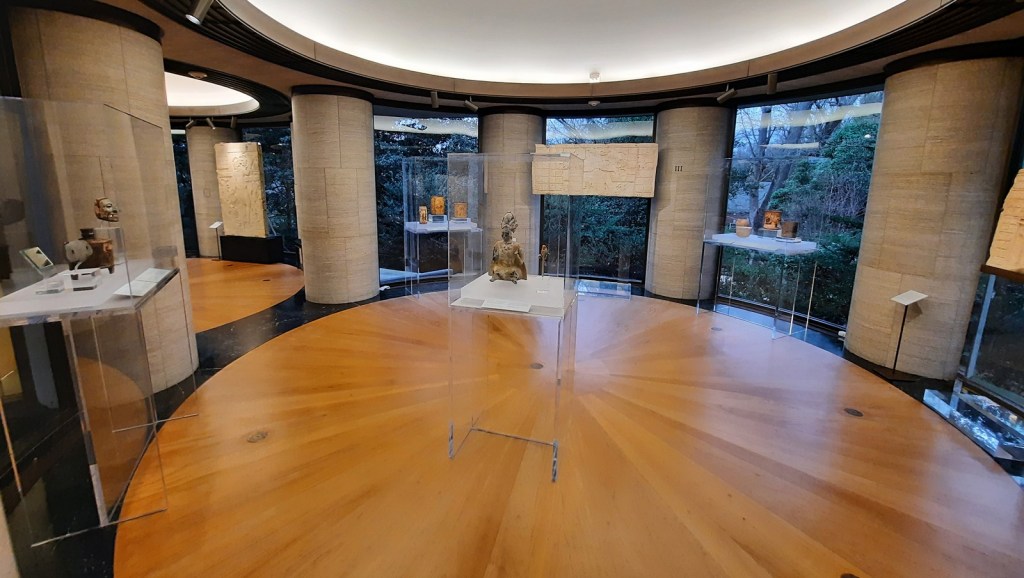
Besides their Byzantine artifacts, they also have a huge collection of pre-Columbian artifacts from the Americas. These are housed in a more modern wing of the complex which is a beautiful architectural complex comprised of circular rooms lined with glass, centered on a fountain and placed within the gorgeous Dumbarton Oaks gardens which we didn’t get to explore on this trip. It’s a peaceful and very different sort of setting and we both liked it a lot. It was against this background that we looked at the artifacts and wondered how they got here.

To make one final complaint, we were left unsatisfied with the way these objects were presented. Part of the reason the Blisses were interested in these objects were because they considered them and wanted others to consider them art pieces, instead of just maybe historical artifacts. I do like appreciating these pieces as art and thinking about the artists and their lives that were so very different from my own, but my super amazing girlfriend and I both wished there was more context or something that we couldn’t put our fingers on to explain these objects. For example, I wanted to know in what context they were found; it would have been edifying to learn if these objects had been found in graves or buried in foundations or just found in the ground somewhere. We appreciated the art of these objects but more explanation of their symbolism or meaning would have been useful too. Of course, considering the provenance of these things maybe they just don’t know.

I don’t have an excellent conclusion here. The Dumbarton Oaks Museum is not particularly large, but it has a very interesting array of artifacts, especially if you are into the Byzantine empire. Since these objects are there, I recommend that you go and look at them and appreciate them for what they are. But it was just that something about the whole museum left me feeling unsatisfied about how these objects got here, or maybe how to appreciate them, or maybe something deeper and more fundamental. But also wow this necklace is an astounding display of craftsmanship:

Gold Skull Necklace

Montpelier

Reading this week:

  • To Lake Tanganyika in a Bath Chair by Annie B. Hore

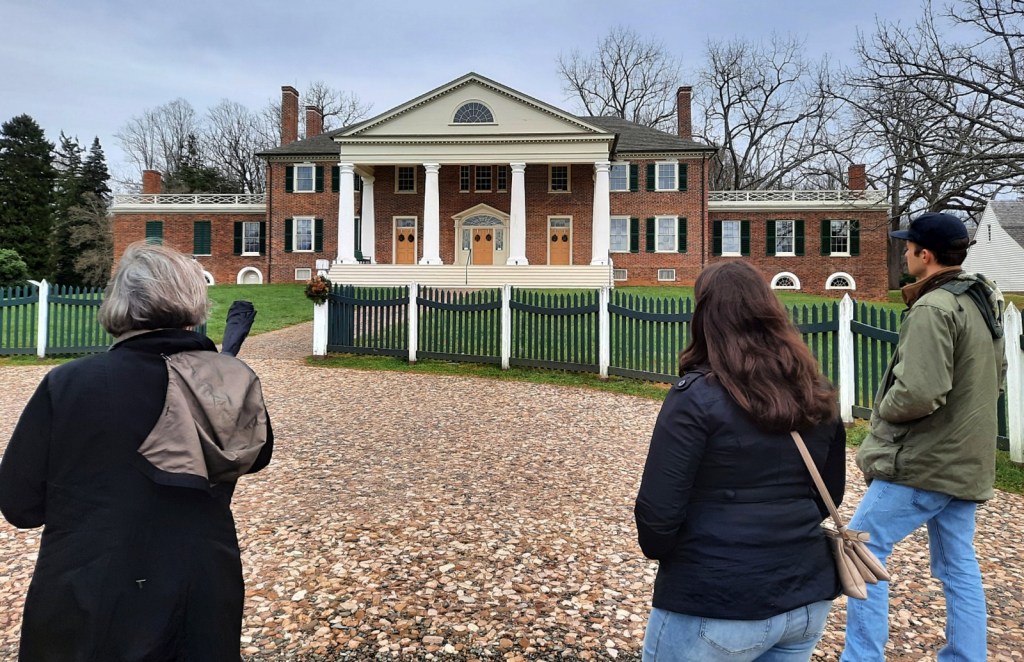
After an extremely good weekend full of poffles and yarn and books and excellent times and of course presidential sites, we rounded out our journey with a trip to James Madison’s Montpelier.

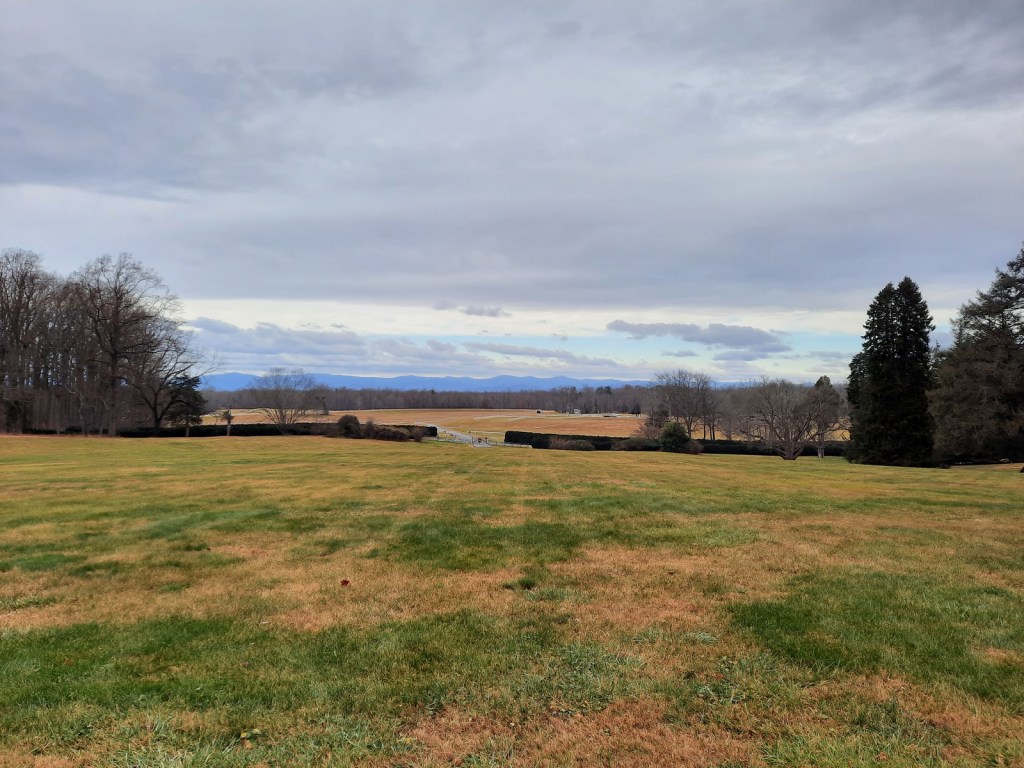
As much of the weekend had been it was cloudy when we arrived and some rain was just thinking of clearing up, but the entrance to Montpelier is meant to impress and does. As you enter the gate you drive through some shallow rolling hills across massive fields of a massive estate. The weather meant it was quiet and we saw deer grazing across the road from a full-sized horse track as we made our way to the visitor’s center. Popping out of the DeLorean in the nearly empty car park, I quipped “busy day” to the only other woman around, who replied with the remarkable comment “you know I only ever met John DeLorean once – and helped his wife over a fence.”

Our guided tour of the house and grounds was once again fantastic. We had one other person join us, and our tour was given by a member of the estate’s board and part of the conservation team, so she was extremely knowledgeable. The estate had been in the hands of several generations of Madisons and she walked us through that history and how it was intertwined with the Virginia tobacco trade, first near the coast and then migrating to the Piedmont. Much like Highland, I think a lot of what was most interesting about Montpelier was the history of the estate itself as an historic site. Again like Highland, it has only been in the past five years or so that they have restored the house to something like Madison would have known and done the archeology to establish the history of all the people who lived there.

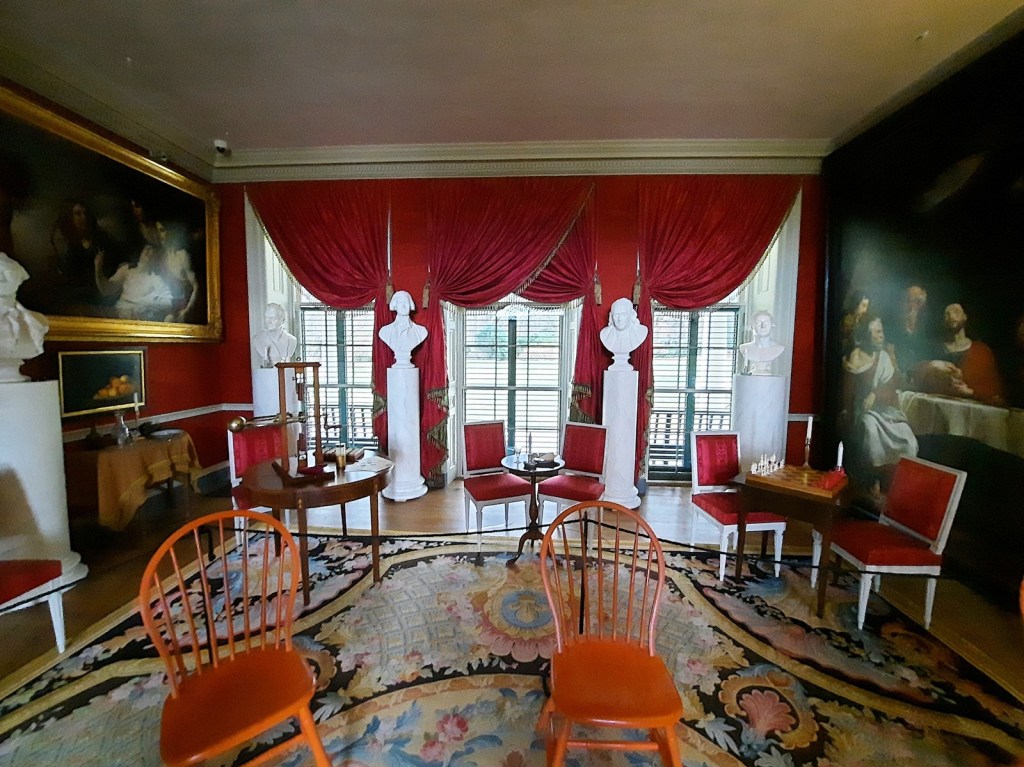
Our guide contrasted that to someplace like Mt. Vernon, which has been a historic site catering to visitors since 1853. Since our tour guide was on the board, we got to learn a lot about how they choose which artifacts to put in the building and where they get them, and a lot of what I was thinking about was the historiography. I extracted myself from that line of thinking for long enough, however, to pause in Madison’s study, the room where he did so much research on the nature of freedom and confederations while overlooking his land worked by people he enslaved.

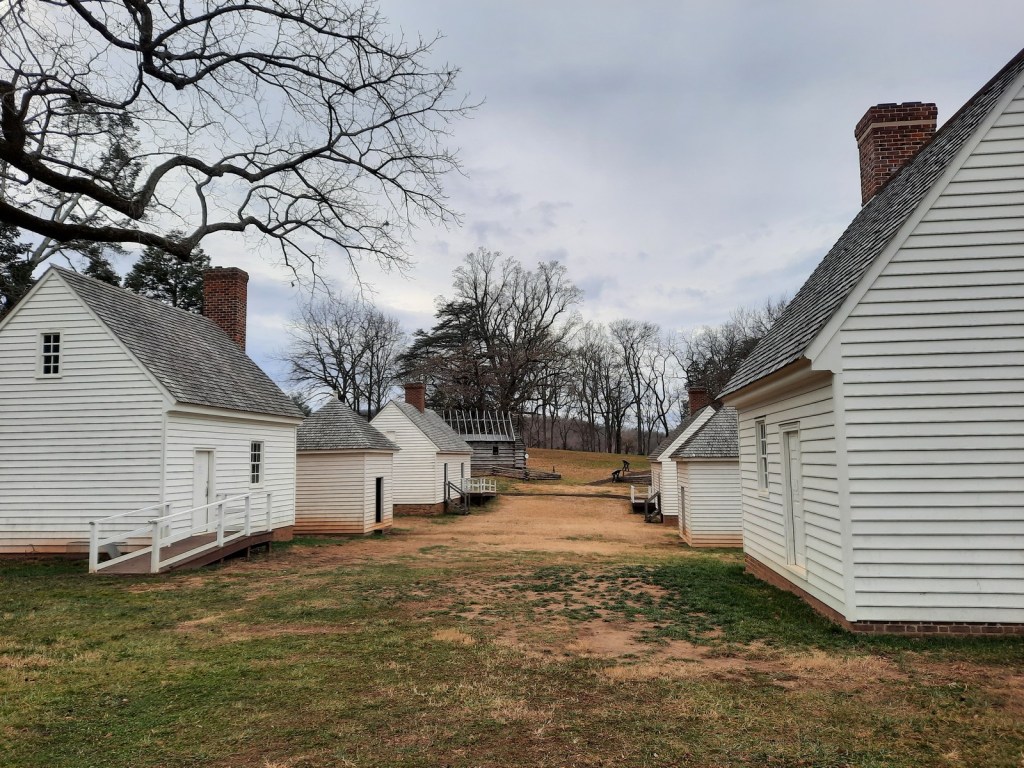
Much like Highland, the story of slavery at Montpelier felt a little tacked on, though with a significantly better budget. They have an award-winning exhibition on slavery at Montpelier, awkwardly tucked into the cellar. The exhibit was brutal and honest and enlightening, but was a thing to do after the tour proper. They have also reconstructed a number of dwellings for enslaved persons and other plantation buildings on the south yard. Here the story of slavery on the plantation continues, and maybe I am an old fogey but I wondered if there was too much attention to the flash instead of substance. But overall it was good and honest.

The most recent owners of the estate were the DuPont family, and a great deal of the modern appearance is due to them. Marion Scott, née DuPont was the last heir to the estate, and loved horses, so the horse track was her doing. She is also responsible for the formal garden on the grounds, which in Madison’s day was a vegetable garden and orchard. The formal garden was nice, but I am much more a sucker for a vegetable garden and orchard. You add a fish pond to the mix and I go absolutely gaga. Much like Highland the estate has extensive, miles-long trails, and apparently a wonderful old-growth forest, but our clothing did not quite match the weather so we didn’t wind up taking advantage of it.

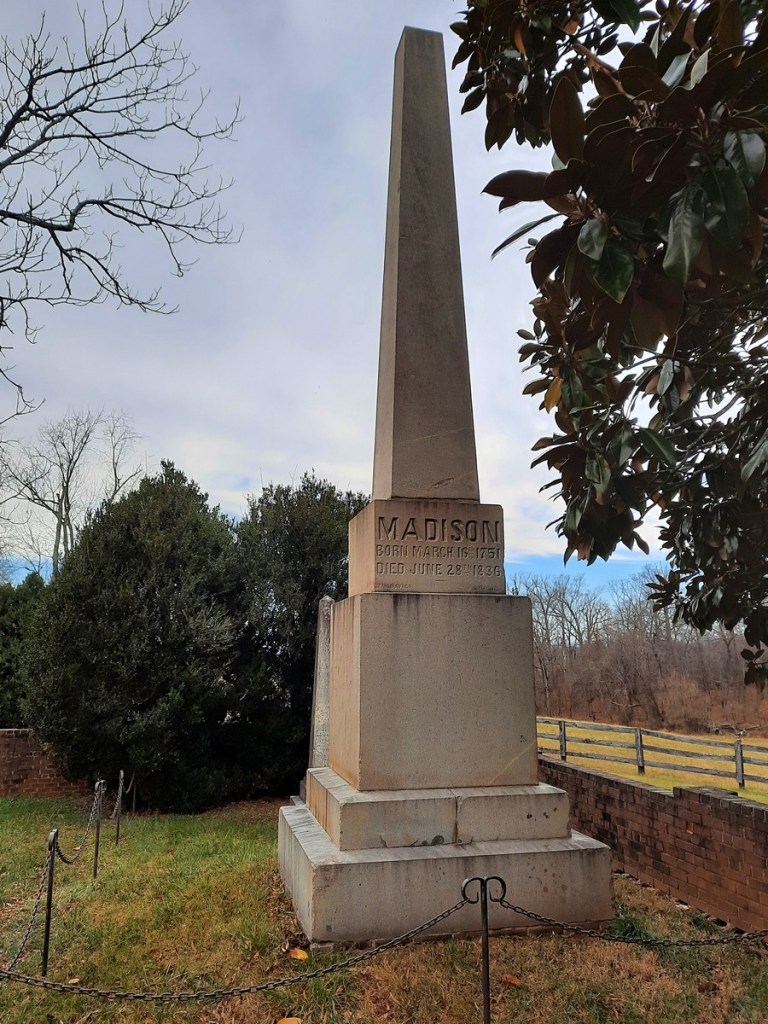
I am sitting here trying to reflect on what I learned about Madison by coming here. I learned a lot about his family history. He was definitely born into privilege and which afforded him the opportunity to go to the University of New Jersey, ie Princeton. Our tour guide compared that, however, to Berkeley in ’69 which is a useful perspective. I still wonder at revolutionaries – many people think they dream big, but how many people dream big enough to start a whole new country? But I think it is easier to dream big when you are already safe and secure. By that measure, a man like Madison, secure for generations nestled in the Virginia foothills and living off the labor of generations enslaved workers, would have been able to dream big indeed.

Second dead president in three days.

Highland

Reading this week:

  • The Green House by Mario Vargas Llosa

Second on our tour of presidential sites in the greater Charlottesville area was Highland, the home of James Monroe!

I arrived at Highland in a terrible mood because the DeLorean betrayed me and wouldn’t start, so we had to take an Uber there. But we had the place almost entirely to ourselves and the staff was all extremely friendly (the kind of friendly you get when you are there to talk to tourists and there are nearly no tourists to talk to) and although it was cloudy it was fairly warm and it is a gorgeous area nestled there in the uh highlands of the Virginia piedmont.

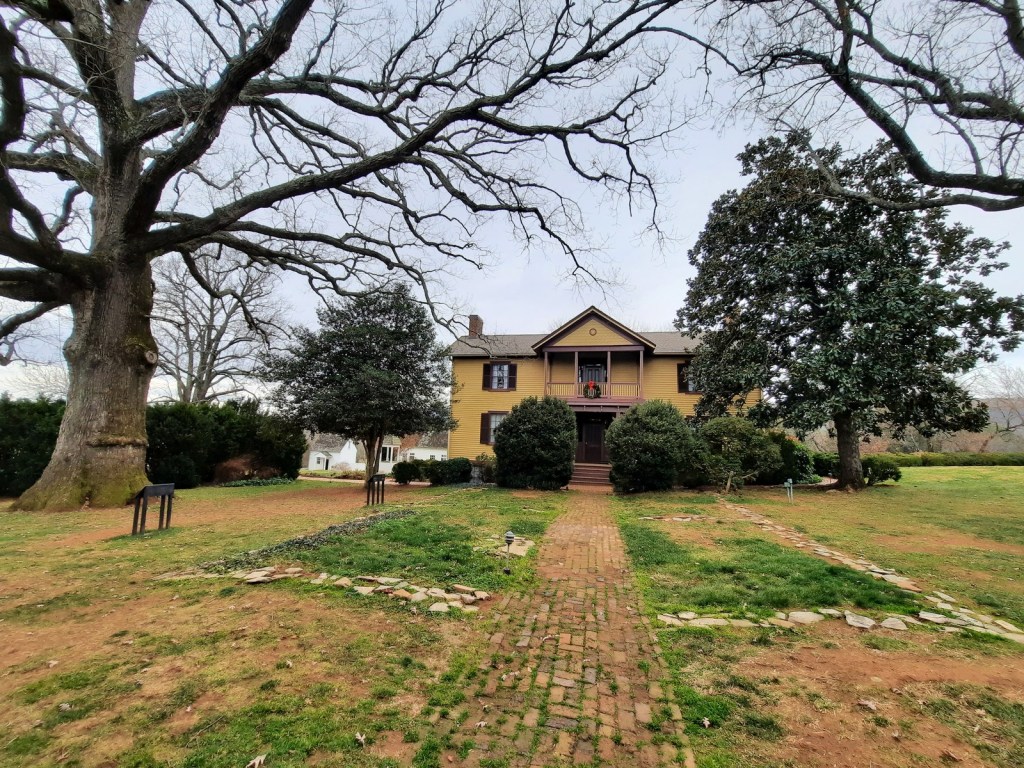
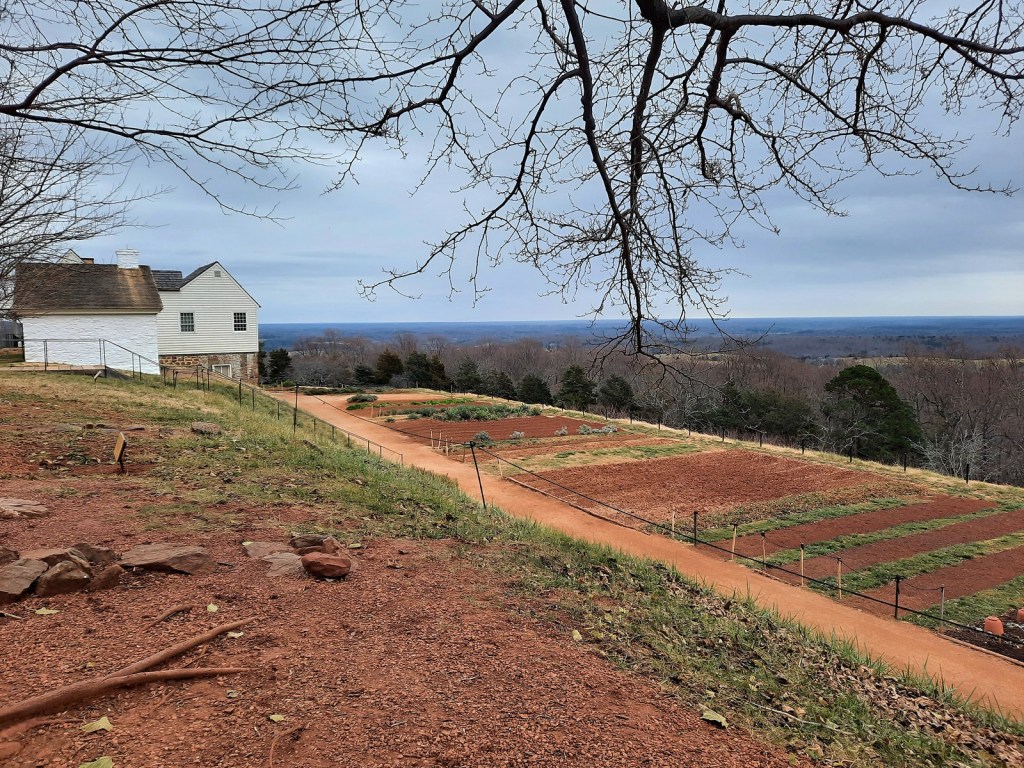
Although we were at Highland for James Monroe there is not really a whole lot of James Monroe there. Our most famous presidential doctrinaire bought the place I think because owning a plantation was the hip thing to do if you are an up and coming 18th century Virginian, and he bought this particular plot because his bff Jefferson was next door. There are three buildings at the site that are contemporary to James Monroe, and that does not include his house. The contemporary buildings are two rooms of a guest house he had built (the backside of the white building in the photo at the top) along with an overseer’s house and a smokehouse which I was disappointed to find had its door closed and locked so I couldn’t see if they had fake hams hanging up.

Once you poke around the grounds you can go into the guest house, which is connected to a larger yellow house and contains (I guess I should say houses) a museum to the plantation and James Monroe. It is quaint and I feel like they must feel like they’re in competition with the James Monroe Museum for James Monroe primacy. Nonetheless I learned a few things, like the fact that Monroe is the dude behind Washington in “Washington Crossing the Delaware.” They focus a lot on his foreign policy work and credentials, which is close to both my heart and my super amazing girlfriend’s, so that was interesting to read about. They have a number of James Monroe artifacts and I am certain that for all James Monroeifiles it is a must-visit.

Probably the most interesting thing about the site was sort of the history of the museum. Apparently for a long time they thought that the yellow house in the photo above was Monroe’s. It was only recently they figured out it wasn’t and that the original house had burned down shortly after Monroe died and his heirs had to sell the place to pay off Monroe’s debts. And then it was only about five years ago that they did some archeology and found the foundations of Monroe’s actual house, which are now outlined in the stones in the above photo. Pretty stunning that they’re still only just figuring out what his house actually looked like.

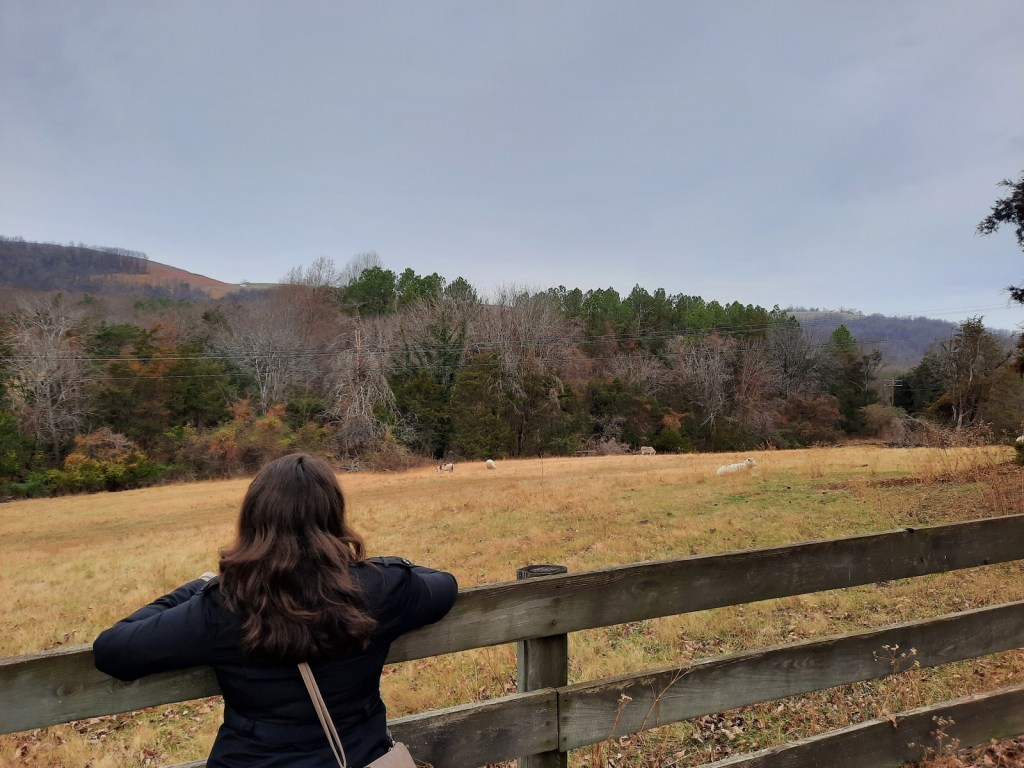
Overall the place had kind of a weird vibe, as in when you go to Washington’s place they’re like “a Great Man lived here” but Monroe’s place feels like the house of someone I could know. That’s not crazy, because most of the buildings on the site were built in the late 1800s, and even in New Haven there were plenty of antebellum buildings in the neighborhood I lived in, and those were occupied by grad students. If Highland has a major advantage over the other two presidential sites we went to, it was probably the sheep, which were very cute.

I praised Monticello for how they addressed slavery, and although Highland didn’t do a bad job it felt a little tacked on. I suspect it is because the place isn’t running on a massive budget and not only lacks the detailed records that Jefferson left behind but even if they had those they probably lack the resources to put up interactive displays or the like. Still, they name names where they can and make sure to not try to excuse or sweep under the rug Monroe’s status as an enslaver.

Overall I think we spent about an hour at Highland. If we had known and prepared better we probably could have taken advantage of the trails on the property, which extend into the woods and I am sure would have been quite beautiful. As it was we spent some time wandering around outside and pondering the balance between expansive foreign policy and being nestled into rolling foothills. Then we called an Uber (talk about labor relationships) and hit up a yarn store.

Monticello

This past weekend, it was my super amazing girlfriend’s birthday, so to celebrate we went down to Charlottesville, VA. It was lovely! We stayed in a quaint little inn and managed to go to if not all then the vast majority of used bookstores and yarn shops in the town and enjoyed every minute of it. But why Charlottesville? I’ll tell you why. My super amazing girlfriend loves presidential sites, and Charlottesville has no shortage of them.

By “no shortage” I specifically mean three. The three presidents are Thomas Jefferson, James Monroe, and James Madison, and the sites are their former homes and plantations of Monticello, Highland, and Montpelier. Over the course of a three-day weekend we went to all three and it was absolutely fantastic. The first one we went to was Monticello on a warm but cloudy December day.

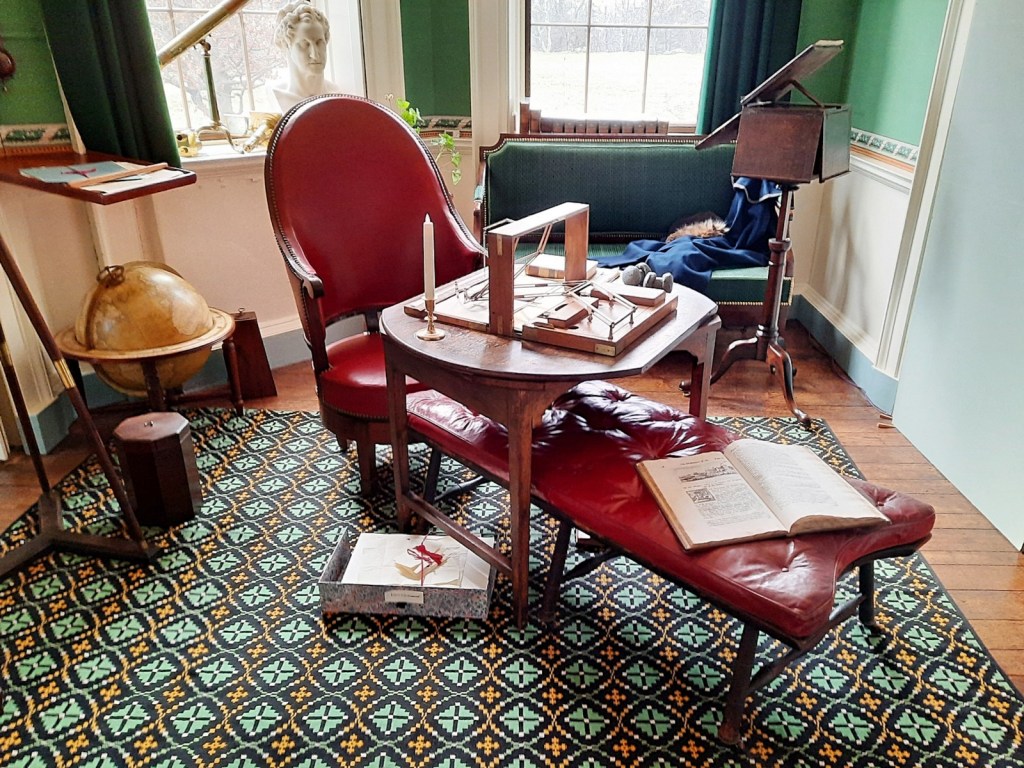
When you arrive at Monticello, you pull up to the Visitor’s Center (a good place for visitors admittedly). Our first destination was the very nice little farm table café they got going on because it was lunch time, but after that I think the general thing to do is probably visit the museum they got there. At Mount Vernon, they like to paint a picture of George Washington as a nerdy farming enthusiast, and in that same way at Monticello they like to portray Thomas Jefferson as a passionate hobbyist architect who maybe also did politics. I gotta say, it is a good thing he was apparently half decent at architecture, though it would probably be funnier if he wasn’t – “this building was designed by Thomas Jefferson. It’s shit, but we gotta keep it because, you know, Jefferson.” So in the museum they have all his European influences as he was designing his house at Monticello and displays of how the dome is constructed and all sorts of drafting tools on display.

This is the house, not the museum, and that’s an automatic letter-copier and not a drafting tool, to be clear.

After poking around the museum we took the bus to the top of the hill for our tour. The tour was really great. Our tour guide was Linda, a short, silver-haired woman wearing a kooky cat pin on a blue pantsuit and round red art deco glasses and who was really passionate about the information she was delivering. It was not busy at Monticello that day (or at any of the sites we would visit) so she had plenty of time to answer all of our questions. I had actually been to Monticello once before a long time ago, and all I really remembered were some nifty gadget doors, Thomas Jefferson’s not-worn-in-yet pair of boots, and his gravestone which didn’t list “president.” All that to say is that I learned a lot!

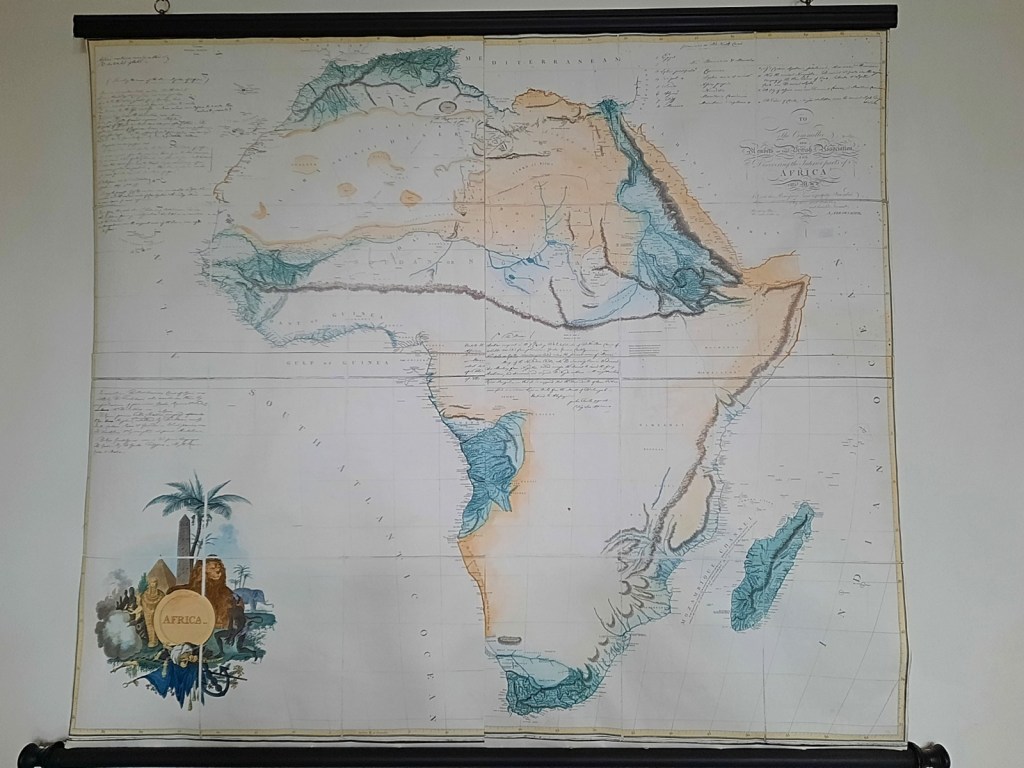
Jefferson’s map of Africa. The reason only Kingdom of Kongo is really filled in is slavery.

Of the three plantations we visited that weekend, Monticello I think did by far the best at telling the story of slavery at the plantation. At Mount Vernon slavery is presented as this sort of unsavory fact of life that an otherwise immaculate George Washington couldn’t help but be involved in. At the other two sites the way they address slavery felt sort of tacked on. But at Monticello slavery is centered in the story as an undeniable and central part of plantation life that was fully intertwined with the story of Thomas Jefferson. They make sure to present the enslaved people’s names and give them credit where it is due, such as in the display three pictures ago listing the people who built Monticello. To be fair to Highland and Montpelier, Monticello has the huge advantage of Thomas Jefferson’s meticulous records and so they know the stories of all these people where in other places it has been lost.

It’s always men that want to build on top of mountains. Monticello has gorgeous views but it wasn’t Jefferson that had to haul everything to the top of a mountain.

And like I said I learned a lot! For example, I learned how interwoven the stories of the Jeffersons and the Hemmings were. I hadn’t learned before that Sally Hemings was the half-sister of Jefferson’s wife, nor had I learned before that Sally had only one African grandparent. After the house tour, we went on the tour about slavery on the plantation, and we learned that Thomas Jefferson “freed” two of his children by Sally Hemmings by just sending them away so they could “pass” for white. One of the most significant facts we learned about Sally Hemings is that she agreed to re-enter slavery after negotiating with Jefferson. He had brought her to France where she was free, because slavery was illegal. She initially refused to return to the United States, and only agreed when Jefferson granted her privileges and pledged to free her children – extraordinary concessions for a 16-year-old girl to extract from one of the more powerful men around.

It wasn’t just Sally Hemings’ story they told. They’ve made sure to try to research every enslaved person’s story the best they could. The things they told were heart-wrenching. I wrote down so I wouldn’t forget how although Joseph Fossett was freed in Jefferson’s will, his wife wasn’t, so that, as Linda told us, he had to watch as his wife was sold away on the auction block placed on the west lawn. I think seared into my brain is Linda’s phrase describing Jefferson’s habit of gifting enslaved persons as part of his daughters’ dowries – “he was very generous with other people’s children.” All this done to people who’s ancestry only differed from Jefferson himself by one Black great-grandparent. The best new perspective I gained I think in my tour of Monticello is from a quote from Andrew Mitchell Davenport, a descendant of Peter Hemings: “Like any fiction worth its weight, race must be read and reread, interpreted, and examined.”

I don’t have a solid transition from that, but neither does America and it probably isn’t something I should transition away from anyways. After you exit the tour you can explore the grounds. They grounds include a fish pond, which of course I was very fond of. They have the usual displays about carriages and the sheer amount of booze that people who are hosting guests every day wind up going through. In the smoke house they had fake hams hanging up, just like the ones at Mount Vernon, so there must be a place out there from which you can buy fake hams to display in your former-presidential-smoke-house. And as you finish with the grounds, you can stroll back down the mountain, on the way passing the grave of the man who caused all this to be built, but thankfully we all know who deserves the credit for building it.

The Chronicle, 1881-1885

This post has been superseded!

I am pleased to announce the second part of what must be honestly the most anticipated project of the century, to wit me transcribing every article in The Chronicle of the London Missionary Society relating to their Central Africa mission. The first part of this project spanned the years 1876 to 1880 (more details on this project overall at that link), and the second part, linked above and embedded below, covers the next five years, 1881-1885.

This batch of transcriptions clocks in at a relatively modest 66,000 words, about 15,000 fewer words than the last time. Opening up the last time I posted a batch of transcriptions I am more than a little surprised that it was only back in April. This feels like a project I have been neglecting for ages, but there ya go, I’m slightly better than I thought. I have become more familiar with The Chronicle during the course of this project and so I am better at extracting the relevant bits. However, the magazine got a new editor in 1885, and so far I can’t really say I like what he’s done with it, but it’s a tad late to complain.

The single biggest revelation I’ve had so far about The Chronicle is that I realized that it is a fundraising document. Up until that revelation I had been thinking of The Chronicle as this handy record created specifically for my benefit. If that were the case, though, it’s honestly a bit of a weird read. They’re Victorians and I am under the impression that this was normal for them, but they go into a lot of gory detail about people’s illnesses. For example they print, at length, the sufferings of Dr. Southon after he is accidentally shot in the arm and slowly dies from infection.

It finally occurred to me that the audience of this magazine are all the churchgoers they are trying to convince to donate to the London Missionary Society. Every year in June the Society publishes their annual report, including a detailed look at their finances. In the transcription I try to translate these into modern-day dollars, and every year the Society needs to fundraise the equivalent of millions of dollars just to try to keep themselves afloat. I realized that the main purpose of The Chronicle was therefore probably to let people know how their donations were being spent, and present an image of a Society doing the best missionary work out of many competing missionary societies while letting people know that they still desperately needed more funds. Someday, when I sit down and actually analyze all that I’ve typed, I will have to keep that in mind.

When we left the missionaries in 1880, they had set up several missionary stations between Zanzibar and Ujiji and were starting to make forays towards the south of Lake Tanganyika. My interest in the London Missionary Society started because I was interested in the first steamship on Lake Tanganyika, the SS Good News. I’m going to grant myself an historic parallel by mentioning that what was the final spur to get LMS setting out into the region was a desire to put a steamship on the lake. So while the SS Good News is a throughline through the entire first decade of the Central Africa Mission, it is during 1881-1885, and really towards the latter part of that timeframe in which the story of the Good News really gets going; it is in August of 1885 that The Chronicle reports the ship was launched (though it still had a lot of fitting out to do).

This is not the Good News, but there are better versions of the same engraving they published in The Chronicle elsewhere on this blog.

Despite the mission’s nautical success, however, it is really not in a good place by the end of 1885. Central Africa was deadly for missionaries. In a lengthy November 1885 article, it’s noted that “since the commencement of the Mission in 1876, twenty-three persons have gone out to take part in the work, and of these no fewer than ten have been removed by death, and nine have retired from the service.” Although many of the nine that retired from the service but didn’t die did so out of general poor health, it is also in this same article that The Chronicle details a new development among the missionaries – people quitting out of fear. The Chronicle published excerpts of letters from recently deployed missionaries saying that they were headed home, not necessarily because they were sick, but because they finally noticed how many people were dying and wanted out before they too were struck down. With those two missionaries heading home, at the end of 1885:

The entire Mission staff is thus reduced to four. The Rev. T.F. Shaw is laboring alone at Urambo, and is the only missionary specially set apart for the work of preaching and teaching. The rest – Captain Hore, Mr. A.J. Swann, and Mr. A. Brooks – went out as laymen, the two former in charge of the boats on Lake Tanganyika, and Mr. Brooks as an artisan missionary.

My final note on this batch of transcriptions is that until this point, I had considered the colonization of this area as somewhere between an unfortunate side effect and an unrelated but parallel enterprise to the evangelization by the missionaries. But now a letter from Captain Hore states plainly that he envisioned European colonization as part and parcel of the enterprise all along: “As to the future of the Mission… if we look further off it is nothing but a tide of Europeans crowding into the continent from all sides, and plenty of the ‘fit’ surviving and evangelizing, colonizing, or amassing wealth, according to their several missions.” I think the missionaries deserve credit for their part in combatting the slave trade in the region, the dire effects of which are also detailed by Captain Hore in this era of The Chronicle. But we have to keep in mind that you don’t have to be intending bad outcomes for bad outcomes to happen, and when we consider the impact these missionaries had we must carefully weigh the bad outcomes along with the good.

If there are any researchers out there using this work, please let me know. I would be delighted to chat more about the history of this region and see what you’re digging up. I don’t know if anyone is using my last batch of transcriptions, but I think I have been cited in at least one college paper from the University of Zambia on World War I, at least. I would like to figure out something productive to do with all this research, but I know my biggest hurdle will be figuring out a way to center African voices into these African stories, and I am conscious I might not be the guy to do that. But between here and that, we have a few more decades to transcribe.

Library of Congress

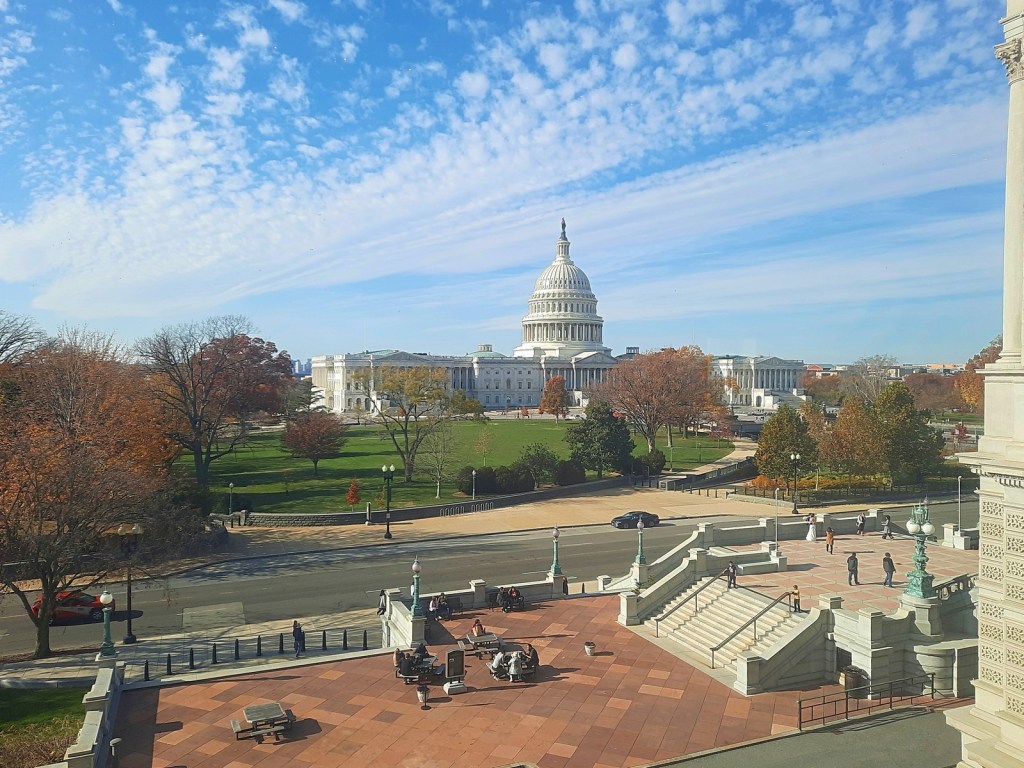
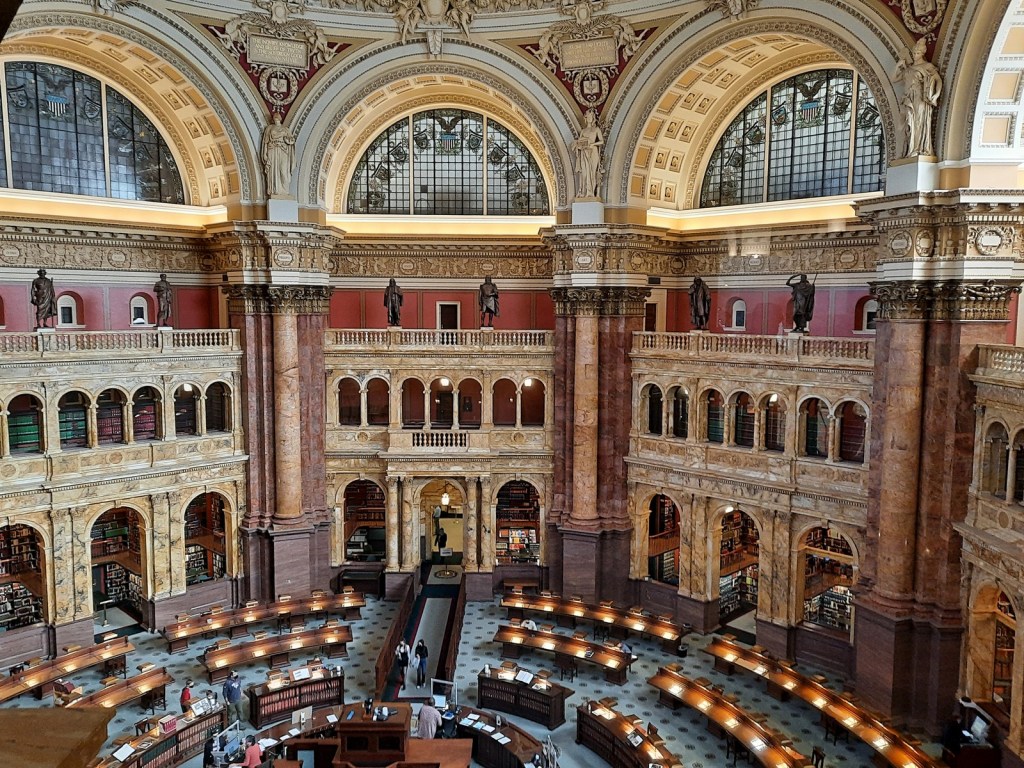
This is a picture of Congress, from the library.

As loyal readers are aware I went to Yale for my graduate degree. That was fun! There were many advantages of going to Yale, but one of them, I am willing to say, was access to the Yale Library. The Yale Library has a very large collection. 15 million items it turns out. With so many items, they have an array of pleasingly obscure items, including at least one book on the lake steamers of the African Great Lakes, which, again, loyal readers are aware is a particular interest of mine. Frankly you never know what you have until it’s gone, and although the Alexandria Library is very nice, I do not think they have 15 million different items, and I can confirm that they have exactly zero books on the lake steamers of the African Great Lakes.

I know I am banging on about the lake steamers here, but I have recently restarted my effort at retyping the Chronicle of the London Missionary Society. I started to feel bad about having stopped pursuing that because I have been reading more books on southern Africa. But since I am reading about Tanganyika, etc, that has me thinking about lake steamers and the like, so that has me remembering there were several books that I wanted to look at while I was in Zambia which I couldn’t because like, I was in Zambia and very far from a library with a collection of any particular note (though Mbala did, in fact, have a library) (I am now realizing that I don’t think I ever wrote about the Tanganyika Victoria Memorial Institute!). Of the two books apparently in the whole world that discuss African Great Lakes steamers, the Yale Library, for all its vast collection, only has one of them (and as of yet will still mail it to me here in Virginia), but for the other I was lost and distraught. Lost and distraught, that is, until the internet reminded me that the Library of Congress has one and I live near the Library of Congress!

The Library of Congress, according to the pamphlet they hand out, has more than 167 million items, which is a lot more than the Alexandria Library and also more than Yale! So I wanted to go and read the book at the Library of Congress. Due to a misunderstanding of the website, I thought that you currently couldn’t do any reading at the Library of Congress, but I wanted to go anyways. My super amazing girlfriend (pictured above) had already been and would be my tour guide. So last Saturday we got on the metro and went to the famously large library.

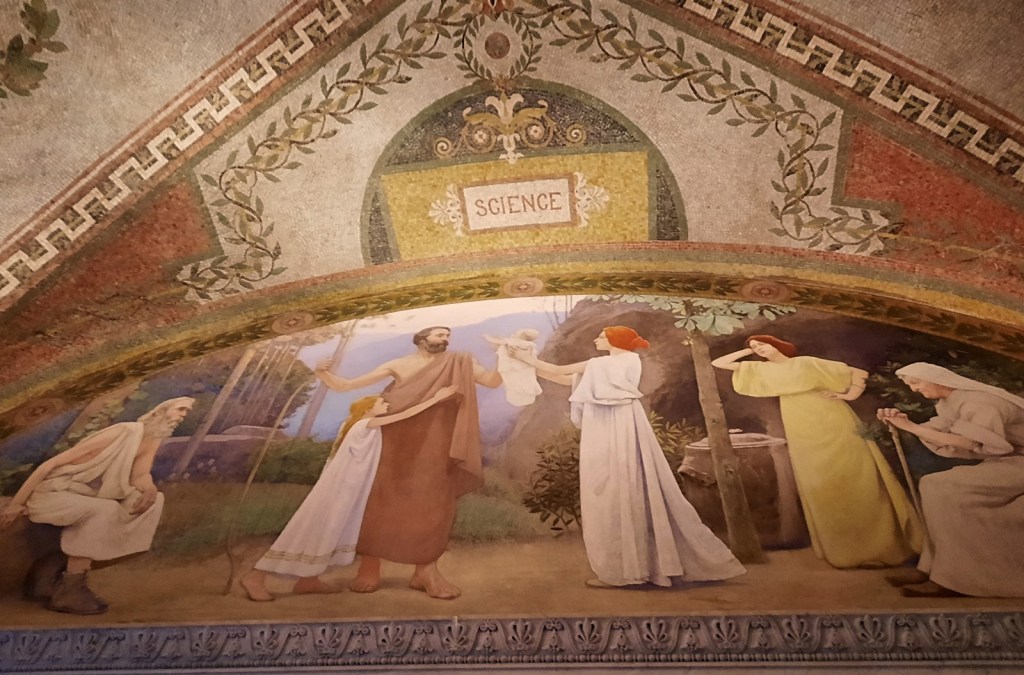
It is very nice! I didn’t realize what it would be like. First and foremost, the Library of Congress is a place dedicated to excellent ceilings. I won’t subject you to them all, but I do like the below one with “SCIENCE” displayed in tile. I do like both mosaics and SCIENCE. Plus there is like a weird baby involved in the image and I don’t know what that is about, but presumably it is about SCIENCE. I suppose I should specify here that I am talking about the Thomas Jefferson building because the library has a number of other buildings, too.

When we went, the library had two major displays set up. In one wing, they had a whole display on early interactions with the Americas. This was based on the collection of some dude (it was quite the collection, dude) and had an impressive array of artifacts. I really was not expecting to see Mayan pottery when I walked into the museum that day. One of the most impressive items was the earliest map to denote the Americas as America. I took a picture that was just whatever, but you can find it here. The bit I looked at the most was Southern Africa which was cool and impressive and stuff.

I also really enjoyed seeing the Taino ceremonial wooden stool. That object is just so ephemeral and rare and also looks like a turtle, which is cool. Of course on a serious note it reminds us about the important and advanced cultures that existed in these places before Columbus came over and wiped them out.

On the other side of the library they had on display Thomas Jefferson’s personal library. He had sold it to Congress when their first library burned down, which was potentially a bad move for book longevity because it wouldn’t be the last time the Library of Congress burned down. Fortunately not all his books burned, and so they had a number of the originals. They also had identical copies of some of the books, more modern reprintings of some of his books, and then also some boxes to fill out the ones they couldn’t get. They had the whole thing in a spiral, and this was the first time I have been out and about with my super amazing girlfriend and said something like “we could do the living room like this” and she agreed. So I am looking forward to turning our living room into a spiral, it’s gonna be great.

The final thing to see was the Main Reading Room. Seeing people reading in the Main Reading Room is what eventually led me to discover that you could read in the Main Reading Room on Saturdays, and I hope that is something I can take advantage of soon, because like I said I want to read that book on steamships. Maybe I will read other books there too someday, who knows. A lot of people apparently do genealogy research there. Me though? I just want to look at boats.

Think of all the boat knowledge hidden away here!

Washington Monument

Reading this week:

  • Finding the Mother Tree by Suzanne Simard

Like I mentioned last week, my super amazing girlfriend’s absolute best friend in the whole wide world was visiting last week, so we were out on the town looking at stuff. One of those stuffs was the Washington Monument!

Now, you see, I grew up over near Annapolis, so I had been to DC plenty of times back in the heady days of my youth. I would see commercials on like, Nickelodeon for contests where you could win a trip to DC and I thought that was a bit of a lame prize because we would go there for field trips, you know? (Despite the regularity, sometimes it didn’t go well; I remember one time we got to the Natural History Museum at 0830 only for the teacher to discover only at that moment the Smithsonian Museums don’t open until 10) However, despite the regularity of my visits to DC, one thing I had never done (among many things, actually) was go up to the top of the Washington Monument.

This is not for lack of trying! It’s just mostly due to lack of trying. Back in the ole’ days, you had to line up for tickets. They were first come first serve, which meant you had to be one of the first however many people in the line, which meant you had to get there early. I did try to do this once. It took forever for me to find parking that day, but I got in line, and the line started moving, and when I was finally three people away from the window they had run out of tickets. This was very sad for me, clearly. But mostly I had just never tried.

But since my super amazing girlfriend’s best friend was in town, they did try, and lo and behold, they got four tickets! Super neat! We showed up at our appointed time, went through security, quickly admired a statue of George Washington, got in the elevator, and head to the top!

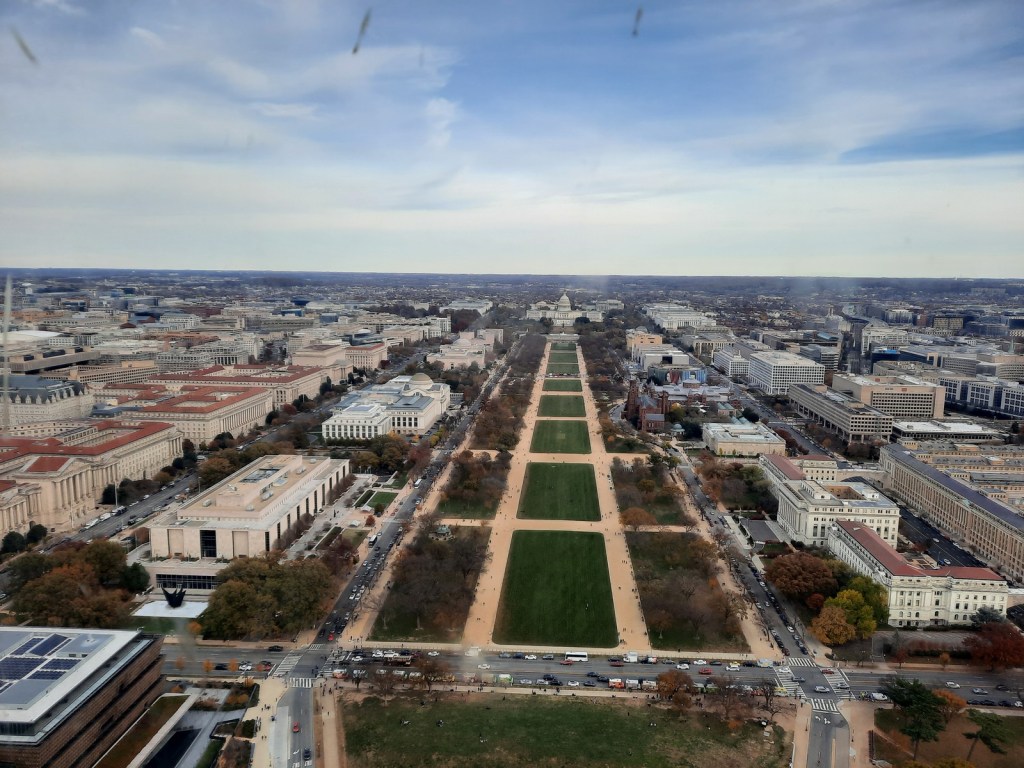
The first and stupidest thing I learned is that the windows look at lot bigger up close than they do from the bottom. I thought they were very tiny. They are small, but not tiny. See? Stupid. There are actually two floors at the top, the 500′ level and the 490′ level. The 500′ level has the windows and you can look out and admire the city. I put those pictures at the bottom. It is a pretty excellent way to see DC all at once (well in four chunks, one for each direction) and you can spend as much time up there as you want. I was like “I can spot my workplace from here!” and “I can spot my house from here!” and “wow the White House has more trees on its grounds than I thought!” You know, deep things like that. It was pretty neat.

After you are done with the 500′ foot level, you descend some stairs to the 490′ level and there is a very tiny museum thingy. There’s not a whole lot there, but the single most interesting thing for me was the above model, which shows how the monument’s very top is constructed. I hadn’t ever thought about it, but the monument is entirely stone (they claim to be the tallest freestanding stone structure in the world, which is neat!) and I was impressed how they did the masonry to put the top together, as demonstrated in the model above. It is also from the 490′ level that you catch the elevator down. Taking the stairs was not an option, though in the elevator on both the way up and down they have a presentation, and on the way down they pause twice to let you look at some of the carved stones on the inside. So that was cool! Having taken the elevator down, we were discharged (you have to go elsewhere for the gift shop), having gained a whole new perspective on this city I’ve been visiting for my whole life.

The mall, Smithsonian Museums, Capitol, etc.
My house is off to the left, beyond Reagan Airport. The tidal basin looked nice!
I discovered my phone could do wide-angle shots, so that’s neat. Look at all the trees by the White House! The State Department is off to the left. The bit with the trees in the background on the right and center is Maryland!