My One Decent Sea Story Pt VII

The most harrowing part of the night is when we spotted a merchant ship. I said earlier but you don’t exactly get many contacts out there in the middle of the Philippine Sea, and I had been hoping to go the night without one (it must have been just before midnight when I took the watch) but here one was coming along. My big worry is that we couldn’t maneuver out of the way of anyone since we didn’t have propulsion. It doesn’t feel great to be a sitting duck nuclear powered warship without propulsion and it feels worse to announce it to the world, but I had the off-going lookout try to rustle up the “not under command” lights which were supposedly hidden in the fan room somewhere. I’m not sure a nuclear-powered submarine has ever displayed those lights and unfortunately I didn’t get to be the first because we never found them. Anyways it was all moot in the end because although the merchant ship was coming from such an angle that we would have been the give-way vessel had giving way been necessary, he never got within 10 miles of us so none of it mattered in the end.

That left me with the second-most-harrowing part of the night, which was that I started to get a little chilly. It might have been the Philippine Sea near the equator, but I was used to warm temperatures and it was the middle of the night and there was a bit of a breeze and there I was in just my coveralls so I started to get just a wee bit cold. I thought fondly of my sweater that was hanging up in my stateroom (on good days, you know when you have a nuclear reactor that operates, the AC is on full blast and the control room gets a little chilly and you can just chill in your fetching little sweater as you command a warship around). I also thought about all my poor crewmates boiling in a very hot submarine with sweat literally dripping down the walls, and more importantly what their reaction would be if I complained about being a little chilly, and so therefore decided that discretion was the better part of valor and opted not to ask a messenger to run me up a sweater.

Meanwhile all those nerds back in the engineroom were trying to fix whatever was wrong so we could start up again. I stayed out of it. I did have to call back at one point to ask nicely if we could turn on the air compressor and the Engineering Officer of the Watch was kind enough to give us the power to do so, but I tried to avoid bothering them and also tried to avoid learning anything at all about what was going on. I was pretty successful. Eventually my relief came up and my watch ended. My relief was standing his first surfaced Officer of the Deck watch and was excited about getting such an easy one after hearing all about my honestly very relaxing seven hours or so. The sun was coming up and he was looking forward to a glorious morning of getting a tan. It was not to be. They had fixed the reactor and it was now time for the emergency reactor startup. That, I understand, went pretty flawlessly, thanks to the Engineering Officer of the Watch who was probably a bit intense for his own good but just intense enough for the good of our continued propulsion. Our poor Officer of the Deck had to suddenly figure out what was going on, ask for various permissions, and, you know, drive a submarine around. Poor guy.

Meanwhile I had a lovely breakfast of whatever the cooks could scrounge up and then hung out until it was time to do some rigging for dive so we could get back underwater once the reactor was going. Those duties eventually complete, I went to bed. The weirdest part about this whole adventure is that when I woke up for my next watch it was honestly like the whole thing had never happened. Everything was back to normal, the walls were no longer sweating, and I took over a watch as Contact Manager in my cozy little sweater with the soft sounds of passive sonar coming in over the speakers. The emergency reactor shutdown and startup and panic and diesel generator not starting and then it did start and high pressure blows and all that jazz was like a weird dream. Except someone had to write an incident report. Not me. I stayed out of it. Nuclear power kids: fantastic, the best, but much more enjoyable when left to other people.

The end!

My One Decent Sea Story Pt VI

As another side note, a buddy of mine one time met someone who worked in Hollywood or something. This person told my friend that he knew some guys and maybe if he worked something up he could pitch a submarine TV show to some people. The greatest submarine TV show is of course Last Resort, but it was fun to imagine alternatives. My buddy turned to me to help out with ideas, and the two I remember were doing an episode a la Waiting… where a new Ensign shows up and can’t get a word in edgewise all day as he is shuffled around from misadventure to misadventure, and my other idea was basically my experience here where a dude wanders around oblivious to the obvious crisis going on around him because he just woke up and had expected drills anyways. Of course this TV show never got pitched let alone made, but knowing someone who knows someone and saying that maybe something could get pitched seemed like a very Hollywood experience if not the quintessential Hollywood experience and I was happy to be a part of it.

On watch the first brilliant idea I had was that we should shut down some sonar arrays. They take up power and we were at periscope depth so they weren’t really all that necessary. So I wandered into the sonar shack with the intention of telling them to shut some stuff down, but when I opened the door I was immediately greeted by our senior sonar tech in his underwear who announced to me all wild-eyed that they had already shut everything down and they were only on the hull array. Later I thought to myself that he should have asked me first before he did that but in the moment I just said good and backed away slowly, and then quickly.

Our senior sonar tech was in his underwear because as I alluded to for our poor Gulf of Aden friends as soon as you shut down the reactor it gets hot. You can only run the air conditioning when you have the reactor because the load is too big for the diesel. And out there near the equator the water temperature is in the 80s, and as the submarine is, you know, immersed in water the coolest it can ever get is in the 80s. Then you add into the mix every source of heat on the submarine, such as any cooking that happens, all the waste heat from the computers, all the body heat from over 100 people, and oh yeah all the latent heat in the steam plant and the decay heat from a whole nuclear reactor and it gets so very very hot on the submarine. Sweat dripping down the walls hot. Our captain pretty quickly said people could go to half-mast on their coveralls, and I was unfortunate enough to get to witness the good (he was not very good) captain set the example by peering through the periscope in his white boxers and white undershirt, positively glowing in the dim red lights of our overheated control room.

My prescient prediction during the pre-watch brief that we might surface, or might not, came true very quickly when the captain burst in to tell the OOD to do a 10-second high-pressure blow. We did that and we were surfaced. Usually surfacing is a bit slower than that, but without the reactor you couldn’t do it the slow way and since we were going to be in this for a bit it was better to be bobbing on the surface instead of maintaining periscope depth. Surfacing through presented some troubles, namely that we had to send someone up to the bridge to man it up there and also have two people on the periscopes and there were barely enough warm bodies to go around. I was on periscope while the bridge got manned by the off-going OOD. Luckily my OOD had gotten the diesel started and came back to man the periscope with me. Once the bridge got manned we had to decide who was going to go up and relieve him since he was off-going. I gave my OOD (well he was supposed to be OOD but due to this whole thing he wasn’t OOD) the option of going up, but he said he would rather stay in control, so up I went to man surface OOD. And man lemme tell ya it was nice. As I was heading up there my poor helm made a point to note that he couldn’t maintain a course within 40 degrees of anything. Since we were in an emergency we were on the emergency propulsion motor which on a good day gives you like three knots but since it wasn’t a good day it wasn’t giving us anything at all really so without propulsion we couldn’t maintain course. That was fine, really, we had no place to be. So there I was on watch with nothing to do since we had nowhere to go and everyone was really busy trying to get the neutrons back in the reactor or whatever. The biggest decision I had to make is that my Chief of the Watch called up and asked if there was any way we could run the high pressure air compressor since we had used up all our air on the surfacing procedure, and so I called back to the Engineering Officer of the Watch, who was pretty busy, and asked nice, and he said we could, so there you go (he had to balance loads on the diesel).

To be continued…

My One Decent Sea Story Pt V

The point I was trying to make with that anecdote is that after discovering that I was just as competent as anybody else trying to run the reactor and “just as competent” meant that everyone was pretty much faking it, the wool was pulled off my eyes and I realized a large chunk of what we did was just dumb. One time I was in the midst of a reactor repair and it would take a lot of context to explain fully but a guy hit the wrong menu item on a laptop and I think re-downloaded some data instead of saving it, or something. This affected nothing and the obvious solution was just to hit like “save” again but we couldn’t do it because it wasn’t in the procedure and so I had to sit there and stare at this dude, and we had both been on watch for like 14 hours at this point, and were very sleep deprived, while the other nuclear people went off and had a very serious discussion over whether we could hit “save” on this stupid little laptop because that was the obvious answer but it wasn’t written in the procedure so we weren’t sure if we would be smited by the nuclear gods if we did this, and look it was all really really stupid and in nuclear power you had to pretend like it wasn’t and I was fed up with it all. I requested to be de-nuked actually. I have a whole other set of stories about how nuclear qualification testing worked, but honestly I’m not going to get into that. If you haven’t caught on the whole schtick of these current set of blog posts is to tell the most meandering sea story possible so I can catch up on over a month’s worth of posts, but going into nuclear qualification testing is a bit too much. I gotta save something for later.

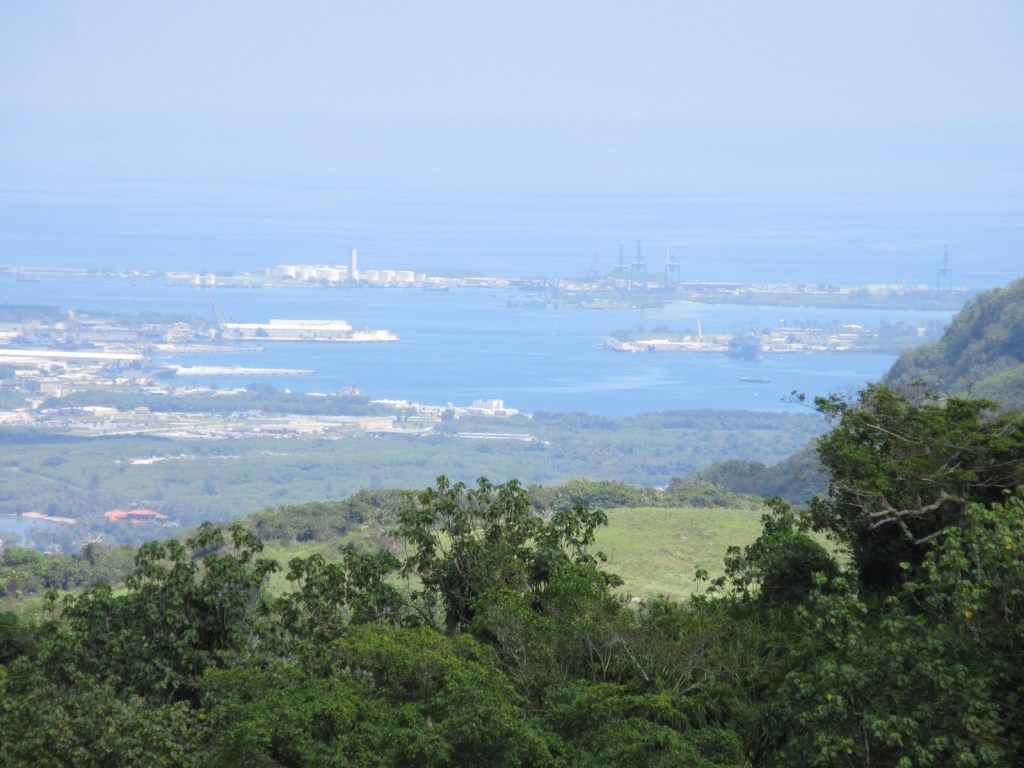
So anyway. Finally. My one decent sea story. Look, it’s going to start off nuke-y which I’ve said is bad but bear with me for a bit. We did an emergency reactor shutdown at sea and I’m not entirely sure why. My impression was that we didn’t really need to but it was the current hip thing to do in the submarine force so we did it. What started this whole thing off was an intentional shutdown. Sort of. A scram drill. A scram drill wasn’t that big of a deal, or at least it isn’t supposed to be. A down-and-up, they’re called. In a simple scram drill you throw the scram switch, half the rods go down, and this shuts down the reactor though the reactor barely notices. I knew they were going to do a down-and-up drill on the watch before my watch, so when I woke up there were 1MCs (ship-wide announcements) about a scram but despite the fact you are supposed to listen to 1MCs I just entirely ignored them. I just went about my wake-up routine, such as going to the bathroom and taking a shower. I was only supposed to stand contact manager that watch, which is a really easy job out there in the middle of the Philippine Sea where you will get like one contact a watch, maybe, and it will be a distant merchant ship, and so all you do is just stand there, so there wasn’t a need for a robust pre-watch tour. So there I was in a little la-la land of my own making when I finally wandered up to the bridge and realized everything was on fire. Luckily, only metaphorically. Our down-and-up drill had just turned into “down” because when they inserted the scram something or other went wrong. I’m not sure what, as I’ve reiterated, but it meant we had to do an emergency reactor shutdown. Look, I know what you’re saying, we had a scram in so the reactor was already shut down, this is true, but we shut it down more. There are procedures and stuff. Maybe some valves? I dunno, it’s been a while. What was going on with the reactor was only relevant to me because the submarine was at periscope depth and people were panicking. If the reactor is going to be shut down for a while you have to start up the diesel so you can continue to run important stuff like reactor coolant pumps with keep the reactor cool, and ventilation fans and ballast pumps which keep us from dying. And just about the time I wandered up to the bridge they were trying to start the diesel and it wasn’t starting. Uh oh! The guy who was supposed to stand OOD was the guy who was in charge of the diesel, so he had to run off to try to fix that so we didn’t die or whatever. That left me the person in charge, and I had barely thought I would need to stay conscious this watch. I tried to evaluate what was going on, watch-wise, which was mostly AHHH EVERYTHING IS BAD AHHH, and then I went down for the pre-watch brief. We normally did the pre-watch brief in the wardroom, but that was full of people trying to figure out how to reverse course on the whole AHHH EVERYTHING IS BAD AHHH thing, and plus half the watchsection, including the OOD, was off trying to fix the problem, so that left me and a small gaggle of the leftover watchstanders in athwartships, the most out-of-the-way place we could muster, with me trying to lead a pre-watch brief. Just to finish painting the picture in my memory it must have been night or something and so all the lights were red and various slightly panicked 1MCs were being announced so it was confusion. And the pre-watch brief consisted I think pretty much literally of me saying: “Well, uh, we are at periscope depth and the reactor is shut down. We might surface, or we might not, who knows, so, um, be prepared for that. Any questions?” There were no questions. We gobbled down some I think olives and pudding (i.e. things out of cans because there was no power to cook with) and head up to watch.

To be continued…

My One Decent Sea Story Pt IV

A normal reactor startup is very boring. All that really actually happens is you pull the control rods out, but since it is the nuclear navy doing that rather boring thing comes with a whole bunch of paperwork and oversight and a big brief and not being allowed off the ship the night before lest you show up to work drunk or hungover, which is probably a fine state to operate a nuclear reactor in but is officially discouraged by the powers that be. So an emergency reactor startup, to a nuke, sounds like a lot of fun. It isn’t too much fun, but something that is a little fun in the nuclear world is about as good as you are going to get so people hanker for it. When nukes talk about emergency reactor startups they are usually described as like, doing a reactor startup without any of the safety stuff, but that is not really true. If the lay man were to watch one they would be bored out of their minds, but theoretically it happens a bit faster than a normal startup because you move some mostly paperwork portions to after the startup instead of during, and like, I don’t think you have quite as many independent checks of some switches or something, but overall what I am trying to say here is that despite it being a very safe and controlled procedure every nuke ever wants to do an emergency reactor startup because it sounds fun and cool and when this submarine got to do one, despite the fact they all spent three days on the edge of heat exhaustion right in the middle of waters surrounded by people who don’t necessarily like us all that much, we were all very jealous.

And then do you know what happened?! Another one of the submarines stationed in Guam did an emergency reactor startup! I don’t recall at all why they felt they had to do an emergency reactor shutdown at sea, but they got to do a startup and we were so very very jealous. I mean it is one thing when some submarine you don’t really know gets to do an emergency reactor startup, but it is a totally different thing when like people you know get to do one! No fair! No fair at all! But our time would come. I make the point that we were jealous because from my understanding there was no real reason we needed to do an emergency reactor shutdown, but it had become the hip cool thing to do so when we had even a modicum of an excuse we went for it. Though I’m not entirely sure what had happened. By this point in my time on the submarine I was thoroughly disgusted with nuclear power. After I got out of the Navy I was trying to get my Mate’s license, and this involved taking classes with a bunch of ex-Navy types. They would ask me why I got out of the Navy, and I would just reply that “nukes are a bunch of anal-retentive assholes,” and all these ex-Navy guys would just nod in agreement and there would be no further questions. So that was part of it. The other part was just like, look, being “Engineer Qualified” is a big thing in the Nuclear Navy. It literally means you are qualified to serve as an Engineer Officer, but in a more general sense it means, or is supposed to mean, that you have a deep understanding of the nuclear plant and are as qualified as anyone to decide how the thing should be operated and that you could, if called upon, run the Engineering Department. You can be in charge of a nuclear reactor! Kind of cool. Before I was Engineer Qualified, I respected the judgement of Engineer Qualified people and thought they had some deep knowledge of nuclear reactors that I lacked but would someday gain. To get Engineer Qualified you go to Prospective Nuclear Engineer Officer School and study up on nuclear stuff for like, I think it was three months? Something like that. I thought people learned stuff there but I am here to tell you: no. I mean they do, but it is all what I refer to as “nuclear trivia.” Like, interesting things about the plant, and it is probably useful to spend some time reading Reactor Plant Manuals after you probably haven’t in a year, but there weren’t any deep secrets about the nature of nuclear power revealed or hidden tomes that only those that have paid their nuclear dues were allowed to read. It was just, you know, kinda nuclear trivia. And you memorized a whole bunch of that stuff and they sent you to DC to talk to some engineers that frankly had better stuff to do that day and they called you “Engineer Qualified” and suddenly you could be an Engineer if you wanted? I immediately lost all respect for anyone who was Engineer Qualified as soon as I became Engineer Qualified. Like all the time the Engineer would think one thing and I would think another and before of course I would have deferred to the Engineer but now I was just as qualified as he was, and clearly since we disagreed he was the idiot, and who the hell put him in charge of all this? That Engineer wound up getting fired for incompetence, which was unfair, because while he was in fact a tad incompetent every new guy is and in the case of the Engineer it is the captain’s job to make him competent and our captain, like I mentioned before, got fired for sheer incompetence and so was in no position to improve the lot of our Engineer. Honestly I think everyone involved is much happier now that they are out of the Navy. But that is a different story.

To be continued…

My One Decent Sea Story Pt III

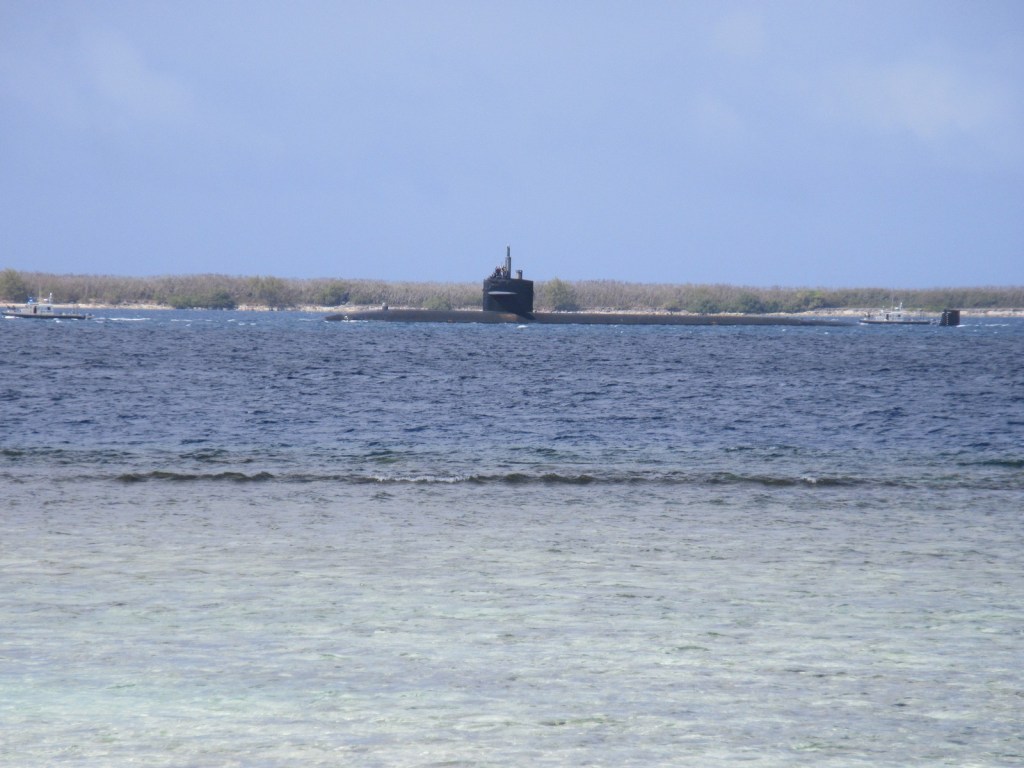
My only decent sea story does not begin in a bar, so it can’t be that good, though it does remind me of this one guy we had on the ship, Roberts. Roberts started his Navy career a bit later than the rest of us, and so when we all met him as impressionable like 25-year-olds he was the unimaginably old age of 28. If I recall correctly he worked as a college professor before joining the Navy. We had recently left Singapore and the ship had just popped out into the Pacific between Indonesia and Australia when Nav heard a weird noise. We were sitting in our stateroom and he asked me what it was and I said like “I don’t know” and we moved on with our lives. The noise was Roberts having a seizure and he woke up on the wardroom table (that’s where they do surgeries if they have to do a surgery at sea) with Doc and the Captain staring down at him. We had to get him off the ship lest he be dying or whatever but we were hundreds and hundreds of miles from any port that would be useful to us. We were eventually told to go back to Singapore and we zoomed on back there, diverting the submarine from whatever important thing we were doing and set off instead on a mad dash to get Roberts to a medical facility. A crew of over a hundred and a whole nuclear reactor and significant operational risk (by which I mean running into a banca boat (“banca” means “boat” so “banca boat” is redundant but that’s what we called them) which would cause us a lot of headaches and the poor guy driving the banca boat his life, probably) all dedicated to making sure Roberts didn’t die. We were successful in getting him to Singapore alive and from there he was supposed to get almost directly onto an airplane to Hawaii (i.e. the closest Naval Hospital that could give him a CT scan). Later, I forget where, we all ran into Roberts and talked about what happened. Turns out when he landed in Singapore, instead of going to the airport he called and got his flight bumped to a day or two later. He then proceeded to spend those two nights just partying his as-far-as-we-knew-at-the-time critically injured brains out. Singapore has a place the sailors all affectionally called the “Four Floors of Whores” (the ship had to post a watch there, to make sure no one got in too much trouble), and let me tell you Roberts was aware of this. He also told us that turns out once he got to Hawaii they discovered he had a brain tumor. It was benign but was pushing on his brain, giving him the seizure. Still, Roberts was viscerally aware that all good sea stories start with “so there I was in a bar…” Like I said this sea story, my one decent sea story, does not begin in a bar. It begins in the Philippine Sea. If you look at a map, the Philippine Sea is indistinguishable from the Pacific Ocean. But one time I was driving from the Bridge while we were tooling around west of Guam, and I noted we were in the Pacific, but my captain very quickly corrected me to say we were in the Philippine Sea. I am sure the fish are the same on either side of Guam and for what it’s worth that captain got fired due to sheer incompetence. Anyways. Previous to this sea story there had been a submarine that had to do an emergency reactor shutdown in I think the Gulf of Aden. Those guys did not have a good time. It is very hot in the Gulf of Aden, and once you shut the reactor down you don’t have air conditioning anymore. It got so hot that people couldn’t stay in the engineroom very long which hampered their efforts at diagnosing whatever was wrong with the reactor that caused them to shut down so they could fix it and start up again, which would give them back air conditioning. It would also of course give them back propulsion because a submarine with a broken reactor is a sitting duck, mostly just bobbing around on the surface with no real defense mechanisms. Not a great situation! Especially in the Gulf of Aden! A frigate came to try to help out but they mostly also just bobbed nearby (not a lot of nuke technicians on a frigate, which are also mostly without defense mechanisms, poor things). But every nuke that I knew was pretty riveted to this story, because an emergency reactor shutdown at sea means you get to do an emergency reactor startup when you finally fix whatever was broken.

To be continued…

My One Decent Sea Story Pt II

Reading this week:

  • The Last Harmattan of Alusine Dunbar by Syl Cheney-Coker

So anyways my one good sea story. Though then again it probably isn’t that good. I know this because when I was but a young Midshipman we were on the submarine week of PROTRAMID. PROTRAMID stands for “Professional Training Midshipmen” (I like how the Navy abbreviates things by just eliminating chunks of words; it gives you a chance to actually figure out what the acronyms are supposed to stand for. So like the Commander of Submarines in the Pacific is COMSUBPAC, very straightforward, good system) and maybe I have mentioned it on this blog before but what you do on PROTRAMID is spend a week seeing what each of the major service assignments are like, namely aviation, Marines, surface ships, and most importantly submarines. Sub week was actually almost terminally boring. We were on the east coast, and so for the submarine portion we were at King’s Bay Naval Base. King’s Bay Naval Base was built where it was because land was cheap and land was cheap because it wasn’t close to anything except swamp (also handy to keep nuclear weapons away from people). So when we had downtime there was very nearly nothing at all to do, because you couldn’t go anywhere, I was too young to (legally) drink, and when you were tired to playing pool in the rec lounge you could I dunno read a book or some other lame-ass thing. This was a major hindrance because we had a lot of downtime during sub week. The submarine force has to try real hard to sell itself, so it tries to be the opposite of like Marine Week, where they have you do a bunch of stuff around the clock and give you very little free time and yell at you a lot. So submarine week they act real nice to you and give you lots of downtime, though that is also a function of there is just not a lot they can do for you for sub week. Submarines do like two things, which is tool around underwater and then occasionally shoot a torpedo. That’s about it, and once they put you in a simulator for each that’s two hours out of the week and then what else are you supposed to do? I wound up with the absolute worst hangover of my life during that week, but that’s a different story.

The point I was trying to make here is that the one thing they DO do on sub week is take you out to ride a submarine for 24 hours. That is a lot of fun actually. They bussed us down from King’s Bay to Cape Canaveral to board the boat there. This was my second time on a submarine, having ridden around a submarine the previous year, so I was like an expert. The biggest thing that annoyed me about the bus ride was hearing all my fellow midshipmen that didn’t want to ride the submarine. They weren’t claustrophobic or had any other good excuse, they just never imagined themselves becoming submariners and would have rather taken the one duty van we had access to back out into town so they could get drunk another night. As I just referenced I am as down as the next guy to get drunk (or I was then) but come on man, if you’re going to become a Marine or whatever there is no other time in your life that you are going to ride a submarine so you might as well take this chance and smoke 500 feet underwater, which I think is kind of neat even though it is bad for your health. There was a brief time when it seemed our sub ride might get cancelled and these guys were cheering, but we got to ride on the submarine so they had to suffer through 24 hours of air conditioning, pizza, and doing what few other people ever get to do! But not before we sat and waited in like a disused café or something, whatever that building was. This event was one of the more memorable of my life because it was there I met a Boatswain (pronounced “bosun;” my senior year at the Academy I was talking to this woman who was service assigned surface ships, which she had not expected. She was earnestly trying to catch up on all the boat lore that she had somehow missed in her four years at the Academy, and I was trying to help out by explaining words like “gunwale” where pronounced “gunnel” and the “forecastle” was pronounced “fo’c’sle” and the boatswain example above, after all of which she replied “are you sure your parents aren’t just from the south?”). You see at this point I was familiar with Boatswain’s Mates, but I hadn’t ever realized you could just have a Boatswain. It makes sense in retrospect (Boatswains, this one told me, are the Warrant Officer versions of Boatswain’s Mates, which I have never bothered to verify). When he told me he was a Boatswain I was like “oh man, I know all your friends!” (mates, get it?) Anyways, it was this man that told me “all good sea stories start with ‘so there I was in a bar…’”

To be continued…

My One Decent Sea Story Pt I

Reading this week:

  • The African American Odyssey of John Kizell by Kevin G. Lowther
  • A Dirty War in West Africa by Lansana Gberie

Thinking back on my time in the Navy, I don’t have a lot of good sea stories. I think this is a nuke thing. I was of course nuclear-trained so I could serve as a submarine officer. I spent a lot of time back in the engineroom doing nuclear things, and the nuclear sea stories don’t really translate well for the general public. I remember telling a real hum-dinger of a story that had the whole crowd laughing (I promise) where the punchline was “and that’s why we have a non-vital bus!”

I think I can verify this nuclear lack of good sea stories thing via my parents. My dad was a nuke, and he barely has any sea stories. He’s told a couple that I later realized where just rehashes of things in Catch-22, which, come on man. His one other good one involved him frightening a young(er) Junior Officer on the bridge of his ship when my dad made the JO think that the captain had relieved him (my dad) for cause, leaving this poor JO alone on the bridge with an apparently angry and mercurial captain. I resonate with this story, because I spent a lot of time when I was OOD making people angry on purpose. My mom on the other hand, whoo boy. She was not a nuke, but was on conventional surface ships (she is so very much not a nuke… one time I asked her about steam generators, which her ship had, and she answered the question but said if I wanted to be sure of the details I should ask dad. Then, in the one time I have ever seen anger behind her eyes, she added “damn nukes never forget”). She’s got endless sea stories. A whole bunch of Hong Kong no-shitters, as the old-timers say. She was also in the Navy back in the day when you could, for example, have a crewmember nicknamed “Purple” as in “Purple Haze” because he was notorious for smoking weed. One of her stories is that while they were in port along with a whole bunch of sharks, Purple went overboard because he was this time very drunk instead of very high. So the ship’s doctor dove in after him and rescued him, which earned the ship’s doctor a severe tongue-lashing from the captain. The captain was much more interested in making sure that the ship’s doctor was safe from sharks than making sure that Purple was safe from sharks. Another time a mysterious light was lit on the ship’s mast. No one knew what it was. They looked it up and discovered it had to do with landing helicopters, which was weird because helicopters didn’t land on her ship. They then did more digging to figure out where the switch for the light was, and traced it to a compartment that had been sealed off (the compartment was for flight control but once they didn’t control any flights any more it was apparently just sealed off). Some of the crew figured out a way to get into that compartment and then proceeded to use it to smoke weed. There was apparently a lot of weed smoking back in the day in the Navy. Or there was another time that one of the other junior officers had made so many small corrections to the ship’s course that he was in fact sailing the ship in the exact wrong direction of which he was supposed to be going, which my mom discovered when she noticed that Australia was off the starboard side of the ship instead of the port side. Or another time when mom was standing OOD and one of her chiefs came through in full overboard gear and when she asked why he just asked if she was driving that night and when she replied in the affirmative he just nodded his head and walked off. And so on! And please remember these are just the stories she is willing to tell me.

To be continued…

It Isn’t the Veteran

I’m going to backdate this (I’m on vacation, which has involved a lot less free time than I anticipated and so I am behind on posts), so I think this post will “officially” come out around Memorial Day but I will note it is “actually” several weeks later. I wanted to talk about what I think is a particularly pernicious sort of attitude I tend to see around the holiday. I wish the following paragraphs were more elegant.

The attitude is that every single right you have as an American or even as a person is because a veteran fought for it and, especially on Memorial Day, died for it. Maybe it doesn’t pop up on your Facebook feed but it pops up on mine. A quick googling brought me “It is the Veteran,” a particularly direct and all-encompassing version of it. Credited there to Sarah Palin’s uncle (?), I’ll quote it here:

It is the veteran, not the preacher who has given us freedom of religion. It is the veteran, not the reporter who has given us freedom of the press. It is the veteran, not the poet who has given us freedom of speech. It is the veteran, not the campus organizer who has given us freedom to assemble. It is the veteran, not the lawyer who has given us the right to a fair trial. It is the veteran, not the politician who has given us the right to vote. It is the veteran who salutes the flag, who serves under the flag and whose coffin will be draped by the flag.

I think I first heard some version of this sentiment during my Plebe year at the Naval Academy. Even then I didn’t like it, but that might have been because I’m just a contrarian instead of some precocious political awakening. I don’t quite get why military veterans and their fans are so eager to claim every good thing that’s ever happened. Veterans are already pretty well lauded, why not let some of the love be spread around?

I think “It is the Veteran” is wrong, and so wrong that it is a full 180 degrees out. I don’t think you get rights because a veteran fought on the battlefield. I also don’t think you get rights just because someone says you have them or because they’re written down on some piece of paper. I think rights come from exercising those rights. Freedom of the press comes from the press writing about politicians that don’t want to be written about. The freedom to assemble comes from assembling when someone doesn’t want you build a movement. And the right to vote comes from voting when vested interests do everything they can to keep you from being heard.

More importantly, the attitude isn’t pernicious just because it is wrong. It is pernicious because it implies that people didn’t really earn their rights. The majority of people aren’t veterans and never will be. Saying that rights come from what veterans did means that the majority of people didn’t earn their rights, but owe their rights to the actions of this very small minority. Their rights are therefore far from being inalienable but instead have been granted.

The eagerness to claim that all rights stem from veterans is therefore I think an eagerness to be able to claim who does and doesn’t get them, or how people get to use them. If rights come from the sacrifices of a group most people will never be in, then it’s valid to say that freedom of speech doesn’t apply when supporting Black Lives Matter. It makes it valid to say that the freedom to vote is only really for people who vote the “right” way. It makes it valid to systematically deny whole groups of people their rights because in your eyes they simply don’t deserve them.

I suspect most people that share the sentiment that we should thank veterans for our rights aren’t thinking about what that actually implies for their rights or for the rights of others. But it is another part of an American way of thinking that allows us to say we’re the greatest nation on Earth without thinking about for whom that is and isn’t true. We are still in an era where people have to struggle every day to attain those rights that Sarah Palin’s uncle would say veterans already granted them. When those rights finally come, it won’t be because they shot enough people. It will be because they broke through the forces holding them down to stand up and exercise those rights.

Veteran Privilege

A much younger me.

The prompt for this post is that yesterday, as I am writing this (you won’t see it until later), I received the first shot of the Pfizer COVID-19 vaccine. My super amazing girlfriend pointed out that it was the one-year anniversary of the pandemic. The reason it is causing me some internal angst is that I only got it because I am a veteran.

Here in Connecticut, they’re deciding vaccine eligibility (at least at the time of this writing, which is gonna be the caveat for this whole post) based purely on age, which I think is probably the best way to go about it. Given my youth and vigor, that would have made me eligible May 3rd at the earliest (at least until President Biden bumped up the time table slightly). However, turns out the Connecticut VA was providing vaccines for any veteran enrolled for health care, regardless of age.

I fretted about whether or not to go get it. I’m very enthusiastic about vaccines in general, and will take just about any I can get. However, during this particular vaccination drive we’ve seen wild disparities in access to the vaccine. As usual, people with money and resources have been able to get vaccines no problem while marginalized communities (I gotta figure out less sanitized language for those groups) have been turned away and maligned despite being eligible. So it felt very weird to me to be able to just waltz in yesterday and get it without even waiting in line.

The level of privilege we afford to veterans in this country is absolutely wild and it has always seemed that way to me. The photo at the top is me as a young Midshipman and it all started there. Even back then I was thanked pretty constantly for my service, despite never ever actually done anything besides go to school. I went to the Naval Academy from 2007-2011, so that was still in the era when 9/11 was a fresh memory and anyone tangentially related to the military got all sorts of free stuff. I think every single one of us felt weird about the whole thing, but I mentally justified my free tickets to Busch Gardens by imagining that one day I would actually do something.

Now, post my military service, I constantly wonder what was so special at military service at all. This hedging might be moot, since no one ever reads this blog, but I know I lived a very particular brand of military life. I never had to face down an enemy trying to shoot me and all my friends, nor did I ever feel that I was in real danger anytime during my service. I was also an officer, which meant that not only did I get eggs to order even when our ship was on a “mission vital to national security” (as the parlance goes), but that I also got to jump right to the front of the waffle line. Even given that, whenever I am afforded a privilege like getting to jump the vaccine line, I’m forced to wonder why I’m so special for this job I used to do.

Military life in many many ways was not a whole lot of fun. We spent a lot of time out at sea away from the world, we worked constantly, and there were a lot of different ways it was potentially dangerous. But is any of that all that special? Long-haul truckers spend a huge amount of time away from their families, but they don’t get the GI bill. Amazon warehouse workers are worked so hard they’re barely allowed to pee, but they don’t get discounts all over the place. And there are tons of dangerous jobs in the world, like loggers and septic tank servicers, but those people don’t get preferentially hired for government jobs and contracts.

I wonder what effect all the privilege granted to veterans has on both them, and currently serving military members. There is plenty of reason to provide veterans with extra resources when you consider that, as a group, veterans can have higher rates of homelessness and suicide than non-veterans (to caveat the other way, I also worry about even bringing that up, because there is another negative stereotype of veterans that they’re unstable and PTSD-riddled, which isn’t true either). My specific worry is that providing all this privilege to veterans is a way to avoid looking at the root cause of many of the problems that military members and veterans face.

I’m sorry I have no idea who originally generated this meme; if this Google image search link works, seems like it’s been reposted a lot.

The above meme caught my eye early in the pandemic. Even outside a pandemic scenario, I really hate martial metaphors in any discussion that doesn’t directly tie to actual warfighting, and even then I don’t like a lot of the terminology. At the beginning of the pandemic, I was especially queasy about all the “front line” language, and it wasn’t until I saw that meme that I really figured out why. The meme criticizes equating health workers with soldiers because it implies a certain number of health workers are going to die and that’s just something we should accept, instead of it being something avoidable.

In the same way, I think we need to interrogate how all the hero worship of veterans and the military implies about what we expect them to put up with. Another friend of mine from the Navy visited me the other weekend, and we were swapping sea stories when she told me that they recently figured out only at the last minute that one of the sailors she supervised had been planning to murder his entire chain of command (including her) and kill himself on his last day at work. This is a very normal story, actually. One night when I was on duty our topside watchstander (who was armed with a handgun) was talking about wanting to kill himself. I did not handle this situation well (no one was harmed in the end), but frankly it was just like, one of the many annoying things that happened that night. We had a number of suicidal sailors, and like my friend a sailor that I supervised who was armed seriously threatened to shoot a number of people. This event was too mundane for anyone to even tell me directly; I found out about it when it was mentioned in passing in the wardroom.

Suicide is the extreme end of the scale, but there are a whole lot of things that people in the military are just expected to put up with and are somehow considered just the normal and perfectly fine way of going about things. I think because we view military members as heroes that are making a sacrifice, and who will gain benefits for life for these sacrifices, we have no real motivation to actually make their life better. Or, at least, it keeps us from conceptualizing a world where we should do that. Every time I think about the terrible parts of Navy life, I think about the sailors on merchant ships, who do stunningly similar jobs to sailors in the Navy but somehow can also get months off every year just as a matter of course.

There are a whole lot of other things I’m not going to be able to eloquently weave in here that should also be interrogated on this subject (race and class are the obvious ones, but other things too). I think the progressive dream for America is in fact currently being implemented, at least in many ways, albeit it only within the confines of the veteran community. If the progressive dream is good, then it must be good that it is at least being partially implemented, right? But since it is framed as something that veterans “deserve” for their “sacrifice,” I don’t know if we’ll ever be able to work on making military service less of a sacrifice, or more importantly really remember why we granted veterans these privileges in the first place (veterans deserve a lot of things, but since when has what people deserve ever been a basis for governance in the United States?). Until we do the work of figuring out as a nation why we venerate veterans so highly, and importantly what effect and implications that has for every other American, I don’t know if we’ll be able to judge whether it’s more toxic than good.

Inauguration 2009

WASHINGTON (Jan. 20, 2009) Midshipmen from the U.S. Naval Academy marches down Pennsylvania Avenue during the 2009 Presidential Inaugural Parade in Washington. More than 5,000 men and women in uniform are providing military ceremonial support to the 2009 Presidential Inauguration, a tradition dating back to George Washington’s 1789 Inauguration. (U.S. Army photo by Staff Sgt. Timothy Kingston/Released)

Reading this week:

  • Solutions and Other Problems by Allie Brosh
  • The Tyranny of Experts by William Easterly (I don’t disagree with the premise, but I don’t think he makes a very cogent argument)
  • Stealth of Nations by Robert Neuwirth
  • You Shall Know Our Velocity by Dave Eggers

I don’t have a lot of fun and unique thoughts about like, the attempted insurrection or riot or what have you that happened last Wednesday, and for a lack of much else to write about (I have just been trying to read as many books as possible while I have the time in order to reduce my backlog), I thought I would write about marching in the 2009 inauguration of President Barack Obama.

Back in January 2009 I was a Youngster at the Naval Academy. The inauguration was coming up, and, as you may have gleaned from the caption in the photo above, the Naval Academy marches in the parade. If I recall correctly, each company got to send three or so people to march in the parade, and I remember them sending out an email asking if anyone wanted to do it. I decided that marching in the inauguration of America’s first black president would be a cool thing to be a part of, so I volunteered. There were enough volunteers that my company held a little tryout. I had to remember how to march (I think I even practiced a little?) because I was a Youngster and therefore actively trying to shed all my last vestiges of professionalism. I think I got the gig because I remembered what some particular drill term meant and executed it correctly. So that was cool!

I think we must have practiced once or twice as a whole group before setting off the morning of the inauguration to DC. They bussed us to the Mall, where there were some staging tents, and I remember driving past the crowds and whatnot. That was cool. The parade is very long, and we were towards the back, so the plan was for us to be in the tents for a bit, and then when it was about time for us to go (long after the parade had already started) to hustle out and form up and start marching.

What I remember most about the day is being very, very cold. I have just looked it up; it seems to have averaged about 24F that day. Furthermore, the dress uniform isn’t great for keeping you warm. You’re walking around in leather shoes and there are only so many layers you can stuff underneath that overcoat. No matter though; the plan was to bust out of our warm, heated tent and then just march march march through DC, past the President, and then onto the busses. This did not happen.

Ground-eye view.

After some time in the tent, we were hustled out and formed up. I think we started marching pretty quick. I forget who was in front of us but for some reason behind us they put the US Navy Ceremonial Guard. Maybe this was to make them look extra-good, but they didn’t need it. You see, those guys are professionals at marching, unlike us, who were just a bunch of schmucks. They should have been in front of us, or maybe far from us so we didn’t tarnish their reputation. I spent a lot of time that day looking at them. You see, despite our quick start, the parade was slow. Very very very slow. I don’t know what the holdup was, because I was so far in the back, you see, but it is simply the nature of long parades that towards the back they don’t go so smoothly and we were feeling it. We started off standing at attention for all this time that we weren’t moving, but before long, as we stopped and started our way through DC, we transitioned to parade rest during the stops and then at ease and finally we were just lolligagging about whenever there was a stop in the parade. The Ceremonial guard, however, I think on purpose always stayed just one step above us. If we were at parade rest, they were at attention. If we were at ease they were at parade rest. And so on. They looked great.

But like I said it was very very cold. My primary motivation for wanting the parade to move was so I could finally get to that long-forgotten place that was warmth. I was pretty sure I was starting to get frost-bit on my toes. I came to the conclusion that if I was ever President I probably just wouldn’t have a parade to spare people standing around in the cold so much.

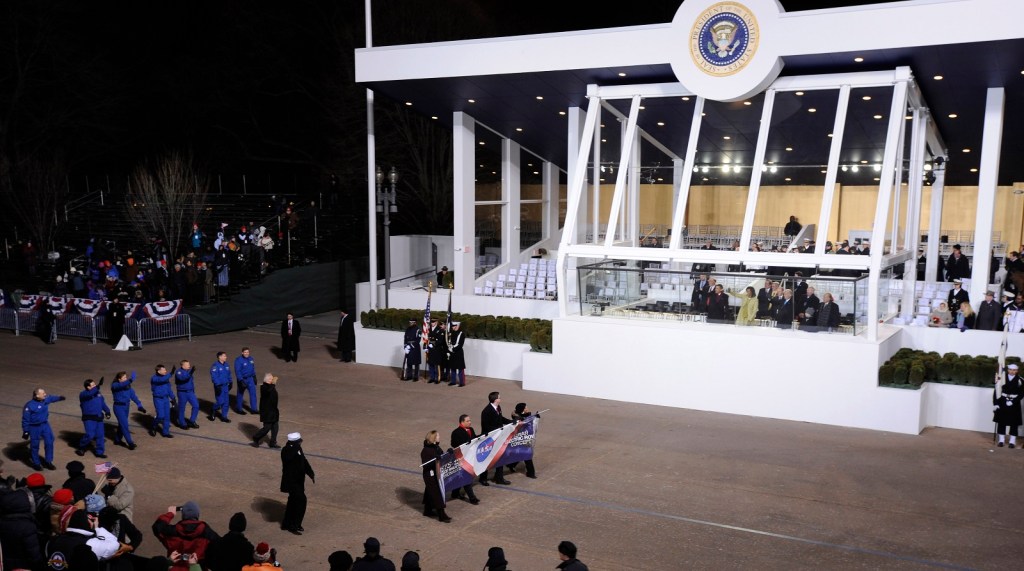
Photo Credit: (NASA/Bill Ingalls)

But finally! Finally we marched past the President. The above photo I got from NASA, which you can tell from the astronauts, but that is about what the stands looked like when we finally marched past too. It was long since dark, and there was almost nobody left in the stands. As a good little marcher, I should have kept my head straight ahead, but I decided to swivel a bit to get a glimpse of the newly-minted President. Much like in the above picture, he looked warm in the reviewing stand, and was very cheerfully waving at us with a huge smile. So that was really neat! I got to be there and be a part of history or whatever! After we walked past him I think it wasn’t far to the busses and I was glad to have made it through with all my toes intact. So that’s my story of marching in Obama’s first inauguration. I hope you liked it.