Library of Congress

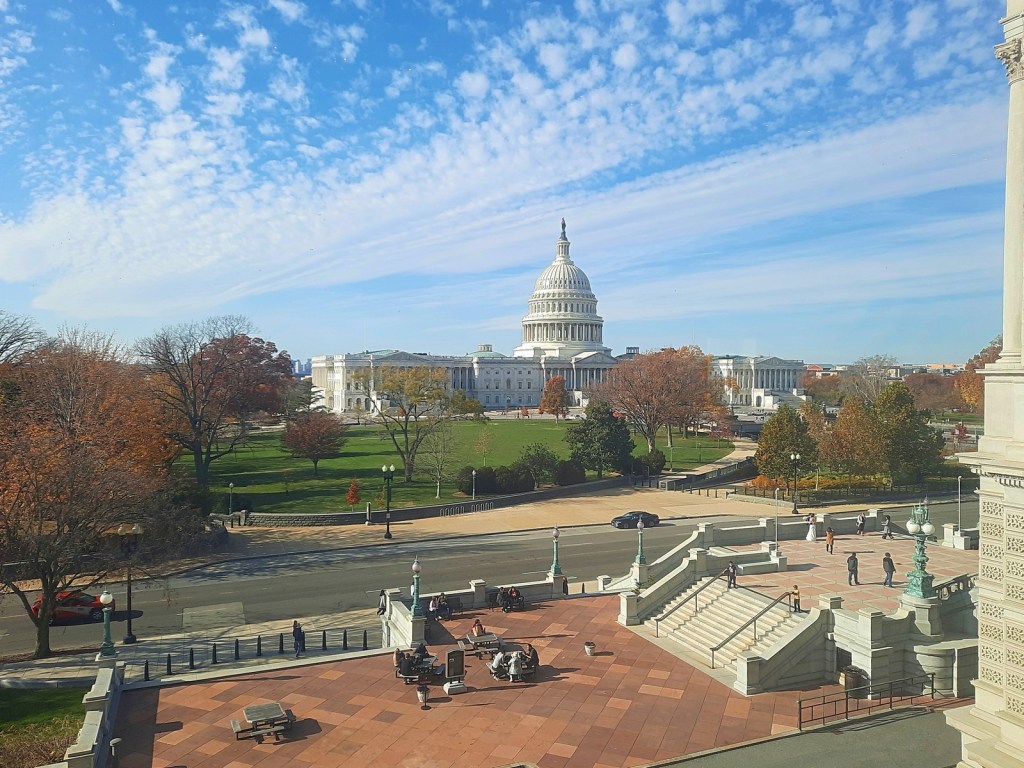
This is a picture of Congress, from the library.

As loyal readers are aware I went to Yale for my graduate degree. That was fun! There were many advantages of going to Yale, but one of them, I am willing to say, was access to the Yale Library. The Yale Library has a very large collection. 15 million items it turns out. With so many items, they have an array of pleasingly obscure items, including at least one book on the lake steamers of the African Great Lakes, which, again, loyal readers are aware is a particular interest of mine. Frankly you never know what you have until it’s gone, and although the Alexandria Library is very nice, I do not think they have 15 million different items, and I can confirm that they have exactly zero books on the lake steamers of the African Great Lakes.

I know I am banging on about the lake steamers here, but I have recently restarted my effort at retyping the Chronicle of the London Missionary Society. I started to feel bad about having stopped pursuing that because I have been reading more books on southern Africa. But since I am reading about Tanganyika, etc, that has me thinking about lake steamers and the like, so that has me remembering there were several books that I wanted to look at while I was in Zambia which I couldn’t because like, I was in Zambia and very far from a library with a collection of any particular note (though Mbala did, in fact, have a library) (I am now realizing that I don’t think I ever wrote about the Tanganyika Victoria Memorial Institute!). Of the two books apparently in the whole world that discuss African Great Lakes steamers, the Yale Library, for all its vast collection, only has one of them (and as of yet will still mail it to me here in Virginia), but for the other I was lost and distraught. Lost and distraught, that is, until the internet reminded me that the Library of Congress has one and I live near the Library of Congress!

The Library of Congress, according to the pamphlet they hand out, has more than 167 million items, which is a lot more than the Alexandria Library and also more than Yale! So I wanted to go and read the book at the Library of Congress. Due to a misunderstanding of the website, I thought that you currently couldn’t do any reading at the Library of Congress, but I wanted to go anyways. My super amazing girlfriend (pictured above) had already been and would be my tour guide. So last Saturday we got on the metro and went to the famously large library.

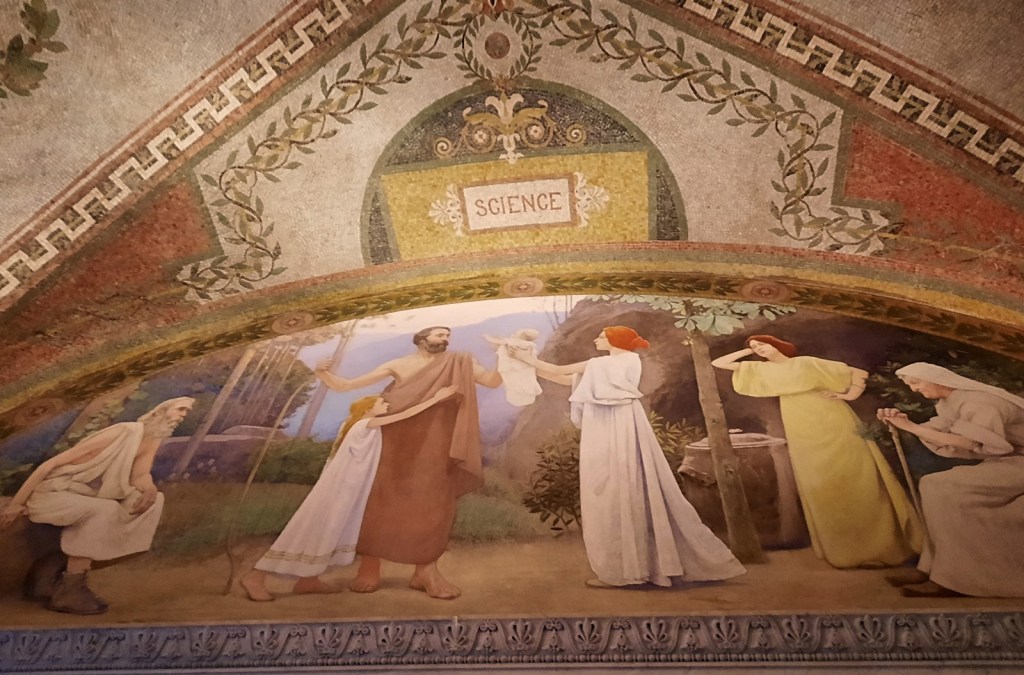
It is very nice! I didn’t realize what it would be like. First and foremost, the Library of Congress is a place dedicated to excellent ceilings. I won’t subject you to them all, but I do like the below one with “SCIENCE” displayed in tile. I do like both mosaics and SCIENCE. Plus there is like a weird baby involved in the image and I don’t know what that is about, but presumably it is about SCIENCE. I suppose I should specify here that I am talking about the Thomas Jefferson building because the library has a number of other buildings, too.
When we went, the library had two major displays set up. In one wing, they had a whole display on early interactions with the Americas. This was based on the collection of some dude (it was quite the collection, dude) and had an impressive array of artifacts. I really was not expecting to see Mayan pottery when I walked into the museum that day. One of the most impressive items was the earliest map to denote the Americas as America. I took a picture that was just whatever, but you can find it here. The bit I looked at the most was Southern Africa which was cool and impressive and stuff.

I also really enjoyed seeing the Taino ceremonial wooden stool. That object is just so ephemeral and rare and also looks like a turtle, which is cool. Of course on a serious note it reminds us about the important and advanced cultures that existed in these places before Columbus came over and wiped them out.

On the other side of the library they had on display Thomas Jefferson’s personal library. He had sold it to Congress when their first library burned down, which was potentially a bad move for book longevity because it wouldn’t be the last time the Library of Congress burned down. Fortunately not all his books burned, and so they had a number of the originals. They also had identical copies of some of the books, more modern reprintings of some of his books, and then also some boxes to fill out the ones they couldn’t get. They had the whole thing in a spiral, and this was the first time I have been out and about with my super amazing girlfriend and said something like “we could do the living room like this” and she agreed. So I am looking forward to turning our living room into a spiral, it’s gonna be great.

The final thing to see was the Main Reading Room. Seeing people reading in the Main Reading Room is what eventually led me to discover that you could read in the Main Reading Room on Saturdays, and I hope that is something I can take advantage of soon, because like I said I want to read that book on steamships. Maybe I will read other books there too someday, who knows. A lot of people apparently do genealogy research there. Me though? I just want to look at boats.
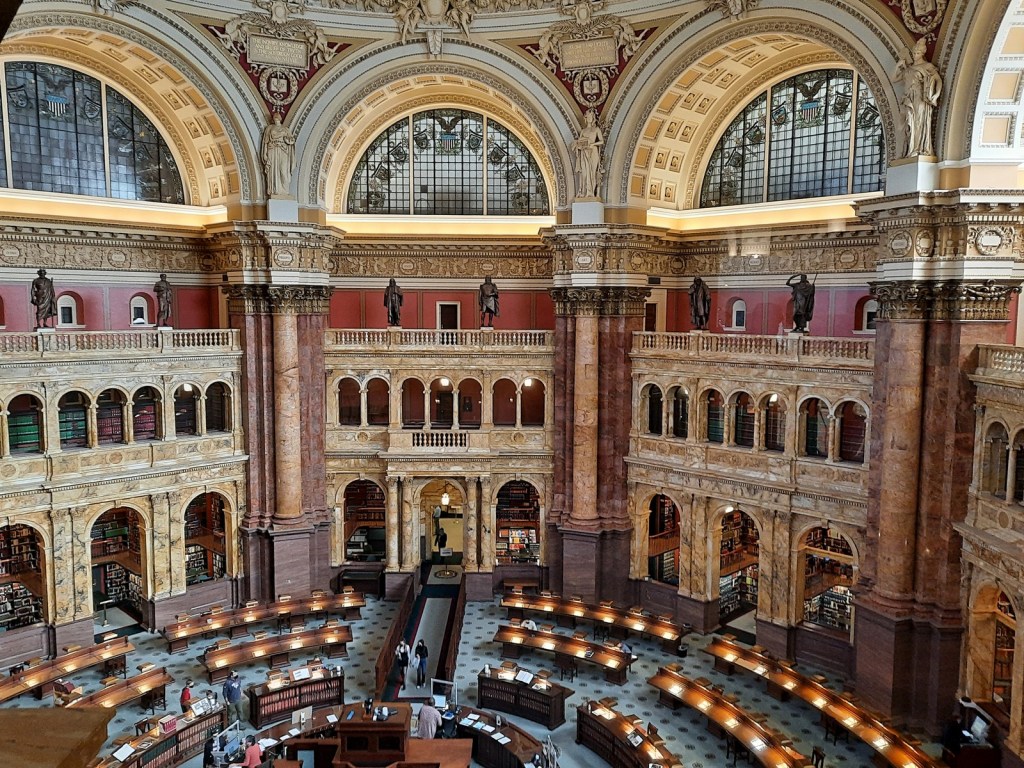
Think of all the boat knowledge hidden away here!

Washington Monument

Reading this week:

  • Finding the Mother Tree by Suzanne Simard

Like I mentioned last week, my super amazing girlfriend’s absolute best friend in the whole wide world was visiting last week, so we were out on the town looking at stuff. One of those stuffs was the Washington Monument!

Now, you see, I grew up over near Annapolis, so I had been to DC plenty of times back in the heady days of my youth. I would see commercials on like, Nickelodeon for contests where you could win a trip to DC and I thought that was a bit of a lame prize because we would go there for field trips, you know? (Despite the regularity, sometimes it didn’t go well; I remember one time we got to the Natural History Museum at 0830 only for the teacher to discover only at that moment the Smithsonian Museums don’t open until 10) However, despite the regularity of my visits to DC, one thing I had never done (among many things, actually) was go up to the top of the Washington Monument.

This is not for lack of trying! It’s just mostly due to lack of trying. Back in the ole’ days, you had to line up for tickets. They were first come first serve, which meant you had to be one of the first however many people in the line, which meant you had to get there early. I did try to do this once. It took forever for me to find parking that day, but I got in line, and the line started moving, and when I was finally three people away from the window they had run out of tickets. This was very sad for me, clearly. But mostly I had just never tried.

But since my super amazing girlfriend’s best friend was in town, they did try, and lo and behold, they got four tickets! Super neat! We showed up at our appointed time, went through security, quickly admired a statue of George Washington, got in the elevator, and head to the top!

The first and stupidest thing I learned is that the windows look at lot bigger up close than they do from the bottom. I thought they were very tiny. They are small, but not tiny. See? Stupid. There are actually two floors at the top, the 500′ level and the 490′ level. The 500′ level has the windows and you can look out and admire the city. I put those pictures at the bottom. It is a pretty excellent way to see DC all at once (well in four chunks, one for each direction) and you can spend as much time up there as you want. I was like “I can spot my workplace from here!” and “I can spot my house from here!” and “wow the White House has more trees on its grounds than I thought!” You know, deep things like that. It was pretty neat.

After you are done with the 500′ foot level, you descend some stairs to the 490′ level and there is a very tiny museum thingy. There’s not a whole lot there, but the single most interesting thing for me was the above model, which shows how the monument’s very top is constructed. I hadn’t ever thought about it, but the monument is entirely stone (they claim to be the tallest freestanding stone structure in the world, which is neat!) and I was impressed how they did the masonry to put the top together, as demonstrated in the model above. It is also from the 490′ level that you catch the elevator down. Taking the stairs was not an option, though in the elevator on both the way up and down they have a presentation, and on the way down they pause twice to let you look at some of the carved stones on the inside. So that was cool! Having taken the elevator down, we were discharged (you have to go elsewhere for the gift shop), having gained a whole new perspective on this city I’ve been visiting for my whole life.

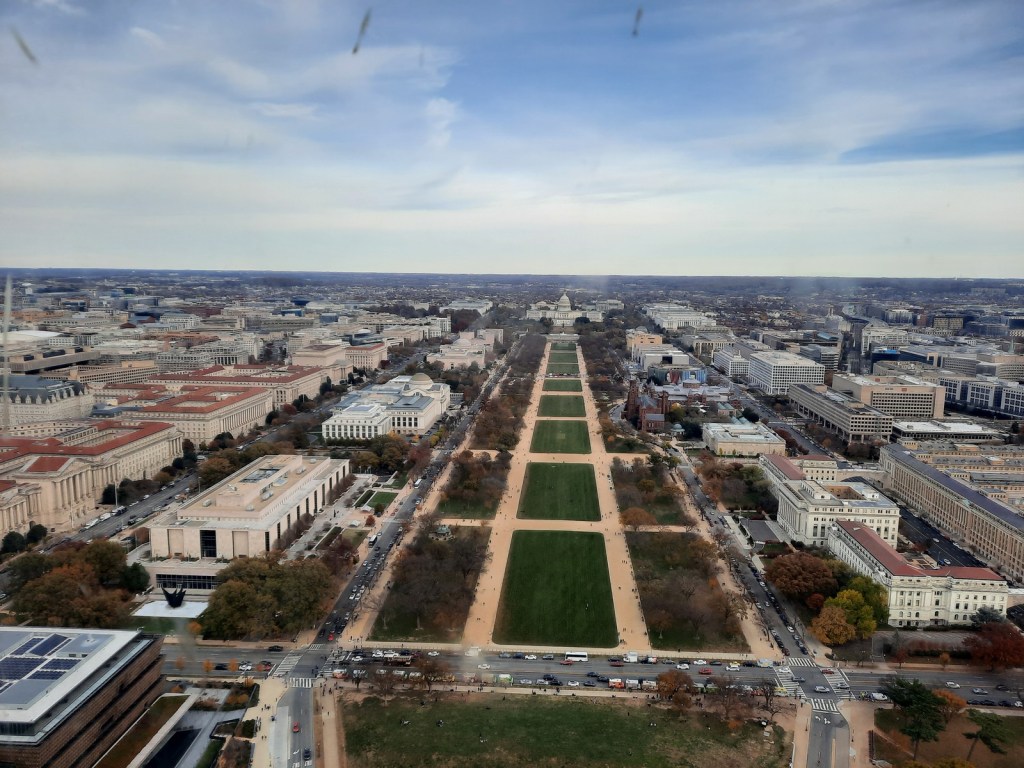
The mall, Smithsonian Museums, Capitol, etc.
My house is off to the left, beyond Reagan Airport. The tidal basin looked nice!
I discovered my phone could do wide-angle shots, so that’s neat. Look at all the trees by the White House! The State Department is off to the left. The bit with the trees in the background on the right and center is Maryland!

Planet Word

Reading this week:

  • House of Glass by Pramoedya Ananta Toer

The other week my super amazing girlfriend’s absolute best friend in the whole wide world was visiting us, and so we went to Planet Word! Planet Word was certainly an interesting take on a museum, and it was interesting to see a different way of presenting information to people.

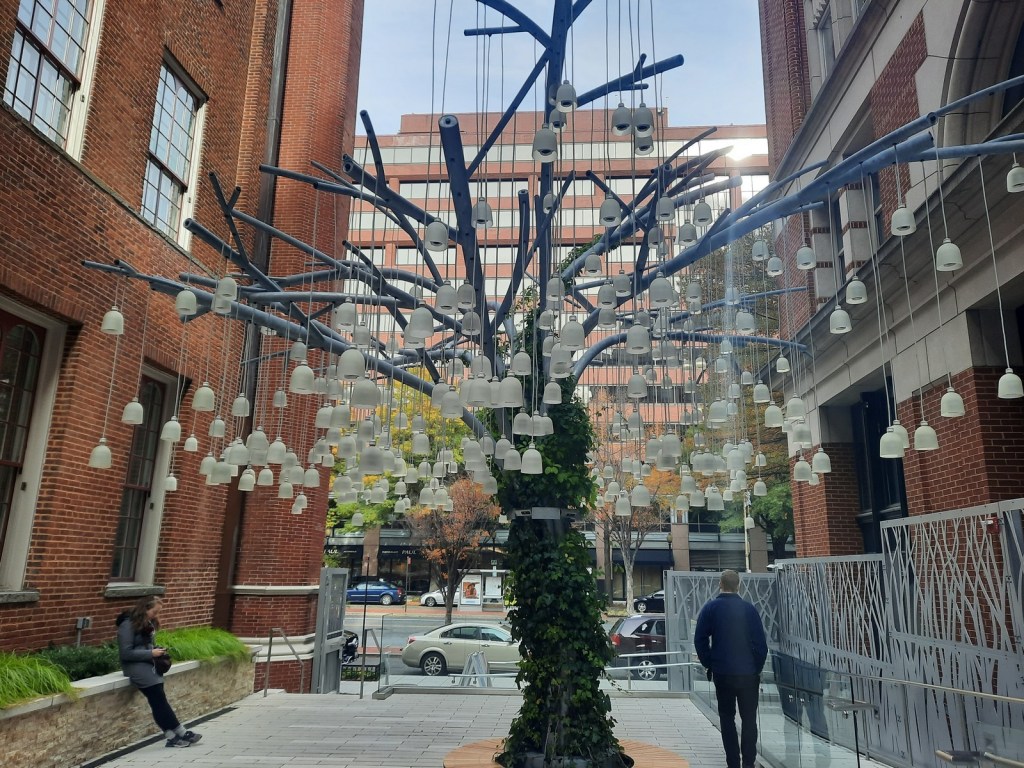
First, despite the name, Planet Word is not a whole planet, but in fact only comprises part of a school building. You turn the corner into a courtyard where you discover a tree-looking thing. Hanging from the tree are a bunch of speakers. They are motion-activated, so as you stand under the speakers you hear different recordings and tracks and I suppose that really gets you into the mood.

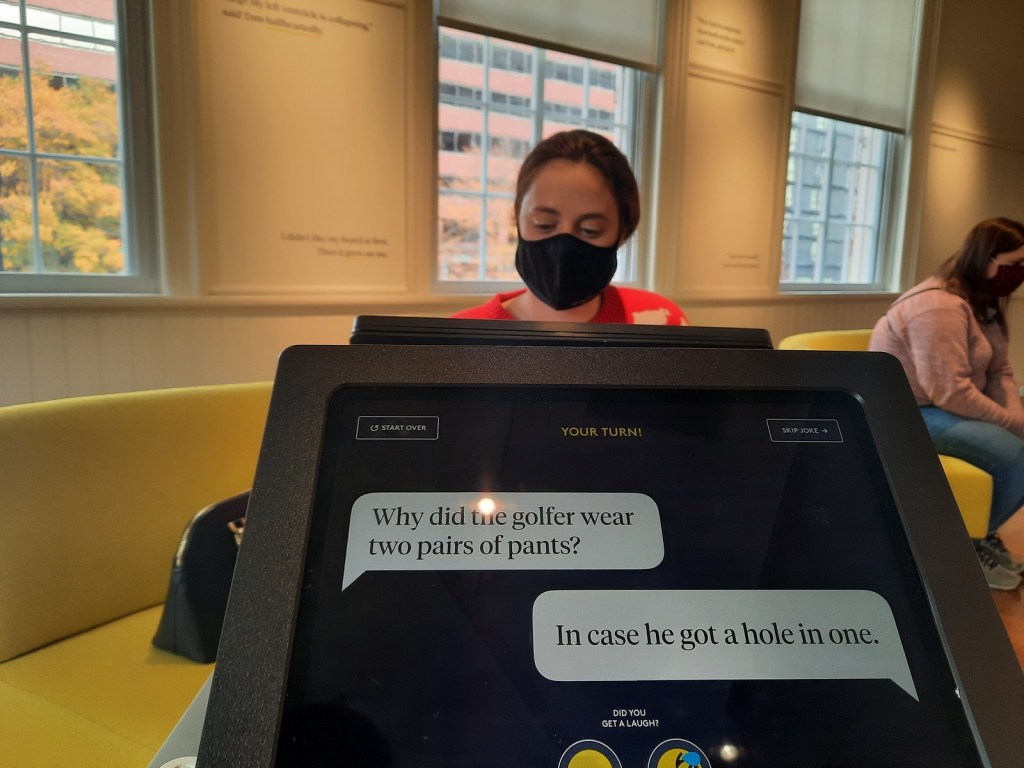
Instead of discreet displays like at uh, a traditional museum, Planet Word is comprised of a series of rooms that explore a wide range of different aspects and uses of language. At the top is a picture of a room about jokes and wordplay. In one bit of the room you pose with pictures of different idioms and then other people have to guess what the idiom is all about. What’s in the picture is a station where you and your partner tell jokes to each other. The screens give you different jokes to tell and it is a game where you score a point if you make the other person laugh. As you can see, the jokes are of the utmost quality so it is a very competitive game. What made me laugh every single time is not how funny the jokes were, but I started laughing because every time my super amazing girlfriend told a joke she would be very proud of herself and laugh at it herself, and it was extremely cute, because she is super amazing.

For me though I think the part I had the most fun in was a section on advertising. There were some displays around the edges of the room, but the center of the room was comprised of a spiraling set of screens that taught you about different aspects of advertising copywriting, like wordplay and double entendre. Once you reached the center of the spiral, and had thus achieved master of the advertising artform, it invited you to make an ad of your own around a couple different potential themes.

Haha butt!

I immediately tried to see what bad words it would let you put on an ad copy. I didn’t try way too hard, because I was afraid of getting us kicked out or revealing too much of the world to the little kids running around, but still I found it extremely entertaining. Right above you can see the masterpiece I finally contributed the world of Planet Word. Once your ad goes up it slowly moves along the spiral for all your museum compatriots to see. For you, my loyal readers who might want to go to Planet Word someday, it does have a word filter, but for some words it is more aggressive than others. It wouldn’t let me type “Poop,” for example, but it would let you put in very simple variations, like “Poopv.” It also of course blocked words like “Fuck,” and wasn’t tricked by the same simple variation like “Fuckv.” Art arises from limitations, and since I had also learned something about subtlety or something (I think) from the spiraly course on copywriting, I decided that a simple “BUTT” would suffice to convey my message to the world.

One of the other big sections of Planet Word was a stylized library. This library had a small selection of books, but the neat part was that if you took a book and put it on the table, as my super amazing girlfriend is aptly demonstrating above, it started projecting on it and became all interactive and stuff and that was pretty neat. They even had my childhood favorite book, The Way Things Work, and so that was very nice to see again. Around the room too they had these displays where if you said a quote, it displayed a model scene from that book. They had scenes from The Little Prince and 20,000 Leagues Under the Sea, among others.

They had a number of different rooms besides those, but I won’t spoil all of them. You know I don’t know if I learned anything in particular from this museum, but it is nice to go to a place that tries a new way of being a museum and a new way of presenting information. It was fun and interactive and a nice way to spend an hour or two. I only wish I had written down some more of the jokes from the game so I could deploy them again later. At parties or something, you know?

GW Textile Museum

My super amazing girlfriend reminded me to take a context photo.

I noticed this place when I went out to lunch with a former boss on the day that we saw Doug Emhoff. It is GW University’s Textile Museum! I am a fan of textiles, my super amazing girlfriend is a super amazing fan of textiles, so when we discovered there was a whole museum dedicated to textiles, we had to go! Unfortunately, it isn’t open on weekends. But fortunately due to my many long years of naval service, this great country of ours gave us a day off to celebrate the day that was 14 days before the first World War ended. So we went to the textile museum!

The textile museum was really good! I knew it was going to be good when we walked in and the guard explained to us that they “have a lot of textiles.” He then immediately recommended that we descend into the basement to let our textile journey begin. Down in the basement is I think their special exhibits space, and they had going a display where contemporary textile artists were taking inspiration from some older textiles to design new clothes and the like. It was pretty neat! Even neater though was the section in the basement they had that showed you how various textiles were made. They had a good chunk of hands-on things in this part of the museum. I liked the exhibit in the photo above, where you could touch both the raw materials that textiles were made of and then the finished fibers on the bottom. Pretty neat to see how various bits of trees, animals, or cocoons get turned into the comfy shirts we all know and love.

They also had a cabinet full of various textile samples, as is being demonstrated by my super amazing girlfriend in the photo above. That was neat to be able to put hands on all the stuff! So all in all a very cool part of the museum that at first glance I thought was going to be mostly for kids.

With the basement exhausted, we got in the elevator to skip over the ground floor and go up to the second floor, where the majority of the textile collection begins in earnest. It is quite the range of textiles from all over the world and from a huge wide range of time periods. If you wanna look at some textiles, do you have the right place for sure.

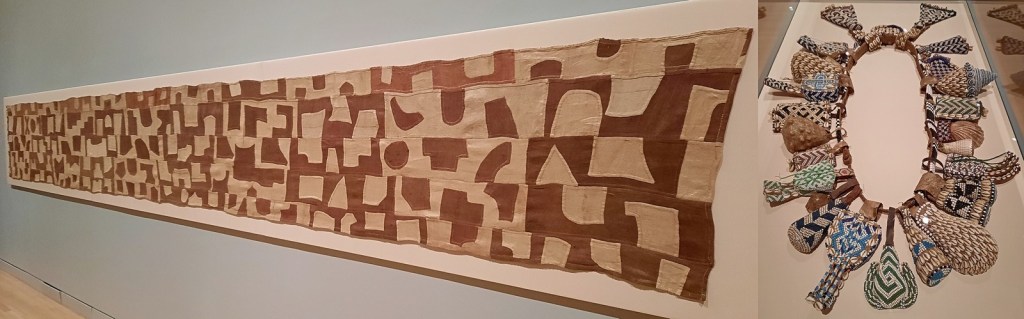
The two above textile examples are both from the Kuba people in the Democratic Republic of the Congo, and both from the mid or early 20th century. On the left is a Tcaka, which as the parenthetical on the plaque noted is a ceremonial dance skirt. On the right is a “royal belt or girdle.” Hard to tell from my tiny picture but it features shells from both the Atlantic and Indian oceans, meant to display the breadth of the chief’s control. So that is pretty neat, and a good example of how the museum certainly doesn’t take a narrow view of what a textile is.

Speaking of which I was pretty stunned to get up close to the piece right in the photo above, which at first I thought was contemporary art but turns out to be a 500 year old Incan khipu! I didn’t think I was going to see one of those up close anytime soon, and here they have it right on the wall. It is well documented on this blog that I like old stuff, and this museum had a lot of old stuff, with textiles thousands of years old. Besides the khipu, they had a notable collection on display of Incan and Inca-era textiles, and it was just stunning how fine those textiles were. If you want to see some old fabric from just about everywhere, this is the place to go.

Side by side with the ancient textiles they also had a huge range of contemporary textiles and textile art. It really let you see how this cultural technology spans the whole era of human civilization. I took an absolutely terrible picture of it, but my favorite art piece in the place I think was “Attitude” by Lia Cook, which you can see on the museum website here and her website here. It is a lot cooler to see in person because due to both the way she creates the image on the fabric, and the texture of the fabric itself, it has a very cool 3D effect that is fantastic to see when you can navigate your head around the piece.

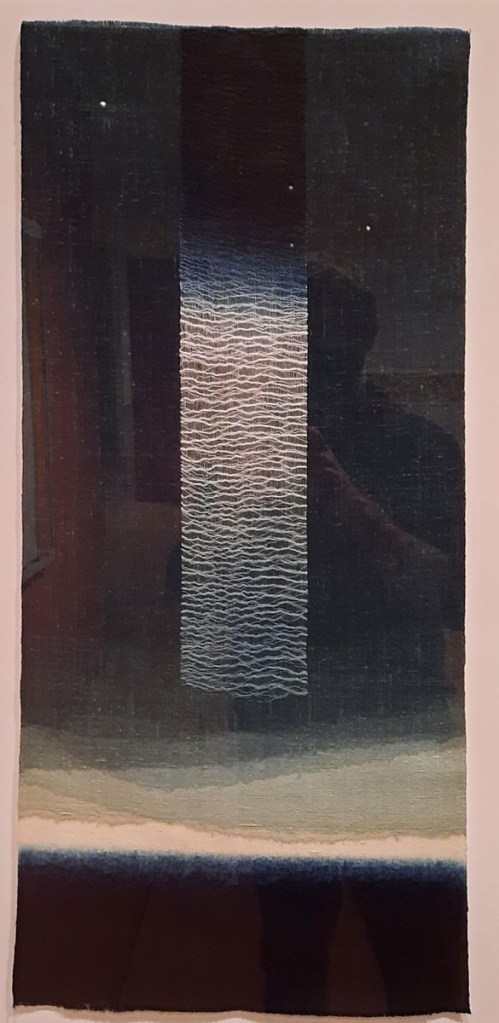
One piece I did get an okay photo of is the below one, which is “Waterscape VI” by Shihoko Fukumoto, and is apparently “indigo dyed, hand woven linen and paper plain weave.” Like the Lia Cook piece, due to the texture of the textiles I think you really gotta see all these pieces in person to get the sense of how they are constructed, especially in the below example to get a sense of lighly the “waterfall” threads are woven in there to give a sense of how water flows in real life. It’s really great!

After getting our fill of textiles, we swung by the museum shop where you can buy, uh, textiles. And also some books on textiles. It is a very nice little shop! We didn’t get anything, but only because we have enough throw pillow covers for now I think. It is not a huge museum but it does have a fantastic collection of textiles defined very broadly, and the range of objects and the way they display them all together really makes you think about much of a throughline this technology has been to people everywhere. Check it out if you can!

Ford’s Theater

Speaking of assassinations, the other week my super amazing girlfriend and her super amazing mother and I went to Ford’s Theater. It was a fairly interesting place!

My super amazing girlfriend had gotten us timed tickets for 11:30, so after a leisurely morning we showed up, picked up our audio guide, and entered the theater. Unbeknownst to us (probably just me?) the place has a whole museum in the basement. I thought it was just going to be the theater. But you enter through the ticket line and then head down some stairs and there is a whole floor of exhibits about Lincoln’s presidency. I thought it did a pretty good job of detailing stuff, not that I know a whole lot more than the average bear about Lincoln’s presidency. There were a fair number of amusing anecdotes and the biggest takeaway for me is that I want to pick up a biography of Grant at some point.

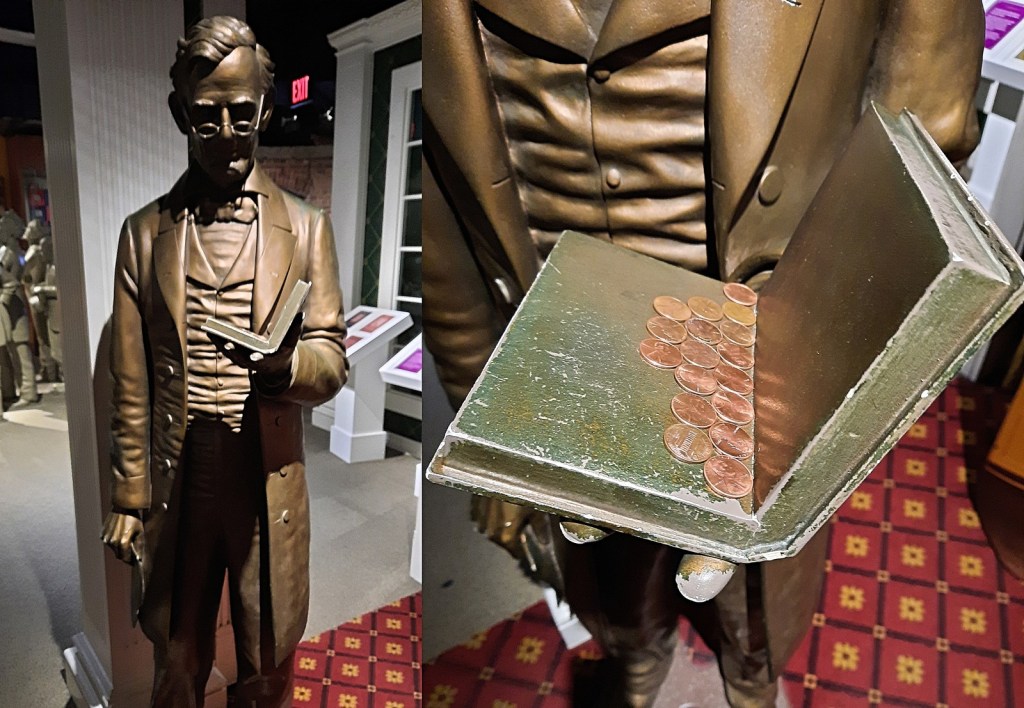
The museum had a number of interesting things. The photo at the top is a statue of Lincoln they had, and I guess I didn’t get the memos about leaving pennies. I think this is so Lincoln can gaze upon his severed head? Not sure. At the very start of the museum, which starts (chronologically) with Lincoln entering DC for his inauguration, they had a set of brass knuckles, a knife, and some goggles that were offered to him for his protection:

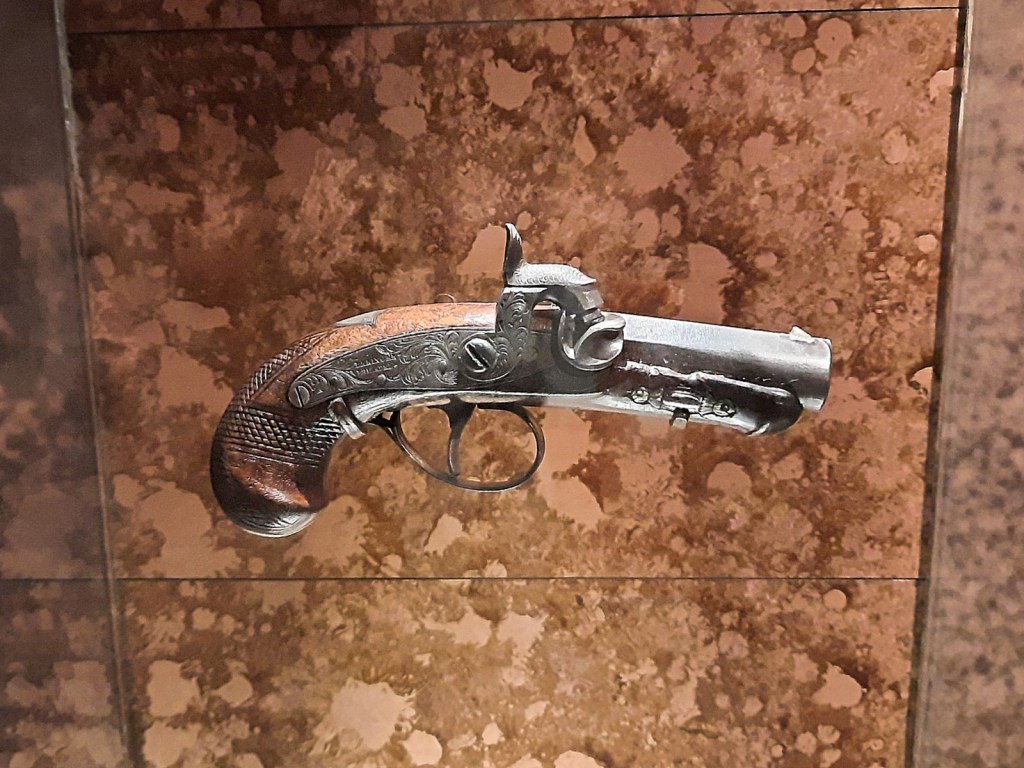
He turned them down but he should have accepted them. Everybody already agrees Lincoln is a badass with an axe, so why not brass knuckles too? Real missed opportunity there. On a more solemn note, they also of course have the pistol that Booth used to kill Lincoln:

Ford’s Theater is still (or actually once again) a working theater, and apparently there was a play that day, so the museum was closing early. This hustled us through the rest of the museum and upstairs to the theater itself, where a very upbeat National Park ranger was answering the same questions I am sure they get 1000 times a day. You can go over and see the box where Booth shot Lincoln, which has the furniture from that night. You can also look up at the box from below, to get the same perspective everyone else had:

And uh, yeah. Then we went to the gift shop, which did have a lapel pin. This is a very short post and I am sorry, I don’t have a lot to say about Lincoln because man a lot has been said about him. Ford’s Theater is a very good museum and lets you see the spot where an act was carried out which killed a very mortal man but which had such a monumental effect on American history it starts to make you reconsider the Great Man theory. Then you can wander over to see the Chinese restaurant where they conspired to enact such a despicable deed.

International Spy Museum

I keep forgetting to take good context photos. Thanks, Wikimedia!

Reading this week:

  • Before the Birth of the Moon by V.Y. Mudimbe

Recently my super amazing girlfriend and I, along with that mysterious other friend I mentioned last week, went to the International Spy Museum. My initial impression was that it was fine, but the more I think about it, man that is a weird place.

This was my first time going, but I remember when it first opened and all the hype. Lines around the block and all that. When we went there were not lines around the block, but that was mostly due to timed tickets what with this era of COVID and all. The museum is split into two major parts over two floors, and when you go in they put you in an elevator to take you to the top so you can work your way down. Out of the elevator you mill about in this waiting room area and get a badge that lets you log onto computers and take part in a mission. You’re supposed to memorize a code name and some facts about your cover identity and stuff. You are shown a short video outlining like, the world of spying and then you are ejected out into the museum.

The first floor is all about the tools of the trade and tradecraft. There is a bit of history of famous spies throughout history, and then a number of displays full of spy gadgets. Most of the museum is from a single collection, and it is indeed an impressive collection of spy stuff. A lot of the stuff on display is from the mid-20th century, but the museum stays pretty current. They cover things like the 2016 DNC hack and other cyberattacks, and they also have a fairly large chunk of information on female spies which I think is supposed to be #empowering.

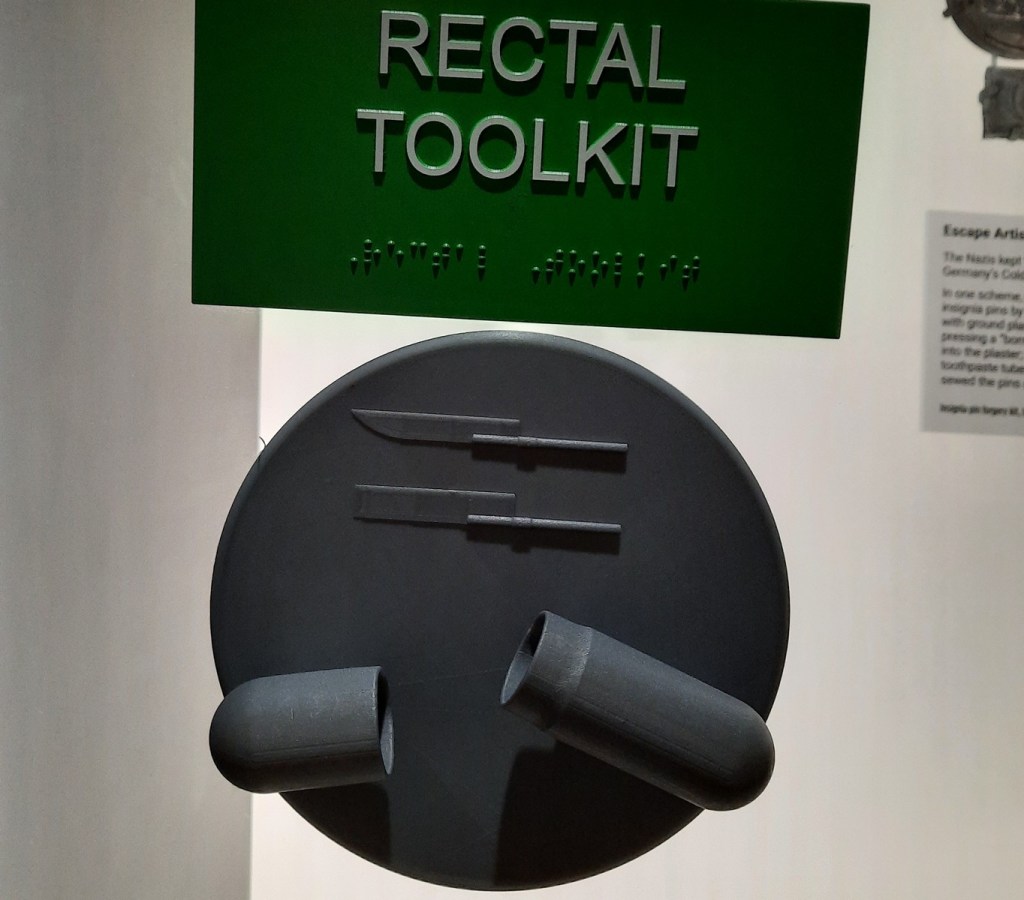
But man look the weird part is, who is this museum for? My initial impression is that it was kinda geared towards kids. They have that spy mission thing I mentioned which I think I would have found astonishingly cool when I was 12 (it was still alright, we all tried to do all of it). The artifacts are all behind glass of course, but on some of the displays they have like, tactile versions you can touch, which includes this one:

So um, yeah kids, know you can really know how big the thing you put up your butt is. Very family-friendly. Maybe this is becoming too much of a theme on this blog, but one thing I don’t really recall the museum doing is trying to grapple at all with the moral aspects of this whole spy game. By definition pretty much everything the museum is detailing is extra-legal, and they don’t super try to ask questions about whether it is all worth it, or who the targets of this spying is and why. My super amazing girlfriend and I watched a group of kids huddled around a very neat display detailing how they assessed Osama bin Laden was in his compound. And people fret kids might learn about slavery.

As you descend from the tradecraft floor, you come to what I think was termed the “kinetic action” floor, aka all about killing people. The above photo is of a underwater canoe thingy so SCUBA-equipped assassins can get places. I was thoroughly impressed by the range of artifacts they had the museum, including even the actual ice axe used to kill Trotsky. Which… wow? These people are bidding on different ebay auctions than I am. I sort of tried to imagine bringing a kid around this place, you know, show them some cool history and murder weapons and really introduce them to the murky world of international extrajudicial assassination. Normal, good parent stuff.

Anyways after all that you descend another set of stairs and then you wind up in the gift shop. They have a really good selection of books, actually, but I was very disappointed to discover that they didn’t have any lapel pins. I really wanted a souvenir of my morally hazardous adventure.

Arlington National Cemetery

Reading this week:

  • Dancing in the Glory of Monsters by Jason K. Stearns

I am at least a week late in posting this and several weeks late in writing it, but during October my super amazing girlfriend and I, along with another friend of ours, visited Arlington National Cemetery. I think of Arlington Cemetery as an old haunt of mine because my grandpa is buried there along with an uncle and aunt of mine. On top of that, I went sailing with Ted Kennedy one time, and since he is buried there too I have plenty of reasons to visit.

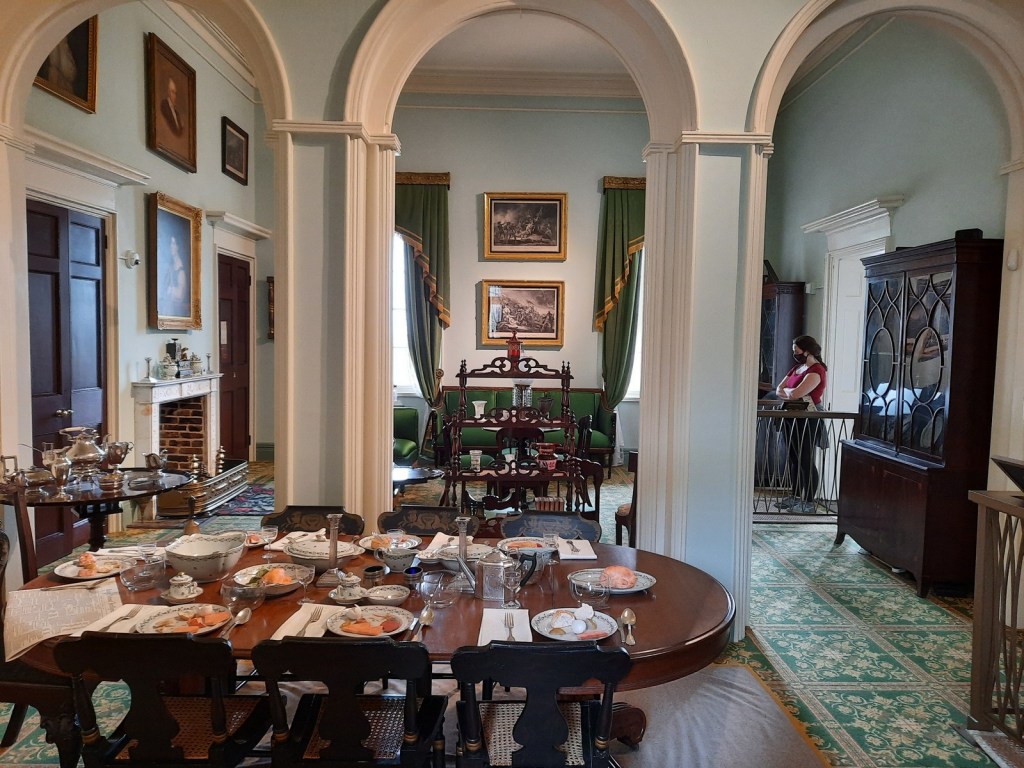
For those not in the know, Arlington Cemetery is located on the site of Robert E. Lee’s estate. It’s more accurately the estate of his wife, Mary Anna Custis Lee, but it became a cemetery when Union Soldiers buried their war dead in her garden as a sort of revenge against Confederate General Lee. The house was built by Mary’s father, George Washington Parke Custis, and I gotta say that man certainly understood the importance of location, location, location. The picture above of course doesn’t do it justice, but his front porch is almost certainly the absolute best place to look over Washington, DC, in its grandeur and depravity.

In all my visits to the cemetery, this was the first time that I actually toured the house. It’s fine. I mean it’s a very nice house, but it isn’t my first plantation house. We somehow wound up between guides, but from what I overheard from the group ahead of us the tour guides were very good at centering the story of enslaved persons in the house and highlighting their identity and personhood. I also hadn’t realized before that next door, but down a little path and through a garden, is a whole (but very tiny) museum on Robert E. Lee.

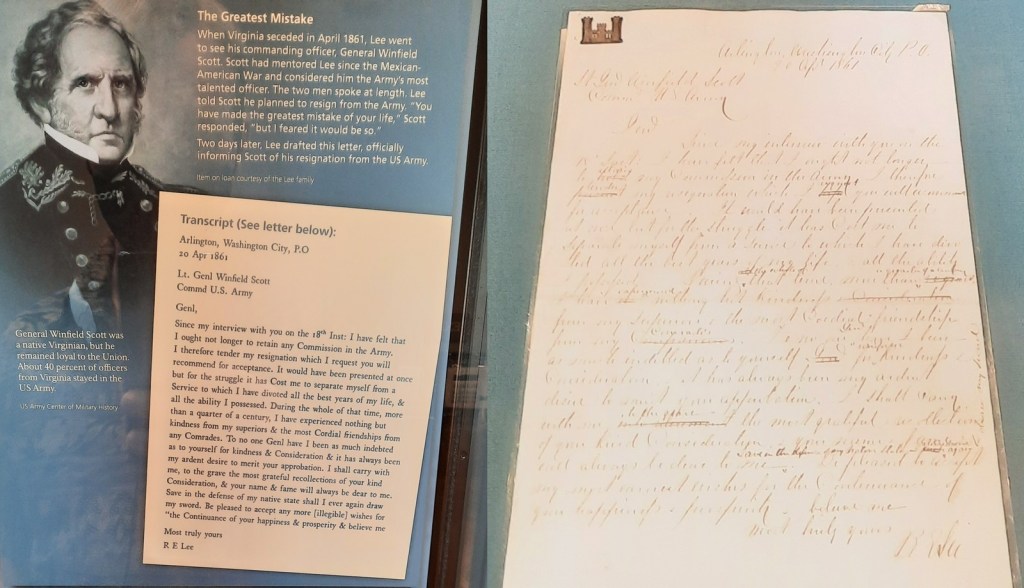
The point of this blog post is my huge disappointment with how they presented Robert E. Lee at Arlington National Cemetery. They swung for nuance but whiffed by trying to teach the controversy. I have some sympathy here, because it is hard to have a museum about a guy and not try to make him sound okay. But they can and should do better.

The central moral dilemma in the story of Robert E. Lee is his decision to resign his commission in the U.S. Army to go fight for the south. He had to decide, and the museum details this at length, whether to remain loyal to his country or to his state. This was undeniably a real moral dilemma for our man Lee, as evidenced by his letters on it. Since this museum is in the context of Arlington Cemetery, they highlight the personal cost of the decision, which was that (among other things) his family would have to abandon the estate as the Union could obviously not leave it in Confederate hands. Nevertheless, he decided his loyalty to the state of Virginia was more important than his loyalty to the United States.

As I tried to lay out in my post on Mt. Vernon, it is important to understand the decisions people made in the context that they made them. For this reason it is necessary to highlight that during this time period, loyalty to one’s state had much more salience than it does today. Hence, the difficulty of Lee’s decision. This is the story the museum tells and the story people who want to use Lee’s legacy for their own benefit want you to know. But as we know today, and as was in fact clear to the men of Lee’s time, the choice to remain loyal to Virginia or to remain loyal to the United States were not moral equivalents.

Lee’s decision to betray his country and join the Confederacy was a choice to lead men into battle and to their deaths, and risk his own life, in order to uphold the institution of slavery. The Confederacy tried to will into being by use of force a country founded on the principle that people are not created equal, that it is the natural order of things that certain people can be bought and sold because the color of their skin means they have no value as people. The moral decision that Lee made was not whether to remain loyal to his state or to his country, and by presenting it that way the museum makes it seem plausible instead of obscene. The moral decision that Robert E. Lee made, after much thought and consideration, was that some people had no inherent right to life or freedom. By presenting it any other way, the museum does at least some work in continuing to deny the personhood of Black people.

That is the central wrong the museum does, but there are other offenses. As we should all be aware by this point, there has been more than a century of work to repair Lee’s reputation. The museum makes hay of Lee’s apparent efforts towards reconciliation. Should Lee get credit for trying to bring the country together when it was his purported military prowess that did the most to tear it apart? Should you trust a glowing quote about Lee from 1925, during the tail end of the (first) height of the Lost Cause narrative? [1] Inside the house, they have a sign detailing that President Ford pardoned Lee in 1975. Without commentary, they quote President Ford as saying “General Lee’s character has been an example to succeeding generations, making the restoration of his citizenship an event in which every American can take pride.”

What are we taking pride in here? The character of a man who thought there were principles more important than the concept that every person is created equal and has the right to life and liberty? Fuck right off.

[1] Actually, from what I can tell Louis Cramton was a pretty great guy. However, the context of that quote is that they were trying to fend off a museum that more fully glorified both Lee and the Confederacy, and the compromise they made was to only glorify Lee a little. Tell you what guys, this is how they always get you: they get you to admit someone had some nice moments, and use that to gloss over the fact he fought to maintain the right to enslave other human beings.

National Museum of African American History & Culture

From inside the museum, overlooking a field of flags with each one representing a death in the United States from COVID-19, over 700,000 in all.

A couple weekends ago my super amazing girlfriend and I finally got to go to the Smithsonian’s National Museum of African American History and Culture, and wow it was phenomenal. It was thanks to the diligent efforts of my super amazing girlfriend that we got to go at all, since she managed to get us tickets. We didn’t actually get to see a whole lot of the museum. All the people we talked to who had visited warned us that it was immense and expansive and would take a whole day at least to see everything. We dismissed these people as less experienced museum-goers than we were. However, they were right. We saw a fantastic amount of artifacts and history and culture and only scratched the surface.

When we entered the museum, the docent who greeted us suggested we start upstairs, in the culture section, because the downstairs history section was “a little crowded.” So to the very top we went, and the first gallery we saw was an art gallery. This was a fantastic collection of art, with the majority (from my impression) from the last two decades or so, but with a selection from the 20th century as well. A running theme of this blog post is going to be that I will have to take many more looks at this museum. Just now, looking at the above picture I took of “The Wives of Sango” by Jeff Donaldson, am I noticing that they are armed with rifles and have bullets around their waists. The docents in the art gallery had to regularly remind people to stay at least a foot or so away from the art; clearly people wanted to get up close and intimate with the works on display.

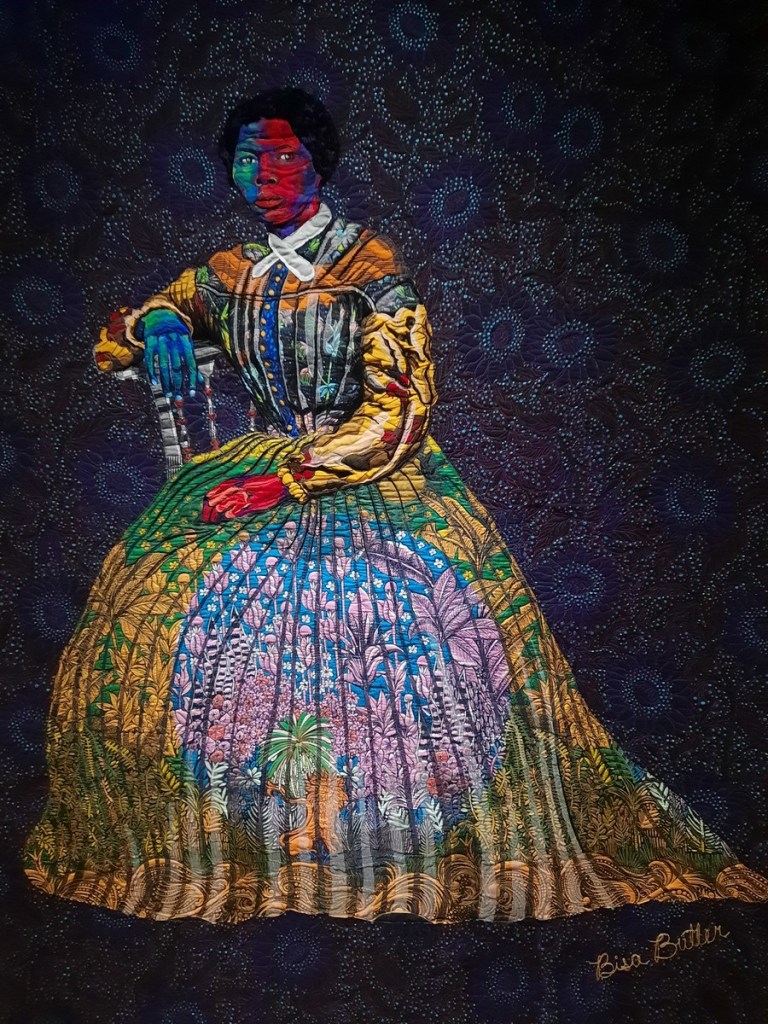
I’m trying to come up with something to say about the museum other than “wow” that isn’t entirely reductive or which stray into something like a liberal gaze. I was thoroughly embarrassed by the fact that as I went through the art gallery, it was difficult to tell what era each piece was from without relying entirely on the accompanying plaque. There were a number of repeating themes, which I took as speaking to the déjà vu of the Black experience in the United States. It is not a positive sign that icons such as Harriet Tubman, depicted above in “I Go to Prepare a Place for You” by Bisa Butler continue to resonate. My picture above of course fails to do it justice, but it is an incredibly constructed quilt drawing on a whole range of inspirations which, in its presence, creates a very powerful effect. You have to go see it, and I will make sure to go see it again.

After walking through the art gallery, we stepped into the light into a huge display of artifacts from over a century of Black music and musicians. When you step through the door, Chuck Berry’s Cadillac El Dorado greets you, but the sheer number of artifacts they have is hard to believe. I was blown away by how much they had to try to tell even a small fraction of the story of the African American cultural experience. That was an absolute hoot walking around and seeing as they trace the different threads of music and popular culture, and explaining how each era responded both to what had come before and the external forces that both attack Black culture and mined it for its own use.

We had barely scratched the surface of these two galleries before we both checked the time and figured out that something like two hours had passed I think. We decided to take the elevator down to the bottom floor where the line to the history section begins. It was quite a line despite the museum being at limited capacity. For those that haven’t been, after getting through the line you descend another three stories down to the very bottom of the museum, and then walk your way up through African American history. It begins by discussing the early aspects of the Atlantic slave trade. One of the most powerful pieces that I saw there was an amulet in the form of miniature shackles. It was from the Lobi people of what is now Ghana, and I was just blown away by what it meant about the deep effect this evil trade had on the people it touched.

The amulet is at the top, with child-sized shackles below it.

We only managed to get through until about 1950 as we proceeded through the history. One of the areas I learned the most about was with slavery on the gulf coast, and about how the history of colonization there and the different communities built by the native people of the region alongside freedom seekers there. That gave me a much better understanding of Black culture in the gulf coast region, though clearly I was only able to pick up the tiniest of details and I need to learn more. What I appreciated about the museum is that they told the personal stories behind the objects and artifacts that had collected, and used those stories to construct their history. They also did not shy away or attempt to sanitize any portion of the history, showing pictures of lynching and violence perpetrated against Black peoples throughout American history. I regret that we didn’t have more time to absorb it, staying at the museum until close. I look forward to the next time I get to visit and I hope every American can do the same.

Cat Café 5

Yes, dear readers, we are already on Cat Café 5. Last Friday, in our ongoing efforts to truly absorb the cultural sights of our new Alexandrian home, we went to the extremely cute Mount Purrnon Cat Café and Wine Bar. As you can tell from both the opening sentence of this paragraph and also of course being a long-time reader, dear reader, this is not my first experience with cat cafés and I am well placed to give you my review of this one.

My review: it was great! My super amazing girlfriend discovered Mount Purrnon by just walking around Alexandria one day and spotting the sign. It was instant love. First of course the name is a presidential pun and that is almost guaranteed to win my super amazing girlfriend’s favor. Second, their logo and (as of this writing) front page picture on their website feature a cat in a tricorn cat, which is exactly the right kind of twee to send her over the edge. And finally, the pièce de résistance, the coup de grâce for our feelings about the place, was the fact that we are very much in the market for a cat to adopt and so we have been thinking about cats a lot.

Cat mugshots

Our most recent cat café experience before this one was Crumbs & Whiskers, and while Crumbs & Whiskers is an excellent cat café that I can personally recommend, the experience here at Mount Purrnon was much different. Crumbs & Whiskers would also like you to come and fall in love with a cat and take it home, but they have aggressively optimized for the perfect instagram experience. Mount Purrnon has been open for about a year, and while they also have an excellent instagram, they haven’t gotten anywhere close to that point yet. They in fact reminded me a lot of Crumbs & Whiskers when they had only been open for about a year, so who knows what the fullness of time will bring.

Mount Purrnon is split into two levels, with the ground floor being the wine bar that is in their name. They also serve beer, cider, food, and dessert. Going to Mount Purrnon was for my super amazing girlfriend and me our big Friday night out, so we came early to get a drink before our appointed time with the cats. That was great! Then we head upstairs to meet the cats. We had the place to ourselves, because for some reason our version of a big Friday night out was not the same as everyone else’s. It was a very chill experience, with our non-feline hosts popping in only to make sure the cat’s food was topped off. So my super amazing girlfriend and I got to just hang out with all the cats and really get a taste for their personality.
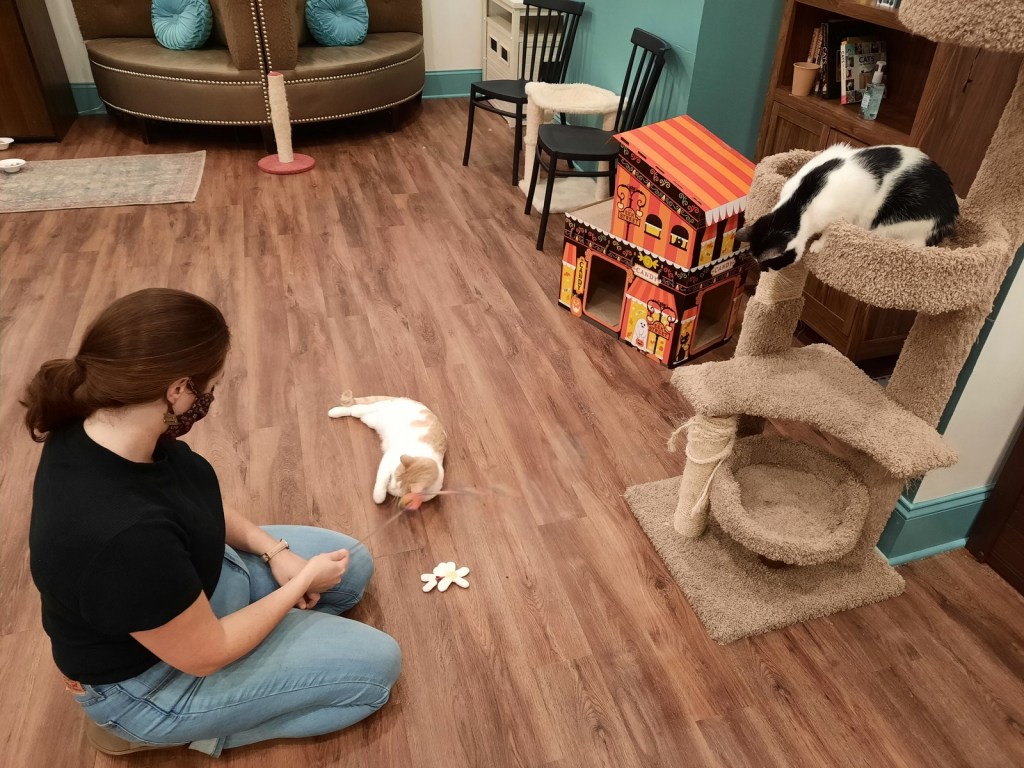
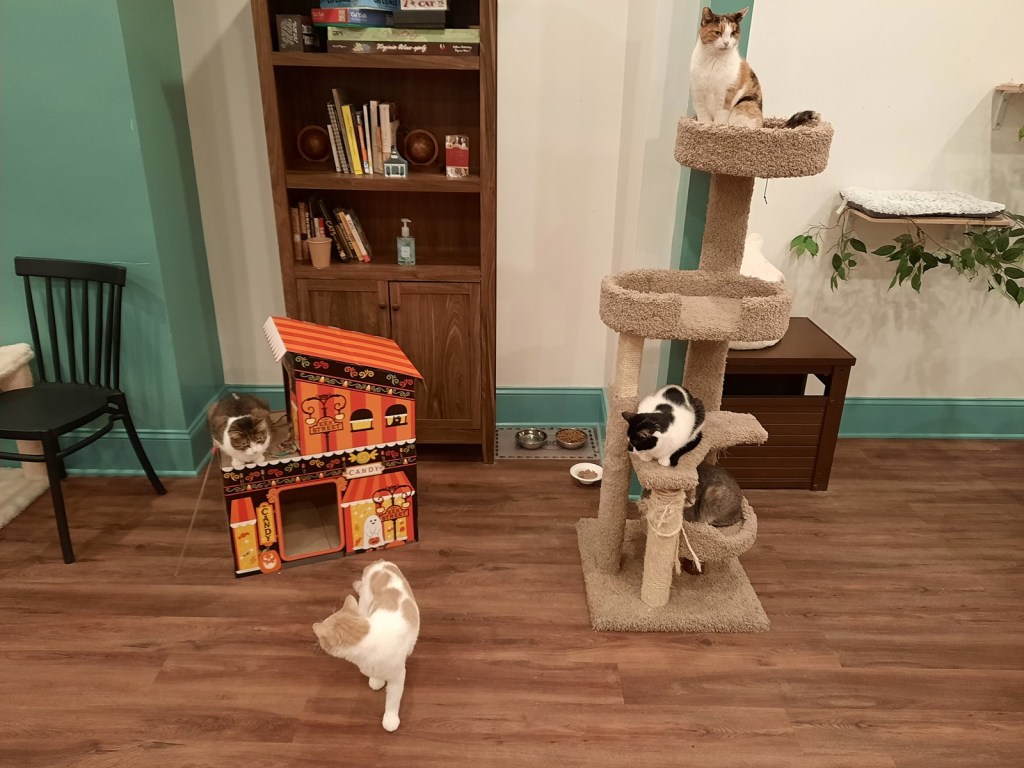
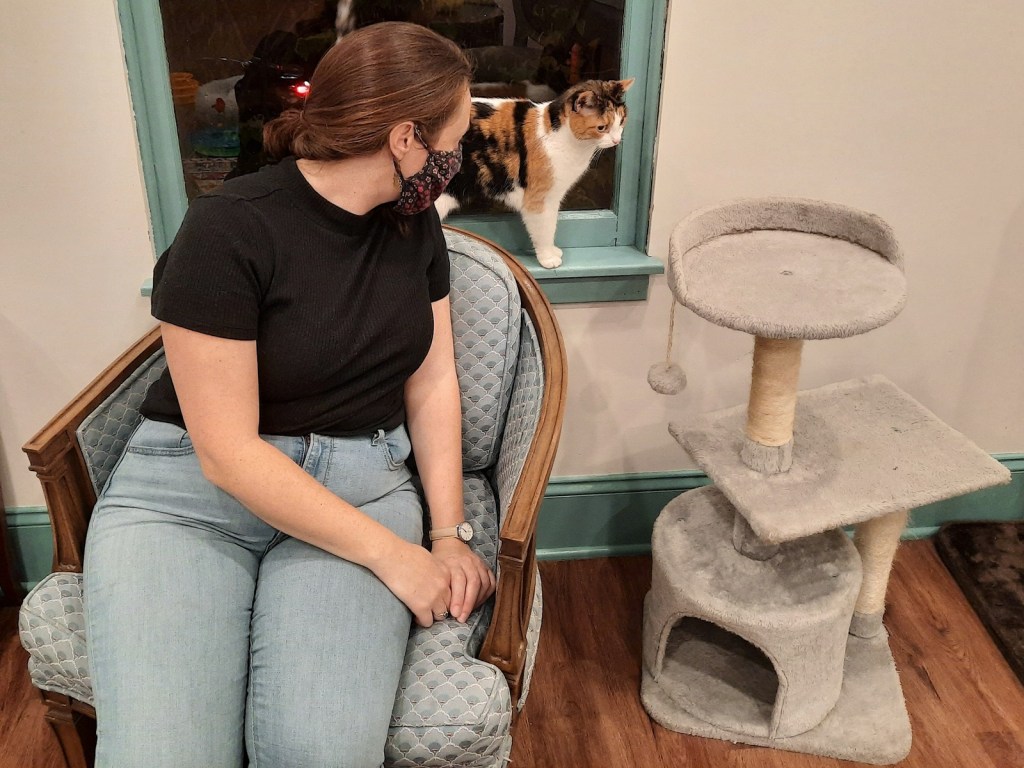
One unfortunate thing for our particular visit is that the cats had, right before we ascended the stairs to the cats, been in a cat fight. This put a number of the cats on edge and also meant another number were hiding underneath one of the chairs. This is simply the nature of cats. About half the cats in the place when we visited had recently come from a hoarder situation, and the socialization aspects of cat cafés had yet to take full effect. But this is one of the points of visiting a cat café, to give the cats some practice being around a variety of friendly humans that just want to give them pets!

Nonetheless we had a great time hanging out with all the cats. There were plenty of toys and plenty of cats and plenty of time to see how each of them are. We went home talking about which of the cats were our favorite and the next morning we put in an application to adopt one! By the time you read this we will potentially be happy new cat parents, and then this blog will go from being purely a tour of every single Smithsonian to being an endless stream of cat photos!

Carlyle House

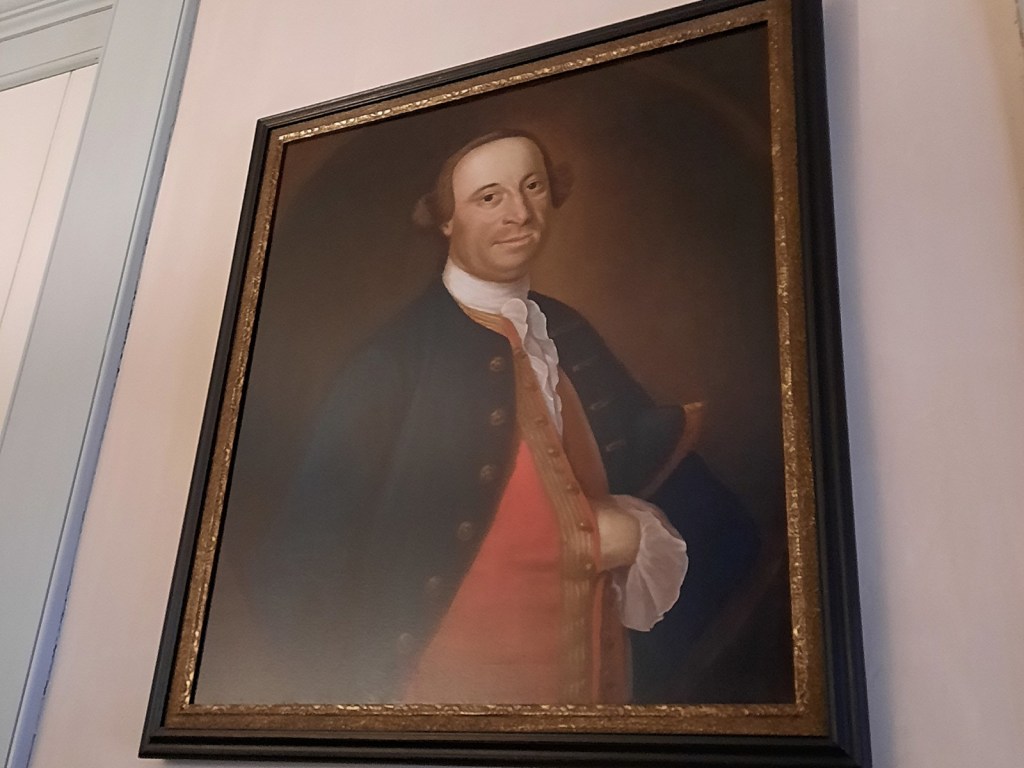
The man himself (a picture of him anyways)

Reading this week:

  • Tram 83 by Fiston Mwanza Mujila

Last weekend, on a gorgeous day, my super amazing girlfriend and I went to go visit the Carlyle House. The Carlyle House is an absolutely lovely little historical house/park run by Northern Virginia parks located here in our new hometown of Alexandria, VA. It is also the former home of John Carlyle, a wealthy early Alexandrian who showed off to everybody by building the first stone house in Alexandria. It used to be on a riverfront property, but now it fronts Lee Street, which I am a little stunned hasn’t been renamed by this point.

The house tour is pretty great and at $5 it’d be a bargain at twice the price. Besides it’s age, it’s claim to fame is being the site of the Congress of Alexandria, when some colonial governors got together to talk about how to fight the French and Indian War. The house itself has been through a lot in the intervening years, though I found it very interesting that the room pictured above, which held the congress, had been reserved as a tourist destination throughout most of its existence, even while the rest of the house was tenements.

Our redcoated mannequin friend above is meant to represent Major General Edward Braddock. Our main man Ed here called the congress when he was sent to prosecute the aforementioned French and Indian War. The congress happened in Carlyle’s House because Ed had, upon arriving in Alexandria, promptly quartered himself in the finest house in town, ie Carlyle’s. The running theme of much of the house tour is that John Carlyle would become (according to the totally unbiased tour guides at Carlyle House) an important and instrumental patriot in the American revolution mostly because Ed Braddock was a massive asshole and terrible houseguest. This is the nitty-gritty, people-centric type of history I do love to see.

Speaking of people, another aspect I liked about the house tour is that I think they approached presenting the history of slavery on the site very well. Slavery was presented as an integral part of the history of the house, instead of an addendum, and unlike some other places they didn’t feel the need to pat themselves on the back for doing the bare minimum. As you can see on the sign pictured above (far from the only one, I promise), the museum gave the names of enslaved persons when possible and treated them as their own people. As I just described in the preceding two paragraphs and unsurprising in a place named “Carlyle House,” they’re still doing a version of Great Man history, but we’re getting to a better place I think.

And, uh, yeah. That’s about what I have to say about the place. They also have some very lovely and I think ahistorical gardens in the back, but they’re nice to walk through and you don’t have to pay the admission fee to do so. My super amazing girlfriend and I are excited to be settling into our new home of Alexandria and are trying to make sure we explore around here instead of only being drawn (as loyal readers of the blog have seen and will see again) the wonderful Smithsonians on offer up in DC. We gotta embrace our new identities as Virginians!