Paperwork enthusiast seeking new frontiers of paperwork. Former submariner, former Peace Corps Volunteer. Opinions, thoughts, and comments reflect no actual persons, living or in the Navy.
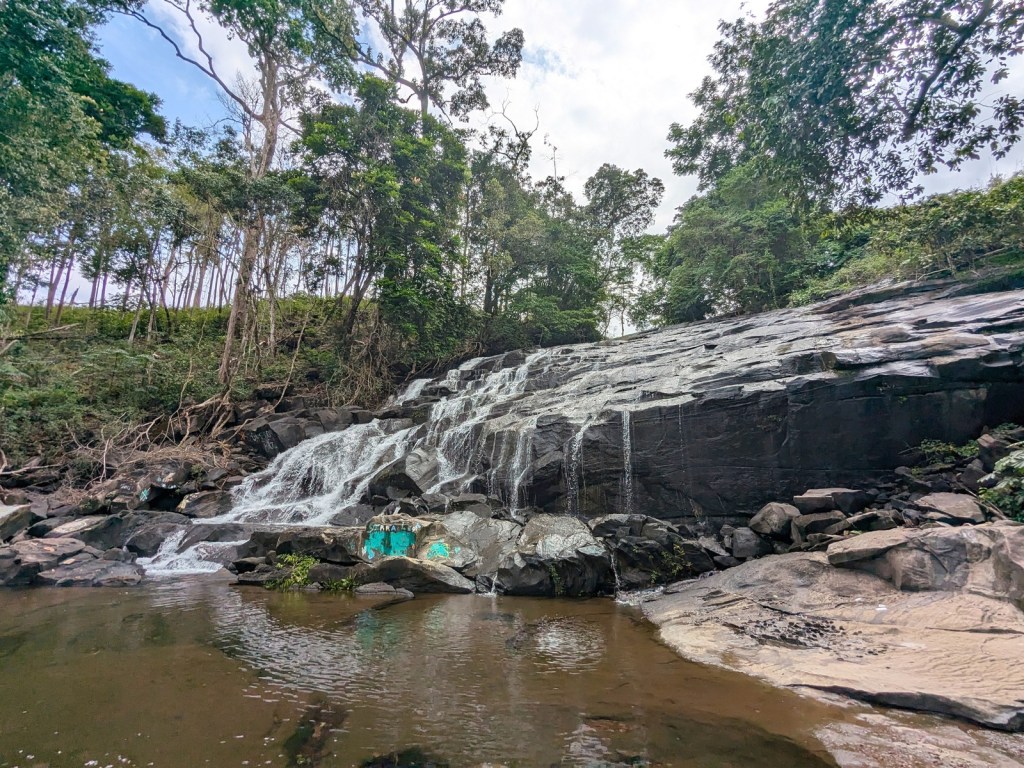
Way back in 2024 and right at the start of the rainy season (yesterday as I’m writing this) we went on a hike to Mambo Falls and it was a lot of fun!
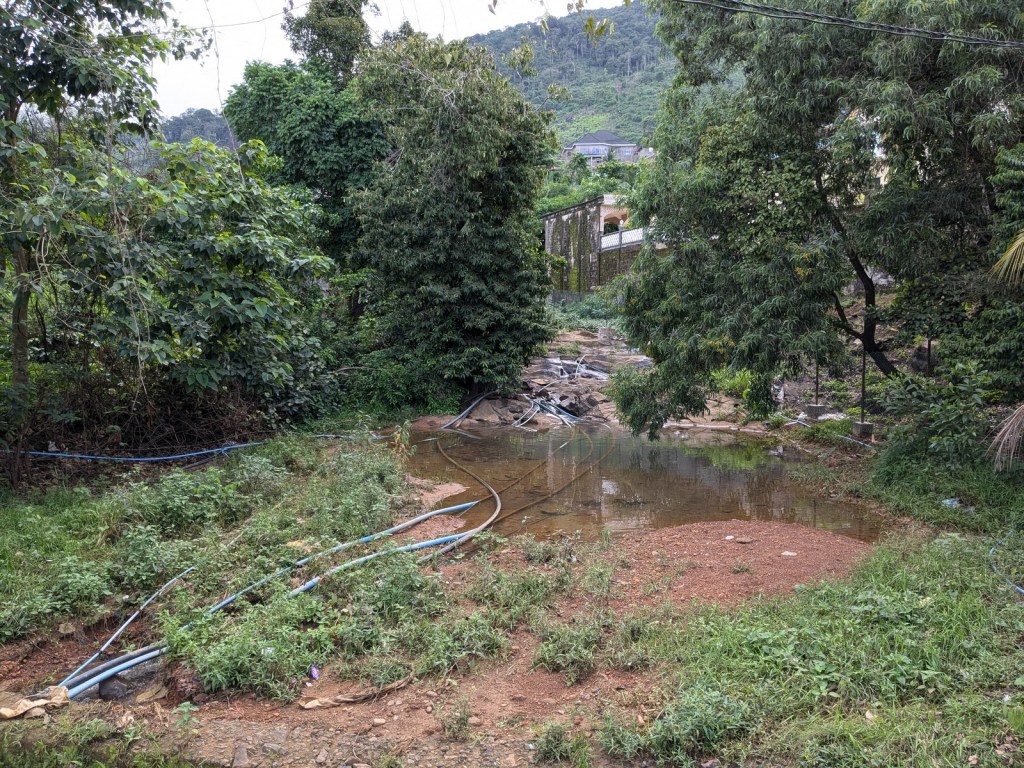
Mambo Falls is apparently one of the more popular hikes in the Freetown vicinity because it isn’t too tough and at the end you get to visit a waterfall. When we visited we parked at J.J. Drive. There was a bridge there and several signs, though don’t cross the bridge, as that is not the way to the waterfall. Please do take note of (what I thought was) the very cool system of pipes that people are clearly using to bring running water to their houses, that is a super neat system:
You can’t really see it from this picture but I think this is a silted-up dam, with the blue pipes leading through a hole in what was the dam wall. There was infrastructure as part of the dam that I think would have led to water pipes, but now they have this system.
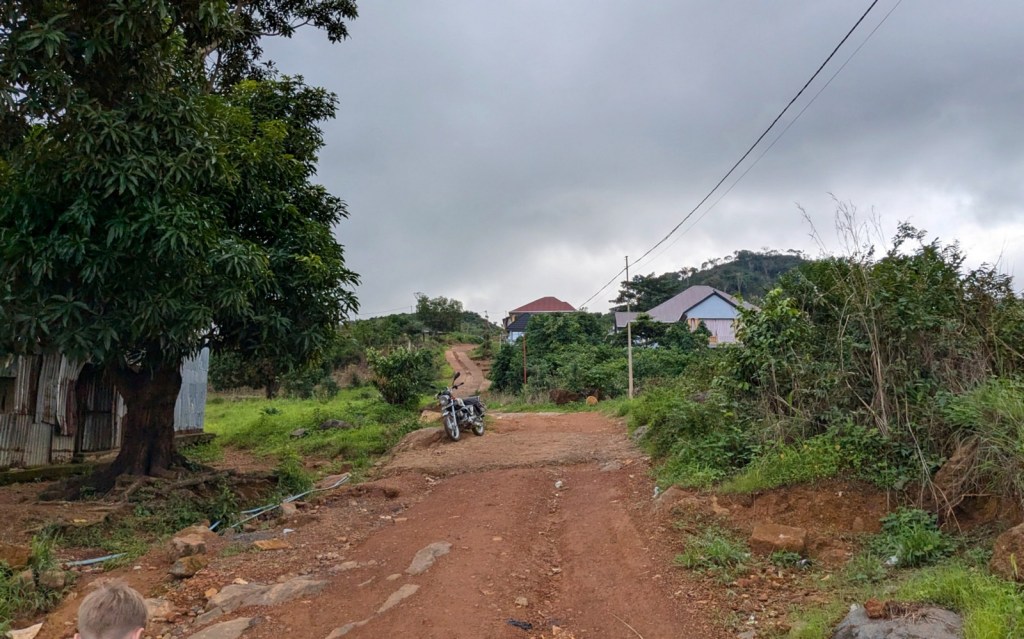
Instead head towards the spot in this link, which is closer to the trailhead, such as it is. Mambo Falls itself is also marked on Google Maps, so that should be helpful. Since the hike is rather popular everyone around will probably realize you’re trying to go to the waterfall and point you in the right direction if you get lost, and you can also ask for directions. Generally, go uphill.
Path toward the waterfall.
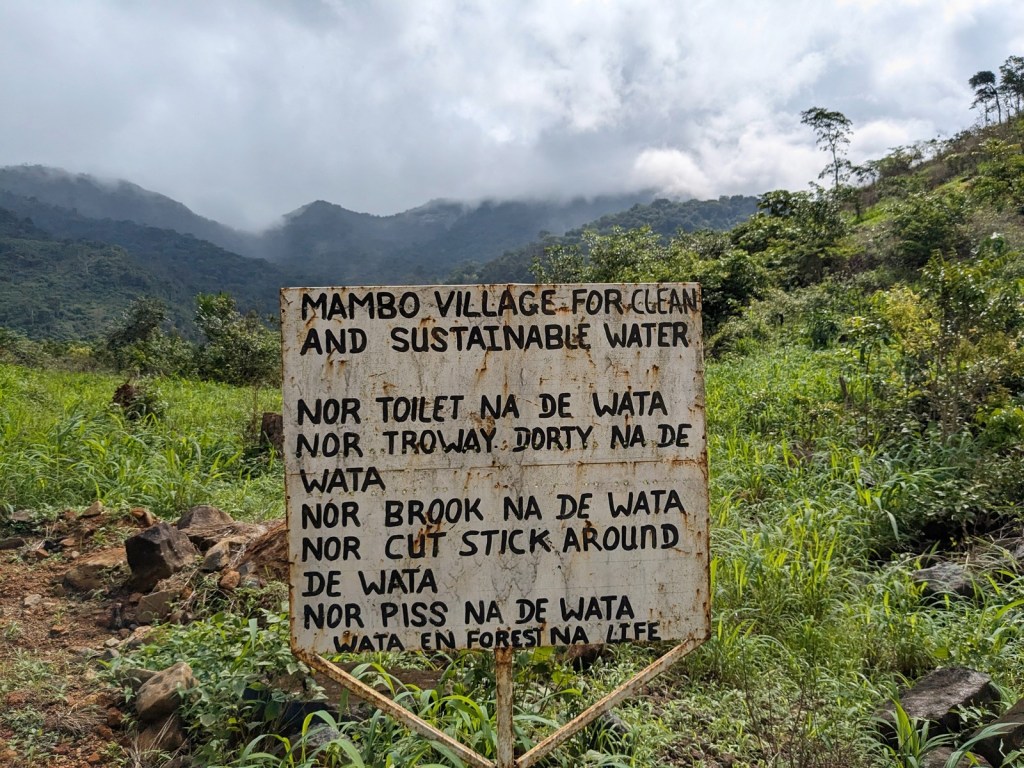
The other reason the hike is so popular, besides being able to see a cool waterfall, is that the trail and the waterfall area itself is maintained as a community project. As such there are signs pointing the way as well as delineating appropriate behavior at the falls. It also means that there is an entry fee to pay for this upkeep, and near the crest of the hill before the descent to the falls itself there will be a small hut where people collect that fee. When we went it was 10 Leones, or less than $0.50 USD at the time. Besides the trails, this meant that the falls area itself was well-kept (as we arrived a man was raking up some of the accumulated leaves), and there were even some small shelters to relax in.
Rules for the trail, in Krio.
The hike itself is not too tough, minus having to walk pretty much straight uphill and then straight downhill. It is much less steep than Sugar Loaf was and significantly shorter. Plus on the way there and the way back you get some incredible views of the valley where the waterfall is and of the ocean from atop the peak. Gorgeous stuff.
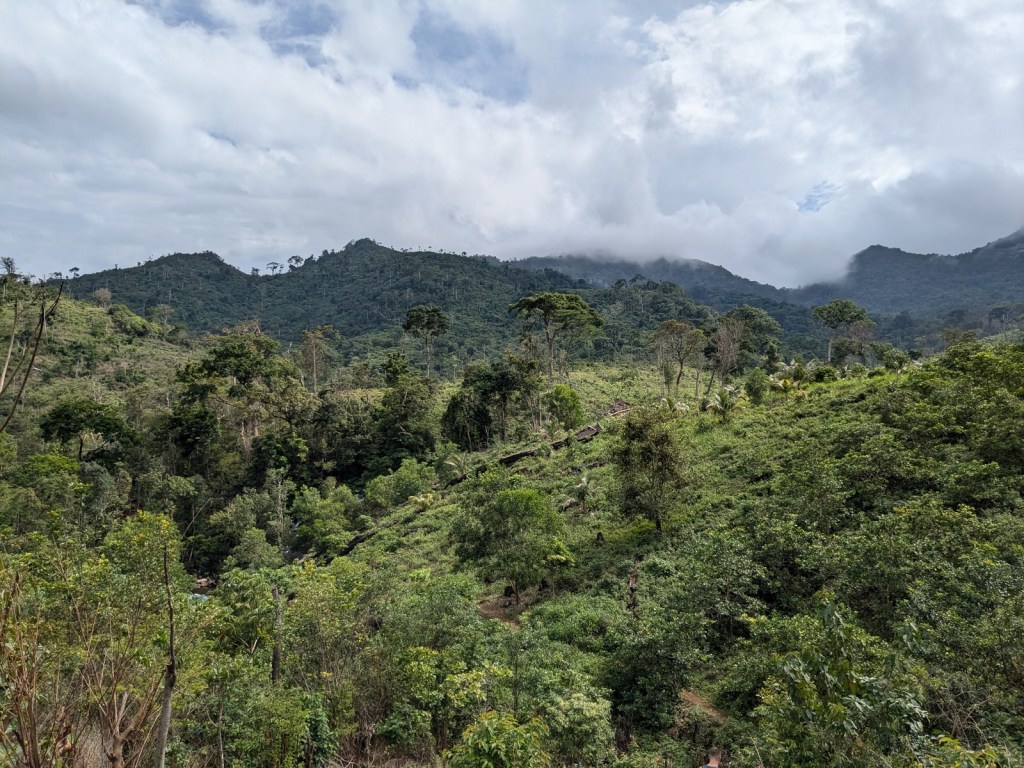
Looking down into the valley with Mambo Falls, which is just barely visible in the lower left. I took this picture though in admiration of the hillside farm in the middle.View of the Atlantic you get on the way back, with the Banana Islands on the horizon on the left.
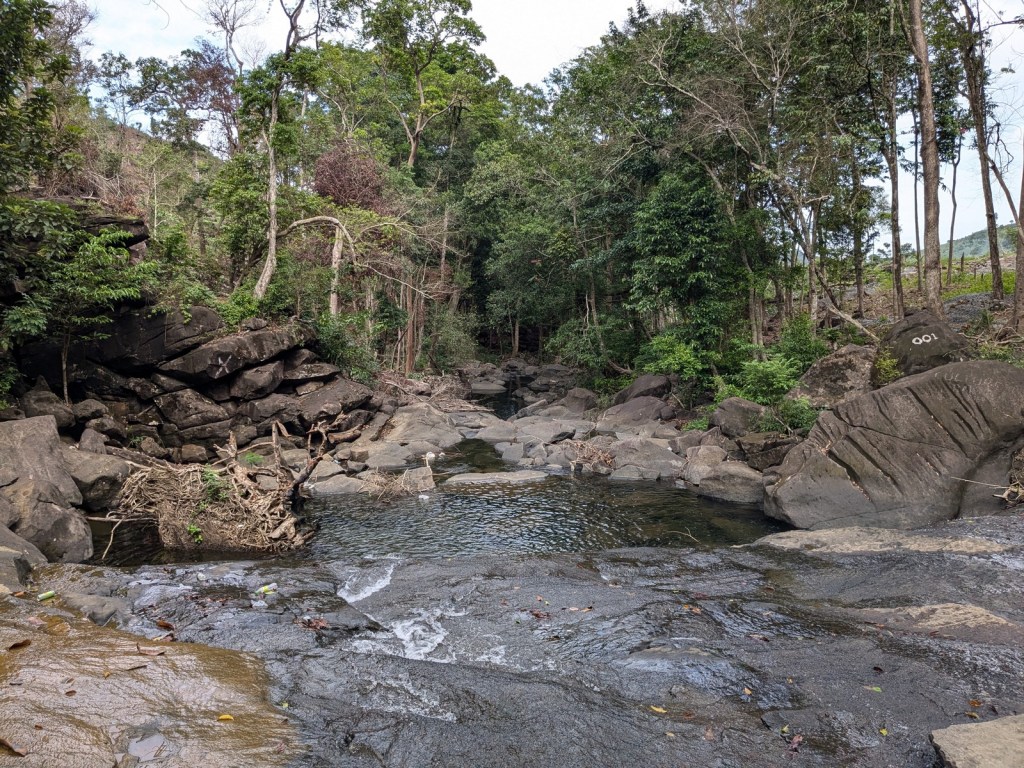
Arriving at the waterfall we had fun doing the normal waterfall stuff, i.e. swimming around in the shallow pool at the base and getting sprayed by the water cascading down the rocks. In the pool as well there were cute crawfish-looking things that were actually pretty ready to fight; I am pretty sure one grazed my feet and I scampered off to the safety of dry land where they couldn’t get me. You’ll probably have company at the pool because it is a popular spot to cool off, but everyone is friendly.
And that was pretty much our hike; we spent about two hours total on the endeavor and it was a very fun way to spend a Saturday morning. Although the community does upkeep on the place if you do go remember to be polite and pack out any trash you bring and be respectful of the site!
Yesterday, (as of writing this), I hiked on up Sugar Loaf Mountain! It was fun and I am still exhausted. My super amazing wife was out of town and a group of people were going hiking up the mountain and invited people along. I was expecting a big crowd but there was not a big crowd instead there was a relatively small group of people who were all much much fitter than me and I spent the whole time struggling to keep up.
The trailhead.
The hike starts in Regent. If you want to do the hike yourself, the trailhead starts here. Follow what Google Maps displays as a road until the end and then keep going along the waterpipes and on up the trail. The picture above is the trailhead, at least how it looked the day we hiked it (at least two years ago as you are reading this), but Freetown keeps expanding its borders so who knows what it will look like when you give it a go.
According to the Visit Sierra Leone site, you are supposed to get a local guide and pay a small donation to hike on up the trail. As far as I could tell we didn’t do that and no one really approached us about it (not clear where one would ask for a guide), but it might be helpful to try to figure it out if you’re not going with someone who already knows what they are doing. The trail is supposedly marked, which is sort of true. It has definitely been marked many times. Hiking up we passed by arrows painted on rocks, paint on trees, and ribbons tied to branches. The trail itself was also usually pretty visible, though people have taken multiple paths around various obstructions, and it seems there are plenty of stories of people taking a wrong fork and winding up on the wrong mountain. If you haven’t seen a discarded water bottle in a bit, you’re probably on the wrong path.
Two guides were engaged, and about eleven o’clock I started, and was one and a half hours making the ascent. No one had been up for a long time, and the path was much overgrown, so that my guides missed their way twice. I never saw any thing like it. It was like going up a ladder, from rock to rock, up, up, at every step – at times pulling ourselves up by the bushes; at other places walking on an extended bare rock, with the inclination of a steep roof, while precipices of thousands of feet lay beneath. It was a very wearying effort, but we reached the top.
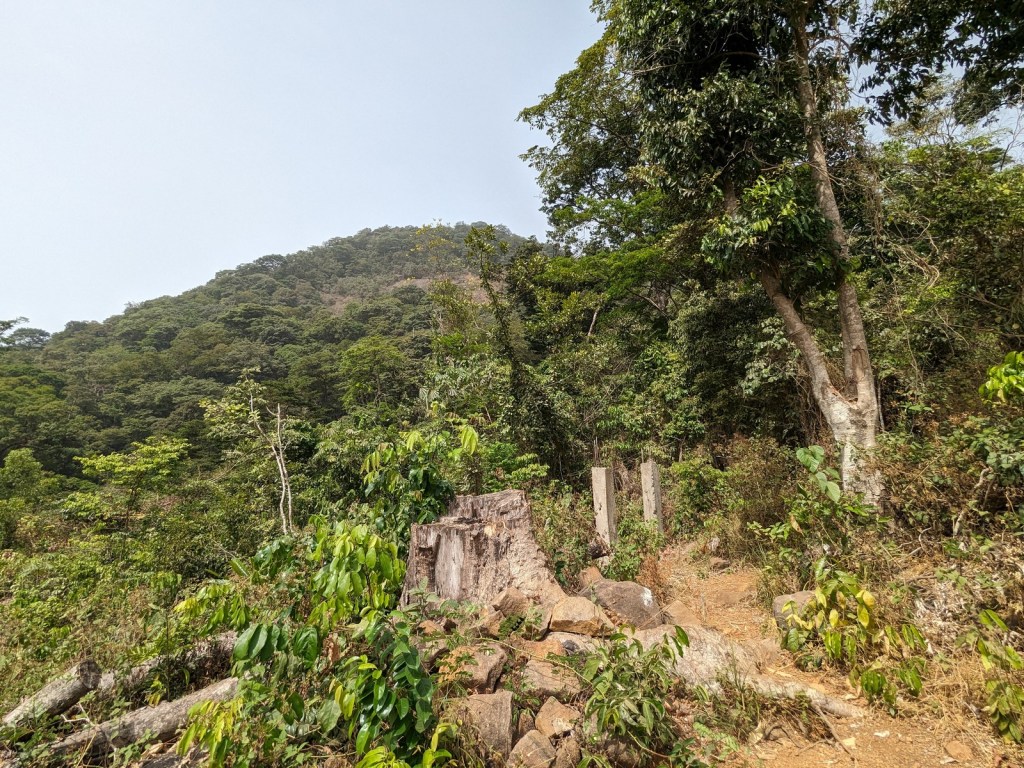
It hasn’t changed much (the trail was less overgrown than he described like I said above, but I think he did it closer to the rainy season). Since the internet said it was a marked trail I had expected, like, switchbacks. The straight-line distance for the trail is not even a mile, and before the hike I had been worried about how long a reasonably curvy trail up the mountain would be. Turns out the trail goes pretty much straight up from the trail head to the tippy-top, gaining (again as far as I can tell from Google Maps) 1000 feet of elevation in about 3000 feet of walking. Steep! I don’t think it would be too too bad if you were taking your time instead of running after people way more in shape than you, but there are definitely some slippery leaves and tricky bits. On the descent I resorted to crabwalking a few times. In the picture above you can see the rock faces our dear man George was talking about, but those were actually easy sections; the rock was grippy enough that you could just (“just”) walk up, though in the rainy season it might be much more hairy.
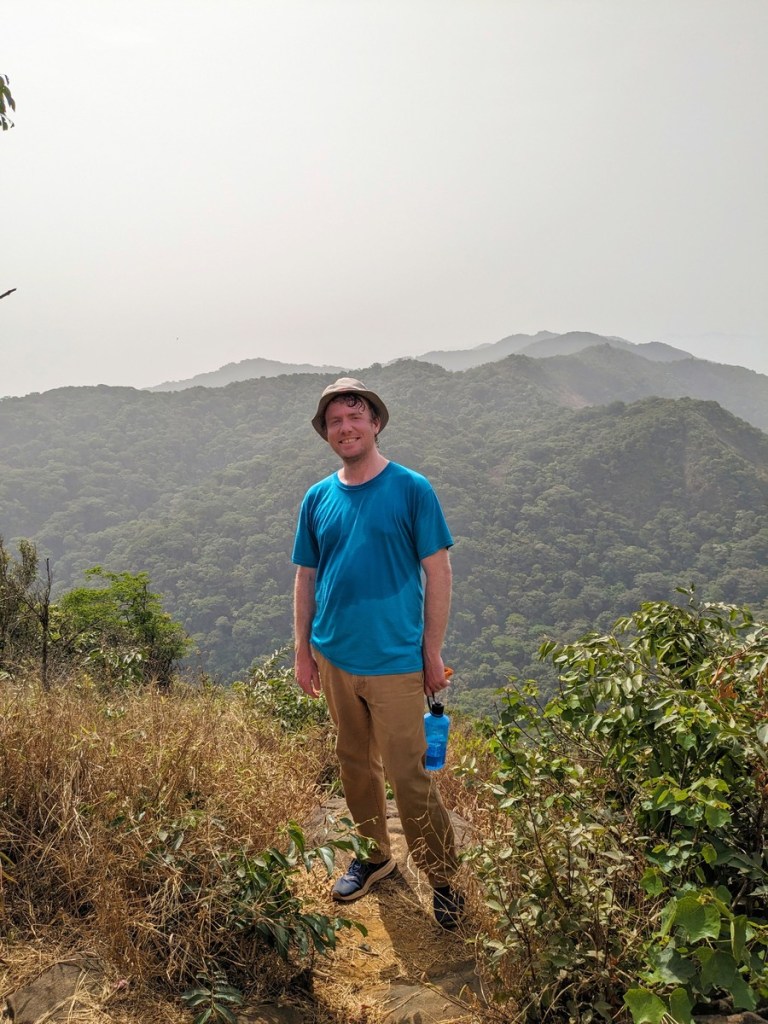
Further down in the paragraph quoted above George describes wondrous sights but unfortunately on the day we hiked up it was more than a bit hazy with the tail end of the Harmattan. What we did see was still rather pretty, but given how pretty it was I can only imagine the sights when the skies are clear. The photo at the top was about 3/4 of the way up and was the best view of Freetown itself, while the photo right above this paragraph was at the summit (I tried smiling I promise but I guess this is the best I could muster so exhausted) looking south into the forest preserve. It’s a gorgeous landscape, so unlike the port side of Freetown which really isn’t far at all, and must be unlike anything else in Sierra Leone until you cross the lowland plateau and hit the hills 100 miles inland. Worth the walk even if it is a doozy!
This is the story of me trying to find Heddle’s Farm. Why did I go looking for it? Because it is there. Maybe.
Early on in our Sierra Leone journey I of course discovered the list of national monuments. In Zambia, it was a book about various national monuments published by their National Monuments Commission that had me out looking at a lot of stuff and then trying to document it on the internet so it was more accessible to other people. I wanted to recreate that here in Sierra Leone because it is fun. These sorts of things have just the right amount of mystery. The places are usually documented enough that you can find them but not documented enough where it’s easy. I should point out that this is about documentation. Someone knows where all these things are; they are written down in government archives somewhere or someone is in charge of going and looking at the things every so often. That someone probably works for the Sierra Leone Monuments and Relics Commission and I really need to get down there and talk to them but I usually have to work when they are open and I just haven’t made it yet. So when I am looking for things there are easier answers but the handicap makes it fun. This brings me to Heddle’s Farm.
Right away I wanted to go look at Heddle’s Farm. Probably what intrigued me the most was that, according to the Sierra Leone Heritage page I just linked to, it eventually became part of the botanical garden of Fourah Bay College. I like botanical gardens so once you find out one exists, you like gotta go. And maybe they sell saplings that I could plant. It also meant I thought it would make it easy to find Heddle’s Farm, I mean, I know where Fourah Bay College is and it’s easy to drive to and botanical gardens are large and easy to spot. Not so. I dragged my super amazing wife out one weekend to drive around the college (through and then back through again that is) to see if we could spot the garden. We couldn’t. Later that week I had her ask some local colleagues about it and they were vaguely aware a botanical garden existed but were not really sure where it would be. So that was a bit of a dead end.
Back on the Sierra Leone Heritage page it recommends that for further reading you turn to A Residence at Sierra Leone. So I did. I bought the book in hardcopy and had it shipped here and read the whole thing for clues to the location of Heddle’s Farm. The book itself is what it says on the cover, a series of letters and journal entries edited together into a day-by-day narrative of the author’s time living in Sierra Leone. During most of the time she stayed in the house that later became known as Heddle’s Farm, after Charles Heddle, who owned it for a while and was very successful. Not to detract from Charles Heddle, who has a significant amount of stuff written about him online, but after reading A Residence in Sierra Leone I wanted to know more about the author. Her name was Elizabeth Melville. She originally published her book as “By a Lady” (edited by the Hon. Mrs. Norton), I assume to avoid anyone featured in the book thinking she was gossiping about them. But googling around I can’t really find anything much about her, though like so many things in Sierra Leone clearly someone knows a significant amount about her, I just don’t know who and I don’t know where they wrote it down. So in an attempt to be helpful to future googlers, I present, based on everything I could find online about her,
A Biography of Elizabeth Melville:
Elizabeth Helen Callender Melville was born in Dunipace, Scotland, on March 14, 1818. In 1840 she moved with her husband and baby to Sierra Leone. Her husband was a judge on the Mixed Commission Court which examined whether seized ships had been part of the slave trade. The family had at least one furlough in England but returned there permanently in 1846. She published her book in 1849.
…and that’s it. Elucidating. Anyways out of reading the book there were a couple of clues. One is that she describes the house as being “at the formidable distance of half an hour’s ride” from Freetown, which I figured put it about a mile from what is now downtown. Another is that she describes looking over at Mount Aureol from the house (she spells it “Oriel”). She says “The hill to our right rises up very abruptly, shutting out the view of both river and opposite shore. It is much higher and still more difficult of access than this; although were a plank (could we find one long enough) flung across from our windows to the corresponding height on the other side, I think I could run across in five minutes.” From that clue her house is not on Mount Aureol, but next to it. When I looked at Google Maps for where Mount Aureol was, it showed me what I interpreted to be the area next to Fourah Bay College (at this point where I still thought a botanical garden was), so I wrongly took this as evidence the house was somewhere on the grounds of college. But since I already had been thwarted looking for a botanical garden on the grounds of the college, I searched for other sources.
One interesting thing I found was the above picture, via the Library of Congress. I figured there could only be so many botanical gardens in Freetown, so that house pictured might be Heddle House itself. I was further encouraged when I noticed the house in the photo looks a lot like the house in the painting that graces the Sierra Leone Heritage webpage. I also, upon re-reading that webpage, noted that Heddle’s Farm is described as being “on the old Leicester Road.” I managed to figure out that the old Leicester Road is the that the Leicester Police Post sits on. I had also come across this Government of Sierra Leone Integrated GIS Portal, and you’ll have to do the zooming yourself but if you zoom in along that road there is a section labelled “Tree Planting” and ah ha! I thought. Botanical garden, trees, tree planting, Old Leicester Road, maybe I have found it, and with a picture of the location and of the house itself in hand maybe I could go find it. So I went out for another drive to hunt the place down, assured of success!
I was unsuccessful. I could discern no tree planting along the road, except for a sign that said “tree planting.” There were no old buildings or anything that looked botanical garden-like, and as I went down the road it got dicier and dicier to the point where I cut my losses and turned around, defeated.
Once I returned home, I puttered around and realized that although my idea of looking at a map for the location of Leicester Road was pretty brilliant, it was not brilliant enough. Between being the home of Elizabeth Melville and the current day, Heddle House spent some time as the home of the Forest Commissioner. I figured the Forest Commissioner’s house, being a government facility, would be on old maps, and I had already found some old maps of Freetown. Specifically, I had found a 1947 map of Freetown from here. Looking down at the area around Fourah Bay College, I discovered two things: one, that Mount Aureol is the hill that Fourah Bay College is located on, and two, a little marker labelled “Heddle’s.” Well! That settled it! This was the location of Heddle House, on the hill next to Fourah Bay College. For your handy reference, I think it is where this marker is on Google Maps. Now all I had to do was go look at it.
This was not as easy as I thought it would be. I knew from my Leicester Road experience that the driving in that area was not so fun, so what I really wanted to do was park at Fourah Bay College and walk over. Mrs. Melville describes riding up Mount Aureol from Heddle House, and I wanted to essentially do the opposite. I made the mistake of picking a Sunday for this adventure and found a rather large church gathering at Fourah Bay College that I was too embarrassed to try to sneak around so I could muck off into the woods. So I drove down the hill and drove back up the adjoining hill, where I thought Heddle House lay. This was encouraging, actually, because I found a stretch of road that seemed to have once been paved, perhaps in the colonial era, like you would presumably do so the forest commissioner can get up to his house. Eventually though I could go no further without (I felt) significant risk of the car tumbling over the side of the cliff, so I parked in front of a shop after asking the proprietor if it was okay. She was very friendly.
View of Fourah Bay College from what I think is the location of Heddle’s Farm.
From my parking spot it was still a bit of a hike up the hill and the most impressive part of the whole adventure is that there are very nice houses up there built with what look like very heavy building materials and I am stunned someone hiked all that concrete and building materials up there. A very nice view though! The picture at the very top of this post is from near the shop I parked at and was pretty encouraging that this was the spot. The tallest building in the right third of the photo is the Freetown City Council building, right smack in the middle of downtown and the oldest part of the city. At one point in her book Mrs. Melville describes being able to see Freetown from her window as if laid out in miniature, and yeah that is exactly what I saw from that vantage point.
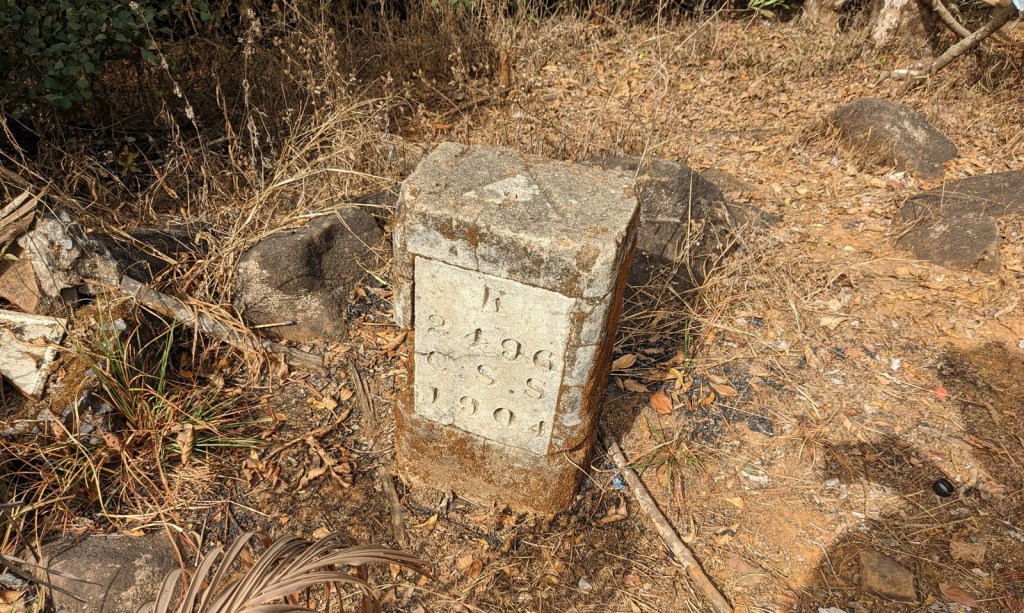
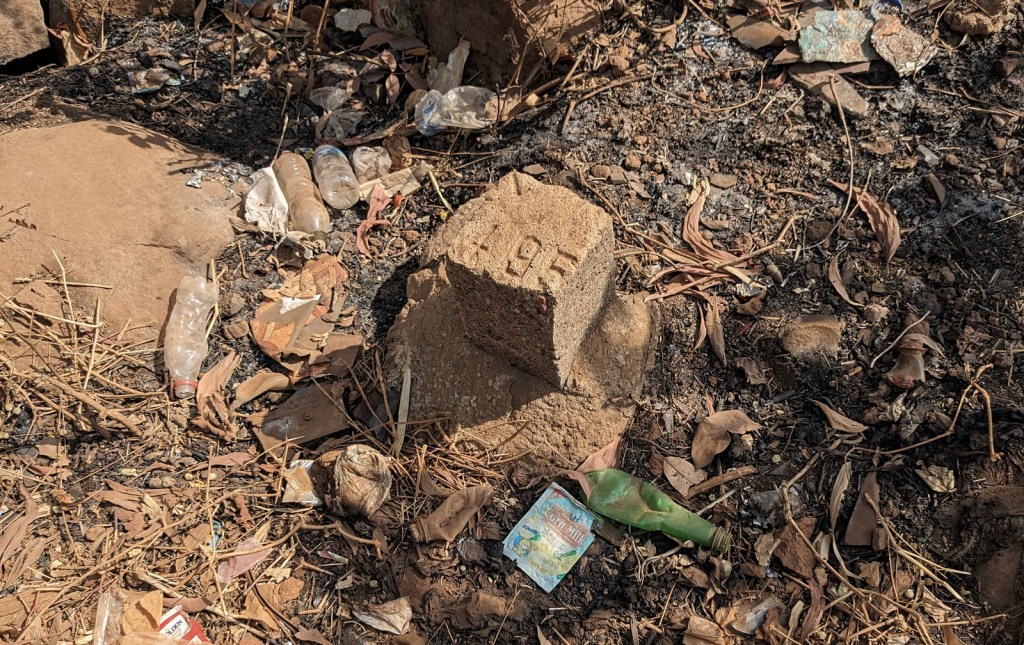
What I had hoped to find at the top of the hill was some sort of historical marker. There are historical markers next to some of the other historical sites I have seen in Sierra Leone, so I was hoping that along one of the paths up there I would find one and it would confirm I was in the right spot. I never did. I was also hoping to find the remains of the house, and I didn’t find those either. For quite a number of years the house had been reduced to just its foundations, and I think even those are gone these days. If you look at the Google Maps link from before, in the area there is a large dirt patch which currently serves as a soccer field and a source of clay for bricks. Nearby is a trash pile and all around the area are homes that have sprung up on the hill as Freetown expands. There is also a communications tower on top of the hill. Various friendly people saw me wandering around and asked what I was up to. I showed them pictures of other historical markers and asked if they knew of something similar up there, to no avail. Some suggested I look over at the college and I went down that path a little ways but didn’t see anything. I also poked around the hill but the only historic-looking thing I found was a geographical survey marker:
Eventually I decided I wasn’t going to see any artifacts that confirmed this was the location of Heddle House but I walked away satisfied anyway. The area clearly matches the description, given the saddle-like nature of the hill, the view of Mount Aureol, and the stunning vista of Freetown laid out in miniature. It’s a beautiful spot and despite the fact I have no idea how people get building materials up there, as a living location it is certainly charming. I don’t think there are any remnants of the botanical garden left, which is a bit sad, but there are other things for Freetown and Fourah Bay College to devote their resources to. The people on top of the hill were very friendly and tried to help. If you’re ever in the area it is probably much more straightforward to go to Fourah Bay College or Leicester Mountain for the views, but if you do get up there they are very nice.
One final note while I’m talking about A Residence in Sierra Leone. At one point in the book Mrs. Melville is relating the story of the 1794 French attack on Freetown, as told to her by various eyewitnesses. Melville is recording this in a letter she wrote in 1846, a half century after the event. Relating the story, she describes how the French “scoured the town in search of stock, which they kept shooting at… books, plants, seeds, dried birds and insects, were torn, trampled upon, and scattered about; telescopes, barometers, thermometers, and an electrical machine shared the same fate…” A mystery (to me anyway) is what the heck she was referring to when she said “an electrical machine?” I mentioned the whole half century thing because the eyewitnesses must have been relatively young when they witnessed the attack, their memory could have been influenced by subsequent events, and Mrs. Melville might have interpreted something they said anachronistically. But with all that being said what 1790s “electrical machine” is existing in a colony that hadn’t been around for a decade at this point? What is this thing she’s referring to? Electrical thingies existed at this point and were popular (Ben Franklin flew his kite in 1752), but what would have been in the colony? It’s listed with weather-related equipment so maybe something to do with that? Or just a scientific novelty? If you know what they are talking about please let me know.
As the last major sight on our DC Staycation tour, my super amazing wife and I visited the National Cathedral. We had been wanting to go for a while, but we hadn’t figured out the bus system until recently, so it was vaguely annoying to get to from where we lived. But since our time in the good ole’ U.S. of A. was running short we finally made the trip.
It was pretty nice? I dunno man I’m not much of a cathedral guy. They don’t do it for me. I like certain churches, but overall Christian religious structures just don’t have the pizzazz of like the one Buddhist temple I’ve seen in person (lots of gold and cushions and statues, good stuff). But one of the appeals of the National Cathedral after all of our recent Staycation touring is that it provided a convenient endcap to some of the stuff we had seen. One example is that the Cathedral, like many of the places we visited, had very nice floors. But a more concrete example is just the previous day we had seen Woodrow Wilson’s old house, and the National Cathedral houses a dead Woodrow Wilson:
Dead Woodrow Wilson
Speaking of racists, one intriguing display the Cathedral had going was about the former location of a stained glass window dedicated to Robert E. Lee and “Stonewall” Jackson. They took those windows down because, you know, hella racism, and they are in the process of replacing them with much better windows. It is always nice to see an institution being so thoughtful about racism, even if it is a century late or whatever. On a much different tone, also nearby is a Flying Buttress dedicated to the memory of Huldah Graeske Morris and George William Morris. I have previously told close friends and acquaintances that when (or if) I die I want a commemorative shoe buckle made in the spirit of George Washington, but upon seeing a commemorative flying buttress I immediately told my super amazing wife I want one of those too. A flying buttress! Who would have thought?
But back to tying this into our previous staycation adventures. Back in the Anderson House, which still has a number of centuries-old tapestries, there used to be even more tapestries. They were hanging in the ballroom, which is now these days decorated with some Japanese screens. After they died the Andersons donated those tapestries to the National Cathedral, so it was nice on this visit to round out seeing some of the Anderson’s old stuff we didn’t get to see when we visited their house:
The Cathedral was actually a fairly alright place for textile art. Besides the tapestries, the children’s chapel had all sorts of embroidery of like cute animals and other stuff that would appeal to kids (presumably, I don’t know what the kids like these days, maybe internet dancing? That could make a good tapestry). One thing they seemed really proud of was that in St. John’s Chapel they had all these kneepads decorated in needlepoints all about “noted Americans.” I picked a few of my favorites below, including John Paul Jones, who I assume is the namesake of the chapel, along with ole’ Bobby Fulton and one of my favorite authors Nathaniel Bowditch (who’s name is pronounced bao-ditch, not BOW-ditch, which should save you some embarrassment if you are ever trying unsuccessfully to impress the Commandant of the Naval Academy when you highlight the books he has on his bookshelf because you are so passionate about navigation):
Anyways that was the ground floor. You can also descend into the basement of the Cathedral, which has more chapels and the like and a sadly closed (while we were visiting) gift shop. But the two best parts of the chapel were first the towers and then the grounds. We only stumbled upon the fact that you could ascend up into the towers of the Cathedral because we noticed the elevators, but if you head on up you can get some really nice views of northwest DC from like the opposite perspective you (I) usually do because I have been up to the top of the Washington Monument twice and been up in the National Cathedral only the one time. It was very pretty when we were visiting in the summer with everything green! Make sure you go up if you visit the Cathedral:
After thoroughly exploring the interior of the Cathedral we head out to walk the grounds. It was pretty hot so we only did so much walking, but the best part of that walking was going through the Bishop’s Garden. It is “inspired by medieval walled gardens” with “terraced landscape features sculpture nestled amid plants of historical interest, native plants, and plants of the Bible and Christian legends.” So that’s neat. The fountains were tranquil and the flowers were pretty and the pathways picturesque and you got some nice views of the Cathedral (including the cranes doing repair work on the exterior which was very neat too) and it is a lovely little place to stroll. Make sure you don’t miss it while you are gawking at variousspace-related things.
His Very Best: Jimmy Carter, a Life by Jonathan Alter
Remote Corners by Harry Mitchell
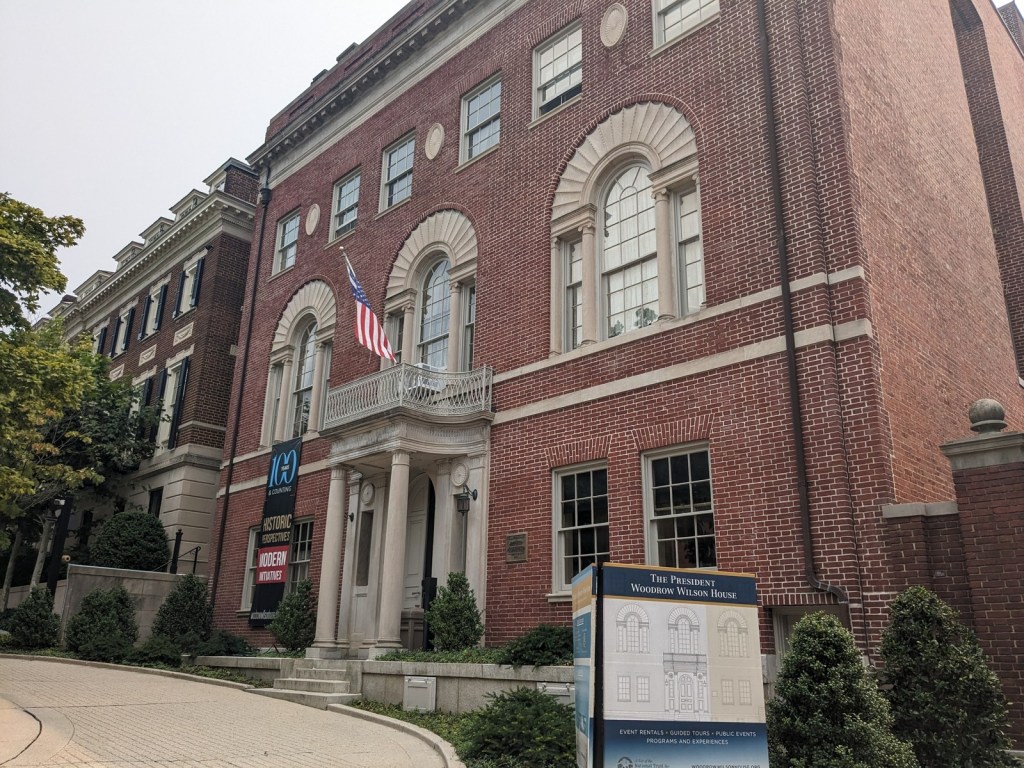
Our continuing staycation non-journey brought us to the Woodrow Wilson House in DC. This is the house that Woodrow Wilson lived in post-presidency. We went because my super amazing wife is a fan of presidential sites and hey this one was there!
The tour we went on was the “Three Generations of Wilson Women” tour because in addition to presidents my super amazing wife likes women. Plus is was the only tour that worked with our schedule that day but we would have been delighted to go anyways. We were joined by a woman who was on her second Wilson House tour for the day along with three foreign women who I guess were hitting the highlights of America. I don’t know if the other tours the house offers focused much on Wilson’s politics but this one mostly skipped it in favor of telling the story of Wilson’s life via the women that surrounded him. And he seemed to have a pretty good chunk of women surrounding him. He had three daughters with his first wife and the tour also takes time to focus on Mary Scott who worked for the Wilsons along with her husband Isaac.
The place is called the Woodrow Wilson House but it was really more the Edith Wilson house. Like I said Wilson moved here post-presidency in 1921 and then died in 1924. He had married Edith while president in 1915. She was 16 years his junior and a whopping 14 years older than his eldest daughter and outlived him by 37 years, dying in 1961. She very much liked being Mrs. Wilson (according to the tour) and spent the next few decades after Wilson’s death sprucing up the house and preserving her version of his legacy.
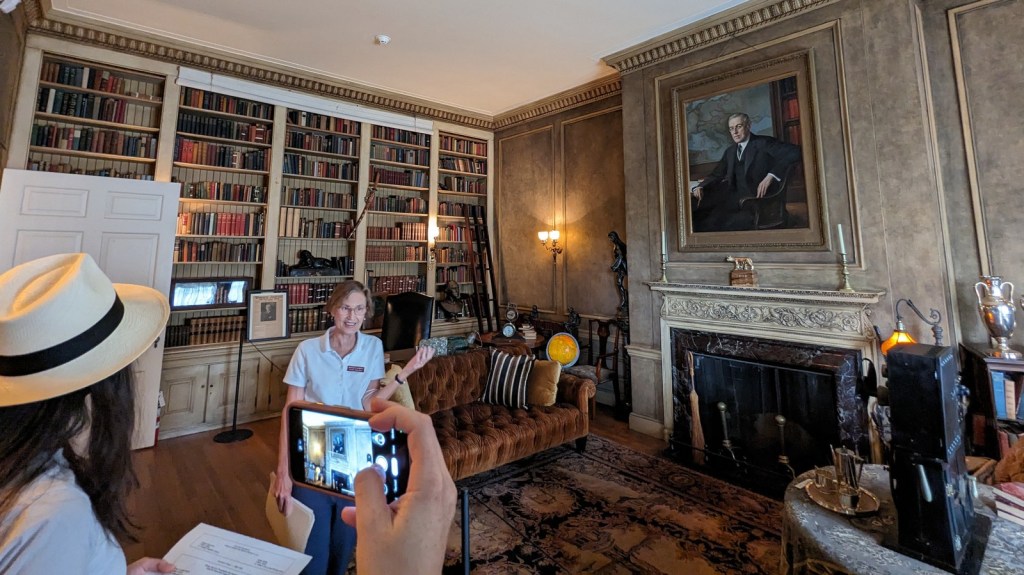
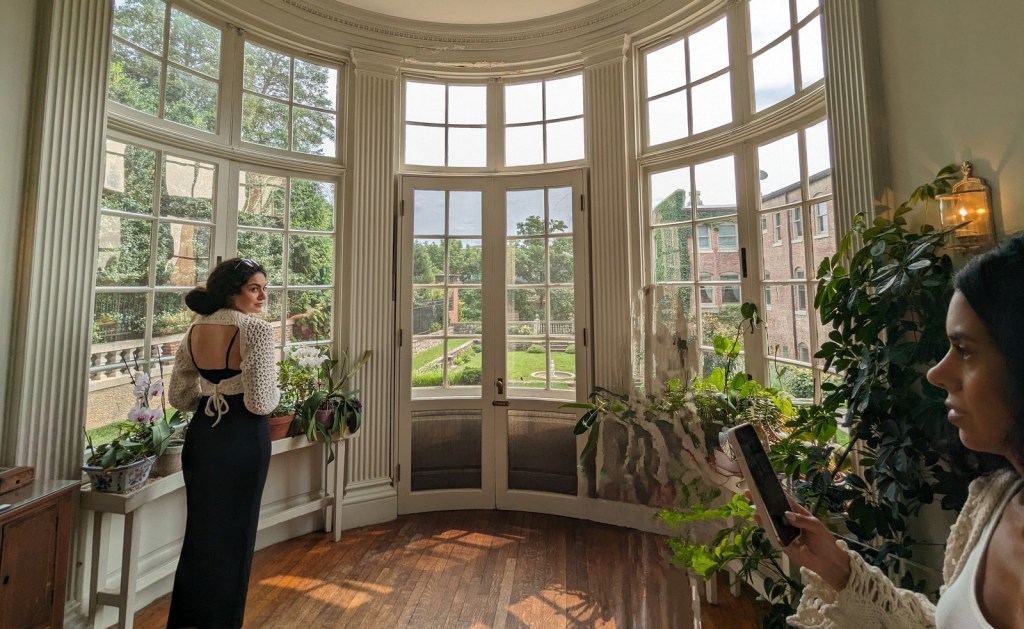
As house tours go, I guess it is a pretty nice house? I haven’t seen the inside of many of these sorta embassy row mansions so hard for me to compare. The staycation, besides featuring very nice floors also featured a good number of tapestries, including at least one large one in this house. The most popular spot was the lovely little sunroom at the top of the stairs that looked out over the garden, and as you can see it was a great spot for pictures:
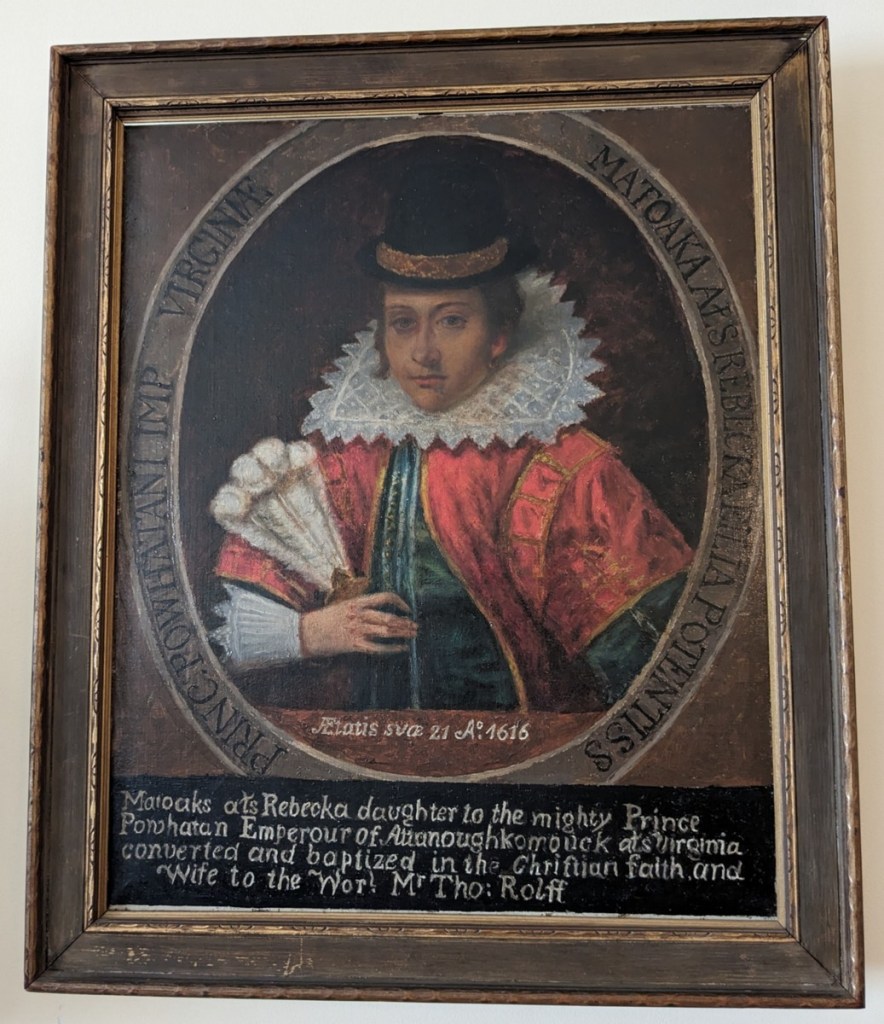
The final detail I’ll note is that up in Edith’s bedroom I saw a statue and then a painting of Pocahontas which our guide hadn’t mentioned but from having recently gone to the Museum of the American Indian I had learned that a good chunk of well-to-do Virginians liked to claim descent from Pocahontas (nee Amonute). This caused problems when Virginia was starting to implement some hella racist laws saying anyone with non-white descent was going to be non-white, which would have included these well-to-do Virginians until the lawmakers included a carveout. Oh racism. Anyways I spotted these Pocahontas things and asked and one of those well-to-do Virginians claiming descent from Pocahontas included Edith Wilson, so there is some cross-museum synergy for you.
And that was pretty much the Wilson House. The staff there are passionate and are working hard to highlight the diverse aspects of the house and Wilson’s legacy though as long as we have a culture that glorifies “Great Men” you are only going to be able to do so much. Nice paintings though!
Another staycation site we visited was Anderson House. We first noticed the place during one of the Embassy Open Days they do in DC. We had wanted to see a bunch of embassies but turns out the lines for all of them were quite long and as we were wandering around we saw a sign for the Society of the Cincinnati and their free museum. We considered going in but were worried that something as serious and pretentious sounding as “Society of the Cincinnati” might be some weird right-wing dark money operation so we wanted to do some research before diving in. After doing that research it seems fine? Clubs like this are always going to be weird but this one seems relatively benign.
The headquarters of the Society of the Cincinnati is now in the former house of Larz and Isabel Anderson. These were two rich people that got married. Man tell you what to be rich in the gilded age. There was a period of time, well-evidenced in DC and also the Met, when you could just bop around Europe and buy up large chunks of all the cultural history there. For the people offended on behalf of Europe, don’t worry, they did this in Asia too apparently, the house has tons of Buddha statues scattered all over the place in niches or in the back yard. The tour guide leading us around mentioned that the Andersons weren’t even religious particularly, “if they saw something they liked they just bought it.” I think The Great Gatsby is supposed to be about how this is all terrible and I suppose for most of the world it was but oh to be gilded in the gilded age.
The two big focuses of the house are Larz Anderson’s diplomatic career and his love of the Society of the Cincinnati. The only two uses the house ever saw were as the personal residence of the Andersons and then has headquarters of the Society. The house incorporates various bits of Society of the Cincinnati symbols in like the plaster work and the like, and after the Andersons died they left it to the Society to use as their headquarters. The single most interesting thing I learned on the tour is that the city of Cincinnati is named after the Society, and not directly after Cincinnatus as I would have assumed. On the tour they talk up the history of the Society a bit, but they’re not exactly trying to get you to join, because you can’t, sorry (not sorry).
As for Larz’s diplomatic career, again, man, to be rich. I guess he was really passionate about diplomacy, no knocking him there, but his storied diplomatic career around which he built is personality was like 8 years total? Very much a hobby. According to Wikipedia, he dropped out of law school, but since his dad had connections to the U.S. minister to the Court of St. James Robert Todd Lincoln he got a job over there as first secretary (this was his first job!) for three years and then went over to Rome to be the chargé d’affaires! Then he went on hiatus for like 15 years and then he is Minister to Belgium and then Ambassador to Japan for a whopping one day, later styling himself as “the first American to rise all the way through the diplomatic ranks from the lowest position to the highest.” Rich people never change. But since he was such a big fan of diplomacy once he built himself a nice big fancy house he let the State Department use it all the time to host fancy parties and the like so that was nice of him.
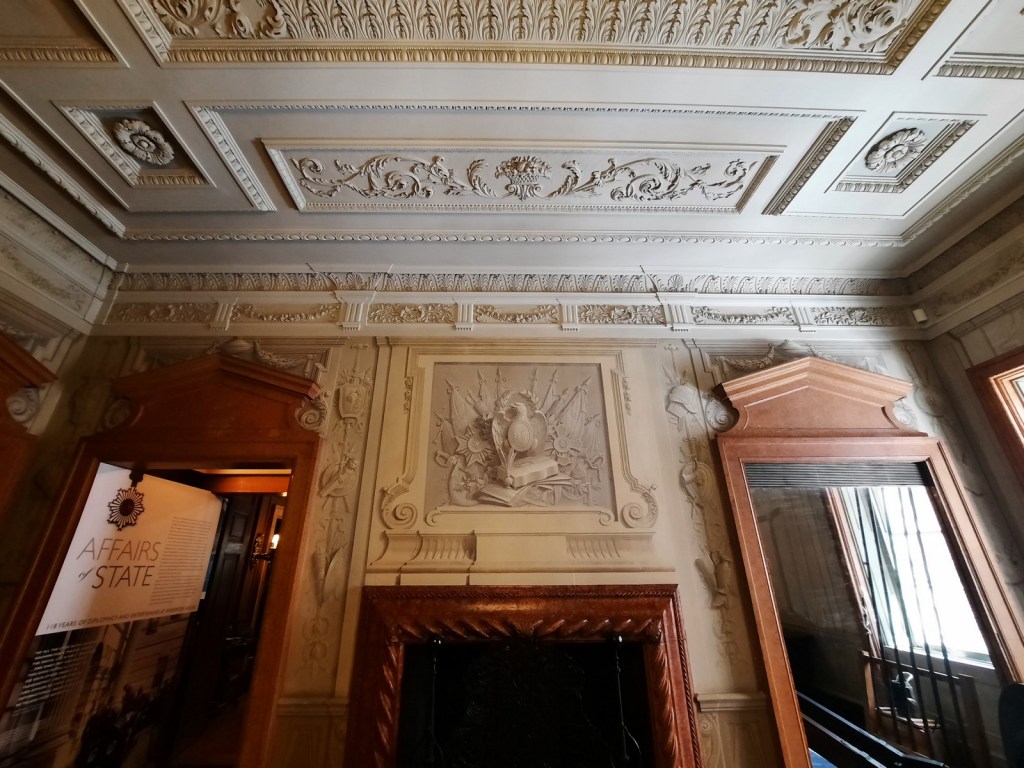
It is a very fancy house, and very gilded age in that I noticed there was a bunch of trompe-l’œil all over the place (see first pic). There was also fancy stuff all over the place, like 400 year-old tapestries and big ole paintings and a table that I thought was pretty neat which is pictured below. I think it was picked up by Isabel Anderson when she was doing the grand tour and features a tabletop made of tons of different bits of granite. Apparently the usefulness of this table is you bought it abroad and then when you came back to build your house you could use it to show your architects/builders which marble you wanted in various bits of the house. To be fair the house had some very nice floors (the whole staycation was a series of very nice floors), but I liked the table because it was like the day before at the Building Museum that I saw the different granite samples and so this was the same thing a century apart and that is neat I thought.
Anywho that was the Anderson House and the Society of the Cincinnati. Their temporary display while we were there was about the history of diplomacy in the house (all those nice parties the State Department threw there) which intrigued me and my super amazing wife suitably, and the house was certainly very pretty to look at. And since the tour was free, it was definitely worth the price.
As part of our pre-departure staycation my super amazing wife and I went to the National Building Museum. It was alright.
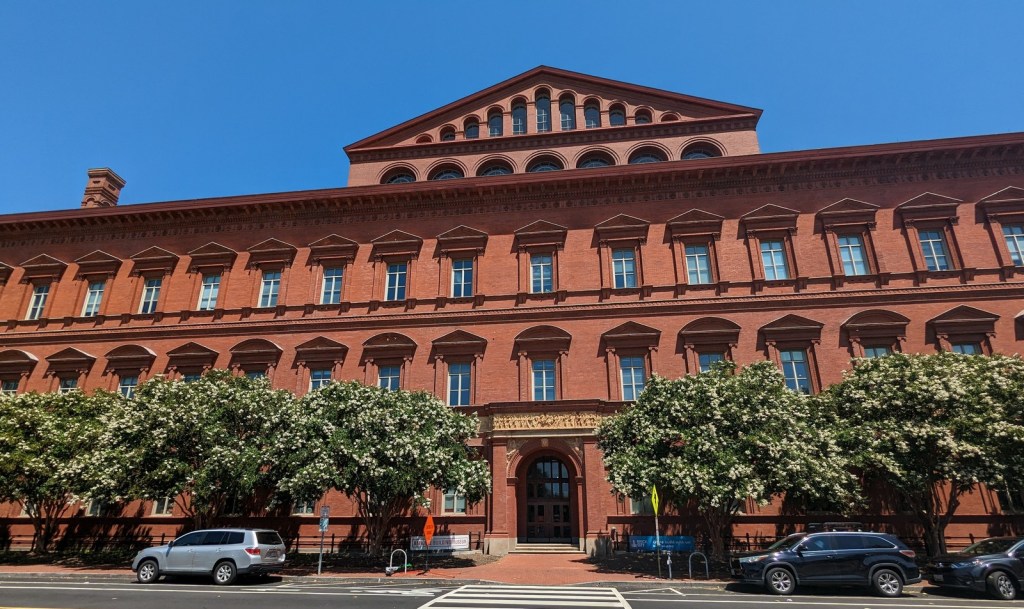
The National Building Museum had been on our list for a while. It got in our heads at some point we should go (I first found out about it years ago when I stumbled across Bantam King ramen, the best ramen shop in DC, and looked across the way to see the museum), but we had never gone because it costs money and neither of us were too sure we were actually all that into buildings. But since we were leaving the country for the forseeable future it was time to see the things we hadn’t seen, and the Building Museum was on the list.
When you enter the museum, man is it impressive. It is certainly a building, I can tell you that. It was originally built for the National Pension Bureau. I was unclear while I was wandering around the museum why the Pension Bureau needed a whole lot of empty space instead of like, offices, but now that I am reading the museum website the space was meant to be large and grand so they could hold large and grand events inside like Presidential Inaugural Balls. Dual-use architecture, nice. As is so often the case the picture just doesn’t do it justice. Those columns are massive. Biggest I’ve ever seen, and I have seen some columns. This huge middle space makes the rest of the museum seem small in comparison.
That was sorta the thing with the museum. It just didn’t feel like there was a whole lot of there there? I don’t know what I was expecting. The exhibits didn’t feel too meaty. There was one very nice one about animals being used in architecture, with a lot of neat items like the below bitumen molds for plaster ornaments. There were also multiple rooms full of legos at the time that kids could use to build buildings out of, but neither my super amazing wife nor I felt like shoving kids out of the way so we could play on legos. The museum had opened with a sort of conceptual gallery of different types of urbanism I guess (the above samples of different granites comes from that), and we very much enjoyed a gallery full of photographs of different buildings, but I’m not sure I walked away with a whole lot more knowledge of buildings than I had before? Maybe I didn’t read closely enough. A building museum has to be tough to curate though, like, I guess there are a lot of different ways you could go with that so any which way you go might make someone a bit unsatisfied.
One really cool thing was the art installation they had in that central hall that sometimes hosts balls. It is in that second photo I included in this post, and is called Look Here by Suchi Reddy. The sculpture included a range of polished metal shapes, all very large, hanging around this sorta central platform thingy that you approached via curved ramps. As you wandered the museum you got to see the piece from a lot of different angles, but the best angle was from the platform. Specifically, laying down on one of the large bean bag chair/furniture thingies they had scattered around the platform, which let you look up at the shapes suspended in space and immersed in the grand hall but more importantly were very comfortable and felt like a nice place to take a nap. From that vantage point it felt like the Building Museum was a place meant for dads to take their kids on a hot summer afternoon so they (the dads) can finally get some lay-down time. So a pretty good place then!
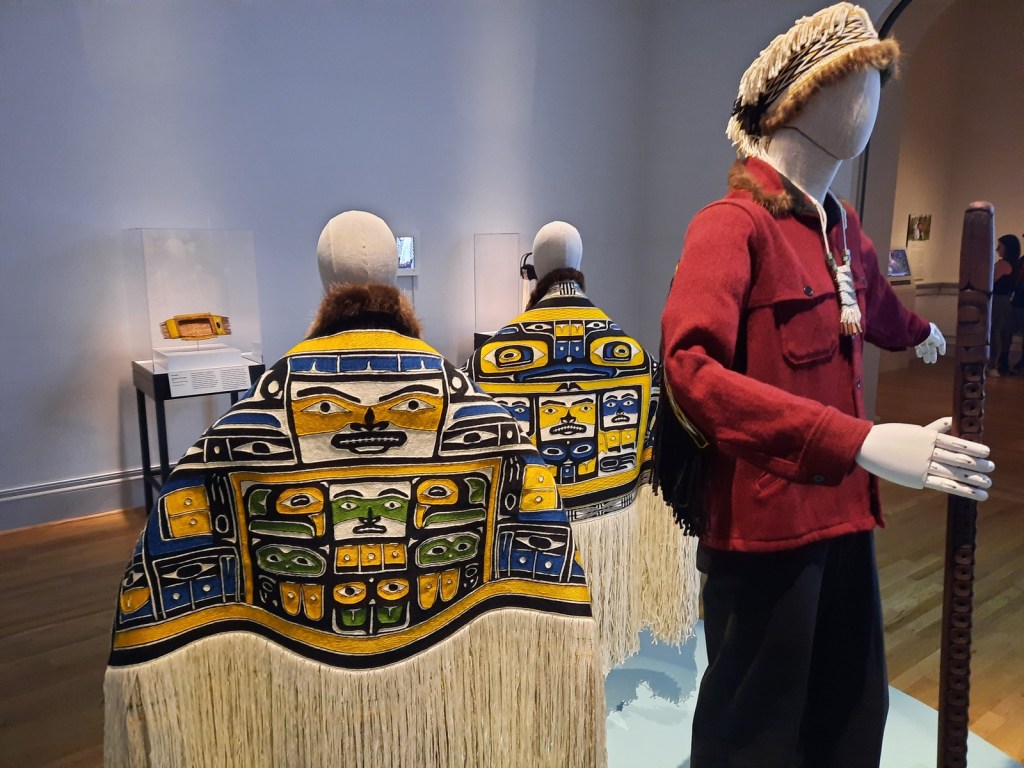
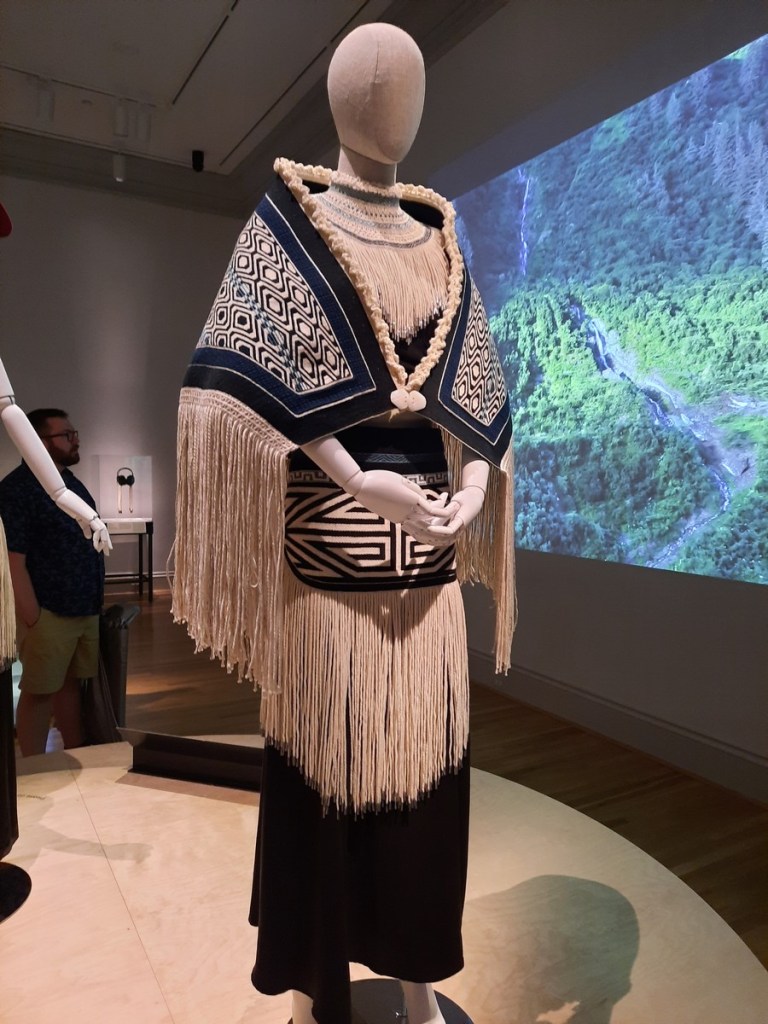
I mentioned it in my last post, but my super amazing wife and I have moved out of the United States and into an undisclosed country. Before we left, we decided to have a fun staycation in DC and one of the things we went to go see was the temporary exhibit at the Smithsonian’s Renwick Gallery, Sharing Honors and Burdens. It was a really fantastic exhibition (more reviews: one, two).
My favorite piece was the one pictured up top, titled Charmed (Bestiary) by Joe Feddersen. It is a series of shapes made from glass that are hanging down on strings. The picture really can’t do it justice and it is absolutely gorgeous, especially as the shapes move about in the breeze provided courtesy of the fan on either side. The shapes are a wide range of symbols, many of them drawn from ancient pictographs and petroglyphs, but sprinkled into them are shapes of much more modern things like bicycles or I think I spotted a submarine. It takes a while to take it all in as you scan through the shapes and more and more things jump out at you. It is a little hard to tell whether the artwork is the glass or the shadows it casts, because since the glass is clear it can be hard to see but the shadows behind come out in sharper relief. It is worth viewing from a variety of angles. My favorite part of looking at it was when we first showed up some young women were doing some fashion photos in front of it, and I think it is great when people combine their art in conversation with other artists’.
The show had a range of traditional techniques combined with the more modern ones to tell a variety of stories. The two pieces at the top are Double Raven Chilkat Dancing Blanket and Lineage Robe by Lily Hope. They are made with thigh-spun merino and cedar bark with beaver fur. The bottom piece is We Are the Ocean by Ursala Hudson, made of merino, silk, steel cones, leather, cedar bark, and silk. Our dear sweet baby angel Tinkerbell is easy to catch; all you have to do is put out a box for her and she jumps right in. Likewise my super amazing wife is easy to catch; all you have to do is put up a video of traditional spinning and weaving techniques and she is hooked (mine is steam plants). She and her friend who joined us were mesmerized by the video part of the exhibit for quite some time, and rightfully so. The artists have done some just stunning work with textiles here to create this vivid sculptural pieces and maybe I need a wardrobe update.
The final piece I have for you is Pueblo Revolt 2180 by Virgil Ortiz, and I think it was actually upstairs with more of the Renwick’s collection of pieces that they gathered because they realized they had the work of a bunch of old white dudes and really should even that out and so went on a buying spree of contemporary stuff by non-old white dudes, but nonetheless it fits the theme of Sharing Honors and Burdens. As the description says, the jar references the Pueblo Revolt of 1680 against Spanish colonizers, but, you know, futurizes it and imagines a scenario where they are finally able to once again control their own land. We appreciate ceramics in this household!
And those were the highlights (for me) of the Renwick’s exhibition. It is really fantastic to see a new set of artists on display in museums like the Renwick, and the fact they have forceful stories told with masterful technique is just icing on the cake.
I don’t really have anything to write about this week! I feel terrible about it! Last week I posted something but it was like a couple of hours late! Am I in a rut?! I don’t know! Life as been busy and full of a range of stressors and not-so-stressors and I mean generally good but I haven’t had a lot of opportunity to do things that feel narratively satisfying to discuss! Lots of little things, no big thing! You know?! But the other weekend my super amazing wife and I went to the most underrated Smithsonian because it is the best Smithsonian, the National Museum of African Art! We went just to pop in and when we were there we discovered that From the Deep was open! This exhibit is sublime! Fantastic! Magnificent! A tour de force!
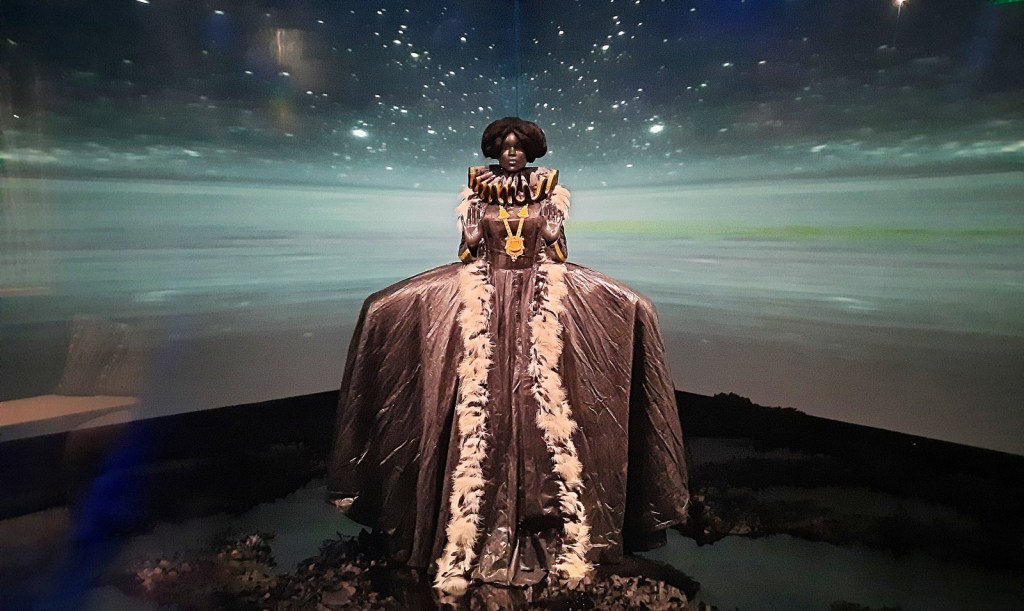
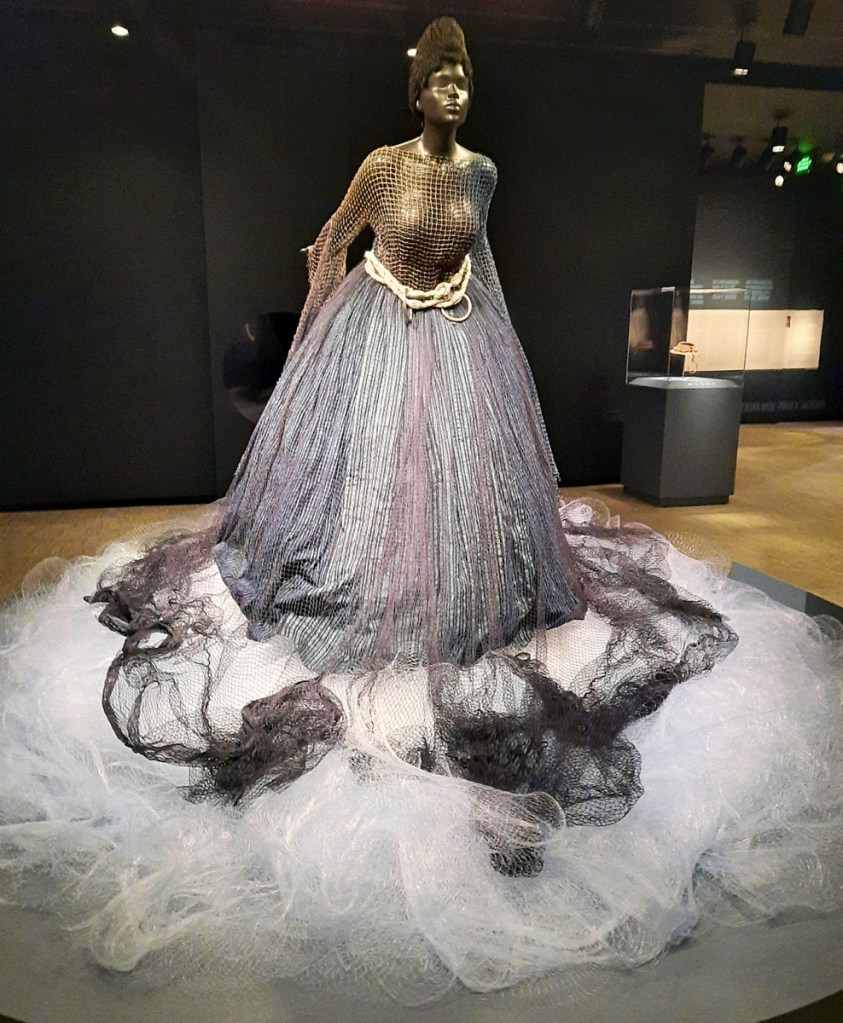
I have just complained about having nothing to write about but then I said we went to From the Deep and I would have just opened with writing about it but it is hard to describe and I am a writer of very limited means! Extremely hard to capture in photos, despite the fact that the bulk of the exhibit is actually photos. From the museum’s page:
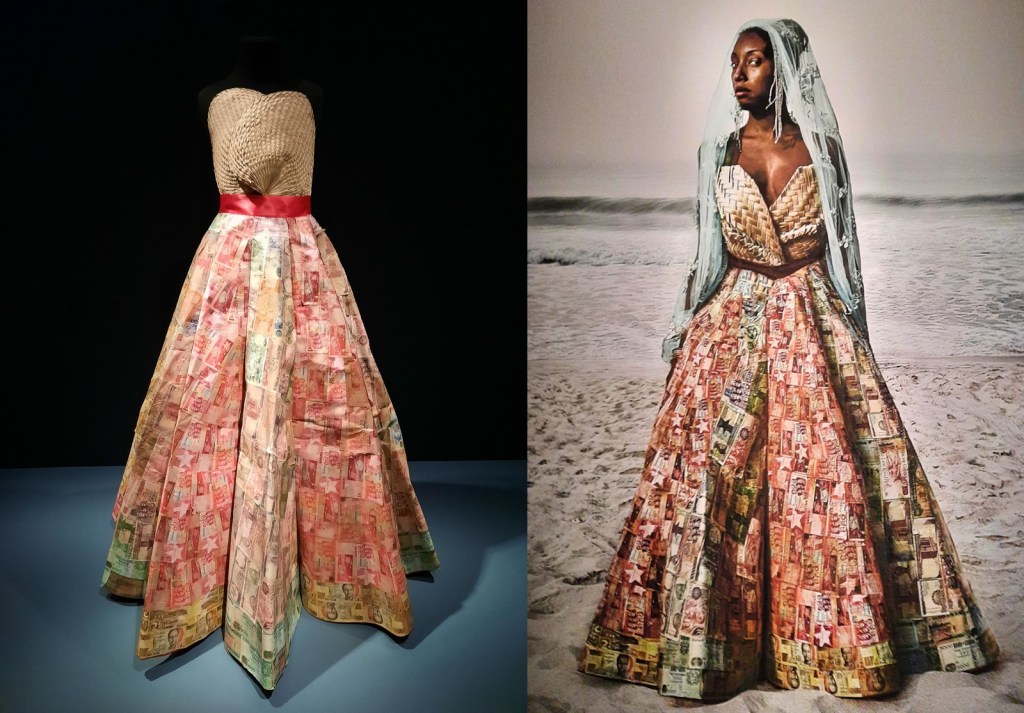
Drexciya’s founding myth has inspired numerous artists, among them Ayana V. Jackson who, in this exhibition, brings to life an immersive, feminist, and sacred aquatopia where African water spirits from Senegal to South Africa both midwife and protect the Drexciyans. Jackson asks that we reckon with the brutal history that cast these beings to the sea while simultaneously envisioning a world of powerful, resilient women.
I just absolutely loved how she has put these costumes together, using the meaningful detritus that would be associated with enslavers’ use of the sea to traffic in their fellow humans. I mean the above dress is made out of fishing nets with a belt of rope! Fantastic! And the below dress, I think the use of the fans as the top is inspired, and also frankly I just go gaga over anything made with banknotes!
You should go see this exhibit!!!! That is the only message I have for you this week!!!! Ayana V. Jackson has assembled an extremely powerful and enveloping series of imagines, motifs, and metaphors that force you to confront an evil history by thinking not about the men that perpetrated it but instead about the women that faced it and the embodiment of their resilience, strength, and future that never was but instead could still be!!!!!
I know I say this a lot around here, but last weekend I was finally able to achieve a dream and visit the NS Savannah! Look, I know I in fact already made a big deal about seeing the Savannah just a few weeks ago, but this time I got to actually go on it. And it was everything I had hoped and dreamed it would be.
I have known for a few years now that they open up the NS Savannah for tours once a year near National Maritime Day. Since I have known that I have been consistently thwarted in taking advantage of this awesome knowledge by the fact that I have either been like in Zambia or else there has been a pandemic, and then I was nearly thwarted again by not being able to find any details about the open day. But now I am here to save you: go to the Baltimore & Chesapeake Steamship Company website at bayheritage.org. They will have all the info and they are also super responsive on email and extremely nice to boot!
This year’s open house/boat was on Sunday and I arrived right at 10am when everything was kicking off. I walked as quickly as I could to the end of the pier where the gangway for the Savannah was and I was one of the first people onboard after a quick safety brief. I was also quickly one of the first offboard because you had to go back down to the pier to start the guided tour of the reactor compartment and engineroom, which of course are the coolest parts of the ship! Holy crap I love steam power.
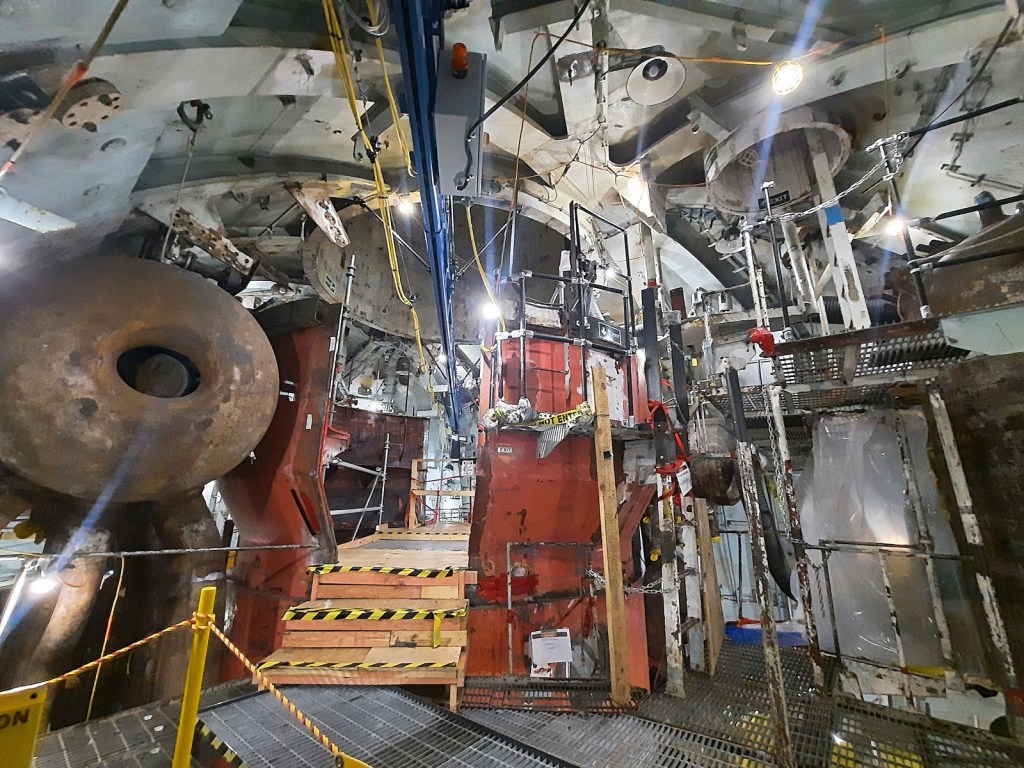
Anyways on our tour we were led around by one of the extremely friendly and knowledgeable reactor techs that normally work on the ship. The Savannah is actually well on its way to being a regular museum ship, and the largest chunk of that works seems to be sufficiently dismantling the reactor compartment so that the public can just wander around willy-nilly. In only the last couple of years they have cut a big hole in the side of the reactor compartment so they could more easily extract some of the components. The coolest effect of that is we got to see the cross-section of the secondary shielding, which was primarily composed of several feet of concrete and then several feet of wooden boards.
The primary shielding (where the reactor itself sat) is the red thing, with the refueling hatch above it. The rusty thing to the left is the steam dryer, above a horizontal U-shaped steam generator below the decking. Peaking in from the right of the frame is the pressurizer.
Inside the reactor compartment the primary shielding is half gone and the reactor vessel itself is long gone. I commented (lightheartedly!) that the place could use a paint job, and apparently it will get a paint job in the bright primary colors that turns out characterizes the engineering components of the ship. In addition to the remnants of the primary shielding, also easily visible was the pressurizer and the steam dryer, along with the hatch at the top of the ship that was used for refueling. If you peered down through the grating, you could also glimpse the U-shaped horizontal steam generator, which is pretty wild.
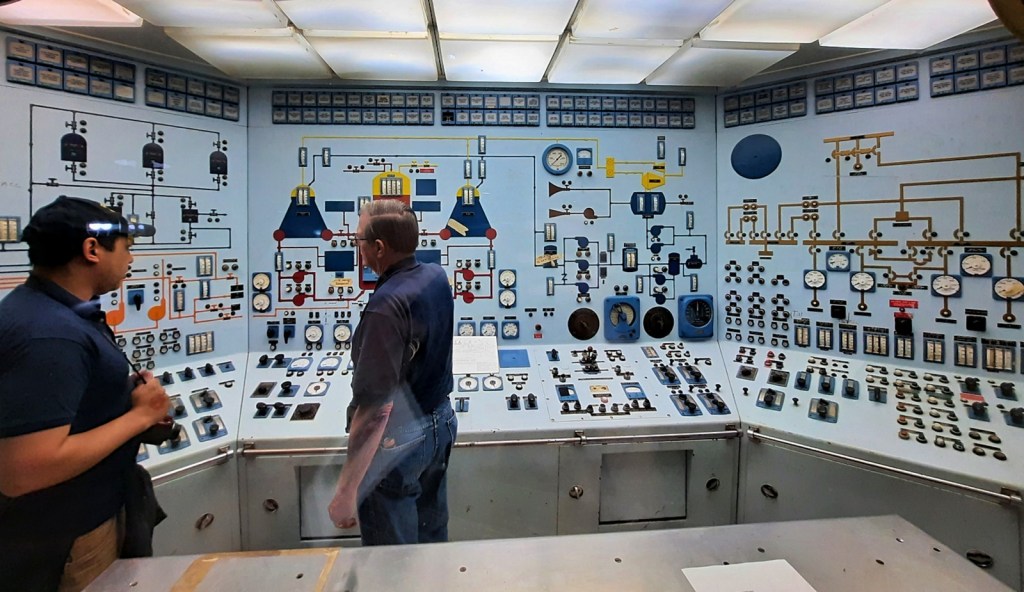
The control panel goes from rod control on the far left, to pumps and steam operations in the middle, to the electrical system far right.
From there we got to go to the control room. The control room was staffed by a man who was actually a reactor operator on the ship back when the reactor needed operating, so he had first-hand knowledge of all the workings of the place (detail I asked about is that it was normally manned by just two reactor operators, a primary and secondary). Reactor control panels are always very fun because they are designed to be the opposite of inscrutable (scrutable if you will), so everything is laid out in very logical orders and you can glean a lot of the reactor and steam plant operation from the layout of the control panel. I spent the whole time admiring rod control switches and coolant pump switches and scram buttons and the like.
Looking down into the engineroom; the control room is behind the woman in the yellow shirt. The red parts are mostly the turbines, and the yellow parts are the reduction gears. You can see the green emergency propulsion motor atop the yellow gears.
Just behind the control room is the engineroom itself, separated by just a window. On the submarine you could sense the engineroom around you from the control room, but you couldn’t actually see it, so this must have been pretty wild. The engineroom is museum-ready with a very colorful paint job. The Savannah only had one screw, so the engineroom only had a single high-pressure turbine and a single low-pressure turbine. We got to admire the emergency propulsion motor and off in a corner were the backup diesel generators. Another very knowledgeable docent pointed these all out to us.
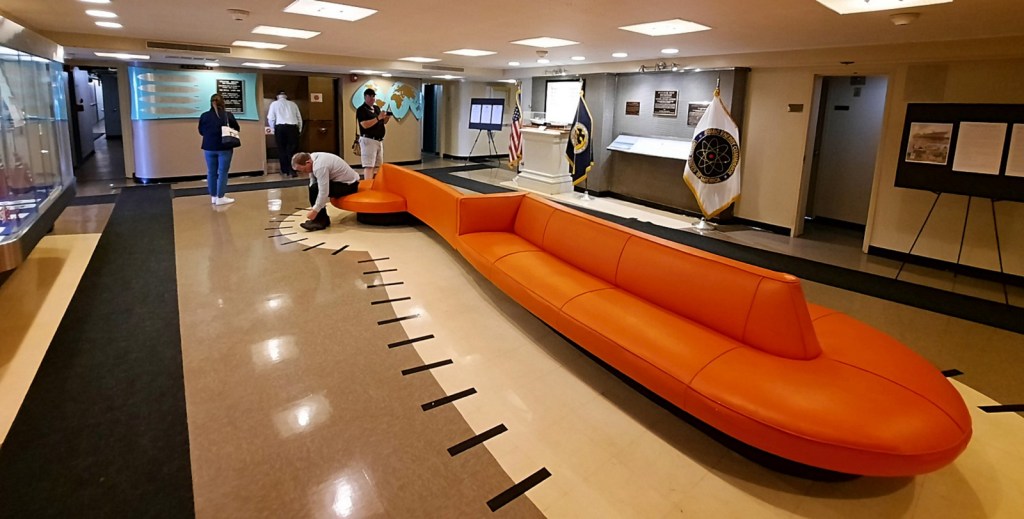
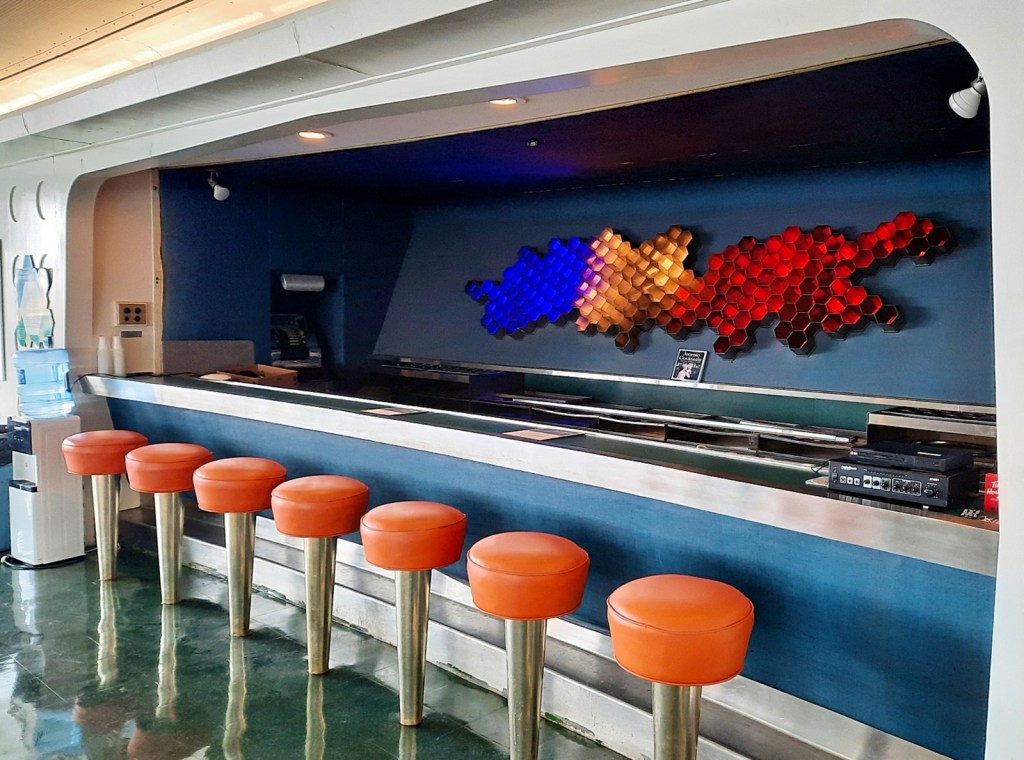
The entry hall into the ship.An absolute dream of a bar on the promenade deck.The dining room; look at the atom symbols in the recessed lighting!!!They need to sell reproduction sets asap!!!!!!
From there we were let loose for the unguided part of the tour. Let me tell ya, the Savannah is a mid-century dream. The ship was meant to distill every hopeful aspect of the atomic age and it absolutely nailed it. Totally perfect, no notes. For the first few years of its life it was a passenger ship in addition to being a cargo ship, so its entry lounge is dominated by a huge orange couch and a magnificent stairway leads you to the various decks. I’ll have to let the pictures speak for themselves, but when I showed her the pictures even my super amazing wife wanted that dining set. It also wasn’t until I was reviewing the photos that I noticed the recessed lights in the dining room were also atomic symbols. Perfect and gorgeous!!!!
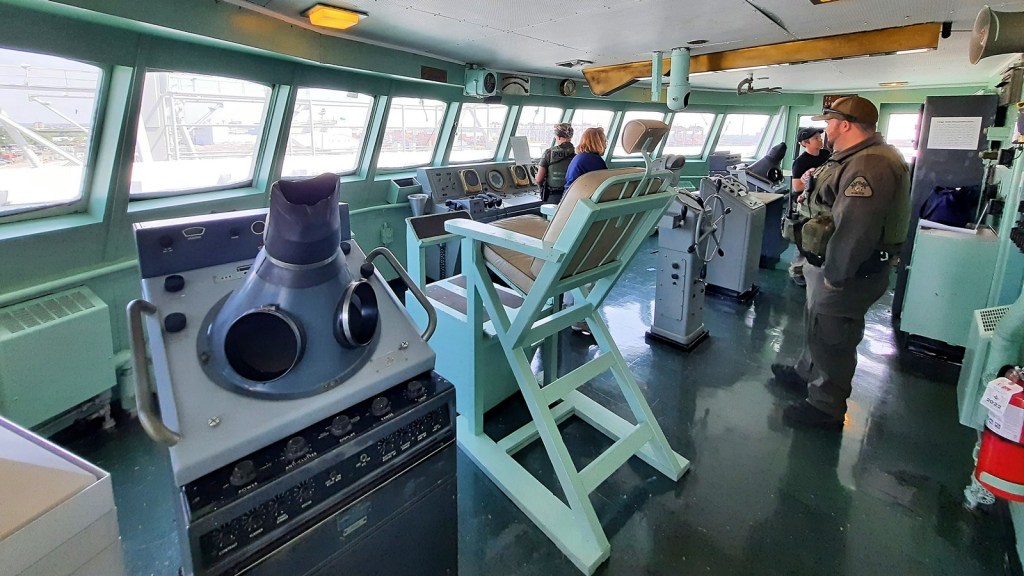
I’m always surprised by how sparse merchant ship bridges are; I’m used to tight-packed radar and sonar screens everywhere but these guys really just need a compass, a helm, and a radar screen (and a comfy chair).She shares a pier with the SS John W. Brown.
Much of the rest of the ship was pretty ship-like (shipshape?). The bridge looked pretty much like a standard bridge and fairly sparse, so much so that I forgot to look for the scram button the bridge crew had up there (not to be trusted with actual reactor operation, the bridge’s scram button only functioned to turn on a light in the reactor control room that said “bridge scram;” the operators could do with that what they thought best I suppose). Topside was, you know, topside. However I couldn’t leave the ship without visiting the other biggest celebrity onboard, the Radarange!
I had been under the impression the Radarange on the Savannah was the first commercial microwave oven ever put into service, but some quick Googling does not seem to back me up on that supposition. It was still an early model and meant to show the true wonders of the future. I mean not only were we splitting the atom here but we could also harness the rotational spectra of O-H bonds to heat up dinner. Truly the embodiment of a world where the promise of clean and abundant energy would solve all humanity’s problems. If only we had kept at it.
I managed to visit the gift shop where I resisted buying a whole lot of swag, but I soon had to literally run off because it came over the ship’s speaker system that I had illegally (though accidentally) parked my DeLorean and if I didn’t hustle it would get towed (speaking of visions of the future). I am so glad I got to finally visit the NS Savannah, especially its super cool reactor compartment, engineroom, and microwave oven, and I am very much looking forward to it being finished with its museum ship conversion so the whole world can see it more than once a year!



















 Pat in the World
You must be logged in to post a comment.