Paperwork enthusiast seeking new frontiers of paperwork. Former submariner, former Peace Corps Volunteer. Opinions, thoughts, and comments reflect no actual persons, living or in the Navy.
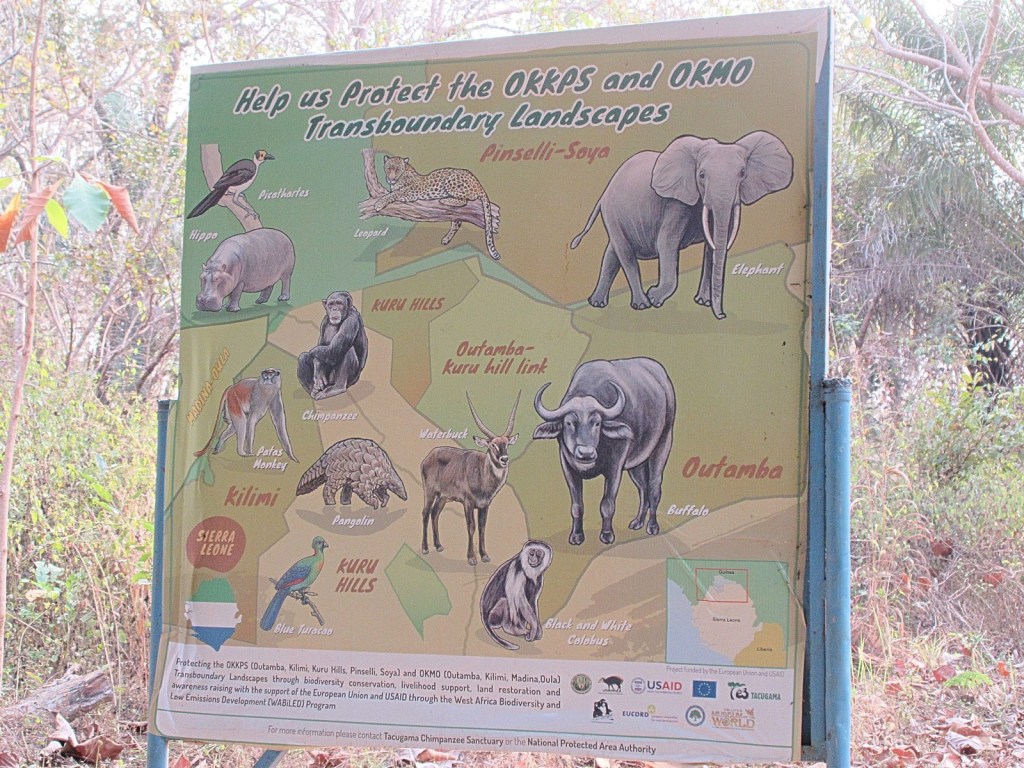
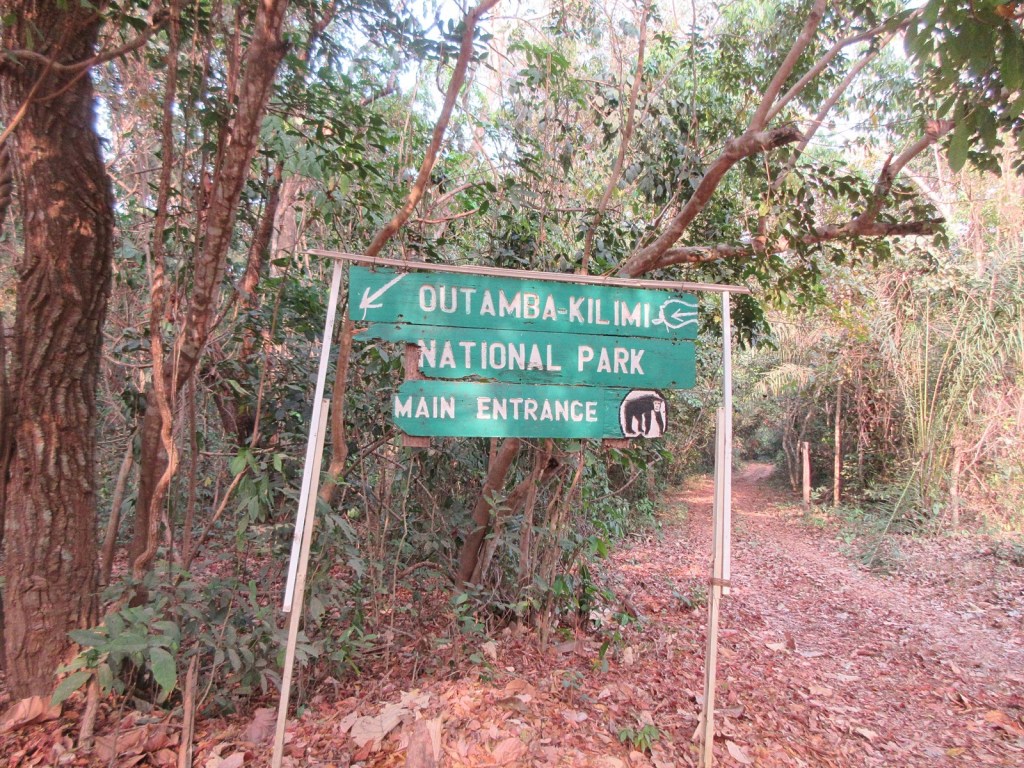
The big draw of Outamba-Kilimi National Park are the hippos, specifically the pygmy hippos (though can they be a big draw if they’re so small). In our outline for this safari the plan for the morning had been originally to hike Karangia Hill for the sunrise. But the previous night our intrepid boat captain had told us that the best time to see the hippos was in the morning, so the first part of our full day in the park was instead spent on the river.
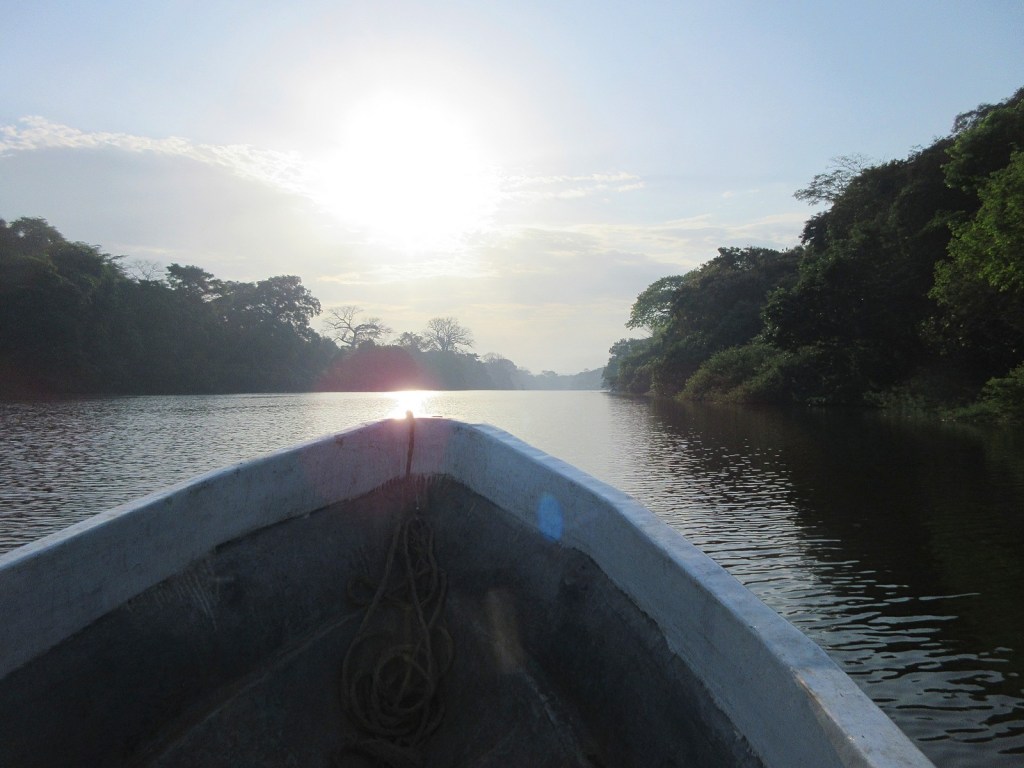
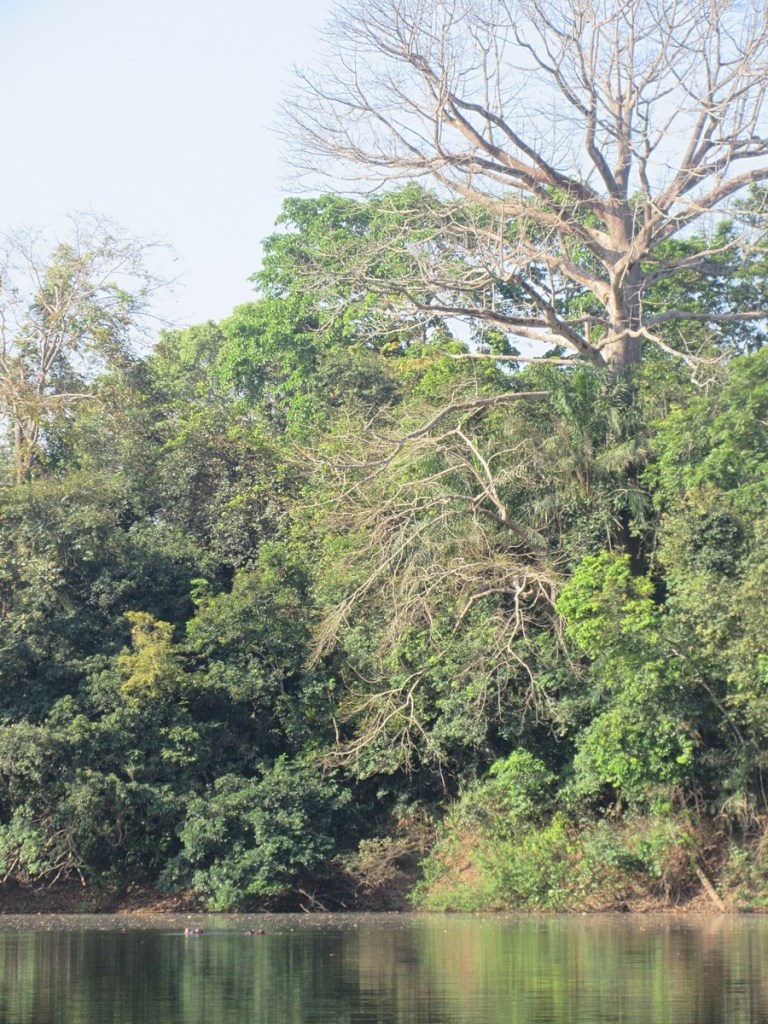
It was not a particularly early start. We woke up (for the final time anyway) later than we had expected and then were served a massive breakfast each of us could only really nibble at. Our just-referenced intrepid boat captain Mohamed had said the best time to set out was at 8, and so at the appointed hour we got into the very sturdy fiberglass craft (courtesy of Tacugama) and set off. It reminded me of the boat trip to Aguateca, but much less speedy. It was very pleasant though. We just cruised along the river admiring the sights. Along the way we passed a camp where a local family had set up for a while to fish, and saw some birds and admired the trees.
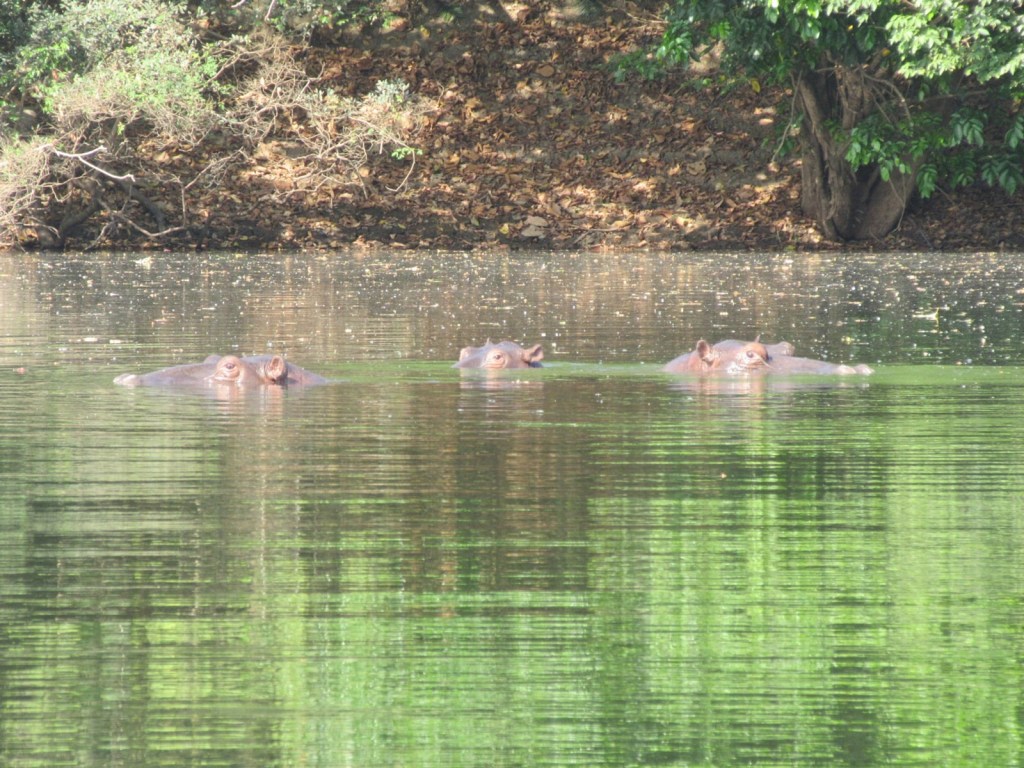
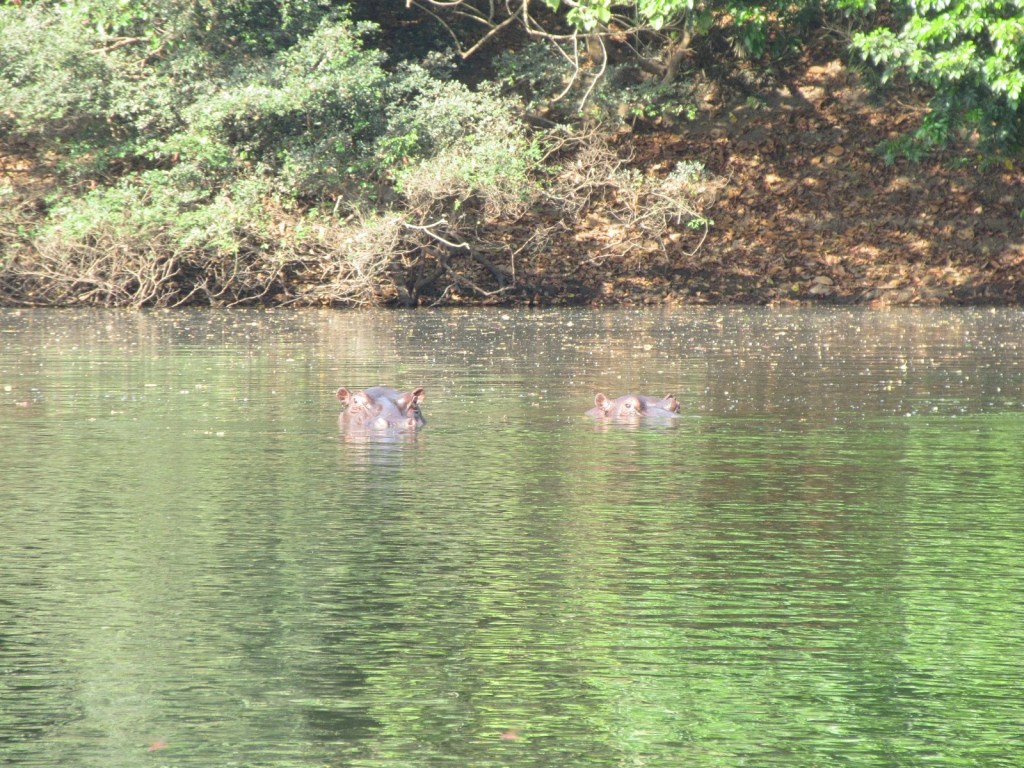
Eventually we came to the spot where the hippos were and shut off the engine. They looked like hippos I suppose. There were at least five of them, occasionally putting their eyes and ears and nose above the water and giving us a hard look, in the way that hippos do. In return, we stared back. Our guide told us these were regular hippos instead of pygmy hippos. They looked pretty small to me but upon review of various photos online I suppose the pygmy hippos have more rounded and less angular faces.
This was a very peaceful time. Our boat captain shut the engine off so we just drifted in the very slow-moving river, repositioning only occasionally. We stayed for a long time. The most harrowing moment was when it seemed like one of the hippos was moving slightly toward us, but the game of chicken ended still quite some distance away. As we got comfortable with the pod eventually we spotted that there was a baby among them, who would pop up only briefly behind another hippo which I assume was its mother. As we admired the hippos other wildlife would make an appearance, with a pair of I think fish eagles swooping down and the trees along the river bank being shaken by monkeys.
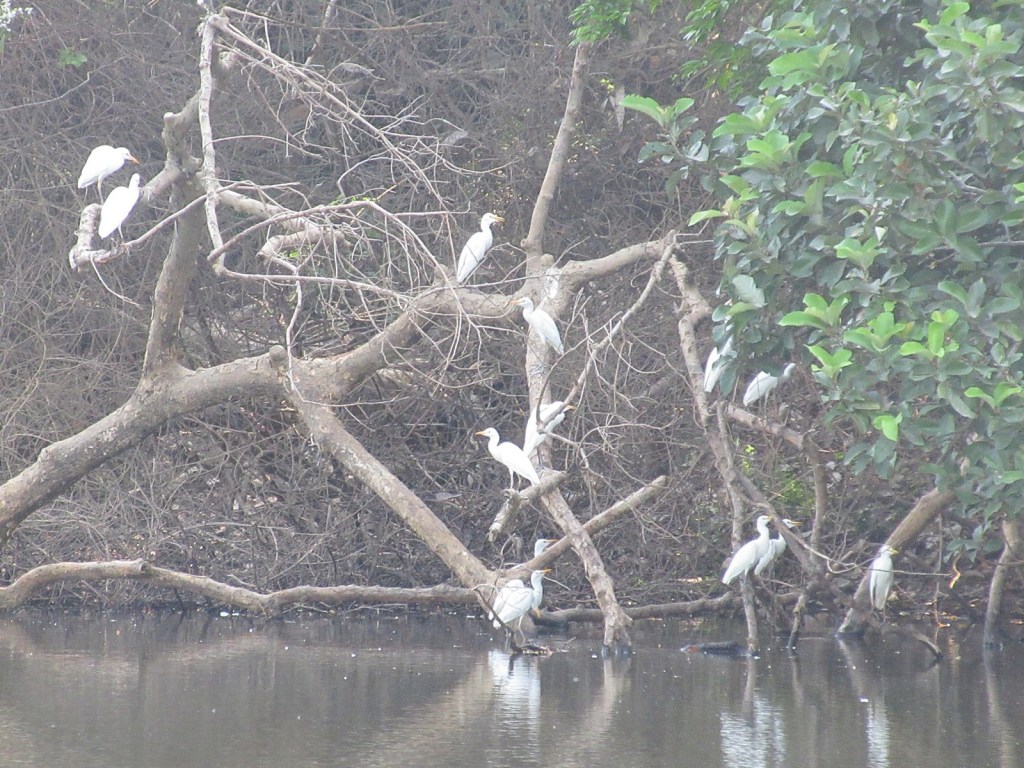
Eventually we turned around and head back up river, puttering back past the fishing village and keeping an eye out for more birds. But like the monkeys the birds eventually came to us. As we were lounging during the afternoon back in camp some green turacos started flitting about the treetops in camp. These are gorgeous birds and were great to admire via binoculars.
Cattle egret in this photo (I guess confused about what they are supposed to sit on), not green turacos.
Our final scheduled event was another forest walk, with the same ranger that took us on the previous one. Although we hadn’t hiked Karangia Hill in the morning, we were rather wiped from all our relaxing, so at the time I was fine with not hiking it. Looking back, I would have maintained the schedule as outlined on the website, with the Hill hike in the morning and hippo boat ride in the afternoon. Though I have heard of other visitors not seeing any hippos in the afternoon, so perhaps if you stay only two nights hippos and the hill are an either/or thing.
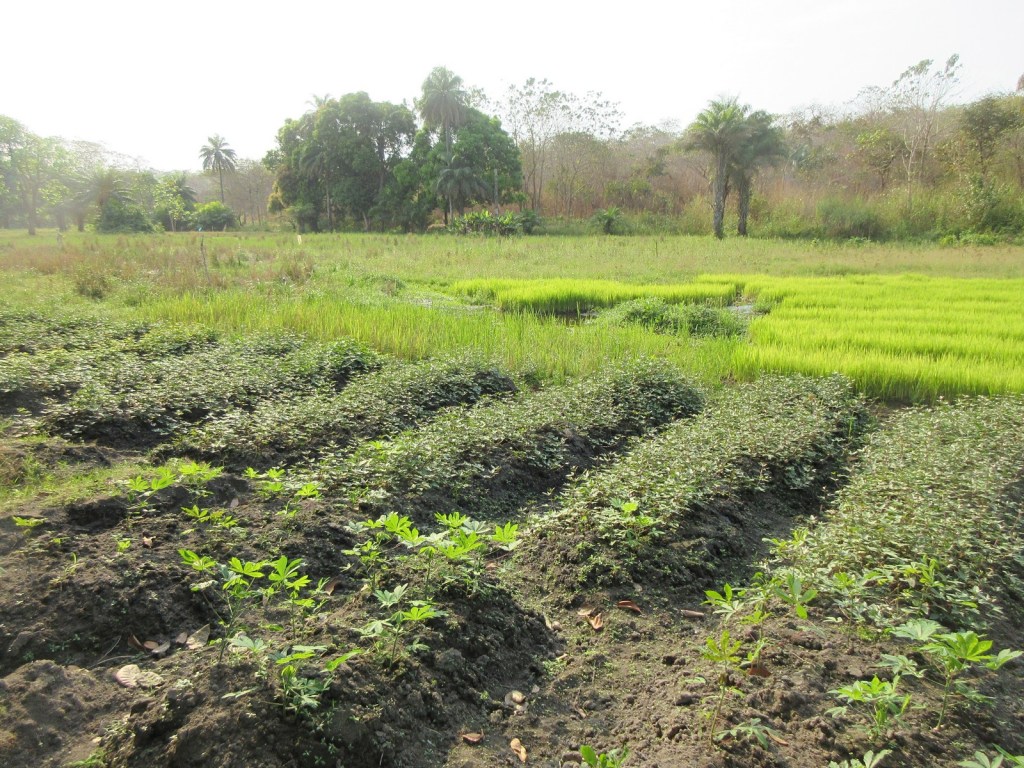
The forest walk though was still pretty great. We didn’t actually do much forest hiking. Instead the ranger took us through the nearby gardens and fields. As we were driving into the park we had passed several rice paddies and other gardens and I had really wanted to get a closer look, and now here we were. After all I love integrated farming and they were integrating this farming in spades (or with spades I guess). Although the garden the ranger took us to was specifically the garden of one of the other rangers, the stretch of land around and outside the park is where the local village does their food production. My super amazing wife was particularly interested in all the goings-on. We saw oil palm seedlings in polypots and rice that was about ready to be transplanted, along with pineapple and sweet potato and cassava. The rice paddies were surrounded by fruit trees and it was entrancing to see the layout of the different food systems, from the rice nurseries down in the “swamp” (the broad and low stream), fruit trees next to that, tree nurseries and sweet potatoes along the banks, and finally highest up the cassava fields and “local beans.” Gorgeous, all of it.
Man I love integrated farming; cassava, sweet potato, rice, and bananas all in one photo!
And with that, our last scheduled event was over. Our VSL guide had spent the time while we were on the forest walk buying a fish to replace the one he had bought in Makeni; apparently he had not secured it the night before and a civet had made off with it (I had wondered what that sound was). But dinner was great and the evening spent reading once again by flashlight. The next morning we had breakfast and set off soon after, enjoying the air conditioning in the car as we reversed our journey from two days before, arriving home in the early afternoon.
Overall, it was a good time, despite all the bug bites. As far as safaris go, it was pretty hokey; the boat ride to see the hippos was the best part, though probably not worth the drive from Freetown. The VSL team was pretty great and made everything run smoothly, and all we had to do was try to eat the massive meals they had prepared for us. For OKNP, I think a serious safari-goer would be better served by trying to get a more adventurous tour company to put together some sort of trek into the park itself. The rangers, after all, do treks into the park, and they enthusiastically explained all the great wildlife inside the park which you couldn’t see from just skirting its edges, like we did. Sierra Leone is just a tough place to travel in many ways, and I am very glad to have gotten upcountry to see such a gorgeous place, but luxury it ain’t.
In the last entry my super amazing wife and I had just finished the journey across rivers and hills to arrive at Outamba-Kilimi National Park (OKNP) in Sierra Leone, on the border with Guinea. And now it was time to set up camp.
Sierra Leone has potential as a tourist destination. Perhaps they don’t want it but there is certainly potential, as there is any place. It could definitely be a world-class birdwatching spot. But so far it is not really set up for it at all. This was evident in OKNP as we pulled up to the campsite. There was not really much there. As I am writing this Wikipedia has a picture of a nice-looking miniature cabin but by the time we visited it more closely resembled a termite mound than tourist hut. The remains of the bathroom facilities were still usable, though that is only because a drop toilet doesn’t require all that much upkeep. Some low walls provided privacy and the lack of roof kept any bats from residing there.
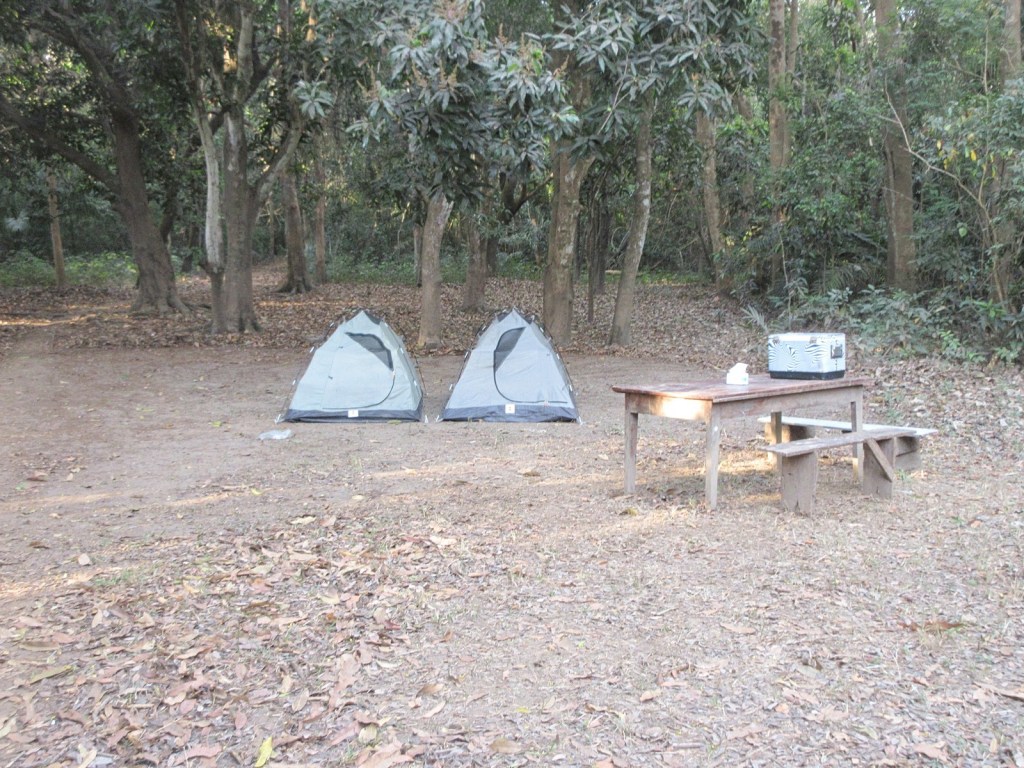
But of course this is why we had arranged the trip with VSL. Upon arrival the guides quickly worked to set up camp. Our sleeping arrangement was a small tent with another to store the stuff we had brought. They provided bedding though if I were to do it again I would bring my own pillow. I think an enterprising visitor could arrange to stay in some of the park rangers’ accommodations and procure food locally but a tent and buying supplies in Makeni is probably indeed the way to go. Be also sure to bring plenty of water.
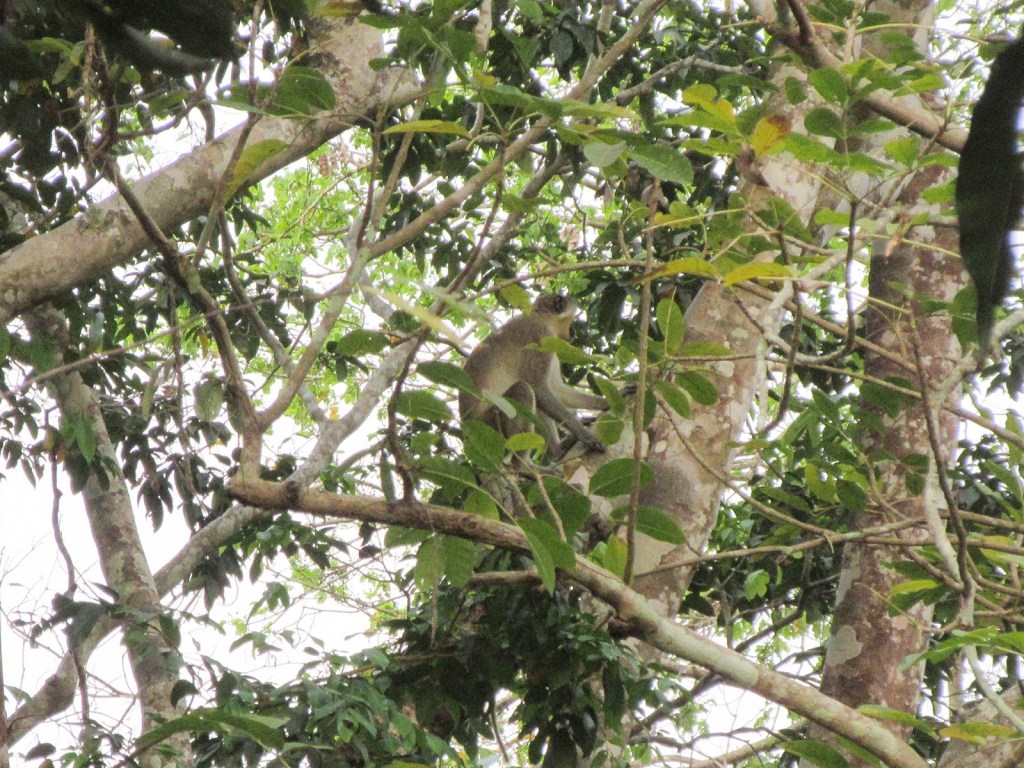
As everything was getting set up and unloaded our guides sent us off on our first park experience, a forest walk with the park rangers. This was pretty short. The park entrance and campsite I think are not actually quite in the park, but instead across the Kaba river. We never actually wound up setting foot in the park itself. I’m not sure if it was just inconvenient or if there was a deeper reason. Instead we skirted along the river to see what we could see. It was late afternoon and I think the rangers were worried about it getting dark. We spotted several monkeys traversing the trees. The rangers identified them as Colobus monkeys but having done some googling here I think they were actually Green monkeys. The most adventuresome part of the walk was crossing a stream via log (“local bridge,” the rangers said) but we survived dry and intact.
Camera-shy monkey.
And from there it was a relatively relaxing time in camp. On safaris I do appreciate the large amount of down time and on this one we had down time in droves. As we were hanging out the same green monkeys we had seen on our walk came through the treetops over camp, giving us a good look but making it seem a little silly we had gone off to find them just before. Later in the evening, having been served a massive dinner we settled down with flashlights to do some reading. This we did outside, as the tent was much too hot still to relax in.
One interesting part of living in Sierra Leone is that I feel like I have learned a lot more about what all these Victorian-era African explorers and missionaries I like to read about went through. Like you read about palm wine all the time but I never had any until we went to Banana Island (we chose to not bring any alcohol on our trip to OKNP, but on our second night, shortly after I was lamenting to my super amazing wife the lack of sundowners, our guide appeared with some poyo he had procured in the neighboring village and poured us each a mug out of the cooking oil bottle it had been stored in; from God to man indeed). For this trip, our experience was bugs. The most bothersome of these in the moment was what I think were the stingless bees that Livingstone wrote about. I can confirm that indeed “the bees are easily known from their habit of buzzing about the eyes, and tickling the skin by sucking it as common flies do.” They broke skin if you didn’t get them soon enough. Though the following week we would find ourselves itching from a hundred bug bites that we hadn’t even noticed we were accumulating. We used bug spray but we should have used much much more.
Finally tired enough that the heat was no longer so bothersome, we settled in to sleep.
I have not been able to spend much time outside of Freetown during our time here in Sierra Leone. This has been for reasons both specific to my situation and more general to Sierra Leone. I was however determined to at least see something of the country and so with the help once again of Visit Sierra Leone (VSL) I booked my super amazing wife and I a trip to Outamba-Kilimi National Park. I chose OKNP, as the cool kids call it, for two reasons: 1) it is there, and 2) VSL had a trip outline we could do over a three-day weekend.
Getting there went very smoothly. Our guide and driver picked us up at our house and off we went for the approximately six-hour drive to the park. Along the way our guide tried to give us a bit of a tour of the country, in large part consisting charmingly of driving directions to various other cities. The main road network in Sierra Leone is both paved and seems to see little traffic (little traffic outside Freetown anyway), so on the first part of the trip we positively flew. I spent the whole time just looking out the window.
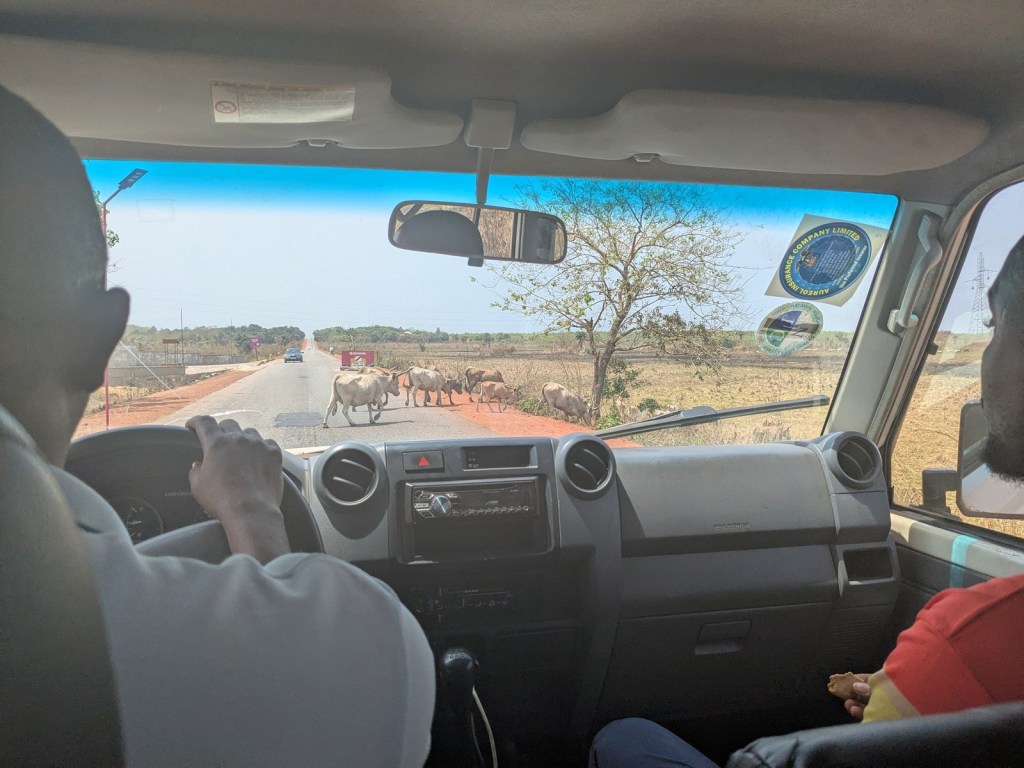
I am tempted to be reductive and say Sierra Leone is gorgeous but every landscape has its intricate charms if you embrace them. In Freetown you get used to living in and on the hills but as you depart Freetown you are traversing the broad plains that comprise most of the western half of the country. There are big skies and low forests. I enjoyed particularly looking at all the various agricultural research and demonstration centers we passed. You see some interesting stuff on the road, which included for us a single motorcycle carrying five people; the man in charge was scootched all the way up on the fuel tank with his four companions stacked behind him. This got an impressed whistle even from our driver and guide. As we moved upcountry we also saw lots and lots of goats and excitingly even some cows.
Along the way we pulled over briefly to pick up plantains but our main mid-journey break was at Makeni. This was our lunch stop but our guide’s main goal was to do all the shopping necessary for our weekend in the park. That could have been interesting to join but we were also happy to relax at a nice restaurant where we ate on the patio and watched the traffic go by. The guides probably also got better prices without us hovering around. In addition to the food the guides also picked up the chef which would join us for the weekend. She was phenomenal and the only flaw with the food on the trip was that it was too much and too good. Three gigantic meals a day that I felt terrible to not be able to finish. The menu was Sierra Leonean, with chicken and fish in peanut sauce the first night and cassava leaves the second. Lunch was pasta with hotdogs, which I understand is a slightly more recent import, but the breakfasts were also heaping and we did not do enough physical activity to justify all these calories. And she whipped this up on camp stoves, to boot.
But that was still slightly in the future as first we had to get from Makeni to the park. As we went along this part the road would proceed to get worse and worse, as is the wont of roads as you extend farther from city centers and the corridors between them in this part of the world. It was also outside Makeni that the hills started, which made the landscape remind me so much of Mbala district in Zambia. It was harmattan when we visited, which meant the distant parts of the landscape faded into blue dust, bolstered by smoke from the occasional brush burning. It was also dry which meant the landscape could have been greener, but I don’t know how far we could have possibly gotten in muddy roads.
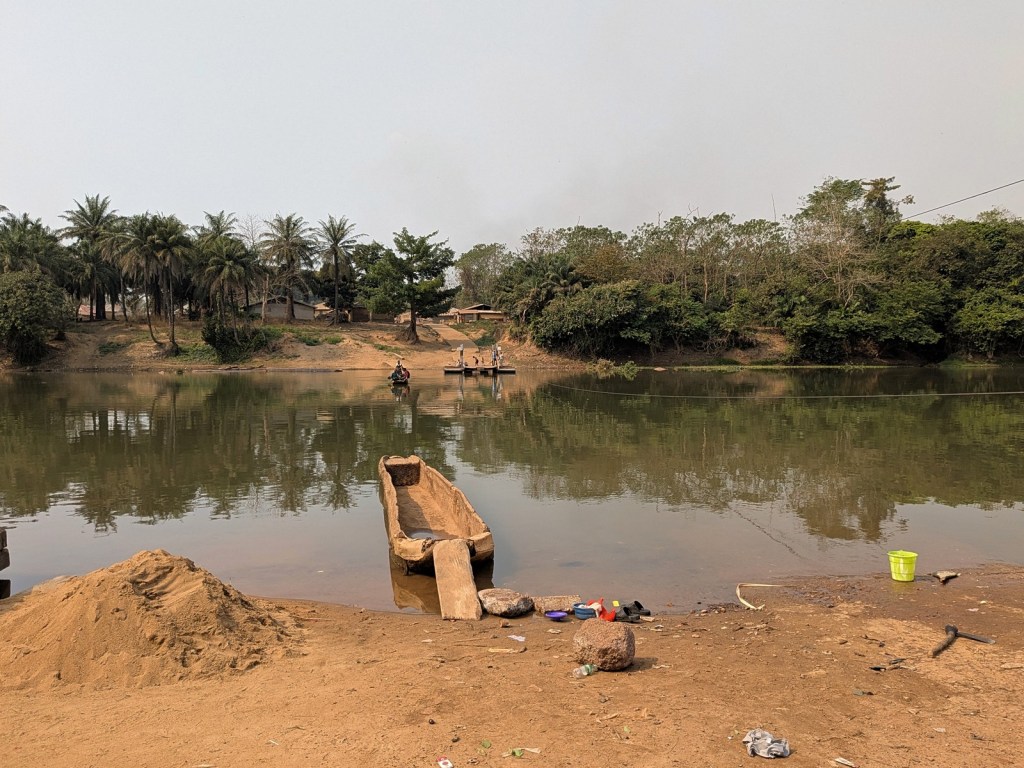
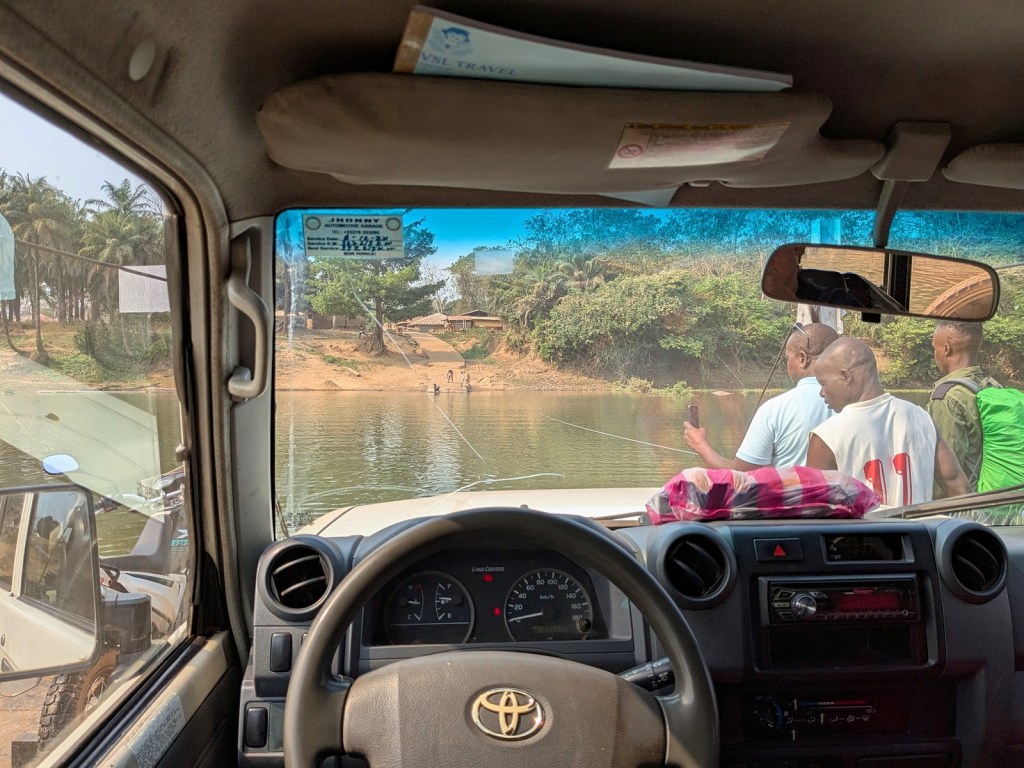
The final barrier to the park was the Little Scarcies River, which we had to cross by ferry. I thoroughly enjoyed this experience. I don’t know how old the ferry is or who built it, but it is a pretty nice system. It is attached to either bank by cable though it is entirely person-powered. The ferry was at the far side as we pulled up so we watched as it was pulled across to our side. On either end of the ferry there are ramps, and as another fun feature they are balanced so as one side goes down the other goes up. We drove onboard and were joined by a motorcycle and smattering of other people looking to cross. After boarding the man slowly pulled us across, and we had a very peaceful time floating over the river. Having not sunk, we drove the last few miles to the park entrance.
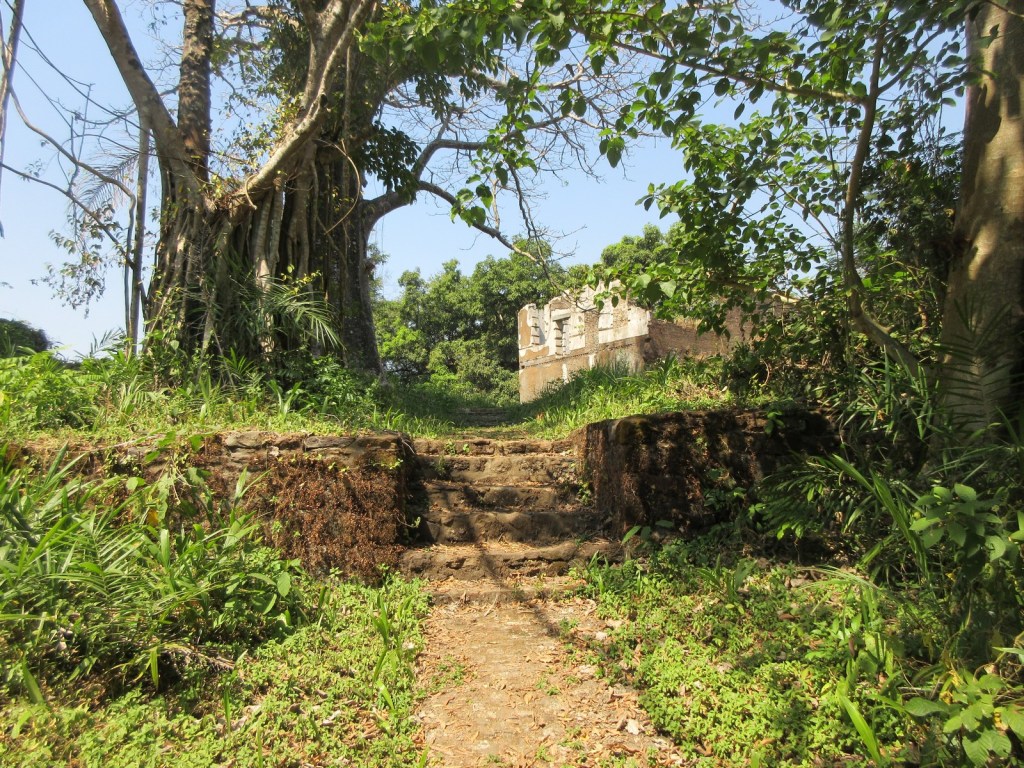
Turning away from the river you are looking at the main part of the castle itself, with the ruins still standing two stories tall. Looping around clockwise the guide pointed out the remains of what he said was the secretariat (record storehouse), a blacksmith shop, and the kitchen, before taking us through the gate into the main slave yard. Here the enslaved people would have been housed while their captors waited on another ship to come.
From within the slave yard.Path down to the upriver beach.Looking back up at the fort from the path to the beach.Looking upriver.
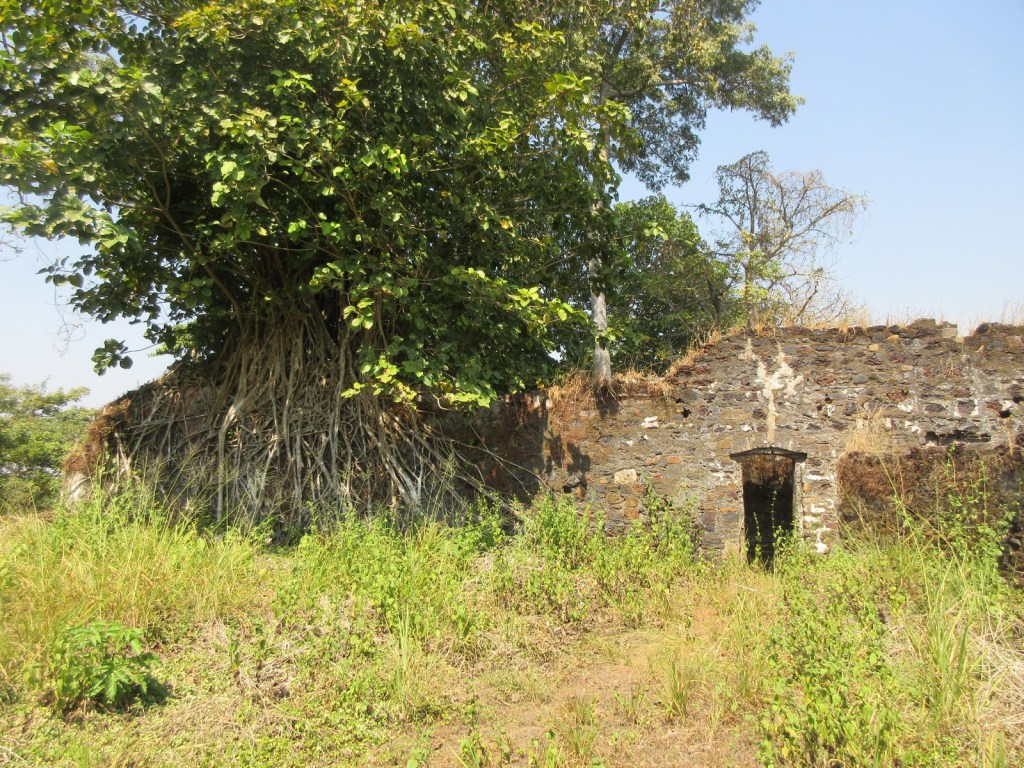
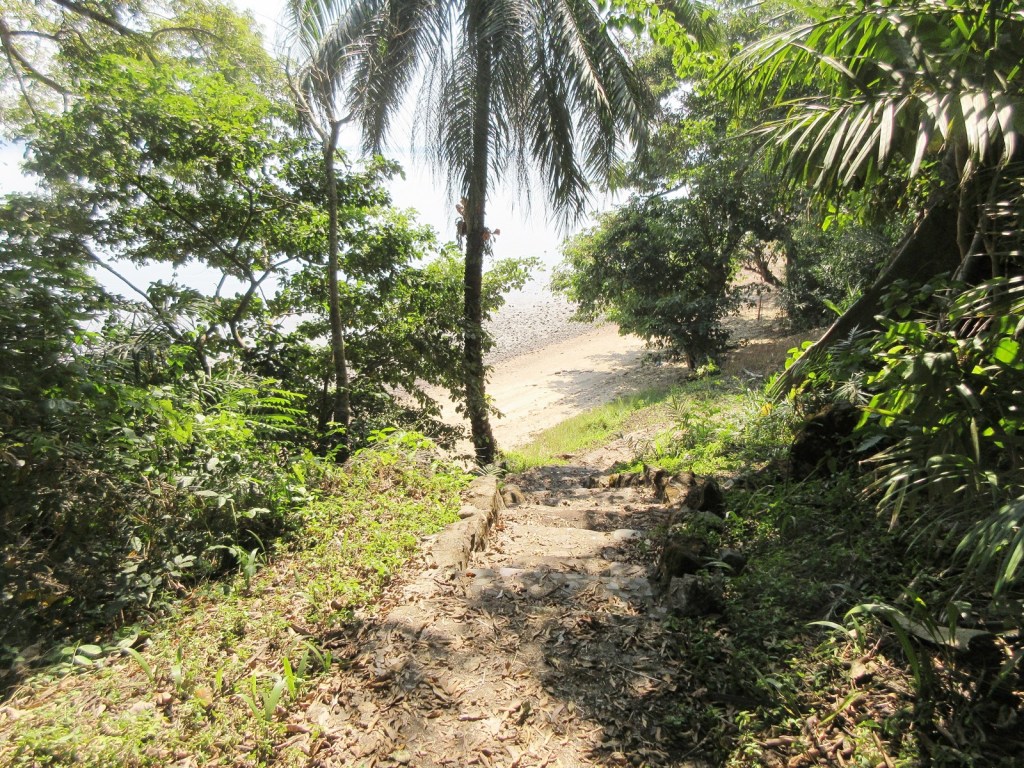
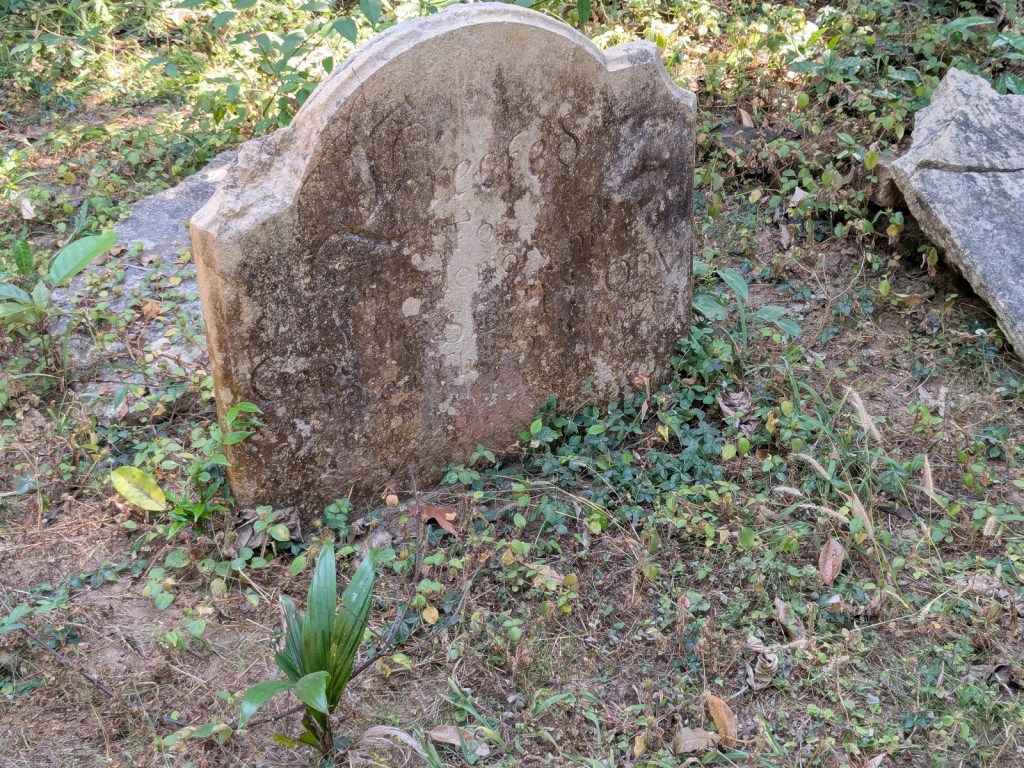
Outside the slave yard and on a path leading down to the beach there is a cotton tree with roots that have followed the square of the brickwork, making a convenient photo spot. Our guide encouraged people to cycle through to take pictures, if they liked. He explained that behind him was the powder store room, in which now lives a large number of bats. On the beach side there is a very small door into the cave-like room, which must have attracted the bats. He said that you could hear the bats, “singing hallelujah praises,” and you know what you could. It must be really cool when they all come out at dusk. Along the beach he also pointed out old piles of oyster shells that would have been used to produce lime. After walking back up the hill this concluded the tour of the fort itself. From there we walked down a short path to the other side of the island to see the graveyard. We didn’t linger and guide shuffled us back to the boats playing more praise songs on his speakers.
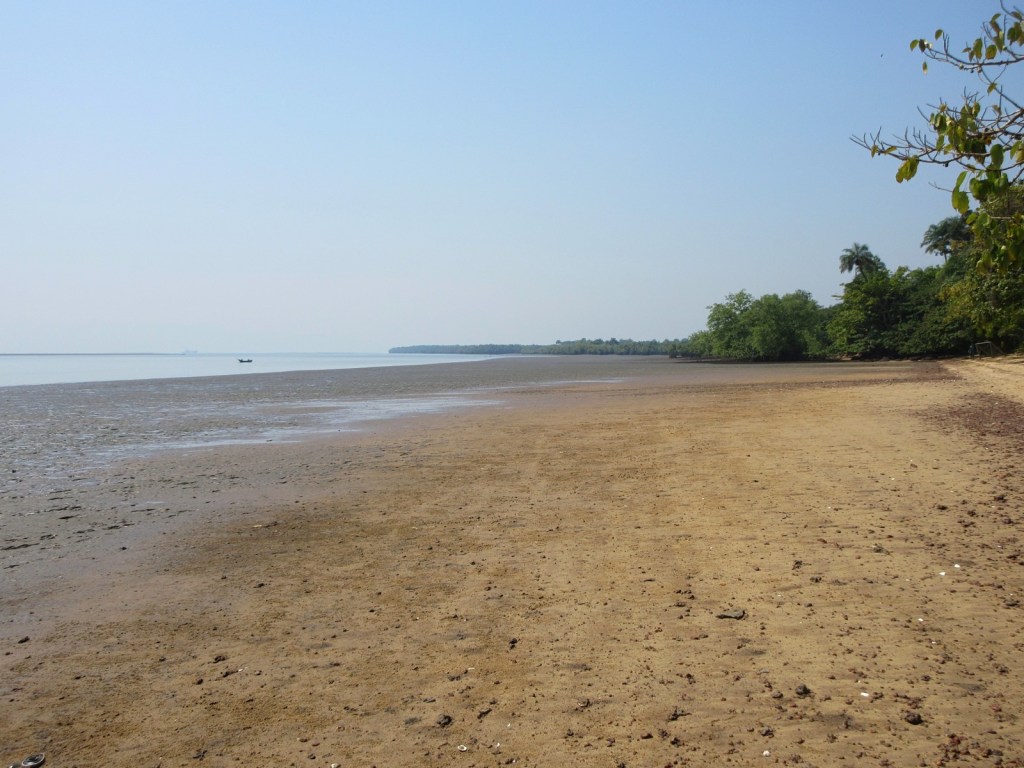
With the A Boat having been replaced in the interim, it was a short hop over to Tasso Island, which was an unexpected treat. Going to Tasso wasn’t unexpected, we were always going to have lunch there, but our short visit was really something. The tide was far out when we landed which meant we alighted onto a rock/concrete structure that looks like it is covered at high tide and got to walk along the beach, admiring some very cool rocks and having a lovely stroll. Up at the restaurant we had a great lunch of rice, fried fish, and plantains, but then the real surprise was being taken up to the Tasso Heritage Center.
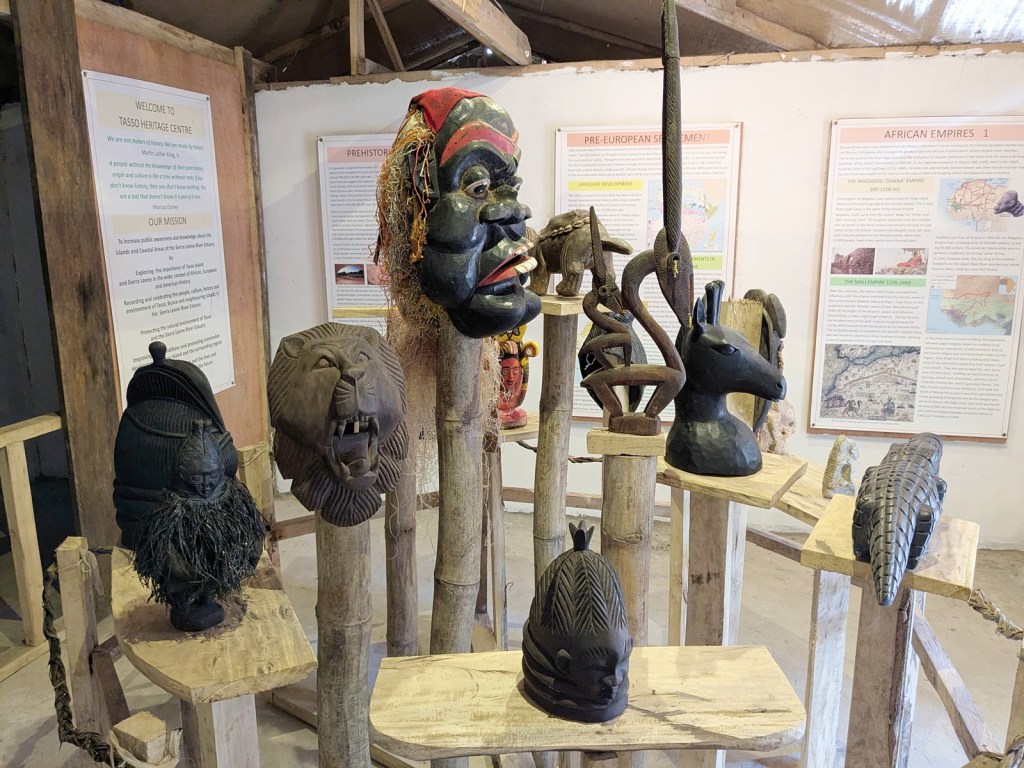
The reason Tasso had lunch facilities is because of the Tasso Ecotourism Project, which as the name suggests is encouraging ecotourism on Tasso Island. It’s part of these overall efforts along with the tour companies that they developed the Heritage Center, which was brand new when we visited, having opened only two months prior. One of the people from the island showed us around the center. Right inside the door there is an impressive collection of Sierra Leonean masks, including Temne, Bundu, and Krio masks. The pride of their collection is an “original carving of the ‘camel’ or ‘horse traveler,’ still wearing its cowrie bead charm, which was carried in front of the Chief on long journeys. It comes from the time of the African Empire invasions, when camels were first seen in Northern Salone.”
Masks of Sierra Leone.
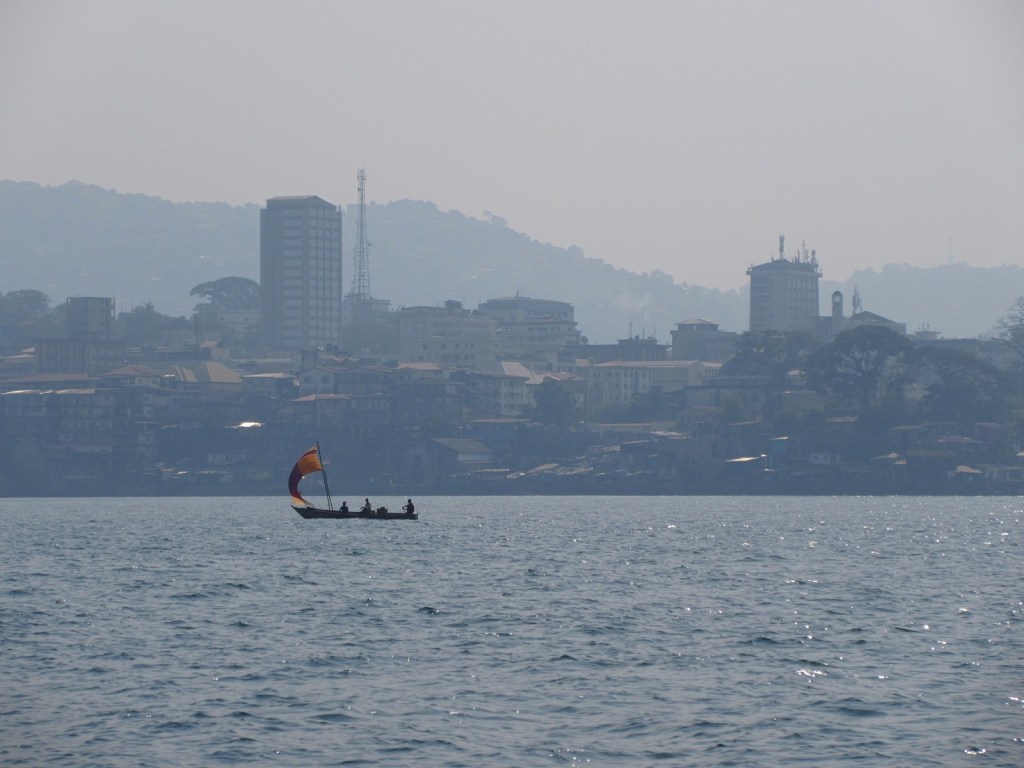
The largest room of the museum discusses the history of slavery in Sierra Leone, and especially the relationship of Tasso to Bunce Island. Since, as discussed, Bunce is very small and primarily chosen as a fortification, Tasso was used as a plantation to provide food and water to Bunce. There were also signs on the longer history of Sierra Leone and its relationship to the rest of west Africa, and a room displaying some of the normal wares of a household. We didn’t get too long to linger but frankly the heritage center rivals the national museum in Freetown, especially for the scholarship on display. But from there it was time to load up onto the boats for the final ride back to Freetown. This went smooth and quick. I ensured my super amazing wife and I sat on the port side for the ride back so I could see all the things I didn’t see on the way out to Bunce. It was so lovely seeing Freetown from the water, spotting downtown and the different hills over which the city spills. It was the cap to a fantastic trip full of history and a showcase for the enduring connections between Sierra Leone and the world.
The sign on the baobab tree says “Welcome to Bunce Island.”
Reading this week:
Between Meals by A.J. Liebling
At the very tail end of 2024, my super amazing wife and I managed to get to Bunce Island! It was really fantastic and is a must-see if you ever find yourself in Sierra Leone. Unlike a lot of things in Sierra Leone, Bunce Island is in fact pretty well documented online. That means there is no need to belabor the history here, but Bunce Island was home to a slave fort/factory that was a base for enslavers along the Sierra Leonean coast for centuries. The site has a particular connection to the United States because of the local rice-growing culture. People from the region were especially prized as slaves in the Carolinas for their knowledge of rice growing, and there is a direct connection between Sierra Leone and the Gullah/Geechee culture in the United States.
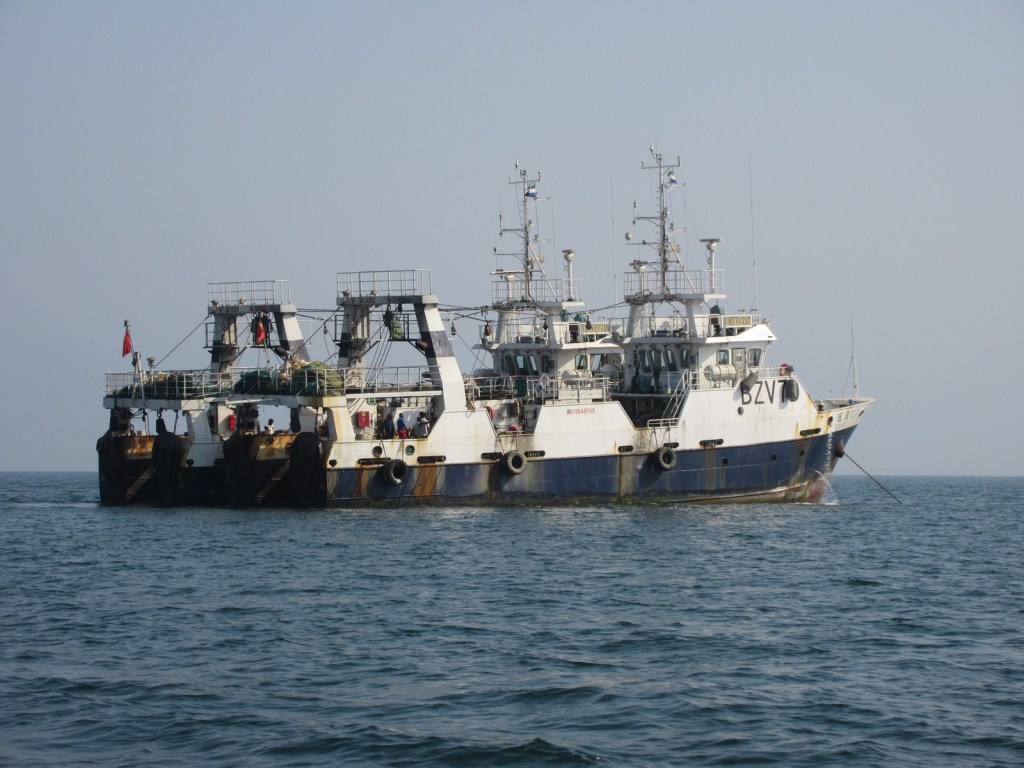
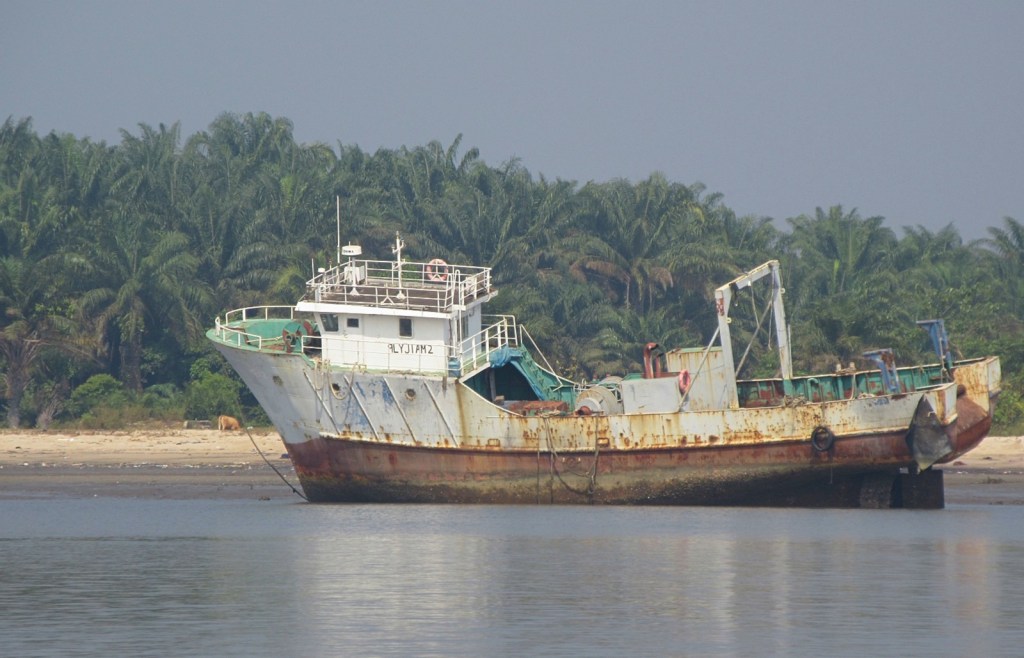
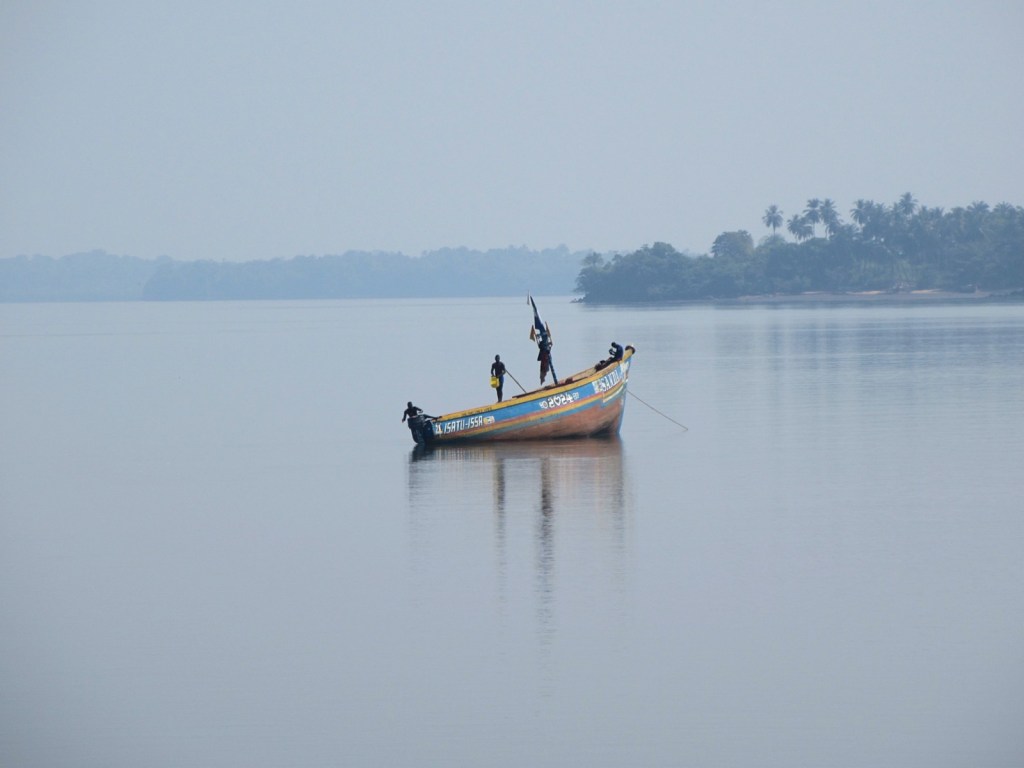
Since Bunce is an island we had to take a boat to get there. We were joining a trip put together by VSL Travel, and so joined up with our trip companions at the SeaCoach terminal. The VSL crew was great and I can highly recommend them. At the terminal we loaded onto two boats. We were on the B Boat, but as we went along it became clear that the A Boat was having trouble. There was a lot of plastic in the water outside Freetown harbor and apparently their engine had sucked some up. That didn’t bother me too much because I was having a grand ole’ time looking at all the different boats in the harbor from slightly closer up than usual. As we went further up the river I really enjoyed seeing all the different fishing villages and fishing boats out and about. At one point we had to veer sharply to the right to avoid running over a line of nets.
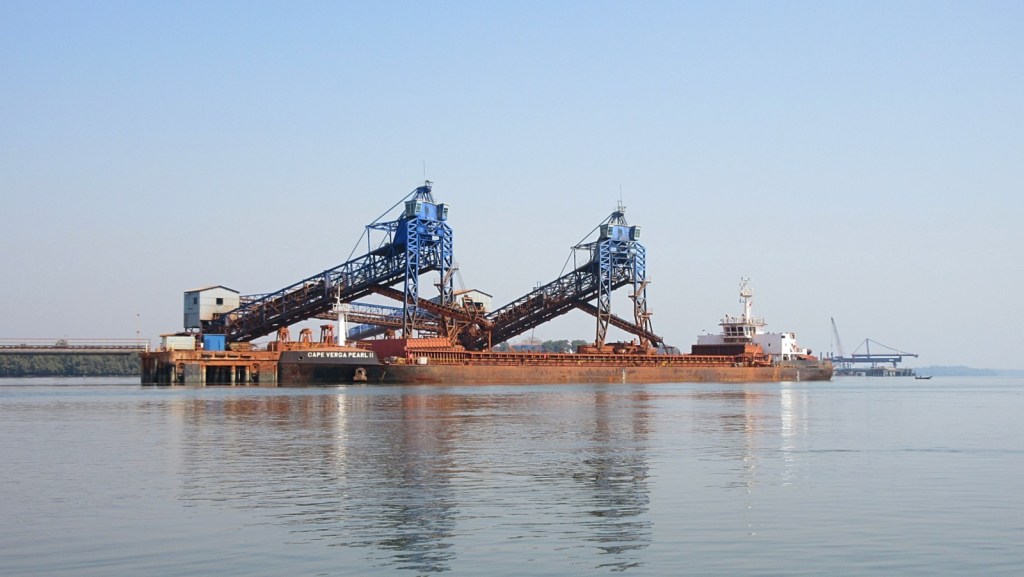
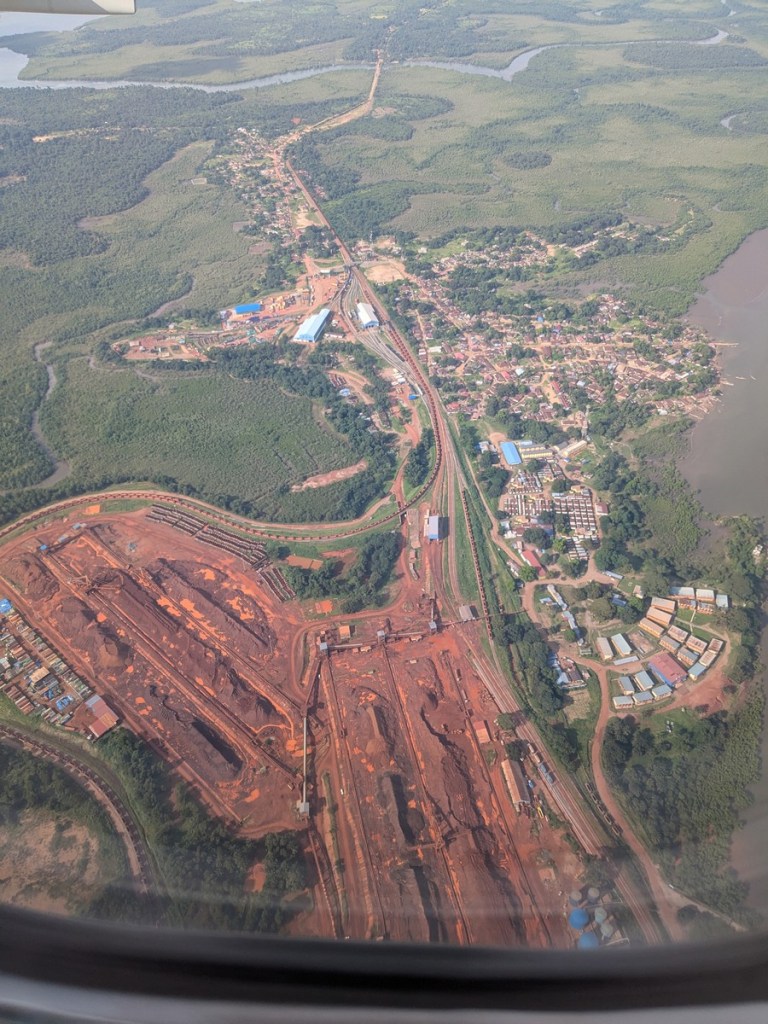
The most unexpected thing we saw was the port of Pepel, where a bulk carrier was being loaded up with ore. The current major export of Sierra Leone is iron ore, and from the Marampa and Tonkolili mines it is transported via rail to Pepel, where it is loaded onto ships for transport elsewhere to be refined. That explains all the bulk carrier ships I always see in Freetown harbor, which is a connection I should have made earlier. It also explains the rail yard I saw from the plane. Happy that things all tie together.
Bulk carrier being loaded with ore.View of Pepel from the air.
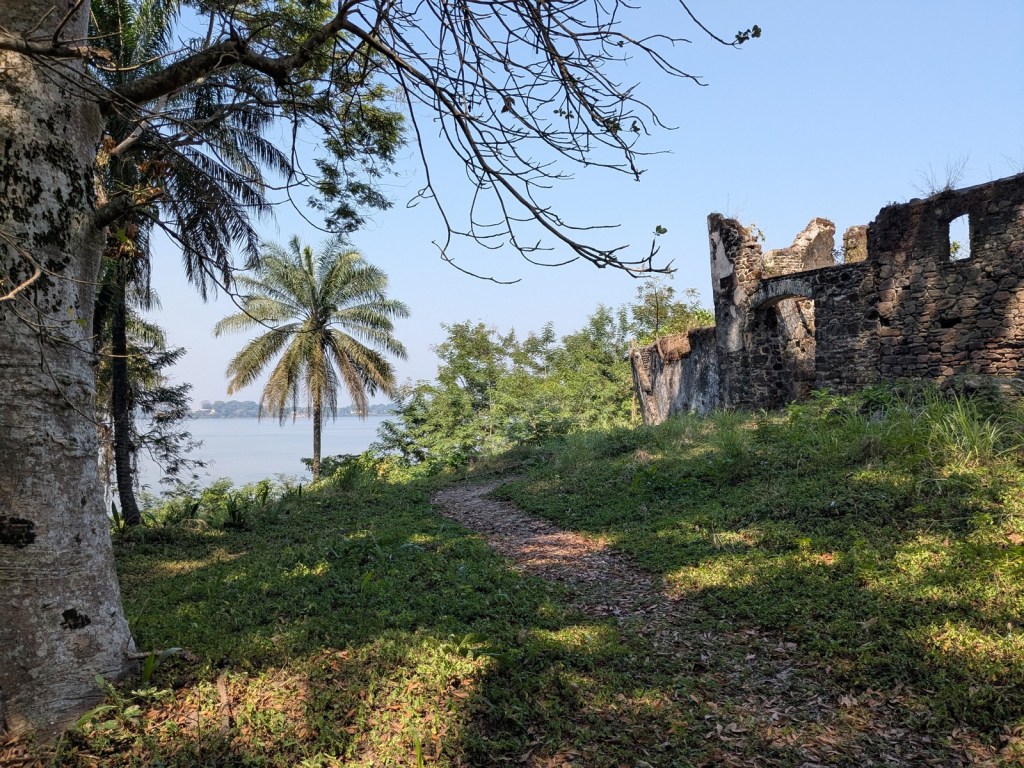
After passing Pepel, we were soon at Bunce. From the dock at Bunce you can look across and see the ships being loaded with ore. There’s a metaphor in there if you care to use it. Bunce Island had been neglected for a while as a historical site but that started getting rectified in 2007, so the infrastructure is pretty good. There is a caretaker on the island with a nice little house, keeping the brick paths fairly clear, and you land at a convenient dock. The fort itself is of course in ruins but as far as ruins go they are well preserved.
Once the A Boat had limped to the island and we were all gathered, the first thing the guide had us do was pray, “no matter your religion.” This prayer consisted of him drawing a circle in the sand and pouring water into it as he played “Amazing Grace” on his speaker. It was better than it sounds in that sentence, I promise. The significance of the circle was lost on me but the guide mentioned that the song was by John Newton, describing him as a former enslaver turned abolitionist. What he didn’t mention I don’t think but was clearly a part of the decision to play the song is that John Newton was in fact himself enslaved in Sierra Leone, when he annoyed the crewmembers of his ship so much they abandoned him here.
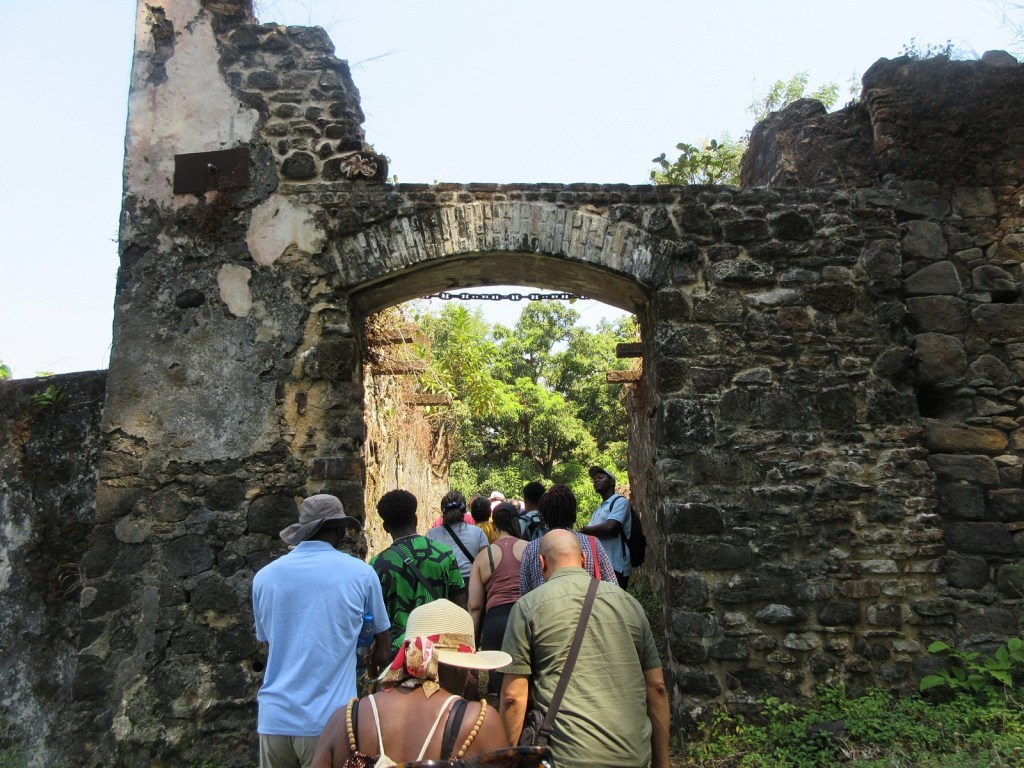
The main gate of the fort.
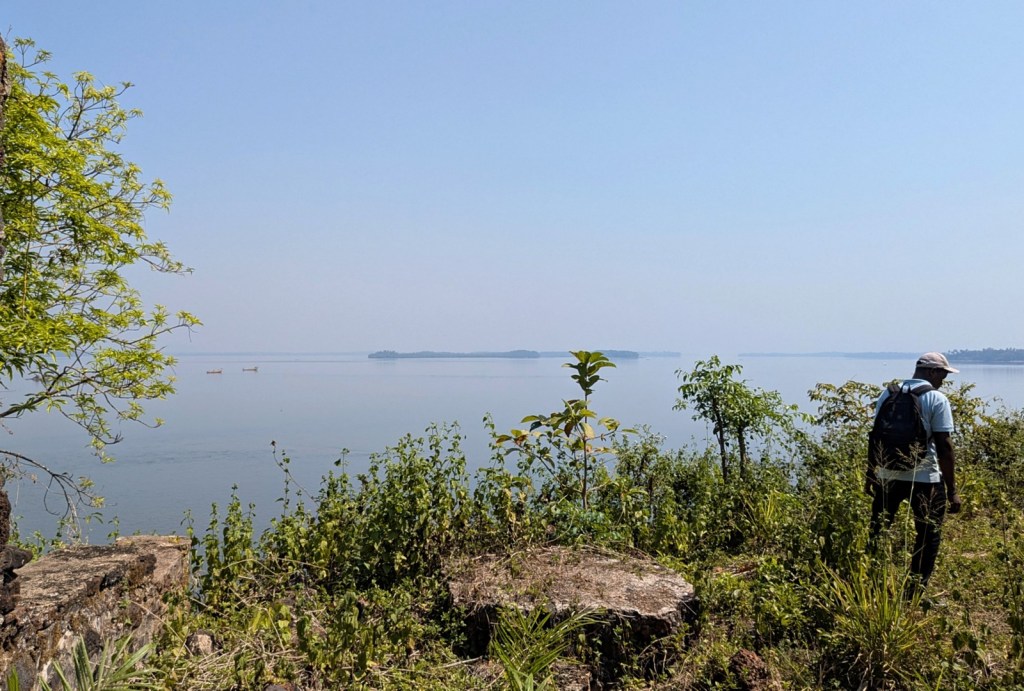
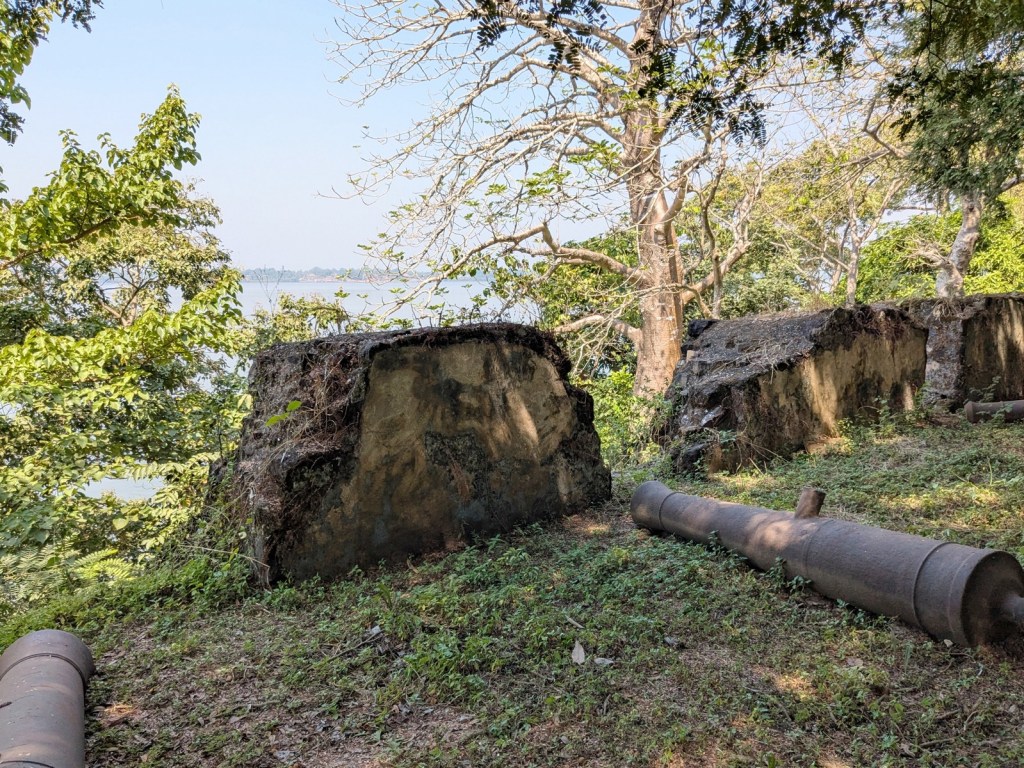
After the prayer the guide gave us a short history of the island and the slave trade in Sierra Leone, which was necessarily compressed but pretty alright. Then we hiked the 100 feet or so on up to the fort (it’s a very small island). The fort is on a gorgeous spot to be the site of so much pain. You can see why they picked it. It’s about as far up the river as you can go in a ship (as evidenced by the ore loaders a mile away), and the island has a small bluff on which the fort is built. With the trees cleared you could see any threats coming from a ways off. We entered the fort through the main gate which brought us past the ruins of the apartments and then onto the main bastion, with cannons on the ground still overlooking the main approach.
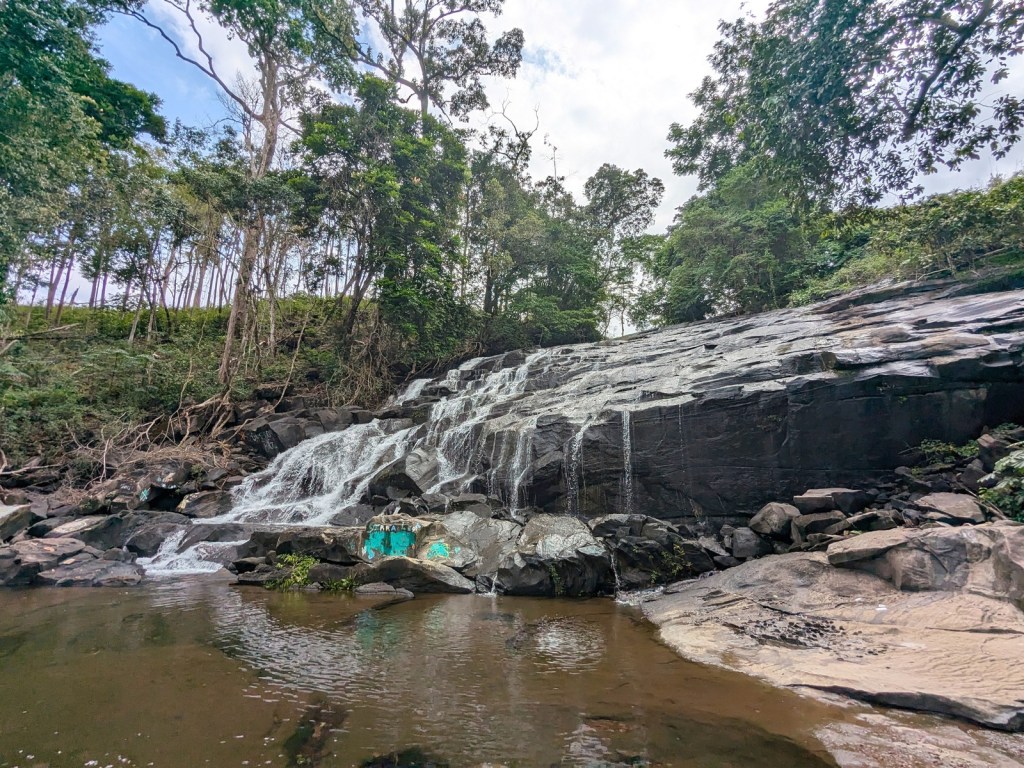
Way back in 2024 and right at the start of the rainy season (yesterday as I’m writing this) we went on a hike to Mambo Falls and it was a lot of fun!
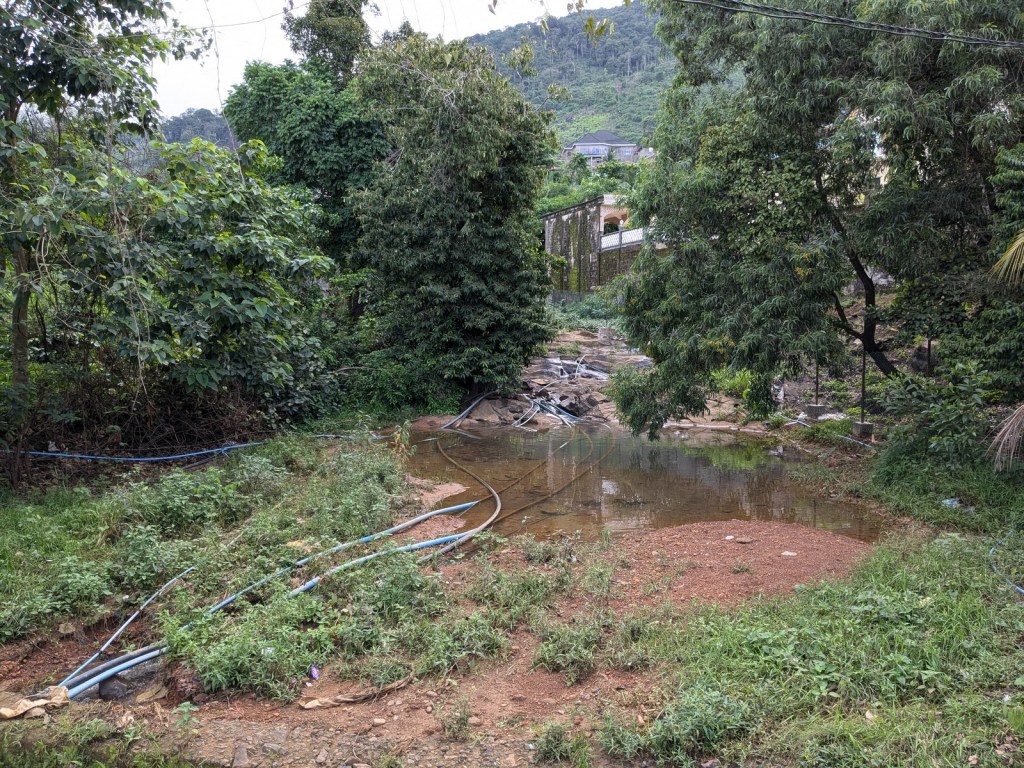
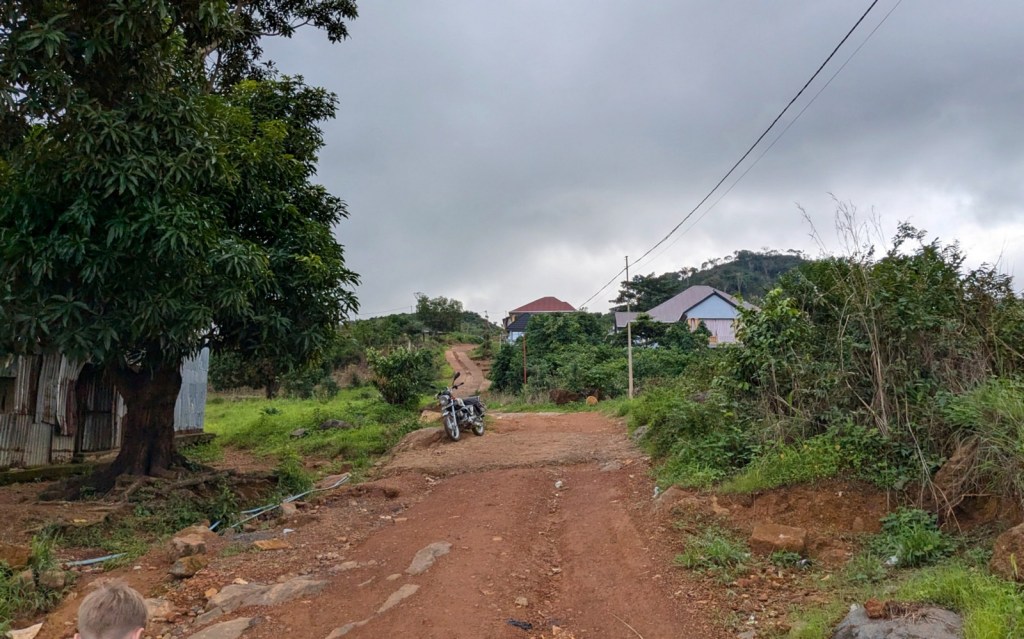
Mambo Falls is apparently one of the more popular hikes in the Freetown vicinity because it isn’t too tough and at the end you get to visit a waterfall. When we visited we parked at J.J. Drive. There was a bridge there and several signs, though don’t cross the bridge, as that is not the way to the waterfall. Please do take note of (what I thought was) the very cool system of pipes that people are clearly using to bring running water to their houses, that is a super neat system:
You can’t really see it from this picture but I think this is a silted-up dam, with the blue pipes leading through a hole in what was the dam wall. There was infrastructure as part of the dam that I think would have led to water pipes, but now they have this system.
Instead head towards the spot in this link, which is closer to the trailhead, such as it is. Mambo Falls itself is also marked on Google Maps, so that should be helpful. Since the hike is rather popular everyone around will probably realize you’re trying to go to the waterfall and point you in the right direction if you get lost, and you can also ask for directions. Generally, go uphill.
Path toward the waterfall.
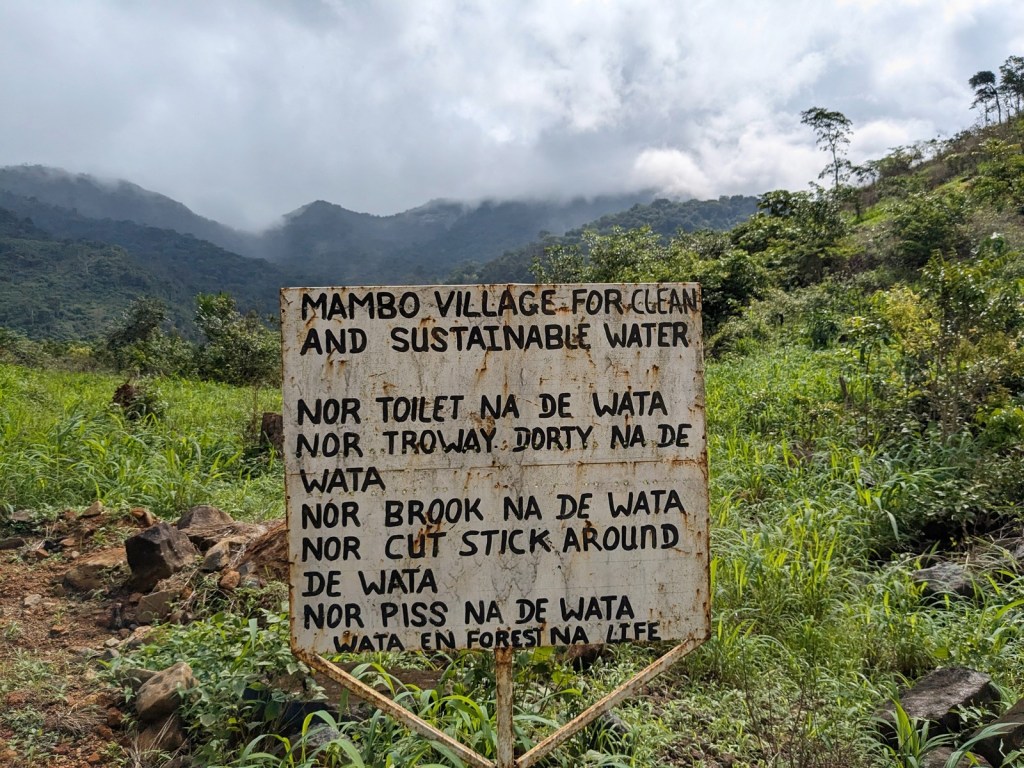
The other reason the hike is so popular, besides being able to see a cool waterfall, is that the trail and the waterfall area itself is maintained as a community project. As such there are signs pointing the way as well as delineating appropriate behavior at the falls. It also means that there is an entry fee to pay for this upkeep, and near the crest of the hill before the descent to the falls itself there will be a small hut where people collect that fee. When we went it was 10 Leones, or less than $0.50 USD at the time. Besides the trails, this meant that the falls area itself was well-kept (as we arrived a man was raking up some of the accumulated leaves), and there were even some small shelters to relax in.
Rules for the trail, in Krio.
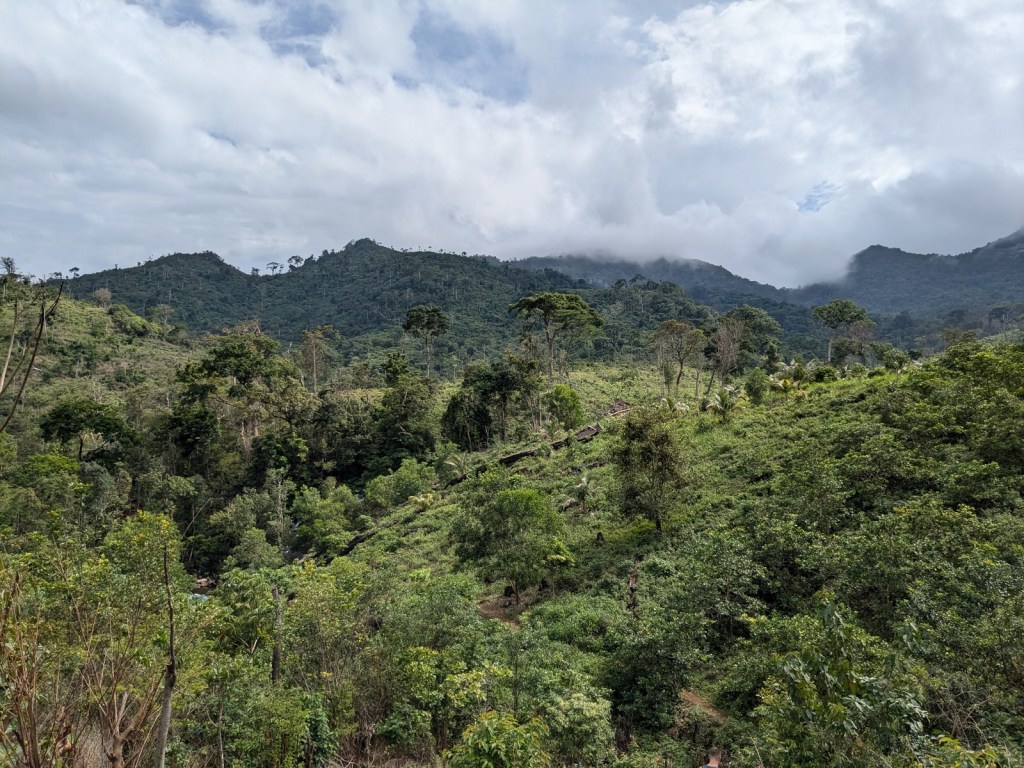
The hike itself is not too tough, minus having to walk pretty much straight uphill and then straight downhill. It is much less steep than Sugar Loaf was and significantly shorter. Plus on the way there and the way back you get some incredible views of the valley where the waterfall is and of the ocean from atop the peak. Gorgeous stuff.
Looking down into the valley with Mambo Falls, which is just barely visible in the lower left. I took this picture though in admiration of the hillside farm in the middle.View of the Atlantic you get on the way back, with the Banana Islands on the horizon on the left.
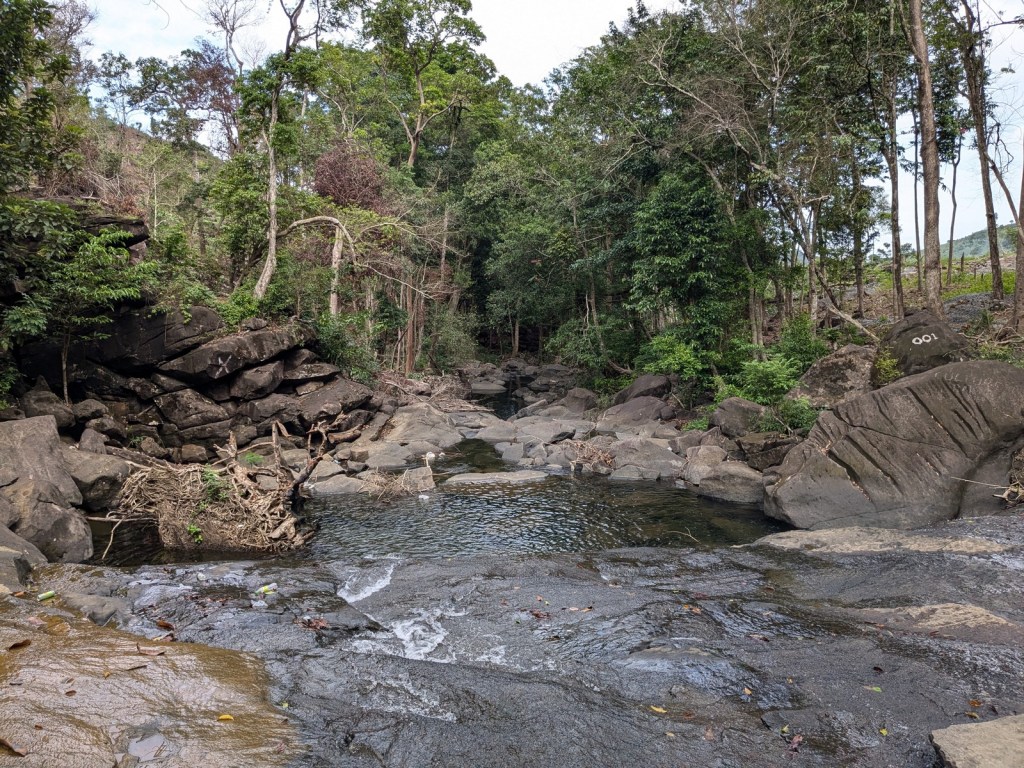
Arriving at the waterfall we had fun doing the normal waterfall stuff, i.e. swimming around in the shallow pool at the base and getting sprayed by the water cascading down the rocks. In the pool as well there were cute crawfish-looking things that were actually pretty ready to fight; I am pretty sure one grazed my feet and I scampered off to the safety of dry land where they couldn’t get me. You’ll probably have company at the pool because it is a popular spot to cool off, but everyone is friendly.
And that was pretty much our hike; we spent about two hours total on the endeavor and it was a very fun way to spend a Saturday morning. Although the community does upkeep on the place if you do go remember to be polite and pack out any trash you bring and be respectful of the site!
I talked about this just two weeks ago at the tail end of the Heddle’s Farm post, but I have spent quite some time trying to figure out what an “electrical machine” is. To recap, at one point in A Residence at Sierra Leone, Elizabeth Melville is describing the 1794 French attack on the colony:
They scoured the town in search of stock, which they kept shooting at all day, rendering it dangerous to walk in the streets; books, plants, seeds, dried birds and insects, were torn, trampled upon, and scattered about: telescopes, barometers, thermometers, and an electrical machine, shared the same fate…
Which, you know, prompts the question: what the heck kind of electrical machine would have existed in a brand-new colony (this version of the colony was a whopping 2.5 years old at this point) on the edge of Africa? It perplexed me. I sat on it for a little bit, not even really knowing what to google, and even contacted a historian who didn’t know.
My first attempt at finding out an answer was trying to figure out if there were any early electric weather instruments. Looking at the company kept by the electrical machine in Melville’s quote, namely barometers and thermometers, I thought maybe whatever the electrical thing was it had to do with weather prediction. Alas although there is a lot on early weather prediction, there was no electricity in sight.
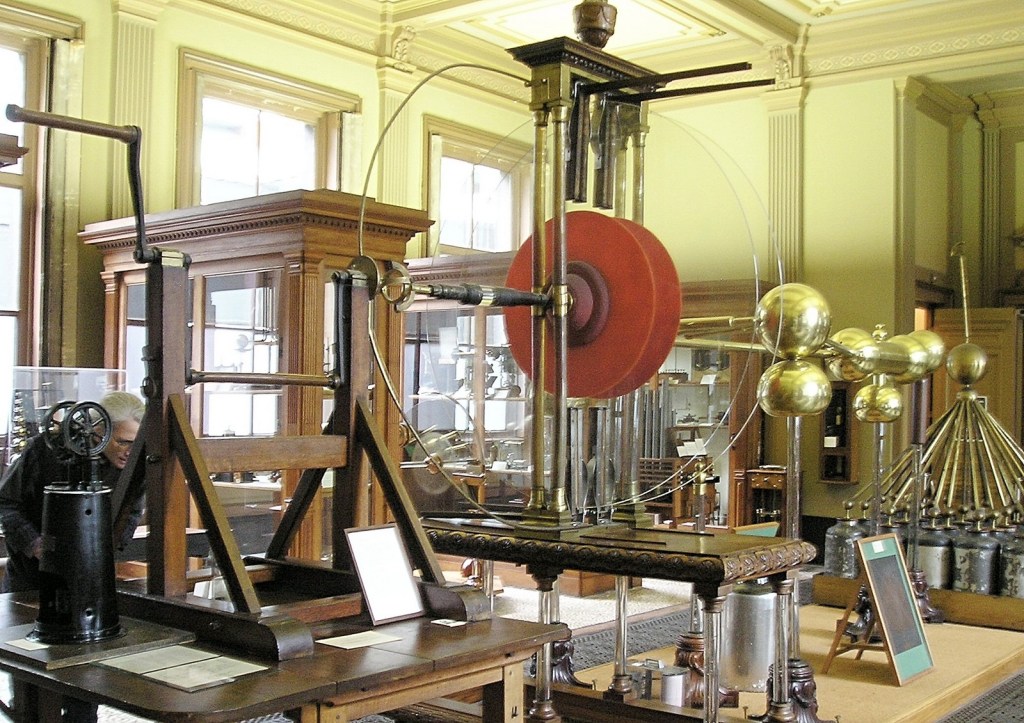
It was at this point, via some magical google search that I have lost, that I found out that towards the end of the 18th century there was this hip new thing: medical electricity. Apparently it was all the rage to give yourself mild shocks thanks to electrostatic generators, like the one pictured at the top. This was pretty revelatory, because here was something that was electrical and also existed in the late 18th century. Except I still ran into the problem of like, would a brand-new colony really have the hippest new medical instruments? (well they were not actually so new by 1794) So I wanted to see if I could find any evidence there really was an electrical machine being used for medicine in Sierra Leone at that time. I couldn’t find any. I managed to identify that in 1794 Thomas Masterman Winterbottom was the appointed physician to the colony, but I couldn’t find anything to associate him with an electrical machine.
Googling continued. The next thing I found was about Henry Smeathman, who was resident in Sierra Leone 1771-1775. In order to establish himself in the area, Smeathman had married the daughter of local potentate James Cleveland. At one point, in order to keep his father-in-law happy, Smeathman had gotten him an “electrical machine” (check the footnotes of the link), establishing that there had been at least one electrical machine in Sierra Leone prior to the French attack. But would that thing have really made its way up to Freetown in the next 20 years, and be so memorable that Melville would have recorded it? (as an aside, I am sad that due to lame things like copyright and not having access to an academic library, I can’t read this book)
But! At this point I think I had the idea to google at the same time all those instruments that Melville had mentioned, which brought me to the book Life and Letters of Zachary Macaulay. Zachary Macaulay, as I am sure you already know, was the governor of Sierra Leone at the time of the attack. The book has an excerpt from his journal, where he describes the attack:
At the other end of the house I found telescopes, hygrometers, barometers, thermometers, and electrical machines lying about in fragments… The collection of natural curiosities next caught my eye. Plants, seeds, dried birds, insects, and drawings were scattered about in great confusion…
Well! Here I finally had a contemporaneous account of an electrical machine being in Sierra Leone. Multiple even! And of it being destroyed in the attack. I also found this account very curious because his description of the aftermath of the attack (a small part of it anyway) so closely matches Melville’s description that it seems like Melville was familiar with Macaulay’s account. Except I don’t think they would have crossed, and Macaualay’s account was in his journal, which as far as I can tell wasn’t published at all until 1876, whereas Melville’s book came out in 1849! History, man. Mysteries deepen, and the plot thickens. (to clarify publication dates, Life and Letters of Zachary Macaulay was published in 1900, but excerpts of his account of the attack was published in The Life and Letters of Lord Macaulay in 1876, Lord Macaulay being Zachary’s son)
Except another except! Okay we’ve established that electrical machines were in the colony in 1794, but we haven’t really established what the hell they were doing there! I mean, it’s clear from the quote, sort of. They were there along with other fun scientific instruments and natural curiosities, so clearly someone in the colony was a naturalist who liked collecting things and showing off cool science experiments to his friends. Was this the governor? From Wikipedia at least, it doesn’t appear Zachary was much of a naturalist or anything. His predecessor was, but man this is a lot of expensive stuff to leave behind in a far-flung African colony, no? And also also also, weren’t both those men running a colony? How did they have the time to also be a naturalist? I have a job and I can barely keep up with this hobbyist blog. I am impressed. Or maybe it was all that “liberated” labor that gave them this free time. Maybe there was another naturalist running around I haven’t identified. Whatever the case, I am excited to delve into more mysteries.
Finally though for your benefit, I have a picture of an electrostatic machine at the top, but if you search “electrical machine” on this museum page, you’ll find a lot more examples of electrostatic generators that were contemporaneous with the colony, and made in England to boot, and portable to top it off! I think those would be much more likely to be the sort of “electrical machines” that the French smashed up. Dang French.
Yesterday, (as of writing this), I hiked on up Sugar Loaf Mountain! It was fun and I am still exhausted. My super amazing wife was out of town and a group of people were going hiking up the mountain and invited people along. I was expecting a big crowd but there was not a big crowd instead there was a relatively small group of people who were all much much fitter than me and I spent the whole time struggling to keep up.
The trailhead.
The hike starts in Regent. If you want to do the hike yourself, the trailhead starts here. Follow what Google Maps displays as a road until the end and then keep going along the waterpipes and on up the trail. The picture above is the trailhead, at least how it looked the day we hiked it (at least two years ago as you are reading this), but Freetown keeps expanding its borders so who knows what it will look like when you give it a go.
According to the Visit Sierra Leone site, you are supposed to get a local guide and pay a small donation to hike on up the trail. As far as I could tell we didn’t do that and no one really approached us about it (not clear where one would ask for a guide), but it might be helpful to try to figure it out if you’re not going with someone who already knows what they are doing. The trail is supposedly marked, which is sort of true. It has definitely been marked many times. Hiking up we passed by arrows painted on rocks, paint on trees, and ribbons tied to branches. The trail itself was also usually pretty visible, though people have taken multiple paths around various obstructions, and it seems there are plenty of stories of people taking a wrong fork and winding up on the wrong mountain. If you haven’t seen a discarded water bottle in a bit, you’re probably on the wrong path.
Two guides were engaged, and about eleven o’clock I started, and was one and a half hours making the ascent. No one had been up for a long time, and the path was much overgrown, so that my guides missed their way twice. I never saw any thing like it. It was like going up a ladder, from rock to rock, up, up, at every step – at times pulling ourselves up by the bushes; at other places walking on an extended bare rock, with the inclination of a steep roof, while precipices of thousands of feet lay beneath. It was a very wearying effort, but we reached the top.
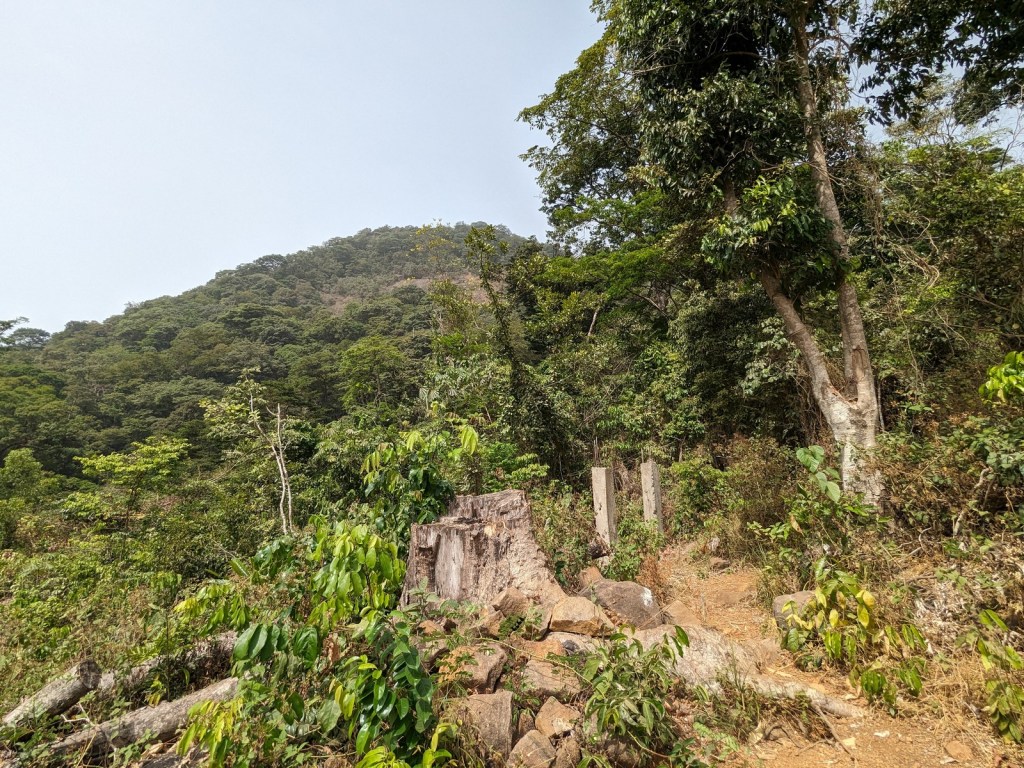
It hasn’t changed much (the trail was less overgrown than he described like I said above, but I think he did it closer to the rainy season). Since the internet said it was a marked trail I had expected, like, switchbacks. The straight-line distance for the trail is not even a mile, and before the hike I had been worried about how long a reasonably curvy trail up the mountain would be. Turns out the trail goes pretty much straight up from the trail head to the tippy-top, gaining (again as far as I can tell from Google Maps) 1000 feet of elevation in about 3000 feet of walking. Steep! I don’t think it would be too too bad if you were taking your time instead of running after people way more in shape than you, but there are definitely some slippery leaves and tricky bits. On the descent I resorted to crabwalking a few times. In the picture above you can see the rock faces our dear man George was talking about, but those were actually easy sections; the rock was grippy enough that you could just (“just”) walk up, though in the rainy season it might be much more hairy.
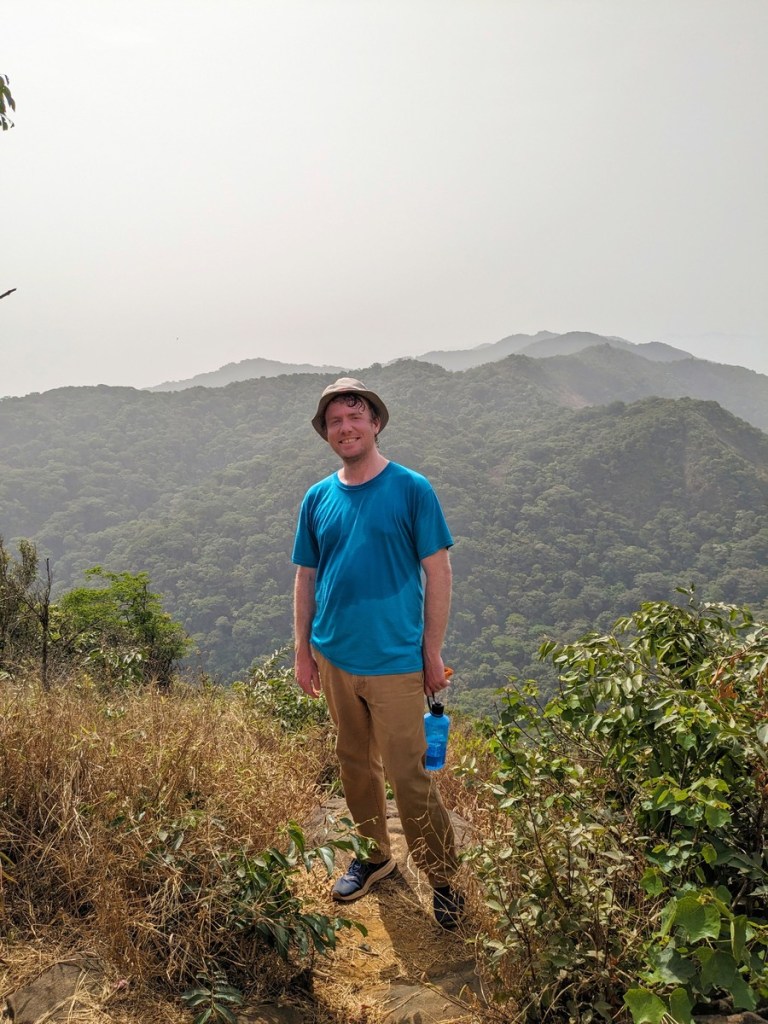
Further down in the paragraph quoted above George describes wondrous sights but unfortunately on the day we hiked up it was more than a bit hazy with the tail end of the Harmattan. What we did see was still rather pretty, but given how pretty it was I can only imagine the sights when the skies are clear. The photo at the top was about 3/4 of the way up and was the best view of Freetown itself, while the photo right above this paragraph was at the summit (I tried smiling I promise but I guess this is the best I could muster so exhausted) looking south into the forest preserve. It’s a gorgeous landscape, so unlike the port side of Freetown which really isn’t far at all, and must be unlike anything else in Sierra Leone until you cross the lowland plateau and hit the hills 100 miles inland. Worth the walk even if it is a doozy!
This is the story of me trying to find Heddle’s Farm. Why did I go looking for it? Because it is there. Maybe.
Early on in our Sierra Leone journey I of course discovered the list of national monuments. In Zambia, it was a book about various national monuments published by their National Monuments Commission that had me out looking at a lot of stuff and then trying to document it on the internet so it was more accessible to other people. I wanted to recreate that here in Sierra Leone because it is fun. These sorts of things have just the right amount of mystery. The places are usually documented enough that you can find them but not documented enough where it’s easy. I should point out that this is about documentation. Someone knows where all these things are; they are written down in government archives somewhere or someone is in charge of going and looking at the things every so often. That someone probably works for the Sierra Leone Monuments and Relics Commission and I really need to get down there and talk to them but I usually have to work when they are open and I just haven’t made it yet. So when I am looking for things there are easier answers but the handicap makes it fun. This brings me to Heddle’s Farm.
Right away I wanted to go look at Heddle’s Farm. Probably what intrigued me the most was that, according to the Sierra Leone Heritage page I just linked to, it eventually became part of the botanical garden of Fourah Bay College. I like botanical gardens so once you find out one exists, you like gotta go. And maybe they sell saplings that I could plant. It also meant I thought it would make it easy to find Heddle’s Farm, I mean, I know where Fourah Bay College is and it’s easy to drive to and botanical gardens are large and easy to spot. Not so. I dragged my super amazing wife out one weekend to drive around the college (through and then back through again that is) to see if we could spot the garden. We couldn’t. Later that week I had her ask some local colleagues about it and they were vaguely aware a botanical garden existed but were not really sure where it would be. So that was a bit of a dead end.
Back on the Sierra Leone Heritage page it recommends that for further reading you turn to A Residence at Sierra Leone. So I did. I bought the book in hardcopy and had it shipped here and read the whole thing for clues to the location of Heddle’s Farm. The book itself is what it says on the cover, a series of letters and journal entries edited together into a day-by-day narrative of the author’s time living in Sierra Leone. During most of the time she stayed in the house that later became known as Heddle’s Farm, after Charles Heddle, who owned it for a while and was very successful. Not to detract from Charles Heddle, who has a significant amount of stuff written about him online, but after reading A Residence in Sierra Leone I wanted to know more about the author. Her name was Elizabeth Melville. She originally published her book as “By a Lady” (edited by the Hon. Mrs. Norton), I assume to avoid anyone featured in the book thinking she was gossiping about them. But googling around I can’t really find anything much about her, though like so many things in Sierra Leone clearly someone knows a significant amount about her, I just don’t know who and I don’t know where they wrote it down. So in an attempt to be helpful to future googlers, I present, based on everything I could find online about her,
A Biography of Elizabeth Melville:
Elizabeth Helen Callender Melville was born in Dunipace, Scotland, on March 14, 1818. In 1840 she moved with her husband and baby to Sierra Leone. Her husband was a judge on the Mixed Commission Court which examined whether seized ships had been part of the slave trade. The family had at least one furlough in England but returned there permanently in 1846. She published her book in 1849.
…and that’s it. Elucidating. Anyways out of reading the book there were a couple of clues. One is that she describes the house as being “at the formidable distance of half an hour’s ride” from Freetown, which I figured put it about a mile from what is now downtown. Another is that she describes looking over at Mount Aureol from the house (she spells it “Oriel”). She says “The hill to our right rises up very abruptly, shutting out the view of both river and opposite shore. It is much higher and still more difficult of access than this; although were a plank (could we find one long enough) flung across from our windows to the corresponding height on the other side, I think I could run across in five minutes.” From that clue her house is not on Mount Aureol, but next to it. When I looked at Google Maps for where Mount Aureol was, it showed me what I interpreted to be the area next to Fourah Bay College (at this point where I still thought a botanical garden was), so I wrongly took this as evidence the house was somewhere on the grounds of college. But since I already had been thwarted looking for a botanical garden on the grounds of the college, I searched for other sources.
One interesting thing I found was the above picture, via the Library of Congress. I figured there could only be so many botanical gardens in Freetown, so that house pictured might be Heddle House itself. I was further encouraged when I noticed the house in the photo looks a lot like the house in the painting that graces the Sierra Leone Heritage webpage. I also, upon re-reading that webpage, noted that Heddle’s Farm is described as being “on the old Leicester Road.” I managed to figure out that the old Leicester Road is the that the Leicester Police Post sits on. I had also come across this Government of Sierra Leone Integrated GIS Portal, and you’ll have to do the zooming yourself but if you zoom in along that road there is a section labelled “Tree Planting” and ah ha! I thought. Botanical garden, trees, tree planting, Old Leicester Road, maybe I have found it, and with a picture of the location and of the house itself in hand maybe I could go find it. So I went out for another drive to hunt the place down, assured of success!
I was unsuccessful. I could discern no tree planting along the road, except for a sign that said “tree planting.” There were no old buildings or anything that looked botanical garden-like, and as I went down the road it got dicier and dicier to the point where I cut my losses and turned around, defeated.
Once I returned home, I puttered around and realized that although my idea of looking at a map for the location of Leicester Road was pretty brilliant, it was not brilliant enough. Between being the home of Elizabeth Melville and the current day, Heddle House spent some time as the home of the Forest Commissioner. I figured the Forest Commissioner’s house, being a government facility, would be on old maps, and I had already found some old maps of Freetown. Specifically, I had found a 1947 map of Freetown from here. Looking down at the area around Fourah Bay College, I discovered two things: one, that Mount Aureol is the hill that Fourah Bay College is located on, and two, a little marker labelled “Heddle’s.” Well! That settled it! This was the location of Heddle House, on the hill next to Fourah Bay College. For your handy reference, I think it is where this marker is on Google Maps. Now all I had to do was go look at it.
This was not as easy as I thought it would be. I knew from my Leicester Road experience that the driving in that area was not so fun, so what I really wanted to do was park at Fourah Bay College and walk over. Mrs. Melville describes riding up Mount Aureol from Heddle House, and I wanted to essentially do the opposite. I made the mistake of picking a Sunday for this adventure and found a rather large church gathering at Fourah Bay College that I was too embarrassed to try to sneak around so I could muck off into the woods. So I drove down the hill and drove back up the adjoining hill, where I thought Heddle House lay. This was encouraging, actually, because I found a stretch of road that seemed to have once been paved, perhaps in the colonial era, like you would presumably do so the forest commissioner can get up to his house. Eventually though I could go no further without (I felt) significant risk of the car tumbling over the side of the cliff, so I parked in front of a shop after asking the proprietor if it was okay. She was very friendly.
View of Fourah Bay College from what I think is the location of Heddle’s Farm.
From my parking spot it was still a bit of a hike up the hill and the most impressive part of the whole adventure is that there are very nice houses up there built with what look like very heavy building materials and I am stunned someone hiked all that concrete and building materials up there. A very nice view though! The picture at the very top of this post is from near the shop I parked at and was pretty encouraging that this was the spot. The tallest building in the right third of the photo is the Freetown City Council building, right smack in the middle of downtown and the oldest part of the city. At one point in her book Mrs. Melville describes being able to see Freetown from her window as if laid out in miniature, and yeah that is exactly what I saw from that vantage point.
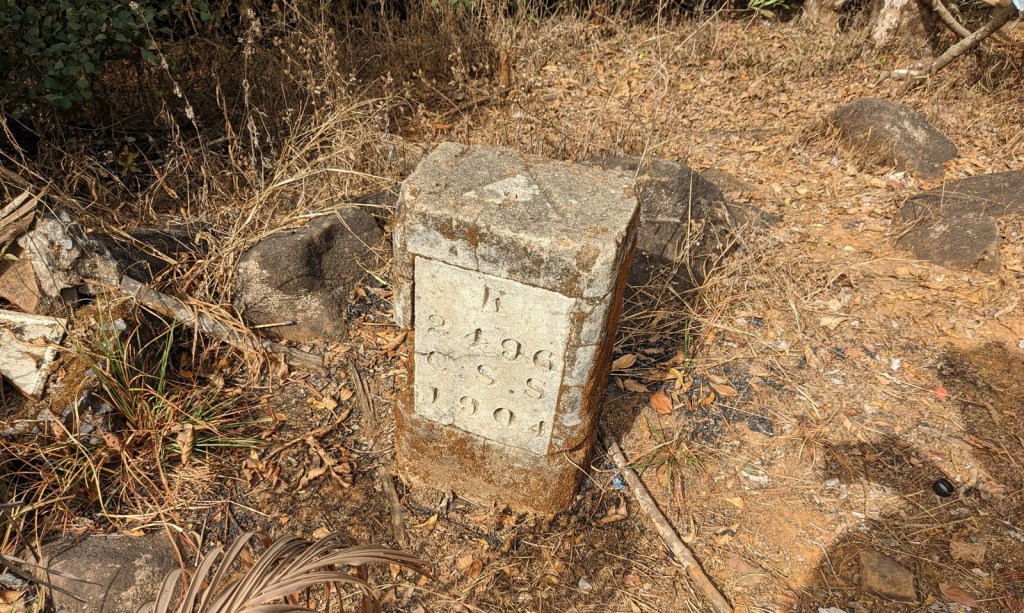
What I had hoped to find at the top of the hill was some sort of historical marker. There are historical markers next to some of the other historical sites I have seen in Sierra Leone, so I was hoping that along one of the paths up there I would find one and it would confirm I was in the right spot. I never did. I was also hoping to find the remains of the house, and I didn’t find those either. For quite a number of years the house had been reduced to just its foundations, and I think even those are gone these days. If you look at the Google Maps link from before, in the area there is a large dirt patch which currently serves as a soccer field and a source of clay for bricks. Nearby is a trash pile and all around the area are homes that have sprung up on the hill as Freetown expands. There is also a communications tower on top of the hill. Various friendly people saw me wandering around and asked what I was up to. I showed them pictures of other historical markers and asked if they knew of something similar up there, to no avail. Some suggested I look over at the college and I went down that path a little ways but didn’t see anything. I also poked around the hill but the only historic-looking thing I found was a geographical survey marker:
Eventually I decided I wasn’t going to see any artifacts that confirmed this was the location of Heddle House but I walked away satisfied anyway. The area clearly matches the description, given the saddle-like nature of the hill, the view of Mount Aureol, and the stunning vista of Freetown laid out in miniature. It’s a beautiful spot and despite the fact I have no idea how people get building materials up there, as a living location it is certainly charming. I don’t think there are any remnants of the botanical garden left, which is a bit sad, but there are other things for Freetown and Fourah Bay College to devote their resources to. The people on top of the hill were very friendly and tried to help. If you’re ever in the area it is probably much more straightforward to go to Fourah Bay College or Leicester Mountain for the views, but if you do get up there they are very nice.
One final note while I’m talking about A Residence in Sierra Leone. At one point in the book Mrs. Melville is relating the story of the 1794 French attack on Freetown, as told to her by various eyewitnesses. Melville is recording this in a letter she wrote in 1846, a half century after the event. Relating the story, she describes how the French “scoured the town in search of stock, which they kept shooting at… books, plants, seeds, dried birds and insects, were torn, trampled upon, and scattered about; telescopes, barometers, thermometers, and an electrical machine shared the same fate…” A mystery (to me anyway) is what the heck she was referring to when she said “an electrical machine?” I mentioned the whole half century thing because the eyewitnesses must have been relatively young when they witnessed the attack, their memory could have been influenced by subsequent events, and Mrs. Melville might have interpreted something they said anachronistically. But with all that being said what 1790s “electrical machine” is existing in a colony that hadn’t been around for a decade at this point? What is this thing she’s referring to? Electrical thingies existed at this point and were popular (Ben Franklin flew his kite in 1752), but what would have been in the colony? It’s listed with weather-related equipment so maybe something to do with that? Or just a scientific novelty? If you know what they are talking about please let me know.
Future Boy by Michael J. Fox and Nelle Fortenberry
Like I warned last week, oops, I have become a train guy. I mean not quite but almost. I complained a few weeks ago about how the history of Sierra Leone wasn’t so obvious to me like it had become in northern Zambia, but things are clicking into place. To the point where, as of writing this (early 2024), I am worried about drifting away from my dream of writing a book about the Central Africa Mission of the London Missionary Society (which I am totally going to do, as soon as I 1) spend weeks in the archives in London, 2) gain journalistic training and travel to Mbala for weeks to gather reflections on the current impact of the mission, and 3) achieve a sort of self-starting discipline I can’t even keep up to keep this blog updated). But things are clicking into place. As I’m starting to find some of the colonial history of Sierra Leone that shape the physical and societal patterns of the place you can spot the remnants of history. Like Hill Station.
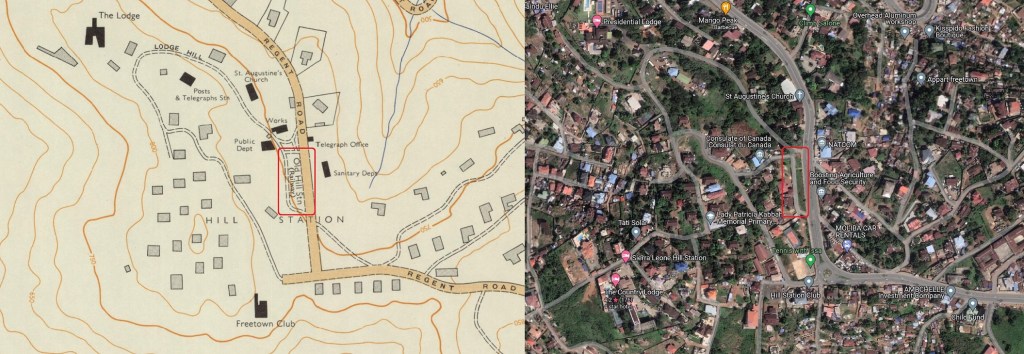
So we have been living here (again as of writing) in Hill Station the neighborhood. It was upon visit to the train museum and reading the little pamphlet we bought in the gift shop that I realized that comes from like, Hill Train Station (a little more research later I’m unclear if that is true, this Hill Station was patterned off a Hill Station in India so the technical etymology of the name might not be a literal train station). Since I like looking at the remnants of history, I wanted to figure out where the actual Hill Station was. I spent a little bit of time looking around on Google Maps satellite view for anything that looked like an old train station or a train right-of-way, but I pretty quickly deemed that as unlikely to yield results. Luckily though I thought of looking at old maps and hit the jackpot right away.
In the top right corner of this map, if you zoom in, you can see a little traffic island sorta thing labelled “Old Hill Stn (Railway).” Well that solved that mystery. It also pointed out where “Hill Station” (the neighborhood) actually was. When I was zooming around Google Maps I was looking too far up the hill. Another thing looking at the old maps is that it is remarkable (to me, I am remarking on it) how much more developed the area is than it was at the tail end of colonialism. These hills are now covered in neighborhoods and houses whereas before Hill Station was an isolated little enclave in a sea of forest.
Speaking of which, what was Hill Station, the neighborhood? Like I just said, an isolated little enclave. Around the turn of the century the British administrators decided that living up on a hill would be a lot better idea than living down in Freetown where their offices were. This was ostensibly for health reasons, to get up into the breezes which hopefully would mean there were far fewer mosquitoes. However, as explained in this excerpt fromThe Creoles of Sierra Leone by Leo Spitzer, in implementation it was a bit more racist than that. Not only would the neighborhood be mosquito-free, but it would also be largely free of anyone non-white, except for the adult servants of the white administrators living there. They put signs up a mile out to keep anyone from even planting a garden. Leo Spitzer’s book is about how Sierra Leonean society split from the British colonialists, and Spitzer credits this spatial separation of administrator and administrated for part of that.
Anyway the other thing about Hill Station is the old houses. Sierra Leone is known for old houses but these old houses are different. The Hill Station neighborhood was not only racist but also expensive. To get all the way up to the hill they had to build a whole railroad, hence the creation of the Station of Hill Station. The neighborhood and railway were built roundabout 1902-1904. The houses they built were referred to as “Harrods Houses,” because they were ordered from Harrods (as in the department store), shipped to Sierra Leone, and constructed on the spot from the kits. So scattered around the hill are apparently 12 of the original 24 or so Harrods Houses with their distinctive look. Not too bad for some pre-World War I kit houses (here is a site with some interior shots).
Circling back to trains, once I figured out where the Hill Station Railway station was, I wanted to figure out where the old railway line was. There was not conveniently wonderful old maps of the railway line that I could find easily. The line only ran until 1929 when there was a nice enough road and enough of the administrators had cars to make it no longer necessary. So any maps I found would have had to be made in that era. One map I did find (via this blog) was on this wonderful website all about post offices that existed on trains and ships, which is a wonderfully niche hobby that I am in real danger of falling into the very moment I turn 40 (check out their committee page). It is not a very exact map but I started to try to trace the route which led me to discover the road with the extremely convenient name Old Railway Line so there’s another mystery in the bag.
But the whole point of this blog post is that after all this research on the Hill Station railway line and hill station itself I went over there and checked it out. It was a lovely little walk on a Sunday morning (to try to make sure it was relatively quiet). First I went to the spot of the old railway line hoping to find some evidence of its existence, but alas not really:
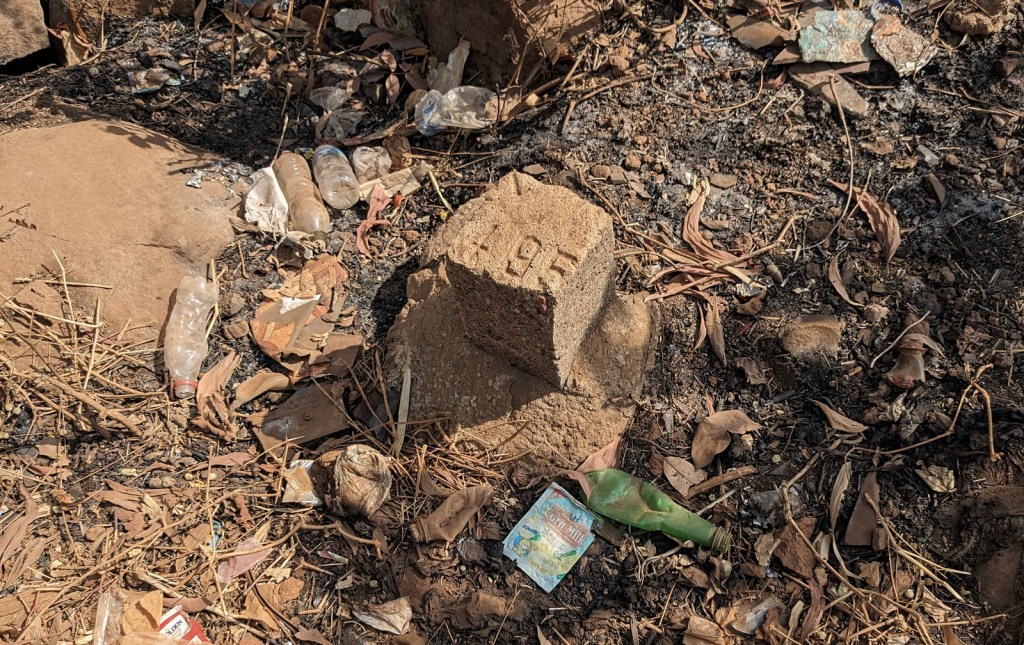
There used to be a train station here.
Then I walked up the hill to check out the Harrods Houses. I had spotted them before on the way to the Country Lodge Hotel and thought to myself they had looked colonial, so I was pleased in the course of all this research to discover they really were. They are popular houses to photograph (and, for the artist Frédéric Lère who I found via Google Maps of all things, to paint) though I tried to be a little discreet.
A pre-World War I Harrods House, intact and still in use.
So the point is, history is cool, trains are cool, and going on walks is cool.











 Pat in the World
You must be logged in to post a comment.