
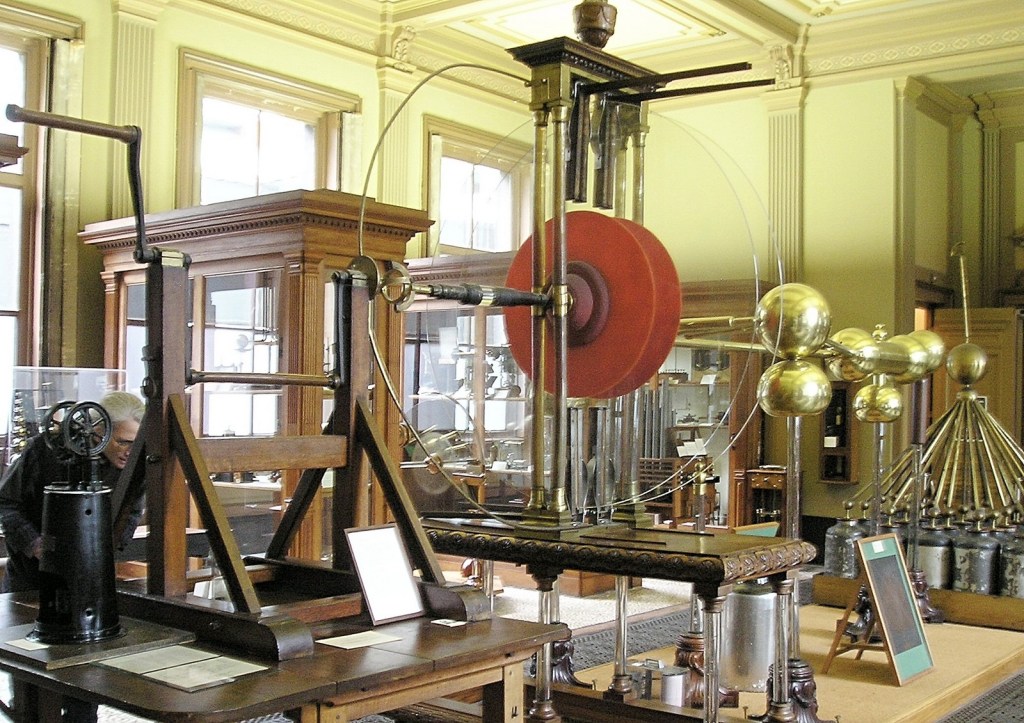
I talked about this just two weeks ago at the tail end of the Heddle’s Farm post, but I have spent quite some time trying to figure out what an “electrical machine” is. To recap, at one point in A Residence at Sierra Leone, Elizabeth Melville is describing the 1794 French attack on the colony:
They scoured the town in search of stock, which they kept shooting at all day, rendering it dangerous to walk in the streets; books, plants, seeds, dried birds and insects, were torn, trampled upon, and scattered about: telescopes, barometers, thermometers, and an electrical machine, shared the same fate…
Which, you know, prompts the question: what the heck kind of electrical machine would have existed in a brand-new colony (this version of the colony was a whopping 2.5 years old at this point) on the edge of Africa? It perplexed me. I sat on it for a little bit, not even really knowing what to google, and even contacted a historian who didn’t know.
My first attempt at finding out an answer was trying to figure out if there were any early electric weather instruments. Looking at the company kept by the electrical machine in Melville’s quote, namely barometers and thermometers, I thought maybe whatever the electrical thing was it had to do with weather prediction. Alas although there is a lot on early weather prediction, there was no electricity in sight.
It was at this point, via some magical google search that I have lost, that I found out that towards the end of the 18th century there was this hip new thing: medical electricity. Apparently it was all the rage to give yourself mild shocks thanks to electrostatic generators, like the one pictured at the top. This was pretty revelatory, because here was something that was electrical and also existed in the late 18th century. Except I still ran into the problem of like, would a brand-new colony really have the hippest new medical instruments? (well they were not actually so new by 1794) So I wanted to see if I could find any evidence there really was an electrical machine being used for medicine in Sierra Leone at that time. I couldn’t find any. I managed to identify that in 1794 Thomas Masterman Winterbottom was the appointed physician to the colony, but I couldn’t find anything to associate him with an electrical machine.
Googling continued. The next thing I found was about Henry Smeathman, who was resident in Sierra Leone 1771-1775. In order to establish himself in the area, Smeathman had married the daughter of local potentate James Cleveland. At one point, in order to keep his father-in-law happy, Smeathman had gotten him an “electrical machine” (check the footnotes of the link), establishing that there had been at least one electrical machine in Sierra Leone prior to the French attack. But would that thing have really made its way up to Freetown in the next 20 years, and be so memorable that Melville would have recorded it? (as an aside, I am sad that due to lame things like copyright and not having access to an academic library, I can’t read this book)
But! At this point I think I had the idea to google at the same time all those instruments that Melville had mentioned, which brought me to the book Life and Letters of Zachary Macaulay. Zachary Macaulay, as I am sure you already know, was the governor of Sierra Leone at the time of the attack. The book has an excerpt from his journal, where he describes the attack:
At the other end of the house I found telescopes, hygrometers, barometers, thermometers, and electrical machines lying about in fragments… The collection of natural curiosities next caught my eye. Plants, seeds, dried birds, insects, and drawings were scattered about in great confusion…
Well! Here I finally had a contemporaneous account of an electrical machine being in Sierra Leone. Multiple even! And of it being destroyed in the attack. I also found this account very curious because his description of the aftermath of the attack (a small part of it anyway) so closely matches Melville’s description that it seems like Melville was familiar with Macaulay’s account. Except I don’t think they would have crossed, and Macaualay’s account was in his journal, which as far as I can tell wasn’t published at all until 1876, whereas Melville’s book came out in 1849! History, man. Mysteries deepen, and the plot thickens. (to clarify publication dates, Life and Letters of Zachary Macaulay was published in 1900, but excerpts of his account of the attack was published in The Life and Letters of Lord Macaulay in 1876, Lord Macaulay being Zachary’s son)
Except another except! Okay we’ve established that electrical machines were in the colony in 1794, but we haven’t really established what the hell they were doing there! I mean, it’s clear from the quote, sort of. They were there along with other fun scientific instruments and natural curiosities, so clearly someone in the colony was a naturalist who liked collecting things and showing off cool science experiments to his friends. Was this the governor? From Wikipedia at least, it doesn’t appear Zachary was much of a naturalist or anything. His predecessor was, but man this is a lot of expensive stuff to leave behind in a far-flung African colony, no? And also also also, weren’t both those men running a colony? How did they have the time to also be a naturalist? I have a job and I can barely keep up with this hobbyist blog. I am impressed. Or maybe it was all that “liberated” labor that gave them this free time. Maybe there was another naturalist running around I haven’t identified. Whatever the case, I am excited to delve into more mysteries.
Finally though for your benefit, I have a picture of an electrostatic machine at the top, but if you search “electrical machine” on this museum page, you’ll find a lot more examples of electrostatic generators that were contemporaneous with the colony, and made in England to boot, and portable to top it off! I think those would be much more likely to be the sort of “electrical machines” that the French smashed up. Dang French.
 Pat in the World
You must be logged in to post a comment.