
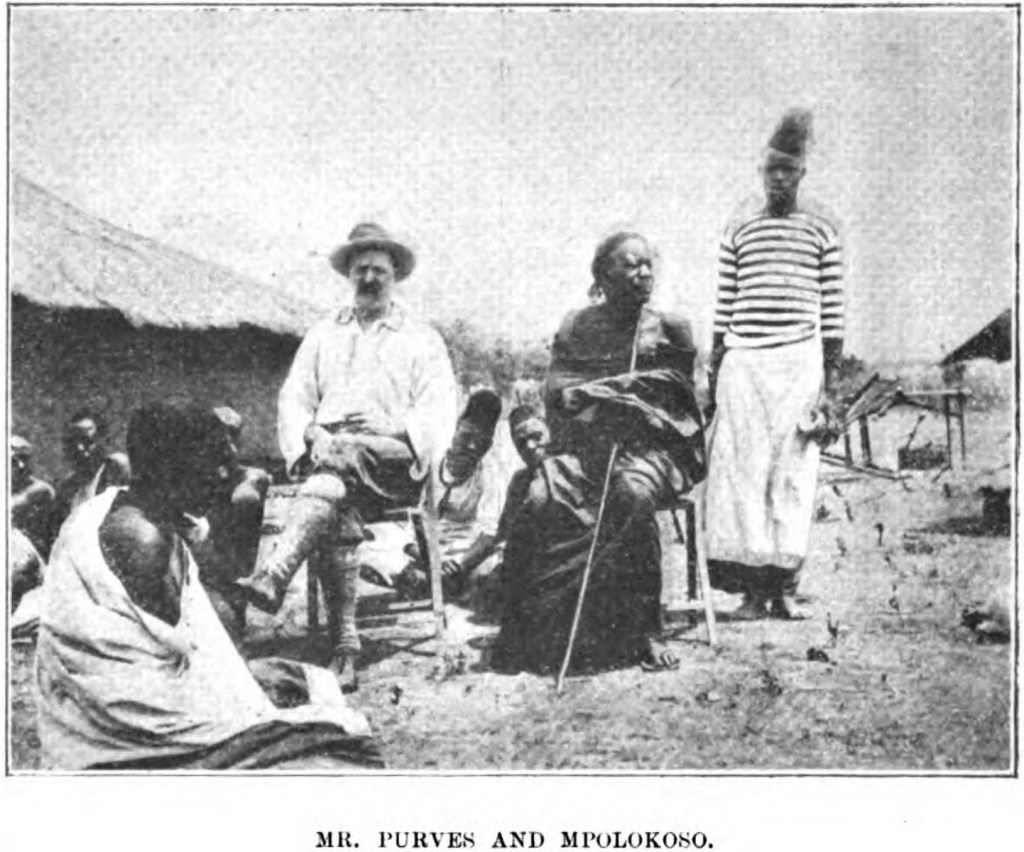
This is the final post in my little series of posting letters from the SOAS archives that pertain to the London Missionary Society extending their Central African Mission to the Bemba (I have more letters on other topics, don’t worry). The LMS had made some exploratory forays into the area and earlier in 1900 had set up a station staffed by their first convert Mr. Joseph Kalulu, aided by two younger teachers Mr. Kisama and Mr. Kawene. Through 1900, the British administration was preventing the Catholic (and French) White Fathers from moving in and setting up their own mission, but there was only so long they could be kept out. The LMS therefore were in a rush to set up their own European-led mission in the area lest the competing denomination win the souls they were vying after.

The LMS therefore sent Mr. A.D. Purves and his wife to go set up that mission, accompanied by Mr. David Kawandami, another locally trained teacher. The letter below is I think his first letter back to the LMS Foreign Secretary Rev. R. Wardlaw Thompson in London, reporting on how it is all going. Long time readers will remember some of the contents because this letter is quoted from in the May 1901 edition of the Chronicle, and then a longer account of the establishment of the mission is given in the September issue.
Purves though would be dead from malaria within a year of sending this letter. Mrs. Purves, widowed, went home to England. This was not, however, the end of the LMS mission to the Bemba. For that full story though I will point you to the definitive account, Mbeleshi in a History of the London Missionary Society by Rev. Dr. Bwalya S. Chuba.
Mbereze [Mbereshi] River, Lunda
17th Dec 1900
Dear Mr. Thompson,
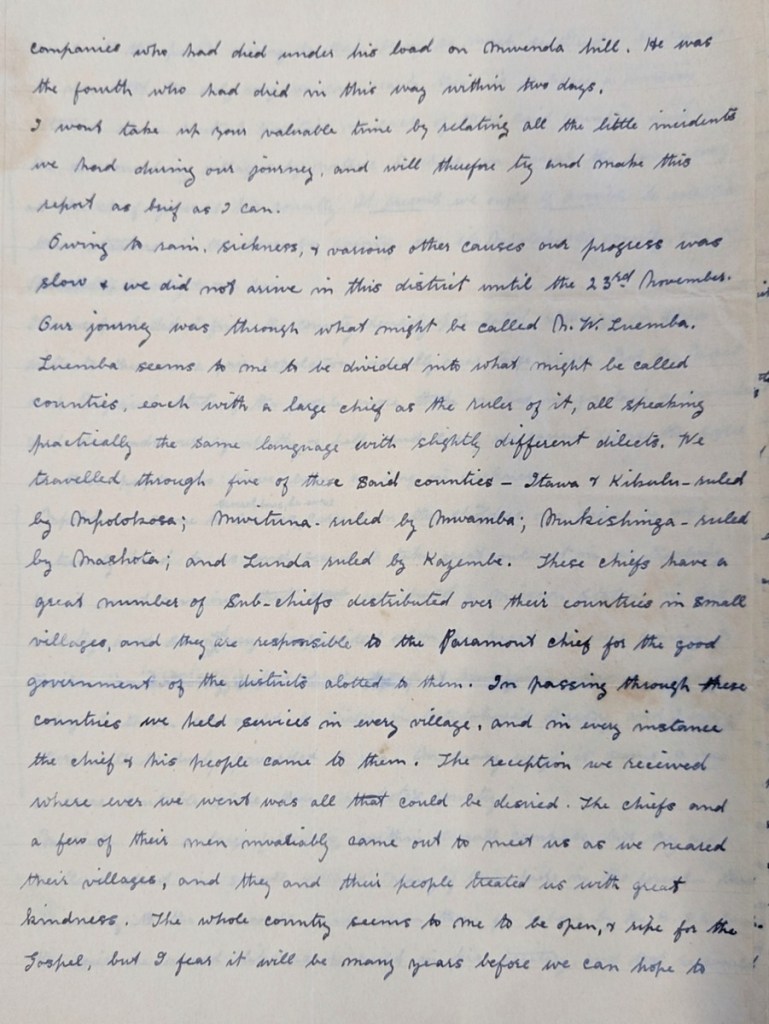
Two days after your wire arrived – 22nd Oct – we left Kawimbe. You would see by my letter of Oct 17th that we were preparing for this journey before we received your wire. I assure you it was a great relief to me when it came as I felt the responsibility of undertaking this work without the sanction of our Directors. Owing to the cultivating season being near at hand I had some difficulty in getting the numbers of carriers we required, but by leaving some loads to follow us later, and taking my cycle, we managed to leave on the above date. All went well the first day, but the second day we had not gone far until we encountered a rough piece of road & the tubes of my cycle got so completely cut that I had not enough stuff to repair them, so I had to walk the remainder of the way to Niamkolo where we arrived about seven o’clock at night pretty tired. Mr. Hemans & Mr. Mackendrick kindly got me a few carriers for my machila and we were therefore able to go on in comfort. The first day from Niamkolo I came across a group of natives standing over the body of a man belonging to one of the transport companies who had died under his load on Mwenda Hill. He was the fourth who had died in this way within two days.
I won’t take up your valuable time by relating all the little incidents we had during our journey, and will therefore try and make this report as brief as I can.
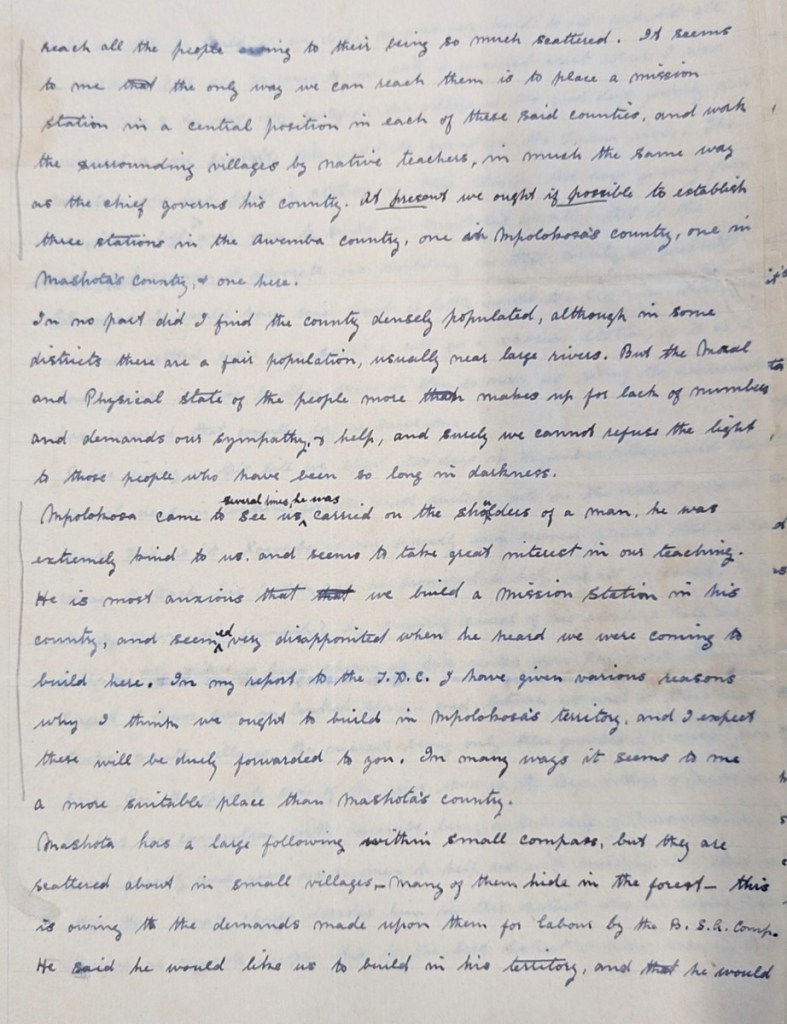
Owing to rain, sickness, & various other causes our progress was slow & we did not arrive in this district until the 23rd November. Our journey was through what might be called N.W. Luemba. Luemba seems to me to be divided into what might be called countries, each with a large chief as the ruler of it, all speaking practically the same language with slightly different dialects. We travelled through five of these said countries – Itawa & Kibaba – ruled by Mpolokoso [Mporokoso]; Mwituna – rulled by Mwamba; Mukishinga – ruled by Mashota; and Lunda ruled by Kazembe. These chiefs have a great number of sub-chiefs distributed over their countries in small villages, and they are responsible to the Paramount chief for the good government of the districts allotted to them. In passing through these countries we held services in every village, and in every instance the chief & his people came to them. The reception we received wherever we went was all that could be desired. The chiefs and a few of their men invariably came out to meet us as we neared their villages, and they and their people treated us with great kindness. The whole country seems to me to be open, & ripe for the Gospel, but I fear it will be many years before we can hope to reach all the people owing to their being so much scattered. It seems to me the only way we can reach them is to place a mission station in a central position in each of these said countries, and work the surrounding villages by native teachers, in much the same way as the chief governs his country. At present we ought if possible to establish these stations in the Awemba country, one in Mpolokoso’s country, one in Mashota’s country, & one here.
In no part did I find the country densely population, although in some districts there are a fair population, usually near large rivers. But the moral and physical state of the people more than makes up for lack of numbers and demands our sympathy & help, and surely we cannot refuse the light to those people who have been so long in darkness.
Mpolokoso came to see us several times, he was carried on the shoulders of a man, he was extremely kind to us, and seems to take great interest in our teaching. He is most anxious that we build a mission station in his country, and seemed very disappointed when he heard we were coming to build here. In my report to the T.D.C. [Tanganyika District Committee] I have given various reasons why I think we ought to build in Mpolokoso’s territory, and I expect these will be duly forwarded to you. In many ways it seems to me a more suitable place than Mashota’s country.
Mashota has a large following within small compass, but they are scattered about in small villages – many of them hide in the forest – this is owing to the demands made upon them for labor by the B.S.A. Company. He said he would like us to build in his territory, and that he would help us all he could if we did. He was very kind to us and did all he could to help us. He came to me with a sprained wrist which I was able to cure & he was very grateful. His village is two good days journey from here and a very suitable site could be found on the Luena [?] river. The Catholics who had built a station in this territory two days journey from here have left it, and gone to build in Mashota’s country, that is the principal reason I advocate our building in that country at present. Otherwise I would have said wait a little until the people in that district are settled before you select a site for a mission station, as it is I don’t think it wise to allow them to stay so near us seeing the Administration has reserved that country for our mission.
Before joining on this site we spent two days in Kazembe’s village, and spent several days in looking for the most suitable site in the district, and I think this is it. Kazembe is very friendly and seemed pleased that we had come to teach his people, and he promised to help us all he could. He had already shown his friendship by sending several of his people to help us to build. The site we have chosen is six miles from Kazembe’s town – the largest I have seen in Central Africa – and between us and it there are twelve small villages, the nearest being only three quarters of a mile from here. On the opposite side of the river there is the large village of Mwabamakapa [?] – he has no connection with Kazembe, being a sub-chief of Mwamba. He is most friendly and gave us 90 men to help us with building etc. There are other three small chiefs besides him in this district who are under Mwamba, therefore as regards people this is the best district I have seen in C.A. We are building on high ground about six hundred yards from the Mberezi river, the site has a good freestone bottom & is therefore dry, and we have a fine prospect. The people in this district will not fluctuate like it does in some others, for there is an abundance of good garden ground near at hand, and the rivers abound in splendid fish, it is therefore the kind of place a native likes best. Our being so far from water is the only thing I see against this site, but we could not get one nearer water without being near a marsh. I hope to be able to bring the water nearer by sinking wells or drainage.
During our journey we crossed five large rivers – the Lofu, the Luangwa, the Kalungwize [Kalungwishi], the Luena, and the Mbereze. We had some difficulty in crossing them owing to this being the rainy season, but we had not a single accident and got all the good we brought with us here in safety. There is one large village between the Luangwa & the Kalungwize which is worthy of notice, it is the village of Sunkata – the son of the chief Mwamba – he is a young man, and is very friendly towards our mission. If we decide to build in Mpolokoso’s territory I think a school ought to be built in this village as soon as possible.
I have not yet met Mr. Crawford of the Garanganze mission, but hope to do so soon. We are five days journey from their nearest station and therefore there is little fear of our intruding in their sphere of labor.
We have over two hundred people working for us at present and we have service with them every morning at 6:45 before we commence the day’s work. I am now able to speak a little to them in their own language. I have several boys who speak both this and the Kiemba language and they have been of great service to me. We have translated three hymns into Kiemba and I am busy translating the third chapters of John’s gospel. During my journey in the beginning of this year I compiled a fairly large vocabulary of Kiemba words and they have been a help to me.
The people seem to have great faith in our medicine and some have come a good distance for it. It is difficult to estimate the influence for good the relief given by our medicine & surgery has over the people, one thing is evident however, which is, it strengthens their faith in us. We had one serious accident here lately. Some boys were digging at an ant-hill, suddenly it collapsed and fell on the hand of a little boy crushing it dreadfully. I managed to patch it up by amputating the two middle fingers. The wounds are healing nicely although at first it looked as if I would need to take the whole hand off. I find the little knowledge of medicine & surgery I have acquired when at home on furlough of great service out here, and it has enabled me to give relief to a great number of suffering ones.
We started a school here with the boys who came for work, Mrs. Purves and the native teachers we brought with us helps me in this work. Mrs. Purves made the alphabet by cutting the letters out of old magazines and pasting them to an old tin box.
We are building a good wattle & daub house & I hope to see it finished in a fortnight from now, with the exception of the doors & windows. It is an object lesson to the people in this district, and many come to look at it. It is set on a hill and can be seen for many miles around and I trust many a wanderer will be led back to the fold by the influence that will radiate from it in the years to come. We have a sawpit dug and the sawyers are already at work cutting up planks. We have made a rough carpenter’s bench and the three carpenters who came with me from Kawimbe are busy making door & window frames. It is wonderful what has taken place here during the past three weeks. When we came here we commenced by cutting down the bush & clearing the grass away, and now there are between thirty & forty grass huts, and the frame of a fair-sized house where three weeks ago there was nothing but bush.
We feel that Our Father has been with us in this work, blessing & guiding us, and helping us during our travels. We have had very little sickness, only a little fever & a slight touch of dysentery during our journey. Since settling here we have had no sickness and we like this climate very much.
Mrs. Purves took a few snapshots with her camera during our journey and she has sent a few negatives to a friend in Edinburgh, asking him to forward you copies of them as they may be of interest.
With kind regards, Yours very truly,
A.D. Purves
P.S. I forgot to mention I found the hymns etc. translated into Kiemba by Mr. Robertson of great service during our journey. They help us in the services very much, and I believe them to be very good translations. A.D.P.
P.S.2. Please excuse soiled papers as all my writing paper has got destroyed by water getting into the box amongst my [?]. A.D.P.



 Pat in the World
You must be logged in to post a comment.