

Reading this week:
- Craftland by James Fox
Although the overall framing device for this series of posts (meant mostly to show you things I found in the SOAS archives) is the efforts of the London Missionary Society to extend their Central African Mission into Bemba territory, we continue our detour into the internal tensions and dissensions between the missionaries themselves. The last post was all about people falling apart, but because I am a hopeful kinda guy now here we are pulling them back together.
The first of the two letters in this post is from John May, writing as Secretary of the missionaries’ Tanganyika District Committee to the LMS Foreign Secretary in London, Rev. R. Wardlaw Thompson. In Mr. Purves’ letter to Thompson, dated a month prior to the below one and featured in the last post, Purves was defending himself against accusations, it seems like, of drunkenness. In the below letter, May reports the happy news that Purves has been reconciled with Mr. Johnson. It does not say the nature of their dispute. In the last letter, Purves had noted that Johnson was in a position to defend him against accusations of drunkenness, and presumably did so on the committee, so who knows what the below amended dispute was (scans of this letter and next are at the bottom):
Kawimbe,
May 24th 1900
Dear Mr. Thompson,
Mr. and Mrs. Johnson are here with their children, on their way home; they leave probably tomorrow, the 25th inst.
Mr. Johnson informs me that from the last letter he received from you, he sees his way clear to go home on furlough, in accordance with Resolution c. of the Directors, contained in letter of Dec 9th 1899.
Yesterday he expressed the wish to meet Mr. Purves and talk matters over with him. I had previously received the enclosed letters from Mr. Purves containing a similar wish to meet Mr. Johnson. So the two gentlemen conferred together in the presence of Mr. Robertson and myself; and after mutual explanations, they were able to come to a good understanding.
Mr. Purves’s letter paved the way for this agreement. I trust the Board will be satisfied with this letter, especially as Mr. Johnson now feels he can work in harmony with Mr. Purves.
We are hoping that soon Dr. Mackay and Mr. Hemans may also be able to come to an understanding with Mr. Purves.
With very kind regards, I am, dear Mr. Thompson, Your respectfully,
John May
Secretary Tanganyika D.C.
It is jumping far ahead in our timeline, but in addition to overcoming whatever the issue was between him and Mr. Johnson, Purves managed to bury the hatchet with Mr. Hemans. Again it is unclear exactly what came between them in the first place (Hemans being the other man named in the exact same sentence as Johnson as someone who could defend Purves against drunkenness charges), but nice they were able to come to terms. So nice how talking to people can help. As for what is going on in the rest of the letter, also very unclear. Some nice words about Rev. George Mackendrick (who would be dead two months after this letter), and then obvious and reasonable offense that his affairs were available for perusal by the other missionaries:
Niamkolo, Tanganyika
Feby. 20, 1901
Dear Mr. Thompson,
I beg to acknowledge your very kind encouraging letter of Sep 15.
To be again reconciled with Mr. Purves has lifted as it were a very great burden off us. After seriously considering the matter, I felt that we should do as the Master would have done if he were here: thus I met Mr. Purves & spoke plainly to him; he then acknowledged his wrongs & apologized for his past action; and our difficulties have been settled most amicably. I am glad to say that we have since been drawn closer than ever to one another & have been laboring shoulder to shoulder.
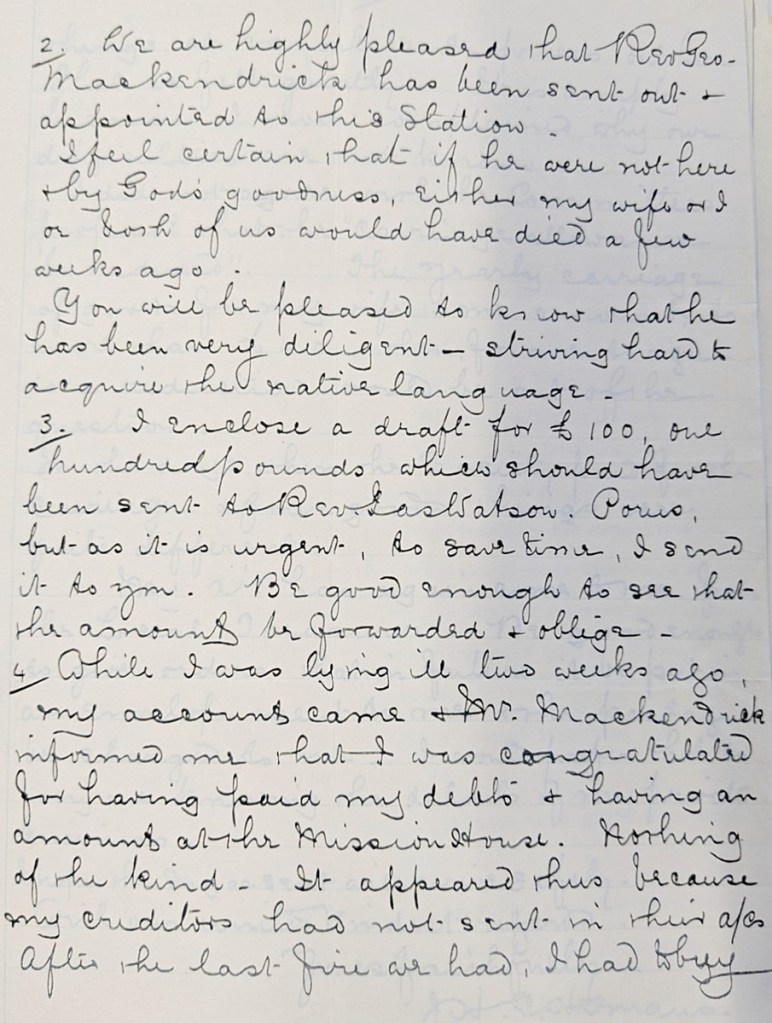
2. We are highly pleased that Rev. Geo Mackendrick has been sent out & appointed to this station. I felt certain that if he were not here & by God’s goodness, either my wife and I or both of us would have died a few weeks ago. You will be pleased to know that he has been very diligent – striving hard to acquire the native language.
3. I enclose a draft for £100, one hundred pounds, which should have been sent to Rev. Las Watson. [?], but as it is urgent, to save time, I send it to you. Be good enough to see that the amount be forwarded & oblige.
4. While I was lying ill two weeks ago, my accounts came & Mr. Mackendrick informed me that I was congratulated for having paid my debts & having an amount at the Mission House. Nothing of the kind – it appeared thus because my creditors had not sent in this a/c. After the last fire we had, I had to buy things at exorbitant prices out here that are felt greatly. It is simply because I never complained why our difficulties are not known.
I did not agree with the Committee’s proposal that the “carriage allowance be reduced.” The yearly carriage of goods for my wife & me amounts to more than £40. Then, for me to agree to a reduction would be out of the question.
In the days when the Society paid for the carriage of our goods, things were quite different.
My a/c has again come to me from the Local Treasurer. Be good enough to give orders that in future it be put in an envelope & sent to me & the postage to be charged to me. I would prefer that to everyone knowing the details of my private business.
I hope the [?] will arrive safely.
With our united kindest regards, Yours faithfully,
J.H.E. Hemans
I realize it is a bit distasteful to air 125-year-old laundry but these are the human dimensions that shape history, the casual aggressions that indicate how we see each other and how organizations function. I still hold grudges from my Peace Corps days serving in the exact same spots as these guys where I have no recollection what my original complaint was, so I am sympathetic the pressures the conditions put you under. And here, from across the chasm of history is a reminder that the answer is so often to sit down and talk it out. And also to keep your mail private.



 Pat in the World
You must be logged in to post a comment.