

Reading this week:
- The Devil That Danced on the Water by Aminatta Forna
Last week we covered a letter from James Hemans to the London Missionary Society Foreign Secretary Rev. R. Wardlaw Thompson urging him to authorize the Central African Mission to open up a new station in the heart of Bemba-land. We immediately part from that journey with a detour.
There was a good amount of drama and tension within the ranks of the LMS’ Central African Mission. I am still picking up on this, because although I spent a whole bunch of time transcribing the Chronicle they spare their readers any of the interpersonal drama and unsavory things that occurred out there. But to quote a paragraph of Robert Rotberg’s Christian Missionaries and the Creation of Northern Rhodesia:
The Missionaries to Northern Rhodesia… were fiercely independent men and they fought bitterly with one another and with their overseas directors, usually to the detriment of their evangelical objectives. In their individual journals and correspondence, expressions of fractiousness, spitefulness, and jealousy compete with one another for space in numerous letters supposedly written more in sorrow than anger.
This will be a long entry but mostly one of other peoples’ texts, so while I am at it I will include another quote from the same chapter above. Hemans was a Black missionary from Jamaica and there was not a little bit of racism among the LMS ranks. This whole Bembaland story could have taken place back in 1894, when the missionaries sent their first expedition to the area. From Christian Missionaries:
Once, when the Bemba paramount chief wanted specifically to ask Hemans about Christianity, the synod forbade him to visit the chief. They thought that a white missionary should be the first to explain the Society’s principles, and to discuss the possible expansion of the London Mission into Bembaland. For the chief, however, only Hemans would do… But the synod was obstinate. It sent a white missionary, who was refused an audience with the chief, and the White Fathers instead occupied most of the Bemba country.
There will be more as this story unfolds, but for now, a letter from Mr. A.D. Purves to the LMS Foreign Secretary, perhaps written more in anger than sorrow:
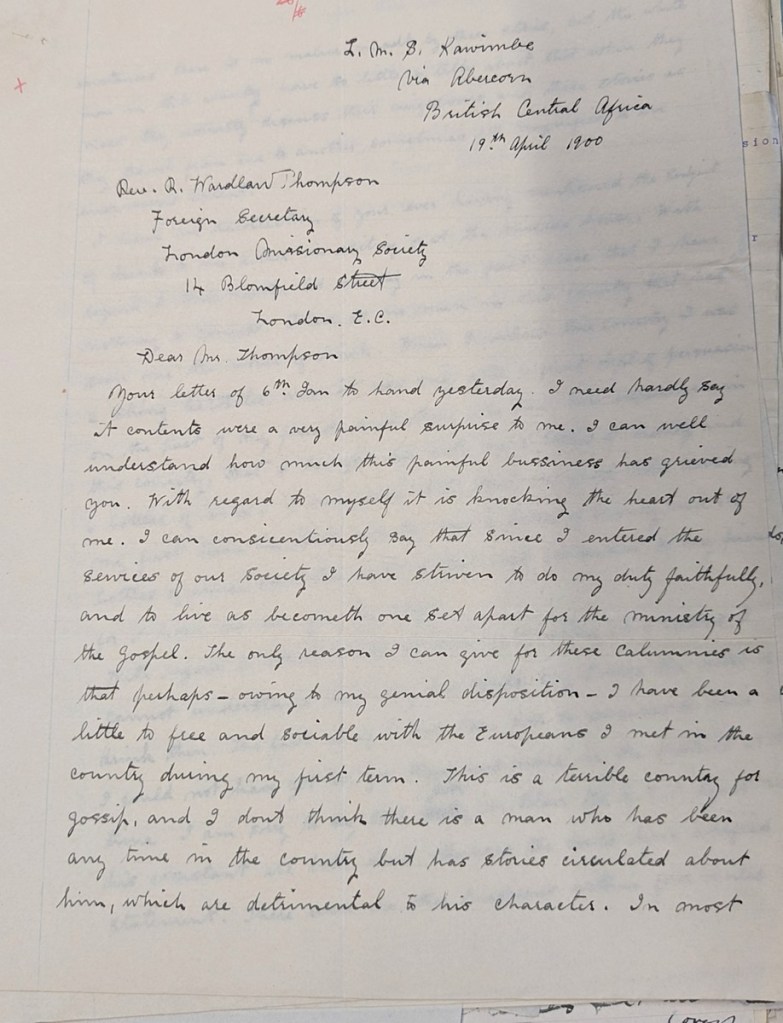
L.M.S. Kawimbe
19th April 1900
Dear Mr. Thompson,
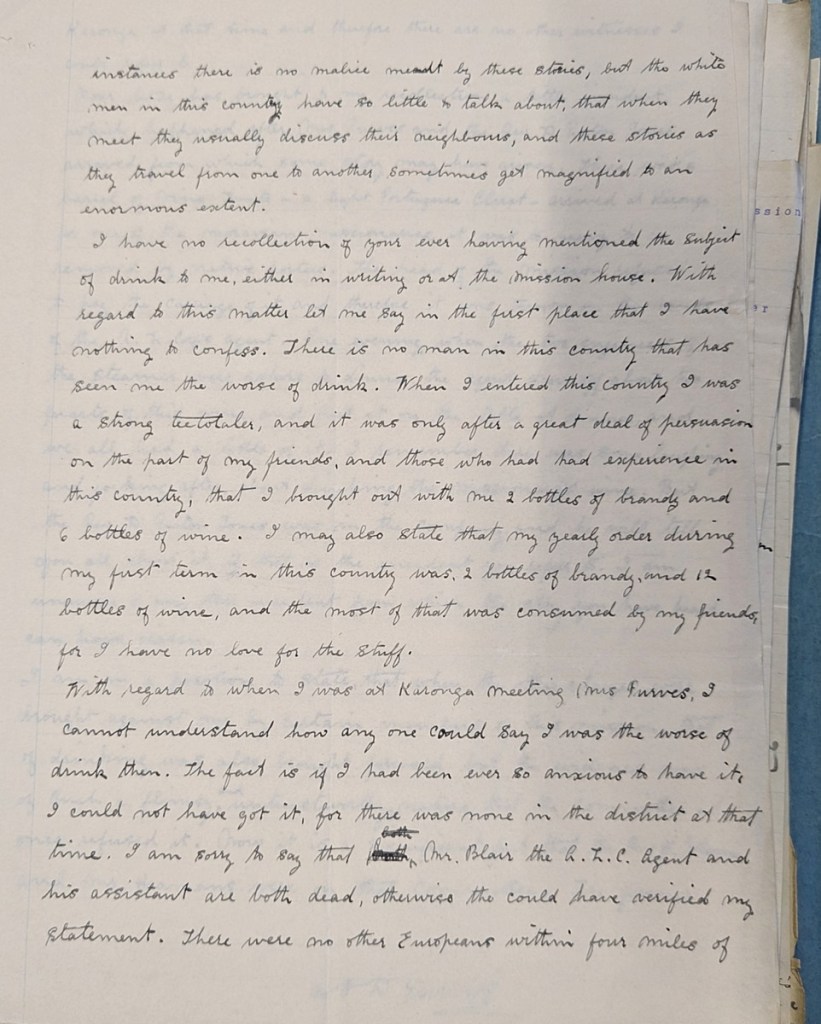
Your letter of 6th Jan to hand yesterday. I need hardly say its contents were a very painful surprise to me. I can well understand how much this painful business has grieved you. With regard to myself it is knocking the heart out of me. I can conscientiously say that since I entered the services of our Society I have striven to do my duty faithfully, and to live as becometh one set apart for the ministry of the Gospel. The only reason I can give for these calumnies is that perhaps – owing to my genial disposition – I have been a little too free and sociable with the Europeans I met in the country during my first term. This is a terrible country for gossip, and I don’t think there is a man who has been any time in the country but has stories circulated about him, which are detrimental to his character. In most instances there is no malice meant by these stories, but the white men in this country have so little to talk about, that when they meet they usually discuss their neighbors, and these stories as they travel from one to another sometimes get magnified to an enormous extent.
I have no recollection of you ever having mentioned the subject of drink to me, either in writing or at the Mission house. With regard to this matter let me say in the first place that I have nothing to confess. There is no man in this country that has seen me the worse of drink. When I entered this country I was a strong teetotaler, and it was only after a great deal of persuasion on the part of my friends, and those who had had experience in this country, that I brought out with me 2 bottles of brandy and 6 bottles of wine. I may also state that my yearly order during my first term in this country was, 2 bottles of brandy, and 12 bottles of wine, and the most of that was consumed by my friends for I have no love for the stuff.
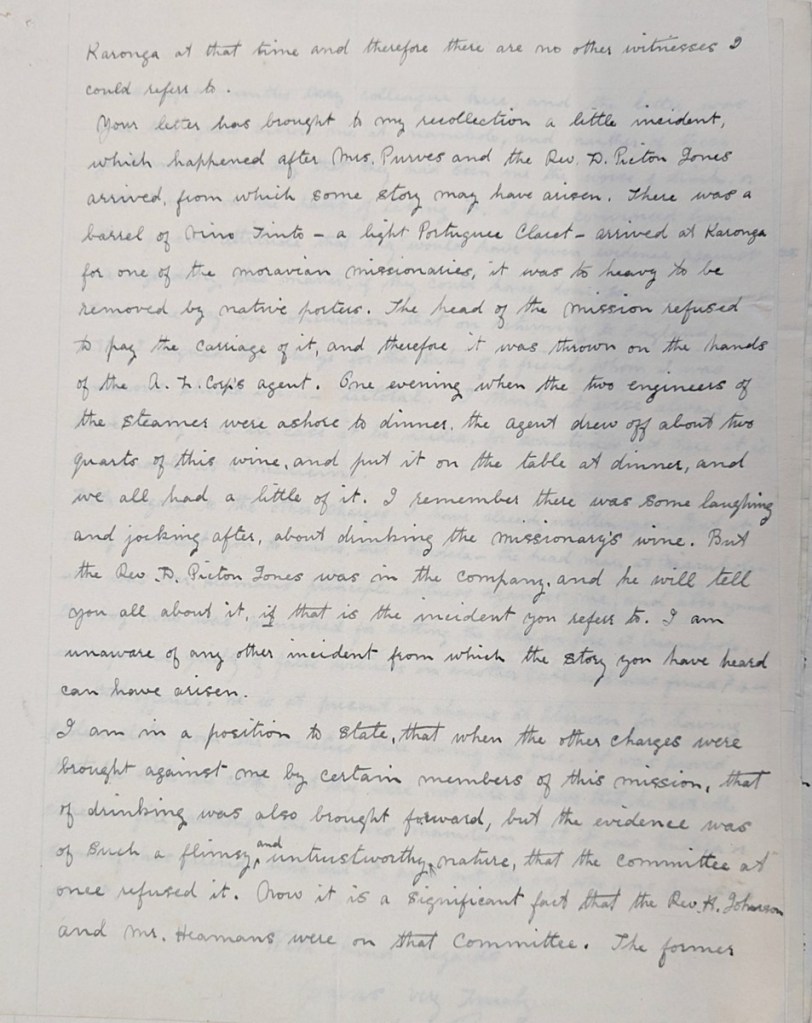
With regard to when I was at Karonga meeting Mrs. Purves, I cannot understand how any one could say I was the worse of drink then. The fact is if I had been ever so anxious to have it, I could not have got it, for there was none in the district at that time. I am sorry to say that Mr. Blair the A.L.C. [African Lakes Corporation] agent and his assistant are both dead, otherwise they could have verified my statement. There were no other Europeans within four miles of Karonga at that time and therefore there are no other witnesses I could refer to.
Your letter has brought to my recollection a little incident which happened after Mrs. Purves and the Rev. D. Picton Jones arrived, from which some story may have arisen. There was a barrel of Vino Tinto – a light Portuguese Claret – arrived at Karonga for one of the Moravian missionaries, it was too heavy to be removed by native porters. The head of the Mission refused to pay the carriage of it, and therefore it was thrown on the hands of the A.L. Corp’s agent. One evening when the two engineers of the steamer were ashore to dinner, the agent drew off about two quarts of this wine, and put it on the table at dinner, and we all had a little of it. I remember there was some laughing and joking after, about drinking the missionary’s wine. But the Rev. D. Picton Jones was in the company, and he will tell you all about it, if that is the incident you refer to. I am unaware of any other incident from which the story you have heard can have arisen.
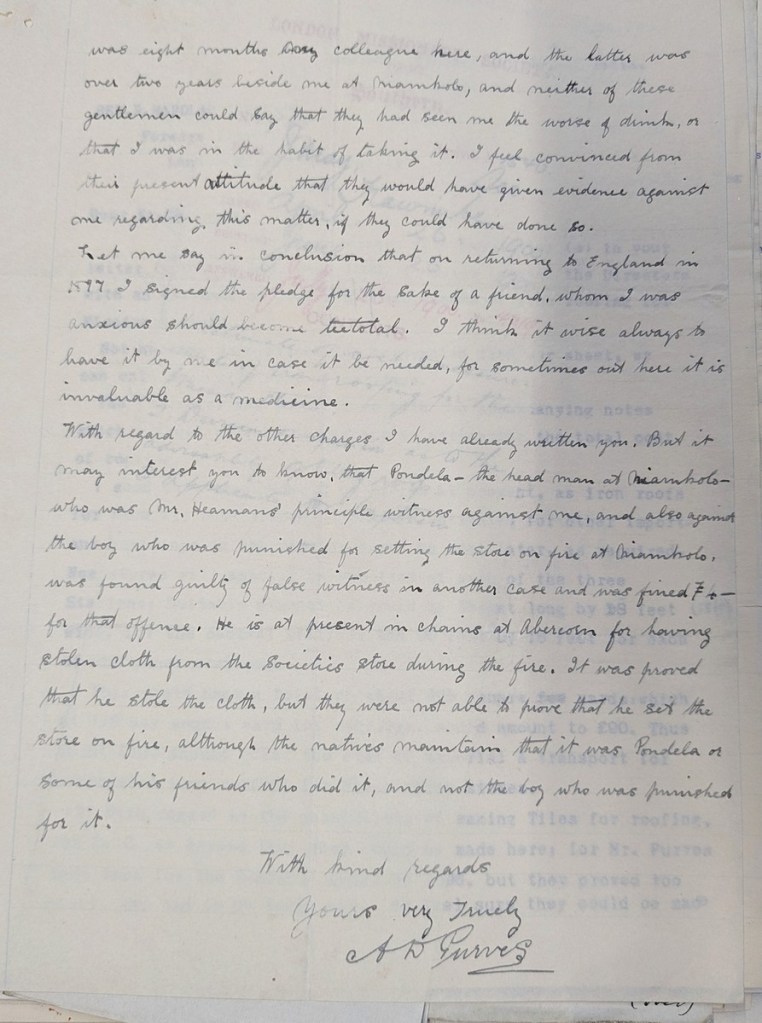
I am in a position to state, that when the other charges were brought against me by certain members of this mission, that of drinking was also brought forward, but the evidence was of such a flimsy and untrustworthy nature, that the committee at once refused it. Now it is a significant fact that the Rev. H. Johnson and Mr. Hemans were on that committee. The former was eight months my colleague here, and the latter was over two years beside me at Niamkolo, and neither of these gentlemen could say that they had seen me the worse of drink, or that I was in the habit of taking it. I feel convinced from their present attitude that they would have given evidence against me regarding this matter, if they could have done so.
Let me say in conclusion that on returning to England in 1897 I signed the pledge for the sake of a friend, whom I was anxious should become teetotal. I think it wise always to have it by me in case it be needed, for sometimes out here it is invaluable as a medicine.
With regard to the other charges I have already written you. But it may interest you to know that Pondela – the head man at Niamkolo – who was Mr. Hemans’ principle witness against me, and also against the boy who was punished for setting the store on fire at Niamkolo, was found guilty of false witness in another case and was fine £4 for that offence. He is at present in chains at Abercorn for having stolen cloth from the Societies store during the fire. It was proved that he stole the cloth, but they were not able to prove that he set the store on fire, although the natives maintain it was Pondela or some of his friends who did it, and not the boy who was punished for it.
With kind regards, Yours very truly,
A.D. Purves
 Pat in the World
You must be logged in to post a comment.