Anderson House

Another staycation site we visited was Anderson House. We first noticed the place during one of the Embassy Open Days they do in DC. We had wanted to see a bunch of embassies but turns out the lines for all of them were quite long and as we were wandering around we saw a sign for the Society of the Cincinnati and their free museum. We considered going in but were worried that something as serious and pretentious sounding as “Society of the Cincinnati” might be some weird right-wing dark money operation so we wanted to do some research before diving in. After doing that research it seems fine? Clubs like this are always going to be weird but this one seems relatively benign.

The headquarters of the Society of the Cincinnati is now in the former house of Larz and Isabel Anderson. These were two rich people that got married. Man tell you what to be rich in the gilded age. There was a period of time, well-evidenced in DC and also the Met, when you could just bop around Europe and buy up large chunks of all the cultural history there. For the people offended on behalf of Europe, don’t worry, they did this in Asia too apparently, the house has tons of Buddha statues scattered all over the place in niches or in the back yard. The tour guide leading us around mentioned that the Andersons weren’t even religious particularly, “if they saw something they liked they just bought it.” I think The Great Gatsby is supposed to be about how this is all terrible and I suppose for most of the world it was but oh to be gilded in the gilded age.

The two big focuses of the house are Larz Anderson’s diplomatic career and his love of the Society of the Cincinnati. The only two uses the house ever saw were as the personal residence of the Andersons and then has headquarters of the Society. The house incorporates various bits of Society of the Cincinnati symbols in like the plaster work and the like, and after the Andersons died they left it to the Society to use as their headquarters. The single most interesting thing I learned on the tour is that the city of Cincinnati is named after the Society, and not directly after Cincinnatus as I would have assumed. On the tour they talk up the history of the Society a bit, but they’re not exactly trying to get you to join, because you can’t, sorry (not sorry).

As for Larz’s diplomatic career, again, man, to be rich. I guess he was really passionate about diplomacy, no knocking him there, but his storied diplomatic career around which he built is personality was like 8 years total? Very much a hobby. According to Wikipedia, he dropped out of law school, but since his dad had connections to the U.S. minister to the Court of St. James Robert Todd Lincoln he got a job over there as first secretary (this was his first job!) for three years and then went over to Rome to be the chargé d’affaires! Then he went on hiatus for like 15 years and then he is Minister to Belgium and then Ambassador to Japan for a whopping one day, later styling himself as “the first American to rise all the way through the diplomatic ranks from the lowest position to the highest.” Rich people never change. But since he was such a big fan of diplomacy once he built himself a nice big fancy house he let the State Department use it all the time to host fancy parties and the like so that was nice of him.

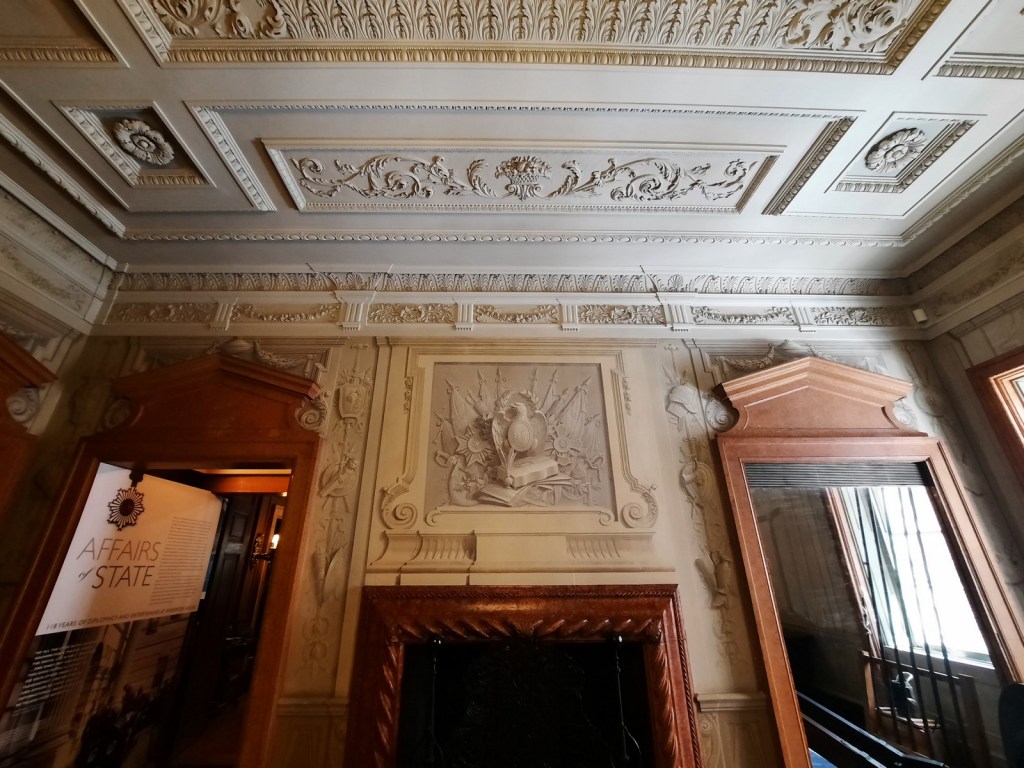
It is a very fancy house, and very gilded age in that I noticed there was a bunch of trompe-l’œil all over the place (see first pic). There was also fancy stuff all over the place, like 400 year-old tapestries and big ole paintings and a table that I thought was pretty neat which is pictured below. I think it was picked up by Isabel Anderson when she was doing the grand tour and features a tabletop made of tons of different bits of granite. Apparently the usefulness of this table is you bought it abroad and then when you came back to build your house you could use it to show your architects/builders which marble you wanted in various bits of the house. To be fair the house had some very nice floors (the whole staycation was a series of very nice floors), but I liked the table because it was like the day before at the Building Museum that I saw the different granite samples and so this was the same thing a century apart and that is neat I thought.

Anywho that was the Anderson House and the Society of the Cincinnati. Their temporary display while we were there was about the history of diplomacy in the house (all those nice parties the State Department threw there) which intrigued me and my super amazing wife suitably, and the house was certainly very pretty to look at. And since the tour was free, it was definitely worth the price.
National Building Museum

As part of our pre-departure staycation my super amazing wife and I went to the National Building Museum. It was alright.

The National Building Museum had been on our list for a while. It got in our heads at some point we should go (I first found out about it years ago when I stumbled across Bantam King ramen, the best ramen shop in DC, and looked across the way to see the museum), but we had never gone because it costs money and neither of us were too sure we were actually all that into buildings. But since we were leaving the country for the forseeable future it was time to see the things we hadn’t seen, and the Building Museum was on the list.

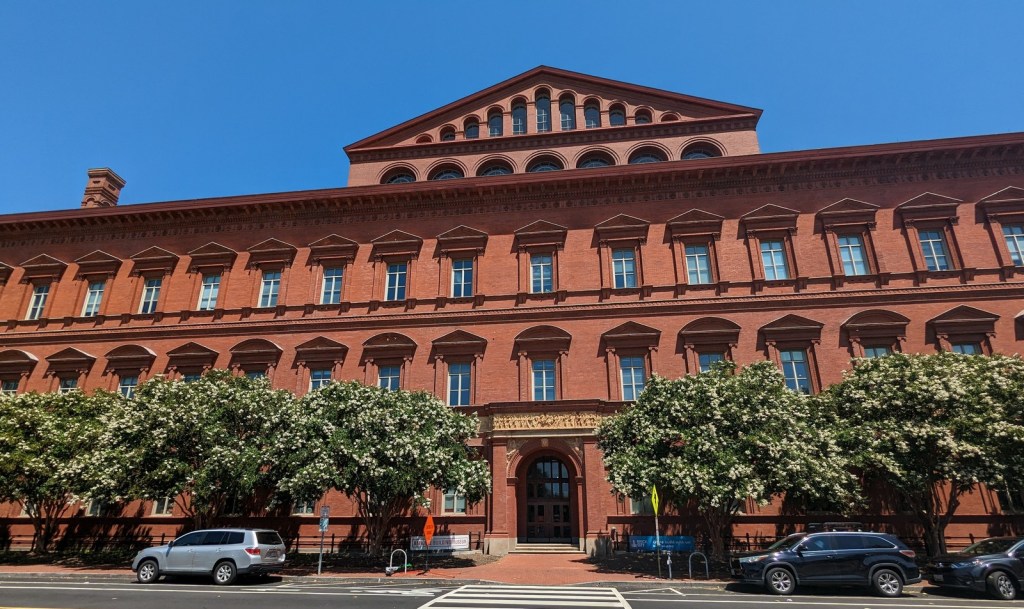
When you enter the museum, man is it impressive. It is certainly a building, I can tell you that. It was originally built for the National Pension Bureau. I was unclear while I was wandering around the museum why the Pension Bureau needed a whole lot of empty space instead of like, offices, but now that I am reading the museum website the space was meant to be large and grand so they could hold large and grand events inside like Presidential Inaugural Balls. Dual-use architecture, nice. As is so often the case the picture just doesn’t do it justice. Those columns are massive. Biggest I’ve ever seen, and I have seen some columns. This huge middle space makes the rest of the museum seem small in comparison.

That was sorta the thing with the museum. It just didn’t feel like there was a whole lot of there there? I don’t know what I was expecting. The exhibits didn’t feel too meaty. There was one very nice one about animals being used in architecture, with a lot of neat items like the below bitumen molds for plaster ornaments. There were also multiple rooms full of legos at the time that kids could use to build buildings out of, but neither my super amazing wife nor I felt like shoving kids out of the way so we could play on legos. The museum had opened with a sort of conceptual gallery of different types of urbanism I guess (the above samples of different granites comes from that), and we very much enjoyed a gallery full of photographs of different buildings, but I’m not sure I walked away with a whole lot more knowledge of buildings than I had before? Maybe I didn’t read closely enough. A building museum has to be tough to curate though, like, I guess there are a lot of different ways you could go with that so any which way you go might make someone a bit unsatisfied.

One really cool thing was the art installation they had in that central hall that sometimes hosts balls. It is in that second photo I included in this post, and is called Look Here by Suchi Reddy. The sculpture included a range of polished metal shapes, all very large, hanging around this sorta central platform thingy that you approached via curved ramps. As you wandered the museum you got to see the piece from a lot of different angles, but the best angle was from the platform. Specifically, laying down on one of the large bean bag chair/furniture thingies they had scattered around the platform, which let you look up at the shapes suspended in space and immersed in the grand hall but more importantly were very comfortable and felt like a nice place to take a nap. From that vantage point it felt like the Building Museum was a place meant for dads to take their kids on a hot summer afternoon so they (the dads) can finally get some lay-down time. So a pretty good place then!

Sharing Honors and Burdens

I mentioned it in my last post, but my super amazing wife and I have moved out of the United States and into an undisclosed country. Before we left, we decided to have a fun staycation in DC and one of the things we went to go see was the temporary exhibit at the Smithsonian’s Renwick Gallery, Sharing Honors and Burdens. It was a really fantastic exhibition (more reviews: one, two).

My favorite piece was the one pictured up top, titled Charmed (Bestiary) by Joe Feddersen. It is a series of shapes made from glass that are hanging down on strings. The picture really can’t do it justice and it is absolutely gorgeous, especially as the shapes move about in the breeze provided courtesy of the fan on either side. The shapes are a wide range of symbols, many of them drawn from ancient pictographs and petroglyphs, but sprinkled into them are shapes of much more modern things like bicycles or I think I spotted a submarine. It takes a while to take it all in as you scan through the shapes and more and more things jump out at you. It is a little hard to tell whether the artwork is the glass or the shadows it casts, because since the glass is clear it can be hard to see but the shadows behind come out in sharper relief. It is worth viewing from a variety of angles. My favorite part of looking at it was when we first showed up some young women were doing some fashion photos in front of it, and I think it is great when people combine their art in conversation with other artists’.

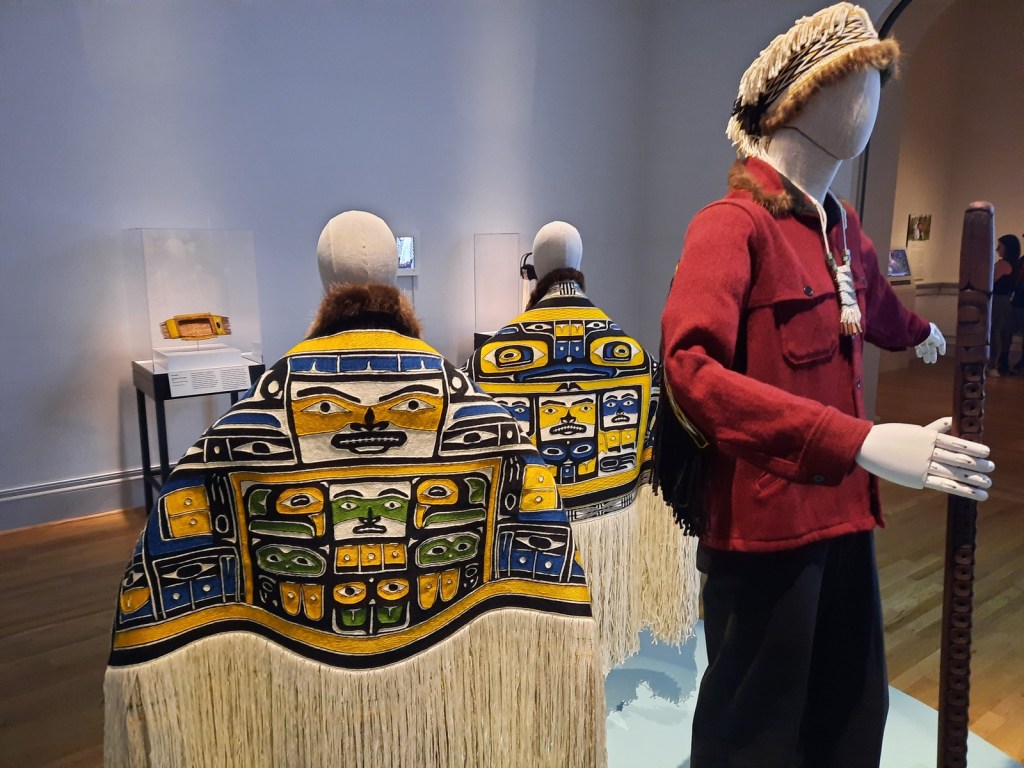
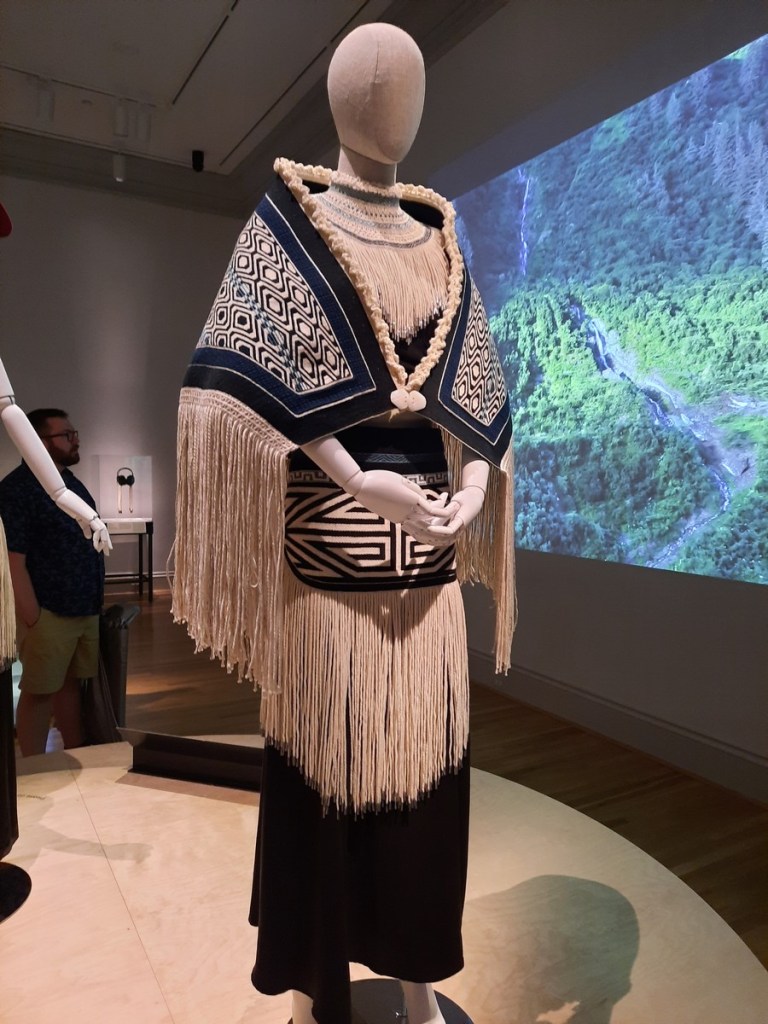
The show had a range of traditional techniques combined with the more modern ones to tell a variety of stories. The two pieces at the top are Double Raven Chilkat Dancing Blanket and Lineage Robe by Lily Hope. They are made with thigh-spun merino and cedar bark with beaver fur. The bottom piece is We Are the Ocean by Ursala Hudson, made of merino, silk, steel cones, leather, cedar bark, and silk. Our dear sweet baby angel Tinkerbell is easy to catch; all you have to do is put out a box for her and she jumps right in. Likewise my super amazing wife is easy to catch; all you have to do is put up a video of traditional spinning and weaving techniques and she is hooked (mine is steam plants). She and her friend who joined us were mesmerized by the video part of the exhibit for quite some time, and rightfully so. The artists have done some just stunning work with textiles here to create this vivid sculptural pieces and maybe I need a wardrobe update.

The final piece I have for you is Pueblo Revolt 2180 by Virgil Ortiz, and I think it was actually upstairs with more of the Renwick’s collection of pieces that they gathered because they realized they had the work of a bunch of old white dudes and really should even that out and so went on a buying spree of contemporary stuff by non-old white dudes, but nonetheless it fits the theme of Sharing Honors and Burdens. As the description says, the jar references the Pueblo Revolt of 1680 against Spanish colonizers, but, you know, futurizes it and imagines a scenario where they are finally able to once again control their own land. We appreciate ceramics in this household!

And those were the highlights (for me) of the Renwick’s exhibition. It is really fantastic to see a new set of artists on display in museums like the Renwick, and the fact they have forceful stories told with masterful technique is just icing on the cake.

Balcony Gardening

This is the saga of my super amazing wife and I trying to garden on our balcony. As you’ll recall from my Peace Corps days, I used to have a rather large garden around my house where I would spend my days growing crops and the like. I even harvested some pretty good stuff towards the end there and made a meal out of it, which is very neat. In New Haven all I really managed to grow was a small mango tree for the porch which I eventually and tragically killed by leaving it outside during some freezing rain. My super amazing wife grew up on a farm and likes to be surrounded by plants and animals so when we moved to our apartment together in Alexandria we got one with a balcony instead of a sun room specifically so we could spend time out there and also try to grow some plants. I first tried to convince her we could raise cows and/or sheep out there, and despite her deep love of sheep we didn’t do either which is sad but there you go.

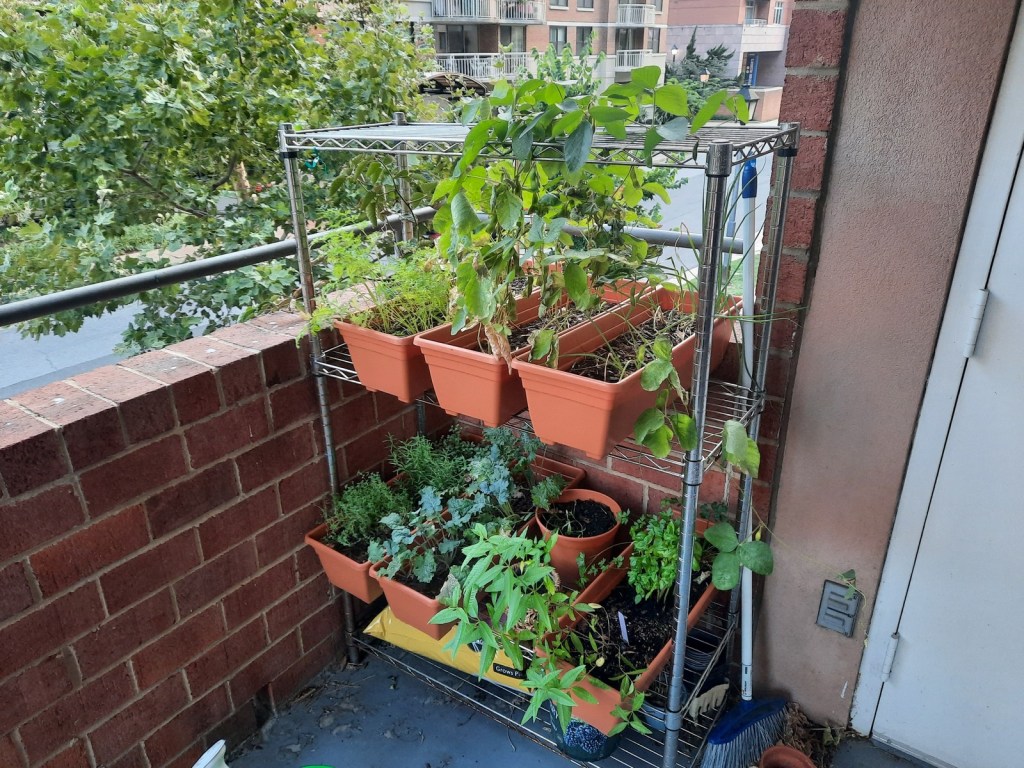
Anyways the garden. We tried growing things both summers we were there (past tense because as I am writing this we have moved out of Alexandria and to an undisclosed country far far away) though summer 1 didn’t go so well. It started off pretty alright but then we disappeared for a week and everything died and we didn’t really manage to get it going again. But summer 2 went a lot better! Our setup was just six or so window garden troughs set up on a metal rack so we could keep it neat and everything outside.

The first little garden bed I planted in summer 2 along with a lemon tree, a date palm, and a flame tree (the flame tree is not a fruit tree but my super amazing wife thought they were pretty when we visited Puerto Rico so I grabbed some seeds from the ground).

My super amazing wife and I had different philosophies when it came to what we decided to grow in our individual garden beds. I pay no heed to practicality and only try to grow what interests me, which is mostly what I fondly remember growing in Zambia, such as carrots and orange sweet potatoes and beans. I also like to try to grow fruit trees, in memory of my little mango tree that again I tragically killed because I was a neglectful plant parent. None of these things however grow particularly well in tiny little containers on a balcony. My super amazing wife on the other hand is really thoughtful about what would grow well in such conditions and what she would actually use in the kitchen and also what would be pretty, so she instead favors herbs and wildflowers. She thought I was very silly when I tried to grow carrots in a balcony container.

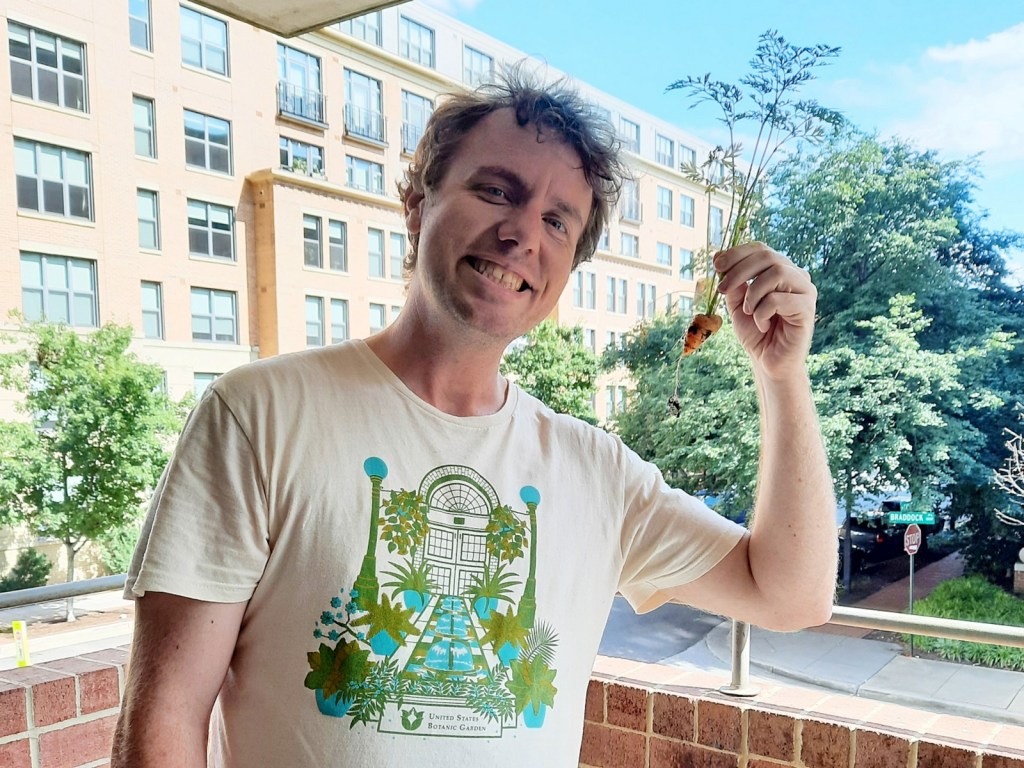
And for a while I thought she was very silly for doubting me because the carrots seemed to grow gangbusters and were looking really good from the top but then when I finally harvested they were tiny and she was right of course (you can see the results in the first pic in this post). But what did a lot better were the soybeans I planted for edamame. Those plants grew pretty big and I got about as big a harvest as you could possibly expect from one tiny little balcony pot, and we subsequently enjoyed some home-grown edamame which was fun:

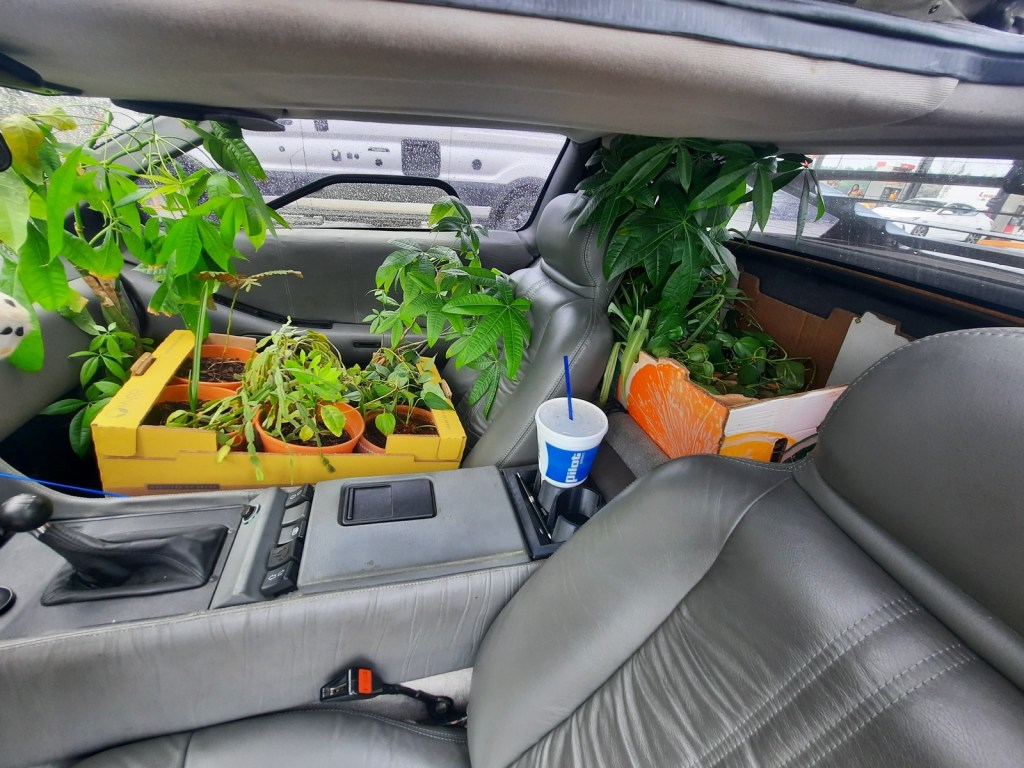
Some of our balcony garden lives on. In addition to the balcony garden, my super amazing wife had a whole bunch of houseplants that she wanted to stay alive while we were living in this undisclosed country. I had to bring my DeLorean down to my parents’ house anyways, so my mom very kindly offered to babysit all the plants for a few years. I was initially going to take the AutoTrain down to Florida and was very much looking forward to that, but turns out you can’t take a DeLorean on the AutoTrain. They don’t accept gullwing doors because the people who park the car on the train wouldn’t be able to get out of the car (so they say). So I wound up driving all the plants down to Florida myself, which was really a fine experience overall (and I finally got to test out my cupholder on a long car drive), but still, it wasn’t relaxing on a train for 16 hours overnight.

My mom has reported that so far the plants we brought her are absolutely thriving. I shouldn’t be too surprised, the difference between me and my mom is that my mom actually looks up what is good for the plants and then behaves accordingly. My little lemon tree was suffering I think because I was overwatering it. I had left for a week and my super amazing wife didn’t water it much and it suddenly grew two new branches, and now in Florida for like a month it is already twice as big despite me trying to grow it for the better part of two years. But having a balcony garden was a hoot and now in undisclosed country we have significantly more space (though still not Zambia space) and I am excited to see what we manage to grow out there!

Balcony garden at the height of its powers.